Catena Aurea by St. Thomas Aguinas
CHAP. 5
5:1–3
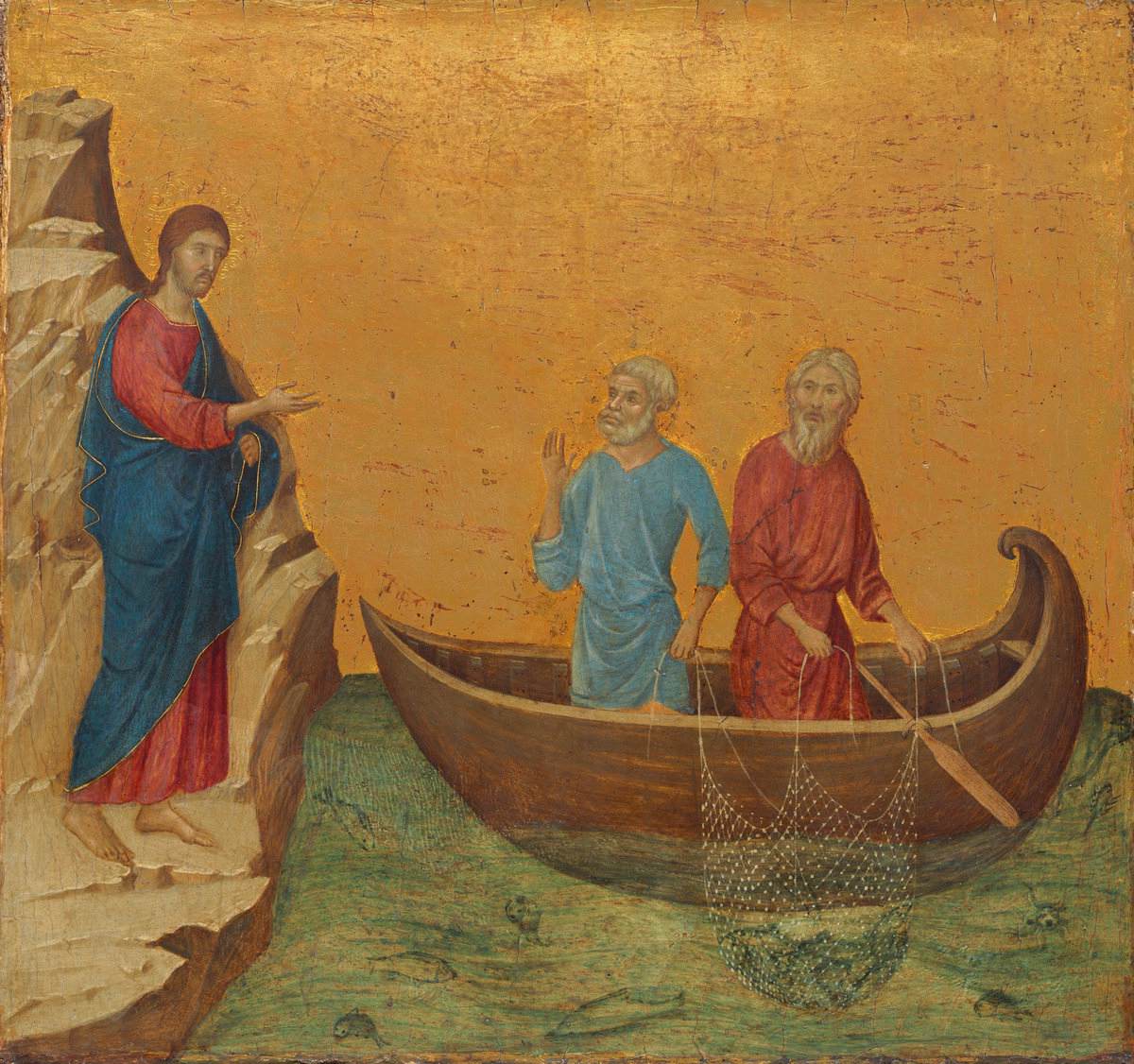
1. And it came to pass, that, as the people pressed upon him to hear the word of God, he stood by the lake of Gennesaret,
2. And saw two ships standing by the lake: but the fishermen were gone out of them, and were washing their nets.
3. And he entered into one of the ships, which was Simon’s, and prayed him that he would thrust out a little from the land. And he sat down, and taught the people out of the ship.
AMBROSE. When the Lord had performed many and various kinds of cures, the multitude began to heed neither time nor place in their desire to be healed. The evening came, they followed; a lake is before them, they still press on; as it is said, And it came to pass, as the people pressed upon him.
CHRYSOSTOM. (Hom. 25. in Matt.) For they clung to Him with love and admiration, and longed to keep Him with them. For who would depart while He performed such miracles? who would not be content to see only His face, and the mouth that uttered such things? Nor as performing miracles only was He an object of admiration, but His whole appearance was overflowing with grace. Therefore when He speaks, they listen to Him in silence, interrupting not the chain of His discourse; for it is said, that they might hear the word of God, &c. It follows, And he stood near the lake of Gennesaret.
BEDE. The lake of Gennesaret is said to be the same as the sea of Galilee or the sea of Tiberias; but it is called the sea of Galilee from the adjacent province, the sea of Tiberias from a neighbouring city. Gennesaret however, is the name given it from the nature of the lake itself, (which is thought from its crossing waves to raise a breeze upon itself,) being the Greek expression for “making a breeze to itself.” (quasi a γιννάω et ἀὴρ.) For the water is not steady like that of a lake, but constantly agitated by the breezes blowing over it. It is sweet to the taste, and wholesome to drink. In the Hebrew tongue, any extent of water, whether it be sweet or salt, is called a sea.
THEOPHYLACT. But the Lord seeks to avoid glory the more it followed Him, and therefore separating Himself from the multitude, He entered into a ship, as it is said, And he saw two ships standing near the lake: but the fishermen were gone out of them, and were washing their nets.
CHRYSOSTOM. This was a sign of leisure, but according to Matthew He finds them mending their nets. For so great was their poverty, that they patched up their old nets, not being able to buy new ones. But our Lord was very desirous to collect the multitudes, that none might remain behind, but they might all behold Him face to face; He therefore enters into a ship, as it is said, And he entered into a ship, which was Simon’s, and prayed him.
THEOPHYLACT. Behold the gentleness of Christ; He asks Peter; and the willingness of Peter, who was obedient in all things.
CHRYSOSTOM. After having performed many miracles, He again commences His teaching, and being on the sea, He fishes for those who were on the shore. Hence it follows, And he sat down and taught the people out of the ship.
GREGORY NAZIANZEN. (Orat. 37.) Condescending to all, in order that He might draw forth a fish from the deep, i. e. man swimming in the everchanging scenes and bitter storms of this life.
BEDE. Now mystically, the two ships represent circumcision and uncircumcision. The Lord sees these, because in each people He knows who are His, and by seeing, i. e. by a merciful visitation, He brings them nearer the tranquillity of the life to come. The fishermen are the doctors of the Church, because by the net of faith they catch us, and bring us as it were ashore to the land of the living. But these nets are at one time spread out for catching fish, at another washed and folded up. For every time is not fitted for teaching, but at one time the teacher must speak with the tongue, and at another time we must discipline ourselves. The ship of Simon is the primitive Church, of which St. Paul says, He that wrought effectually in Peter to the Apostleship of circumcision. (Gal. 2:8.) The ship is well called one, for in the multitude of believers there was one heart and one soul. (Acts 4:32.)
AUGUSTINE. (de Quæst. Ev. 1. 2. c. 2.) From which ship He taught the multitude, for by the authority of the Church He teaches the Gentiles. But the Lord entering the ship, and asking Peter to put off a little from the land, signifies that we must be moderate in our words to the multitude, that they may be neither taught earthly things, nor from earthly things rush into the depths of the sacraments. Or, the Gospel must first be preached to the neighbouring countries of the Gentiles, that (as He afterwards says, Launch out into the deep,) He might command it to be preached afterwards to the more distant nations.
5:4–7
4. Now when he had left speaking, he said unto Simon, Launch out into the deep, and let down your nets for a draught.
5. And Simon answering said unto him, Master, we have toiled all the night, and have taken nothing: nevertheless at thy word I will let down the net.
6. And when they had this done, they inclosed a great multitude of fishes: and their net brake.
7. And they beckoned unto their partners, which were in the other ship, that they should come and help them. And they came, and filled both the ships, so that they began to sink.
CYRIL OF ALEXANDRIA. Having sufficiently taught the people, He returns again to His mighty works, and by the employment of fishing fishes for His disciples. Hence it follows, When he had left off speaking, he said unto Simon, Launch out into the deep, and let down your nets for a draught.
CHRYSOSTOM. (Hom. 6. in Matt.) For in His condescension to men, He called the wise men by a star, the fishermen by their art of fishing.
THEOPHYLACT. Peter did not refuse to comply, as it follows, And Simon answering said unto him, Master, we have toiled all night and have taken nothing. He did not go on to say, “I will not hearken to thee, nor expose myself to additional labour,” but rather adds, Nevertheless, at thy word I will let down the net. But our Lord, since he had taught the people out of the ship, left not the master of the ship without reward, but conferred on him a double kindness, giving him first a multitude of fishes, and next making him His disciple: as it follows, And when they had done this, they inclosed a great multitude of fishes. They took so many fishes that they could not pull them out, but sought the assistance of their companions; as it follows, But their net brake, and they beckoned to their partners who were in the other ship to come, &c. Peter summons them by a sign, being unable to speak from astonishment at the draught of fishes. We next hear of their assistance, And they came and filled both the ships.
AUGUSTINE. (de Con. Ev. lib. 4. c. 6.) John seems indeed to speak of a similar miracle, but this is very different from the one he mentions. That took place after our Lord’s resurrection at the lake of Tiberias, and not only the time, but the miracle itself is very different. For in the latter the nets being let down on the right side took one hundred and fifty-three fishes, and these of large size, which it was necessary for the Evangelist to mention, because though so large the nets were not broken, and this would seem to have reference to the event which Luke relates, when from the multitude of the fishes the nets were broken.
AMBROSE. Now in a mystery, the ship of Peter, according to Matthew, is beaten about by the waves, (Matt. 8:24.) according to Luke, is filled with fishes, in order that you might understand the Church at first wavering, at last abounding. The ship is not shaken which holds Peter; that is which holds Judas. In each was Peter; but he who trusts in his own merits is disquieted by another’s. Let us beware then of a traitor, lest through one we should many of us be tossed about. Trouble is found there where faith is weak, safety here where love is perfect. Lastly, though to others it is commanded, Let down your nets, to Peter alone it is said, Launch out into the deep, i. e. into deep researches. What is so deep, as the knowledge of the Son of God! But what are the nets of the Apostles which are ordered to be let down, but the interweaving of words and certain folds, as it were, of speech, and intricacies of argument, which never let those escape whom they have once caught. And rightly are nets the Apostolical instruments for fishing, which kill not the fish that are caught, but keep them safe, and bring up those that are tossing about in the waves from the depths below to the regions above. But he says, Master, we have toiled the whole night and have caught nothing; for this is not the work of human eloquence but the gift of divine calling. But they who had before caught nothing, at the word of the Lord inclosed a great multitude of fishes.
CYRIL OF ALEXANDRIA. Now this was a figure of the future. For they will not labour in vain who let down the net of evangelical doctrine, but will gather together the shoals of the Gentiles.
AUGUSTINE. (ut sup.) Now the circumstance of the nets breaking, and the ships being filled with the multitude of fishes so that they began to sink, signifies that there will be in the Church so great a multitude of carnal men, that unity will be broken up, and it will be split into heresies and schisms.
BEDE. The net is broken, but the fish escape not, for the Lord preserves His own amid the violence of persecutors.
AMBROSE. But the other ship is Judæa, out of which James and John are chosen. These then came from the synagogue to the ship of Peter in the Church, that they might fill both ships. For at the name of Jesus every knee shall bow, whether Jew or Greek.
BEDE. Or the other ship is the Church of the Gentiles, which itself also (one ship being not sufficient) is filled with chosen fishes. For the Lord knows who are His, and with Him the number of His elect is sure. And when He finds not in Judæa so many believers as He knows are destined to eternal life, He seeks as it were another ship to receive His fishes, and fills the hearts of the Gentiles also with the grace of faith. And well when the net brake did they call to their assistance the ship of their companions, since the traitor Judas, Simon Magus, Ananias and Sapphira, and many of the disciples, went back. And then Barnabas and Paul were separated for the Apostleship of the Gentiles.
AMBROSE. We may understand also by the other ship another Church, since from one Church several are derived.
CYRIL OF ALEXANDRIA. But Peter beckons to his companions to help them. For many follow the labours of the Apostles, and first those who brought out the writings of the Gospels, next to whom are the other heads and shepherds of the Gospel, and those skilled in the teaching of the truth.
BEDE. But the filling of these ships goes on until the end of the world. But the fact that the ships, when filled, begin to sink, i. e. become weighed low down in the water; (for they are not sunk, but are in great danger,) the Apostle explains when he says, In the last days perilous times shall come; men shall be lovers of their own selves, &c. (2 Tim. 3:1, 2.) For the sinking of the ships is when men, by vicious habits, fall back into that world from which they have been elected by faith.
5:8–11
8. When Simon Peter saw it, he fell down at Jesus’ knees, saying, Depart from me; for I am a sinful man, O Lord.
9. For he was astonished, and all that were with him, at the draught of the fishes which they had taken:
10. And so was also James, and John, the sons of Zebedee, which were partners with Simon. And Jesus said unto Simon, Fear not; from henceforth thou shalt catch men.
11. And when they had brought their ships to land, they forsook all, and followed him.
BEDE. Peter was astonished at the divine gift, and the more he feared, the less did he now presume; as it is said, When Simon Peter saw it, he fell down at Jesus’ knees, saying, Depart from me; for I am a sinful man, O Lord.
CYRIL OF ALEXANDRIA. For calling back to his consciousness the crimes he had committed, he is alarmed and trembles, and as being unclean, he believes it impossible he can receive Him who is clean, for he had learnt from the law to distinguish between what is defiled and holy.
GREGORY OF NYSSA. When Christ commanded to let down the nets, the multitude of the fishes taken was just as great as the Lord of the sea and land willed. For the voice of the Word is the voice of power, at whose bidding at the beginning of the world light and the other creatures came forth. At these things Peter wonders, for he was astonished, and all that were with him, &c.
AUGUSTINE. (de con. Ev. lib. ii. 17.) He does not mention Andrew by name, who however is thought to have been in that ship, according to the accounts of Matthew and Mark. It follows, And Jesus said unto Simon, Fear not.
AMBROSE. Say thou also, Depart from me, for I am a sinful man, O Lord, that God may answer, Fear not. Confess thy sin, and the Lord will pardon thee. See how good the Lord is, who gives so much to men, that they have the power of making alive. As it follows, From henceforth thou shalt catch men.
BEDE. This especially belongs to Peter himself, for the Lord explains to him what this taking of fish means; that in fact as now he takes fishes by the net, so hereafter he will catch men by words. And the whole order of this event shews what is daily going on in the Church, of which Peter is the type.
CHRYSOSTOM. (Hom. 14. in Matt.) But mark their faith and obedience. For though they were eagerly engaged in the employment of fishing, yet when they heard the command of Jesus, they delayed not, but forsook all and followed Him. Such is the obedience which Christ demands of us; we must not forego it, even though some great necessity urges us. Hence it follows, And having brought their ships to land.
AUGUSTINE. (ubi sup.) Matthew and Mark here briefly state the matter, and how it was done. Luke explains it more at large. There seems however to be this difference, that he makes our Lord to have said to Peter only, From henceforth thou shalt catch men, whereas they related it as having been spoken to both the others. But surely it might have been said at first to Peter, when he marvelled at the immense draught of fishes, as Luke suggests, and afterwards to both, as the other two have related it. Or we must understand the event to have taken place as Luke relates, and that the others were not then called by the Lord, but only it was foretold to Peter that he should catch men, not that he should no more be employed in fishing; and hence there is room for supposing that they returned to their fishing, so that afterwards that might happen which Matthew and Mark speak, of. For then the ships were not brought to land, as if with the intention of returning, but they followed Him as calling or commanding them to come. (Matt. 4:20, Mark 1:18.) But if according to John, Peter and Andrew followed Him close by Jordan, how do the other Evangelists say that He found them fishing in Galilee, and called them to the discipleship? Except we understand that they did not see the Lord near Jordan so as to join Him inseparably, but knew only who He was, and marvelling at Him returned to their own.
AMBROSE. But mystically, those whom Peter takes by his word, he claims not as his own booty or his own gift. Depart, he says, from me, O Lord. Fear not then also to ascribe what is thy own to the Lord, for what was His He has given to us.
AUGUSTINE. (de Quæst. Ev. lib. ii. c. 2.) Or, Peter speaks in the character of the Church full of carnal men, Depart from me, for I am a sinful man. As if the Church, crowded with carnal men, and almost sunk by their vices, throws off from it, as it were, the rule in spiritual things, wherein the character of Christ chiefly shines forth. For not with the tongue do men tell the good servants of God that they should depart from them, but with the utterance of their deeds and actions they persuade them to go away, that they may not be governed by the good. And yet all the more anxiously do they hasten to pay honours to them, just as Peter testified his respect by falling at the feet of our Lord, but his conduct in saying, Depart from me.
BEDE. But the Lord allays the fears of carnal men, that no one trembling at the consciousness of his guilt, or astonished at the innocence of others, might be afraid to undertake the journey of holiness.
AUGUSTINE. (ubi sup.) But the Lord did not depart from them, shewing thereby that good and spiritual men, when they are troubled by the wickedness of the many, ought not to wish to abandon their ecclesiastical duties, that they might live as it were a more secure and tranquil life. But the bringing their ships to land, and forsaking all to follow Jesus, may represent the end of time, when those who have clung to Christ shall altogether depart from the storms of this world.
Catena Aurea Luke 5
Mother Teresa of Calcutta (1910-1997)

“By blood, I am Albanian. By citizenship, an Indian. By faith, I am a Catholic nun. As to my calling, I belong to the world. As to my heart, I belong entirely to the Heart of Jesus. ”Small of stature, rocklike in faith, Mother Teresa of Calcutta was entrusted with the mission of proclaiming God’s thirsting love for humanity, especially for the poorest of the poor. “God still loves the world and He sends you and me to be His love and His compassion to the poor.” She was a soul filled with the light of Christ, on fire with love for Him and burning with one desire: “to quench His thirst for love and for souls.”
This luminous messenger of GodÂ’s love was born on 26 August 1910 in Skopje, a city situated at the crossroads of Balkan history. The youngest of the children born to Nikola and Drane Bojaxhiu, she was baptised Gonxha Agnes, received her First Communion at the age of five and a half and was confirmed in November 1916. From the day of her First Holy Communion, a love for souls was within her. Her fatherÂ’s sudden death when Gonxha was about eight years old left in the family in financial straits. Drane raised her children firmly and lovingly, greatly influencing her daughterÂ’s character and vocation. GonxhaÂ’s religious formation was further assisted by the vibrant Jesuit parish of the Sacred Heart in which she was much involved.
At the age of eighteen, moved by a desire to become a missionary, Gonxha left her home in September 1928 to join the Institute of the Blessed Virgin Mary, known as the Sisters of Loreto, in Ireland. There she received the name Sister Mary Teresa after St. Thérèse of Lisieux. In December, she departed for India, arriving in Calcutta on 6 January 1929. After making her First Profession of Vows in May 1931, Sister Teresa was assigned to the Loreto Entally community in Calcutta and taught at St. MaryÂ’s School for girls. On 24 May 1937, Sister Teresa made her Final Profession of Vows, becoming, as she said, the “spouse of Jesus” for “all eternity.” From that time on she was called Mother Teresa. She continued teaching at St. MaryÂ’s and in 1944 became the schoolÂ’s principal. A person of profound prayer and deep love for her religious sisters and her students, Mother TeresaÂ’s twenty years in Loreto were filled with profound happiness. Noted for her charity, unselfishness and courage, her capacity for hard work and a natural talent for organization, she lived out her consecration to Jesus, in the midst of her companions, with fidelity and joy.
On 10 September 1946 during the train ride from Calcutta to Darjeeling for her annual retreat, Mother Teresa received her “inspiration,” her “call within a call.” On that day, in a way she would never explain, Jesus’ thirst for love and for souls took hold of her heart and the desire to satiate His thirst became the driving force of her life. Over the course of the next weeks and months, by means of interior locutions and visions, Jesus revealed to her the desire of His heart for “victims of love” who would “radiate His love on souls.” “Come be My light,” He begged her. “I cannot go alone.” He revealed His pain at the neglect of the poor, His sorrow at their ignorance of Him and His longing for their love. He asked Mother Teresa to establish a religious community, Missionaries of Charity, dedicated to the service of the poorest of the poor. Nearly two years of testing and discernment passed before Mother Teresa received permission to begin. On August 17, 1948, she dressed for the first time in a white, blue-bordered sari and passed through the gates of her beloved Loreto convent to enter the world of the poor.
After a short course with the Medical Mission Sisters in Patna, Mother Teresa returned to Calcutta and found temporary lodging with the Little Sisters of the Poor. On 21 December she went for the first time to the slums. She visited families, washed the sores of some children, cared for an old man lying sick on the road and nursed a woman dying of hunger and TB. She started each day in communion with Jesus in the Eucharist and then went out, rosary in her hand, to find and serve Him in “the unwanted, the unloved, the uncared for.” After some months, she was joined, one by one, by her former students.
On 7 October 1950 the new congregation of the Missionaries of Charity was officially established in the Archdiocese of Calcutta. By the early 1960s, Mother Teresa began to send her Sisters to other parts of India. The Decree of Praise granted to the Congregation by Pope Paul VI in February 1965 encouraged her to open a house in Venezuela. It was soon followed by foundations in Rome and Tanzania and, eventually, on every continent. Starting in 1980 and continuing through the 1990s, Mother Teresa opened houses in almost all of the communist countries, including the former Soviet Union, Albania and Cuba.
In order to respond better to both the physical and spiritual needs of the poor, Mother Teresa founded the Missionaries of Charity Brothers in 1963, in 1976 the contemplative branch of the Sisters, in 1979 the Contemplative Brothers, and in 1984 the Missionaries of Charity Fathers. Yet her inspiration was not limited to those with religious vocations. She formed the Co-Workers of Mother Teresa and the Sick and Suffering Co-Workers, people of many faiths and nationalities with whom she shared her spirit of prayer, simplicity, sacrifice and her apostolate of humble works of love. This spirit later inspired the Lay Missionaries of Charity. In answer to the requests of many priests, in 1981 Mother Teresa also began the Corpus Christi Movement for Priests as a “little way of holiness” for those who desire to share in her charism and spirit.
During the years of rapid growth the world began to turn its eyes towards Mother Teresa and the work she had started. Numerous awards, beginning with the Indian Padmashri Award in 1962 and notably the Nobel Peace Prize in 1979, honoured her work, while an increasingly interested media began to follow her activities. She received both prizes and attention “for the glory of God and in the name of the poor.”
The whole of Mother Teresa’s life and labour bore witness to the joy of loving, the greatness and dignity of every human person, the value of little things done faithfully and with love, and the surpassing worth of friendship with God. But there was another heroic side of this great woman that was revealed only after her death. Hidden from all eyes, hidden even from those closest to her, was her interior life marked by an experience of a deep, painful and abiding feeling of being separated from God, even rejected by Him, along with an ever-increasing longing for His love. She called her inner experience, “the darkness.” The “painful night” of her soul, which began around the time she started her work for the poor and continued to the end of her life, led Mother Teresa to an ever more profound union with God. Through the darkness she mystically participated in the thirst of Jesus, in His painful and burning longing for love, and she shared in the interior desolation of the poor.
During the last years of her life, despite increasingly severe health problems, Mother Teresa continued to govern her Society and respond to the needs of the poor and the Church. By 1997, Mother Teresa’s Sisters numbered nearly 4,000 members and were established in 610 foundations in 123 countries of the world. In March 1997 she blessed her newly-elected successor as Superior General of the Missionaries of Charity and then made one more trip abroad. After meeting Pope John Paul II for the last time, she returned to Calcutta and spent her final weeks receiving visitors and instructing her Sisters. On 5 September Mother Teresa’s earthly life came to an end. She was given the honour of a state funeral by the Government of India and her body was buried in the Mother House of the Missionaries of Charity. Her tomb quickly became a place of pilgrimage and prayer for people of all faiths, rich and poor alike. Mother Teresa left a testament of unshakable faith, invincible hope and extraordinary charity. Her response to Jesus’ plea, “Come be My light,” made her a Missionary of Charity, a “mother to the poor,” a symbol of compassion to the world, and a living witness to the thirsting love of God.
Less than two years after her death, in view of Mother TeresaÂ’s widespread reputation of holiness and the favours being reported, Pope John Paul II permitted the opening of her Cause of Canonization. On 20 December 2002 he approved the decrees of her heroic virtues and miracles.
Homily of John Paul II
vatican.va
Gospel Reading: From: Luke 5:1-11
The Miraculous Catch of Fish and the Calling of the First Disciples
------------------------------------------------------------------------------------
[1] While the people pressed upon Him (Jesus) to hear the word of God, He was standing by the Lake of Gennesaret. [2] And He saw two boats by the lake, but the fishermen had gone out of them and were washing their nets. [3] Getting into one of the boats, which was Simon's, He asked him to put out a little from the land. And He sat down and taught the people from the boat. [4] And when He had ceased speaking, He said to Simon, "Put out into the deep and let down your nets for a catch." [5] And Simon answered, "Master, we toiled all night and took nothing! But at your word I will let down the nets." [6] And when they had done this, they enclosed a great shoal of fish; and as their nets were breaking, [7] they beckoned to their partners in the other boat to come and help them. And they came and filled both the boats, so that they began to sink. [8] But when Simon Peter saw it, he fell down at Jesus' knees, saying, "Depart from me, for I am a sinful man, O Lord." [9] For he was astonished, and all that were with Him, at the catch of fish which they had taken; [10] And so also were James and John, sons of Zebedee, who were partners with Simon. And Jesus said to Simon, "Do not be afraid; henceforth you will be catching men." [11] And when they had brought their boats to land, they left everything and followed Him.
***********************************************************************
Commentary:
1. "Just as they do today! Can't you see? They want to hear God's message, even though outwardly they may not show it. Some perhaps have forgotten Christ's teachings. Others, through no fault of their own, have never known them and they think that religion is something odd. But of this we can be sure, that in every man's life there comes a time sooner or later when his soul draws the line. He has had enough of the usual explanations. The lies of the false prophets no longer satisfy. Even though they may not admit it at the time, such people are longing to quench their thirst with the teachings of our Lord" (St. J. Escriva, "Friends of God", 260).
3. The Fathers saw in Simon's boat a symbol of the pilgrim Church on earth. "This is the boat which according to St. Matthew was in danger of sinking and according to St. Luke was filled with fish. Here we can see the difficult beginnings of the Church and its later fruitfulness" (St. Ambrose, "Expositio Evangelii sec. Lucam, in loc."). Christ gets into the boat in order to teach the crowds--and from the barque of Peter, the Church, He continues to teach the whole world.
Each of us can also see himself as this boat Christ uses for preaching. Externally no change is evident: "What has changed? There is a change inside our soul, now that Christ has come aboard, as He went aboard Peter's boat. Its horizon has been expanded. It feels a greater ambition to serve and an irrepressible desire to tell all creation about the "magnalia Dei" (Acts 2:11), the marvellous doings of our Lord, if only we let Him work" (St. J. Escriva, "Friends of God", 265).
4. "When He had finished His catechizing, He told Simon: `Put out into the deep, and lower your nets for a catch.' Christ is the master of this boat. He it is who prepares the fishing. It is for this that He has come into the world, to do all He can so that His brothers may find the way to glory and to the love of the Father" ("Friends of God", 260). To carry this task out, our Lord charges all of them to cast their nets, but it is only Peter He tells to put out into the deep.
This whole passage refers in some way to the life of the Church. In the Church the bishop of Rome, Peter's successor, "is the vicar of Jesus Christ because he represents Him on earth and acts for Him in the government of the Church" ("St. Pius X Catechism", 195). Christ is also addressing each one of us, urging us to be daring in apostolate: `"Duc in altum. Put out into deep water!' Throw aside the pessimism that makes a coward of you. `Et laxate retia vestra in capturam. And pay out you nets for a catch.' Don't you see that you, like Peter, can say: `In nomine tuo, laxabo rete': Jesus, if You say so, I will search for souls?" (St. J. Escriva, "The Way", 792).
"If you were to fall into the temptation of wondering, `Who's telling me to embark on this?', we would have reply, `Christ Himself is telling you, is begging you.' `The harvest is plentiful enough, but the laborers are few. You must ask the Lord to whom the harvest belongs to send laborers out for the harvesting' (Matthew 9:37-38). Don't take the easy way out. Don't say, `I'm no good at this sort of thing; there are others who can do it; it isn't my line.' No, for this sort of thing, there is no one else: if you could get away with that argument, so could everyone else. Christ's plea is addressed to each and every Christian. No one can consider himself exempt, for whatever reason--age, health or occupation. There are no excuses whatsoever. Either we carry out a fruitful apostolate, or our faith will prove barren" ("Friends of God", 272).
5. When Christ gives him these instructions, Peter states the difficulties involved. "A reasonable enough reply. The night hours were the normal time for fishing, and this time the catch had yielded nothing. What was the point of fishing by day? But Peter has faith: `But at Your word I will let down the nets.' He decides to act on Christ's suggestion. He undertakes the work relying entirely on the word of our Lord" ("Friends of God", 261).
8. Peter does not want Christ to leave him; aware of his sins, he declares his unworthiness to be near Christ. This reminds us of the attitude of the centurion who confesses his unworthiness to receive Jesus into his house (Matthew 8:8). The Church requires her children to repeat these exact words of the centurion before receiving the Blessed Eucharist. She also teaches us to show due external reverence to the Blessed Sacrament when going to Communion: by falling down on his knees Peter also shows that internal adoration of God should be also be expressed externally.
11. Perfection is not simply a matter of leaving all things but of doing so in order to follow Christ--which is what the Apostles did: they gave up everything in order to be available to do what God's calling involved.
We should develop this attitude of availability, for "Jesus isn't satisfied `going halves': He wants the lot" (St. J. Escriva, "The Way", 155).
If we don't give ourselves generously, we will find it very difficult to follow Jesus: "Detach yourself from people and things until you are stripped of them. For, says Pope St. Gregory, the devil has nothing of his own in this world, and naked he comes to battle. If you go clothed to fight him, you will soon be pulled to the ground: for he will have something to catch you by" ("The Way", 149).