Free Republic
Browse · Search
Religion
Topics · Post Article

Skip to comments.

Catholic Caucus: Daily Mass Readings 26-August-2024
Universalis/Jerusalem Bible ^

Posted on 08/26/2024 4:42:02 AM PDT by annalex

26 August 2024

Monday of week 21 in Ordinary Time


Monument to Saint Teresa Jornet, in Valencia, next to a nursing home for the Little Sisters of the Abandoned Elderly

Readings at Mass

Liturgical Colour: Green. Year: B(II).


First reading
2 Thessalonians 1:1-5,11-12

We thank God for your faith and your love

From Paul, Silvanus and Timothy, to the Church in Thessalonika which is in God our Father and the Lord Jesus Christ; wishing you grace and peace from God the Father and the Lord Jesus Christ.
  We feel we must be continually thanking God for you, brothers; quite rightly, because your faith is growing so wonderfully and the love that you have for one another never stops increasing; and among the churches of God we can take special pride in you for your constancy and faith under all the persecutions and troubles you have to bear. It all shows that God’s judgement is just, and the purpose of it is that you may be found worthy of the kingdom of God; it is for the sake of this that you are suffering now.
  Knowing this, we pray continually that our God will make you worthy of his call, and by his power fulfil all your desires for goodness and complete all that you have been doing through faith; because in this way the name of our Lord Jesus Christ will be glorified in you and you in him, by the grace of our God and the Lord Jesus Christ.

Responsorial Psalm
Psalm 95(96):1-5
Proclaim the wonders of the Lord among all the peoples.
O sing a new song to the Lord,
  sing to the Lord all the earth.
  O sing to the Lord, bless his name.
Proclaim the wonders of the Lord among all the peoples.
Proclaim his help day by day,
  tell among the nations his glory
  and his wonders among all the peoples.
Proclaim the wonders of the Lord among all the peoples.
The Lord is great and worthy of praise,
  to be feared above all gods;
  the gods of the heathens are naught.
Proclaim the wonders of the Lord among all the peoples.

Gospel AcclamationJn17:17
Alleluia, alleluia!
Your word is truth, O Lord:
consecrate us in the truth.
Alleluia!
Or:Jn10:27
Alleluia, alleluia!
The sheep that belong to me listen to my voice,
says the Lord,
I know them and they follow me.
Alleluia!

Gospel
Matthew 23:13-22

Alas for you, blind guides!

Jesus said: ‘Alas for you, scribes and Pharisees, you hypocrites! You who shut up the kingdom of heaven in men’s faces, neither going in yourselves nor allowing others to go in who want to.
  ‘Alas for you, scribes and Pharisees, you hypocrites! You who travel over sea and land to make a single proselyte, and when you have him you make him twice as fit for hell as you are.
  ‘Alas for you, blind guides! You who say, “If a man swears by the Temple, it has no force; but if a man swears by the gold of the Temple, he is bound.” Fools and blind! For which is of greater worth, the gold or the Temple that makes the gold sacred? Or else, “If a man swears by the altar it has no force; but if a man swears by the offering that is on the altar, he is bound.” You blind men! For which is of greater worth, the offering or the altar that makes the offering sacred? Therefore, when a man swears by the altar he is swearing by that and by everything on it. And when a man swears by the Temple he is swearing by that and by the One who dwells in it. And when a man swears by heaven he is swearing by the throne of God and by the One who is seated there.’

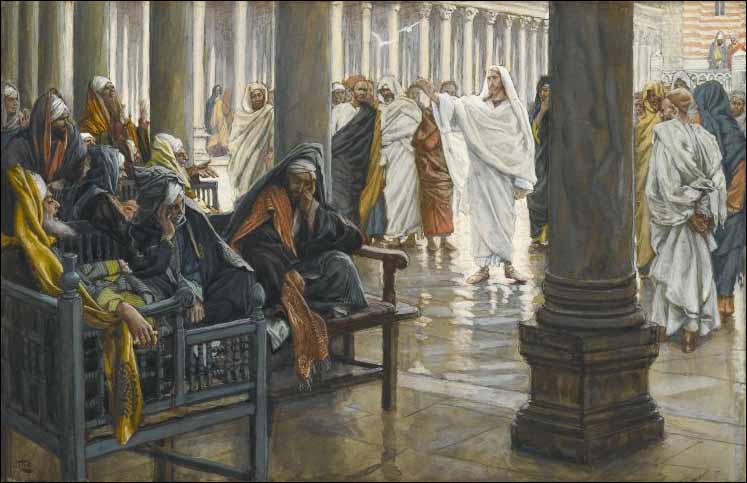
Christian Art

Illustration

Each day, The Christian Art website gives a picture and reflection on the Gospel of the day.

The readings on this page are from the Jerusalem Bible, which is used at Mass in most of the English-speaking world. The New American Bible readings, which are used at Mass in the United States, are available in the Universalis apps, programs and downloads.

You can also view this page with the Gospel in Greek and English.


TOPICS: Catholic; General Discusssion; Prayer; Worship
KEYWORDS: catholic; mt23; ordinarytime; prayer
For your reading, reflection, faith-sharing, comments, questions, discussion.

1 posted on 08/26/2024 4:42:02 AM PDT by annalex
[ Post Reply | Private Reply | View Replies]

To: All

KEYWORDS: catholic; mt23; ordinarytime; prayer;


2 posted on 08/26/2024 4:42:26 AM PDT by annalex (fear them not)
[ Post Reply | Private Reply | To 1 | View Replies]

To: nickcarraway; NYer; ELS; Pyro7480; livius; ArrogantBustard; Catholicguy; RobbyS; marshmallow; ...

Alleluia Ping

Please FReepmail me to get on/off the Alleluia Ping List.


3 posted on 08/26/2024 4:43:08 AM PDT by annalex (fear them not)
[ Post Reply | Private Reply | To 2 | View Replies]

To: annalex
My dad is back in the hospital. [JimRob update at 242]
Jim still needs our prayers. Thread 2
Prayer thread for Salvation's recovery
Pray for Ukraine
Prayer thread for Fidelis' recovery
Update on Jim Robinson's health issues
4 posted on 08/26/2024 4:43:28 AM PDT by annalex (fear them not)
[ Post Reply | Private Reply | To 3 | View Replies]

To: annalex
Matthew
 English: Douay-RheimsLatin: Vulgata ClementinaGreek NT: Byzantine/Majority Text (2000)
 Matthew 23
13But woe to you scribes and Pharisees, hypocrites; because you shut the kingdom of heaven against men, for you yourselves do not enter in; and those that are going in, you suffer not to enter. Væ autem vobis scribæ et pharisæi hypocritæ, quia clauditis regnum cælorum ante homines ! vos enim non intratis, nec introëuntes sinitis intrare.23:14 ουαι υμιν γραμματεις και φαρισαιοι υποκριται οτι κλειετε την βασιλειαν των ουρανων εμπροσθεν των ανθρωπων υμεις γαρ ουκ εισερχεσθε ουδε τους εισερχομενους αφιετε εισελθειν
14Woe to you scribes and Pharisees, hypocrites: because you devour the houses of widows, praying long prayers. For this you shall receive the greater judgment. Væ vobis scribæ et pharisæi hypocritæ, quia comeditis domos viduarum, orationes longas orantes ! propter hoc amplius accipietis judicium.23:13 ουαι δε υμιν γραμματεις και φαρισαιοι υποκριται οτι κατεσθιετε τας οικιας των χηρων και προφασει μακρα προσευχομενοι δια τουτο ληψεσθε περισσοτερον κριμα
15Woe to you scribes and Pharisees, hypocrites; because you go round about the sea and the land to make one proselyte; and when he is made, you make him the child of hell twofold more than yourselves. Væ vobis scribæ et pharisæi hypocritæ, quia circuitis mare, et aridam, ut faciatis unum proselytum, et cum fuerit factus, facitis eum filium gehennæ duplo quam vos.ουαι υμιν γραμματεις και φαρισαιοι υποκριται οτι περιαγετε την θαλασσαν και την ξηραν ποιησαι ενα προσηλυτον και οταν γενηται ποιειτε αυτον υιον γεεννης διπλοτερον υμων
16Woe to you blind guides, that say, Whosoever shall swear by the temple, it is nothing; but he that shall swear by the gold of the temple, is a debtor. Væ vobis duces cæci, qui dicitis : Quicumque juraverit per templum, nihil est : qui autem juraverit in auro templo, debet.ουαι υμιν οδηγοι τυφλοι οι λεγοντες ος αν ομοση εν τω ναω ουδεν εστιν ος δ αν ομοση εν τω χρυσω του ναου οφειλει
17Ye foolish and blind; for whether is greater, the gold, or the temple that sanctifieth the gold? Stulti et cæci : quid enim majus est ? aurum, an templum, quod sanctificat aurum ?μωροι και τυφλοι τις γαρ μειζων εστιν ο χρυσος η ο ναος ο αγιαζων τον χρυσον
18And whosoever shall swear by the altar, it is nothing; but whosoever shall swear by the gift that is upon it, is a debtor. Et quicumque juraverit in altari, nihil est : quicumque autem juraverit in dono, quod est super illud, debet.και ος εαν ομοση εν τω θυσιαστηριω ουδεν εστιν ος δ αν ομοση εν τω δωρω τω επανω αυτου οφειλει
19Ye blind: for whether is greater, the gift, or the altar that sanctifieth the gift? Cæci : quid enim majus est, donum, an altare, quod sanctificat donum ?μωροι και τυφλοι τι γαρ μειζον το δωρον η το θυσιαστηριον το αγιαζον το δωρον
20He therefore that sweareth by the altar, sweareth by it, and by all things that are upon it: Qui ergo jurat in altari, jurat in eo, et in omnibus quæ super illud sunt.ο ουν ομοσας εν τω θυσιαστηριω ομνυει εν αυτω και εν πασιν τοις επανω αυτου
21And whosoever shall swear by temple, sweareth by it, and by him that dwelleth in it: Et quicumque juraverit in templo, jurat in illo, et in eo qui habitat in ipso :και ο ομοσας εν τω ναω ομνυει εν αυτω και εν τω κατοικησαντι αυτον
22And he that sweareth by heaven, sweareth by the throne of God, and by him that sitteth thereon. et qui jurat in cælo, jurat in throno Dei, et in eo qui sedet super eum.και ο ομοσας εν τω ουρανω ομνυει εν τω θρονω του θεου και εν τω καθημενω επανω αυτου

(*) v. 19 μωροι, "dull" is omitted in translations.

5 posted on 08/26/2024 4:47:34 AM PDT by annalex (fear them not)
[ Post Reply | Private Reply | To 4 | View Replies]

To: annalex

Catena Aurea by St. Thomas Aguinas

23:13

13. But woe unto you, Scribes and Pharisees, hypocrites! for ye shut up the kingdom of heaven against men: for ye neither go in yourselves, neither suffer ye them that are entering to go in.

ORIGEN. Christ is truly the Son of that God Who gave the Law; after the example of the blessings pronounced in the Law, did Himself pronounce the blessings of them that are saved; and also after the cursings of the Law, He now sets forth a woe against sinners; Woe unto you, Scribes and Pharisees, hypocrites. They who allow that it is compatible with goodness to utter these denunciations against sinners, should understand that the purpose of God is the same in the cursings of the Law. Both the cursing there and the woe here fall upon the sinner not from Him who denounces, but from themselves who commit the sins which are denounced, and worthily bring upon themselves the inflictions of God’s discipline, appointed for the turning of men to good. So a father rebuking a son utters words of cursing, but does not desire that he should become deserving of those curses, but rather that he should turn himself from them. He adds the cause of this woe, Ye shut up the kingdom of heaven against men; for ye neither go in yourselves, nor suffer them that are entering to go in. These two commandments are by nature inseparable; because not to suffer others to enter in, is of itself enough to keep the hinderer out.

PSEUDO-CHRYSOSTOM. By the kingdom of heaven is meant the Scriptures, because in them the kingdom of heaven is lodged; the understanding of these is the door. Or the kingdom of heaven is the blessedness of heaven, and the door thereof Christ, by Whom men enter in. The door-keepers are the Priests, to whom is committed the word of teaching or interpreting Scripture, by which the door of truth is opened to men. The opening of this door is right interpretation. And observe that He said not, Woe unto you, for ye open, but, for ye shut up; the Scriptures then are not shut up, though they are obscure.

ORIGEN. The Pharisees and the Scribes then would neither enter in, nor hear Him who said, By me if any man enter in he shall be saved; (John 10:9.) nor would they suffer those to enter in, who were able to have believed through the things which had been spoken before by the Law and the Prophets concerning Christ, but shut up the door with every kind of device to deter men from entering. Also they detracted from His teaching, denied all prophecy concerning Him, and blasphemed every miracle as deceitful, or wrought by the Devil. All who in their evil conversation set an example of sinning to the people, and who commit injustice, offending the weak, seem to shut up the kingdom of heaven before men. And this sin is found among the people, and chiefly among the doctors, when they teach men what the Gospel righteousness requires of them, but do not what they teach. But those who both teach and live well open to men the kingdom of heaven, and both enter in themselves, and invite others to enter in. Many also will not suffer those who are willing to enter into the kingdom of heaven, when they without reason excommunicate out of jealousy others who are better than themselves; thus they refuse them entrance, but these of sober spirit, overcoming by their patience this tyranny, although forbidden, yet enter in and inherit the kingdom. Also they who with much rashness have set themselves to the profession of teaching before they have learned, and following Jewish fables, detract from those who search out the higher things of Scripture; these do, as far as in them lies, shut out men from the kingdom of heaven.

23:14

14. Woe unto you, Scribes and Pharisees, hypocrites! for ye devour widows’ houses, and for a pretence make long prayer: therefore ye shall receive the greater damnation.

CHRYSOSTOM. (Hom. lxxiii.) Next the Lord rebukes them for their gluttony, and what was the worst, that not from the rich but from widows they took wherewith to fill their bellies, thus burdening the poverty of those whom they should have relieved.

GLOSS. (interlin.) Devour widows’ houses, that is, your superstitions have this only aim, namely, to make a gain of the people that is put under you.

PSEUDO-CHRYSOSTOM. The female sex is imprudent, as not contemplating with reason all that it sees or hears; and weak, as being easily turned either from bad to good, or from good to bad. The male sex is more prudent and hardy. And therefore pretenders to holiness practise most upon women, who are unable to see their hypocrisy, and are easily inclined to love them on the ground of religion. But widows they chiefly choose to attempt; first, because a woman who has her husband to advise her is not so readily deceived; and secondly, she has not the means of giving, being in the power of her husband. The Lord then, whilst He confounds the Jewish Priests, instructs the Christian that they should not frequent widows rather than others, for though their purpose may not be bad, it gives occasion to suspicions.

CHRYSOSTOM. The manner of this plundering is grievous, for they make long prayers. Every one who does evil deserves punishment; but he who takes occasion for his offence from religion, deserves more severe punishment; Therefore ye shall receive the greater damnation.

PSEUDO-CHRYSOSTOM. First, for that ye are wicked, and then because ye put on the cloak of sanctity. Your covetousness you dress up in the colour of religion, and use God’s arms in the Devil’s service, that iniquity may be loved while it is thought to be piety.

HILARY. Or, because their observance of the kingdom of heaven proceeds hence, that they may keep up their practice of going about to widows’ houses, they shall therefore receive the heavier judgment, as having their own sin and the ignorance of others to answer for.

GLOSS. (interlin. Luke 12:47.) Or, because the servant that knew his Lord’s will and did it not, shall he beaten with many stripes.

23:15

15. Woe unto you, Scribes and Pharisees, hypocrites! for ye compass sea and land to make one proselyte, and when he is made, you make him two fold more the child of hell than yourselves.

CHRYSOSTOM. This the next charge against them is, that they are unequal to the salvation of many, seeing they need so much labour to bring one to salvation; and not only are they slack in conversion, but destroy even those whom they do convert, by corrupting them by example of evil life.

HILARY. That they compass sea and land signifies that throughout the whole world they shall be enemies of Christ’s Gospel, and shall bring men under the yoke of the Law against the justification of faith. There were proselytes made into the Synagogue from among the Gentiles, the small number of whom is here denoted by what is said one proselyte. For after the preaching of Christ there was no faith left in their doctrine, but whoever was gained to the faith of the Jews became a child of hell.

ORIGEN. For all who Judaize since the coming of the Saviour, are taught to follow the temper of those who cried at that time, Crucify, crucify him.

HILARY. And he becomes the child of a twofold punishment, because he has not obtained remission of his Gentile sins, and because he has joined the society of those who persecuted Christ.

JEROME. Or otherwise; The Scribes and Pharisees compassed the whole world to make proselytes of the Gentiles, that is, to mix the uncircumcised stranger with the people of God.

PSEUDO-CHRYSOSTOM. And that not of compassion from desire to save him whom they taught, but either from covetousness, that the greater number of worshippers might increase the number of offerings made in sacrifice, or out of vain glory. For he who sinks himself in a slough of sins, how should he be desirous to rescue another out of them? Will a man be more merciful to another than to himself? By a man’s actions therefore it may be known whether he seeks another’s conversion for God’s sake, or out of vain glory.

GREGORY. (Mor. xxxi. 9.) But forasmuch as hypocrites though they do ever crooked things, yet cease not to speak right things, and thus by their good instructions beget sons, but are not able to bring them up by good life, but the more they give themselves up to worldly works, the more willingly do they suffer those whom they have begotten to work the same. And because their hearts are hardened, these very sons whom they have begotten they do not own by any sign of the affection due. Wherefore it is here said of the hypocrites, And when he is made, ye make him twofold more the child of hell than yourselves.

AUGUSTINE. (cont. Faust. xvi. 29. et cf. cont. Adimant. 16.) This He said not because proselytes were circumcised, but because they imitated the lives of those from following whom He had prohibited His disciples, saying, Do ye not after their works. Two things are observable in this command; first, the honour shewn to Moses’ teaching, (Matt. 23:3.) that even wicked men when sitting in his seat are compelled to teach good things; and that the proselyte is made a child of hell, not by hearing the words of the Law, but by following their doings. And twofold more than they for this reason, that he neglects to fulfil what he had undertaken of his own choice, having been not born a Jew, but of free will become a Jew.

JEROME. Or, because before while he was a Gentile he erred in ignorance, and was only a child of hell; but seeing the vices of his masters, and understanding that they destroyed in their actions what they taught in words, he returns to his vomit, and becoming a Gentile, he is worthy of greater punishment as one that has deserted his cause.

PSEUDO-CHRYSOSTOM. Or, because while he was a worshipper of idols, he observed righteousness even because of men; but when he became a Jew, prompted by the example of evil teachers, he became worse than his teachers.

CHRYSOSTOM. For a disciple imitates a virtuous master, but goes beyond a vicious one.

JEROME. He is called a child of hell in the same way as one is said to be a child of perdition, and a child of this world; every man is called the son of him whose works he does.

ORIGEN. From this place we learn that there will be a difference of torment in hell, seeing one is here said to be singly a child of hell, another twofold. And we ought to consider here whether it is possible that a man should be generally a child of hell, as a Jew, suppose, or a Gentile, or whether specially so in consequence of some particular sins; that as a righteous man is increased in glory by the abundance of his righteousnesses, so a sinner’s punishment is increased manifold by the number of his sins.

23:16–22

16. Woe unto you, ye blind guides, which say, Whosoever shall swear by the temple, it is nothing; but whosoever shall swear by the gold of the temple, he is a debtor!

17. Ye fools and blind: for whether is greater, the gold, or the temple that sanctifieth the gold?

18. And, Whosoever shall swear by the altar, it is nothing; but whosoever sweareth by the gift that is upon it, he is guilty.

19. Ye fools and blind: for whether is greater, the gift, or the altar that sanctifieth the gift?

20. Whoso therefore shall swear by the altar, sweareth by it, and by all things thereon.

21. And whoso shall swear by the temple, sweareth by it, and by him that dwelleth therein.

22. And he that shall swear by heaven, sweareth by the throne of God, and by him that sitteth thereon.

JEROME. As by making broad phylacteries and fringes they sought after the reputation of sanctity, and made this again a means of gain, so now He charges them with being teachers of wickedness by their fraudulent pretence of tradition. For when in any dispute or quarrel, or ambiguous cause, one swore by the temple, and was afterwards convicted of falsehood, he was not held guilty. This is what is meant by that, Whosoever shall swear by the temple, it is nothing, that is, he owes nothing, But if he had sworn by the gold, or by the money which was offered to the Priests in the temple, he was immediately compelled to pay down that by which he had sworn.

PSEUDO-CHRYSOSTOM. The temple pertains to God’s glory, and to man’s spiritual salvation, but the gold of the temple though it pertains to the glory of God, yet does it more so to the delight of man, and the profit of the Priests. The Jews then pronounced the gold which delighted them, and the gifts which fed them, to be more holy than the temple, that they might make men more disposed to offer gifts, than to pour out prayers in the temple. Whence the Lord suitably reproves them in these words. Yet have some Christians at present an equally foolish notion. See, they say, in any suit if one swear by God, it seems nought; but if one swear by the Gospel, he seems to have done some great thing. To whom we shall say in like manner, Ye fools and blind! the Scriptures were written because of God, God is not because of the Scriptures. Greater therefore is God, than what is hallowed by Him.

JEROME. Again, if one swore by the altar, none held him guilty of perjury; but if he swore by the gift or the victims or the other things which are offered to God upon the altar, this they exacted most rigorously. And all this they did not out of fear of God, but out of covetousness. Thus the Lord charges them with both folly and fraud, inasmuch as the altar is much greater than the victims which are sanctified by the altar.

GLOSS. (non occ.) And lest their infatuation should go so far, that they should affirm that the gold was more holy than the temple, and the gift than the altar, He argues on another ground, that in the oath which is sworn by the temple and the altar is contained the oath by the gold or by the gift.

ORIGEN. In like manner the custom which the Jews had of swearing by the Heaven He reprobates. For they did not, as they supposed, avoid the danger of taking an oath by God, because, Whose sweareth by heaven, sweareth by the throne of God, and by him that sitteth thereon.

GLOSS. (ord.) For whoso swears by the creature that is subject, swears by the Divinity that rules over the creation.

ORIGEN. Now an oath is in confirmation of somewhat that has been spoken. The oath here then may signify testimony of Scripture which we produce in confirmation of that word which we speak. So that Divine Scripture is the temple of God, the gold is the meaning which it contains. As the gold which is outside the Temple is not sanctified, so all thoughts which are without divine Scripture, however admirable they may seem, are not hallowed. We ought not therefore to bring any speculations of our own for the confirmation of doctrine, unless such as we can shew are hallowed by being contained in divine Scripture. The altar is the human heart, which is the chief thing in man. The offerings and gifts that are hid upon the altar, are every thing which are done in the heart, as to pray, to sing, to do alms, to fast. Every offering of a man then is sanctified by his heart, by which the offering is made. There cannot therefore be a more honourable offering than the heart of man, out of which the offering proceeds. If then one’s conscience does not smite him, he has confidence towards God, not by reason of his gifts, but so to speak because he has rightly ordered the altar of his heart. Thirdly, we may say that over the temple, that is over every Scripture, and over the altar, that is over every heart, there is a certain meaning which is called the Heaven, the throne of God Himself, in which we shall be able to see the things that are revealed face to face, when that which is perfect is come.

HILARY. For since Christ is come, reliance upon the Law is vain; for not Christ by the Law, but the Law by Christ, is sanctified, in whom it rests as on a seat or throne; so are they fools and blind, who, overlooking the sanctifier, pay honour to the things sanctified.

AUGUSTINE. (Quæst. Ev. i. 34.) The temple and altar we may also understand of Christ Himself; the gold and the gifts, of the praise and sacrifice of prayer which we offer in Him and through Him. For not He by them, but they by Him, are sanctified.

Catena Aurea Matthew 23


6 posted on 08/26/2024 4:50:26 AM PDT by annalex (fear them not)
[ Post Reply | Private Reply | To 5 | View Replies]

To: annalex


The Last Judgement

Petrus Christus

1452
Oak, 134 x 56 cm
Staatliche Museen, Berlin

7 posted on 08/26/2024 4:50:52 AM PDT by annalex (fear them not)
[ Post Reply | Private Reply | To 6 | View Replies]

To: annalex

Saint Teresa of Jesus Jornet Ibars

Feast Day: Aug 26

Patronage: The Poor, The Abandoned and Aged

Teresa Jornet Ibars was the born January 9th, 1843 in the Catalan region of Spain. She was the foundress of the Little Sisters of the Abandoned Aged, better known as the Little Sisters of the Poor. This is not to be confused with the Congregation also called this founded by St. Jeanne Jugan.

From a young age, Teresa had a strong concern for the poor, often bringing them to the home of an aunt, where they were sure to receive assistance. Later she moved to Lerida, and lived with another aunt as she pursued her education. She became a teacher in Barcelona. During this time, she felt drawn to the monastic life and applied for admission to the Poor Clares, but she was not accepted. For this reason she devoted herself to her teaching and became a Carmelite tertiary to help in the development of her Spiritual life. She was encouraged by her Spiritual Director to undertake caring for the many elderly people of the area who were living alone and in poverty. She accepted this challenge.

In 1872, she opened the first house in Barbastro. Her sister Maria helped her, and the following year the small group took the habit and became a religious Congregation. Since Teresa had previously been with the Carmelite Order, she took the name of their great foundress, Teresa of Jesus. She was elected the first superior of the new community. They were totally dedicated to the care of the aged. Mother Teresa of Jesus taught her Sisters to sacrifice their own personal comforts for that of the men and women that they cared for. In addition for her intense commitment, she was noted for her overwhelming peace, and that drew in many young women to join her.

An outbreak of cholera hit Spain in 1897, and she joined the other members of the Congregation in their care of the victims of this plague. By the time it ended, 24 Sister, and seventy of their patients had died from the disease. She was physically overwhelmed and retired to the house in Liria. This is where she died, on August 26, 1897. At the time of her death, her Congregation had fifty houses. She was beatified in 1958 by Pope Pius XII, and canonized in 1974 by Pope Paul VI.

Practical Take Away

The life of St. Teresa of Jesus Jornet Ibars shows us that one person can make a difference, as well as many other things. The fact that she had fifty houses, all caring for the sick at the time of her death, was all made possible because she said “yes” to Jesus. She had a desire to help the poor and abandoned, and helped them one by one, by taking them to her aunt’s house. This little act of compassion would grow into a Congregation of fifty houses in her life’s time. If we call upon her intercession, we can get her help, and we can make a difference in the lives of others as well. We are all called to be saints, lets not miss our opportunity.
newmanministry.com
8 posted on 08/26/2024 4:58:50 AM PDT by annalex (fear them not)
[ Post Reply | Private Reply | To 7 | View Replies]

To: annalex

9 posted on 08/26/2024 5:00:42 AM PDT by annalex (fear them not)
[ Post Reply | Private Reply | To 8 | View Replies]

To: annalex
NAVARRE BIBLE COMMENTARY (RSV)

Ad Majorem Dei Gloriam (To the Greater Glory of God)

First Reading:

From: 2 Thessalonians 1:1-5, 11-12

Greeting
-----------
[1] Paul, Silvanus, and Timothy, To the church of the Thessalonians in God our Father and the Lord Jesus Christ: [2] Grace to you and peace from God the Father and the Lord Jesus Christ.

Thanksgiving
-----------------
[3] We are bound to give thanks to God always for you, brethren, as is fitting, because your faith is growing abundantly, and the love of every one of you for one another is increasing. [4] Therefore we ourselves boast of you in the churches of God for your steadfastness and faith in all your persecutions and in the afflictions which you are enduring.

[5] This is evidence of the righteous judgment of God, that you may be made worthy of the kingdom of God, for which you are suffering.

Prayer for Perseverance
------------------------------
[11] To this end we always pray for you, that our God may make you worthy of his call, and may fulfill every good resolve and work of faith by his power, [12] so that the name of our Lord Jesus may be glorified in you, and you in him, according to the grace of our God and the Lord Jesus Christ.

***********************************************************************
Commentary:

1-2. This heading is similar to that of the first letter. Two slight differences bear comment. The first is the adjective "our" applied to God the Father. This underlines the divine filiation of Christians. Only the second person, the Word, is the Son of God by nature; human beings are children of God by adoption, thanks to the Son's deigning to make us sharers in the divine filiation which is his in all its fullness; in theology this is expressed in the well-known proposition that we are "filii in Filio," sons in the Son. "The Son of God, his only son by nature," St Augustine says, "deigned to become Son of man, so that we who are sons of man by nature might become sons of God by grace" ("The City of God", 21,15). And St Irenaeus explains that "if the Word became flesh, and if the Son of God became Son of man, he did this so that man, by entering into communion with the Word and receiving the privilege of adoption, might become a son of God" ("Against Heresies", 2,19).

The Second Vatican Council gives the same teaching when it says that "the followers of Christ, called by God not in virtue of their works but by his design and grace, and justified in the Lord Jesus, have been made sons of God in the baptism of faith and partakers of the divine nature, and so are truly sanctified" ("Lumen Gentium", 40). The full import of what Christian life means becomes clear if one keeps in mind "this expressible and simple fact--that he is our Father and we are his children" (St J. Escriva, "Friends of God", 144).

The second difference in the heading (as compared with the first letter) is that it specifically says that grace comes "from God the Father and [from] the Lord Jesus Christ". Peace is inseparable from grace, and has its source in God. That is why the Second Vatican Council emphasized that "peace on earth, which flows from love of one's neighbor, symbolizes and derives from the peace of Christ which proceeds from God the Father" ("Gaudium Et Spes", 78).

See the note on 1 Thess 1:1-2.

3-4. As in other letters, the Apostle expresses his deep gratitude to the Lord (cf. Phil 4:6; Col 3:15-17; 1 Tim 2:1; etc.). By doing so he is imitating Jesus himself who at the start of prayer used to praise the Father and give him thanks (cf. Mt 11:25; 15:36; 26:27 and par.; Jn 11:41; etc.). In its supreme act of worship, the Mass, the Church exclaims at the start of the Preface: "We do well always and everywhere to give you thanks." In addition to showing the nobility of our feelings, gratefulness also puts us in the way of further gifts, because the Lord is particularly well disposed to a humble and grateful heart. As St Bernard teaches, "someone who humbly recognizes himself as obliged for gifts and who is grateful for them, is bound to receive many more. For if he shows that he is faithful in little things, he has a right to be entrusted with many; whereas on the contrary, someone who does not appreciate the favors he has been given renders himself unworthy of being given additional favors" ("Sermons on Psalm 90", 4).

That is why the Christian feels the need to express his gratitude to God: "Thank you, my Jesus, for your choosing to become perfect Man, with a most loving and lovable heart; a heart which loves unto death; a heart which suffers; which is fitted with joy and sorrow; which delights in the things of men and shows us the way to heaven; which subjects itself heroically to duty and acts with mercy; which watches over the poor and the rich, which cares for sinners and the just.... Thank you, my Jesus. Give us hearts to measure up to Yours!" (St. J. Escriva, "Furrow", 813).

"Your faith is growing": faith needs to grow, it needs to be alive. It grows when it is joined to love. The Thessalonians were active in their practice of faith and love, and this meant that their morale was good despite persecution and affliction. "Observe how the love and mutual solidarity of the believers is a great help in resisting evils and bearing affliction," St John Chrysostom says. "That deep fraternity was a great source of consolation. It is only a weak faith and an imperfect charity that afflictions cause to waver; but a solid, robust faith is in fact strengthened by affliction. A weak, languid soul derives no benefit from suffering, whereas a generous soul finds in suffering a source of new energy" ("Hom. on 2 Thess, ad loc.").

5. Fidelity to God, even in a situation which is adverse and difficult; is a guarantee of future reward. Our Lord sometimes allows us to experience suffering for the sake of the Gospel; he thereby tests our love and makes us worthy of the enduring Kingdom which awaits us in the life to come. In a particularly authoritative way, Paul VI taught that "the Kingdom of God begun here below in the Church of Christ is not of this world whose form is passing, and [...] its proper growth cannot be confounded with the progress of civilization, of science or of human technology, but [...] consists in an ever more profound knowledge of the unfathomable riches of Christ, an ever stronger hope in eternal blessings, an ever more ardent response to the Love of God, and an ever more generous bestowal of grace and holiness among men" ("Creed of the People of God", 27).

Suffering, like faith, should he accepted as a mark of God's special love: "it has been granted to you that...you should not only believe in him but also suffer for his sake" (Phil 1:29). Making the same point John Paul II reminds us that "in bringing about the Redemption through suffering, Christ has also raised human suffering to the level of the Redemption. Thus each man, in his suffering, can also become a sharer in the redemptive suffering of Christ" ("Salvifici Doloris", 19).

11. St. Paul takes up the thread of the prayer he began in v. 4, asking God to keep the believers true to their calling. He himself is very good example of how teachers of Christian doctrine should approach their work; he does not confine himself to expounding the truths of faith: the first step he takes is to pray for his work to be fruitful. St. Augustine observes that anyone who wants to teach the word of God "tries as far as possible to make his words understandable, pleasing and persuasive. But he should be convinced that if he is to obtain a good result it will be due more to the piety of his prayers than to his gifts of speech. And so, praying for those he is to address, he should be more a supplicant than a speaker. When the time comes for him to speak, before actually doing so he should raise his parched soul to God that he may utter only what he has himself eaten and drunk" ("Christian Instruction", 4, 15).

The Apostle asks God to make the Thessalonians "worthy of his call", that their efforts should have the support of divine grace, for no supernatural action can be planned, begun or brought to a conclusion without the grace of God (cf. Boniface II, "Per Filium Nostrum, Dz-Sch", 399). Hence the liturgical prayer: "Lord, be the beginning and end of all that we do and say. Prompt our actions with your grace, and complete them with your all-powerful help" ("Liturgy of the Hours", Morning Prayer, Monday Week 1).

12. The Greek formula here translated as "according to the grace of our God and the Lord Jesus Christ" could also be interpreted as "according to the grace of our God and Lord Jesus Christ"--in which case we would have here a confession of christological faith which would be of enormous value on account of its antiquity. It would be an acknowledgment of Christ being both God ("Theos") and Lord ("Kyrios"), that is, "Iesus Christus, Dominus et Deus noster". However, the expression "our God" often appears in Pauline writings (cf., in this very chapter, vv. 2 and 11); he also frequently uses the formula "Lord Jesus Christ". This suggests that there is a distinction between "our God" and "the Lord Jesus Christ" (or even "our Lord Jesus Christ"); hence the preferred translation.

10 posted on 08/26/2024 8:56:29 AM PDT by fidelis (Ecce Crucem Domini! Fugite partes adversae! Vicit Leo de tribu Juda, Radix David! Alleluia!)
[ Post Reply | Private Reply | To 9 | View Replies]

Gospel Reading:

From: Matthew 23:13-22

Jesus Indicts the Scribes and Pharisees
------------------------------------------------
(Jesus said to the scribes and Pharisees,) [13] "But woe to you, scribes and Pharisees, hypocrites! because you shut the Kingdom of Heaven against men; for you neither enter yourselves, nor allow those who would enter to go in. [15] Woe to you, scribes and Pharisees, hypocrites! for you traverse sea and land to make a single proselyte, and when he becomes proselyte, you make him twice as much a child of Hell as yourselves.

[16] "Woe to you, blind guides, who say, `If any one swears by the temple, it is nothing; but if any one swears by the gold of the temple, he is bound by his oath.' [17] You blind fools! For which is greater, the gold or the temple that has made the gold sacred? [18] And you say, `If any one swears by the altar, it is nothing; but if one swears by the gift that is on the altar, he is bound by his oath.' [19] You blind men! For which is greater, the gift or the altar that makes the gift sacred? [20] So he who swears by the altar, swears by it and everything on it; [21] and he who swears by the temple, swears by it and by him who dwells in it; [22] and he who swears by Heaven, swears by the throne of God and by Him who sits upon it."

***********************************************************************
Commentary:

13. Here comes our Lord's invective against the behavior of the scribes and Pharisees: His "woes" condemn their past conduct and threaten them with punishment if they do not repent and mend their ways.

14. As RSV points out, "other authorities add here (or after verse 12) verse 14, "Woe to you, scribes and Pharisees, hypocrites! For you devour widows' houses and for a pretense you make long prayers; therefore you will receive greater condemnation." Our Lord is not reproaching them for praying long prayers but for their hypocrisy and cupidity. By going in for a lot of external religious practices, the Pharisees wanted to be recognized as devout men and then trade on that reputation particularly with vulnerable people. Widows, for example, would ask them to say prayers; the Pharisees in turn would ask for alms. What Jesus means here is that prayer should always come from an upright heart and a generous spirit.

15. "Proselyte": a pagan convert to Judaism. The root of the word means "he who comes", he who--coming from idolatry--joins the chosen people in response to a calling from God. The Pharisees spared no effort to gain converts. Our Lord reproaches them not for this, but because they were concerned only about human success, their motivation being vainglory.

The sad thing about these proselytes was that, after receiving the light of Old Testament revelation, they remained under the influence of scribes and Pharisees, who passed on to them their own narrow outlook.

22. Our Lord's teaching about taking oaths is given in the Sermon on the Mount (Matthew 5:33-37). Jesus does away with the nitpicking casuistry of the Pharisees by focusing directly on the uprightness of the intention of the oath-taker and by stressing the respect due to God's majesty and dignity. What Jesus wants is a pure heart, with no element of deceit.

Our Lord particularly reproves any tendency to undermine the content of an oath, as the Doctors of the Law tended to do, thereby failing to respect holy things and especially the holy name of God. He therefore draws attention to the commandment of the Law which says, `You shall not take the name of the Lord your God in vain" (Exodus 20:7; Leviticus 19:12; Deuteronomy 5:11).

11 posted on 08/26/2024 8:57:05 AM PDT by fidelis (Ecce Crucem Domini! Fugite partes adversae! Vicit Leo de tribu Juda, Radix David! Alleluia!)
[ Post Reply | Private Reply | To 10 | View Replies]

Click here to go to the My Catholic Life! Devotional thread for today’s Gospel Reading.

12 posted on 08/26/2024 8:57:53 AM PDT by fidelis (Ecce Crucem Domini! Fugite partes adversae! Vicit Leo de tribu Juda, Radix David! Alleluia!)
[ Post Reply | Private Reply | To 11 | View Replies]

Disclaimer: Opinions posted on Free Republic are those of the individual posters and do not necessarily represent the opinion of Free Republic or its management. All materials posted herein are protected by copyright law and the exemption for fair use of copyrighted works.

Free Republic
Browse · Search
Religion
Topics · Post Article

FreeRepublic, LLC, PO BOX 9771, FRESNO, CA 93794
FreeRepublic.com is powered by software copyright 2000-2008 John Robinson