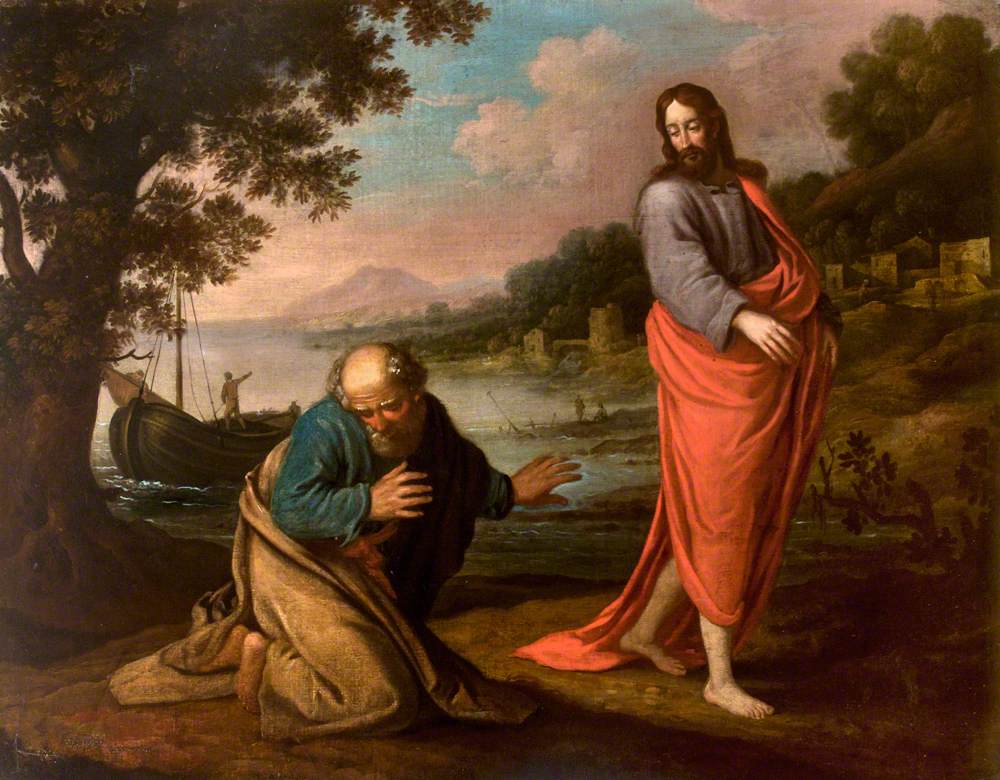
Catena Aurea by St. Thomas Aguinas
16:13–19
13. When Jesus came into the coasts of Cæsarea Philippi, he asked his disciples, saying, Whom do men say that I the Son of man am?
14. And they said, Some say that thou art John the Baptist; some, Elias; and others, Jeremias, or one of the prophets.
15. He saith unto them, But whom say ye that I am?
16. And Simon Peter answered and said, Thou art the Christ, the Son of the living God.
17. And Jesus answered and said unto him, Blessed art thou, Simon Barjona: for flesh and blood hath not revealed it unto thee, but my Father which is in heaven.
18. And I say also unto thee, That thou art Peter, and upon this rock I will build my Church: and the gates of hell shall not prevail against it.
19. And I will give unto thee the keys of the kingdom of heaven: and whatsoever thou shalt bind on earth shall be bound in heaven: and whatsoever thou shalt loose on earth shall be loosed in heaven.
GLOSS. (non occ.) As soon as the Lord had taken His disciples out of the teaching of the Pharisees, He then suitably proceeds to lay deep the foundations of the Gospel doctrine; and to give this the greater solemnity, it is introduced by the name of the place, When Jesus came into the coasts of Cæsarea Philippi.
CHRYSOSTOM. (Hom. liv.) He adds ‘of Philip,’ to distinguish it from the other Cæsarea, of Strato. And He asks this question in the former place, leading His disciples far out of the way of the Jews, that being set free from all fear, they might say freely what was in their mind.
JEROME. This Philip was the brother of Herod, the tetrarch of Ituræa, and the region of Trachonitis, who gave to the city, which is now called Panæas, the name of Cæsarea in honour of Tiberius Cæsar.
GLOSS. (ap. Anselm.) When about to confirm the disciples in the faith, He would first take away from their minds the errors and opinions of others, whence it follows, And he asked his disciples, saying, Whom do men say that the Son of Man is?
ORIGEN. Christ puts this question to His disciples, that from their answer we may learn that there were at that time among the Jews various opinions concerning Christ; and to the end that we should always investigate what opinion men may form of us; that if any ill be said of us, we may cut off the occasions of it; or if any good, we may multiply the occasions of it.
GLOSS. (non occ.) So by this instance of the Apostles, the followers of the Bishops are instructed, that whatever opinions they may hear out of doors concerning their Bishops, they should tell them to them.
JEROME. Beautifully is the question put, Whom do men say that the Son of Man is? For they who speak of the Son of Man, are men: but they who understood His divine nature are called not men but Gods.
CHRYSOSTOM. He says not, Whom do the Scribes and Pharisees say that I am? but, Whom do men say that I am? searching into the minds of the common people, which were not perverted to evil. For though their opinion concerning Christ was much below what it ought to have been, yet it was free from wilful wickedness; but the opinion of the Pharisees concerning Christ was full of much malice.
HILARY. By asking, Whom do men say that the Son of Man is? He implied that something ought to be thought respecting Him beyond what appeared, for He was the Son of Man. And in thus enquiring after men’s opinion respecting Himself, we are not to think that He made confession of Himself; for that which He asked for was something concealed, to which the faith of believers ought to extend itself. We must hold that form of confession, that we so mention the Son of God as not to forget the Son of Man, for the one without the other offers us no hope of salvation; and therefore He said emphatically, Whom do men say that the Son of Man is?
JEROME. He says not, Whom, do men say that I am? but, Whom do men say that the Son of Man is? that He should not seem to ask ostentatiously concerning Himself. Observe, that wherever the Old Testament has ‘Son of Man,’ the phrase in the Hebrew is ‘Son of Adam,’
ORIGEN. Then the disciples recount the divers opinions of the Jews relating to Christ; And they said, Some say John the Baptist, following Herod’s opinion; others Elias, (vid. Matt. 14:2.) supposing either that Elias had gone through a second birth, or that having continued alive in the body, He had at this time appeared; others Jeremias, whom the Lord had ordained to be Prophet among the Gentiles, not understanding that Jeremias was a type of Christ; or one of the Prophets, in a like way, because of those things which God spoke to them through the Prophets, yet they were not fulfilled in them, but in Christ.
JEROME. It was as easy for the multitudes to be wrong in supposing Him to be Elias and Jeremias, as Herod in supposing Him to be John the Baptist; whence I wonder that some interpreters should have sought for the causes of these several errors.
CHRYSOSTOM. The disciples having recounted the opinion of the common people, He then by a second question invites them to higher thoughts concerning Him, and therefore it follows, Jesus saith unto them, Whom say ye that I am? You who are with Me always, and have seen greater miracles than the multitudes, ought not to agree in the opinion of the multitudes. For this reason He did not put this question to them at the commencement of His preaching, but after He had done many signs; then also He spoke many things to them concerning His Deity.
JEROME. Observe how by this connexion of the discourse the Apostles are not styled men but Gods. For when He had said, Whom say ye that the Son of Man is? Ho adds, Whom say ye that I am? as much as to say, They being men think of Me as man, ye who are Gods, whom do you think Me?
RABANUS. He enquires the opinions of His disciples and of those without, not because He was ignorant of them; His disciples He asks, that He may reward with due reward their confession of a right faith, and the opinions of those without He enquires, that having the wrong opinions first set forth, it might be proved that the disciples had received the truth of their confession not from common opinion, but out of the hidden treasure of the Lord’s revelation.
CHRYSOSTOM. When the Lord enquires concerning the opinion of the multitudes, all the disciples answer; but when all the disciples are asked, Peter as the mouth and head1 of the Apostles answers for all, as it follows, Simon Peter answered and said, Thou art Christ, the Son of the living God.
ORIGEN. Peter denied that Jesus was any of those things which the Jews supposed, by his confession, Thou art the Christ, which the Jews were ignorant of; but he added what was more, the Son of the living God, (Ezek. 33:11.) who had said by his Prophets, I live, saith the Lord. And therefore was He called the living Lord, but in a more especial manner as being eminent above all that had life; for He alone has immortality, and is the fount of life, wherefore He is rightly called God the Father; for He is life as it were flowing out of a fountain, who said, I am the life. (John 14:6.)
JEROME. He calls Him the living God, in comparison of those gods who are esteemed gods, but are dead; such, I mean, as Saturn, Jupiter, Venus, Hercules, and the other monsters of idols.
HILARY. This is the true and unalterable faith, that from God came forth God the Son, who has eternity out of the eternity of the Father. That this God took unto Him a body and was made man is a perfect confession. Thus He embraced all in that He here expresses both His nature and His name, in which is the sum of virtues.
RABANUS. And by a remarkable distinction it was that the Lord Himself puts forward the lowliness of the humanity which He had taken upon Him, while His disciple shews us the excellence of His divine eternity.
HILARY. This confession of Peter met a worthy reward, for that he had seen the Son of God in the man. Whence it follows, Jesus answered and said unto him, Blessed art thou, Simon Barjonas, for flesh and blood has not revealed this unto thee, but my Father who is in heaven.
JEROME. This return Christ makes to the Apostle for the testimony which Peter had spoken concerning Him, Thou art Christ, the Son of the living God. The Lord said unto him, Blessed art thou, Simon Bar-jonas? Why? Because flesh and blood has not revealed this unto thee, but My Father. That which flesh and blood could not reveal, was revealed by the grace of the Holy Spirit. By his confession then he obtains a title, which should signify that he had received a revelation from the Holy Spirit, whose son he shall also be called; for Barjonas in our tongue signifies The son of a dove. Others take it in the simple sense, that Peter is the son of Johnq, according to that question in another place, Simon, son of John, lovest thou me? (John 21:15.) affirming that it is an error of the copyists in writing here Barjonas for Barjoannas, dropping one syllable. Now Joanna is interpreted ‘The grace of God.’ But either name has its mystical interpretation; the dove signifies the Holy Spirit; and the grace of God signifies the spiritual gift.
CHRYSOSTOM. It would be without meaning to say, Thou art the son of Jonas, unless he intended to shew that Christ is as naturally the Son of God, as Peter is the son of Jonas, that is, of the same substance as him that begot him.
JEROME. Compare what is here said, flesh and blood hath not revealed it unto thee, with the Apostolic declaration, Immediately I was not content with flesh and blood, (Gal. 1:16.) meaning there by this expression the Jews; so that here also the same thing is shewn in different words, that not by the teaching of the Pharisees, but by the grace of God, Christ was revealed to him the Son of God.
HILARY. Otherwise; He is blessed, because to have looked and to have seen beyond human sight is matter of praise, not beholding that which is of flesh and blood, but seeing the Son of God by the revelation of the heavenly Father; and he was held worthy to be the first to acknowledge the divinity which was in Christ.
ORIGEN. It must be enquired in this place whether, when they were first sent out, the disciples knew that He was the Christ. For this speech shews that Peter then first confessed Him to be the Son of the living God. And look whether you can solve a question of this sort, by saying that to believe Jesus to be the Christ is less than to know Him; and so suppose that when they were sent to preach they believed that Jesus was the Christ, and afterwards as they made progress they knew Him to be so. Or must we answer thus; That then the Apostles had the beginnings of a knowledge of Christ, and knew some little concerning Him; and that they made progress afterwards in the knowledge of Him, so that they were able to receive the knowledge of Christ revealed by the Father, as Peter, who is here blessed, not only for that he says, Thou art the Christ, but much more for that he adds, the Son of the living God.
CHRYSOSTOM. And truly if Peter had not confessed that Christ was in a peculiar sense born of the Father, there had been no need of revelation; nor would he have been worthy of this blessing for confessing Christ to be one of many adopted sons; for before this they who were with Him in the ship had said, Truly thou art the Son of God. (John 1:49.) Nathanael also said, Rabbi, thou art the Son of God. Yet were not these blessed because they did not confess such sonship as does Peter here, but thought Him one among many, not in the true sense a son; or, if chief above all, yet not the substance of the Father. But see how the Father reveals the Son, and the Son the Father; from none other comes it to confess the Son than of the Father, and from none other to confess the Father than of the Son; so that from this place even it is manifest that the Son is of the same substance, and to be worshipped together with the Father. Christ then proceeds to shew that many would hereafter believe what Peter had now confessed, whence He adds, And I say unto thee, that thou art Peter,
JEROME. As much as to say, You have said to me, Thou art Christ, the Son of the living God, therefore I say unto thee, not in a mere speech, and that goes not on into operation; but I say unto thee, and for Me to speak is to make it sor, that thou art Peter. For as from Christ proceeded that light to the Apostles, whereby they were called the light of the world, and those other names which were imposed upon them by the Lord, so upon Simon who believed in Christ the Rock, He bestowed the name of Peter (Rock.)
AUGUSTINE. (de Cons. Ev. ii. 53.) But let none suppose that Peter received that name here; he received it at no other time than where John relates that it was said unto him, Thou shalt be called Cephas, which is interpreted, Peter. (John 1:42.)
JEROME. And pursuing the metaphor of the rock, it is rightly said to him as follows: And upon this rock I will build my Church.
CHRYSOSTOM. That is, On this faith and confession I will build my Church. Herein shewing that many should believe what Peter had confessed, and raising his understanding, and making him His shepherd.
AUGUSTINE. (Retract. i. 21.) I have said in a certain place of the Apostle Peter, that it was on him, as on a rock, that the Church was built. But I know that since that I have often explained these words of the Lord, Thou art Peter, and on this rock will I build my Church, as meaning upon Him whom Peter had confessed in the words, Thou art Christ, the Son of the living God; and so that Peter, taking his name from this rock, would represent the Church, which is built upon this rock. For it is not said to him, Thou art the rock, but, Thou art Peter. (1 Cor. 10:4.) But the rock was Christ, whom because Simon thus confessed, as the whole Church confesses Him, he was named Peter. Let the reader choose whether of these two opinions seems to him the more probable.
HILARY. But in this bestowing of a new name is a happy foundation of the Church, and a rock worthy of that building, which should break up the laws of hell, burst the gates of Tartarus, and all the shackles of death. And to shew the firmness of this Church thus built upon a rock, He adds, And the gates of hell shall not prevail against it.
GLOSS. (interlin.) That is, shall not separate it from the love and faith of Me.
JEROME. I suppose the gates of hell to mean vice and sin, or at least the doctrines of heretics by which men are ensnared and drawn into hell.
ORIGEN. But in heavenly things every spiritual sin is a gate of hell, to which are opposed the gates of righteousness.
RABANUS. The gates of hell are the torments and promises of the persecutors. Also, the evil works of the unbelievers, and vain conversation, are gates of hell, because they shew the path of destruction.
ORIGEN. He does not express what it is which they shall not prevail against, whether the rock on which He builds the Church, or the Church which He builds on the rock; but it is clear that neither against the rock nor against the Church will the gates of hell prevail.
CYRIL OF ALEXANDRIA.s; According to this promise of the Lord, the Apostolic Church of Peter remains pure and spotless from all leading into error, or heretical fraud, above all Heads and Bishops, and Primates of Churches and people, with its own Pontiffs, with most abundant faith, and the authority of Peter. And while other Churches have to blush for the error of some of their members, this reigns alone immoveably established, enforcing silence, and stopping the mouths of all heretics; and wet, not drunken with the wine of pride, confess together with it the type of truth, and of the holy apostolic tradition.
JEROME. Let none think that this is said of death, implying that the Apostles should not be subject to the condition of death, when we see their martyrdoms so illustrious.
ORIGEN. Wherefore if we, by the revelation of our Father who is in heaven, shall confess that Jesus Christ is the Son of God, having also our conversation in heaven, to us also shall be said, Thou art Peter; for every one is a Rock who is an imitator of Christ. But against whomsoever the gates of hell prevail, he is neither to be called a rock upon which Christ builds His Church; neither a Church, or part of the Church, which Christ builds upon a rock.
CHRYSOSTOM. Then He speaks of another honour of Peter, when He adds, And I will give thee the keys of the kingdom of heaven; as much as to say, As the Father hath given thee to know Me, I also will give something unto thee, namely, the keys of the kingdom of heaven.
RABANUS. For as with a zeal beyond the others he had confessed the King of heaven, he is deservedly entrusted more than the others with the keys of the heavenly kingdom, that it might be clear to all, that without that confession and faith none ought to enter the kingdom of heaven. By the keys of the kingdom He means discernment1 and power; power, by which he binds and looses, discernment, by which he separates the worthy from the unworthy.
GLOSS. (interlin.) It follows, And whatsoever thou shalt bind; that is, whomsoever thou shalt judge unworthy of forgiveness while he lives, shall be judged unworthy with God; and whatsoever thou shalt loose, that is, whomsoever thou shalt judge worthy to be forgiven while he lives, shall obtain forgiveness of his sins from God.
ORIGEN. See how great power has that rock upon which the Church is built, that its sentences are to continue firm as though God gave sentence by it.
CHRYSOSTOM. See how Christ leads Peter to a high understanding concerning himself. These things that He here promises to give him, belong to God alone, namely to forgive sins, and to make the Church immoveable amidst the storms of so many persecutions and trials.
RABANUS. But this power of binding and loosing, though it seems given by the Lord to Peter alone, is indeed given also to the other Apostles, and is even now in the^ Bishops and Presbyters in every Church. (vid. Matt. 18:18.) But Peter received in a special manner the keys of the kingdom of heaven, and a supremacy of judicial power, that all the faithful throughout the world might understand that all who in any manner separate themselves from the unity of the faith, or from communion with him, such should neither be able to be loosed from the bonds of sin, nor to enter the gate of the heavenly kingdom.
GLOSS. (ap. Anselm.) This power was committed specially to Peter, that we might thereby be invited to unity. For He therefore appointed him the head of the Apostles, that the Church might have one principal Vicar of Christ, to whom the different members of the Church should have recourse, if ever they should have dissensions among them. But if there were many heads in the Church, the bond of unity would be broken. Some say that the words upon earth denote that power was not given to men to bind and loose the dead, but the living; for he who should loose the dead would do this not upon earth, but after the earth.
SECOND COUNCIL OF CONSTANTINOPLE. (Concil. Con. ii. Collat. 8.) How is it that some do presume to say that these things are said only of the living? Know they not that the sentence of anathema is nothing else but separation? They are to be avoided who are held of grievous faults, whether they are among the living, or not. For it is always behoveful to fly from the wicked. Moreover there are divers letters read of Augustine of religious memory, who was of great renown among the African bishops, which affirmed that heretics ought to be anathematized even after death. (vid. Aug. Ep. 185. 4.) Such an ecclesiastical tradition other African Bishops also have preserved. And the Holy Roman Church also has anathematized some Bishops after death, although no accusation had been brought against their faith in their lifetimeu.
JEROME. Bishops and Presbyters; not understanding this passage, assume to themselves something of the lofty pretensions of the Pharisees, and suppose that they may either condemn the innocent, or absolve the guilty; whereas what will be enquired into before the Lord will be not the sentence of the Priests, but the life of him that is being judged. We read in Leviticus of the lepers, how they are commanded to shew themselves to the Priests, and if they have the leprosy, then they are made unclean by the Priest; not that the Priest makes them leprous and unclean, but that the Priest has knowledge of what is leprosy and what is not leprosy, and can discern who is clean, and who is unclean. In the same way then as there the Priest makes the leper unclean, here the Bishop or Presbyter binds or looses not those who are without sin, or guilt, but in discharge of his function when he has heard the varieties of their sins, he knows who is to be bound, and who loosed.
ORIGEN. Let him then be without blame who binds or looses another, that he may be found worthy to bind or loose in heaven. Moreover, to him who shall be able by his virtues to shut the gates of hell, are given in reward the keys of the kingdom of heaven. For every kind of virtue when any has begun to practise it, as it were opens itself before Him, the Lord, namely, opening it through His grace, so that the same virtue is found to be both the gate, and the key of the gate. But it may be that each virtue is itself the kingdom of heaven.
16:20–21
20. Then charged he his disciples that they should tell no man that he was Jesus the Christ.
21. From that time forth began Jesus to shew unto his disciples, how that he must go unto Jerusalem and suffer many things of the elders and Chief Priests and Scribes, and be killed, and be raised again the third day.
ORIGEN. Seeing Peter had confessed Him to be Christ the Son of the living God, because He would not have them preach this in the mean time, He adds, Then charged he his disciples that they should tell no man that he was Jesus the Christ.
JEROME. When then above He sends His disciples to preach, and commands them to proclaim His advent, this seems contrary to His command here, that they should not say that He is Jesus the Christ. To me it seems that it is one thing to preach Christ, and another to preach Jesus the Christ. Christ is a common title of dignity, Jesus the proper name of the Saviour.
ORIGEN. Or they then spake of Him in lowly words, as only a great and wonderful man, but as yet proclaimed Him not as the Christ. Yet if any will have it that He was even at the first proclaimed to be Christ, he may say that now He chose that first short announcement of His name to be left in silence and not repeated, that that little which they had heard concerning Christ might be digested into their minds. Or the difficulty may be solved thus: that the former relation concerning their preaching Christ does not belong to the time before His Resurrection, but to the time that should be after the Resurrection; and that the command now given is meant for the time present; for it were of no use to preach Him, and to be silent concerning His cross. Moreover, He commanded them that they should tell no man that He was the Christ, and prepared them that they should afterwards say that He was Christ who was crucified, and who rose again from the dead.
JEROME. But that none should suppose that this is only my explanation, and not an evangelic interpretation, what follows explains the reasons of His forbidding them to preach Him at that time; Then began Jesus to shew unto his disciples that he must needs go unto Jerusalem, and suffer many things of the elders and Scribes, and Chief Priests, and be put to death, and rise again the third day. The meaning is; Then preach Me when I shall have suffered these things, for it will be of no avail that Christ be preached publicly, and His Majesty spread abroad among the people, when after a little time they shall see Him scourged and crucified.
CHRYSOSTOM. For what having once had root has afterwards been torn up, if it is again planted, is with difficulty retained among the multitude; but what having been once rooted has continued ever after unmoved, is easily brought on to a further growth. He therefore dwells on these sorrowful things, and repeats His discourse upon them, that He may open the minds of His disciples.
ORIGEN. And observe that it is not said,’ He began to say,’ or ‘to teach,’ but to shew; for as things are said to be shewn to the sense, so the things which Christ spake are said to be shewn by Him. Nor indeed do I think, that to those who saw Him suffering many things in the flesh, were those things which they saw so shewn as this representation in words shewed to the disciples the mystery of the passion and resurrection of Christ. At that time, indeed, He only began to shew them, and afterwards when they were more able to receive it, He shewed them more fully; for all that Jesus began to do, that He accomplished. He must needs go to Jerusalem, to be put to death indeed in the Jerusalem which is below, but to rise again and reign in the heavenly Jerusalem. But when Christ rose again, and others were risen with Him, they no longer sought the Jerusalem which is beneath, or the house of prayer in it, but that which is above. He suffers many things from the elders of the earthly Jerusalem, that He may be glorified by those heavenly elders who receive His mercies. He rose again from the dead on the third day, that He may deliver from the evil one, and purchase for such as are so delivered this gift, that they be baptized in spirit, soul, and body, in the name of the Father, and the Son, and the Holy Spirit, who are three days perpetually present to those that through them have been made children of light.
16:22–23
22. Then Peter took him, and began to rebuke him, saying, Be it far from thee, Lord: this shall not be unto thee.
23. But he turned, and said unto Peter, Get thee behind me, Satan: thou art an offence unto me: for thou savourest not the things that be of God, but those that be of men.
ORIGEN. While Christ was yet speaking the beginnings of the things which He was shewing unto them, Peter considered them unworthy of the Son of the living God. And forgetting that the Son of the living God does nothing, and acts in no way worthy of blame, he began to rebuke Him; and this is what is said, And Peter took him, and began to rebuke him.
JEROME. We have often said that Peter had too hot a zeal, and a very great affection towards the Lord the Saviour. Therefore after that his confession, and the reward of which he had heard from the Saviour, he would not have that his confession destroyed, and thought it impossible that the Son of God could be put to death, but takes Him to him affectionately, or takes Him aside that he may not seem to be rebuking his Master in the presence of his fellow disciples, and begins to chide Him with the feeling of one that loved Him, and to contradict Him, and say, Be it far from thee, Lord; or as it is better in the Greek, ἵλεώς σοι Κύριε, οὐ μὴ ἔσται σοι τοῦτο, that is, Be propitious to Thyself, Lord, this shall not be unto Thee.
ORIGEN. As though Christ Himself had needed a propitiation. His affection Christ allows, but charges him with ignorance; as it follows, He turned and said unto Peter, Get thee behind me, Satan, thou art an offence unto me.
HILARY. The Lord, knowing the suggestion of the craft of the devil, says to Peter, Get thee behind me; that is, that he should follow the example of His passion; but to him by whom this expression was suggested, He turns and says, Satan, thou art an offence unto me. For we cannot suppose that the name of Satan, and the sin of being an offence, would be imputed to Peter after those so great declarations of blessedness and power that had been granted him.
JEROME. But to me this error of the Apostle, proceeding from the warmth of his affection, will never seem a suggestion of the devil. Let the thoughtful reader consider that that blessedness of power was promised to Peter in time to come, not given him at the time present; had it been conveyed to him immediately, the error of a false confession would never have found place in him.
CHRYSOSTOM. For what wonder is it that this should befal Peter, who had never received a revelation concerning these things? For that you may learn that that confession which he made concerning Christ was not spoken of himself, observe how in these things which had not been revealed to him, he is at a loss. Estimating the things of Christ by human and earthly principles, he judged it mean and unworthy of Him that He should suffer. Therefore the Lord added, For thou savourest not the things that be of God, but the things that be of men.
JEROME. As much as to say; It is of My will, and of the Father’s will, that I should die for the salvation of men; you considering only your own will would not that the grain of wheat should fall into the ground, that it may bring forth much fruit; therefore as you speak what is opposed to My will, you ought to be called My adversary. For Satan is interpreted ‘adverse’ or ‘contrary.’
ORIGEN. Yet the words in which Peter and those in which Satan are rebuked, are not, as is commonly thought, the same; to Peter it is said, Get thee behind me, Satan; that is, follow me, thou that art contrary to my will; to the Devil it is said, Go thy way, Satan, understanding not ‘behind me,’ but ‘into everlasting fire.’ He said therefore to Peter, Get thee behind me, as to one who through ignorance was ceasing to walk after Christ. And He called him Satan, as one, who through ignorance had somewhat contrary to God. But he is blessed to whom Christ turns, even though He turn in order to rebuke him. But why said He to Peter, Thou art an offence unto me, (Ps. 119:165.) when in the Psalm it is said, Great peace have they that love thy law, and there is no offence to them? It must be answered, that not only is Jesus not offended, but neither is any man who is perfect in the love of God; and yet he who does or speaks any thing of the nature of an offence, may be an offence even to one who is incapable of being offended. Or he may hold every disciple that sinneth as an offence, as Paul speaks, Who is offended, and I burn not?. (2 Cor. 11:29.)
Catena Aurea Matthew 16
Catena Aurea by St. Thomas Aguinas
9:57–62
57. And it came to pass, that, as they went in the way, a certain man said unto him, Lord, I will follow thee whithersoever thou goest.
58. And Jesus said unto him, Foxes have holes, and birds of the air have nests; but the Son of man hath not where to lay his head.
59. And he said unto another, Follow me. But he said, Lord, suffer me first to go and bury my father.
60. Jesus said unto him, Let the dead bury their dead; but go thou and preach the kingdom of God.
61. And another also said, Lord, I will follow thee; but let me first go bid them farewell, which are at home at my house.
62. And Jesus said unto him, No man, having put his hand to the plough, and looking back, is fit for the kingdom of God.
CYRIL OF ALEXANDRIA. (non occ.) Although the Almighty Lord is bountiful, He does not grant to every one absolutely and indiscriminately heavenly and divine gifts, but to those only who are worthy to receive them, who free themselves and their souls from the stains of wickedness. And this we are taught by the force of the angelic words, And it came to pass, that, us they went in the way, a certain man said unto him, Lord, I will follow thee. First indeed there is much tardiness implied in the manner of his coming. It is next shewn that he is filled with too great presumption. For he sought not to follow Christ simply as several others of the people, but rather caught at the honour of the Apostleship. Whereas Paul says, No one taketh the honour to himself but he that is called of God. (Heb. 5:4.)
ATHANASIUS. (non occ.) He dared also to match himself with the incomprehensible power of the Saviour, saying, I will follow thee whithersoever thou goest; for to follow the Saviour simply to hear His teaching is possible to human nature, as it directs itself towards men, but it is not possible to go with Him wherever He is; for He is incomprehensible, and is not confined by place.
CYRIL OF ALEXANDRIA. In another respect also our Lord deservedly gives him a refusal, for He taught that to follow the Lord, a man must take up his cross, and renounce the affection of this present life. And our Lord finding this lacking in him does not blame him, but corrects him.
It follows, And Jesus says to him, The foxes have holes, &c.
THEOPHYLACT. For having seen our Lord drawing much people to Him, he thought that he received reward from them, and that if he followed our Lord, he might obtain money.
BEDE. Therefore it is said to him, Why do you seek to follow Me for the riches and gain of this world, when so great is My poverty that I have not even a place of rest, and take shelter under another man’s roof.
CHRYSOSTOM. See how our Lord sets forth by his works the poverty which he taught. For him was no table spread, no lights, no house, nor any such thing.
CYRIL OF ALEXANDRIA. Now under a mystical signification He applies the name of foxes and birds of the air to the wicked and crafty powers of evil spirits. As if He said, Since foxes and birds of the air have their abode in thee, how shall Christ rest in thee? What fellowship has light with darkness? (2 Cor. 6:14.)
ATHANASIUS. Or herein our Lord teaches the greatness of His gift, as if He said, All created things may be confined by place, but the Word of God has incomprehensible power. Say not then, I will follow thee whithersoever thou goest. But if thou wouldest be a disciple, cast off 1 foolish things, for it is impossible for him who remains in foolishness to become a disciple of the Word.
AMBROSE. Or, He compares foxes to heretics, because they are indeed a wily animal, and, ever intent upon fraud, commit their robberies by stealth. They let nothing be safe, nothing be at rest, nothing secure, for they hunt their prey into the very abodes of men. The fox again, an animal full of craft, makes no hole for itself, yet likes to lie always concealed in a hole. So the heretics, who know not how to construct a house for themselves, circumscribe and deceive others. This animal is never tamed, nor is it of use to man. Hence the Apostle, A heretic after the first and second admonition reject. (Tit. 3:10.) But the birds of the air, which are frequently brought in to represent spiritual wickedness, build as it were their nests in the breasts of the wicked, and as long as deceit reigns over the affections, the divine principle has no opportunity to take possession. But when a man has proved his heart to be innocent, upon him Christ leans in some measure the weight of His greatness, for by a more abundant shedding of grace He is planted in the breasts of good men. So then it does not seem reasonable that we should think him faithful and simple, who is rejected by the judgment of the Lord, notwithstanding that he promised the service of unwearied attendance; but our Lord cares not for this kind of service, but only purity of affection, nor is his attendance accepted whose sense of duty is not proved. For the hospitality of faith should be given with circumspection, lest while opening the interior of our house to the unbelieving, through our imprudent credulity we fall a snare to the treachery of others. Therefore that you may be aware that God despises not attendance upon him but deceit, He who rejected the deceitful man chose the innocent. For it follows, And he said unto another, Follow me. But He says this to him, whose father He knew to be dead. Hence it follows, But he said, Lord, suffer me first to go and bury my father.
BEDE. He did not refuse the discipleship, but his wish was, having fulfilled the filial duty of burying his father, to follow Christ more freely.
AMBROSE. But the Lord calls those upon whom He has compassion. Hence it follows, And Jesus said, Let the dead bury their dead. Since we have received as a religious duty the burial of the human body, how is it thus that the burial even of a father’s dead body is forbidden, unless you are to understand that human things are to be postponed to divine? It is a good employment, but the hindrance is greater, for he who divides his pursuits, draws down his affections; he who divides his care, delays his advances. We must first set about the things which are most important. For the Apostles also, that they might not be occupied in the office of distributing alms, ordained ministers for the poor.
CHRYSOSTOM. (Hom. 27. in Matt.) But what more necessary than the burial of his father, what more easy, seeing that there would not be much time given to it? We are then hereby taught that it becomes us not to spend even the slightest portion of our time in vain, although we have a thousand things to compel us, nay to prefer spiritual things to even our greatest necessities. For the devil watchfully presses close upon us, wishing to find any opening, and if he causes a slight negligence, he ends in producing a great weakness.
AMBROSE. The performance of a father’s burial is not then prohibited, but the observance of religious duty is preferred to the ties of relationship. The one is left to those in like condition, the other is commanded to those who are left. But how can the dead bury the dead? unless you here understand a twofold death, one a natural death, the other the death of sin. (Rom. 9:11.) There is also a third death, by which we die unto sin, live unto God.
CHRYSOSTOM. (ubi sup.) By thus saying, their dead, he shews that this man’s father was not his dead, for I suppose that the deceased was of the number of the unbelieving.
AMBROSE. Or because the throat of the ungodly is an open sepulchre, their memory is ordered to be forgotten whose services die together with their bodies. Nor is the son recalled from his duty to his father, but the faithful is separated from the communion of the unbelieving; there is no prohibition of duty, but a mystery of religion, that is, that we should have no fellowship with the dead Gentiles.
CYRIL OF ALEXANDRIA. Or else, his father was borne down with years, and he thought he was doing an honourable act in proposing to pay the kind offices which were due to him, according to Exodus, Honour thy father and thy mother. (Exod. 20:12.) Hence when calling him to the ministry of the Gospel, our Lord said, Follow me, he sought for a time of respite, which should suffice for the support of his decrepit father, saying, Permit me first to go and bury my father, not that he asked to bury his deceased father, for Christ would not have hindered the wish to do this, but he said, Bury, that is, support in old age even till death. But the Lord said to him, Let the dead bury their dead. For there were other attendants also bound by the same tie of relationship, but as I consider dead, because they had not yet believed Christ. Learn from this, that our duty to God is to be preferred to our love for our parents, to whom we shew reverence, because through them have we been born. But the God of all, when as yet we were not, brought us into being, our parents were made the ministers of our introduction.
AUGUSTINE. (de Con. Ev. l. ii. c. 23.) Our Lord spoke this to the man to whom He had said, Follow me. But another disciple put himself forward, to whom no one had spoken any thing, saying, I will follow thee, O Lord; but let me first go and bid them farewell who are at home, lest perchance they look for me as they are wont.
CYRIL OF ALEXANDRIA. Now this promise is worthy of our admiration and full of all praise, but to bid farewell to those who are at home, to get leave from them, shews that he was still somehow divided from the Lord, in that he had not yet resolved, to make this venture with his whole heart. For to wish to consult relations who would not agree to his proposal betokens one somewhat wavering. Wherefore our Lord condemns this, saying, No man, having put his hand to the plough, and looking back, is fit for the kingdom of God. He puts his hand to the plough who is ambitious to follow, yet looks back again who seeks an excuse for delay in returning home, and consulting with his friends.
AUGUSTINE. (Serm. 100.) As if he said to him, The East calls thee, and thou turnest to the West.
BEDE.: To put one’s hand to the plough, is also, (as it were by a certain sharp instrument,) by the wood and iron of our Lord’s passion, to wear away the hardness of our heart, and to open it to bring forth the fruits of good works. But if any one, having begun to exercise this, delights to look back with Lot’s wife to the things which he had left, he is deprived of the gift of the kingdom to come.
GREEK EXPOSITOR. (Nilus Monac.) For the frequent looking upon the things which we have forsaken, through the force of habit draws us back to our past way of life. For practice has great power to retain to itself. Is not habit generated of use, and nature of habit? But to get rid of or change nature is difficult; for although when compelled it for a while turns aside, it very rapidly returns to itself.
BEDE. But if the disciple about to follow our Lord is reproved for wishing even to bid farewell at home, what will be done to such as for no advantage-sake frequently visit the houses of those whom they have left in the world?
Catena Aurea Luke 9