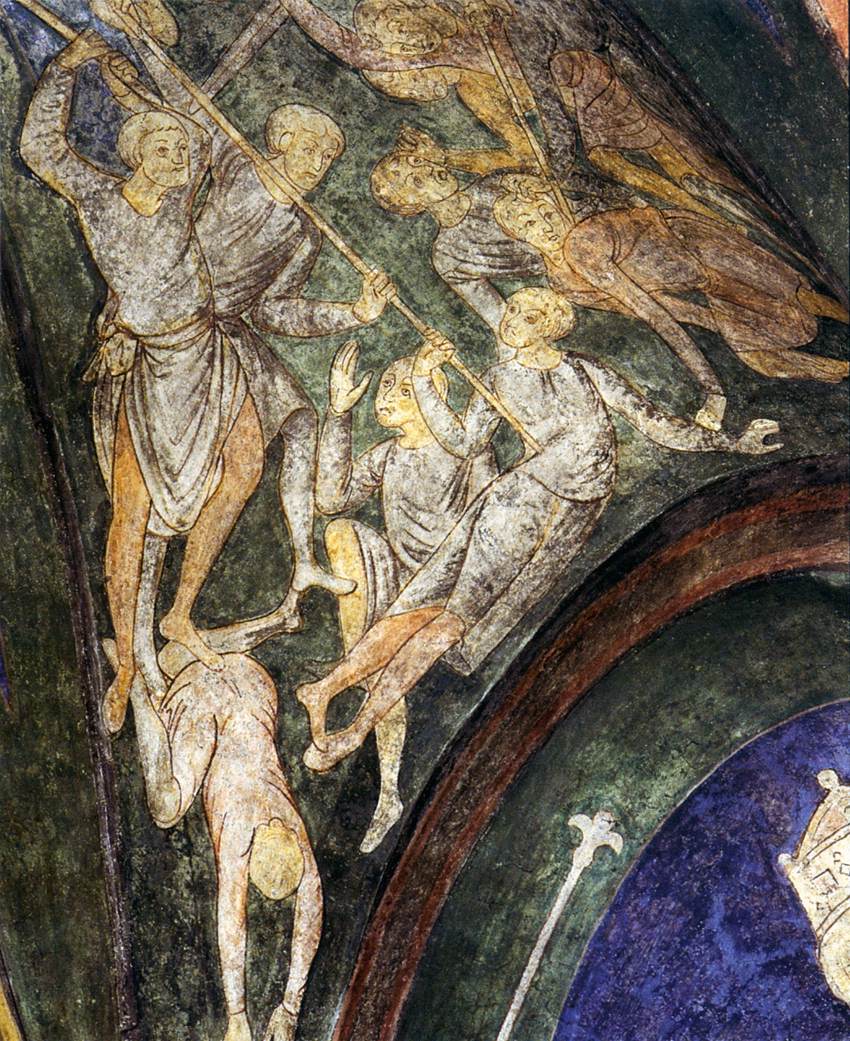
Catena Aurea by St. Thomas Aguinas
13:36–43
36. Then Jesus sent the multitude away, and went into the house: and his disciples came unto him, saying, Declare unto us the parable of the tares of the field.
37. He answered and said unto them, He that soweth the good seed is the Son of man;
38. The field is the world; the good seed are the children of the kingdom; but the tares are the children of the wicked one;
39. The enemy that sowed them is the devil; the harvest is the end of the world; and the reapers are the angels.
40. As therefore the tares are gathered and burned in the fire; so shall it be in the end of this world.
41. The Son of man shall send forth his angels, and they shall gather out of his kingdom all things that offend, and them which do iniquity;
42. And shall cast them into a furnace of fire: there shall be wailing and gnashing of teeth.
43. Then shall the righteous shine forth as the sun in the kingdom of their Father. Who hath ears to hear, let him hear.
CHRYSOSTOM. The Lord had spoken to the multitude in parables, that He might induce them to ask Him of their meaning; yet, though He had spoken so many things in parables, no man had yet asked Him aught, and therefore He sends them away; Then Jesus sent the multitude away, and went into the house. None of the Scribes followed Him here, from which it is clear that they followed Him for no other purpose than that they might catch Him in His discourse.
JEROME. The Lord sends away the multitude, and enters the house that His disciples might come to Him and ask Him privately of those things which the people neither deserved to hear, nor were able.
RABANUS. Figuratively; Having sent away the multitude of unquiet Jews, He enters the Church of the Gentiles, and there expounds to believers heavenly sacraments, whence it follows, And his disciples came to him, saying, Explain to us the parable of the tares of the field.
CHRYSOSTOM. Before, though desirous to learn, they had feared to ask; but now they ask freely and confidently because they had heard, To you it is given to know the mystery of the kingdom of heaven; and therefore they ask when alone, not envying the multitude to whom it was not so given. They pass over the parables of the leaven and the mustard-seed as plain; and ask concerning the parable of the tares, which has some agreement with the foregoing parable concerning the seed, and shews somewhat more than that. And accordingly the Lord expounds it to them, as it follows, He answered and said unto them, He that sows the good seed is the Son of man.
REMIGIUS. The Lord styles Himself the Son of Man, that in that title He might set an example of humility; or perhaps because it was to come to pass that certain heretics would deny Him to be really man; or that through belief in His Humanity we might ascend to knowledge of His Divinity.
CHRYSOSTOM. The field is the world. Seeing it is He that sows His own field, it is plain that this present world is His. It follows, The good seed are the children of the kingdom.
REMIGIUS. That is, the saints, and elect men, who are counted as sons.
AUGUSTINE. (cont. Faust. xviii. 7.) The tares the Lord expounds to mean, not as Manichæus interprets, certain spurious parts inserted among the true Scriptures, but all the children of the Evil one, that is, the imitators of the fraud of the Devil. As it follows, The tares are the children of the evil one, by whom He would have us understand all the wicked and impious.
AUGUSTINE. (Quæst. Ev. i. 10.) For all weeds among corn are called tares. It follows, The enemy who sowed this is the Devil.
CHRYSOSTOM. For this is part of the wiles of the Devil, to be ever mixing up truth with error. The harvest is the end of the world. In another place He says, speaking of the Samaritans, Lift up your eyes, and consider the fields that they are already white for the harvest; (John 4:35.) and again, The harvest truly is great, but the labourers are few, (Luke 10:2.) in which words He speaks of the harvest as being already present. How then does He here speak of it as something yet to come? Because He has used the figure of the harvest in two significations as He says there that it is one that soweth, and another that reapeth; but here it is the same who both sows and reaps; indeed there He brings forward the Prophets, not to distinguish them from Himself, but from the Apostles, for Christ Himself by His Prophets sowed among the Jews and Samaritans. The figure of harvest is thus applied to two different things. Speaking of first conviction and turning to the faith, He calls that the harvest, as that in which the whole is accomplished; but when He enquires into the fruits ensuing upon the hearing the word of God, then He calls the end of the world the harvest, as here.
REMIGIUS. By the harvest is denoted the day of judgment, in which the good are to be separated from the evil; which will be done by the ministry of Angels, as it is said below, that the Son of Man shall come to judgment with His Angels. As then the tares are gathered and burned in the fire, so shall it be in the end of this world. The Son of man shall send forth his Angels, and they shall gather out of his kingdom all offences, and them which do iniquity.
AUGUSTINE. (De Civ. Dei. xx. 9.) Out of that kingdom in which are no offences? The kingdom then is His kingdom which is here, namely, the Church.
AUGUSTINE. (Quæst. Ev. i. 10.) That the tares are first separated, signifies that by tribulation the wicked shall be separated from the righteous; and this is understood to be performed by good Angels, because the good can discharge duties of punishment with a good spirit, as a judge, or as the Law, but the wicked cannot fulfil offices of mercy.
CHRYSOSTOM. Or we may understand it of the kingdom of the heavenly Church; and then there will be held out here a two-fold punishment; first that they fall from glory as that is said, And they shall gather out of his kingdom all offences, to the end, that no offences should be seen in His kingdom; and then that they are burned. And they shall cast them into a furnace of fire.
JEROME. The offences are to be referred to the tares.
GLOSS. (non occ.) The offences, and, them that do iniquity, are to be distinguished as heretics and schismatics; the offences referring to heretics; while by them that do iniquity are to be understood schismatics. Otherwise; By offences may be understood those that give their neighbour an occasion of falling, by those that do iniquity all other sinners.
RABANUS. Observe, He says, Those that do iniquity, not, those who have done; because not they who have turned to penitence, but they only that abide in their sins are to be delivered to eternal torments.
CHRYSOSTOM. Behold the unspeakable love of God towards men! He is ready to shew mercy, slow to punish; when He sows, He sows Himself; when He punishes, He punishes by others, sending His Angels to that. It follows, There shall be weeping and gnashing of teeth.
REMIGIUS. In these words is shewn the reality of the resurrection of the body; and further, the twofold pains of hell, extreme heat, and extreme cold. And as the offences are referred to the tares, so the righteous are reckoned among the children of the kingdom; concerning whom it follows, Then the righteous shall shine as the sun in the kingdom of their Father. For in the present world the light of the saints shines before men, but after the consummation of all things, the righteous themselves shall shine as the sun in the kingdom of their Father.
CHRYSOSTOM. Not that they shall not shine with higher brightness, but because we know no degree of brightness that surpasses that of the sun, therefore He uses an example adapted to our understanding.
REMIGIUS. That He says, Then shall they shine, implies that they now shine for an example to others, but they shall then shine as the sun to the praise of God. He that hath ears to hear, let him hear.
RABANUS. That is, Let him understand who has understanding, because all these things are to be understood mystically, and not literally.
Catena Aurea Matthew 13
Saint of the Day for November 5
(c. 406 – c. 450)
Saint Peter Chrysologus’ Story
A man who vigorously pursues a goal may produce results far beyond his expectations and his intentions. Thus it was with Peter “of the Golden Words,” as he was called, who as a young man became bishop of Ravenna, the capital of the empire in the West.
At the time there were abuses and vestiges of paganism evident in his diocese, and these Peter was determined to battle and overcome. His principal weapon was the short sermon, and many of them have come down to us. They do not contain great originality of thought. They are, however, full of moral applications, sound in doctrine, and historically significant in that they reveal Christian life in fifth-century Ravenna. So authentic were the contents of his sermons that some 13 centuries later, he was declared a doctor of the Church by Pope Benedict XIII. He who had earnestly sought to teach and motivate his own flock was recognized as a teacher of the universal Church.
In addition to his zeal in the exercise of his office, Peter Chrysologus was distinguished by a fierce loyalty to the Church, not only in its teaching, but in its authority as well. He looked upon learning not as a mere opportunity but as an obligation for all, both as a development of God-given faculties and as a solid support for the worship of God.
Some time before his death around A.D. 450, Peter returned to his birthplace of Imola, in northern Italy. His liturgical feast is celebrated on July 30.
Reflection
Quite likely, it was Saint Peter Chrysologus’ attitude toward learning that gave substance to his exhortations. Next to virtue, learning, in his view, was the greatest improvement to the human mind and the support of true religion. Ignorance is not a virtue, nor is anti-intellectualism. Knowledge is neither more nor less a source of pride than physical, administrative, or financial prowess. To be fully human is to expand our knowledge—whether sacred or secular—according to our talent and opportunity.
franciscanmedia.org
NAVARRE BIBLE COMMENTARY (RSV)
Ad Majorem Dei Gloriam (To the Greater Glory of God)
First Reading:
From: Jeremiah 14:17-22
Oracles in a time of drought
----------------------------------
[And the Lord said to me:] [17] "You shall say to them this word: 'Let my eyes run down with tears night and day, and let them not cease, for the virgin daughter of my people is smitten with a great wound, with avery grievous blow. [18] If I go out into the field, behold, those slain by the sword! And if I enter the city, behold, the diseases of famine! For both prophet and priest ply their trade through the land, and have no knowledge.'"
[19] Hast thou utterly rejected Judah? Does thy soul loathe Zion? Why hast thou smitten us so that there is no healing for us? We looked for peace, but no good came; for a time of healing, but behold, terror. [20] We acknowledge our wickedness. O Lord, and the iniquity of our fathers, for we have sinned against thee. [21] Do not spurn us, for thy name's sake; do not dishonour thy glorious throne; remember and do not break thy covenant with us.
[22] Are there any among the false gods of the nations that can bring rain? Or can the heavens give showers? Art thou not he, O Lord our God? We set our hope on thee, for thou doest all these things.
********************************************************************************
Commentary:
14:1-15:9. This highly dramatic passage is made up of poems and dialogues between God and Jeremiah. It paints a picture of anguish, hunger and death – a desperate attempt to provoke repentance. "The prophet includes here a prayer to God on behalf of his chosen people, so that having punished them he will also show them his mercy" (St Thomas Aquinas, Postilla super Jeremiam, 14, 1). What Jeremiah had been saying about the evils that would befall Jerusalem was all coming true. After the attack on the city in 597 and the deportation that ensued, the situation was terrible. The affliction suffered by the city was compounded by a terrible drought which made its plight and that of all Judah even worse (14:1-6; cf. 8:18-23). In their extremity the people cry out to God, begging him not to treat them like strangers (14:7-9). The Lord replies through his prophet, and despite Jeremiah's attempts to excuse his fellow citizens, he does not mince his words: all these disasters are due to the faults and sins of the people (14:10-12), who made the mistake of relying on false prophets who put their minds at ease with promises of peace and prosperity (14:13-16). Jeremiah is deeply distressed by the whole situation, and he again begs God not to punish Judah (14:17-19); and the people again entreat God, their only hope (14:20-22). But the Lord has already promulgated his sentence. He will not go back on it -- not even if the nation's great mediators, Moses and Samuel, were to speak on its behalf (15:1-4; cf. Ex 32:11-14; 1 Sam 7:8-12). Its wickedness dates back a long time -- certainly to the reign of Manasseh (698-642), the son of Hezekiah (15:4), who tolerated and even promoted impiety and idolatry (2 Kings 21:1-18). So, the Lord had no option but to carry out his sentence (15:5-9): Judah had "rejected" him (cf. 15:6). This last part of the oracle is very severe and shows the profound pain felt by the prophet, for there is nothing he can do to ward off this great misfortune.
The words of 15:2 (cf. 43:11) are quoted in the book of Revelation (13:10) with reference to the latter days, to exhort readers to accept the truth of God's message and bear persecution with endurance and faith.