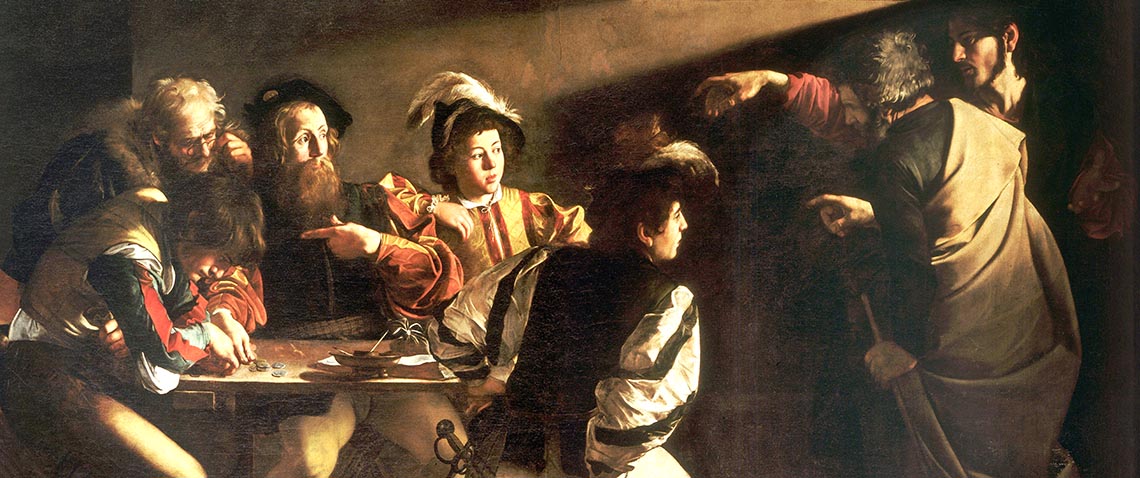
Catena Aurea by St. Thomas Aguinas
9:9–13
9. And as Jesus passed forth from thence, he saw a man, named Matthew, sitting at the receipt of custom: and he saith unto him, Follow me. And he arose, and followed him.
10. And it came to pass, as Jesus sat at meat in the house, behold, many Publicans and sinners came and sat down with him and his disciples.
11. And when the Pharisees saw it, they said unto his disciples, Why eateth your Master with Publicans and sinners?
12. But when Jesus heard that, he said unto them, They that be whole need not a physician, but they that are sick.
13. But go ye and learn what that meaneth, I will have mercy, and not sacrifice: for I am not come to call the righteous, but sinners to repentance.
CHRYSOSTOM. (Hom. xxx.) Having wrought this miracle, Christ would not abide in the same place, lest He should rouse the envy of the Jews. Let us also do thus, not obstinately opposing those who lay in wait for us. And as Jesus departed thence, (namely from the place in which He had done this miracle,) he saw a man sitting at the receipt of custom, Matthew by name.
JEROME. The other Evangelists from respect to Matthew have not called him by his common name, but say here, Levi, for he had both names. Matthew himself, according to that Solomon says. The righteous man accuses himself, (Prov. 18:17.) calls himself both Matthew and Publican, to shew the readers that none need despair of salvation who turn to better things, seeing he from a Publican became an Apostle.
GLOSS. (ap. Anselm.) He says, sitting at the receipt of custom, that is, in the place where the tolls were collected. He was named Telonarius, from a Greek word signifying taxes.
CHRYSOSTOM. Herein he shews the excellent power of Him that called him; while engaged in this dangerous office He rescued him from the midst of evil, as also Paul while he was yet mad against the Church. He saith unto him, Follow me. As you have seen the power of Him that calleth, so learn the obedience of him that is called; he neither refuses, nor requests to go home and inform his friends.
REMIGIUS. He esteems lightly human dangers which might accrue to him from his masters for leaving his accounts in disorder, but, he arose, and followed him. And because he relinquished earthly gain, therefore of right was he made the dispenser of the Lord’s talents.
JEROME. Porphyry and the Emperor Julian insist from this account, that either the historian is to be charged with falsehood, or those who so readily followed the Saviour with haste and temerity; as if He called any without reason. They forget also the signs and wonders which had preceded, and which no doubt the Apostles had seen before they believed. Yea the brightness of effulgence of the hidden Godhead which beamed from His human countenance might attract them at first view. For if the loadstone can, as it is said, attract iron, how much more can the Lord of all creation draw to Himself whom He will!
CHRYSOSTOM. But why did He not call him at the same time with Peter and John and the others? Because he was then still in a hardened state, but after many miracles, and great fame of Christ, when He who knows the inmost secrets of the heart, perceived him more disposed to obedience, then He called him.
AUGUSTINE. (De Cons. Ev. ii. 26.) Or, perhaps it is more probable that Matthew here turns back to relate something that he had omitted; and we may suppose Matthew to have been called before the sermon on the mount; for on the mount, as Luke relates, the twelve, whom He also named Apostles, were chosen.
GLOSS. (non occ.) Matthew places his calling among the miracles; for a great miracle it was, a Publican becoming an Apostle.
CHRYSOSTOM. Why is it then that nothing is said of the rest of the Apostles how or when they were called, but only of Peter, Andrew, James, John, and Matthew? Because these were in the most alien and lowly stations, for nothing can be more disreputable than the office of Publican, nothing more abject than that of fisherman.
GLOSS. (ap. Anselm.) As a meet return for the heavenly mercy, Matthew prepared a great feast for Christ in his house, bestowing his temporal goods on Him of whom he looked to receive everlasting goods. It follows, And it came to pass as he sat at meat in the house.
AUGUSTINE. (De. Cons. Ev. ii. 27.) Matthew has not said in whose house Jesus sat at meat (on this occasion), from which we might suppose, that this was not told in its proper order, but that what took place at some other time is inserted here as it happened to come into his mind; did not Mark and Luke who relate the same shew that it was in Levi’s, that is, in Matthew’s house.
CHRYSOSTOM. Matthew being honoured by the entrance of Jesus into his house, called together all that followed the same calling with himself; Behold many Publicans and sinners came and sat down with Jesus, and with his disciples.
GLOSS. (ap. Anselm.) The Publicans were they who were engaged in public business, which seldom or never can be carried on without sin. And a beautiful omen of the future, that he that was to be an Apostle and doctor of the Gentiles, at his first conversion draws after him a great multitude of sinners to salvation, already performing by his example what he was shortly to perform by word.
GLOSS. (ord.) Tertullian says that these must have been Gentiles, because Scripture says, There shall be no payer of tribute in Israel, as if Matthew were not a Jew. But the Lord did not sit down to meat with Gentiles, being more especially careful not to break the Law, as also He gave commandment to His disciples below, Go not into the way of the Gentiles.
JEROME. But they had seen the Publican turning from sins to better things, and finding place of repentance, and on this account they do not despair of salvation.
CHRYSOSTOM. Thus they came near to our Redeemer, and that not only to converse with Him, but to sit at meat with Him; for so not only by disputing, or healing, or convincing His enemies, but by eating with them, He oftentimes healed such as were ill-disposed, by this teaching us, that all times, and all actions, may be made means to our advantage. When the Pharisees saw this they were indignant; And the Pharisees beholding said to his disciples, Why eateth your Master with Publicans and sinners? It should be observed, that when the disciples seemed to be doing what was sinful, these same addressed Christ, Behold, thy disciples are doing what it is not allowed to do on the Sabbath. (Mat. 12:2.) Here they speak against Christ to His disciples, both being the part of malicious persons, seeking to detach the hearts of the disciple from the Master.
RABANUS. (e Beda.) They are here in a twofold error; first, they esteemed themselves righteous, though in their pride they had departed far from righteousness; secondly, they charged with unrighteousness those who by recovering themselves from sin were drawing near to righteousness.
AUGUSTINE. (ubi sup.) Luke seems to have related this a little differently; according to him the Pharisees say to the disciples, Why do ye eat and drink with Publicans and sinners? (Luke 5:30.) not unwilling that their Master should be understood to be involved in the same charge; insinuating it at once against Himself and His disciples. Therefore Matthew and Mark have related it as said to the disciples, because so it was as much an objection against their Master whom they followed and imitated. The sense therefore is one in all, and so much the better conveyed, as the words are changed while the substance continues the same.
JEROME. For they do not come to Jesus while they remain in their original condition of sin, as the Pharisees and Scribes complain, but in penitence, as what follows proves; But Jesus hearing said, They that be whole need not a physician, but they that are sick.
RABANUS. He calls Himself a physician, because by a wonderful kind of medicine He was wounded for our iniquities that He might heal the wound of our sin. By the whole, He means those who seeking to establish their own righteousness have not submitted to the true righteousness of God. By the sick, (Rom. 10:3.) He means those who, tied by the consciousness of their frailty, and seeing that they are not justified by the Law, submit themselves in penitence to the grace of God.
CHRYSOSTOM. Having first spoken in accordance with common opinion, He now addresses them out of Scripture, saying, Go ye, and learn what that meaneth, I will have mercy and not sacrifice.
JEROME. This text from Osee (Hosea 6:6.) is directed against the Scribes and Pharisees, who, deeming themselves righteous, refused to keep company with Publicans and sinners.
CHRYSOSTOM. As much as to say; How do you accuse me for reforming sinners? Therefore in this you accuse God the Father also. For as He wills the amendment of sinners, even so also do I. And He shews that this that they blamed was not only not forbidden, but was even by the Law set above sacrifice; for He said not, I will have mercy as well as sacrifice, but chooses the one and rejects the other.
GLOSS. (ap. Anselm.) Yet does not God contemn sacrifice, but sacrifice without mercy. But the Pharisees often offered sacrifices in the temple that they might seem to men to be righteous, but did not practise the deeds of mercy by which true righteousness is proved.
RABANUS. He therefore warns them, that by deeds of mercy they should seek for themselves the rewards of the mercy that is above, and, not overlooking the necessities of the poor, trust to please God by offering sacrifice. Wherefore, He says, Go; that is, from the rashness of foolish fault-finding to a more careful meditation of Holy Scripture, which highly commends mercy, and proposes to them as a guide His own example of mercy, saying, I came not to call the righteous but sinners.
AUGUSTINE. (ubi sup.) Luke adds to repentance, which explains the sense; that none should suppose that sinners are loved by Christ because they are sinners; and this comparison of the sick shews what God means by calling sinners, as a physician does the sick to be saved from their iniquity as from a sickness: which is done by penitence.
HILARY. Christ came for all; how is it then that He says He came not for the righteous? Were there those for whom it needed not that He should come? But no man is righteous by the law. He shews how empty their boast of justification, sacrifices being inadequate to salvation, mercy was necessary for all who were set under the Law.
CHRYSOSTOM. Whence we may suppose that He is speaking ironically, as when it is said, Behold now Adam is become as one of us. (Gen. 3:22.) For that there is none righteous on earth Paul shews, All have sinned, and need glory of God. (Rom. 3:23.) By this saying He also consoled those who were called; as though He had said, So far am I from abhorring sinners, that for their sakes only did I come.
GLOSS. (ap. Anselm.) Or; Those who were righteous, as Nathanael and John the Baptist, were not to be invited to repentance. Or. I came not to call the righteous, that is, the feignedly righteous, those who boasted of their righteousness as the Pharisees, but those that owned themselves sinners.
RABANUS. In the call of Matthew and the Publicans is figured the faith of the Gentiles who first gaped after the gain of the world, and are now spiritually refreshed by the Lord; in the pride of the Pharisees, the jealousy of the Jews at the salvation of the Gentiles. Or, Matthew signifies the man intent on temporal gain; Jesus sees him, when He looks on him with the eyes of mercy. For Matthew is interpreted ‘given,’ Levi ‘taken,’ the penitent is taken out of the mass of the perishing, and by God’s grace given to the Church. And Jesus saith unto him, Follow me, either by preaching, or by the admonition of Scripture, or by internal illumination.
Catena Aurea Matthew 9
NAVARRE BIBLE COMMENTARY (RSV)
Ad Majorem Dei Gloriam (To the Greater Glory of God)
First Reading:
From: Amos 8:4-6, 9-12
Exploiters denounced
-------------------------------
[4] Hear this, you who trample upon the needy, and bring the poor of the land to an end, [5] saying, “When will the new moon be over, that we may sell grain? And the Sabbath, that we may offer wheat for sale, that we may make the ephah small and the shekel great, and deal deceitfully with false balances, [6] that we may buy the poor for silver and the needy for a pair of sandals, and sell the refuse of the wheat?”
A day of judgment
--------------------------
[9] “And on that day.” says the Lord God “I will make the sun go down at noon, and darken the earth in broad daylight. [10] I will turn your feasts into mourning, and all your songs into lamentation; I will bring sackcloth upon all loins, and baldness on every head; I will make it like the mourning for an only son, and the end of it like a bitter day.”
[11] “Behold, the days are coming,” says the Lord God, “when I will send a famine on the land; not a famine of bread, nor a thirst for water, but of hearing the words of the Lord. [12] They shall wander from sea to sea, and from north to east; they shall run to and fro, to seek the word of the Lord, but they shall not find it.
**************************************************************
Commentary:
8:1-14. The fourth vision, that of the ripe fruit (vv. 13), introduces a denunciation of injustices (vv. 4-8 and a further description of the “day of the Lord” (vv 9-14). The three things are interconnected. In the vision, the prophet plays with the words (v. 2) “summer fruit”, qayits, and “end”, qets (see notes q and r). In this way he is saying that Israel’s rottenness has run its course (vv. 4-8); nothing can be done about it now – nothing but wait for the day of the Lord’s judgment (vv. 9-14).
In his denunciation of injustices, Amos mentions, specifically, fraud (v. 5) and exploitation of others when they are suffering need (v. 6). Church catechesis uses this and other passages (cf. Deut 24:14-15; 25:13-16; Jas 5:4) to spell out what the virtue of justice involves: “We should not dedicate our lives to the accumulation of money and wealth when there are so many others who struggle to survive in abject poverty; thus shall we heed the warning contained in the words of the prophet Amos: Hear this, you who trample upon the needy, and bring the poor of the land to an end, saying, ‘When will the new moon be over, that we may sell grain? And the Sabbath, that we may offer wheat for sale’” (St Gregory Nazianzen, “De pauperum amore [Oratio, 14]”, 24).
Gospel Reading: From: Matthew 9:9-13
The Call of Matthew
-------------------
[9] As Jesus passed on from there, He saw a man called Matthew sitting at the tax office; and He said to him, "Follow Me." And he rose and followed Him.
[10] And as He sat at table in the house, behold, many tax collectors and sinners came and sat down with Jesus and His disciples. [11] And when the Pharisees saw this, they said to His disciples, "Why does your Teacher eat with tax collectors and sinners?" [12] But when He heard it, He said, "Those who are well have no need of a physician, but those who are sick. [13] Go and learn what this means, `I desire mercy, and not sacrifice.' For I came not to call the righteous, but sinners."
***********************************************************************
Commentary:
9. "Tax office": a public place for the payment of taxes. On "following Jesus", see the note on Matthew 8:18-22.
The Matthew whom Jesus calls here is the Apostle of the same name and the human author of the first Gospel. In Mark 2:14 and Luke 5:27 he is called Levi the son of Alphaeus or simply Levi.
In addition to Baptism, through which God calls all Christians (cf. note on Matthew 8:18-22), the Lord can also extend, to whomever He chooses, a further calling to engage in some specific mission in the Church. This second calling is a special grace (cf. Matthew 4:19-21; Mark 1:17-20; John 1:30; etc.) additional to the earlier calling through Baptism. In other words, it is not man who takes the initiative; it is Jesus who calls, and man who responds to this call by his free personal decision: "You did not choose Me, but I chose you" (John 15:16).
Matthew's promptitude in "following" Jesus' call is to be noted. When God speaks, soul may be tempted to reply, "Tomorrow; I'm not ready yet." In the last analysis this excuse, and other excuses, are nothing but a sign of selfishness and fear (different from that fear which can be an additional symptom of vocation: cf. John 1). "Tomorrow" runs the risk of being too late.
As in the case of the other Apostles, St. Matthew is called in the midst of the ordinary circumstances of his life: "What amazes you seems natural to me: that God has sought you out in the practice of your profession! That is how He sought the first, Peter and Andrew, James and John, beside their nets, and Matthew, sitting in the custom-house. And--wonder of wonders!--Paul, in his eagerness to destroy the seed of the Christians" (St J. Escriva, "The Way", 799).
10-11. The attitude of these Pharisees, who are so prone to judge others and classify them as just men or sinners, is at odds with the attitude and teaching of Jesus. Earlier on, He said, "Judge not, that you be not judged" (Matthew 7:1), and elsewhere He added, "Let him who is without sin among you be the first to throw a stone at her" (John 8:7).
The fact is that all of us are sinners; and our Lord has come to redeem all of us. There is no basis, therefore, for Christians to be scandalized by the sins of others, since any one of us is capable of committing the vilest of sins unless God's grace comes to our aid.
12. There is no reason why anyone should be depressed when he realizes he is full of failings: recognition that we are sinners is the only correct attitude for us to have in the presence of God. He has come to seek all men, but if a person considers himself to be righteous, by doing so he is closing the door to God; all of us in fact are sinners.
13. Here Jesus quotes Hosea 6:6, keeping the hyperbole of the Semitic style. A more faithful translation would be: "I desire mercy MORE THAN sacrifice". It is not that our Lord does not want the sacrifices we offer Him: He is stressing that every sacrifice should come from the heart, for charity should imbue everything a Christian does—especially his worship of God (see 1 Corinthians 13:1-13; Matthew 5:23-24).