Skip to comments.
Catholic Caucus: Daily Mass Readings 11-June-2024
Universalis/Jerusalem Bible ^
Posted on 06/11/2024 4:28:53 AM PDT by annalex
11 June 2024
Saint Barnabas, Apostle
on Tuesday of week 10 in Ordinary Time
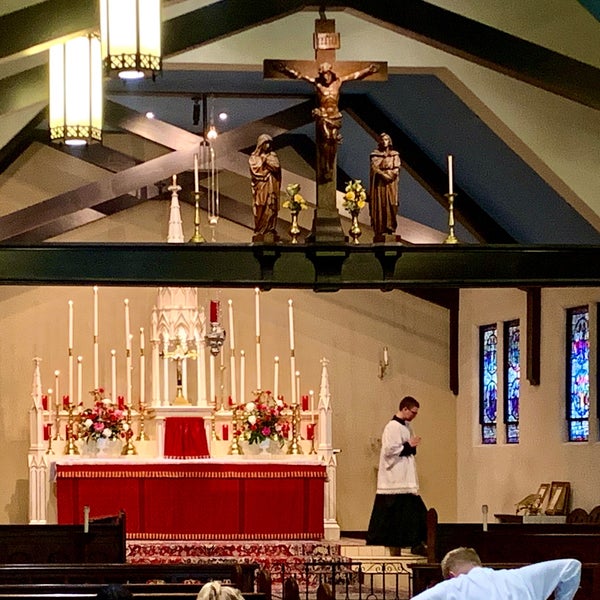
Barnabas Catholic Church Omaha, Nebraska Readings at MassLiturgical Colour: Red. Year: B(II). Readings for the feria Readings for the memorial These are the readings for the feria
The following reading is proper to the memorial, and must be used even if you have otherwise chosen to use the ferial readings. | First reading |
|---|
| Acts 11:21-26,13:1-3 |
|---|
He was a good man, filled with the Holy Spirit and with faithA great number believed and were converted to the Lord. The church in Jerusalem heard about this and they sent Barnabas to Antioch. There he could see for himself that God had given grace, and this pleased him, and he urged them all to remain faithful to the Lord with heartfelt devotion; for he was a good man, filled with the Holy Spirit and with faith. And a large number of people were won over to the Lord. Barnabas then left for Tarsus to look for Saul, and when he found him he brought him to Antioch. As things turned out they were to live together in that church a whole year, instructing a large number of people. It was at Antioch that the disciples were first called ‘Christians.’ In the church at Antioch the following were prophets and teachers: Barnabas, Simeon called Niger, and Lucius of Cyrene, Manaen, who had been brought up with Herod the tetrarch, and Saul. One day while they were offering worship to the Lord and keeping a fast, the Holy Spirit said, ‘I want Barnabas and Saul set apart for the work to which I have called them.’ So it was that after fasting and prayer they laid their hands on them and sent them off.
The following reading is proper to the memorial, and must be used even if you have otherwise chosen to use the ferial readings. | Responsorial Psalm |
|---|
| Psalm 97(98):1-6 |
|---|
The Lord has shown his salvation to the nations. Sing a new song to the Lord for he has worked wonders. His right hand and his holy arm have brought salvation. The Lord has shown his salvation to the nations. The Lord has made known his salvation; has shown his justice to the nations. He has remembered his truth and love for the house of Israel. The Lord has shown his salvation to the nations. All the ends of the earth have seen the salvation of our God. Shout to the Lord, all the earth, ring out your joy. The Lord has shown his salvation to the nations. Sing psalms to the Lord with the harp with the sound of music. With trumpets and the sound of the horn acclaim the King, the Lord. The Lord has shown his salvation to the nations.
| Gospel Acclamation | Ph2:15-16 |
|---|
Alleluia, alleluia! You will shine in the world like bright stars because you are offering it the word of life. Alleluia! Alleluia, alleluia! Your light must shine in the sight of men, so that, seeing your good works, they may give the praise to your Father in heaven. Alleluia!
Your light must shine in the sight of menJesus said to his disciples: ‘You are the salt of the earth. But if salt becomes tasteless, what can make it salty again? It is good for nothing, and can only be thrown out to be trampled underfoot by men. ‘You are the light of the world. A city built on a hill-top cannot be hidden. No one lights a lamp to put it under a tub; they put it on the lamp-stand where it shines for everyone in the house. In the same way your light must shine in the sight of men, so that, seeing your good works, they may give the praise to your Father in heaven.’ Continue These are the readings for the memorial
| First reading |
|---|
| Acts 11:21-26,13:1-3 |
|---|
He was a good man, filled with the Holy Spirit and with faithA great number believed and were converted to the Lord. The church in Jerusalem heard about this and they sent Barnabas to Antioch. There he could see for himself that God had given grace, and this pleased him, and he urged them all to remain faithful to the Lord with heartfelt devotion; for he was a good man, filled with the Holy Spirit and with faith. And a large number of people were won over to the Lord. Barnabas then left for Tarsus to look for Saul, and when he found him he brought him to Antioch. As things turned out they were to live together in that church a whole year, instructing a large number of people. It was at Antioch that the disciples were first called ‘Christians.’ In the church at Antioch the following were prophets and teachers: Barnabas, Simeon called Niger, and Lucius of Cyrene, Manaen, who had been brought up with Herod the tetrarch, and Saul. One day while they were offering worship to the Lord and keeping a fast, the Holy Spirit said, ‘I want Barnabas and Saul set apart for the work to which I have called them.’ So it was that after fasting and prayer they laid their hands on them and sent them off.
| Responsorial Psalm |
|---|
| Psalm 97(98):1-6 |
|---|
The Lord has shown his salvation to the nations. Sing a new song to the Lord for he has worked wonders. His right hand and his holy arm have brought salvation. The Lord has shown his salvation to the nations. The Lord has made known his salvation; has shown his justice to the nations. He has remembered his truth and love for the house of Israel. The Lord has shown his salvation to the nations. All the ends of the earth have seen the salvation of our God. Shout to the Lord, all the earth, ring out your joy. The Lord has shown his salvation to the nations. Sing psalms to the Lord with the harp with the sound of music. With trumpets and the sound of the horn acclaim the King, the Lord. The Lord has shown his salvation to the nations.
| Gospel Acclamation | Mt28:19,20 |
|---|
Alleluia, alleluia! Go, make disciples of all the nations. I am with you always; yes, to the end of time. Alleluia!
You received without charge: give without chargeJesus said to his apostles, ‘As you go, proclaim that the kingdom of heaven is close at hand. Cure the sick, raise the dead, cleanse the lepers, cast out devils. You received without charge, give without charge. Provide yourselves with no gold or silver, not even with a few coppers for your purses, with no haversack for the journey or spare tunic or footwear or a staff, for the workman deserves his keep. ‘Whatever town or village you go into, ask for someone trustworthy and stay with him until you leave. As you enter his house, salute it, and if the house deserves it, let your peace descend upon it; if it does not, let your peace come back to you.’ Continue Christian Art Each day, The Christian Art website gives a picture and reflection on the Gospel of the day. The readings on this page are from the Jerusalem Bible, which is used at Mass in most of the English-speaking world. The New American Bible readings, which are used at Mass in the United States, are available in the Universalis apps, programs and downloads.
You can also view this page with the Gospel in Greek and English. |
TOPICS: Catholic; General Discusssion; Prayer; Worship
KEYWORDS: catholic; mt10; mt5; ordinarytime; prayer
For your reading, reflection, faith-sharing, comments, questions, discussion.
1
posted on
06/11/2024 4:28:53 AM PDT
by
annalex
To: All
KEYWORDS: catholic; mt10; mt5; ordinarytime; prayer
2
posted on
06/11/2024 4:29:43 AM PDT
by
annalex
(fear them not)
To: nickcarraway; NYer; ELS; Pyro7480; livius; ArrogantBustard; Catholicguy; RobbyS; marshmallow; ...

Alleluia Ping Please FReepmail me to get on/off the Alleluia Ping List.
3
posted on
06/11/2024 4:30:30 AM PDT
by
annalex
(fear them not)
To: annalex
4
posted on
06/11/2024 4:30:52 AM PDT
by
annalex
(fear them not)
To: annalex
| Matthew |
| | English: Douay-Rheims | Latin: Vulgata Clementina | Greek NT: Byzantine/Majority Text (2000) |
| | Matthew 5
|
| 13. | You are the salt of the earth. But if the salt lose its savour, wherewith shall it be salted? It is good for nothing any more but to be cast out, and to be trodden on by men. | Vos estis sal terræ. Quod si sal evanuerit, in quo salietur ? ad nihilum valet ultra, nisi ut mittatur foras, et conculcetur ab hominibus. | υμεις εστε το αλας της γης εαν δε το αλας μωρανθη εν τινι αλισθησεται εις ουδεν ισχυει ετι ει μη βληθηναι εξω και καταπατεισθαι υπο των ανθρωπων |
| 14. | You are the light of the world. A city seated on a mountain cannot be hid. | Vos estis lux mundi. Non potest civitas abscondi supra montem posita, | υμεις εστε το φως του κοσμου ου δυναται πολις κρυβηναι επανω ορους κειμενη |
| 15. | Neither do men light a candle and put it under a bushel, but upon a candlestick, that it may shine to all that are in the house. | neque accedunt lucernam, et ponunt eam sub modio, sed super candelabrum, ut luceat omnibus qui in domo sunt. | ουδε καιουσιν λυχνον και τιθεασιν αυτον υπο τον μοδιον αλλ επι την λυχνιαν και λαμπει πασιν τοις εν τη οικια |
| 16. | So let your light shine before men, that they may see your good works, and glorify your Father who is in heaven. | Sic luceat lux vestra coram hominibus : ut videant opera vestra bona, et glorificent Patrem vestrum, qui in cælis est. | ουτως λαμψατω το φως υμων εμπροσθεν των ανθρωπων οπως ιδωσιν υμων τα καλα εργα και δοξασωσιν τον πατερα υμων τον εν τοις ουρανοις |
5
posted on
06/11/2024 4:34:11 AM PDT
by
annalex
(fear them not)
To: annalex

Catena Aurea by St. Thomas Aguinas
5:13
13. Ye are the salt of the earth: but if the salt have lost his savour, wherewith shall it be salted? it is thenceforth good for nothing, but to be cast out, and to be trodden under foot of men.
CHRYSOSTOM. When He had delivered to His Apostles such sublime precepts, so much greater than the precepts of the Law, that they might not be dismayed and say, How shall we be able to fulfil these things? He sooths their fears by mingling praises with His instructions, saying, Ye are the salt of the earth. This shews them how necessary were these precepts for them. Not for your own salvation merely, or for a single nation, but for the whole world is this doctrine committed to you. It is not for you then to flatter and deal smoothly with men, but, on the contrary, to be rough and biting as salt is. When for thus offending men by reproving them ye are reviled, rejoice; for this is the proper effect of salt to be harsh and grating to the depraved palate. Thus the evil-speaking of others will bring you no inconvenience, but will rather be a testimony of your firmness.
HILARY. There may be here seen a propriety in our Lord’s language which may be gathered by considering the Apostles’ office, and the nature of salt. This, used as it is by men for almost every purpose, preserves from decay those bodies which are sprinkled with it; and in this, as well as in every sense of its flavour as a condiment, the parallel is most exact. The Apostles are preachers of heavenly things, and thus, as it were, salters with eternity; rightly called the salt of the earth, as by the virtue of their teaching, they, as it were, salt and preserve bodies for eternity.
REMIGIUS. Moreover, salt is changed into another kind of substance by three means, water, the heat of the sun, and the breath of the wind. Thus Apostolical men also were changed into spiritual regeneration by the water of baptism, the heat of love, and the breath of the Holy Spirit. That heavenly wisdom also, which the Apostles preached, dries up the humours of carnal works, removes the foulness and putrefaction of evil conversation, kills the work of lustful thoughts, and also that worm of which it is said their worm dieth not. (Is. 66:24.)
REMIGIUS. The Apostles are the salt of the earth, that is, of worldly men who are called the earth, because they love this earth.
JEROME. Or, because by the Apostles the whole human race is seasoned.
PSEUDO-CHRYSOSTOM. A doctor when he is adorned with all the preceding virtues, then is like good salt, and his whole people are salted by seeing and hearing him.
REMIGIUS. It should be known, that in the Old Testament no sacrifice was offered to God unless it were first sprinkled with salt, for none can present an acceptable sacrifice to God without the flavour of heavenly wisdom.
HILARY. And because man is ever liable to change, He therefore warns the Apostles, who have been entitled the salt of the earth, to continue stedfast in the might of the power committed to them, when He adds, If the salt have lost its savour, wherewith shall it be salted?
JEROME. That is, if the doctor have erred, by what other doctor shall he be corrected?
AUGUSTINE. (Serm. in Mont. i. 6.) If you by whom the nations are to be salted shall lose the kingdom of heaven through fear of temporal persecution, who are they by whom your error shall be corrected. Another copy has, If the salt have lost all sense, shewing that they must be esteemed to have lost their sense, who cither pursuing abundance, or fearing lack of temporal goods, lose those which are eternal, and which men can neither give nor take away.
HILARY. But if the doctors having become senseless, and having lost all the savour they once enjoyed, are unable to restore soundness to things corrupt, they are become useless; and are thenceforth fit only to be cast out and trodden by men.
JEROME. The illustration is taken from husbandry. Salt, though it be necessary for seasoning of meats and preserving flesh, has no further use. Indeed we read in Scripture of vanquished cities sown with salt by the victors, that nothing should thenceforth grow there.
GLOSS. (ap. Anselm.) When then they who are the heads have fallen away, they are fit for no use but to be cast out from the office of teacher.
HILARY. Or even cast out from the Church’s store rooms to be trodden under foot by those that walk.
AUGUSTINE. (ubi sup.) Not he that suffers persecution is trodden under foot of men, but he who through fear of persecution falls away. For we can tread only on what is below us; but he is no way below us, who however much he may suffer in the body, yet has his heart fixed in heaven.
5:14
14. Ye are the light of the world. A city that is set on an hill cannot be hid.
GLOSS. As the doctors by their good conversation are the salt with which the people is salted; so by their word of doctrine they are the light by which the ignorant are enlightened.
PSEUDO-CHRYSOSTOM. But to live well must go before to teach well; hence after He had called the Apostles the salt, He goes on to call them the light of the world. Or, for that salt preserves a thing in its present state that it should not change for the worse, but that light brings it into a better state by enlightening it; therefore the Apostles were first called salt with respect to the Jews and that Christian body which had the knowledge of God, and which they keep in that knowledge; and now light with respect to the Gentiles whom they bring to the light of that knowledge.
AUGUSTINE. (ubi sup.) By the world here we must not understand heaven and earth, but the men who are in the world; or those who love the world for whose enlightenment the Apostles were sent.
HILARY. It is the nature of a light to emit its rays whithersoever it is carried about, and when brought into a house to dispel the darkness of that house. Thus the world, placed beyond the pale of the knowledge of God, was held in the darkness of ignorance, till the light of knowledge was brought to it by the Apostles, and thenceforward the knowledge of God shone bright, and from their small bodies, whithersoever they went about, light is ministered to the darkness.
REMIGIUS. For as the sun sends forth his beams, so the Lord, the Sun of righteousness, sent forth his Apostles to dispel the night of the human race.
CHRYSOSTOM. Mark how great His promise to them, men who were scarce known in their own country that the fame of them should reach to the ends of the earth. The persecutions which He had foretold, were not able to dim their light, yea they made it but more conspicuous.
JEROME. He instructs them what should be the boldness of their preaching, that as Apostles they should not be hidden through fear, like lamps under a corn-measure, but should stand forth with all confidence, and what they have heard in the secret chambers, that declare upon the house tops.
CHRYSOSTOM. Thus shewing them that they ought to be careful of their own walk and conversation, seeing they were set in the eyes of all, like a city on a hill, or a lamp on a stand.
PSEUDO-CHRYSOSTOM. This city is the Church of which it is said, Glorious things are spoken of thee, thou city of God. (Ps. 87:3.) Its citizens are all the faithful, of whom the Apostle speaks, Ye are fellow-citizens of the saints. (Eph. 2:19.) It is built upon Christ the hill, of whom Daniel thus, A stone hewed without hands (Dan. 2:34.) became a great mountain.
AUGUSTINE. (ubi sup.) Or, the mountain is the great righteousness, which is signified by the mountain from which the Lord is now teaching.
PSEUDO-CHRYSOSTOM. A city set on a hill cannot be hidden though it would; the mountain which bears makes it to be seen of all men; so the Apostles and Priests who are founded on Christ cannot be hidden even though they would, because Christ makes them manifest.
HILARY. Or, the city signifies the flesh which He had taken on Him; because that in Him by this assumption of human nature, there was as it were a collection of the human race, and we by partaking in His flesh become inhabitants of that city. He cannot therefore be hid, because being set in the height of God’s power, He is offered to be contemplated of all men in admiration of his works.
PSEUDO-CHRYSOSTOM. How Christ manifests His saints, suffering them not to be hid, He shews by another comparison, adding, Neither do men light a lamp to put it under a corn-measure, but on a stand.
CHRYSOSTOM. Or, in the illustration of the city, He signified His own power, by the lamp He exhorts the Apostles to preach with boldness; as though He said, ‘I indeed have lighted the lamp, but that it continue to burn will be your care, not for your own sakes only, but both for others who shall receive its light and for God’s glory.’
PSEUDO-CHRYSOSTOM. The lamp is the Divine word, of which it is said, Thy word is a lamp unto my feet. (Ps. 119:105.) They who light this lamp are the Father, the Son, and the Holy Spirit.
AUGUSTINE. (ubi sup.) With what meaning do we suppose the words, to put it under a corn-measure, were said? To express concealment simply, or that the corn-measure has a special signification? The putting the lamp under the corn-measure means the preferring bodily ease and enjoyment to the duty of preaching the Gospel, and hiding the light of good teaching under temporal gratification. The corn-measure aptly denotes the things of the body, whether because our reward shall be measured out to us, as each one shall receive the things done in the body; (2 Cor. 5:10.) or because worldly goods which pertain to the body come and go within a certain measure of time, which is signified by the corn-measure, whereas things eternal and spiritual are contained within no such limit. He places his lamp upon a stand, who subdues his body to the ministry of the word, setting the preaching of the truth highest, and subjecting the body beneath it. For the body itself serves to make doctrine shine more clear, while the voice and other motions of the body in good works serve to recommend it to them that learn.
PSEUDO-CHRYSOSTOM. Or, men of the world may be figured in the corn-measure as these are empty above, but full beneath, so worldly men are foolish in spiritual things, but wise in earthly things, and therefore like a corn-measure they keep the word of God hid, whenever for any worldly cause he had not dared to proclaim the word openly, and the truth of the faith. The stand for the lamp is the Church which bears the word of life, and all ecclesiastical persons. (vid. Phil. 2:15.)
HILARY. Or, the Lord likened the Synagogue to a corn-measure, which only receiving within itself such fruit as was raised, contained a certain measure of limited obedience.
AMBROSE. (non occ.) And therefore let none shut up his faith within the measure of the Law, but have recourse to the Church in which the grace of the sevenfold Spirit shines forth.
BEDE. (in loc. quoad sens.) Or, Christ Himself has lighted this lamp, when He filled the earthen vessel of human nature with the fire of His Divinity, which He would not either hide from them that believe, nor put under a bushel that is shut up under the measure of the Law, or confine within the limits of any one oration. The lampstand is the Church, on which He set the lamp, when He affixed to our foreheads the faith of His incarnation.
HILARY. Or, the lamp, i. e. Christ Himself, is set on its stand when He was suspended on the Cross in His passion, to give light for ever to those that dwell in the Church; to give light, He says, to all that are in the house.
AUGUSTINE. For it is not absurd if any one will understand the house to be the Church. Or, the house may be the world itself, according to what He said above, Ye are the light of the world.
HILARY. He instructs the Apostles to shine with such a light, that in the admiration of their work God may be praised, Let your light so shine before men, that they may see your good works.
PSEUDO-CHRYSOSTOM. That is, teaching with so pure a light, that men may not only hear your words, but see your works, that those whom as lamps ye have enlightened by the word, as salt ye may season by your example. For by those teachers who do as well as teach, God is magnified; for the discipline of the master is seen in the behaviour of the family. And therefore it follows, and they shall glorify your Father which is in heaven.
AUGUSTINE. (Serm. in Mont. i. 7.) Had He only said, That they may see your good works, He would have seemed to have set up as an end to be sought the praises of men, which the hypocrites desire; but by adding, and glorify your Father, he teaches that we should not seek as an end to please men with our good works, but referring all to the glory of God, therefore seek to please men, that in that God may be glorified.
HILARY. He means not that we should seek glory of men, but that though we conceal it, our work may shine forth in honour of God to those among whom we live.
Catena Aurea Matthew 5
6
posted on
06/11/2024 4:36:14 AM PDT
by
annalex
(fear them not)
To: annalex
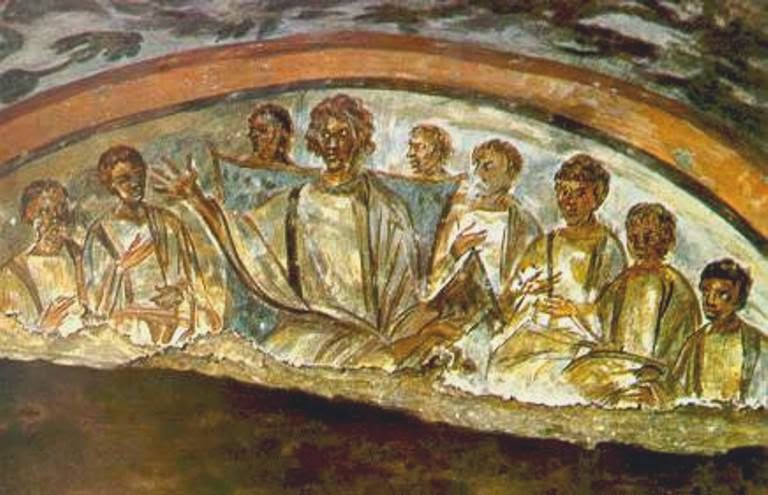
Christ Among the Apostles
Crypt of Ampliatus in the Catacombs of St. Domitilla in Rome
4th Century
7
posted on
06/11/2024 4:36:40 AM PDT
by
annalex
(fear them not)
To: annalex
| Matthew |
| | English: Douay-Rheims | Latin: Vulgata Clementina | Greek NT: Byzantine/Majority Text (2000) |
| | Matthew 10
|
| 7. | And going, preach, saying: The kingdom of heaven is at hand. | Euntes autem prædicate, dicentes : Quia appropinquavit regnum cælorum. | πορευομενοι δε κηρυσσετε λεγοντες οτι ηγγικεν η βασιλεια των ουρανων |
| 8. | Heal the sick, raise the dead, cleanse the lepers, cast out devils: freely have you received, freely give. | Infirmos curate, mortuos suscitate, leprosos mundate, dæmones ejicite : gratis accepistis, gratis date. | ασθενουντας θεραπευετε λεπρους καθαριζετε δαιμονια εκβαλλετε δωρεαν ελαβετε δωρεαν δοτε |
| 9. | Do not possess gold, nor silver, nor money in your purses: | Nolite possidere aurum, neque argentum, neque pecuniam in zonis vestris : | μη κτησησθε χρυσον μηδε αργυρον μηδε χαλκον εις τας ζωνας υμων |
| 10. | Nor scrip for your journey, nor two coats, nor shoes, nor a staff; for the workman is worthy of his meat. | non peram in via, neque duas tunicas, neque calceamenta, neque virgam : dignus enim est operarius cibo suo. | μη πηραν εις οδον μηδε δυο χιτωνας μηδε υποδηματα μηδε ραβδους αξιος γαρ ο εργατης της τροφης αυτου εστιν |
| 11. | And into whatsoever city or town you shall enter, inquire who in it is worthy, and there abide till you go thence. | In quamcumque autem civitatem aut castellum intraveritis, interrogate, quis in ea dignus sit : et ibi manete donec exeatis. | εις ην δ αν πολιν η κωμην εισελθητε εξετασατε τις εν αυτη αξιος εστιν κακει μεινατε εως αν εξελθητε |
| 12. | And when you come into the house, salute it, saying: Peace be to this house. | Intrantes autem in domum, salutate eam, dicentes : Pax huic domui. | εισερχομενοι δε εις την οικιαν ασπασασθε αυτην |
| 13. | And if that house be worthy, your peace shall come upon it; but if it be not worthy, your peace shall return to you. | Et siquidem fuerit domus illa digna, veniet pax vestra super eam : si autem non fuerit digna, pax vestra revertetur ad vos. | και εαν μεν η η οικια αξια ελθετω η ειρηνη υμων επ αυτην εαν δε μη η αξια η ειρηνη υμων προς υμας επιστραφητω |
| 14. | And whosoever shall not receive you, nor hear your words: going forth out of that house or city shake off the dust from your feet. | Et quicumque non receperit vos, neque audierit sermones vestros : exeunte foras de domo, vel civitate, excutite pulverem de pedibus vestris. | και ος εαν μη δεξηται υμας μηδε ακουση τους λογους υμων εξερχομενοι της οικιας η της πολεως εκεινης εκτιναξατε τον κονιορτον των ποδων υμων |
| 15. | Amen I say to you, it shall be more tolerable for the land of Sodom and Gomorrha in the day of judgment, than for that city. | Amen dico vobis : Tolerabilius erit terræ Sodomorum et Gomorrhæorum in die judicii, quam illi civitati. | αμην λεγω υμιν ανεκτοτερον εσται γη σοδομων και γομορρων εν ημερα κρισεως η τη πολει εκεινη |
8
posted on
06/11/2024 4:40:00 AM PDT
by
annalex
(fear them not)
To: annalex
Catena Aurea by St. Thomas Aguinas
GLOSS. (non occ.) Having told them to whom they should go, He now introduces what they should preach; Go and preach, saying, The kingdom of heaven is at hand.
RABANUS. The kingdom of heaven is here said to draw nigh by the faith in the unseen Creator which is bestowed upon us, not by any movement of the visible elements. The saints are rightly denoted by the heavens, because they contain God by faith, and love Him with affection.
CHRYSOSTOM. Behold the greatness of their ministry, behold the dignity of the Apostles. They are not to preach of any thing that can be an object of sense, as Moses and the Prophets did; but things new and unlooked for; those preached earthly goods, but these the kingdom of heaven and all the goods that are there.
GREGORY. (ubi sup.) Miracles also were granted to the holy preachers, that the power they should shew might be a pledge of the truth of their words, and they who preached new things should also do new things; wherefore it follows, Heal the sick, raise the dead, cleanse the lepers, cast out dæmons.
JEROME. Lest peasants untaught and illiterate, without the graces of speech, should obtain credit with none when they announced the kingdom of heaven, He gives them power to do the things above mentioned, that the greatness of the miracles might approve the greatness of their promises.
HILARY. The exercise of the Lord’s power is wholly entrusted to the Apostles, that they who were formed in the image of Adam, and the likeness of God, should now obtain the perfect image of Christ; and whatever evil Satan had introduced into the body of Adam, this they should now repair by communion with the Lord’s power.
GREGORY. (Hom. in Ev. xxix. 4.) These signs were necessary in the beginning of the Church; the faith of the believers must be fed with miracles, that it might grow.
CHRYSOSTOM. But afterwards they ceased when a reverence for the faith was universally established. Or, if they were continued at all, they were few and seldom; for it is usual with God to do such things when evil is increased, then He shews forth His power.
GREGORY. (ubi sup.) The Holy Church daily doth spiritually, what it then did materially by the Apostles; yea, things far greater, inasmuch as she raises and cures souls and not bodies.
REMIGIUS. The sick are the slothful who have not strength to live well; the lepers are the unclean in sin and carnal delights; the dæmoniacs are they that are given up under the power of the Devil.
JEROME. And because spiritual gifts are more lightly esteemed when money is made the means of obtaining them, He adds a condemnation of avarice; Freely ye have received, freely give; I your Master and Lord have imparted these to you without price, do you therefore give them to others in like manner, that the free grace of the Gospel be not corrupted.
GLOSS. (non occ.) This He says, that Judas who had the bag might not use the above power for getting money; a plain condemnation of the abomination of the simoniacal heresy.
GREGORY. (Hom. in Ev. iv. 4.) For He knew before that there would be some that would turn the gift of the Spirit which they had received into merchandize, and pervert the power of miracles into an instrument of their covetousness.
CHRYSOSTOM. Observe how He is as careful that they should be upright in moral virtue, as that they should have the miraculous powers, shewing that miracles without these are nought. Freely ye have received, seems a check upon their pride; freely give, a command to keep themselves pure from filthy lucre. Or, that what they should do might not be thought to be their own benevolence, He says, Freely ye have received; as much as to say; Ye bestow nothing of your own on those ye relieve; for ye have not received these things for money, nor for wages of labour; as ye have received them, so give to others; for indeed it is not possible to receive a price equal to their value.
10:9–10
9. Provide neither gold, nor silver, nor brass in your purses,
10. Nor scrip for your journey, neither two coats, neither shoes, nor yet staves: for the workman is worthy of his meat.
CHRYSOSTOM. The Lord having forbidden to make merchandize of spiritual things, proceeds to pull up the root of all evil, saying, Possess neither gold, nor silver.
JEROME. For if they preach without receiving reward for it, the possession of gold and silver and wealth was unnecessary. For had they had such, they would have been thought to be preaching, not for the sake of men’s salvation, but their own gain.
CHRYSOSTOM. This precept then first frees the Apostles from all suspicions; secondly, from all care, so that they may give up their whole time to preaching the word; thirdly, teaches them their excellence. This is what He said to them afterwards, Was any thing lacking to you, when I sent you without bag or scrip?
JEROME. As He had cut off riches, which are meant by gold and silver, He now almost cuts off necessaries of life; that the Apostles, teachers of the true religion, who taught men that all things are directed by God’s providence, might shew themselves to be without thought for the morrow.
GLOSS. (non occ.) Whence He adds, Neither money in your purses. For there are two kinds of things necessary; one is the means of buying necessaries, which is signified by the money in their purses; the other the necessaries themselves, which are signified by the scrip.
JEROME. In forbidding the scrip, neither scrip for your journey,He aimed at those philosophers commonly called Bactroperatæ (vid. Cotel. not. in Herm. Past. ii. 1.), who being despisers of this world, and esteeming all things as nothing, yet carry a bag about with them. Nor two coats. By the two coats He seems to mean a change of raiment; not to bid us be content with a single tunic in the snow and frosts of Scythia, but that they should not carry about a change with them, wearing one, and carrying about the other as provision for the future. Nor shoes. It is a precept of Plato, that the two extremities of the body should be left unprotected, and that we should not accustom ourselves to tender care of the head and feet; for if these parts be hardy, it will follow that the rest of the body will be vigorous and healthy. Nor staff; for having the protection of the Lord, why need we seek the aid of a staff?
REMIGIUS. The Lord shews by these words that the holy preachers were reinstated in the dignity of the first man, who as long as he possessed the heavenly treasures, did not desire other; but having lost those by sinning, he straightway began to desire the other.
CHRYSOSTOM. A happy exchange! In place of gold and silver, and the like, they received power to heal the sick, to raise the dead. For He had not commanded them from the beginning, Possess neither gold nor silver; but only then when He said at the same time, Cleanse the lepers, cast out dæmons. Whence it is clear that He made them Angels more than men, freeing them from all anxiety of this life, that they might have but one care, that of teaching; and even of that He in a manner takes away the burden, saying, Be not careful what ye shall speak. Thus what seemed hard and burdensome, He shews them to be light and easy. For nothing is so pleasant as to be delivered from all care and anxiety, more especially when it is possible, being delivered from this, to lack nothing, God being present, and being to us instead of all things.
JEROME. As He had sent the Apostles forth unprovided and unencumbered on their mission, and the condition of the teachers seemed a hard one, He tempered the severity of the rules by this maxim, The labourer is worthy of his hire, i. e. Receive what you need for your food and clothing. Whence the Apostle says, Having food and raiment, let us therewith be content. (1 Tim. 6:8. Gal. 6:6.) And again, Let him that is catechized communicate unto him that catechizeth in all good things; that they whose disciples reap spiritual things, should make them partakers of their carnal things, not for the gratification of covetousness, but for the supply of wants.
CHRYSOSTOM. It behoved the Apostles to be supported by their disciples, that neither they should be haughty towards those whom they taught, as though they gave all, and received nothing; and that the others, on their part, should not fall away, as overlooked by them. Also that the Apostles might not cry, He bids us lead the life of beggars, and should be ashamed thereat, He shews that this is their due, calling them labourers, and that which is given their hire. For they were not to suppose that because what they gave was only words, therefore they were to esteem it but a small benefit that they conferred; therefore He says, The labourer is worthy of his meat. This He said not to signify that the labours of the Apostles were only worth so much, but laying down a rule for the Apostles, and persuading those that gave, that what they gave was only what was due.
AUGUSTINE. (Serm. 46.) The Gospel therefore is not for sale, that it should be preached for reward. For if they so sell it, they sell a great thing for a small price. Let preachers then receive their necessary support from the people, and from God the reward of their employment. For the people do not give pay to those that minister to them in the love of the Gospel, but as it were a stipend that may support them to enable them to work.
AUGUSTINE. (De Cons. Ev. ii. 30.) Otherwise; When the Lord said to the Apostles, Possess not gold, He added immediately, The labourer is worthy of his hire, to shew why He would not have them possess and carry about these things; not that these things were not needed for the support of this life, but that He sent them in such a way as to shew that these things were due to them from those to whom they preached the Gospel, as pay to soldiers. It is clear that this precept of the Lord does not at all imply that they ought not according to the Gospel to live by any other means, than by the contributions of those to whom they preached; otherwise Paul transgressed this precept when he lived by the labour of his own hands. But He gave the Apostles authority that these things were due to them from the house in which they abode. But when the Lord has issued a command, if it be not performed, it is the sin of disobedience; when He bestows a privilege, it is in any one’s power not to use it, and as it were to refrain from claiming his right. The Lord then having sanctioned this maxim, that they who preach the Gospel should live of the Gospel, He spoke these things to the Apostles, that being confident they should not possess nor carry about with them the necessaries of life, neither things great nor things small. Therefore He adds, Nor a staff, to shew that from His people all things are due to His ministers, and they require no superfluities. This authority He signifies by the staff, saying in Mark, Take nothing but a staff only. (Mark 6:18.) And when He forbids them (in Matthew) to take with them shoes, He forbids that carefulness and thought which would be anxious to carry them lest they should be wanting. Thus also we must understand concerning the two coats, that none should think it necessary to carry another besides that which he wore, supposing that he should have need of it; for it would be in his power to obtain one by this authority which the Lord gave. Further that we read in Mark that they should be shod with sandals, seems to imply that this kind of shoe has a mystic meaning in it, that the foot should neither be covered above, nor yet bare beneath, that is, that the Gospel should not be hid, nor yet rest itself on earthly advantage. Also when He forbids them to carry two coats, He warned them not to walk deceitfully, but in simplicity. So we cannot doubt that all these things were said by the Lord, partly in a direct, partly in a figurative sense; and that of the two Evangelists one inserted some things, the other other things, in his narrative. If any one should think that the Lord could not in one speech speak some things in a direct, and some things in a mystic sense, let him look at any other of His sayings, and he will see how hasty and unlearned his opinion is. When the Lord commands that the left hand should not know what the right hand doeth, does he think that almsgiving, and the rest of His precepts in that place are to be taken figuratively?
JEROME. Thus far we have expounded by the letter; but metaphorically, as we often find gold put for the sense, silver for the words, brass for the voice—all these we may say we are not to receive from others, but to have them given by the Lord. We are not to take up the teaching of heretics, of philosophers, and of corrupt doctrine.
HILARY. The girdle is the making ready for the ministry, the girding up that we may be active in duty; we may suppose that the forbidding money in the girdle is to warn us from suffering any thing in the ministry to be bought and sold. We are not to have a scrip by the way, that is, we are to leave all care of our worldly substance; for all treasure on earth is hurtful to the heart, which will be there where the treasure is. Not two coats, for it is enough to have once put on Christ, nor after true knowledge of Him ought we to be clothed with any other garment of heresy or law. Not shoes, because standing on holy ground as was said to Moses not covered with the thorns and prickles of sin, we are admonished to have no other preparation of our walk than that we have received from Christ.
JEROME. Or; The Lord herein teaches us that our feet are not to be bound with the chains of death, but to be bare as we tread on the holy ground. We are not to carry a staff which may be turned into a serpent, nor to trust in any arm of flesh; for all such is a reed on which if a man lean ever so lightly, it will break and go into his hand and pierce him.
HILARY. Neither a staff; that is, We are not to seek rights of extraneous power, having a rod from the root of Jesse.
10:11–15
11. And into whatsoever city or town ye shall enter, enquire who in it is worthy; and there abide till ye go thence.
12. And when ye come into an house, salute it.
13. And if the house be worthy, let your peace eome upon it: but if it be not worthy, let your peace return to you.
14. And whosoever shall not receive you, nor hear your words, when ye depart out of that house or eity, shake off the dust of your feet.
15. Verily I say unto you, It shall be more tolerable for the land of Sodom and Gomorrha in the day of judgment, than for that city.
CHRYSOSTOM. The Lord had said above, The workman is worthy of his meat; that they should not hence suppose that He would open all doors to them, He here commands them to use much circumspection in the choice of a host, saying, Into what city or town ye enter, enquire who in it is worthy.
JEROME. The Apostles, on entering a strange town, could not know of each inhabitant what sort of man he was; they were to choose their host therefore by the report of the people, and opinion of the neighbours, that the worthiness of the preacher might not be disgraced by the ill character of his entertainer.
CHRYSOSTOM. How then did Christ Himself abide with the publican? Because he was made worthy by his conversion; for this command that he should be worthy, had respect not to their rank, but to their furnishing food. For if he be worthy he will provide them with food, especially when they need no more than bare necessaries. Observe how though He stripped them of all property, He supplied all their wants, suffering them to abide in the houses of those whom they taught. For so they were both themselves set free from care, and convinced men that it was for their salvation only that they had come, seeing they carried nothing about with them, and desired nothing beyond necessaries. And they did not lodge at all places indiscriminately, for He would not have them known only by their miracles, but much more by their virtues. But nothing is a greater mark of virtue, than to discard superfluities.
JEROME. One host is chosen who does not so much confer a favour upon him who is to abide with him, as receive one. For it is said, Who in it is worthy, that he may know that he rather receives than does a favour.
CHRYSOSTOM. Also observe that He has not yet endowed them with all gifts; for He has not given them power to discern who is worthy, but bids them seek out; and not only to find out who is worthy, but also not to pass from house to house, saying, And there remain until ye depart out of that city; so they would neither make their entertainer sorrowful, nor themselves incur suspicion of lightness or gluttony.
AMBROSE. (in Luc. 9:5.) The Apostles are not to choose carelessly the house into which they enter, that they may have no cause for changing their lodging; the same caution is not enforced upon the entertainer, lest in choosing his guests, his hospitality should be diminished. When ye enter a house, salute it, saying, Peace be to this house.
GLOSS. (interlin.) As much as to say, Pray ye for peace upon the master of the house, that all resistance to the truth may be pacified.
JEROME. Here is a latent allusion to the form of salutation in Hebrew and Syriac; they say Salemalach or Salamalach, for the Greek χαῖρε, or Latin Ave; that is, ‘Peace be with you.’ The command then is, that on entering any house they should pray for peace for their host; and, as far as they may be able, to still all discords, so that if any quarrel should arise, they, who had prayed for peace should have it—others should have the discord; as it follows, And if that house be worthy, your peace shall rest upon it; but if it be not worthy, your peace shall return to you again.
REMIGIUS. (ap. Raban.) Thus either the hearer, being predestined to eternal life, will follow the heavenly word when he hears it; or if there be none who will hear it, the preacher himself shall not be without fruit; for his peace returns to him when he receives of the Lord recompense for all his labour.
CHRYSOSTOM. The Lord instructs them, that though they were teachers, yet they should not look to be first saluted by others; but that they should honour others by first saluting them. And then He shews them that they should give not a salutation only, but a benediction, when He says, If that house be worthy, your peace shall rest upon it.
REMIGIUS. The Lord therefore taught his disciples to offer peace on their entering into a house, that by means of their salutation their choice might be directed to a worthy house and host. As though He had said, Offer peace to all, they will shew themselves either worthy by accepting, or unworthy by not accepting it; for though you have chosen a host that is worthy by the character he bears among his neighbours, yet ought you to salute him, that the preacher may seem rather to enter by invitation, than to intrude himself. This salutation of peace in few words may indeed be referred to the trial of the worthiness of the house or master.
HILARY. The Apostles salute the house with the prayer of peace; yet so as that peace seems rather spoken than given. For their own peace which was the bowels of their pity ought not to rest upon the house if it were not worthy; then the sacrament of heavenly peace could be kept within the Apostles own bosom. Upon such as rejected the precepts of the heavenly kingdom an eternal curse is left by the departure of the Apostles, and the dust shaken from their feet; And whosoever shall not receive you, nor hear your words, when ye go out of that house, or that town, cast the dust off your feet. For he that lives in any place seems to have a kind of fellowship with that place. By the casting the dust off the feet therefore all that belonged to that house is left behind, and nothing of healing or soundness is borrowed from the footsteps of the Apostles having trod their soil.
JEROME. Also they shake off the dust as a testimony of the Apostles’ toil, that in preaching the Gospel they had come even so far, or as a token that from those that rejected the Gospel they would accept nothing, not even the necessaries of life.
RABANUS. Otherwise; The feet of the disciples signify the labour and progress of preaching. The dust which covers them is the lightness of earthly thoughts, from which even the greatest doctors cannot be free; their anxiety for their hearers involves them in cares for their prosperity, and in passing through the ways of this world, they gather the dust of the earth they tread upon. They then who have despised the teaching of these doctors, turn upon themselves all the toils and dangers and anxieties of the Apostles as a witness to their damnation. And lest it should seem a slight thing not to receive the Apostles, He adds, Verily I say unto you, it shall be more tolerable for Sodom and Gomorrah in the day of judgment, than for that city.
JEROME. Because to the men of Sodom and Gomorrah no man had ever preached; but this city had been preached to and had rejected the Gospel.
REMIGIUS. (ap. Raban.) Or because the men of Sodom and Gomorrah were hospitable among their sensuality, but they had never entertained such strangers as the Apostles.
JEROME. But if it shall be more tolerable for the land of Sodom than for that city, hence we may learn that there is difference of degree in the punishment of sinners.
REMIGIUS. Sodom and Gomorrah are especially mentioned, to shew that those sins which are against nature are particularly hateful to God, for which the world was drowned with the waters of the deluge, four towns were overthrown, and the world is daily afflicted with manifold evils.
HILARY. Figuratively, The Lord teaches us not to enter the houses or to mix in the acquaintance of those who persecute Christ, or who are ignorant of Him; and in each town to enquire who among them is worthy, i. e. where there is a Church wherein Christ dwells; and not to pass to another, because this house is worthy, this host is our right host. But there would be many of the Jews who would be so well disposed to the Law, that though they believed in Christ because they admired His works, yet they would abide in the works of the Law; and others again who, desiring to make trial of that liberty which is in Christ, would feign themselves ready to forsake the Law for the Gospel; many also would be drawn aside into heresy by perverse understanding. And since all these would falsely maintain that with them only was Catholic verity, therefore we must with great caution seek out the house, i. e. the Church.
Catena Aurea Matthew 10
9
posted on
06/11/2024 4:41:47 AM PDT
by
annalex
(fear them not)
To: annalex

Christ in Majesty
c. 1100
Fresco, height c. 400 cm
Château des Moines, Berzé-la-Ville
10
posted on
06/11/2024 4:42:08 AM PDT
by
annalex
(fear them not)
To: annalex
Saint of the Day for June 11
(c. 75)
Saint Barnabas’ Story
Barnabas, a Jew of Cyprus, comes as close as anyone outside the Twelve to being a full-fledged apostle. He was closely associated with Saint Paul—he introduced Paul to Peter and the other apostles—and served as a kind of mediator between the former persecutor and the still suspicious Jewish Christians.
When a Christian community developed at Antioch, Barnabas was sent as the official representative of the church of Jerusalem to incorporate them into the fold. He and Paul instructed in Antioch for a year, after which they took relief contributions to Jerusalem.
Later Paul and Barnabas, now clearly seen as charismatic leaders, were sent by Antioch officials to preach to the gentiles. Enormous success crowned their efforts. After a miracle at Lystra, the people wanted to offer sacrifice to them as gods—Barnabas being Zeus, and Paul, Hermes—but the two said, “We are of the same nature as you, human beings. We proclaim to you good news that you should turn from these idols to the living God” (see Acts 14:8-18).
But all was not peaceful. They were expelled from one town, they had to go to Jerusalem to clear up the ever-recurring controversy about circumcision, and even the best of friends can have differences. When Paul wanted to revisit the places they had evangelized, Barnabas wanted to take along his cousin John Mark, author of the Gospel, but Paul insisted that since Mark had deserted them once, he was not fit to take along now. The disagreement that followed was so sharp that Barnabas and Paul separated: Barnabas taking Mark to Cyprus, Paul taking Silas to Syria. Later they were reconciled—Paul, Barnabas and Mark.
When Paul stood up to Peter for not eating with gentiles for fear of his Jewish friends, we learn that “even Barnabas was carried away by their hypocrisy” (see Galatians 2:1-13).
Reflection
Barnabas is spoken of simply as one who dedicated his life to the Lord. He was a man “filled with the Holy Spirit and faith. Thereby, large numbers were added to the Lord.” Even when he and Paul were expelled from Antioch in Pisidia—modern-day Turkey—they were “filled with joy and the Holy Spirit.”
Saint Barnabas is the Patron Saint of:
Cyprus
franciscanmedia.org
11
posted on
06/11/2024 4:48:48 AM PDT
by
annalex
(fear them not)
To: annalex

Saint Barnabas
Anonimo Lombardo
12
posted on
06/11/2024 4:51:34 AM PDT
by
annalex
(fear them not)
To: annalex
NAVARRE BIBLE COMMENTARY (RSV)
Ad Majorem Dei Gloriam (To the Greater Glory of God)
First Reading:
From: Acts 11:21b-26; 13:1-3
The Beginning of the Church in Antioch (Continuation)
---------------------------------------------------------------------
[21] A great number that believed turned to the Lord. [22] News of this came to the ears of the Church in Jerusalem, and they sent Barnabas to Antioch. [23] When he came and saw the grace of God, he was glad; and he exhorted them all to remain faithful to the Lord with steadfast purpose; [24] for he was a good man, full of the Holy Spirit and of faith. And a large company was added to the Lord. [25] So Barnabas went to Tarsus to look for Saul; [26] and when he had found him, he brought him to Antioch. For a whole year they met with the Church, and taught a large company of people and in Antioch the disciples were for the first time called Christians.
The Mission of Barnabas and Paul
--------------------------------
[1] Now in the Church at Antioch there were prophets and teachers, Barnabas, Symeon who was called Niger, Lucius of Cyrene, Manaen, a member of the court of Herod the Tetrarch, and Saul. [2] While they were worshipping the Lord and fasting, the Holy Spirit said, "Set apart for Me Barnabas and Saul for the work to which I have called them." [3] Then after fasting and praying they laid their hands on them and sent them off.
***********************************************************************
Commentary:
19-30. This account links up with Acts 8:1-4, which describes the flight of Christians from Jerusalem due to the first persecution following on the martyrdom of St. Stephen. We are now told about the spread of the Gospel to Antioch on the Orontes, the capital of the Roman province of Syria. Antioch was the first major city of the ancient world where the word of Jesus Christ was preached. It was the third city of the empire, after Rome and Alexandria, with a population of about half a million and a sizeable Jewish colony, and was a very important cultural, economic and religious center.
In Antioch the Gospel is proclaimed not only to Jews and proselytes. These Hellenist Jews from Jerusalem preached the Gospel to all and sundry as part of their ordinary everyday activity. St. Luke does not give us any names: the preachers are ordinary Christians. "Notice", says Chrysostom, "that it is grace which does everything. And also reflect on the fact that this work is begun by unknown workers and only when it begins to prosper do the Apostles send Barnabas" ("Hom. On Acts", 25).
The Christian mission at Antioch played a key part in the spread of Christianity. Evangelization of non-Jews becomes the norm; it is not just something which happens in a few isolated cases. Nor is it limited to "God-fearers"; it extends to all the Gentiles. The center of gravity of the Christian Church begins to move from Jerusalem to Antioch, which will become the springboard for the evangelization of the pagan world.
22-26. The community at Jerusalem, where the Apostles were based, felt responsible for everything that happened in the Christian mission-field. This was why they sent Barnabas to oversee developments in Antioch. Barnabas was a man whom the Apostles trusted, noted for his virtue (he was mentioned in Acts 4:36).
No doubt it was because of all the work opening before the preacher of the Gospel that Barnabas sought out Paul, who had returned to Tarsus after his conversion and his visit to Jerusalem (9:30). Barnabas probably knew that the future Apostle was the very man he needed to join him in the work of evangelization about to be undertaken by the Antiochene Church. Barnabas' sense of responsibility and his zeal to find laborers for the Lord's harvest (cf. Matthew 9:38) lead to the first of the great missionary journeys, in which Paul's vocation find full scope.
26. We do not exactly know who first began to describe the disciples as "Christians". In any event the fact that they were given a name shows that everyone recognized them as an identifiable group. The name also suggests that the term "Christos"--Messiah, Anointed--is no longer regarded simply as a messianic title but also as a proper name.
Some Fathers of the Church see this name as further indication that people do not become disciples of the Lord through human causes. "Although the holy Apostles were our teachers and have given us the Gospel of the Savior, it is not from them that we have taken our name: we are "Christians" through Christ and it is for Him that we are called in this way" (St. Athanasius, "Oratio I Contra Arianos", 2).
1. From this point onwards Luke's account centers on the Church of Antioch. This was a flourishing community, with members drawn from all sectors of society. In some respects its organization structure was like that of the Jerusalem Church; in others, not. It clearly had ordained ministers who were responsible for its government, who preached and administered the Sacraments; along these we find prophets (cf. 11:28) and teachers, specially trained members of the community.
In the early Church "teachers" were disciples well versed in Sacred Scripture who were given charge of catechesis. They instructed the catechumens and other Christians in the basic teaching of the Gospel as passed on by the Apostles, and some of them had a capacity for acquiring and communicating to others an extensive and profound knowledge of the faith.
Teachers do not necessarily have to be priests or preachers. Preaching was usually reserved to ordained ministers; teachers had an important position in the Church: they were responsible for on-going doctrinal and moral education and were expected faithfully to hand on the same teaching as they themselves had received. A virtuous life and due learning would have protected them against any temptation to invent new teachings or go in for mere speculation not based on the Gospel (cf. 1 Timothy 4:7; 6:20; Titus 2:1).
The "Letter to Diognetus" describes the ideal Christian teacher: "I do not speak of passing things nor do I go in search of new things, but, like the disciple of the Apostles that I am, I become a teacher of peoples. I do nothing but hand on what was given me by those who made themselves worthy disciples of the truth" (XI, 1).
2-3. "Worship" of the Lord includes prayer, but it refers primarily to the celebration of the Blessed Eucharist, which is at the center of all Christian ritual. This text indirectly establishes a parallel between the Mass and the sacrificial rite of the Mosaic Law. The Eucharist provides a Christian with the nourishment he needs, and its celebration "causes the Church of God to be built up and grow in stature" (Vatican II, "Unitatis Redintegratio", 15). Significantly, the Eucharist is associated with the start of this new stage in the expansion of the Church.
Paul and Barnabas receive a missionary task directly from the Holy Spirit, and by an external sign--the laying on of hands--the Antiochene community prays to God to go with them and bless them. In His promotion of the spread of the Church the Holy Spirit does not act at a distance, so to speak. Every step in the progress of the Church in the world is rightly attributed to the initiative of the Paraclete. It is as if God were repeatedly ratifying His salvific plans to make it perfectly plain that He is ever-faithful to His promises. "The mission of the Church is carried out by means of that activity through which, in obedience to Christ's command and moved by the grace and love of the Holy Spirit, the Church makes itself fully present to all men and people" (Vatican II, "Ad Gentes", 5).
The dispatch of Paul and Barnabas is inspired by the Holy Spirit, but it is also an ecclesial act: the Church gives them this charge, specifying God's plans and activating the personal vocation of the two envoys.
The Lord, "who had set me apart before I was born and had called me by his grace [sent me] in order that I might preach Him among the Gentiles" (Galatians 1:15-16), now arranges, through the Church, for this mission to begin.
Fasting and prayer are the best preparation for the spiritual enterprise on which Paul and Barnabas are about to embark. "First, prayer; then, atonement; in the third place, very much 'in the third place', action" (St J. Escriva, "The Way", 82). They know very well that their mission is not man-made and that it will produce results only with God's help. The prayer and penance which accompany apostolate are not just aimed at obtaining graces from God for others: the purpose of this prayer and fasting is to purify hearts and lips, so that the Lord will be at their side and ensure that none of their words "fall to the ground" (1 Samuel 3:19).
13
posted on
06/11/2024 8:58:12 AM PDT
by
fidelis
(Ecce Crucem Domini! Fugite partes adversae! Vicit Leo de tribu Juda, Radix David! Alleluia!)
Gospel Reading: From: Matthew 5:13-16
Salt of the Earth and Light of the World
----------------------------------------
(Jesus said to the multitude:) [13] "You are the salt of the earth; but if salt has lost its taste, how shall its saltness be restored? It is no longer good for anything except to be thrown out and trodden under foot by men.
[14] "You are the light of the world. A city set on a hill cannot be hid. [15] Nor do men light a lamp and put it under a bushel, but on a stand, and it gives light to all in the house. [16] Let your light so shine before men, that they may see your good works and give glory to your Father who is in Heaven."
***********************************************************************
Commentary:
13-16. These verses are a calling to that apostolate which is part and parcel of being a Christian. Every Christian has to strive for personal sanctification, but he also has to seek the sanctification of others. Jesus teaches us this, using the very expressive simile of salt and light. Salt preserves food from corruption; it also brings out its flavor and makes it more pleasant; and it disappears into the food; the Christian should do the same among the people around him.
"You are salt, apostolic soul. `Bonum est sal': salt is a useful thing', we read in the holy Gospel; `si autem sal evanuerit': but if the salt loses its taste', it is good for nothing, neither for the land nor for the manure heap; it is thrown out as useless. You are salt, apostolic soul. But if you lose your taste..." (St J. Escriva, "The Way", 921).
Good works are the fruit of charity, which consists in loving others as God loves us (cf. John 15:12). "I see now", St. Therese of Lisieux writes, "that true charity consists in bearing with the faults of those about us, never being surprised at their weaknesses, but edified at the least sign of virtue. I see above all that charity must not remain hidden in the bottom of our hearts: `nor do men light a lamp and put it under a bushel, but on a stand, and it gives light to all in the house.' It seems to me that this lamp is the symbol of charity; it must shine out not only to cheer those we love best but all in the house" ("The Autobiography of a Saint", Chapter 9).
Apostolate is one of the clearest expressions of charity. The Second Vatican Council emphasized the Christian's duty to be apostolic. Baptism and Confirmation confer this duty, which is also a right (cf. "Lumen Gentium", 33), so much so that, because the Christian is part of the mystical body, "a member who does not work at the growth of the body to the extent of his possibilities must be considered useless both to the Church and to himself" ("Apostolicam Actuositatem", 2). "Laymen have countless opportunities for exercising the apostolate of evangelization and sanctification. The very witness of a Christian life, and good works done in a supernatural spirit, are effective in drawing men to the faith and to God; and that is what the Lord has said: "Let your light so shine before men, that they may see your good works and give glory to your Father who is in Heaven" ("Apostolicam Actuositatem", 6).
"The Church must be present to these groups [those who do not even believe in God] through those of its members who live among them or have been sent to them. All Christians by the example of their lives and witness of their word, wherever they live, have an obligation to manifest the new man which they put on in Baptism, and to reveal the power of the Holy Spirit by whom they were strengthened at Confirmation, so that others, seeing their good works, might glorify the Father and more perfectly perceive the true meaning of human life and the universal solidarity of mankind" ("Ad Gentes", 11; cf. 36).
14
posted on
06/11/2024 8:58:29 AM PDT
by
fidelis
(Ecce Crucem Domini! Fugite partes adversae! Vicit Leo de tribu Juda, Radix David! Alleluia!)
To: fidelis
15
posted on
06/11/2024 8:59:40 AM PDT
by
fidelis
(Ecce Crucem Domini! Fugite partes adversae! Vicit Leo de tribu Juda, Radix David! Alleluia!)
To: fidelis
 Please join Cardinal Burke’s novena to Our Lady of Guadalupe for ‘crises of our age’ (Started March 12—Never too late to join!)
Let us pray.
O Virgin Mother of God, we fly to your protection and beg your intercession against the darkness and sin which ever more envelop the world and menace the Church. Your Son, Our Lord Jesus Christ, gave you to us as our mother as He died on the Cross for our salvation. So too, in 1531, when darkness and sin beset us, He sent you, as Our Lady of Guadalupe, on Tepeyac to lead us to Him Who alone is our light and our salvation.
Through your apparitions on Tepeyac and your abiding presence with us on the miraculous mantle of your messenger, Saint Juan Diego, millions of souls converted to faith in your Divine Son. Through this novena and our consecration to you, we humbly implore your intercession for our daily conversion of life to Him and the conversion of millions more who do not yet believe in Him. In our homes and in our nation, lead us to Him Who alone wins the victory over sin and darkness in us and in the world.
Unite our hearts to your Immaculate Heart so that they may find their true and lasting home in the Most Sacred Heart of Jesus. Ever guide us along the pilgrimage of life to our eternal home with Him. So may our hearts, one with yours, always trust in God's promise of salvation, in His never-failing mercy toward all who turn to Him with a humble and contrite heart. Through this novena and our consecration to you, O Virgin of Guadalupe, lead all souls in America and throughout the world to your Divine Son in Whose name we pray. Amen.
16
posted on
06/11/2024 9:00:31 AM PDT
by
fidelis
(Ecce Crucem Domini! Fugite partes adversae! Vicit Leo de tribu Juda, Radix David! Alleluia!)
To: fidelis
“Father of heaven and earth, you send your word among us through the great and the small. Grant us the willingness to hear and to serve the Gospel through whatever means you make available, through Jesus Christ our Lord. Amen.” (From Magnificat magazine)
17
posted on
06/11/2024 9:01:30 AM PDT
by
fidelis
(Ecce Crucem Domini! Fugite partes adversae! Vicit Leo de tribu Juda, Radix David! Alleluia!)
To: fidelis
18
posted on
06/11/2024 9:01:55 AM PDT
by
fidelis
(Ecce Crucem Domini! Fugite partes adversae! Vicit Leo de tribu Juda, Radix David! Alleluia!)
June is the month of devotion to the Sacred Heart of Jesus:
"Come to me, all who labor and are heavy laden, and I will give you rest. Take my yoke upon you, and learn from me; for I am gentle and lowly in heart, and you will find rest for your souls. For my yoke is easy, and my burden is light.”
(Matthew 11:28-30)
19
posted on
06/11/2024 9:02:27 AM PDT
by
fidelis
(Ecce Crucem Domini! Fugite partes adversae! Vicit Leo de tribu Juda, Radix David! Alleluia!)
Disclaimer:
Opinions posted on Free Republic are those of the individual
posters and do not necessarily represent the opinion of Free Republic or its
management. All materials posted herein are protected by copyright law and the
exemption for fair use of copyrighted works.
FreeRepublic.com is powered by software copyright 2000-2008 John Robinson