Free Republic
Browse · Search
Religion
Topics · Post Article

Skip to comments.

Catholic Caucus: Daily Mass Readings 28-January-2024
Universalis/Jerusalem Bible ^

Posted on 01/28/2024 9:51:27 AM PST by annalex

28 January 2024

4th Sunday in Ordinary Time


ST. THOMAS AQUINAS UNIVERSITY PARISH, Charlottesville, VA

Readings at Mass

Liturgical Colour: Green. Year: B(II).


First reading
Deuteronomy 18:15-20 ©

I will raise up a prophet and put my words into his mouth

Moses said to the people: ‘The Lord your God will raise up for you a prophet like myself, from among yourselves, from your own brothers; to him you must listen. This is what you yourselves asked of the Lord your God at Horeb on the day of the Assembly. “Do not let me hear again” you said “the voice of the Lord my God, nor look any longer on this great fire, or I shall die”; and the Lord said to me, “All they have spoken is well said. I will raise up a prophet like yourself for them from their own brothers; I will put my words into his mouth and he shall tell them all I command him. The man who does not listen to my words that he speaks in my name, shall be held answerable to me for it. But the prophet who presumes to say in my name a thing I have not commanded him to say, or who speaks in the name of other gods, that prophet shall die.”’

Responsorial Psalm
Psalm 94(95):1-2,6-9 ©
O that today you would listen to his voice! ‘Harden not your hearts.’
Come, ring out our joy to the Lord;
  hail the rock who saves us.
Let us come before him, giving thanks,
  with songs let us hail the Lord.
O that today you would listen to his voice! ‘Harden not your hearts.’
Come in; let us bow and bend low;
  let us kneel before the God who made us:
for he is our God and we
  the people who belong to his pasture,
  the flock that is led by his hand.
O that today you would listen to his voice! ‘Harden not your hearts.’
O that today you would listen to his voice!
  ‘Harden not your hearts as at Meribah,
  as on that day at Massah in the desert
when your fathers put me to the test;
  when they tried me, though they saw my work.’
O that today you would listen to his voice! ‘Harden not your hearts.’

Second reading
1 Corinthians 7:32-35 ©

Give your undivided attention to the Lord

I would like to see you free from all worry. An unmarried man can devote himself to the Lord’s affairs, all he need worry about is pleasing the Lord; but a married man has to bother about the world’s affairs and devote himself to pleasing his wife: he is torn two ways. In the same way an unmarried woman, like a young girl, can devote herself to the Lord’s affairs; all she need worry about is being holy in body and spirit. The married woman, on the other hand, has to worry about the world’s affairs and devote herself to pleasing her husband. I say this only to help you, not to put a halter round your necks, but simply to make sure that everything is as it should be, and that you give your undivided attention to the Lord.

Gospel AcclamationMt11:25
Alleluia, alleluia!
Blessed are you, Father,
Lord of heaven and earth,
for revealing the mysteries of the kingdom
to mere children.
Alleluia!
Or:Mt4:16
Alleluia, alleluia!
The people that lived in darkness
has seen a great light;
on those who dwell in the land and shadow of death
a light has dawned.
Alleluia!

GospelMark 1:21-28 ©

Unlike the scribes, he taught them with authority

Jesus and his disciples went as far as Capernaum, and as soon as the sabbath came he went to the synagogue and began to teach. And his teaching made a deep impression on them because, unlike the scribes, he taught them with authority.
  In their synagogue just then there was a man possessed by an unclean spirit and it shouted, ‘What do you want with us, Jesus of Nazareth? Have you come to destroy us? I know who you are: the Holy One of God.’ But Jesus said sharply, ‘Be quiet! Come out of him!’ And the unclean spirit threw the man into convulsions and with a loud cry went out of him. The people were so astonished that they started asking each other what it all meant. ‘Here is a teaching that is new’ they said ‘and with authority behind it: he gives orders even to unclean spirits and they obey him.’ And his reputation rapidly spread everywhere, through all the surrounding Galilean countryside.

Christian Art

Illustration

Each day, The Christian Art website gives a picture and reflection on the Gospel of the day.

The readings on this page are from the Jerusalem Bible, which is used at Mass in most of the English-speaking world. The New American Bible readings, which are used at Mass in the United States, are available in the Universalis apps, programs and downloads.

You can also view this page with the Gospel in Greek and English.


TOPICS: Catholic; General Discusssion; Prayer; Worship
KEYWORDS: catholic; mk1; ordinarytime; prayer
For your reading, reflection, faith-sharing, comments, questions, discussion.

1 posted on 01/28/2024 9:51:27 AM PST by annalex
[ Post Reply | Private Reply | View Replies]

To: All

KEYWORDS: catholic; mk1; ordinarytime; prayer


2 posted on 01/28/2024 9:51:53 AM PST by annalex (fear them not)
[ Post Reply | Private Reply | To 1 | View Replies]

To: nickcarraway; NYer; ELS; Pyro7480; livius; ArrogantBustard; Catholicguy; RobbyS; marshmallow; ...

Alleluia Ping

Please FReepmail me to get on/off the Alleluia Ping List.


3 posted on 01/28/2024 9:53:05 AM PST by annalex (fear them not)
[ Post Reply | Private Reply | To 1 | View Replies]

To: annalex
My dad is back in the hospital. [JimRob update at 242]
Jim still needs our prayers. Thread 2
Prayer thread for Salvation's recovery
Pray for Ukraine
Prayer thread for Fidelis' recovery
Update on Jim Robinson's health issues
4 posted on 01/28/2024 9:53:30 AM PST by annalex (fear them not)
[ Post Reply | Private Reply | To 3 | View Replies]

To: annalex
Mark
 English: Douay-RheimsLatin: Vulgata ClementinaGreek NT: Byzantine/Majority Text (2000)
 Mark 1
21And they entered into Capharnaum, and forthwith upon the sabbath days going into the synagogue, he taught them. Et ingrediuntur Capharnaum : et statim sabbatis ingressus in synagogam, docebat eos.και εισπορευονται εις καπερναουμ και ευθεως τοις σαββασιν εισελθων εις την συναγωγην εδιδασκεν
22And they were astonished at his doctrine. For he was teaching them as one having power, and not as the scribes. Et stupebant super doctrina ejus : erat enim docens eos quasi potestatem habens, et non sicut scribæ.και εξεπλησσοντο επι τη διδαχη αυτου ην γαρ διδασκων αυτους ως εξουσιαν εχων και ουχ ως οι γραμματεις
23And there was in their synagogue a man with an unclean spirit; and he cried out, Et erat in synagoga eorum homo in spiritu immundo : et exclamavit,και ην εν τη συναγωγη αυτων ανθρωπος εν πνευματι ακαθαρτω και ανεκραξεν
24Saying: What have we to do with thee, Jesus of Nazareth? art thou come to destroy us? I know who thou art, the Holy One of God. dicens : Quid nobis et tibi, Jesu Nazarene ? venisti perdere nos ? scio qui sis, Sanctus Dei.λεγων εα τι ημιν και σοι ιησου ναζαρηνε ηλθες απολεσαι ημας οιδα σε τις ει ο αγιος του θεου
25And Jesus threatened him, saying: Speak no more, and go out of the man. Et comminatus est ei Jesus, dicens : Obmutesce, et exi de homine.και επετιμησεν αυτω ο ιησους λεγων φιμωθητι και εξελθε εξ αυτου
26And the unclean spirit tearing him, and crying out with a loud voice, went out of him. Et discerpens eum spiritus immundus, et exclamans voce magna, exiit ab eo.και σπαραξαν αυτον το πνευμα το ακαθαρτον και κραξαν φωνη μεγαλη εξηλθεν εξ αυτου
27And they were all amazed, insomuch that they questioned among themselves, saying: What thing is this? what is this new doctrine? for with power he commandeth even the unclean spirits, and they obey him. Et mirati sunt omnes, ita ut conquirerent inter se dicentes : Quidnam est hoc ? quænam doctrina hæc nova ? quia in potestate etiam spiritibus immundis imperat, et obediunt ei.και εθαμβηθησαν παντες ωστε συζητειν προς εαυτους λεγοντας τι εστιν τουτο τις η διδαχη η καινη αυτη οτι κατ εξουσιαν και τοις πνευμασιν τοις ακαθαρτοις επιτασσει και υπακουουσιν αυτω
28And the fame of him was spread forthwith into all the country of Galilee. Et processit rumor ejus statim in omnem regionem Galilææ.εξηλθεν δε η ακοη αυτου ευθυς εις ολην την περιχωρον της γαλιλαιας

5 posted on 01/28/2024 9:56:16 AM PST by annalex (fear them not)
[ Post Reply | Private Reply | To 4 | View Replies]

To: annalex

Catena Aurea by St. Thomas Aguinas

1:21–22

21. And they went into Capernaum; and straightway on the sabbath day he entered into the synagogue, and taught.

22. And they were astonished at his doctrine: for he taught them as one that had authority, and not as the Scribes.

PSEUDO-JEROME. Mark, arranging the sayings of the Gospel as they were in his own mind, not in themselves, quits the order of the history, and follows the order of the mysteries. Wherefore he relates the first miracle on the sabbath day, saying, And they go into Capernaum.

THEOPHYLACT. Quitting Nazareth. Now on the sabbath day, when the Scribes were gathered together, he entered into a synagogue, and taught. Wherefore there follows, And straightway on the sabbath day, having entered into the synagogue, he taught them. For for this end the Law commanded them to give themselves up to rest on the sabbath day, that they might meet together to attend to sacred reading. Again, Christ taught them by rebuke, not by flattery as did the Pharisees; wherefore it says, And they were astonished at his doctrine; for he taught them as one having power, and not as the Scribes. He taught them also in power, transforming men to good, and He threatened punishment to those who did not believe on Him.

BEDE. (ubi sup.) The Scribes themselves taught the people what was written in Moses and the Prophets: but Jesus as the God and Lord of Moses himself, by the freedom of His own will, either added those things which appeared wanting in the Law, or altered things as He preached to the people; as we read in Matthew, It was said to them of old time, but I say unto you. (Mat. 5:27)

1:23–28

23. And there was in their synagogue a man with an unclean spirit; and he cried out,

24. Saying, Let us alone; what have we to do with thee, thou Jesus of Nazareth? art thou come to destroy us? I know thee who thou art, the Holy One of God.

25. And Jesus rebuked him, saying, Hold thy peace, and come out of him.

26. And when the unclean spirit had torn him, and cried with a loud voice, he came out of him.

27. And they were all amazed, insomuch that they questioned among themselves, saying, What thing is this? what new doctrine is this? for with authority commandeth he even the unclean spirits, and they do obey him.

28. And immediately his fame spread abroad throughout all the region round about Galilee.

BEDE. (in Marc. i. 7) Since by the envy of the devil death first entered into the world, it was right that the medicine of healing should first work against the author of death; and therefore it is said, And there was in their synagogue a man, &c.

PSEUDO-CHRYSOSTOM. (Vict. Ant. e Cat. in Marc.) The word Spirit is applied to an Angel, the air, the soul, and even the Holy Ghost. Lest therefore by the sameness of the name we should fall into error, he adds, unclean. And he is called unclean on account of his impiousness and far removal from God, and because he employs himself in all unclean and wicked works.

AUGUSTINE. (de Civ. Dei, ix. 21) Moreover, how great is the power which the lowliness of God, appearing in the form of a servant, has over the pride of devils, the devils themselves know so well, that they express it to the same Lord clothed in the weakness of flesh. For there follows, And he cried out, saying, What have we to do with thee, Jesus of Nazareth, &c. For it is evident in these words that there was in them knowledge, but there was not charity; and the reason was, that they feared their punishment from Him, and loved not the righteousness in Him.

BEDE. (ubi sup.) For the devils, seeing the Lord on the earth, thought that they were immediately to be judged.

PSEUDO-CHRYSOSTOM. (Vict. Ant. e Cat. in Marc.) Or else the devil so speaks, as if he said, ‘by taking away uncleanness, and giving to the souls of men divine knowledge, Thou allowest us no place in men.’

THEOPHYLACT. For to come out of man the devil considers as his own perdition; for devils are ruthless, thinking that they suffer some evil, so long as they are not troubling men. There follows, I know that thou art the Holy One of God.

PSEUDO-CHRYSOSTOM. (Vict. Ant. e Cat. in Marc.) As if he said, Methinks that Thou art come; for he had not a firm and certain knowledge of the coming of God. But he calls Him holy not as one of many, for every prophet was also holy, but he proclaims that He was the One holy; by the article in Greek he shews Him to be the One, but by his fear he shews Him to be Lord of all.

AUGUSTINE. (ubi sup.) For He was known to them in that degree in which He wished to be known; and He wished as much as was fitting. He was not known to them as to the holy Angels, who enjoy Him by partaking of His eternity according as He is the Word of God; but as He was to be made known in terror, to those beings from whose tyrannical power He was about to free the predestinate. He was known therefore to the devils, not in that He is eternal Life, but by some temporal effects of His Power, which might be more clear to the angelic senses of even bad spirits than to the weakness of men.

PSEUDO-CHRYSOSTOM. (Vict. Ant. e Cat. in Marc.) Further, the Truth did not wish to have the witness of unclean spirits; wherefore there follows, And Jesus threatened him, saying, &c. Whence a healthful precept is given to us; let us not believe devils, howsoever they may proclaim the truth. It goes on, And the unclean spirit tearing him, &c. For, because the man spoke as one in his senses and uttered his words with discretion, lest it should be thought that he put together his words not from the devil but out of his own heart, He permitted the man to be torn by the devil, that He might shew that it was the devil who spoke.

THEOPHYLACT. That they might know, when they saw it, from how great an evil the man was freed, and on account of the miracle might believe.

BEDE. (ubi sup.) But it may appear to be a discrepancy, that he should have gone out of him, tearing him, or, as some copies have it, vexing him, when, according to Luke, he did not hurt him. But Luke himself says, When he had, cast him into the midst, he came out from him, without hurting him. (Luke 4:35) Wherefore it is inferred that Mark meant by vexing or tearing him, what Luke expresses, in the words, When he had cast him into the midst; so that what he goes on to say, And did not hurt him, may be understood to mean, that the tossing of his limbs and vexing, did not weaken him, as devils are wont to come out even with the cutting off and tearing away of limbs. But seeing the power of the miracle, they wonder at the newness of our Lord’s doctrine, and are roused to search into what they had heard by what they had seen. Wherefore there follows, And they all wondered &c. For miracles were done that they might more firmly believe the Gospel of the kingdom of God, which was being preached, since those who were promising heavenly joys to men on earth, were shewing forth heavenly things and divine works even on earth. For before (as the Evangelist says) He was teaching them as one who had power, and now, as the crowd witnesses, with power He commands the evil spirits, and they obey Him. (1 John 5:20. John 17:3) It goes on, And immediately His fame spread abroad, &c.

GLOSS. (non occ.) For those things which men wonder at they soon divulge, for out of the abundance of the heart the mouth speaketh. (Mat. 12:24)

PSEUDO-JEROME. Moreover, Capernaum is mystically interpreted the town of consolation, and the sabbath as rest. The man with an evil spirit is healed by rest and consolation, that the place and time may agree with his healing. This man with an unclean spirit is the human race, in which uncleanness reigned from Adam to Moses; for they sinned without law, and perished without law. (v. Rom. 5:14. 2:12) And he, knowing the Holy One of God, is ordered to hold his peace, for they knowing God did not glorify him as God, but rather served the creature than the Creator. (1:21.25) The spirit tearing the man came out of him. When salvation is near, temptation is at hand also. Pharaoh, when about to leti Israel go, pursues Israel; the devil, when despised, rises up to create scandals.

Catena Aurea Mark 1


6 posted on 01/28/2024 9:57:56 AM PST by annalex (fear them not)
[ Post Reply | Private Reply | To 5 | View Replies]

To: annalex


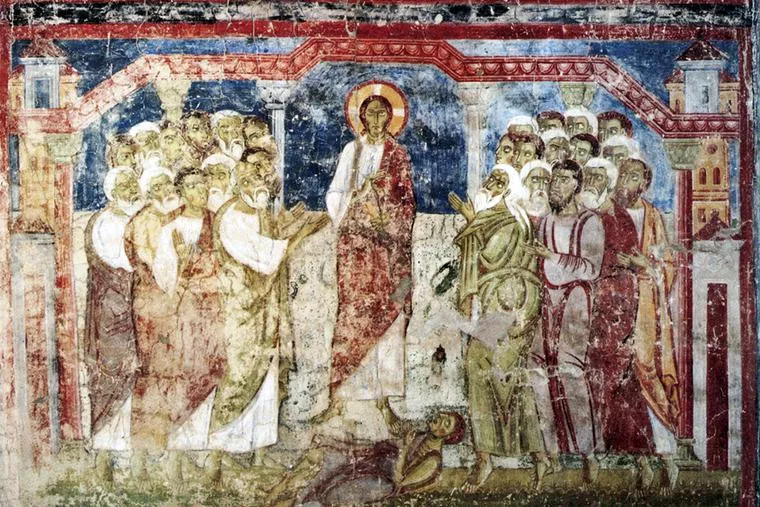
The exorcism in the Synagogue of Capernaum

Romanesque fresco from Lambach Abbey in Upper Austria

7 posted on 01/28/2024 10:01:35 AM PST by annalex (fear them not)
[ Post Reply | Private Reply | To 6 | View Replies]

To: annalex

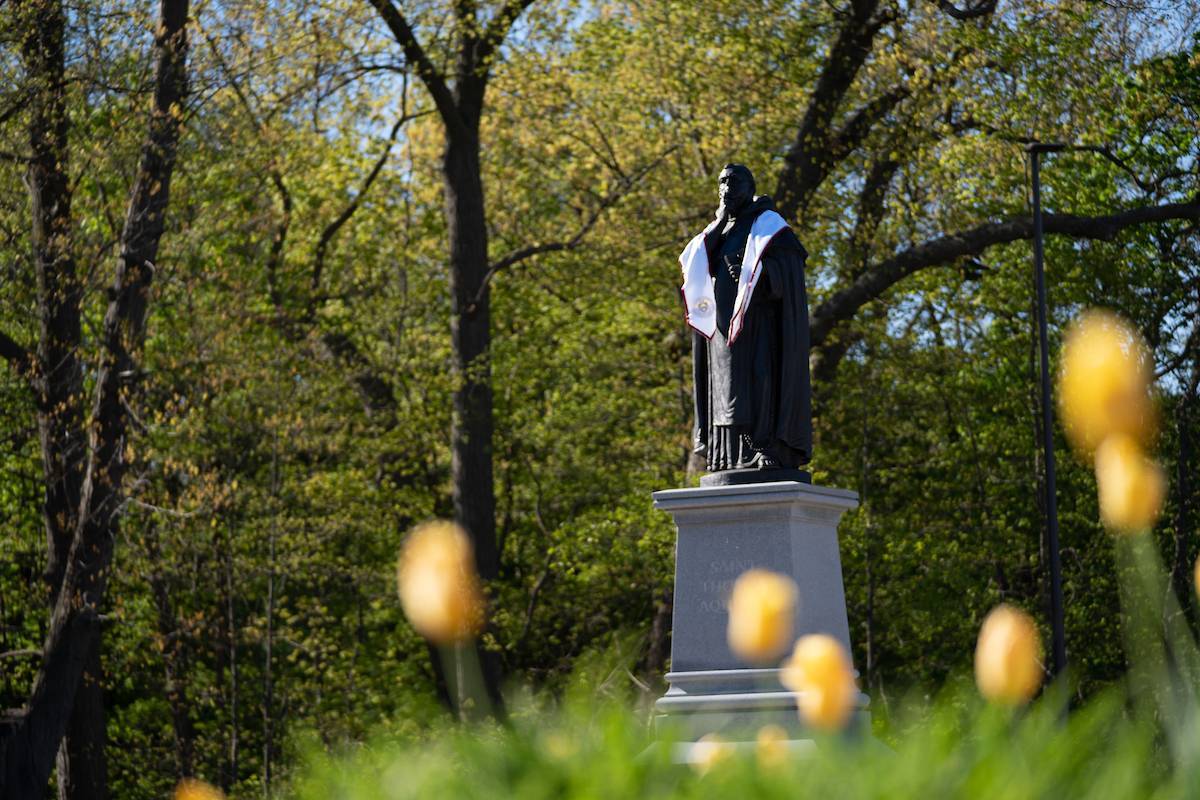
Statue of Thomas Aquinas at Aquinas College

Saint Thomas Aquinas


Thomas Aquinas (1225 - 1274; of Aquino, Italy) was an Italian philosopher and theologian known as the Angelic Doctor. Born of a wealthy family at Rocca Secca, near Naples, in Italy, he disappointed his family by joining a poor order of preachers (1244) that followed the Rule of Dominic and were therefore known as Dominicans. In 1245, he began to study in Paris, France with Albertus Magnus whose favorite pupil he became.

In 1248, he accompanied Albert to Cologne, Germany. From there, Thomas returned to Paris (1252) where he became known as a great teacher and theologian. He spent some time in Rome as a papal advisor, returned to Paris to teach for a period and then returned to Naples to found a house of studies (1272). In 1274, on the way to a church council at Lyons, France, he took sick and died at the age of 49.

His works show him to be a brilliant lecturer, a clear thinker and an Aristotelian. In an age which was uncomfortable with the notion that the universe could be known apart from revelation, he pioneered the use of the Greek philosophy that featured the power of reason to demonstrate that God and his universe could be understood by reason guided by faith. His large girth and slow, deliberate style earned him the nickname "The Dumb Ox!"

He was the composer of several memorable religious hymns - O Salutaris Hostia and Pange Lingua being the most familiar to modern worshippers. His extensive writings explored the relationship between the mind of man and the mind of God and his synthesis of knowledge relating to this joining of intellect and religious belief, entitled The Summa Theologica (1267-1273), earned him a lasting reputation among scholars and religious alike. An earlier work, Summa Contra Gentiles (1258 - 1260), is written in a style that attempts to establish the truth of Christian religious belief in arguments addressed to an intelligent, but non-Christian reader.

His proofs for the existence of God, apart from faith and revelation, utilizing the power of reason are considered flawed by some 20th century historians of philosophy (Bertrand Russell, for example) because, he argues, Thomas proved what he already believed to be true. Therefore, according to Russell, his work should be viewed as an artful, concise argument, but not a decisive proof.

In spite of this reservation, Russell acknowledges Thomas's contributions to the intellectual movement called Scholasticism, which succeeded in liberating scholarship from the provincial shackles that uninformed religious censorship often created for it. Thomas also continued in the spirit of Albert the Great to lay a foundation of legitimacy for the Christian study of natural phenomena that allowed Christian Europe to proceed to the initial stages of the scientific revolution. Pope Leo XIII declared Scholasticism in 1879, in the encyclical Aeterni Patris, to be the official Roman Catholic philosophy.

Aquinas' five proofs for the existence of God might be summarized as follows:

  1. The unmoved Mover: Whatever is moved, is moved by something, and since an endless regress is not possible, a Prime Mover is required.
  2. The first Cause: Every result has a cause and since an endless regress is impossible, there must be a First Cause.
  3. The ultimate Necessity: Essentially a repeat of Reason (2.), there must be a source for all consequences which follow.
  4. Perfect Source: All perfection in the world requires, as its source, an Ultimate Perfection.
  5. Purpose: Even lifeless things have a purpose which must be defined by something outside themselves, since only living things can have an internal purpose.

Statue of St Thomas Aquinas


A statue of St. Thomas Aquinas faces the entrance to the first floor of the Academic Building. (See photo, left) It was sculpted by Sr. Phyllis Mrozinski, O.P. and was dedicated on September 16, 1990. It replaces a statue of Thomas, dedicated in the spring of 1956 that was damaged in a fire while it was being stored in what is now the Pastoral Center, or Bukowski Chapel.


Also on view in the display case is a three-volume set of the Summa Theologica.

Thomas's teacher at the University of Paris, Albert the Great, Albertus Magnus, is the man for whom the Aquinas science building is named. Albert is known to have practiced experimental science - his efforts to test the validity of the claims associated with the use of herbal medicines and folk remedies for disease was unusual for his time. Such skepticism, on the part of Albert, was adopted by his pupil, Thomas, and led both men to believe that one could be a sincere Christian and an objective observer of natural phenomena.


aquinas.edu
8 posted on 01/28/2024 10:06:52 AM PST by annalex (fear them not)
[ Post Reply | Private Reply | To 7 | View Replies]

To: annalex


The Triumph of St Thomas Aquinas

Francesco Traini

c. 1323
Santa Catarina, Pisa

9 posted on 01/28/2024 10:15:36 AM PST by annalex (fear them not)
[ Post Reply | Private Reply | To 8 | View Replies]

To: annalex
Click here to go to the FR thread for the Sacred Page meditations on the Scripture readings for this Sunday's Mass.

Click here to go to the My Catholic Life! Devotional thread for today’s Gospel Reading

10 posted on 01/28/2024 11:02:38 AM PST by fidelis (Ecce Crucem Domini! Fugite partes adversae! Vicit Leo de tribu Juda, Radix David! Alleluia!)
[ Post Reply | Private Reply | To 3 | View Replies]

To: fidelis
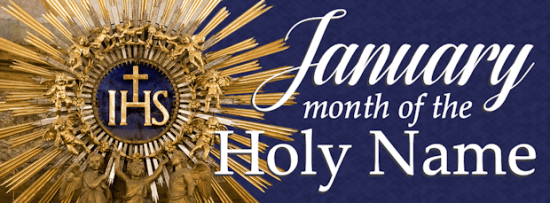
January is the month of devotion to the Most Holy Name of Jesus:


11 posted on 01/28/2024 11:03:09 AM PST by fidelis (Ecce Crucem Domini! Fugite partes adversae! Vicit Leo de tribu Juda, Radix David! Alleluia!)
[ Post Reply | Private Reply | To 10 | View Replies]

Disclaimer: Opinions posted on Free Republic are those of the individual posters and do not necessarily represent the opinion of Free Republic or its management. All materials posted herein are protected by copyright law and the exemption for fair use of copyrighted works.

Free Republic
Browse · Search
Religion
Topics · Post Article

FreeRepublic, LLC, PO BOX 9771, FRESNO, CA 93794
FreeRepublic.com is powered by software copyright 2000-2008 John Robinson