Mark CHAP. 2
2:1–12
1. And again he entered into Capernaum after some days; and it was noised that he was in the house.
2. And straightway many were gathered together, insomuch that there was no room to receive them, no, not so much as about the door: and he preached the word unto them.
3. And they came unto him, bringing one sick of the palsy, which was borne of four.
4. And when they could not come nigh unto him for the press, they uncovered the roof where he was: and when they had broken it up, they let down the bed wherein the sick of the palsy lay.
5. When Jesus saw their faith, he said unto the sick of the palsy, Son, thy sins be forgiven thee.
6. But there were certain of the Scribes sitting there, and reasoning in their hearts,
7. Why doth this man thus speak blasphemies? who can forgive sins but God only?
8. And immediately when Jesus perceived in his spirit that they so reasoned within themselves, he said unto them, Why reason ye these things in your hearts?
9. Whether is it easier to say to the sick of the palsy, Thy sins be forgiven thee; or to say, Arise, and take up thy bed, and walk?
10. But that ye may know that the Son of man hath power on earth to forgive sins, (he saith to the sick of the palsy,)
11. I say unto thee, Arise, and take up thy bed, and go thy way into thine house.
12. And immediately he arose, took up the bed, and went forth before them all; insomuch that they were all amazed, and glorified God, saying, We never saw it on this fashion.
BEDE. (in Marc. 1. 10) Because the compassion of God deserts not even carnal persons, He accords to them the grace of His presence, by which even they may be made spiritual. After the desert, the Lord returns into the city; wherefore it is said, And again he entered into Capernaum, &c.
AUGUSTINE. (de Con. Evan. ii. 25) But Matthew writes this miracle as if it were done in the city of the Lord, whilst Mark places it in Capernaum, which would be more difficult of solution, if Matthew had also named Nazareth. But seeing that Galilee itself might be called the city of the Lord, who can doubt but that the Lord did these things in His own city, since He did them in Capernaum, a city of Galilee; particularly as Capernaum was of such importance in Galilee as to be called its metropolis? Or else, Matthew passed by the things which were done after He came into His own city, until He came to Capernaum, and so adds on the story of the paralytic healed, subjoining, And, behold, they presented to him a man sick of the palsy, after he had said that He came into His own city.
PSEUDO-CHRYSOSTOM. (Vict. Aut. e Cat. in Marc.) Or else, Matthew called Capernaum His city because He went there frequently, and there did many miracles. It goes on: And it was noised that he was in the house, &c. For the desire of hearing Him was stronger than the toil of approaching Him. After this, they introduce the paralytic, of whom Matthew and Luke speak; wherefore there follows: And they came unto him bearing one sick of the palsy, who was carried by four. Finding the door blocked up by the crowd, they could not by any means enter that way. Those who carried him, however, hoping that he could merit the grace of being healed, raising the bed with their burden, and uncovering the roof, lay him with his bed before the face of the Saviour. And this is that which is added: And when they could not lay him before him, &c. There follows: But when Jesus saw their faith, he said to the sick of the palsy, Son, thy sins be forgiven thee. He did not mean the faith of the sick man, but of his bearers; for it sometimes happens, that a man is healed by the faith of another.
BEDE. (ubi sup.) It may indeed be seen, how much each person’s own faith weighs with God, when that of another had such influence that the whole man at once rose up, healed body and soul, and by one man’s merit, another should have his sins forgiven him.
THEOPHYLACT. He saw the faith of the sick man himself, since he would not have allowed himself to be carried, unless he had had faith to be healed.
BEDE. (ubi sup.) Moreover, the Lord being about to cure the man of the palsy, first loosed the chains of his sins, in order to shew that he was condemned to the loosening of his joints, because of the bonds of his sins, and could not be healed to the recovery of his limbs, unless these were first loosened. But Christ’s wonderful humility calls this man, despised, weak, with all the joints of his limbs unstrung, a son, when the priests did not deign to touch him. Or at least, He therefore calls him a son, because his sins are forgiven him. It goes on: But there were certain of the scribes sitting there, and reasoning in their hearts, Why doth this man speak blasphemies?
CYRIL OF ALEXANDRIA.a; Now they accuse Him of blasphemy, anticipating the sentence of His death: for there was a command in the Law, that whosoever blasphemed should be put to death. And this charge they laid upon Him, because He claimed for Himself the divine power of remitting sins: wherefore it is added, Who can forgive sin, save God only? For the Judge of all alone has power to forgive sin.
BEDE. (ubi sup.) Who remits sin by those also to whom He has assigned the power of remitting, and therefore Christ is proved to be very God, for He is able to remit sins as God. The Jews then are in error, who although they hold the Christ both to be God, and to be able to remit sins, do not however believe that Jesus is the Christ. But the Arians err much more madly, who although overwhelmed with the words of the Evangelist, so that they cannot deny that Jesus is the Christ, and can remit sin, nevertheless fear not to deny that He is God. But He Himself, desiring to shame the traitors both by His knowledge of things hidden and by the virtue of His works, manifests Himself to be God. For there follows: And immediately when Jesus perceived in his spirit that they so reasoned, he said unto them, Why reason ye these things in your hearts? In which He shews Himself to be God, since He can know the hidden things of the heart; and in a manner though silent He speaks thus, With the same power and majesty, by which I look upon your thoughts, I can forgive the sins of men.
THEOPHYLACT. But though their thoughts were laid bare, still they remain insensible, refusing to believe that He who knew their hearts could forgive sins, wherefore the Lord proves to them the cure of the soul by that of the body, shewing the invisible by the visible, that which is more difficult by that which is easier, although they did not look upon it as such. For the Pharisees thought it more difficult to heal the body, as being more open to view; but the soul more easy to cure, because the cure is invisible; so that they reasoned thus, Lo, He does not now cure the body, but heals the unseen soul; if He had had more power, He would at once have cured the body, and not have fled for refuge to the unseen world. The Saviour, therefore, shewing that He can do both, says, Which is the easier? as if He said, I indeed by the healing of the body, which is in reality more easy, but appears to you more difficult, will prove to you the health of the soul, which is really more difficult.
PSEUDO-CHRYSOSTOM. (Vict. Ant. e Cat. in Marc.) And because it is easier to say than to do, there was still manifestly something to say in opposition, for the work was not yet manifested; wherefore He subjoins, But that ye may know, &c. as if He said, Since ye doubt my word, I will bring on a work which will confirm what was unseen. But He says in a marked manner, On earth to forgive sins, that He might shew that He has joined the power of the divinity to the human nature by an inseparable union, because although He was made man, yet He remained the Word of God; and although by an economy He conversed on the earth with men, nevertheless He was not prevented from working miracles and from giving remission of sins. For His human nature did not in any thing take away from these things which essentially belonged to His Divinity, nor the Divinity hinder the Word of God from becoming on earth, according to the flesh, the Son of Man without change and in truth.
THEOPHYLACT. Again, He says, Take up thy bed, to prove the greater certainty of the miracle, shewing that it is not a mere illusion; and at the same time to shew that He not only healed, but gave strength; thus He not only turns away souls from sin, but gives them the power of working out the commandments.
BEDE. (ubi sup.) A carnal sign therefore is given, that the spiritual sign may be proved, although it belongs to the same power to do away with the distempers of both soul and body; whence it follows: And immediately he arose, took up the bed, and went forth before them all.
CHRYSOSTOM. (non occ.) Further, He first healed by the remission of sins that which He had come to seek, that is, a soul, so that when they faithlessly doubted, then He might bring forward a work before them, and in this way His word might be confirmed by the work, and a hidden sign be proved by an open one, that is, the health of the soul by the healing of the body.
BEDE. (ubi sup.) We are also informed, that many sicknesses of body arise from sins, and therefore perhaps sins are first remitted, that the causes of sickness being taken away, health may be restored. For men are afflicted by fleshly troubles for five causes, in order to increase their merits, as Job and the Martyrs; or to preserve their lowliness, as Paul by the messenger of Satan; or that they may perceive and correct their sins, as Miriam, the sister of Moses, and this paralytic; or for the glory of God, as the man born blind and Lazarus; or as the beginnings of the pains of damnation, as Herod and Antiochus. But wonderful is the virtue of the Divine power, where without the least interval of time, by the command of the Saviour, a speedy health accompanies His words. Wherefore there follows: Insomuch that they were all amazed. Leaving the greater thing, that is, the remission of sins, they only wonder at that which is apparent, that is, the health of the body.
THEOPHYLACT. This is not however the paralytic, whose cure is related by John, (John 5) for he had no man with him, this one had four; he is cured in the pool of the sheep market, but this one in a house. It is the same man, however, whose cure is related by Matthew (Matt. 9) and Mark. But mystically, Christ is still in Capernaum, in the house of consolation.
BEDE. (ubi sup.) Moreover, whilst the Lord is preaching in the house, there is not room for them, not even at the door, because whilst Christ is preaching in Judæa, the Gentiles are not yet able to enter to hear Him, to whom, however, though placed without, he directed the words of His doctrine by His preachers.
PSEUDO-JEROME. Again, the palsy is a type of the torpor, in which man lies slothful in the softness of the flesh, though desiring health.
THEOPHYLACT. If therefore I, having the powers of my mind unstrung, remain, whenever I attempt any thing good without strength, as a palsied man, and if I be raised on high by the four Evangelists, and be brought to Christ, and there hear myself called son, then also are my sins quitted by me; for a man is called the son of God because he works the commandments.
BEDE. Or else, because there are four virtues, by which a man is through an assured heart exalted so that he merits safety; which virtues some call prudence, fortitude, temperance, and justice. Again, they desire to bring the palsied man to Christ, but they are impeded on every side by the crowd which is between them, because often the soul desires to be renewed by the medicine of Divine grace, but through the sluggishness of the grovelling body is held back by the hindrance of old custom. Oftentimes amidst the very sweetnesses of secret prayer, and, as it may be called, the pleasant converse with God, a crowd of thoughts, cutting off the clear vision of the mind, shuts out Christ from its sight. Let us not then remain in the lowest ground, where the crowds are bustling, but aim at the roof of the house, that is, the sublimity of the Holy Scripture, and meditate on the law of the Lord.
THEOPHYLACT. But how should I be borne to Christ, if the roof be not opened. For the roof is the intellect, which is set above all those things which are within us; here it has much earth about it in the tiles which are made of clay, I mean, earthly things: but if these be taken away, the virtue of the intellect within us is freed from its load. After this let it be let down, that is, humbled. For it does not teach us to be puffed up, because our intellect has its load cleared away, but to be humbled still more.
BEDE. (ubi sup.) Or else, the sick man is let down after the roof is opened, because, when the Scriptures are laid open to us, we arrive at the knowledge of Christ, that is, we descend to His lowliness, by the dutifulness of faith. But by the sick man being let down with his bed, it is meant that Christ should be known by man, whilst yet in the flesh. But by rising from the bed is meant the soul’s rousing itself from carnal desires, in which it was lying in sickness. To take up the bed is to bridle the flesh itself by the bands of continence, and to separate it from earthly pleasures, through the hope of heavenly rewards. But to take up the bed and to go home is to return to paradise. Or else the man, now healed, who had been sick carries back home his bed, when the soul, after receiving remission of sins, returns, even though encompassed with the body, to its internal watch over itself.
THEOPHYLACT. It is necessary to take up also one’s bed, that is the body, to the working of good. For then shall we be able to arrive at contemplation, so that our thoughts should say within us, never have we seen in this way before, that is never understood as we have done since we have been cured of the palsy; for he who is cleansed from sin, sees more purely.
Catena Aurea Mark 2



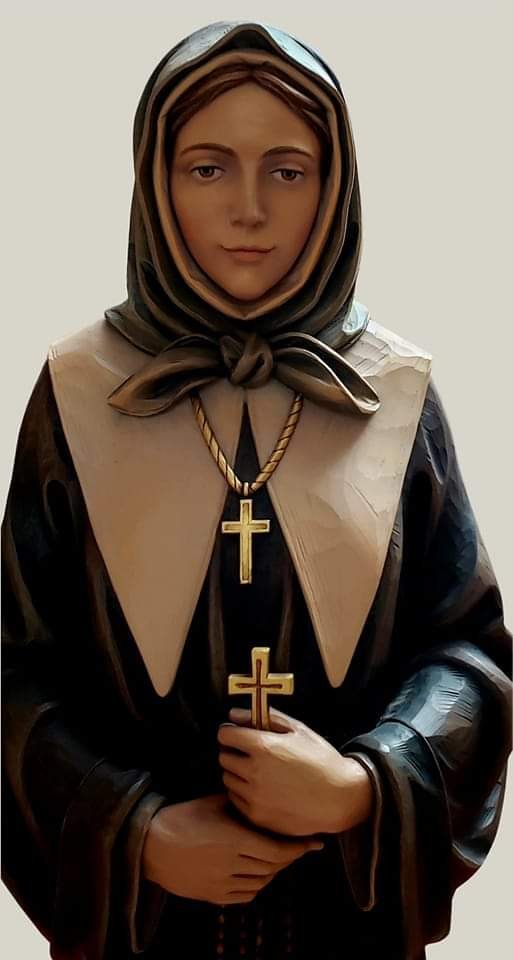
 St. Marguerite Bourgeoys was a French missionary who educated native people and settlers in Montreal and Quebec—she is one of Canada’s first saints.
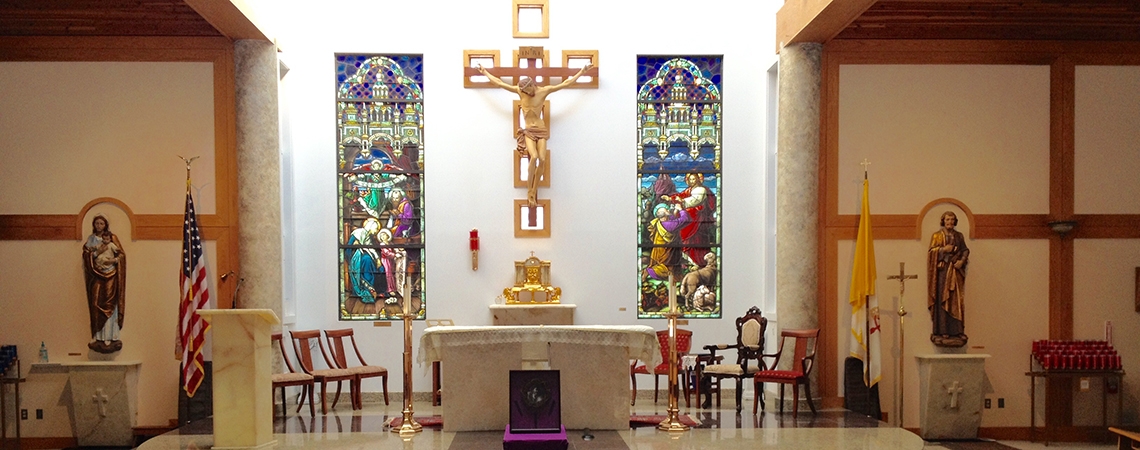
 St. Marguerite Bourgeoys is represented in this stained glass window to the left that was installed in the chapel of the Stayer Center for Executive Education on Notre Dame's campus; some of Marguerite's relics are housed in the reliquary chapel in the Basilica.