Mark CHAP. 1
1:40–45
40. And there came a leper to him, beseeching him, and kneeling down to him, and saying unto him, If thou wilt, thou canst make me clean.
41. And Jesus, moved with compassion, put forth his hand, and touched him, and saith unto him, I will; be thou clean.
42. And as soon as he had spoken, immediately the leprosy departed from him, and he was cleansed.
43. And he straitly charged him, and forthwith sent him away;
44. And saith unto him, See thou say nothing to any man: but go thy way, shew thyself to the Priest, and offer for thy cleansing those things which Moses commanded, for a testimony unto them.
45. But he went out, and began to publish it much, and to blaze abroad the matter, insomuch that Jesus could no more openly enter into the city, but was without in desert places: and they came to him from every quarter.
BEDE. (in Marc. i. 7) After that the serpent-tongue of the devils was shut up, and the woman, who was first seduced, cured of a fever, in the third place, the man, who listened to the evil counsels of the woman, is cleansed from his leprosy, that the order of restoration in the Lord might be the same as was the order of the fall in our first parents; whence it goes on: And there came a leper to him, beseeching him.
AUGUSTINE. (de Con. Evan. ii. 19) Mark puts together circumstances, from which one may infer that he is the same as that one whom Matthew (Matt. 8:2) relates to have been cleansed, when the Lord came down from the mount, after the sermon.
BEDE. (in Marc. i. 9) And because the Lord said that He came not to destroy the Law but to fulfill, (Matt. 5:17) he who was excluded by the Law, inferring that he was cleansed by the power of the Lord, shewed that that grace, which could wash away the stain of the leper, was not from the Law, but over the Law. And truly, as in the Lord authoritative power, so in him the constancy of faith is shewn; for there follows, Lord, if thou wilt, thou canst make me clean. He falls on his face, which is at once a gesture of lowliness and of shame, to shew that every man should blush for the stains of his life. But his shame did not stifle confession; he shewed his wound, and begged for medicine, and the confession is full of devotion and of faith, for he refers the power to the will of the Lord.
THEOPHYLACT. For he said not, If thou wilt, pray unto God, but, If thou wilt, as thinking Him very God.
BEDE. (ubi sup.) Moreover, he doubted of the will of the Lord, not as disbelieving His compassion, but, as conscious of his own filth, he did not presume. It goes on; But Jesus, moved with compassion, put forth his hand, and touched him, and saith unto him, I will, be thou clean. It is not, as many of the Latins think, to be taken to mean and read, I wish to cleanse thee, but that Christ should say separately, I will, and then command, be thou clean.
CHRYSOSTOM. (Hom. 25. in Matt) Further, the reason why He touches the leper, and did not confer health upon him by word alone, was, that it is said by Moses in the Law, that he who touches a leper, shall be unclean till the evening; that is, that he might shew, that this uncleanness is a natural one, that the Law was not laid down for Him, but on account of mere men. Furthermore, He shews that He Himself is the Lord of the Law; and the reason why He touched the leper, though the touch was not necessary to the working of the cure, was to shew that He gives health, not as a servant, but as the Lord.
BEDE. (ubi sup.) Another reason why He touched him, was to prove that He could not be defiled, who freed others from pollution. At the same time it is remarkable, that He healed in the way in which He had been begged to heal. If thou will, says the leper, thou canst make me clean. I will, He answered, behold, thou hast My will, be clean; now thou hast at once the effect of My compassion.
CHRYSOSTOM. (Hom. 25. in Matt) Moreover, by this, not only did He not take away the opinion of Him entertained by the leper, but He confirmed it; for He puts to flight the disease by a word, and what the leper had said in word, He filled up in deed; wherefore there follows, And when he had spoken, immediately, &c.
BEDE. (ubi sup.) For there is no interval between the work of God and the command, because the work is in the command, for He commanded, and they were created. (Ps. 148:5) There follows: And he straitly charged him, and forthwith, &c. See thou tell no man.
CHRYSOSTOM. (Hom. 25) As if He said, It is not yet time that My works should be preached, I require not thy preaching. By which He teaches us not to seek worldly honour as a reward for our works. It goes on: But go thy way, shew thyself to the chief of the priests. Our Saviour sent him to the priest for the trial of his cure, and that he might not be cast out of the temple, but still be numbered with the people in prayer. He sends him also, that he might fulfil all the parts of the Law, in order to stop the evil-speaking tongue of the Jews. He Himself indeed completed the work, leaving them to try it.
BEDE. (ubi sup.) This He did in order that the priest might understand that the leper was not healed by the Law, but by the grace of God above the Law. There follows: And offer for thy cleansing what. Moses, &c.
THEOPHYLACT. He ordered him to offer the gift which they who were healed were accustomed to offer, as if for a testimony, that He was not against the Law, but rather confirmed the Law, inasmuch as He Himself worked out the precepts of the Law.
BEDE. (ubi sup.) If any one wonders, how the Lord seems to approve of the Jewish sacrifice, which the Church rejects, let him remember, that He had not yet offered His own holocaust in His passion. And it was not right that significative sacrifices should be taken away, before that which they signified was confirmed by the witness of the Apostles in their preaching, and by the faith of the believing people.
THEOPHYLACT. But the leper, although the Lord forbade him, disclosed the benefit, wherefore it goes on: But he having gone out, began to publish and to blaze abroad the tale; for the person benefited ought to be grateful, and to return thanks, even though his benefactor requires it not.
BEDE. (ubi sup. v. Greg. Moral. 19:22) Now it may well be asked, why our Lord ordered His action to be concealed, and yet it could not be kept hid for an hour? But it is to be observed, that the reason why, in doing a miracle, He ordered it to be kept secret, and yet for all that it was noised abroad, was, that His elect, following the example of His teaching, should wish indeed that in the great things which they do, they should remain concealed, but should nevertheless unwillingly be brought to light for the good of others. Not then that He wished any thing to be done, which He was not able to bring about, but, by the authority of His teaching, He gave an example of what His members ought to wish for, and of what should happen to them even against their will.
BEDE. Further, this perfect cure of one man brought large multitudes to the Lord; wherefore it is added, So that he could not any more openly enter into the city, but could only be without in desert places.
CHRYSOSTOM. (non occ.) For the leper every where proclaimed his wonderful cure, so that all ran to see and to believe on the Healer; thus the Lord could not preach the Gospel, but walked in desert places; wherefore there follows, And they came together to him from all places.
PSEUDO-JEROME. Mystically, our leprosy is the sin of the first man, which began from the head, when he desired the kingdoms of the world. For covetousness is the root of all evil; wherefore Gehazi, engaged in an avaritious pursuit, is covered with leprosy.
BEDE. (ubi sup.) But when the hand of the Saviour, that is, the Incarnate Word of God, is stretched out, and touches human nature, it is cleansed from the various parts of the old error.
PSEUDO-JEROME. This leprosy is cleansed on offering an oblation to the true Priest after the order of Melchisedec; for He tells us, Give alms of such things as ye have, and, behold, all things are clean unto you. (Luke 11:41) But in that Jesus could not openly enter into the city, it is meant to be conveyed, that Jesus is not manifested to those, who are enslaved to the love of praise in the broad highway, and to their own wills, but to those who with Peter go into the desert, which the Lord chose for prayer, and for refreshing His people; that is, those who quit the pleasures of the world, and all that they possess, that they may say, The Lord is my portion. But the glory of the Lord is manifested to those, who meet together on all sides, that is, through smooth ways and steep, whom nothing can separate from the love of Christ. (Rom. 8:35)
BEDE. (in Marc. i. 10) Even after working a miracle in that city, the Lord retires into the desert, to shew that He loves best a quiet life, and one far removed from the cares of the world, and that it is on account of this desire, He applied Himself to the healing of the body.
Catena Aurea Mark 1




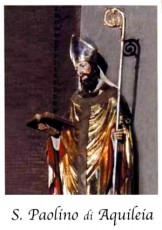
 After ten years of this, Paulinus was made the Patriarch of Aquileia (a position which he, like many saints appointed to the episcopacy, only accepted reluctantly), an ancient Roman city that had been much reduced in stature after it had been sacked by Attila the Hun. He is remembered as having been “Charlemagne’s favorite Italian bishop.” Besides his pastoral work, he was known for fighting for the rights of the Church to be independent from the civil power; he was actually able to procure the right of Aquileia to elect its own bishops in the future rather than having them imposed on them by the emperor, as Paulinus himself had been.
 Paulinus II of Aquilea blessing the Friulian-Slavic army before its campaign against the Avars. (Depicted in Aquileia Cathedral)