Posted on 12/01/2023 8:16:56 AM PST by annalex
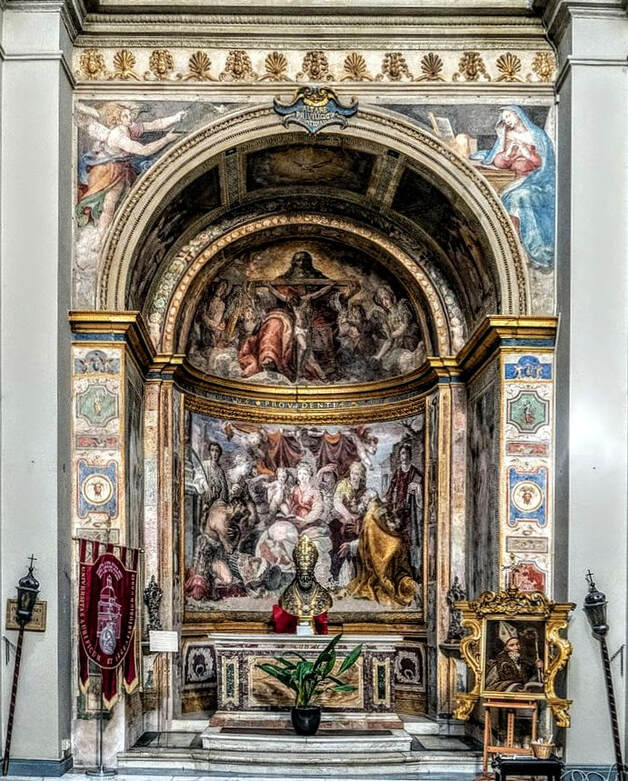
Friday of week 34 in Ordinary Time ![]() The Church of Sant' Eligio degli Orefici, Rome Readings at MassLiturgical Colour: Green. Year: A(I).
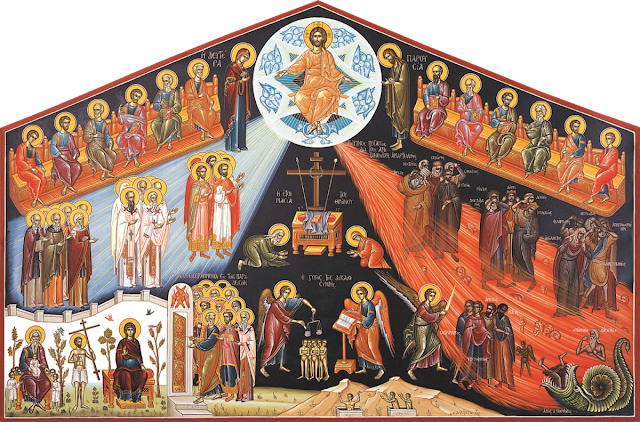
'I saw, coming on the clouds of heaven, one like a son of man'I, Daniel, have been seeing visions in the night. I saw that the four winds of heaven were stirring up the great sea; four great beasts emerged from the sea, each different from the other. The first was like a lion with eagle’s wings; and as I looked its wings were torn off, and it was lifted from the ground and set standing on its feet like a man; and it was given a human heart. The second beast I saw was different, like a bear, raised up on one of its sides, with three ribs in its mouth, between its teeth. “Up!” came the command “Eat quantities of flesh!” After this I looked, and saw another beast, like a leopard, and with four bird’s wings on its flanks; it had four heads, and power was given to it. Next I saw another vision in the visions of the night: I saw a fourth beast, fearful, terrifying, very strong; it had great iron teeth, and it ate, crushed and trampled underfoot what remained. It was different from the previous beasts and had ten horns. While I was looking at these horns, I saw another horn sprouting among them, a little one; three of the original horns were pulled out by the roots to make way for it; and in this horn I saw eyes like human eyes, and a mouth that was full of boasts. As I watched: Thrones were set in place and one of great age took his seat. His robe was white as snow, the hair of his head as pure as wool. His throne was a blaze of flames, its wheels were a burning fire. A stream of fire poured out, issuing from his presence. A thousand thousand waited on him, ten thousand times ten thousand stood before him. A court was held and the books were opened. The great things the horn was saying were still ringing in my ears, and as I watched, the beast was killed, and its body destroyed and committed to the flames. The other beasts were deprived of their power, but received a lease of life for a season and a time. I gazed into the visions of the night. And I saw, coming on the clouds of heaven, one like a son of man. He came to the one of great age and was led into his presence. On him was conferred sovereignty, glory and kingship, and men of all peoples, nations and languages became his servants. His sovereignty is an eternal sovereignty which shall never pass away, nor will his empire ever be destroyed.
Mountains and hills! bless the Lord. Give glory and eternal praise to him! Every thing that grows on the earth! bless the Lord. Give glory and eternal praise to him! Springs of water! bless the Lord. Give glory and eternal praise to him! Seas and rivers! bless the Lord. Give glory and eternal praise to him! Sea beasts and everything that lives in water! bless the Lord. Give glory and eternal praise to him! Birds of heaven! all bless the Lord. Give glory and eternal praise to him! Animals wild and tame! all bless the Lord. Give glory and eternal praise to him!
Alleluia, alleluia! Stand erect, hold your heads high, because your liberation is near at hand. Alleluia!
My words will never pass awayJesus told his disciples a parable: ‘Think of the fig tree and indeed every tree. As soon as you see them bud, you know that summer is now near. So with you when you see these things happening: know that the kingdom of God is near. I tell you solemnly, before this generation has passed away all will have taken place. Heaven and earth will pass away, but my words will never pass away.’ Christian Art![]() Each day, The Christian Art website gives a picture and reflection on the Gospel of the day. The readings on this page are from the Jerusalem Bible, which is used at Mass in most of the English-speaking world. The New American Bible readings, which are used at Mass in the United States, are available in the Universalis apps, programs and downloads. |
KEYWORDS: catholic; lk21; ordinarytime; prayer;

Please FReepmail me to get on/off the Alleluia Ping List.
| Luke | |||
| English: Douay-Rheims | Latin: Vulgata Clementina | Greek NT: Byzantine/Majority Text (2000) | |
| Luke 21 | |||
| 29. | And he spoke to them in a similitude. See the fig tree, and all the trees: | Et dixit illis similitudinem : Videte ficulneam, et omnes arbores : | και ειπεν παραβολην αυτοις ιδετε την συκην και παντα τα δενδρα |
| 30. | When they now shoot forth their fruit, you know that summer is nigh; | cum producunt jam ex se fructum, scitis quoniam prope est æstas. | οταν προβαλωσιν ηδη βλεποντες αφ εαυτων γινωσκετε οτι ηδη εγγυς το θερος εστιν |
| 31. | So you also, when you shall see these things come to pass, know that the kingdom of God is at hand. | Ita et vos cum videritis hæc fieri, scitote quoniam prope est regnum Dei. | ουτως και υμεις οταν ιδητε ταυτα γινομενα γινωσκετε οτι εγγυς εστιν η βασιλεια του θεου |
| 32. | Amen, I say to you, this generation shall not pass away, till all things be fulfilled. | Amen dico vobis, quia non præteribit generatio hæc, donec omnia fiant. | αμην λεγω υμιν οτι ου μη παρελθη η γενεα αυτη εως αν παντα γενηται |
| 33. | Heaven and earth shall pass away, but my words shall not pass away. | Cælum et terra transibunt : verba autem mea non transibunt. | ο ουρανος και η γη παρελευσονται οι δε λογοι μου ου μη παρελθωσιν |

21:28–33
28. And when these things begin to come to pass, then look up, and lift up your heads; for your redemption draweth nigh.
29. And he spake to them a parable; Behold the fig tree, and all the trees;
30. When they now shoot forth, ye see and know of your own selves that summer is now nigh at hand.
31. So likewise ye, when ye see these things come to pass, know ye that the kingdom of God is nigh at hand.
32. Verily I say unto you, This generation shall not pass away, till all be fulfilled.
33. Heaven and earth shall pass away: but my words shall not pass away.
GREGORY. (Hom. 1. in Ev.) Having in what has gone before spoken against the reprobate, He now turns His words to the consolation of the elect; for it is added, When these things begin to be, look up, and lift up your heads, for your redemption draweth nigh; as if he says, When the buffettings of the world multiply, lift up your heads, that is, rejoice your hearts, for when the world closes whose friends ye are not, the redemption is near which ye seek. For in holy Scripture the head is often put for the mind, for as the members are ruled by the head, so are the thoughts regulated by the mind. To lift up our heads then, is to raise up our minds to the joys of the heavenly country.
EUSEBIUS. Or else, To those that have passed through the body and bodily things, shall be present spiritual and heavenly bodies: that is, they will have no more to pass the kingdom of the world, and then to those that are worthy shall be given the promises of salvation. For having received the promises of God which we look for, we who before were crooked shall be made upright, and we shall lift up our heads who were before bent low; because the redemption which we hoped for is at hand; that namely for which the whole creation waiteth.
THEOPHYLACT. That is, perfect liberty of body and soul. For as the first coming of our Lord was for the restoration of our souls, so will the second be manifested unto the restoration of our bodies.
EUSEBIUS. He speaks these things to His disciples, not as to those who would continue in this life to the end of the world, but as if uniting in one body of believers in Christ both themselves and us and our posterity, even to the end of the world.
GREGORY. (ut sup.) That the world ought to be trampled upon and despised, He proves by a wise comparison, adding, Behold the fig tree and all the trees, when they now put forth fruit, ye know that summer is near. As if He says, As from the fruit of the tree the summer is perceived to be near, so from the fall of the world the kingdom of God is known to be at hand. Hereby is it manifested that the world’s fall is our fruit. For hereunto it puts forth buds, that whomsoever it has fostered in the bud it may consume in slaughter. But well is the kingdom of God compared to summer; for then the clouds of our sorrow flee away, and the days of life brighten up under the clear light of the Eternal Sun.
AMBROSE. Matthew speaks of the fig-tree only, Luke of all the trees. But the fig-tree shadows forth two things, either the ripening of what is hard, or the luxuriance of sin; that is, either that, when the fruit bursts forth in all trees and the fruitful fig-tree abounds, (that is, when every tongue confesses God, even the Jewish people confessing Him,) we ought to hope for our Lord’s coming, in which shall be gathered in as at summer the fruits of the resurrection. Or, when the man of sin shall clothe himself in his light and fickle boasting as it were the leaves of the synagogue, we must then suppose the judgment to be drawing near. For the Lord hastens to reward faith, and to bring an end of sinning.
AUGUSTINE. (ut sup.) But when He says, When ye shall see these things to come to pass, what can we understand but those things which were mentioned above. But among them we read, And then shall they see the Son of man coming. When therefore this is seen, the kingdom of God is not yet, but nigh at hand. Or must we say that we are not to understand all the things before mentioned, when He says, When ye shall see these things, &c. but only some of them; this for example being excepted, And then shall they see the Son of man. But Matthew would plainly have it taken with no exception, for he says, And so ye, when ye see all these things, among which is the seeing the coming of the Son of man; in order that it may be understood of that coming whereby He now comes in His members as in clouds, or in the Church as in a great cloud.
TITUS BOSTRENSIS. Or else, He says, the kingdom of God is at hand, meaning that when these things shall be, not yet shall all things come to their last end, but they shall be already tending towards it. For the very coming of our Lord itself, casting out every principality and power, is the preparation for the kingdom of God.
EUSEBIUS. For as in this life, when winter dies away, and spring succeeds, the sun sending forth its warm rays cherishes and quickens the seeds hid in the ground, just laying aside their first form, and the young plants sprout forth, having put on different shades of green; so also the glorious coming of the Only-begotten of God, illuminating the new world with His quickening rays, shall bring forth into light from more excellent bodies than before the seeds that have long been hidden in the whole world, i. e. those who sleep in the dust of the earth. And having vanquished death, He shall reign from henceforth the life of the new world.
GREGORY. (in Hom. 1. in Ev.) But all the things before mentioned are confirmed with great certainty, when He adds, Verily I say unto you, &c.
BEDE. He strongly commends that which he thus foretels. And, if one may so speak, his oath is this, Amen, I say unto you. Amen is by interpretation “true.” Therefore the truth says, I tell you the truth, and though He spoke not thus, He could by no means lie. But by generation he means either the whole human race, or especially the Jews.
EUSEBIUS. Or by generation He means the new generation of His holy Church, shewing that the generation of the faithful would last up to that time, when it would see all things, and embrace with its eyes the fulfilment of our Saviour’s words.
THEOPHYLACT. For because He had foretold that there should be commotions, and wars, and changes, both of the elements and in other things, lest any one might suspect that Christianity itself also would perish, He adds, Heaven and earth shall pass away, but my words shall not pass away: as if He said, Though all things should be shaken, yet shall my faith fail not. Whereby He implies that He sets the Church before the whole creation. The creation shall suffer change, but the Church of the faithful and the words of the Gospel shall abide for ever.
GREGORY. (ut sup.) Or else, The heaven and earth shall pass away, &c. As if He says, All that with us seems lasting, does not abide to eternity without change, and all that with Me seems to pass away is held fixed and immoveable, for My word which passeth away utters sentences which remain unchangeable, and abide for ever.
BEDE. But by the heaven which shall pass away we must understand not the æthereal or the starry heaven, but the air from which the birds are named “of heaven.” But if the earth shall pass away, how does Ecclesiastes say, The earth standeth for ever? (Ecc. 1:4.) Plainly then the heaven and earth in the fashion which they now have shall pass away, but in essence subsist eternally.
Catena Aurea Luke 21


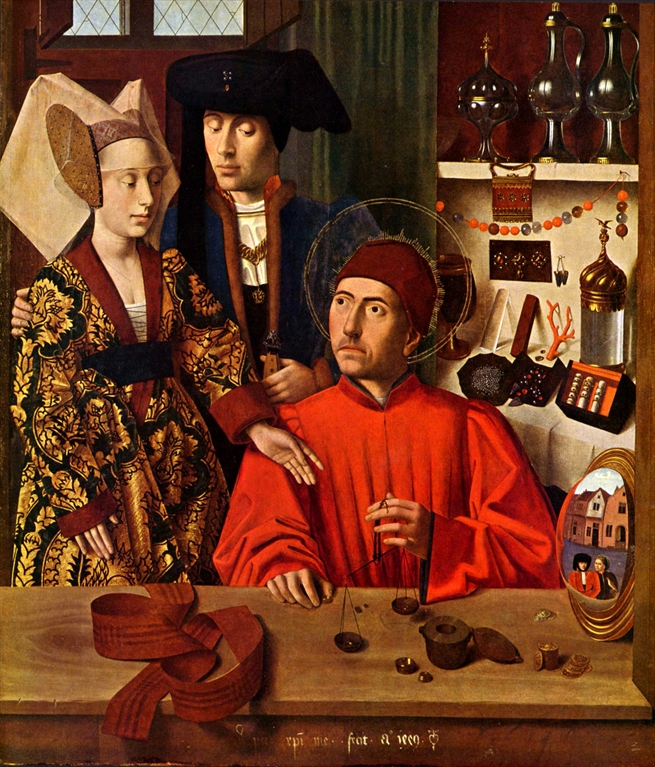
Clotaire was suitably impressed both by Eligius' designing ability and his honesty: Eligius could have simply pocketed the additional gold and precious jewels, but instead gave back the surplus to the king. Subsequently, Clotaire invited him to join the court as the master of the mint. Their honeymoon period did not last long, unfortunately, as Clotaire asked Eligius to swear an oath of allegiance. Eligius hesitated, as he was unsure whether or not Clotaire was going to use this oath for nefarious purposes. Eligius, as a member of the kingdom of the Merovingians, was not a subject of Clotaire who owed him his allegiance. Clotaire continued to press Eligius, annoyed that this otherwise loyal master of mint was resisting his will. Finally, Clotaire came to see that Eligius' refusal was not a matter of resistance, but a matter of conscience, as Eligius wanted nothing to stand in the way of his commitment to doing what he knew was his Christian duty, even his duty to his employer. King Clotaire was so impressed by Eligius' integrity, he embraced him, declaring to Eligius that his conscience was "a better pledge of fidelity than other men's oaths."
King Clotaire's son, Dagobert I, also admired Eligius and kept him in the royal household when his father died. Eligius became such a trusted advisor that he became sort of a gatekeeper to the royal presence. Many visitors stopped to see Eligius and ask for his counsel before reaching the king. The legend of St. Eligius' life details the many splendid monuments in Paris that Eligius crafted out of gold, including reliquaries for St. Martin of Tours and St. Denys.
Eligius dealt in fine things and became rich enough to acquire many fine things and great wealth of his own. Yet, he often gave away his riches in large sums. His home was identified by the crowds of the poor around his house. Eligius' desire to forswear worldly goods for the poor grew into a great desire to join the monastic life. Eligius and his fellow courtier, St. Audoneus, began to contemplate leaving the court to found monasteries. King Dagobert was reluctant to let them go, but eventually, he bequeathed to them estates that they could use to house their monastic communities.
Eligius founded the monastery of Solignac, which followed the joint rules of St. Columban and St. Benedict. Eligius realized that he needed less land than he originally had asked for from the king to complete his building projects, and returned to Dagobert, mortally contrite and begged his forgiveness for swindling him while asking him to take back the land. Dagobert responded: "Some of my officers do not scruple to rob me of whole estates, whereas Eligius is afraid of having one inch of ground which is not his."
Eligius and Audoneus became bishops of Noyon and Rouen, respectively and were consecrated in the year 635 or 641. Eligius' conscientiousness became a hallmark of his episcopacy, and he was highly regarded for his thoughtful pastoral care. He began missionary work into central Europe and cared for the poor and sick wherever he went.
St. Eligius died on December 1, 660. St. Eligius was a widely venerated saint during the middle ages throughout Europe. He is the patron saint of goldsmiths and blacksmiths and is especially honored by the guild of goldsmiths in Paris, where he spent much of his secular smithing career. Eligius provides an admirable model of how a Christian can work in and with the material world and yet continue to always serve God, not mammon.
The image above, "St. Eligius in his shop," by Petrus Christus, was accessed via Wikimedia Commons.
St. Eligius, honest smith and conscientious steward of Christ's flock—pray for us!
Disclaimer: Opinions posted on Free Republic are those of the individual posters and do not necessarily represent the opinion of Free Republic or its management. All materials posted herein are protected by copyright law and the exemption for fair use of copyrighted works.