Catena Aurea by St. Thomas Aguinas
14:2527
25. And there went great multitudes with him: and he turned, and said unto them,
26. If any man come to me, and hate not his father, and mother, and wife, and children, and brethren, and sisters, yea, and his own life also, he cannot be my disciple.
27. And whosoever doth not bear his cross, and come after me, cannot be my disciple.
GREGORY. (in Hom. 37. in Ev.) The mind is kindled, when it hears of heavenly rewards, and already desires to be there, where it hopes to enjoy them without ceasing; but great rewards cannot be reached except by great labours. Therefore it is said, And there went great multitudes with him: and he turned to them, and said, &c.
THEOPHYLACT. For because many of those that accompanied Him followed not with their whole heart, but lukewarmly, He shews what kind of a man his disciple ought to be.
GREGORY. (in Hom. ut sup.) But it may be asked, how are we bid to hate our parents and our relations in the flesh, who are commanded to love even our enemies? But if we weigh the force of the command we are able to do both, by rightly distinguishing them so as both to love those who are united to us by the bond of the flesh, and whom we acknowledge our relations, and by hating and avoiding not to know those whom we find our enemies in the way of God. For he is as it were loved by hatred, who in his carnal wisdom, pouring into our ears his evil sayings, is not heard.
AMBROSE. For if for thy sake the Lord renounces His own mother, saying, Who is my mother? and who are my brethren? (Matt. 12:48, Mark 3:33.) why dost thou deserve to be preferred to thy Lord? But the Lord will have us neither be ignorant of nature, nor be her slaves, but so to submit to nature, that we reverence the Author of nature, and depart not from God out of love to our parents.
GREGORY. (in Hom. ut sup.) Now to shew that this hatred towards relations proceeds not from inclination or passion, but from love, our Lord adds, yea, and his own life also. It is plain therefore that a man ought to hate his neighbour, by loving as himself him who hated him. For then we rightly hate our own soul when we indulge not its carnal desires, when we subdue its appetites, and wrestle against its pleasures. That which by being despised is brought to a better condition, is as it were loved by hatred.
CYRIL OF ALEXANDRIA. But life must not be renounced, which both in the body and the soul the blessed Paul also preserved, that yet living in the body he might preach Christ. But when it was necessary to despise life so that he might finish his course, he counts not his life dear unto him. (Acts 20:24.)
GREGORY. (in Hom. ut sup.) How the hatred of life ought to be shewn He declares as follows; Whosoever bears not his cross, &c.
CHRYSOSTOM. He means not that we should place a beam of wood on our shoulders, but that we should ever have death before our eyes. As also Paul died daily and despised death. (1 Cor. 15:31.)
BASIL. By bearing the cross also he announced the death of his Lord, saying, The world is crucified to me, and I to the world, (Gal. 6:14.) which we also anticipate at our very baptism, in which our old man is crucified, that the body of sin may be destroyed.
GREGORY. (in Hom. 37. in Ev.) Or because the cross is so called from torturing. In two ways we bear our Lords cross, either when by abstinence we afflict our bodies, or when through compassion of our neighbour we think all his necessities our own. But because some exercise abstinence of the flesh not for Gods sake but for vain-glory, and shew compassion, not spiritually but carnally, it is rightly added, And, cometh after me. For to bear His cross and come after the Lord, is to use abstinence of the flesh, or compassion to our neighbour, from the desire of an eternal gain.
14:2833
28. For which of you, intending to build a tower, sitteth not down first, and counteth the cost, whether he have sufficient to finish it?
29. Lest haply, after he hath laid the foundation, and is not able to finish it, all that behold it begin to mock him,
30. Saying, This man began to build, and was not able to finish.
31. Or what king, going to make war against another king, sitteth not down first, and consulteth whether he be able with ten thousand to meet him that cometh against him with twenty thousand?
32. Or else, while the other is yet a great way off, he sendeth an ambassage, and desireth conditions of peace.
33. So likewise, whosoever he be of you that for-saketh not all that he hath, he cannot be my disciple.
GREGORY. (37. in Ev.) Because He had been giving high and lofty precepts, immediately follows the comparison of building a tower, when it is said, For which of you intending to build a tower does not first count &c. For every thing that we do should be preceded by anxious consideration. If then we desire to build a tower of humility, we ought first to brace ourselves against the ills of this world.
BASIL. (in Esai. 2.) Or the tower is a lofty watch-tower fitted for the guardianship of the city and the discovery of the enemys approach. In like manner was our understanding given us to preserve the good, to guard against the evil. For the building up whereof the Lord bids us sit down and count our means if we have sufficient to finish.
GREGORY OF NYSSA. (lib. de Virg. 17.) For we must be ever pressing onward that we may reach the end of each difficult undertaking by successive increases of the commandments of God, and so to the completion of the divine work. For neither is one stone the whole fabric of the tower, nor does a single command lead to the perfection of the soul. But we must lay the foundation, and according to the Apostle, thereupon must be placed store of gold, silver, and precious stones. (1 Cor. 3:12.) Whence it is added, Lest haply after he hath laid the foundation, &c.
THEOPHYLACT. For we ought not to lay a foundation, i. e. begin to follow Christ, and not bring the work to an end, as those of whom St. John writes, That many of his disciples went backward. (John 6:66.) Or by the foundation understand the word of teaching, as for instance concerning abstinence. There is need therefore of the above-mentioned foundation, that the building up of our works be established, a tower of strength from the face of the enemy. (Ps. 61:3.) Otherwise, man is laughed at by those who see him, men as well as devils.
GREGORY. (ubi sup.) For when occupied in good works, unless we watch carefully against the evil spirits, we find those our mockers who are persuading us to evil. But another comparison is added proceeding from the less to the greater, in order that from the least things the greatest may be estimated. For it follows, Or what king, going to make war against another king, sitteth not down first, and consultelh whether he be able with ten thousand to meet him that cometh against him with twenty thousand?
CYRIL OF ALEXANDRIA. For we fight against spiritual wickedness in high places; (Eph. 6:12.) but there presses upon us a multitude also of other enemies, fleshly lust, the law of sin raging in our members, and various passions, that is, a dreadful multitude of enemies.
AUGUSTINE. Or the ten thousand of him who is going to fight with the king who has twenty, signify the simplicity of the Christian about to contend with the subtlety of the devil.
THEOPHYLACT. The king is sin reigning in our mortal body; (Rom. 6:12.) but our understanding also was created king. If then he wishes to fight against sin, let him consider with his whole mind. For the devils are the satellites of sin, which being twenty thousand, seem to surpass in number our ten thousand, because that being spiritual compared to us who are corporeal, they are come to have much greater strength.
AUGUSTINE. (ut sup.) But as with respect to the unfinished tower, he alarms us by the reproaches of those who say, The man began to build, and was not able to finish, so with regard to the king with whom the battle was to be, he reproved even peace, adding, Or else, while the other is yet a great way off, he sendeth an ambassage, and desireth conditions of peace; signifying that those also who forsake all they possess cannot endure from the devil the threats of even coming temptations, and make peace with him by consenting unto him to commit sin.
GREGORY. (in Hom. ut sup.) Or else, in that awful trial we come not to the judgment a match for our king, for ten thousand are against twenty thousand, two against one. He comes with a double army against a single. For while we are scarcely prepared in deeds only, he sifts us at once both in thought and deed. While then he is yet afar off, who though still present in judgment, is not seen, let us send him an embassy, our tears, our works of mercy, the propitiatory victim. This is our message which appeases the coming king.
AUGUSTINE. Now to what these comparisons refer, He on the same occasion sufficiently explained, when he said, So likewise whosoever he be of you that forsaketh not all that he hath, he cannot be my disciple. The cost therefore of building the tower, and the strength of the ten thousand against the king who has twenty thousand, mean nothing else than that each one should forsake all that he hath. The foregoing introduction tallies then with the final conclusion. For in the saying that a man forsakes all that he hath, is contained also that he hates his father and mother, his wife and children, brothers and sisters, yea and his own wife also. For all these things are a mans own, which entangle him, and hinder him from obtaining not those particular possessions which will pass away with time, but those common blessings which will abide for ever.
BASIL. But our Lords intention in the above-mentioned example is not indeed to afford occasion or give liberty to any one to become His disciple or not, as indeed it is lawful not to begin a foundation, or not to treat of peace, but to shew the impossibility of pleasing God, amidst those things which distract the soul, and in which it is in danger of becoming an easy prey to the snares and wiles of the devil.
BEDE. But there is a difference between renouncing all things and leaving all things. For it is the way of few perfect men to leave all things, that is, to cast behind them the cares of the world, but it is the part of all the faithful to renounce all things, that is, so to hold the things of the world as by them not to be held in the world.
Catena Aurea Luke 14
Who was Elizabeth of the Trinity? The story behind a new saint
By Carl Bunderson Vatican City, Jun 21, 2016 / 02:03 am
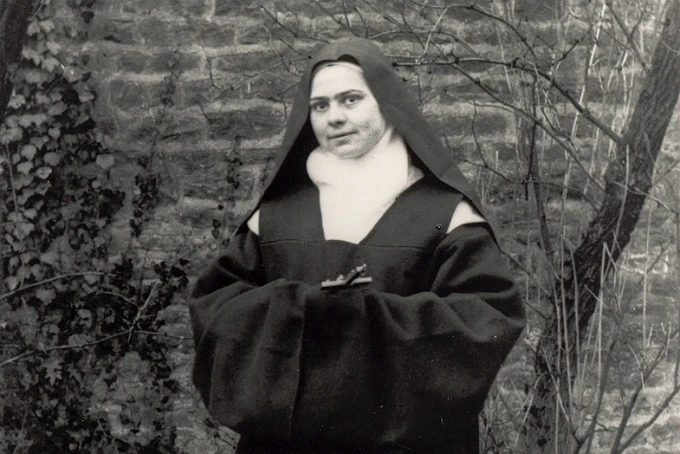
Pope Francis has announced the canonization date of Blessed Elizabeth of the Trinity, a Carmelite nun of the 20th century who will be formally recognized as a saint October 16.
In March, the Pope had acknowledged a miracle worked through the intercession of Blessed Elizabeth, paving the way for her canonization.
"The Lord has chosen to answer her prayers for us…before she died, when she was suffering with Addison's disease, she wrote that it would increase her joy in heaven if people ask for her help," said Dr. Anthony Lilles, academic dean of St. John's Seminary in Camarillo.
Lilles earned his doctorate in spiritual theology at Rome's Angelicum writing a dissertation on Bl. Elizabeth of the Trinity.
"If her friends ask for her help it would increase her joy in heaven: so it increases Elizabeth's joy when you ask her to pray for your needs," he told CNA. "That's the first reason (to have devotion to her): the Church has recognized the power of her intercession."
Bl. Elizabeth of the Trinity was born in France in 1880, and grew up in Dijon close to the city's Carmelite monastery. Lilles recounted that when one time when Bl. Elizabeth visited the monastery when she was 17, "the mother superior there said, 'I just received this circular letter about the death of Therese of Lisieux, and I want you to read it.' That circular letter would later become the Story of a Soul; in fact, what she was given was really the first edition of Story of a Soul."
...it was a lightning moment in her life, where everything kind of crystallized and she understood how to respond to what God was doing in her heart.
"Elizabeth read it and she was inclined towards contemplative prayer; she was a very pious person who worked with troubled youth and catechized them, but when she read Story of a Soul she knew she needed to become a Carmelite: it was a lightning moment in her life, where everything kind of crystallized and she understood how to respond to what God was doing in her heart."
Elizabeth then told her mother she wanted to enter the Carmel, but she replied that she couldn't enter until she was 21, "which was good for the local Church," Lilles explained, "because Elizabeth continued to work with troubled youth throughout that time, and do a lot of other good work in the city of Dijon before she entered."
She entered the Carmel in Dijon in 1901, and died there in 1906 – at the age of 26 – from Addison's disease.
Elizabeth wrote several works while there, the best-known of which is her prayer "O My God, Trinity Whom I Adore." Also particularly notable are her "Heaven in Faith," a retreat she wrote three months before her death for her sister Guite; and the "Last Retreat," her spiritual insights from the last annual retreat she was able to make.
Cardinal Albert Decourtray, who was Bishop of Dijon from 1974 to 1981, was cured of cancer through Bl. Elizabeth's intercession – a miracle that allowed her beatification in 1984.
The healing acknowledged by Pope Francis March 4 was that of Marie-Paul Stevens, a Belgian woman who had Sjögren's syndrome, a glandular disease.
In 2002 Stevens "had asked Bl. Elizabeth to help her manage the extreme discomforts of the pathology she had, and in thanksgiving, because she felt like she had received graces … she travelled to the Carmelite monastery just outside Dijon," Lilles said. "And when she got to the monastery, she was completely healed."
Lilles added that a second reason to have devotion to Bl. Elizabeth of the Trinity is because she died "believing that she had a spiritual mission to help lead souls to a deeper encounter with Christ Jesus."
"You could call it contemplative prayer, or even mystical prayer. She said her mission was to lead souls out of themselves and into a great silence, where God could imprint himself in them, on their souls, so that they became more God-like."
In prayer, he said, "we make space for (God) to transform us more fully into the image and likeness he intended us to become, but which sin has marred. Contemplative prayer is a means towards this transformation, and Bl. Elizabeth of the Trinity believed before she died that her spiritual mission would be to help souls enter into that kind of transformative, contemplative prayer, where they could become saints."
She understood that the way she loved souls all the way was to help them find and encounter the Lord.
During her time in the Carmel of Dijon, Bl. Elizabeth found encouragement from the writings of St. Therese of Lisieux, particularly her "Offering to Merciful Love," a prayer found in Story of a Soul, Lilles said: "You find references to the Offering to Merciful Love throughout the writings of Bl. Elizabeth of the Trinity, it was probably something she herself prayed often."
"The second way that Elizabeth of the Trinity was influenced by Therese of Lisieux was a poem that St. Therese wrote called 'Living by Love'; in this poem Therese celebrates how the love of Jesus is the heartbeat, the deepest reality of her life, and because he lived to lay down his life for her, she wants to live to lay down her life for human love, which as the poem goes on, means loving all whom he sends her way, without reserve and all the way, giving people the generous love that we have received from Christ, sharing it with others."
"That idea deeply, deeply influenced Elizabeth of the Trinity and in fact inspired her own way of life and her own spiritual mission to help lead souls into mystical prayer," Lilles reflected. "She understood that the way she loved souls all the way was to help them find and encounter the Lord."
"So, the spiritual missions of Therese of Lisieux and Elizabeth of the Trinity coincide: great theologians like Hans Urs von Balthasar recognized that. And these spiritual missions have both greatly influenced the Church in the 20th and early 21st centuries in very powerful ways."
"I'm so glad that Elizabeth has been recognized for her part in building up the Church in the 20th century."
An earlier version of this article was originally published on CNA March 8, 2016.
catholicnewsagency.com