
Catena Aurea by St. Thomas Aguinas
14:15–24
15. And when one of them that sat at meat with him heard these things, he said unto him, Blessed is he that shall eat bread in the kingdom of God.
16. Then said he unto him, A certain man made a great supper, and bade many:
17. And sent his servant at supper time to say to them that were bidden, Come; for all things are now ready.
18. And they all with one consent began to make excuse. The first said unto him, I have bought a piece of ground, and I must needs go and see it: I pray thee have me excused.
19. And another said, I have bought five yoke of oxen, and I go to prove them: I pray thee have me excused.
20. And another said, I have married a wife, and therefore I cannot come.
21. So that servant came, and shewed his lord these things. Then the master of the house being angry said to his servant, Go out quickly into the streets and lanes of the city, and bring in hither the poor, and the maimed, and the halt, and the blind.
22. And the servant said, Lord, it is done as thou hast commanded, and yet there is room.
23. And the lord said unto the servant, Go out into the highways and hedges, and compel them to come in, that my house may be filled.
24. For I say unto you, That none of those men which were bidden shall taste of my supper.
EUSEBIUS. Our Lord had just before taught us to prepare our feasts for those who cannot repay, seeing that we shall have our reward at the resurrection of the just. Some one then, supposing the resurrection of the just to be one and the same with the kingdom of God, commends the above-mentioned recompense; for it follows, When one of them that sat at meat with him heard these things, he said unto him, Blessed is he that shall eat bread in the kingdom of God.
CYRIL OF ALEXANDRIA. That man was carnal, and a careless hearer of the things which Christ delivered, for he thought the reward of the saints was to be bodily.
AUGUSTINE. (Serm. 112.) Or because he sighed for something afar off, and that bread which he desired lay before him. For who is that Bread of the kingdom of God but He who says, I am the living bread which came down from heaven? (John 6:51.) Open not thy mouth, but thy heart.
BEDE. But because some receive this bread by faith merely, as if by smelling, but its sweetness they loathe to really touch with their mouths, our Lord by the following parable condemns the dulness of those men to be unworthy of the heavenly banquet. For it follows, But he said unto him, A certain man made a great supper, and bade many.
CYRIL OF ALEXANDRIA. This man represents God the Father just as images are formed to give the resemblance of power. For as often as God wishes to declare His avenging power, He is called by the names of bear, leopard, lion, and others of the same kind; but when He wishes to express mercy, by the name of man. The Maker of all things, therefore, and Father of Glory, or the Lord, prepared the great supper which was finished in Christ.
For in these latter times, and as it were the setting of our world, the Son of God has shone upon us, and enduring death for our sakes, has given us His own body to eat. Hence also the lamb was sacrificed in the evening according to the Mosaic law. Rightly then was the banquet which was prepared in Christ called a supper.
GREGORY. (Hom. 36. in Evan.) Or he made a great supper, as having prepared for us the full enjoyment of eternal sweetness. He bade many, but few came, because sometimes they who themselves are subject to him by faith, by their lives oppose his eternal banquet. And this is generally the difference between the delights of the body and the soul, that fleshly delights when not possessed provoke a longing desire for them, but when possessed and devoured, the eater soon turns from satiety to loathing; spiritual delights, on the other hand, when not possessed are loathed, when possessed the more desired. But heavenly mercy recalls those despised delights to the eyes of our memory, and in order that we should drive away our disgust, bids us to the feast. Hence it follows, And he sent his servant, &c.
CYRIL OF ALEXANDRIA. That servant who was sent is Christ Himself, who being by nature God and the true Son of God, emptied Himself, and took upon Him the form of a servant. But He was sent at supper time. For not in the beginning did the Word take upon Him our nature, but in the last time; and he adds, For all things are ready. For the Father prepared in Christ the good things bestowed upon the world through Him, the removal of sins, the participation of the Holy Spirit, the glory of adoption. To these Christ bade men by the teaching of the Gospel.
AUGUSTINE. (ubi sup.) Or else, the Man is the Mediator between God and man, Christ Jesus; He sent that they who were bidden might come, i. e. those who were called by the prophets whom He had sent; who in the former times invited to the supper of Christ, were often sent to the people of Israel, often bade them to come at supper time. They received the inviters, refused the supper. They received the prophets and killed Christ, and thus ignorantly prepared for us the supper. The supper being now ready, i. e. Christ being sacrificed, the Apostles were sent to those, to whom prophets had been sent before.
GREGORY. By this servant then who is sent by the master of the family to bid to supper, the order of preachers is signified. But it is often the case that a powerful person has a despised servant, and when his Lord orders any thing through him, the servant speaking is not despised, because respect for the master who sends him is still kept up in the heart. Our Lord then offers what he ought to be asked for, not ask others to receive. He wishes to give what could scarcely be hoped for; yet all begin at once to make excuse, for it follows, And they all began with one consent to make excuse. Behold a rich man invites, and the poor hasten to come. We are invited to the banquet of God, and we make excuse.
AUGUSTINE. (ubi sup.) Now there were three excuses, of which it is added, The first said unto him, I have bought a piece of ground, and I must needs go and see it. The bought piece of ground denotes government. Therefore pride is the first vice reproved. For the first man wished to rule, not willing to have a master.
GREGORY. (ubi sup.) Or by the piece of ground is meant worldly substance. Therefore he goes out to see it who thinks only of outward things for the sake of his living.
AMBROSE. Thus it is that the worn out soldier is appointed to serve degraded offices, as he who intent upon things below buys for himself earthly possessions, can not enter into the kingdom of heaven. Our Lord says, Sell all that thou hast, and follow me.
It follows, And another said, I have bought five yoke of oxen, and I go to prove them.
AUGUSTINE. (Serm. 112.) The five yoke of oxen are taken to be the five senses of the flesh; in the eyes sight, in the ears hearing, in the nostrils smelling, in the mouth taste, in all the members touch. But the yoke is more easily apparent in the three first senses; two eyes, two ears, two nostrils. Here are three yoke. And in the mouth is the sense of taste which is found to be a kind of double, in that nothing is sensible to the taste, which is not touched both by the tongue and palate. The pleasure of the flesh which belongs to the touch is secretly doubled. It is both outward and inward. But they are called yoke of oxen, because through those senses of the flesh earthly things are pursued. For the oxen till the ground, but men at a distance from faith, given up to earthly things, refuse to believe in any thing, but what they arrive at by means of the five-fold sense of the body. “I believe nothing but what I see.” If such were our thoughts, we should be hindered from the supper by those five yoke of oxen. But that you may understand that it is not the delight of the five senses which charms and conveys pleasure, but that a certain curiosity is denoted, he says not, I have bought five yoke of oxen, and go to feed them, but go to prove them.
GREGORY. (in Hom. 36. in Ev.) By the bodily senses also because they cannot comprehend things within, but take cognizance only of what is without, curiosity is rightly represented, which while it seeks to shake off a life which is strange to it, not knowing its own secret life, desires to dwell upon things without. But we must observe, that the one who for his farm, and the other who to prove his five yoke of oxen, excuse themselves from the supper of their Inviter, mix up with their excuse the words of humility. For when they say, I pray thee, and then disdain to come, the word sounds of humility, but the action is pride. It follows, And this said, I have married a wife, and therefore I cannot come.
AUGUSTINE. (ubi sup.) That is, the delight of the flesh which hinders many, I wish it were outward and not inward. For he who said, I have married a wife, taking pleasure in the delights of the flesh, excuses himself from the supper; let such a one take heed lest he die from inward hunger.
BASIL. But he says, I cannot come, because that the human mind when it is degenerating to worldly pleasures, is feeble in attending to the things of God.
GREGORY. (Hom. 36.) But although marriage is good, and appointed by Divine Providence for the propagation of children, some seek therein not fruitfulness of offspring, but the lust of pleasure. And so by means of a righteous thing may not unfitly an unrighteous thing be represented.
AMBROSE. Or marriage is not blamed; but purity is held up to greater honour, since the unmarried woman careth for the things of the Lord, that she may be holy in body and spirit, but she that is married careth for the things of the world. (1 Cor. 7:34.)
AUGUSTINE. (ubi sup.) Now John when he said, all that is in the world is the lust of the flesh, and the lust of the eyes, and the pride of life, (1 John 2:16.) began from the point where the Gospel ended. The lust of the flesh, I have married a wife; the lust of the eyes, I have bought fire yoke of oxen; the pride of life, I have bought a farm. But proceeding from a part to the whole, the five senses have been spoken of under the eyes alone, which hold the chief place among the five senses. Because though properly the sight belongs to the eyes, we are in the habit of ascribing the act of seeing to all the five senses.
CYRIL OF ALEXANDRIA. But whom can we suppose these to be who refused to come for the reason just mentioned, but the rulers of the Jews, whom throughout the sacred history we find to have been often reproved for these things?
ORIGEN. Or else, they who have bought a piece of ground and reject or refuse the supper, are they who have taken other doctrines of divinity, but have despised the word which they possessed. But he who has bought five yoke of oxen is he who neglects his intellectual nature, and follows the things of sense, therefore he cannot comprehend a spiritual nature. But he who has married a wife is he who is joined to the flesh, a lover of pleasure rather than of God. (1 Tim. 3:4.)
AMBROSE. Or let us suppose that three classes of men are excluded from partaking of that supper, Gentiles, Jews, Heretics. The Jews by their fleshly service impose upon themselves the yoke of the law, for the five yoke are the yoke of the Ten Commandments, of which it is said, And he declared unto you his covenant, which he commanded you to perform, even ten commandments; and he wrote them upon two tables of stone. (Deut. 4:13.) That is, the commands of the Decalogue. Or the five yoke are the five books of the old law. But heresy indeed, like Eve with a woman’s obstinacy, tries the affection of faith. And the Apostle says that we must flee from covetousness, lest entangled in the customs of the Gentiles we be unable to come to the kingdom of Christ. (Eph. 5:3, Col. 3:5, Heb. 13:5, 1 Tim. 6:11.) Therefore both he who has bought a farm is a stranger to the kingdom, and he who has chosen the yoke of the law rather than the gift of grace, and he also who excuses himself because he has married a wife.
It follows, And the servant returned, and told these things to his Lord.
AUGUSTINE. (in Gen. ad lit. c. 19.) Not for the sake of knowing inferior beings does God require messengers, as though He gained aught from them, for He knows all things stedfastly and unchangeably. But he has messengers for oursakes and their own, because to be present with God, and stand before Him so as to consult Him about His subjects, and obey His heavenly commandments, is good for them in the order of their own nature.
CYRIL OF ALEXANDRIA. But with the rulers of the Jews who refused their call, as they themselves confessed, Have any of the rulers believed on him? (John 7:48.) the Master of the household was wroth, as with them that deserved His indignation and anger; whence it follows, Then the master of the house being angry, &c.
PSEUDO-BASIL. (app. Hom. in Ps. 37.) Not that the passion of anger belongs to the Divine substance, but an operation such as in us is caused by anger, is called the anger and indignation of God.
CYRIL OF ALEXANDRIA. Thus it was that the master of the house is said to have been enraged with the chiefs of the Jews, and in their stead were called men taken from out of the Jewish multitude, and of weak and impotent minds. For at Peter’s preaching, first indeed three thousand, then five thousand believed, and afterwards much people; whence it follows, He said unto his servant, Go out straightway into the streets and lanes of the city, and bring in hither the poor, and the maimed, and the halt, and the blind. (Acts 2:41, 44.
AMBROSE. He invites the poor, the weak, and the blind, to shew that weakness of body shuts out no one from the kingdom of heaven, and that he is guilty of fewer sins who lacks the incitement to sin; or that the infirmities of sin are forgiven through the mercy of God. Therefore he sends to the streets, that from the broader ways they may come to the narrow way.
Because then the proud refuse to come, the poor (Greg. Hom. 36.) are chosen, since they are called weak and poor who are weak in their own judgment of themselves, for there are poor, and yet as it were strong, who though lying in poverty are proud; the blind are they who have no brightness of understanding; the lame are they who have walked not uprightly in their works. But since the faults of these are expressed in the weakness of their members, as those were sinners who when bidden refused to come, so also are these who are invited and come; but the proud sinners are rejected, the humble are chosen. God then chooses those whom the world despises, because for the most part the very act of contempt recals a man to himself. And men so much the sooner hear the voice of God, as they have nothing in this world to take pleasure in. When then the Lord calls certain from the streets and lanes to supper, He denotes that people who had learnt to observe in the city the constant practice of the law. But the multitude who believed of the people of Israel did not fill the places of the upper feast room. Hence it follows, And the servant said, Lord, it is done as thou hast commanded, and yet there is room. For already had great numbers of the Jews entered, but yet there was room in the kingdom for the abundance of the Gentiles to be received. Therefore it is added, And the Lord said unto the servant, Go out into the highways and hedges, and compel them to come in, that my house may be filled. When He commanded His guests to be collected from the wayside and the hedges, He sought for a rural people, that is, the Gentiles.
AMBROSE. Or, He sends to the highways and about the hedges, because they are fit for the kingdom of God, who, not absorbed in the desire for present goods, are hastening on to the future, set in a certain fixed path of good will. And who like a hedge which separates the cultivated ground from the uncultivated, and keeps off the incursion of the cattle, know how to distinguish good and evil, and to hold up the shield of faith against the temptations of spiritual wickedness.
AUGUSTINE. (Serm. 112.) The Gentiles came from the streets and lanes, the heretics come from the hedges. For they who make a hedge seek for a division; let them be drawn away from the hedges, plucked asunder from the thorns. But they are unwilling to be compelled. By our own will, say they, will we enter. Compel them to enter, He says. Let necessity be used from without, thence arises a will.
GREGORY. (in Hom. 36.) They then who, broken down by the calamities of this world, return to the love of God, are compelled to enter. But very terrible is the sentence which comes next. For I say unto you, That none of those men which were bidden shall taste of my supper. Let no one then despise the call, lest if when bidden he make excuse, when he wishes to enter he shall not be able.
Catena Aurea Luke 14
Hermit, apostle, founder, mystic, prophet, exorcist… These diverse facets harmonized in the soul of this Carmelite who, in his excelling love for the Church, became mystically united to her.
Archipelago of the Balearic Islands, Spain. At the south-eastern tip of Ibiza Island, facing the cliffs dropping almost vertically into the Mediterranean, an imposing rocky islet juts up out of the water. Though not far from the coast, the roughness of the sea and the steep shoreline make it difficult to access. Only on clear days do ferrymen dare to make the crossing.
After landing on the craggy coast, a few hours of arduous ascent are needed to reach the top of the island, located at nearly 400 metres above sea level. Just below the peak, carved into the steep rock face is a small cave burrowed into the heart of the deserted mountain.
It is a refuge for birds of prey? Or a shelter for some solitary wild animal? No. However, there are signs in this grotto of the presence of an aquiline soul, a courageous apostle, who withdrew there to pray.
It was on the little island of Es Vedrà that this remarkable hermit discovered the central point of his mission: to serve and defend the object of his ardent love, the Holy Church, which he contemplated mystically under the figure of a maiden.
Let us briefly consider the life of this man, Blessed Francisco Palau y Quer.
The burgeoning of a vocation under Elijah’s mantle
He was born on December 29, 1811, in the village of Aitona, into a devout farming family. His penchant for learning gained him entrance into the Seminary of Lérida at the age of seventeen, where contact with the Carmelite priests who provided spiritual assistance to the students opened his soul to the religious vocation.
Undecided as to which order he should enter, he resolved to make a novena to the prophet Elijah, to whom he had been devoted since childhood. On the last day of the novena, the statue before which he was praying came to life and covered him with its mantle. Such a clear sign left no room for doubt: he would be a Carmelite!
He entered the novitiate of Barcelona in 1832. The time was not a favourable one for entering religious life, as the first flares of the liberal revolution had already ignited. Nevertheless, he professed his perpetual vows with impressive resolution and clear-sightedness on November 15, 1833: “When I made my religious profession, the revolution already held in its hand a burning torch to set all the religious houses ablaze and a dreadful dagger to murder the individuals sheltered in them. I was well aware of the pressing danger I faced.”1
His prognostications were soon confirmed. Two years later, when he was a deacon, the Monastery of St. Joseph in Barcelona was burned and all the religious imprisoned. They were soon released, but prohibited by the civil authority from leading a community life. Friar Francisco Palau would remain outside the cloister until the end of his life, maintaining his fidelity to the Carmelite vocation in the manner of St. Elijah: alternating between precious moments of profound solitude and intense action.
The solitary and the apostolic life
After leaving prison, he returned to his birthplace, settling in a grotto on the outskirts of the city. From then on, wherever he went, he built small hermitages or used those provided by nature as his dwelling. He liked to live “in the most deserted, wild and solitary places, for thus with fewer distractions he could contemplate the plans of God for society and the Church.” 2
Defying the government prohibition and following the counsel of his superior, he was ordained a priest in 1836 by the Bishop Jaime Fort y Puig of Barbastro. It was now possible for the young priest to dedicate himself to fruitful action through popular missions and by attending those who sought him, impelled by the reputation for sanctity he had already earned by this time.
However, the integrity of his conduct and the effectiveness of his preaching displeased many… Persecutions and misunderstandings soon arose, coming from both civil and ecclesiastical authorities, and even from his fellow countrymen.
On one occasion, as he prayed in his hermitage after a blessed day of mission, four men who had attended his preaching came up to him. One of them took the lead and entered the grotto with the intention of killing him. Why? For the same motive that the sacred author indicates in the false reasoning of the wicked: “Let us lie in wait for the righteous man, because he is inconvenient to us” (Wis 2:12).
Calmly, the religious asked him:
— Have you come to kill me, brother? It would be better for you to confess, for it has been years since you last did so, and you do not know when God will call you to judgement. Come, repeat with me: I a sinner…
These words moved that hardened soul. Amid sobs, the potential killer confessed his faults, and was soon followed by his companions. His criminal audacity had been vanquished by the meek intransigence of the defenceless anchorite. The islets of Es Vedrà (in the background) and Es Vedranell seen from the coast of Ibiza
Es Vedrà: the solitude his heart desired
In 1840, the Spanish political situation had worsened, obliging Fr. Palau to take refuge in France. For almost eleven years he resided in the Dioceses of Perpignan and Montauban, always living in secluded grottos. A group of disciples gathered around him, giving rise to a nucleus of hermits, as well as to an incipient feminine community. These were the first seeds of his future foundation.
Returning to Spain in 1851, he went to the Diocese of Barcelona, where he was warmly welcomed by Bishop José Domingo Costa y Borrás. A period of intense apostolic activity began, marked by concern for the lack of religious instruction among the faithful and the consequent corruption of customs.
He founded the School of Virtue in St. Augustine’s Parish, a permanent catechesis for adults who sought to confront “error with truth, darkness with light, shadows with reality, falsity with authenticity” and to be “a School that would define and call formal virtue by the names, words and terms proper to it, and to describe the vices by their disastrous and devastating properties.” 3
This was one of his undertakings that bore the greatest influence on society. With time, about two thousand people from all classes, especially workers, were gathering on Sundays to hear his teachings.
The resounding success of the School of Virtue, however, made it the target of malicious calumnies. Based on the false accusation of involvement in the workers’ strikes that erupted in Barcelona, the civil governor closed it in 1854 and exiled Blessed Palau to the Island of Ibiza, where, paradoxically, he found his preferred site for solitude: the little island of Es Vedrà.
“In the Balearic Islands, Providence had prepared for me the solitude such as my heart desired,” 4 he himself narrates. To that rugged rock “nobody can approach except by boat; and its sheer cliffs rise so abruptly from the water that they can only be scaled by native experts. This is where I withdraw, from time to time, for my solitary life.” 5
The graces received there were such that, after six years of exile in the Balearic Islands, he often returned to Es Vedrà to “render accounts to God for my life and to consult the designs of His Providence,” 6 he writes.
Mystical union with the Church
The year 1860 held a crucial event for him, one which would give meaning to his life. According to his own commentary, the time of his youth, his entrance into Carmel and the vicissitudes that followed, the periods of isolation, his priestly ministry and the resulting tribulations all amounted to a prolonged search: “I had spent my life in search of object of my love, until the year of 1860. I knew well that it existed, but how far I was from imagining what it was!” 7
It was the month of November, and he was preparing for the last session of the mission he preached in Ciudadela, on the nearby Island of Menorca, when he was transported in ecstasy before the throne of God, where a most beautiful woman clothed in glory appeared to him, her face covered by a fine veil. He understood her to be the Church, which the Eternal Father entrusted to him as a daughter.
He expressed the strong impression the scene made on his soul in these terms: “I desired to know this young Woman who came to me wrapped in mystery and hidden under a veil. Nevertheless, although veiled, I had such a sublime infused knowledge of her, I saw in her attitude such grandeur, that my happiness would be if she would accept me as the humblest of her servants and attendants.” 8
“Holy Church!” he would later exclaim. “For twenty years I sought thee: I was looking at thee but did not know thee, for thou wert hidden beneath the obscure shadows of mysterty, of figures and metaphors, and I could only see thee under the form of a being incomprehensible to me; it was thus that I saw thee and loved thee. It is thee, holy Church, my beloved! Thou art the sole object of my love!” 9
Thus began a relationship between him and the Church as a mystical person. “I am a reality, a perfectly organized moral body: my head is God made Man; my bones, my flesh, my nerves, my members are all the Angels, Saints and the just destined for glory; my soul, the spirit that vivifies me, is the Holy Spirit,” 10 she would say to him in one of his visions. These became more frequent, culminating in a spiritual espousal, in which Our Lord Jesus Christ gave the Church to him, also, as spouse.
The beautiful lady of the first manifestations was followed by Sarah, Rebecca, Esther, Judith and other prefigures of the Church from the Old Testament. In this way she transmitted her sublime mysteries to him and strengthened their bonds of union. At a certain point, the perfect archetype and most pure mirror of the Mystical Bride of Christ appeared to him, the Most Holy Virgin.
At the service of the Mystical Bride of Christ
Such profound heavenly communications made the ecclesial cause the rectrix principle of his existence: “My mission is simply to proclaim to the people that thou art infinitely beautiful and lovable, and to exhort them to love thee.” 11 With this zeal, he set out to evangelize in several cities of Spain.
The mystical experiences with the Church were at the root of his foundational plans. Sensing himself called to unite the active life with the rich contemplative tradition of Carmel, he founded two religious congregations: that of the Third Order Carmelite Brothers, abolished during the Spanish Civil War, and a feminine congregation, today divided into two branches, the Missionary Carmelites and the Teresian Missionary Carmelites.
In his pastoral work, Blessed Palau also made good use of the pen. He had already published spiritual works, such as “The Struggle of the Soul with God and Catechism of the Virtues, and others of a polemical nature in his own defence, such as The Solitary Life and The School of Virtue Vindicated. Of this time, the letters sent to his disciples, and the articles of the weekly publication El Ermitaño stand out. In them he sets forth impressive analyses and previsions regarding ecclesiastical and social events.
Of no less importance was his work as an exorcist. “I command you: expel the devils wherever you encounter them,” 12 he heard in one of his visions. He was convoked to exercise this ministry, which he did with excellent results, to the degree that the ecclesiastical authorities permitted him.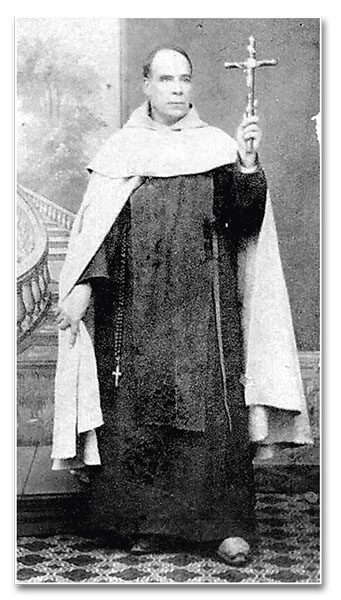 One of the few extant photographs of the Blessed
Future triumph of the Holy Church
A new phase would mark his supernatural relationship with the Mystical Body of Christ. He was in Es Vedrà, on a tempestuous morning in 1865. The peak of the rock was enveloped in a luminous cloud that transformed “the light of the sun into darkness.” 13
In the centre of it, the Church appeared to him, represented by Queen Esther. After amiable greetings, she said: “On various occasions you have given proofs of your love, of your obedience, of your fidelity, of your firmness, of your perseverance and of your loyalty to me; and I have placed my love and my trust in you. From now on, we will deal with the fate and the situation of the Roman Church and your mission in it.” 14
Thus began, in an apex of mystical union, a series of revelations regarding the internal and external evils assailing the Church and those which, in the future, would befall her. At the same time, Fr. Palau contemplated her immortal glory and definitive victory through the intervention of a man filled with the spirit of Elijah.
In this intention he addressed ardent supplications to God and offered austere penances, not neglecting to register his prophetic hopes on the pages of El Ermitaño: “If the true restoration comes, which consists in the conversion of all nations and their kings to God, the restorer cannot be a king, but an apostle; war does not convert, but destroys, and this apostle will be Elijah, the promised Elijah, no matter the name given him when he appears. Whether he is called John, Moses, or Peter matters little: the mission of Elijah will restore human society, because God in His Providence has thus ordained it.” 15
From the militant to the triumphant Church
Since his youth, Blessed Francisco Palau desired to shed his blood for the Holy Church. However, a daily martyrdom of boundless dedication was asked of him, amid misunderstandings, calumnies and sufferings…
The last years of his life were devoted to preaching, exorcism and the juridical consolidation of his foundations. His last days were spent with his spiritual sons who were caring for typhoid fever patients. Taken ill, he arrived at Tarragona in the beginning of 1872, and on March 20 he serenely departed from the Church militant to contemplate the Church triumphant without veils.
Nevertheless, like the towering Es Vedrà defying the fury of the waves, his luminous example soars above the undulations of time and makes his faith in the promise of the Saviour resound throughout history: “Thou art Peter; and upon this rock I will build My Church, and the gates of hell shall not prevail against it” (Mt 16:18). ◊
Notes
1 BLESSED FRANCISCO PALAU Y QUER. La vida solitaria [The Solitary Life], c.2, n.10. In: Obras selectas. Burgos: Monte Carmelo, 1988, p.212.
2 Idem, c.5, n.20, p.215.
3 BLESSED FRANCISCO PALAU Y QUER. La Escuela de la Virtud vindicada [The School of Virtue Vindicated]. L.II, c.2, n.23. In: Obras selectas, op. cit., p.252.
4 BLESSED FRANCISCO PALAU Y QUER. Carta [Letter] 101/115. Al P. Pascual de Jesús María, 1/8/1866, n.2. In: Obras selectas, op. cit., p.852.
5 Idem, ibidem.
6 Idem, n.3.
7 BLESSED FRANCISCO PALAU Y QUER. Mis relaciones con la Iglesia [My relationship with the Church], c.8, n.21. In: Obras selectas, op. cit., p.454.
8 Idem, II, n.3, p.353.
9 Idem, III, n.1, p.354.
10 Idem, c.20, n.6, p.595.
11 Idem, c.12, n.2, p.530.
12 Idem, c.8, n.30, p.459.
13 Idem, n.27, p.457.
14 Idem, n.28.
15 BLESSED FRANCISCO PALAU Y QUER. Anarquía social [Social Anarchy]. In: El Ermitaño. Barcelona. Ano IV. N.114 (12 jan., 1871); p.4.
catholicmagazine.news


