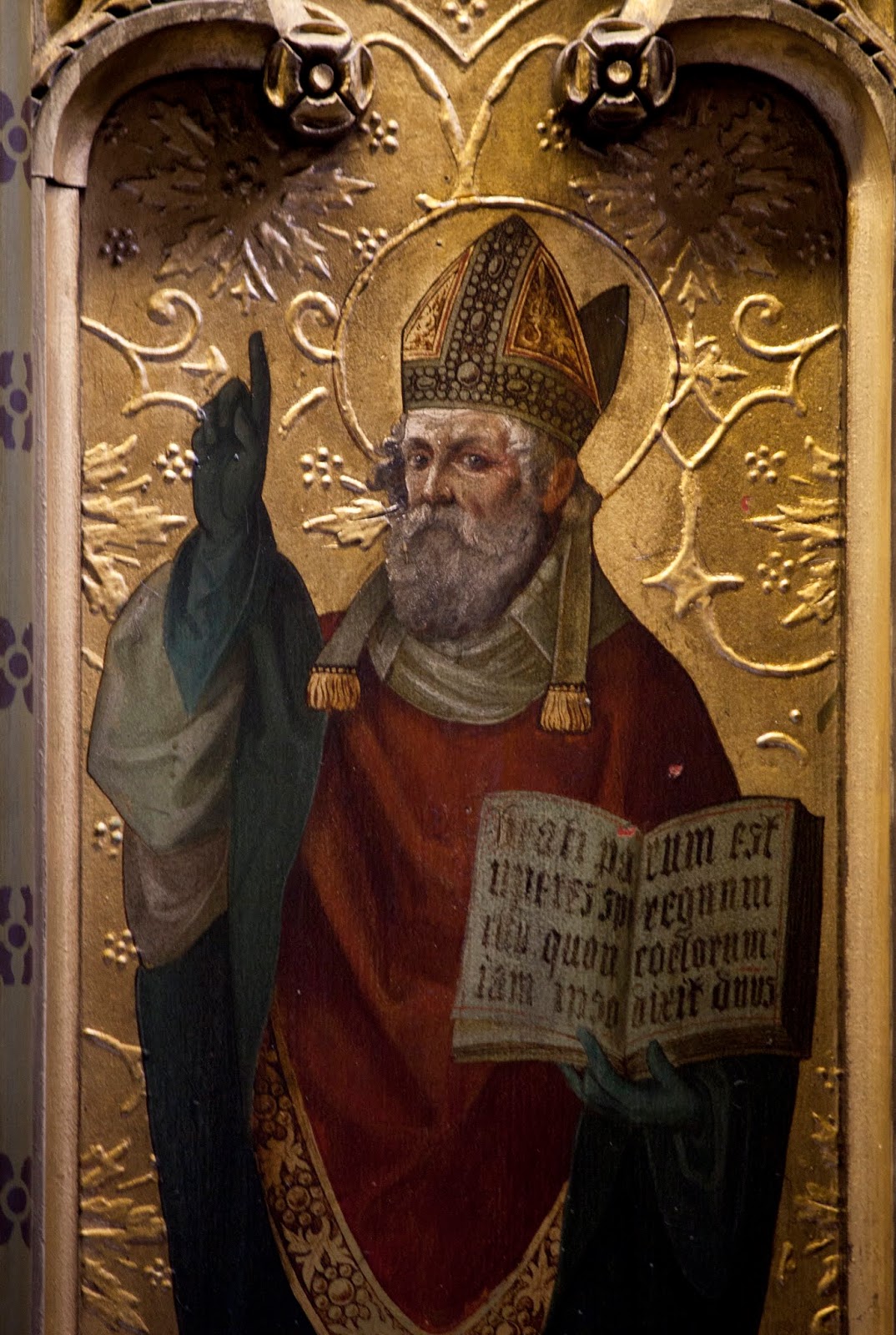
Catena Aurea by St. Thomas Aguinas
10:38–42
38. Now it came to pass, as they went, that he entered into a certain village: and a certain woman named Martha received him into her house.
39. And she had a sister called Mary, which also sat at Jesus’ feet, and heard his word.
40. But Martha was cumbered about much serving, and came to him, and said, Lord, dost thou not care that my sister hath left me to serve alone? bid her therefore that she help me.
41. And Jesus answered and said unto her, Martha, Martha, thou art careful and troubled about many things:
42. But one thing is needful: and Mary hath chosen that good part, which shall not be taken away from her.
BEDE. The love of God and our neighbour, which was contained above in words and parables, is here set forth in very deed and reality; for it is said, Now it came to pass, as they went, that he entered into a certain village.
ORIGEN. The name of which village Luke indeed here omits, but John mentions, calling it Bethany. (John 11.)
AUGUSTINE. (Ser. 103.) But the Lord, who came to his own, and his own received him not, (John 1:12.) was received as a guest, for it follows, And a certain woman named Martha received him into her house, &c. as strangers are accustomed to be received. But still a servant received her Lord, the sick her Saviour, the creature her Creator. But if any should say, “O blessed are they who have been thought worthy to receive Christ into their houses,” grieve not thou, for He says, For inasmuch as ye have done it to the least of my brethren, ye have done it unto me. (Matt. 25:40.) But taking the form of a servant, He wished therein to be fed by servants, by reason of His condescension, not His condition. He had a body in which He was hungry and thirsty, but when He was hungry in the desert, Angels ministered to Him. (Matt. 4:11.) In wishing therefore to be fed, He came Himself to the feeder. Martha then, setting about and preparing to feed our Lord, was occupied in serving; but Mary her sister chose rather to be fed by the Lord, for it follows, And she had a sister called Mary, which also sat at Jesus’ feet, and heard his word.
CHRYSOSTOM. It is not said of Mary simply that she sat near Jesus, but at His feet, to shew her diligence, stedfastness, and zeal, in hearing, and the great reverence which she had for our Lord.
AUGUSTINE. (ubi sup.) Now as was her humility in sitting at His feet, so much the more did she receive from Him. For the waters pour down to the lowest part of the valley, but flow away from the rising of the hill.
BASIL. (Const. Mon. c. 1.) Now every work and word of our Saviour is a rule of piety and virtue. For to this end did He put on our body, that as much as we can we might imitate His conversation.
CYRIL OF ALEXANDRIA. By His own example then He teaches His disciples how they ought to behave in the houses of those who receive them, namely, when they come to a house, they should not remain idle, but rather fill the minds of those who receive them with sacred and divine teaching. But let those who make ready the house, go to meet their guests gladly and earnestly, for two reasons. First, indeed, they will be edified by the teaching of those whom they receive; next also they will receive the reward of charity. And hence it follows here, But Martha was cumbered about much serving, &c.
AUGUSTINE. (ubi sup.) Martha was well engaged in ministering to the bodily wants or wishes of our Lord, as of one who was mortal, but He who was clothed in mortal flesh; in the beginning was the Word. Behold then what Mary heard, The Word was made flesh. Behold then Him to whom Martha ministered. The one was labouring, the other at rest. But yet Martha, when much troubled in her occupation and business of serving, interrupted our Lord, and complained of her sister. For it follows, And said, Lord, dost thou not care that my sister hath left me to serve alone? For Mary was absorbed in the sweetness of our Lord’s words; Martha was preparing a feast for our Lord, in whose feast Mary was now rejoicing. While then she was listening with delight to those sweet words, and was feeding on them with the deepest affection, our Lord was interrupted by her sister. What must we suppose was her alarm, lest the Lord should say to her, “Rise, and help thy sister?” Our Lord therefore, who was not at a loss, for He had shewn He was the Lord, answered as follows, And Jesus answered and said unto her, Martha, Martha. The repetition of the name is a mark of love, or perhaps of drawing the attention, that she should listen more earnestly. When twice called, she hears, Thou art troubled about many things, that is, thou art busied about many things. For man wishes to meet with something when he is serving, and can not; and thus between seeking what is wanting and preparing what is at hand, the mind is distracted. For if Martha had been sufficient of herself, she would not have required the aid of her sister. There are many, there are diverse things, which are carnal, temporal, but one is preferred to many. For one is not from many, but many from one. Hence it follows, But one thing is needful. Mary wished to be occupied about one, according to that, It is good for me to cling close unto the Lord. (Ps. 73:28.) The Father, the Son, the Holy Spirit, are one. To this one he does not bring us, unless we being many have one heart. (Acts 4:32.)
CYRIL OF ALEXANDRIA. Or else, when certain brethren have received God, they will not be anxious about much service, nor ask for those things which are not in their hands, and are beyond their needs. For every where and in every thing that which is superfluous is burdensome. For it begets weariness in those who are wishing to bestow it, while the guests feel that they are the cause of trouble.
BASIL. (in reg. fus. int. 19.) It is foolish also to take food for the support of the body, and thereby in return to hurt the body, and to hinder it in the performance of the divine command. If then a poor man come, let him receive a model and example of moderation in food, and let us not prepare our own tables for their sakes, who wish to live luxuriously. For the life of the Christian is uniform, ever tending to one object, namely, the glory of God. But the life of those who are without is manifold and vacillating, changed about at will. And how in truth canst thou, when thou settest thy table before thy brother with profusion of meats, and for the pleasure of feasting sake, accuse him of luxury, and revile him as a glutton, censuring his indulgence in that which thou thyself affordest him? Our Lord did not commend Martha when busied about much serving.
AUGUSTINE. (Serm. 104.) What then? Must we think that blame was cast upon the service of Martha, who was engaged in the cares of hospitality, and rejoiced in having so great a guest? If this be true, let men give up ministering to the needy; in a word, let them be at leisure, intent only upon getting wholesome knowledge, taking no care what stranger is in the village in want of bread; let works of mercy be unheeded, knowledge only be cultivated.
THEOPHYLACT. Our Lord does not then forbid hospitality, but the troubling about many things, that is to say, hurry and anxiety. And mark the wisdom of our Lord, in that at first He said nothing to Martha, but when she sought to tear away her sister from hearing, then the Lord took occasion to reprove her. For hospitality is ever honoured as long as it keeps us to necessary things. But when it begins to hinder us from attending to what is of more importance, then it is plain that the hearing of the divine word is the more honourable.
AUGUSTINE. (Serm. 104.) Our Lord then does not blame the actions, but distinguishes between the duties. For it follows, Mary hath chosen that good part, &c. Not thine a bad one, but hers a better. Why a better? because it shall not be taken away from her. From thee the necessary burden of business shall one time be taken away. For when thou comest into that country, thou wilt find no stranger to receive with hospitality. But for thy good it shall be taken away, that what is better may be given thee. Trouble shall be taken away, that rest may be given. Thou art yet at sea; she is in port. For the sweetness of truth is eternal, yet in this life it is increased, and in the next it will be made perfect, never to be taken away.
AMBROSE. May you then like Mary be influenced by the desire of wisdom. For this is the greater, this the more perfect work. Nor let the care of ministering to others turn thy mind from the knowledge of the heavenly word, nor reprove or think indolent those whom thou seest seeking after wisdom.
AUGUSTINE. (de Qu. Evang. l. ii. q. 30.) Now mystically, by Martha’s receiving our Lord into her house is represented the Church which now receives the Lord into her heart. Mary her sister, who sat at Jesus’ feet and heard His word, signifies the same Church, but in a future life, where ceasing from labour, and the ministering to her wants, she shall delight in Wisdom alone. But by her complaining that her sister did not help her, occasion is given for that sentence of our Lord, in which he shews that Church to be anxious and troubled about much service, when there is but one thing needful, which is yet attained through the merits of her service; but He says that Mary hath chosen the good part, for through the one the other is reached, which shall not be taken away.
GREGORY. (6. Mor. c. 18.) Or by Mary who sat and heard our Lord’s words, is signified the contemplative life; by Martha engaged in more outward services, the active life. Now Martha’s care is not blamed, but Mary is praised, for great are the rewards of an active life, but those of a contemplative are far better. Hence Mary’s part it is said will never be taken away from her, for the works of an active life pass away with the body, but the joys of the contemplative life the rather begin to increase from the end.
Catena Aurea Luke 10
Saint Paulinus, Bishop of York (+ 644)
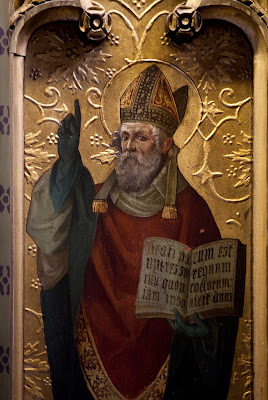 |
| St. Paulinus of York (Feast Day - October 10) |
In the middle 400's the pagan Anglo-Saxons invaded Britain, driving the Christian Britons north and west into Cornwall, Wales, Scotland, and Ireland. In 597 a band of monks headed by Saint Augustine of Canterbury, with the aide and blessing of Pope Gregory the Dialogist, arrived in southeastern England, in the kingdom of Kent, and began to evangelize the people there, with considerable success.
In 601 a second group of monks arrived, including Paulinus (born around 584), together with sacred vessels, altar-cloths, and other ornaments for churches, vestments for priests, relics of the apostles and martyrs, and many books; decreeing by letters from Pope Gregory that when the northern countries should receive the faith, York should be appointed a metropolitan see, in like manner with Canterbury. Sometime after 616, Edwin, the pagan king of Northumbria (the region north of the Humber river--roughly the northern quarter of England), asked for the hand in marriage of Ethelburga, the sister of the king of Kent. He was told that a Christian princess could not marry a pagan, but he promised that she would be free to practice her religion, and that he would listen to Christian preachers, and seriously consider becoming a Christian himself. At this Ethelburga agreed to marry him, and went north in 625, taking with her as chaplain the monk Paulinus, who was consecrated bishop for the purpose by Archbishop Justus of Canterbury.
Edwin heard the preaching of Paulinus for many months, and finally consulted his advisors. Coifi, the high priest of the pagan religion, advised adopting Christianity, since he said that the pagan religion had not proved satisfactory. Another nobleman agreed, saying: "Life is like a banquet hall. Inside is light and fire and warmth and feasting, but outside it is cold and dark. A sparrow flies in through a window at one end, flies the length of the hall, and out through a window at the other end. That is what life is like. At birth we emerge from the unknown, and for a brief while we are here on this earth, with a fair amount of comfort and happiness. But then we fly out the window at the other end, into the cold and dark and unknown future. If the new religion can lighten that darkness for us, then let us follow it." The other elders and counselors of the king gave similar advice, and so in 627 the king and many of his chief men were baptized.
The king was baptized by Bishop Paulinus at York on Easter Sunday in 627, together with his son Osfrid, whom he had by a former wife. The ceremony was performed in a church of wood, raised in haste. King Edwin afterwards began one of stone, which was finished by Saint Oswald. Bede takes notice that churches and fonts not being yet built spacious enough for the crowds that flocked to receive baptism, Saint Paulinus, when the king resided amongst the Deiri, baptized in the river Swale, near Cataract, where the king’s palace stood. Among those baptized by Paulinus were Hilda, later the founding abbess of Whitby Abbey, and Hilda's successor, Eanflaed, Edwin's daughter. As the only Roman bishop in England, Paulinus also consecrated another Gregorian missionary, Honorius, as Archbishop of Canterbury after Justus' death, some time between 628 and 631.
Other conversions followed, and the Church in Northumbria flourished. However, six years later, King Edwin was defeated and killed by Cadwallon of Wales and Penda of Mercia at the battle of Hatfield Chase. Paulinus left his deacon James in charge of what remained of the Church there, and took Queen Ethelburga and her children back to Kent by ship. There the elderly Paulinus was given the bishopric of Rochester, which he held till his death on 10 October 644, having been bishop nineteen years, says Bede (Paulinus sat first eight years at York, from 625 to 633, and afterwards eleven at Rochester, from 633 to 644, in all nineteen years and three months). Bede describes Paulinus as "a man tall of stature, a little stooping, with black hair and a thin face, a hooked and thin nose, his aspect both venerable and awe-inspiring."
johnsanidopoulos.com