Matthew CHAP. 18
18:21–2221. Then came Peter to him, and said, Lord, how oft shall my brother sin against me, and I forgive him? till seven times?
22. Jesus saith unto him, I say not unto thee, Until seven times: but, Until seventy times seven.
JEROME. The Lord had said above, See that ye despise not one of these little ones, and had added, If thy brother sin against thee, &c. making also a promise, If two of you, & c. by which the Apostle Peter was led to ask, Lord, how oft shall my brother sin against me, and I forgive him? And to his question he adds an opinion, Until seven times?
CHRYSOSTOM. (Hom. lxi.) Peter thought that he had made a large allowance; but what answers Christ the Lover of men? it follows, Jesus saith unto him, I say not unto thee, Until seven times, but, Until seventy times seven.
AUGUSTINE. (Serm. 83. 3.) I am bold to say, that if he shall sin seventy-eight times, thou shouldest forgive him; yea, and if a hundred; and how oft soever he sin against thee, forgive him. For if Christ found a thousand sins, yet forgave them all, do not you withdraw your forgiveness. For the Apostle says, Forgiving one another, if any man hath a quarrel against any, even as God in Christ forgave you. (Col. 3:13.)
CHRYSOSTOM. When He says, Until seventy times seven, He does not limit a definite number within which forgiveness must be kept; but He signifies thereby something endless and ever enduring.
AUGUSTINE. (ubi sup.) Yet not without reason did the Lord say, Seventy times seven; for the Law is set forth in ten precepts; and the Law is signified by the number ten, sin by eleven, because it is passing the denary line. Seven is used to be put for a whole, because time goes round in seven days. Take eleven seven times, and you have seventy. He would therefore have all trespasses forgiven, for this is what He signifies by the number seventy-seven.
ORIGEN. Or, because the number six seems to denote toil and labour, and the number seven repose, He says that forgiveness should be given to all brethren who live in this world, and sin in the things of this world. But if any commit transgressions beyond these things, he shall then have no further forgiveness.
JEROME. Or understand it of four hundred and ninety times, that He bids us forgive our brother so oft.
RABANUS. It is one thing to give pardon to a brother when he seeks it, that he may live with us in social charity, as Joseph to his brethren; and another to a hostile foe, that we may wish him good, and if we can do him good, as David mourning for Saul.
18:23–35
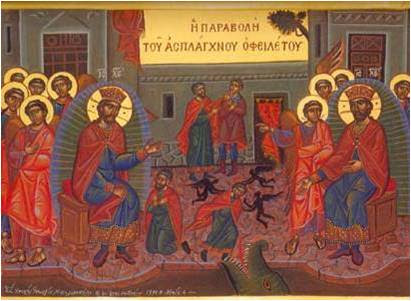
23. Therefore is the kingdom of heaven likened unto a certain king, which would take account of his servants.
24. And when he had begun to reckon, one was brought unto him, which owed him ten thousand talents.
25. But forasmuch as he had not to pay, his lord commanded him to be sold, and his wife, and children, and all that he had, and payment to be made.
26. The servant therefore fell down, and worshipped him, saying, Lord, have patience with me, and I will pay thee all.
27. Then the lord of that servant was moved with compassion, and loosed him, and forgave him the debt.
28. But the same servant went out, and found one of his fellow-servants, which owed him an hundred pence: and he laid hands on him, and took him by the throat, saying, Pay me that thou owest.
29. And his fellowservant fell down at his feet, and besought him, saying, Have patience with me, and I will pay thee all.
30. And he would not: but went and cast him into prison, till he should pay the debt.
31. So when his fellowservants saw what was done, they were very sorry, and came and told unto their lord all that was done.
32. Then his lord, after that he had called him, said unto him, O thou wicked servant, I forgave thee all that debt, because thou desiredst me:
33. Shouldest not thou also have had compassion on thy fellowservant, even as I had pity on thee?
34. And his lord was wroth, and delivered him to the tormentors, till he should pay all that was due unto him.
35. So likewise shall my heavenly Father do also unto you, if ye from your hearts forgive not every one his brother their trespasses.
CHRYSOSTOM. That none should think that the Lord had enjoined something great and burdensome in saying that we must forgive till seventy times seven, He adds a parable.
JEROME. For it is customary with the Syrians, especially they of Palestine, to add a parable to what they speak; that what their hearers might not retain simply, and in itself, the instance and similitude may be the means of retaining.
ORIGEN. The Son of God, as He is wisdom, righteousness, and truth (vid. 1 Cor. 1:30.), so is He a kingdom; not indeed any of those which are beneath, but all those which are above, reigning over those in whose senses reigns justice and the other virtues; these are made of heaven because they bear the image of the heavenly. This kingdom of heaven then, i. e. the Son of God, when He was made in the likeness of sinful flesh, was then like to a king, in uniting man to himself.
REMIGIUS. Or, by the kingdom of heaven is reasonably understood the holy Church, in which the Lord works what He speaks of in this parable. By the man is sometimes represented the Father, as in that, The kingdom of heaven is like to a king, who made a marriage for his son; and sometimes the Son; but here we may take it for both, the Father and the Son, who are one God. God is called a King, inasmuch as He created and governs all things.
ORIGEN. The servants, in these parables, are only they who are employed in dispensing the word, and to whom this business is committed.
REMIGIUS. Or, by the servants of this King are signified all mankind whom He has created for His own praise, and to whom He gave the law of nature; He takes account with them, when He would look into each man’s manners, life, and deeds, that He may render to each according to that He has done; as it follows, And when He had begun to reckon, one was brought unto Him which owed Him ten, thousand talents.
ORIGEN. The King takes account of our, whole life then, when we must all be presented before the judgment-seat of Christ. (2 Cor. 5:10.) We mean not this so as that any should think that the business itself must needs require a long time. For God, when He will scrutinize the minds of all, will by some undescribable power cause every thing that every man has done to pass speedily before the mind of each. He says, And when he began to take account, because the beginning of the judgment is that it begin from the house of God. (1 Pet. 4:17.) At His beginning to take account there is brought unto Him one who owes Him many talents; one, that is, who had wrought great evils; one on whom much had been enjoined, and had yet brought no gain; who perhaps had destroyed as many men as he owed talents; one who was therefore become a debtor of many talents, because he had followed the woman sitting upon a talent of lead, whose name is Iniquity. (Zech. 5:7.)
JEROME. I know that some interpret the man who owed the ten thousand talents to be the devil, and by his wife and children who were to be sold when he persevered in his wickedness, understand foolishness, and hurtful thoughts. For as wisdom is called the wife of the righteous man, so the wife of the unrighteous and the sinner is called foolishness. But how the Lord remits to the devil ten thousand talents, and how he would not remit ten denarii to us his fellow-servants, of this there is no ecclesiastical interpretation, nor is it to be admitted by thoughtful men.
AUGUSTINE. (Serm. 83, 6.) Therefore let us say, that because the Law is set forth in ten precepts, the ten thousand talents which he owed denote all sins which can be done under the Law.
REMIGIUS. Man who sinned of his own will and choice, has no power to rise again by his own endeavour, and has not wherewith to pay, because he finds nothing in himself by which he may loose himself from his sins; whence it follows, And when he had not to pay, his lord commanded him to be sold, and his wife and children, and all that he had, and payment to be made. The fool’s wife is folly, and the pleasure or lust of the flesh.
AUGUSTINE. (Quæst. Ev. i. 25.) This signifies that the transgressor of the decalogue deserves punishment for his lusts and evil deeds; and that is his price; for the price for which they sell is the punishment of him that is damned.
CHRYSOSTOM. This command issued not of cruelty, but of unspeakable tenderness. For he seeks by these terrors to bring him to plead that he be not sold, which fell out, as he shews when he adds, The servant therefore fell down and besought him, saying, Have patience with me, and I will pay thee all.
REMIGIUS. That he says, falling down, shews how the sinner humbled himself, and offered amends. Have patience with me, expresses the sinner’s prayer, begging respite, and space to correct his error. Abundant is the bounty of God, and His clemency to sinners converted, seeing He is ever ready to forgive sins by baptism or penitence, as it follows, But the lord of that servant had mercy upon him, and loosed him, and forgave him the debt.
CHRYSOSTOM. See the exuberance of heavenly love! The servant asked only a brief respite, but he gives him more than he had asked, a full remittance and cancelling of the whole debt. He was minded to have forgiven him from the very first, but he would not have it to be of his own mere motion, but also of the other’s suit, that he might not depart without a gift. But he did not remit the debt till he had taken account, because he would have him know how great debts he set him free of, that by this he should at the least be made more merciful to his fellow servants. And indeed as far as what has gone he was worthy to be accepted; for he made confession, and promised that he would pay the debt, and fell down and begged, and confessed the greatness of his debt. But his after deeds were unworthy of the former, for it follows, But the same servant went out, and found one of his fellow-servants which owed him a hundred denarii.
AUGUSTINE. (Serm. 83. 6.) That He says he owed him a hundred denarii is taken from the same number, ten, the number of the Law. For a hundred times a hundred are ten thousand, and ten times ten are a hundred; and those ten thousand talents and these hundred denarii are still keeping to the number of the Law; in both of them you find sins. Both are debtors, both are suitors for remission; so every man is himself a debtor to God, and has his brother his debtor.
CHRYSOSTOM. But there is as great difference between sins committed against men, and sins committed against God, as between ten thousand talents and a hundred denarii; yea rather there is still greater difference. This appears from the difference of the persons, and from the fewness of the offenders. For when we are seen of man we withhold and are loath to sin, but we cease not daily though God see us, but act and speak all things fearlessly. Not by this only are our sins against God shewn to be more heinous, but also by reason of the benefits which we have received from Him; He gave us being, and has done all things in our behalf, has breathed into us a rational soul, has sent His Son, has opened heaven to us, and made us His sons. If then we should every day die for Him, could we make Him any worthy return? By no means; it should rather redound again to our advantage. But, on the contrary, we offend against His laws.
REMIGIUS. So by him who owed ten thousand talents are represented those that commit the greater crimes; by the debtor of a hundred denarii those who commit the lesser.
JEROME. That this may be made plainer, let us speak it in instances. If any one of you shall have committed an adultery, a homicide, or a sacrilege, these greater sins of ton thousand talents shall be remitted when you beg for it, if you also shall remit lesser offences to those that trespass against you.
AUGUSTINE. (ubi sup.) But this unworthy, unjust servant would not render that which had been rendered to him, for it follows, And he laid hands on him, and held him by the throat, saying, Pay me that thou, owest.
REMIGIUS. That is, he pressed him hardly, that he might exact vengeance from him.
ORIGEN. He therefore, as I suppose, took him by the throat, because he had come forth from the king; for he would not have so handled his fellow servant, if he had not gone forth from the king.
CHRYSOSTOM. By saying, as he went out, He shews that it was not after long time, but immediately, while the favour he had received still sounded in his ears, he abused to wickedness the liberty his lord had accorded him. What the other did is added, And his fellow-servant fell down, and besought him, saying, Have patience with me, and I will pay thee all,
ORIGEN. Observe the exactness of Scripture; the servant who owed many talents fell down, and worshipped the king; he who owed the hundred denarii falling down, did not worship, but besought his fellow servant, saying, Have patience. But the ungrateful servant did not even respect the very words which had saved himself, for it follows, but he would not.
AUGUSTINE. (Quæst. Ev. i. 25.) That is, he nourished such thoughts towards him that he sought his punishment. But he went his way.
REMIGIUS. That is, his wrath was the rather inflamed, to exact vengeance of him; And he cast him into prison, until he should pay the debt; that is, he seized his brother, and exacted vengeance of him.
CHRYSOSTOM. Observe the Lord’s tenderness, and the servant’s cruelty; the one for ten thousand talents, the other for ten denarii; the one a suitor to his fellow, the other to his lord; the one obtained entire remission, the other sought only respite, but he got it not. They who owed nought grieved with him; his fellow-servants, seeing what was done, were very sorry.
AUGUSTINE. (Quæst. Ev. i. 25.) By the fellow-servants is understood the Church, which binds one and looses another.
REMIGIUS. Or perhaps they represent the Angels, or the preachers of the holy Church, or any of the faithful, who when they see a brother whose sins are forgiven refusing to forgive his fellow-servant, they are sorrowful over his perdition. And they came, and told their lord, what was done. They came not in body, but in spirit. To tell their Lord, is to shew the woe and sorrow of the heart in their carriage. It follows, Then his lord called him. He called him by the sentence of death, and bade him pass out of this world, and said unto him, Thou wicked servant, I forgave thee all that debt, because thou prayedst me.
CHRYSOSTOM. When he owed him ten thousand talents, he did not call him wicked, nor did he at all chide him, but had mercy on him; but now when he had been ungenerous to his fellow-servant, then he says to him, Thou wicked servant; and this is what is said, Oughtest thou not to have had mercy upon thy fellow-servant.
REMIGIUS. And it is to be known, that we read no answer made by that servant to his lord; by which it is shewn us, that in the day of judgment, and altogether after this life, all excusing of ourselves shall be out off,
CHRYSOSTOM. Because kindness had not mended him, it remains that he be corrected by punishment; whence it follows, And the lord of that servant was angry, and delivered him to the torturers until he should pay the whole debt. He said not merely, Delivered him, but was angry, this he had not said before; when his Lord commanded that he should be sold; for that was not in wrath, but in love, for his correction; now this is a sentence of penalty and punishment,
REMIGIUS. For God is said then to be wroth, when he takes vengeance on sinners. Torturers are intended for the dæmons, who are always ready to take up lost souls, and torture them in the pangs of eternal punishment. Will any who is once sunk into everlasting condemnation ever come to find season of repentance, and a way to escape? Never; that until is put for infinity; and the meaning is, He shall be ever paying, and shall never quit the debt, but shall be ever under punishment,
CHRYSOSTOM. By this is shewn that his punishment shall be increasing and eternal, and that he shall never pay. And however irrevocable are the graces and callings of God, yet wickedness has that force, that it seems to break even this law.
AUGUSTINE. (Serm. 83, 7.) or God says, Forgive, and ye shall be forgiven; (Luke 6:37.) I have first forgiven, forgive you then after Me; for if you forgive not, I will call you back, and will require again all that I had remitted to you. For Christ neither deceives nor is deceived; and He adds here, Thus will my heavenly Father do unto you, if ye from your hearts forgive not every one his brother their trespasses. It is better that you should cry out with your mouth, and forgive in your heart, than that you should speak smoothly, and be unrelenting in your heart For the Lord adds, From your hearts, to the end that though, out of affection you put him to discipline, yet gentleness should not depart out of your heart. What is more beneficial than the knife of the surgeon? He is rough with the sore that the man may be healed; should he be tender with the sore, the man were lost.
JEROME. Also this, from your hearts, is added to take away all feigned reconciliations. Therefore the Lord’s command to Peter under this similitude of the king and his servant who owed him ten thousand talents, and was forgiven by his lord upon his entreaty, is, that he also should forgive his fellow-servants their lesser trespasses.
ORIGEN. He seeks to instruct us, that we should be ready to shew clemency to those who have done us harm, especially if they offer amends, and plead to have forgiveness.
RABANUS. Allegorically; The servant here who owed the ten thousand talents, is the Jewish people bound to the Ten Commandments in the Law. These the Lord oft forgave their trespasses, when being in difficulties they besought His mercy; but when they were set free, they exacted the utmost with great severity from all their debtors; and of the gentile people which they hated, they required circumcision and the ceremonies of the Law; yea, the Prophets and Apostles they barbarously put to death. For all this the Lord gave them over into the hands of the Romans as to evil spirits, who should punish them with eternal tortures.
Catena Aurea Matthew 18