Catena Aurea by St. Thomas Aguinas
4:31–37
31. And came down to Capernaum, a city of Galilee, and taught them on the sabbath days.
32. And they were astonished at his doctrine: for his word was with power.
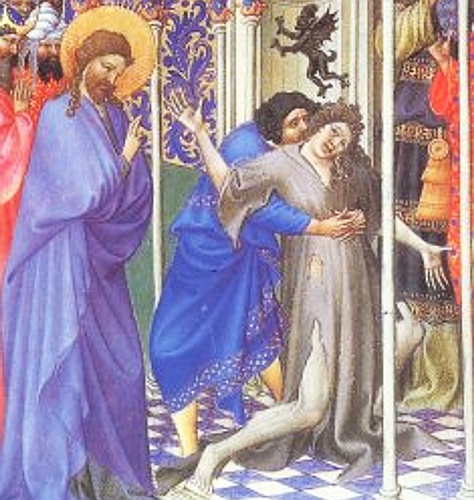
33. And in the synagogue there was a man, which had a spirit of an unclean devil, and cried out with a loud voice,
34. Saying, Let us alone; what have we to do with thee, thou Jesus of Nazareth? art thou come to destroy us? I know thee who thou art; the Holy One of God.
35. And Jesus rebuked him, saying, Hold thy peace, and come out of him. And when the devil had thrown him in the midst, he came out of him, and hurt him not.
36. And they were all amazed, and spake among themselves, saying, What a word is this! for with authority and power he commandeth the unclean spirits, and they come out.
37. And the fame of him went out into every place of the country round about.
AMBROSE. Neither indignation at their treatment, nor displeasure at their wickedness, caused our Lord to abandon Judæa, but unmindful of His injuries, and remembering mercy, at one time by teaching, at another by healing, He softens the hearts of this unbelieving people, as it is said, And he went down to Capernaum.
CYRIL OF ALEXANDRIA. For although He knew that they were disobedient and hard of heart, He nevertheless visits them, as a good Physician tries to heal those who are suffering from a mortal disease. But He taught them boldly in the synagogues, as Esaias saith, I have not spoken in secret, in a dark place of the earth. (Isa. 45:19.) On the sabbath day also He disputed with them, because they were at leisure. They wondered therefore at the mightiness of His teaching, His virtue, and His power, as it follows, And they were astonished at his doctrine, for his word was with power. That is, not soothing, but urging and exciting them to seek salvation. Now the Jews supposed Christ to be one of the saints or prophets. But in order that they might esteem Him higher, He passes beyond the prophetic limits. For he said not, “Thus saith the Lord,” but being the Master of the Law, He uttered things which were above the Law, changing the letter to the truth, and the figures to the spiritual meaning.
BEDE. The word of the teacher is with power, when he performs that which he teaches. But he who by his actions belies what he preaches is despised.
CYRIL OF ALEXANDRIA. But He generally intermingles with His teaching the performance of mighty works. For those whose reason does not incline to knowledge, are roused by the manifestation of miracles. Hence it follows, And there was in the synagogue a man which had a devil.
AMBROSE. The work of divine healing commenced on the sabbath, signifying thereby that he began anew where the old creation ceased, in order that He might declare at the very beginning that the Son of God was not under the Law, but above the Law. Rightly also He began on the sabbath, that He might shew Himself the Creator, who interweaves His works one within another, and follows up that which He had before begun; just as a builder determining to reconstruct a house, begins to pull down the old one, not from the foundation, but from the top, so as to apply his hand first to that part, where he had before left off. Holy men may through the word of God deliver from evil spirits, but to bid the dead rise again, is the work of Divine power alone.
CYRIL OF ALEXANDRIA. But the Jews spoke falsely of the glory of Christ, saying, He casteth out devils by Beelzebub the prince of the devils. To remove this charge, when the devils came beneath His invincible power, and endured not the Divine Presence, they sent forth a savage cry, as it follows: And he cried with a loud voice, saying, Let us alone; what have we to do with thee, &c.
BEDE. As if he said, Abstain a while from troubling me, thou who hast no fellowship with our designs.
AMBROSE. It ought not to shock any one that the devil is mentioned in this book as the first to have spoken the name of Jesus of Nazareth. For Christ received not from him that name which an Angel brought down from heaven to the Virgin. The devil is of such effrontery, that he is the first to use a thing among men and bring it as something new to them, that he may strike people with terror at his power. Hence it follows: For I know thee who thou art, the Holy One of God.
ATHANASIUS. (ad Epise. Æg. et Lib.) He spoke of Him not as a Holy One of God, as if He were like to the other saints, but as being in a remarkable manner the Holy One, with the addition of the article. For He is by nature holy by partaking of whom all others are called holy. Nor again did He speak this as if He knew it, but He pretended to know it.
CYRIL OF ALEXANDRIA. (et Tit. Bost.) For the devils thought by praises of this sort to make Him a lover of vainglory, that He might be induced to abstain from opposing or destroying them by way of grateful return.
CHRYSOSTOM. The devil wished also to disturb the order of things, and to deprive the Apostles of their dignity, and to incline the many to obey Him.
ATHANASIUS. (ut sup.) Although he confessed the truth he controlled his tongue, lest with the truth he should also publish his own disgrace, which should teach us not to care for such, although they speak the truth, for we who know the divine Scripture, must not be taught by the devil, as it follows: And Jesus rebuked him, saying, Be silent, &c.
BEDE. But by the permission of God, the man who was to be delivered from the devil is thrown into the midst, that the power of the Saviour being manifested might bring over many to the way of salvation. As it follows: And when he had thrown him in the midst. But this seems to be opposed to Mark, who says, And the unclean spirit tearing him, and crying with a loud voice, went out of him, unless we understand that Mark meant by tearing him the same as Luke by these words, And when he had thrown him in the midst, so that what follows, and hurt him not, might be understood to mean, that that twisting of limbs, and sore troubling, did not weaken him, as is often the case when devils depart from a man, leaving him with limbs cut and torn off. Well then do they wonder at such complete restoration of health. For it follows: And fear came upon all.
THEOPHYLACT. As if they said, What is this word by which he commands, Go out, and he went out?
BEDE. Holy men were able by the word of God to cast out devils, but the Word Himself does mighty works by His own power.
AMBROSE. In a mystery, the man in the synagogue with the unclean spirit is the Jewish people, which being fast bound in the wiles of the devil, defiled its vaunted cleanliness of body by the pollution of the heart. And truly it had an unclean spirit, because it had lost the Holy Spirit. For the devil entered whence Christ had gone out.
THEOPHYLACT. We must know also that many now have devils, namely, such as fulfil the desires of devils, as the furious have the dæmon of anger; and so of the rest. But the Lord came into the synagogue when the thoughts of the man were collected, and then says to the dæmon that dwelt there, Hold thy peace, and immediately throwing him into the middle he departs out of him. For it becomes not a man always to be angry, (that is, like the brutes,) nor always to be without anger, (for that is want of feeling,) but he must take the middle path, and have anger against what is evil; and so the man is thrown into the midst when the unclean spirit departs from him.
Catena Aurea Luke 4
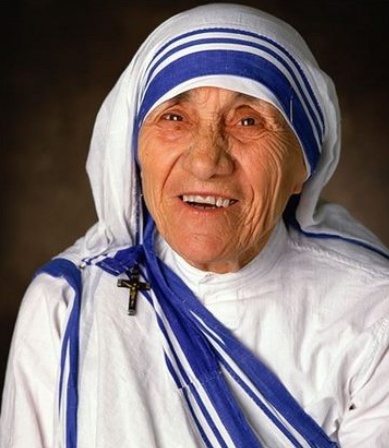
Mother Teresa of Calcutta
“By blood, I am Albanian. By citizenship, an Indian. By faith, I am a Catholic nun. As to my calling, I belong to the world. As to my heart, I belong entirely to the Heart of Jesus. ”Small of stature, rocklike in faith, Mother Teresa of Calcutta was entrusted with the mission of proclaiming God’s thirsting love for humanity, especially for the poorest of the poor. “God still loves the world and He sends you and me to be His love and His compassion to the poor.” She was a soul filled with the light of Christ, on fire with love for Him and burning with one desire: “to quench His thirst for love and for souls.”
This luminous messenger of GodÂ’s love was born on 26 August 1910 in Skopje, a city situated at the crossroads of Balkan history. The youngest of the children born to Nikola and Drane Bojaxhiu, she was baptised Gonxha Agnes, received her First Communion at the age of five and a half and was confirmed in November 1916. From the day of her First Holy Communion, a love for souls was within her. Her father’s sudden death when Gonxha was about eight years old left in the family in financial straits. Drane raised her children firmly and lovingly, greatly influencing her daughter’s character and vocation. Gonxha’s religious formation was further assisted by the vibrant Jesuit parish of the Sacred Heart in which she was much involved.
At the age of eighteen, moved by a desire to become a missionary, Gonxha left her home in September 1928 to join the Institute of the Blessed Virgin Mary, known as the Sisters of Loreto, in Ireland. There she received the name Sister Mary Teresa after St. Thérèse of Lisieux. In December, she departed for India, arriving in Calcutta on 6 January 1929. After making her First Profession of Vows in May 1931, Sister Teresa was assigned to the Loreto Entally community in Calcutta and taught at St. Mary’s School for girls. On 24 May 1937, Sister Teresa made her Final Profession of Vows, becoming, as she said, the “spouse of Jesus” for “all eternity.” From that time on she was called Mother Teresa. She continued teaching at St. Mary’s and in 1944 became the school’s principal. A person of profound prayer and deep love for her religious sisters and her students, Mother TeresaÂ’s twenty years in Loreto were filled with profound happiness. Noted for her charity, unselfishness and courage, her capacity for hard work and a natural talent for organization, she lived out her consecration to Jesus, in the midst of her companions, with fidelity and joy.
On 10 September 1946 during the train ride from Calcutta to Darjeeling for her annual retreat, Mother Teresa received her “inspiration,” her “call within a call.” On that day, in a way she would never explain, Jesus’ thirst for love and for souls took hold of her heart and the desire to satiate His thirst became the driving force of her life. Over the course of the next weeks and months, by means of interior locutions and visions, Jesus revealed to her the desire of His heart for “victims of love” who would “radiate His love on souls.” “Come be My light,” He begged her. “I cannot go alone.” He revealed His pain at the neglect of the poor, His sorrow at their ignorance of Him and His longing for their love. He asked Mother Teresa to establish a religious community, Missionaries of Charity, dedicated to the service of the poorest of the poor. Nearly two years of testing and discernment passed before Mother Teresa received permission to begin. On August 17, 1948, she dressed for the first time in a white, blue-bordered sari and passed through the gates of her beloved Loreto convent to enter the world of the poor.
After a short course with the Medical Mission Sisters in Patna, Mother Teresa returned to Calcutta and found temporary lodging with the Little Sisters of the Poor. On 21 December she went for the first time to the slums. She visited families, washed the sores of some children, cared for an old man lying sick on the road and nursed a woman dying of hunger and TB. She started each day in communion with Jesus in the Eucharist and then went out, rosary in her hand, to find and serve Him in “the unwanted, the unloved, the uncared for.” After some months, she was joined, one by one, by her former students.
On 7 October 1950 the new congregation of the Missionaries of Charity was officially established in the Archdiocese of Calcutta. By the early 1960s, Mother Teresa began to send her Sisters to other parts of India. The Decree of Praise granted to the Congregation by Pope Paul VI in February 1965 encouraged her to open a house in Venezuela. It was soon followed by foundations in Rome and Tanzania and, eventually, on every continent. Starting in 1980 and continuing through the 1990s, Mother Teresa opened houses in almost all of the communist countries, including the former Soviet Union, Albania and Cuba.
In order to respond better to both the physical and spiritual needs of the poor, Mother Teresa founded the Missionaries of Charity Brothers in 1963, in 1976 the contemplative branch of the Sisters, in 1979 the Contemplative Brothers, and in 1984 the Missionaries of Charity Fathers. Yet her inspiration was not limited to those with religious vocations. She formed the Co-Workers of Mother Teresa and the Sick and Suffering Co-Workers, people of many faiths and nationalities with whom she shared her spirit of prayer, simplicity, sacrifice and her apostolate of humble works of love. This spirit later inspired the Lay Missionaries of Charity. In answer to the requests of many priests, in 1981 Mother Teresa also began the Corpus Christi Movement for Priests as a “little way of holiness” for those who desire to share in her charism and spirit.
During the years of rapid growth the world began to turn its eyes towards Mother Teresa and the work she had started. Numerous awards, beginning with the Indian Padmashri Award in 1962 and notably the Nobel Peace Prize in 1979, honoured her work, while an increasingly interested media began to follow her activities. She received both prizes and attention “for the glory of God and in the name of the poor.”
The whole of Mother Teresa’s life and labour bore witness to the joy of loving, the greatness and dignity of every human person, the value of little things done faithfully and with love, and the surpassing worth of friendship with God. But there was another heroic side of this great woman that was revealed only after her death. Hidden from all eyes, hidden even from those closest to her, was her interior life marked by an experience of a deep, painful and abiding feeling of being separated from God, even rejected by Him, along with an ever-increasing longing for His love. She called her inner experience, “the darkness.” The “painful night” of her soul, which began around the time she started her work for the poor and continued to the end of her life, led Mother Teresa to an ever more profound union with God. Through the darkness she mystically participated in the thirst of Jesus, in His painful and burning longing for love, and she shared in the interior desolation of the poor.
During the last years of her life, despite increasingly severe health problems, Mother Teresa continued to govern her Society and respond to the needs of the poor and the Church. By 1997, Mother Teresa’s Sisters numbered nearly 4,000 members and were established in 610 foundations in 123 countries of the world. In March 1997 she blessed her newly-elected successor as Superior General of the Missionaries of Charity and then made one more trip abroad. After meeting Pope John Paul II for the last time, she returned to Calcutta and spent her final weeks receiving visitors and instructing her Sisters. On 5 September Mother Teresa’s earthly life came to an end. She was given the honour of a state funeral by the Government of India and her body was buried in the Mother House of the Missionaries of Charity. Her tomb quickly became a place of pilgrimage and prayer for people of all faiths, rich and poor alike. Mother Teresa left a testament of unshakable faith, invincible hope and extraordinary charity. Her response to Jesus’ plea, “Come be My light,” made her a Missionary of Charity, a “mother to the poor,” a symbol of compassion to the world, and a living witness to the thirsting love of God.
Less than two years after her death, in view of Mother Teresa’s widespread reputation of holiness and the favours being reported, Pope John Paul II permitted the opening of her Cause of Canonization. On 20 December 2002 he approved the decrees of her heroic virtues and miracles.
Homily of John Paul II
vatican.va