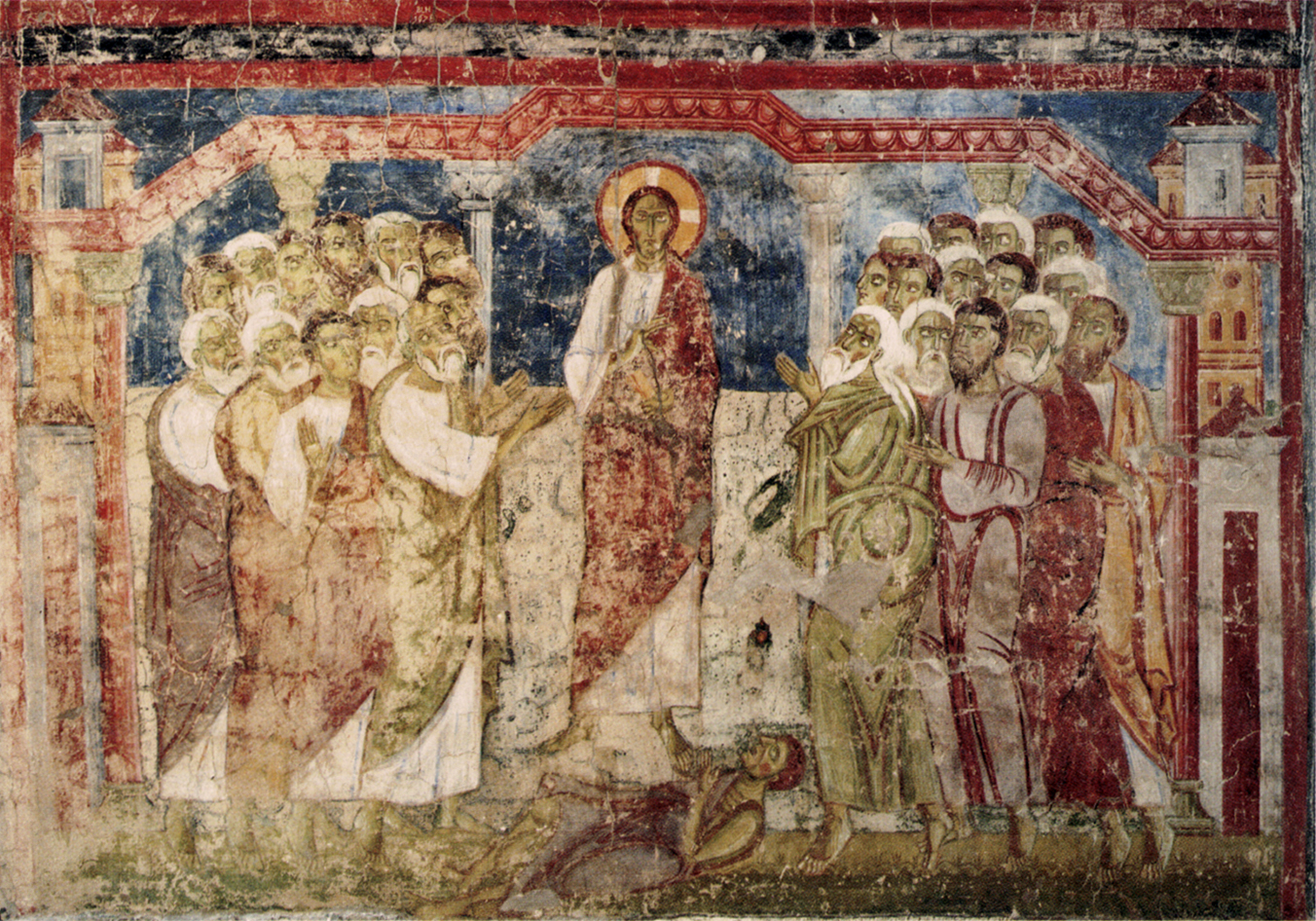
4:14–21
14. And Jesus returned in the power of the Spirit into Galilee: and there went out a fame of him through all the region round about.
15. And he taught in their synagogues, being glorified of all.
16. And he came to Nazareth, where he had been brought up: and, as his custom was, he went into the synagogue on the sabbath day, and stood up for to read.
17. And there was delivered unto him the book of the prophet Esaias. And when he had opened the book, he found the place where it was written,
18. The Spirit of the Lord is upon me, because he hath anointed me to preach the Gospel to the poor: he hath sent me to heal the brokenhearted, to preach deliverance to the captives, and recovering of sight to the blind, to set at liberty them that are bruised,
19. To preach the acceptable year of the Lord.
20. And he closed the book, and he gave it again to the minister, and sat down. And the eyes of all them that were in the synagogue were fastened on him.
21. And he began to say unto them, This day is this Scripture fulfilled in your ears.
ORIGEN. The Lord having overcome the tempter, power was added to Him, i. e. as far as regards the manifestation of it. Hence it is said, And Jesus returned in the power of the Spirit.
BEDE. By the power of the Spirit he means shewing forth of miracles.
CYRIL OF ALEXANDRIA. Now He performed miracles not from any external power, and from having as it were the acquired grace of the Holy Spirit, as other saints, but rather as being by nature the Son of God, and partaking of all things which are the Father’s, He exercises as by His own power and operation that grace which is of the Holy Spirit. But it was right that from that time He should become known, and that the mystery of His humanity should shine forth among those who were of the seed of Israel. It therefore follows, And his fame went out.
BEDE. And because wisdom belongs to teaching, but power to works, both are joined here, as it follows, And he taught in the synagogue.
Synagogue, which is a Greek word, is rendered in Latin congregatio. By this name then the Jews were accustomed to call not only the gathering together of people, but also the house where they met together to hear the word of God; as we call by the name of Church, both the place and the company of the faithful. But there is this difference between the synagogue which is called congregation, and the Church which is interpreted convocation, that flocks and cattle, and any thing else can be gathered together in one, but only rational beings can be called together. Accordingly the Apostolical doctors thought right to call a people which was distinguished by the superior dignity of a new grace rather by the name of Church, than Synagogue. But rightly also was the fact of His being magnified by those present proved, by actual evidence of word and deed, as it follows, And he was magnified by all.
ORIGEN. But you must not think that they only were happy, and that you are deprived of Christ’s teaching. For now also throughout the world He teaches through His instruments, and is now more glorified by all men, than at that time when those only in one province were gathered together.
CYRIL OF ALEXANDRIA. He communicates the knowledge of Himself to those among whom He was brought up according to the flesh. As it follows, And he came to Nazareth.
THEOPHYLACT. That He might teach us to benefit and instruct first our brethren, then to extend our kindness to the rest of our friends.
BEDE. They flocked together on the Sabbath day in the synagogues, that, resting from all worldly occupations, they might set themselves down with a quiet mind to meditate on the precepts of the Law. Hence it follows, And he entered as was his custom on the Sabbath day into the synagogue.
AMBROSE. The Lord in every thing so humbled Himself to obedience, that He did not despise even the office of a reader, as it follows, And he rose up to read, and there was delivered unto him the book, &c. He received the book indeed, that He might shew Himself to be the same who spoke in the Prophets, and that He might stop the blasphemies of the wicked, who say that there is one God of the Old Testament, another of the New; or who say that Christ had His beginning from a virgin. For how did He begin from a virgin, who spoke before that virgin was?
ORIGEN. He opens not the book by chance, and finds a chapter containing a prophecy of Himself, but by the providence of God. Hence it follows, And when he had opened the book, he found the place, &c. (Is. 61:1.)
ATHANASIUS. (Orat. 2. cont. Arian.) He says this to explain to us the cause of the revelation made to the world, and of His taking upon Him the human nature. For as the Son, though He is the giver of the Spirit, does not refuse to confess as man that by the Spirit He casts out devils, so, inasmuch as He was made man, He does not refuse to say, The Spirit of the Lord is upon me.
CYRIL OF ALEXANDRIA. In like manner we confess Him to have been anointed, inasmuch as He took upon Him our flesh, as it follows, Because he hath anointed me. For the Divine nature is not anointed, but that which is cognate to us. So also when He says that He was sent, we must suppose Him speaking of His human nature. For it follows, He hath sent me to preach the gospel to the poor.
AMBROSE. You see the Trinity coeternal and perfect. The Scripture speaks of Jesus as perfect God and perfect man. It speaks of the Father, and the Holy Spirit, who was shewn to be a cooperator, when in a bodily form as a dove He descended upon Christ.
ORIGEN. By the poor He means the Gentile nations, for they were poor, possessing nothing at all, having neither God, nor Law, nor Prophets, nor justice, and the other virtues.
AMBROSE. Or, He is anointed all over with spiritual oil, and heavenly virtue, that He might enrich the poverty of man’s condition with the everlasting treasure of His resurrection.
BEDE. He is sent also to preach the Gospel to the poor, saying, Blessed are the poor, for yours is the kingdom of heaven.
CYRIL OF ALEXANDRIA. For perhaps to the poor in spirit He declares in these words, that among all the gifts which are obtained through Christ, upon them was bestowed a free gift. It follows, To heal the broken hearted. He calls those broken hearted, who are weak, of an infirm mind, and unable to resist the assaults of the passions, and to them He promises a healing remedy.
BASIL. (non occ.) Or, He came to heal the broken hearted, i. e. to afford a remedy to those that have their heart broken by Satan through sin, because beyond all other things sin lays prostrate the human heart.
BEDE. Or, because it is written, A broken and a contrite heart God will not despise. (Ps. 51:17.) He says therefore, that He is sent to heal the broken hearted, as it is written, Who heals the broken hearted. (Ps. 147:3.)
It follows, And to preach deliverance to the captives.
CHRYSOSTOM. (in Ps. 125.) The word captivity has many meanings. There is a good captivity, which St. Paul speaks of when he says, Bringing into captivity every thought to the obedience of Christ. (2 Cor. 10:5.) There is a bad captivity also, of which it is said, Leading captive silly women laden with sins. (2 Tim. 3:6.) There is a captivity present to the senses, that is by our bodily enemies. But the worst captivity is that of the mind, of which he here speaks. For sin exercises the worst of all tyrannies, commanding to do evil, and destroying them that obey it. From this prison of the soul Christ lets us free.
THEOPHYLACT. But these things may be understood also of the dead, who being taken captive have been loosed from the dominion of hell by the resurrection of Christ. It follows, And recovering of sight to the blind.
CYRIL OF ALEXANDRIA. For the darkness which the Devil has spread over the human heart, Christ the Sun of Righteousness has removed, making men, as the Apostle says, children not of night and darkness, but of light and the day. (1 Thess. 5:5.) For they who one time wandered have discovered the path of the righteous. It follows, To set at liberty them that are bruised.
ORIGEN. For what had been so shattered and dashed about as man, who was set at liberty by Jesus and healed?
BEDE. Or, to set at liberty them that are bruised; i. e. to relieve those who had been heavy laden with the intolerable burden of the Law.
ORIGEN. But all these things were mentioned first, in order that after the recovery of sight from blindness, after deliverance from captivity, after being healed of divers wounds, we might come to the acceptable year of the Lord. As it follows, To preach the acceptable year of the Lord. Some say that, according to the simple meaning of the word, the Saviour preached the Gospel throughout Judæa in one year, and that this is what is meant by preaching the acceptable year of the Lord. Or, the acceptable year of the Lord is the whole time of the Church, during which while present in the body, it is absent from the Lord.
BEDE. For not only was that year acceptable in which our Lord preached, but that also in which the Apostle preaches, saying, Behold, now is the accepted time. (2 Cor. 6:2.) After the acceptable year of the Lord, he adds, And the day of retribution;a that is, the final retribution, when the Lord shall give to every one according to his work.
AMBROSE. Or, by the acceptable year of the Lord, he means this day extended through endless ages, which knows of no return to a world of labour, and grants to men everlasting reward and rest. It follows, And he closed the book, and he gave it again.
BEDE. He read the book to those who were present to hear Him, but having read it, He returned it to the minister; for while He was in the world He spoke openly, teaching in the synagogues and in the temple; but about to return to heaven, He committed the office of preaching the Gospel to those who from the beginning were eye-witnesses and ministers of the word. He read standing, because while explaining those Scriptures which were written of Him, He condescended to work in the flesh; but having returned the book, He sits down, because He restored Himself to the throne of heavenly rest. For standing is the part of the workman, but sitting of one who is resting or judging. So also let the preacher of the word rise up and read and work and preach, and sit down, i. e. wait for the reward of rest. But He opens the book and reads, because sending the Spirit, He taught His Church all truth; having shut the book, He returned it to the minister, because all things were not to be said unto all, but He committed the word to the teacher to be dispensed according to the capacity of the hearers. It follows, And the eyes of all in the synagogue were fastened on him.
ORIGEN. And now also if we will, our eyes can look upon the Saviour. For when you direct your whole heart to wisdom, truth, and the contemplation of the only-begotten Son of God, your eyes behold Jesus.
CYRIL OF ALEXANDRIA. But then He turned the eyes of all men upon Him, wondering how He knew the writing which He had never learnt. But since it was the custom of the Jews to say that the prophecies spoken of Christ are completed either in certain of their chiefs, i. e. their kings, or in some of their holy prophets, the Lord made this announcement; as it follows, But he began to say unto them that this Scripture is fulfilled.
BEDE. Because, in fact, as that Scripture had foretold, the Lord was both doing great things, and preaching greater.
4:22–27
22. And all bare him witness, and wondered at the gracious words which proceeded out of his mouth. And they said, Is not this Joseph’s son?
23. And he said unto them, Ye will surely say unto me this proverb, Physician, heal thyself: whatsoever we have heard done in Capernaum, do also here in thy country.
24. And he said, Verily I say unto you, No prophet is accepted in his own country.
25. But I tell you of a truth, many widows were in Israel in the days of Elias, when the heaven was shut up three years and six months, when great famine was throughout all the land;
26. But unto none of them was Elias sent, save unto Sarepta, a city of Sidon, unto a woman that was a widow.
27. And many lepers were in Israel in the time of Eliseus the prophet; and none of them was cleansed, saving Naaman the Syrian.
CHRYSOSTOM. (Hom. 48. in Matt.) When our Lord came to Nazareth, He refrains from miracles, lest He should provoke the people to greater malice. But He sets before them His teaching no less wonderful than His miracles. For there was a certain ineffable grace in our Saviour’s words which softened the hearts of the hearers. Hence it is said, And they all bare him witness.
BEDE. They bare Him witness that it was truly He, as He had said, of whom the prophet had spoken.
CHRYSOSTOM. (ubi sup.) But foolish men though wondering at the power of His words little esteemed Him because of His reputed father. Hence it follows, And they said, Is not this the son of Joseph?
CYRIL OF ALEXANDRIA. But what prevents Him from filling men with awe, though He were the Son as was supposed of Joseph? Do you not see the divine miracles, Satan already prostrate, men released from their sickness?
CHRYSOSTOM. (ubi sup.) For though after a long time and when He had begun to shew forth His miracles, He came to them; they did not receive Him, but again were inflamed with envy. Hence it follows, And he said unto them, Ye will surely say unto me this proverb, Physician, heal thyself.
CYRIL OF ALEXANDRIA. It was a common proverb among the Hebrews, invented as a reproach, for men used to cry out against infirm physicians, Physician, heal thyself.
GLOSS. (ordin.) It was as if they said, We have heard that you performed many cures in Capernaum; cure also thyself, i. e. Do likewise in your own city, where you were nourished and brought up.
AUGUSTINE. (de Cons. Ev. lib. ii. 42.) But since St. Luke mentions that great things had been already done by Him, which he knows he had not yet related, what is more evident than that he knowingly anticipated the relation of them. For he had not proceeded so far beyond our Lord’s baptism as that he should be supposed to have forgotten that he had not yet related any of those things which were done in Capernaum.
AMBROSE. But the Saviour purposely excuses Himself for not working miracles in His own country, that no one might suppose that love of country is a thing to be lightly esteemed by us. For it follows, But he says, Verily I say unto you, that no prophet is accepted in his own country.
CYRIL OF ALEXANDRIA. As if He says, You wish me to work many miracles among you, in whose country I have been brought up, but I am aware of a very common failing in the minds of many. To a certain extent it always happens, that even the very best things are despised when they fall to a man’s lot, not scantily, but ever at his will. So it happens also with respect to men. For a friend who is ever at hand, does not meet with the respect due to him.
BEDE. Now that Christ is called a Prophet in the Scriptures, Moses bears witness, saying, God shall raise up a Prophet unto you from among your brethren. (Deut. 18:15.)
AMBROSE. But this is given for an example, that in vain can you expect the aid of Divine mercy, if you grudge to others the fruits of their virtue. The Lord despises the envious, and withdraws the miracles of His power from them that are jealous of His divine blessings in others. For our Lord’s Incarnation is an evidence of His divinity, and His invisible things are proved to us by those which are visible. See then what evils envy produces. For envy a country is deemed unworthy of the works of its citizen, which was worthy of the conception of the Son of God.
ORIGEN. As far as Luke’s narrative is concerned, our Lord is not yet said to have worked any miracle in Capernaum. For before He came to Capernaum, He is said to have lived at Nazareth. I cannot but think therefore that in these words, “whatsoever we have heard done in Capernaum,” there lies a mystery concealed, and that Nazareth is a type of the Jews, Capernaum of the Gentiles. For the time will come when the people of Israel shall say, “The things which thou hast shewn to the whole world, shew also to us.” Preach thy word to the people of Israel, that then at least, when the fulness of the Gentiles has entered, all Israel may be saved. Our Saviour seems to me to have well answered, No prophet is accepted in his own country, but rather according to the type than the letter; though neither was Jeremiah accepted in Anathoth his country, nor the rest of the Prophets. But it seems rather to be meant that we should say, that the people of the circumcision were the countrymen of all the Prophets. And the Gentiles indeed accepted the prophecy of Jesus Christ, esteeming Moses and the Prophets who preached of Christ, far higher than they who would not from these receive Jesus.
AMBROSE. By a very apt comparison the arrogance of envious citizens is put to shame, and our Lord’s conduct shewn to agree with the ancient Scriptures. For it follows, But I tell you of a truth, many widows were in Israel in the days of Elias: not that the days were his, but that he performed his works in them.
CHRYSOSTOM. He himself, an earthly angel, a heavenly man, who had neither house, nor food, nor clothing like others, carries the keys of the heavens on his tongue. And this is what follows, When the heaven was shut. But as soon as he had closed the heavens and made the earth barren, hunger reigned and bodies wasted away, as it follows, when there was a famine through the land.
BASIL. (Hom. 2. de jejun. Hom. de fame.) For when he beheld the great disgrace that arose from universal plenty, he brought a famine that the people might fast, by which he checked their sin which was exceeding great. But crows were made the ministers of food to the righteous, which are wont to steal the food of others.
CHRYSOSTOM. (Hom. in Pet. et Eli.) But when the stream was dried up by which the cup of the righteous man was filled, God said, Go to Sarepta, a city of Sidon; there I wall command a widow woman to feed you. As it follows, But to none of them was Elias sent, save unto Sarepta, a city of Sidon, unto a woman that was a widow. And this was brought to pass by a particular appointment of God. For God made him go a long journey, as far as Sidon, in order that having seen the famine of the country he should ask for rain from the Lord. But there were many rich men at that time, but none of them did any thing like the widow. For in the respect shewn by the woman toward the prophet, consisted her riches not of lands, but of good will.
AMBROSE. But he says in a mystery, “In the days of Elias,” because Elias brought the day to them who saw in his works the light of spiritual grace, and so the heaven was opened to them that beheld the divine mystery, but was shut when there was famine, because there was no fruitfulness in acknowledging God. But in that widow to whom Elias was sent was prefigured a type of the Church.
ORIGEN. For when a famine came upon the people of Israel, i. e. of hearing the word of God, a prophet came to a widow, of whom it is said, For the desolate hath many more children than she which hath an husband; (Isa. 54:1, Gal. 4:27.) and when he had come, he multiplies her bread and her nourishment.
BEDE. Sidonia signifies a vain pursuit, Sarepta fire, or scarcity of bread. By all which things the Gentiles are signified, who, given up to vain pursuits, (following gain and worldly business,) were suffering from the flames of fleshly lusts, and the want of spiritual bread, until Elias, (i. e. the word of prophecy,) now that the interpretation of the Scriptures had ceased because of the faithlessness of the Jews, came to the Church, that being received into the hearts of believers he might feed and refresh them.
BASIL. (Hom. in div.) Every widowed soul, bereft of virtue and divine knowledge, as soon as she receives the divine word, knowing her own failings, learns to nourish it with the bread of virtue, and to water the teaching of virtue from the fountain of life.
ORIGEN. He cites also another similar example, adding, And there were many lepers in Israel at the time of Eliseus the Prophet, and none of them were cleansed but Naaman the Syrian, who indeed was not of Israel.
AMBROSE. Now in a mystery the people pollute the Church, that another people might succeed, gathered together from foreigners, leprous indeed at first before it is baptized in the mystical stream, but which after the sacrament of baptism, washed from the stains of body and soul, begins to be a virgin without spot or wrinkle.
BEDE. For Naaman, which means beautiful, represents the Gentile people, who is ordered to be washed seven times, because that baptism saves which the seven-fold Spirit renews. His flesh after washing began to appear as a child’s, because grace like a mother begets all to one childhood, or because he is conformed to Christ, of whom it is said, Unto us a Child is born. (Isa. 9:6.)
4:28–30
28. And all they in the synagogue, when they heard these things, were filled with wrath,
29. And rose up, and thrust him out of the city, and led him unto the brow of the hill whereon their city was built, that they might cast him down head-long.
30. But he passing through the midst of them went his way.
CYRIL OF ALEXANDRIA. He convicted them of their evil intentions, and therefore they are enraged, and hence what follows, And all they in the synagogue when they heard these things were filled with wrath. Because He had said, This day is this prophecy fulfilled, they thought that He compared Himself to the prophets, and are therefore enraged, and expel Him out of their city, as it follows, And they rose up, and cast him out.
AMBROSE. It can not be wondered at that they lost their salvation who cast the Saviour out of their city. But the Lord who taught His Apostles by the example of Himself to be all things to all men, neither repels the willing, nor chooses the unwilling; neither struggles against those who cast Him out, nor refuses to hear those who supplicate Him. But that conduct was the result of no slight enmity, which, forgetful of the feelings of fellow citizens, converts the causes of love into the bitterest hatred. For when the Lord Himself was extending His blessings among the people, they began to inflict injuries upon Him, as it follows, And they led him unto the brow of the hill, that they might cast him down.
BEDE. Worse are the Jewish disciples than their master the Devil. For he says, Cast thyself down; they actually attempt to cast Him down. But Jesus having suddenly changed His mind, or seized with astonishment, went away, since He still reserves for them a place of repentance. Hence it follows, He passing through the midst of them went his way.
CHRYSOSTOM. (48. in Joann.) Herein He shews both His human nature and His divine. To stand in the midst of those who were plotting against Him, and not be seized, betokened the loftiness of His divinity; but His departure declared the mystery of the dispensation, i. e. His incarnation.
AMBROSE. At the same time we must understand that this bodily endurance was not necessary, but voluntary. When He wills, He is taken, when He wills, He escapes. For how could He be held by a few who was not held by a whole people? But He would not have the impiety to be the deed of the many, in order that by a few indeed He might be afflicted, but might die for the whole world. Moreover, He had still rather heal the Jews than destroy them, that by the fruitless issue of their rage they might be dissuaded from wishing what they could not accomplish.
BEDE. The hour of His Passion had not yet come, which was to be on the preparation of the Passover, nor had He yet come to the place of His Passion, which not at Nazareth, but at Jerusalem, was prefigured by the blood of the victims; nor had He chosen this kind of death, of whom it was prophesied that He should be crucified by the world.
Catena Aurea Luke 4