Catena Aurea by St. Thomas Aguinas
14:22–33
22. And straightway Jesus constrained his disciples to get into a ship, and to go before him unto the other side, while he sent the multitudes away.
23. And when he had sent the multitudes away, he went up into a mountain apart to pray: and when the evening was come, he was there alone.
24. But the ship was now in the midst of the sea, tossed with waves: for the wind was contrary.
25. And in the fourth watch of the night Jesus went unto them, walking on the sea.
26. And when the disciples saw him walking on the sea, they were troubled, saying, It is a spirit; and they cried out for fear.
27. But straightway Jesus spake unto them, saying, Be of good cheer; it is I; be not afraid.
28. And Peter answered him and said, Lord, if it be thou, bid me come unto thee on the water.
29. And he said, Come. And when Peter was come down out of the ship, he walked on the water, to go to Jesus.
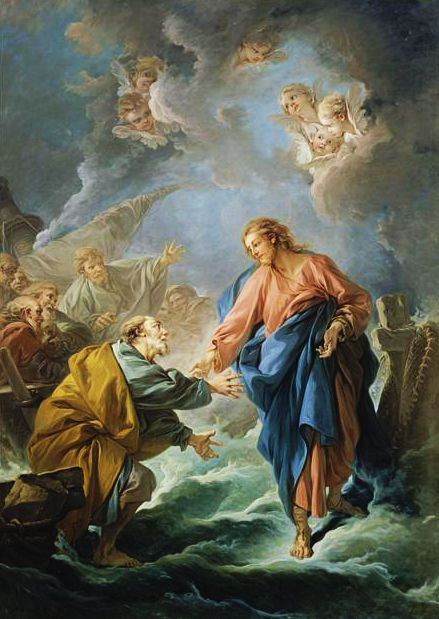
30. But when he saw the wind boisterous, he was afraid; and beginning to sink, he cried, saying, Lord, save me.
31. And immediately Jesus stretched forth his hand, and caught him, and said unto him, O thou of little faith, wherefore didst thou doubt?
32. And when they were come into the ship, the wind ceased.
33. Then they that were in the ship came and worshipped him, saying, Of a truth thou art the Son of God.
CHRYSOSTOM. Desiring to occasion a diligent examination of the things that had been done, He commanded those who had beheld the foregoing sign to be separated from Him; for even if He had continued present it would have been said that He had wrought the miracle fantastically, and not in verity; but it would never be urged against Him that He had done it in His absence; and therefore it is said, And straightway Jesus compelled his disciples to get into a ship, and to go before him to the other side, while he sent the multitudes away.
JEROME. These words shew that they left the Lord unwillingly, not desiring through their love for their teacher to be separated from Him even for a moment.
CHRYSOSTOM. It should be observed, that when the Lord works a great miracle, He sends the multitudes away, teaching us thereby never to pursue the praise of the multitude, nor to attract them to us. Further, He teaches us that we should not be ever mixed with crowds, nor yet always shunning them; but that both may be done with profit; whence it follows, And when he had sent the multitude away, he went up into a mountain apart to pray; shewing us that solitude is good, when we have need to pray to God. For this also He goes into the desert, and there spends the night in prayer, to teach us that for prayer we should seek stillness both in time and place.
JEROME. That He withdraws to pray alone, you should refer not to Him who fed five thousand on five loaves, but to Him who on hearing of the death of John withdrew into the desert; not that we would separate the Lord’s person into two parts, but that His actions are divided between the God and the man.
AUGUSTINE. (De Cons. Ev. ii. 47.) This may seem contrary to that Matthew says, that having sent the multitudes away, He went up into a mountain that He might pray alone; and John again says, that it was on a mountain that He fed this same multitude. But since John himself says further, that after that miracle He retired to a mountain that He might not be held by the multitude, who sought to make Him a king, it is clear that He had come down from the mountain when He fed them. Nor do Matthew’s words, He went up into a mountain alone to pray, disagree with this, though John says, When he knew that they would come to make him a king, he withdrew into a mountain himself alone. (John 6:15.) For the cause of His praying is not contrary to the cause of His retiring, for herein the Lord teaches us that we have great cause for prayer when we have cause for flight. Nor, again, is it contrary to this that Matthew says first, that He bade His disciples go into the boat, and then that He sent the multitudes away, and went into a mountain alone to pray; while John relates that He first withdrew to the mountain, and then, when it was late, his disciples went down to the sea, and when they had entered into a boat, &c. for who does not see that John is relating as afterwards done by His disciples what Jesus had commanded before He retired into the mountain?
JEROME. Rightly had the Apostles departed from the Lord as unwilling, and slow to leave Him, lest they should suffer shipwreck whilst He was not with them. For it follows, Now when it was evening he was there alone; that is, in the mountain; but the boat was in the middle of the sea tossed with the waves; for the wind was contrary.
CHRYSOSTOM. Again, the disciples suffer shipwreck, as they had done before; but then they had Him in the boat, but now they are alone. Thus gradually He leads them to higher things, and instructs them to endure all manfully.
JEROME. While the Lord tarries in the top of the mountain, straightway a wind arises contrary to them, and stirs up the sea, and the disciples are in imminent peril of shipwreck, which continues till Jesus comes.
CHRYSOSTOM. But He suffers them to be tossed the whole night, exciting their hearts by fear, and inspiring them with greater desire and more lasting recollection of Him; for this reason He did not stand by them immediately, but as it follows, in the fourth watch of the night he came to them walking upon the sea.
JEROME. The military guards and watches are divided into portions of three hours each. When then he says that the Lord came to them in the fourth watch, this shews that they had been in danger the whole night.
CHRYSOSTOM. Teaching them not to seek a speedy riddance of coming evil, but to bear manfully such things as befal them. But when they thought that they were delivered, then was their fear increased, whence it follows, And seeing him walking upon the sea, they were troubled, saying, It is a vision, and through fear they cried out. For this the Lord ever does; when He is to rescue from any evil, He brings in things terrible and difficult. For since it is impossible that our temptation should continue a long time, when the warfare of the righteous is to be finished, then He increases their conflicts, desiring to make greater gain of them; which He did also in Abraham, making his hot conflict his trial of the loss of his son.
JEROME. A confused noise and uncertain sound is the mark of great fear. But if, according to Marcion and Manichæus, our Lord was not born of a virgin, but was seen in a phantasm, how is it that the Apostles now fear that they have seen a phantasm (or vision)?
CHRYSOSTOM. Christ then did not reveal Himself to His disciples until they cried out; for the more intense their fear, the more did they rejoice in His presence; whence it follows, And immediately Jesus spoke to them, saying, Be of good cheer, it is J, be not afraid. This speech took away their fear, and prepared their confidence.
JEROME. Whereas He says, It is I, without saying who, either they might be able to understand Him speaking through the darkness of night; or they might know that it was He who had spoken to Moses, Say unto the children of Israel, He that is has sent me unto you. (Exod. 3:14.) On every occasion Peter is found to be the one of the most ardent faith. And with the same zeal as ever, so now, while the others are silent, he believes that by the will of his Master he will be able to do that which by nature he cannot do; whence it follows, Peter answered and said unto him, Lord, if it be thou, bid me come unto thee upon the water. As much as to say, Do thou command, and straightway it will become solid; and that body which is in itself heavy will become light.
AUGUSTINE. (Serm. 76. 5.) This I am not able by myself, but in Thee I am able. Peter confessed what he was in himself, and what he should receive from Him by whose will he believed he should be enabled to do that which no human infirmity was equal to.
CHRYSOSTOM. See how great his warmth, how great his faith. He said not, Pray and entreat for me; but Bid me; he believes not only that Christ can Himself walk on the sea, but that He can lead others also thereon; also he wishes to come to Him speedily, and this, so great a thing, he asks not from ostentation, but from love. For he said not, Bid me walk upon the waters, but, Bid me come unto thee. And it seems that having shewn in the first miracle that He has power over the sea, He now leads them to a more powerful sign; He saith unto him, Come. And Peter, going forth of the boat, walked on the sea, that he might go to Jesus.
JEROME. Let those who think that the Lord’s body was not real, because He walked upon the yielding waters as a light æthereal substance, answer here how Peter walked, whom they by no means deny to be man.
RABANUS. Lastly, Theodorus wrote that the Lord had not bodily weight in respect of His flesh, but without weight walked on the sea. But the catholic faith preaches the contrary; for Dionysius says that He walked on the wave, without the feet, being immersed, having bodily weight, and the burden of matter.
CHRYSOSTOM. Peter overcame that which was greater, the waves, namely, of the sea, but is troubled by the lesser, the blowing wind, for it follows, But seeing the wind boisterous, he was afraid. Such is human nature, in great trials ofttimes holding itself aright, and in lesser falling into fault. This fear of Peter shewed the difference between Master and disciple, and thereby appeased the other disciples. For if they had indignation when the two brothers prayed to sit on the right and left hand, much more had they now. For they were not yet made spiritual; afterwards when they had been made spiritual, they every where yield the first place to Peter, and appoint him to lead in harangues to the people.
JEROME. Moreover he is left to temptation for a short season, that his faith may be increased, and that he may understand that he is saved not by his ability to ask, but by the power of the Lord. For faith burned at his heart, but human frailty drew him into the deep.
AUGUSTINE. (Serm. 76. 8.) Peter then presumed on the Lord, he tottered as man, but returned to the Lord, as it follows, And when he began to sink, he cried out, saying, Lord, save me. Does the Lord then desert him in his peril of failure whom he had hearkened to when he first called on Him? Immediately Jesus stretched forth his hand, and caught him.
CHRYSOSTOM. He bade not the winds to cease, but stretched forth His hand and caught him, because his faith was required. For when our own means fail, then those which are of God stand. Then to shew that not the strength of the tempest, but the smallness of his faith worked the danger, He saith unto him, O thou of little faith, why didst thou doubt? which shews that not even the wind would have been able to hurt him, if his faith had been firm. But as the mother bears on her wings and brings back to the nest her chick which has left the nest before its time and has fallen, so did Christ. And when they were come into the boat, the wind ceased. Then they that were in the boat came and worshipped him, saying, Truly thou art the Son of God.
RABANUS. (Non occ.) This may be understood either of the sailors, or of the Apostles.
CHRYSOSTOM. Observe how He leads all gradually to that which is above them; He had before rebuked the sea, now He shews forth His power yet more by walking upon the sea, by bidding another to do the same, and by saving him in his peril; therefore they said unto Him, Truly thou art the Son of God, which they had not said above.
JEROME. If then upon this single miracle of stilling the sea, a thing which often happens by accident after even great tempests, the sailors and pilots confessed them to be truly the Son of God, how does Arrius preach in the Church itself that He is a creature?
PSEUDO-AUGUSTINE. (App. Serm. 72. 1.) Mystically; The mountain is loftiness. But what is higher than the heavens in the world? And Who it was that ascended into heaven, that our faith knows. Why did He ascend alone into heaven? Because no man has ascended into heaven, but He that came down from heaven. For even when He shall come in the end, and shall have exalted us into heaven, He will yet ascend alone, inasmuch as the head with its body is One Christ, and now the head only is ascended. He went up to pray, because He is ascended to make intercession to His Father for us.
HILARY. Or, that He is alone in the evening, signifies His sorrow at the time of His passion, when the rest were scattered from Him in fear.
JEROME. Also He ascends into the mountain alone because the multitude cannot follow Him aloft, until He has instructed it by the shore of the sea.
AUGUSTINE. (ubi sup.) But while Christ prays on high, the boat is tossed with great waves in the deep; and forasmuch as the waves rise, that boat can be tossed; but because Christ prays, it cannot be sunk. Think of that boat as the Church, and the stormy sea as this world.
HILARY. That He commands His disciples to enter the ship and to go across the sea, while He sends the multitudes away, and after that He goes up into the mountain to pray; He therein bids us to be within the Church, and to be in peril until such time as returning in His splendour He shall give salvation to all the people that shall be remaining of Israel, and shall for give their sins; and having dismissed them into His Father’s kingdom, returning thanks to His Father, He shall sit down in His glory and majesty. Meanwhile the disciples are tossed by the wind and the waves; struggling against all the storms of this world, raised by the opposition of the unclean spirit.
AUGUSTINE. (ubi sup.) For when any of a wicked will and of great power, proclaims a persecution of the Church, then it is that a mighty wave rises against the boat of Christ.
RABANUS. Whence it is well said here, that the ship was in the middle of the sea, and He alone on the land, because the Church is sometimes oppressed with such persecution that her Lord may seem to have forsaken her for a season.
AUGUSTINE. (ubi sup.) The Lord came to visit His disciples who are tossed on the sea in the fourth watch of the night—that is, at its close; for each watch consisting of three hours, the night has thus four watches.
HILARY. The first watch Was therefore of the Law, the second of the Prophets, the third His coming in the flesh, the fourth His return in glory.
AUGUSTINE. (ubi sup.) Therefore in the fourth watch of the night, that is when the night is nearly ended, He shall come, in the end of the world, when the night of iniquity is past, to judge the quick and the dead. But His coming was with a wonder. The waves swelled, but they were trodden upon. Thus howsoever the powers of this world shall swell themselves, our Head shall crush their head.
HILARY. But Christ coming in the end shall find His Church wearied, and tossed by the spirit of Anti-Christ, and by the troubles of the world. And because by their long experience of Anti-Christ they will be troubled at every novelty of trial, they shall have fear even at the approach of the Lord, suspecting deceitful appearances. But the good Lord banishes their fear, saying, It is I; and by proof of His presence takes away their dread of impending shipwreck.
AUGUSTINE. (Quæst. Ev. i. 15.) Or; That the disciples here say, It is a phantasm, figures those who yielding to the Devil shall doubt of the coming of Christ. That Peter cries to the Lord for help that he should not be drowned, signifies that He shall purge His Church with certain trials even after the last persecution; as Paul also notes, saying, He shall be saved, yet so as by fire. (1 Cor. 3:15.)
HILARY. Or; That Peter alone out of all the number of those that were in the vessel has courage to answer, and to pray that the Lord would bid him come to Him upon the waters, figures the frowardness of his will in the Lord’s passion, when following after the Lord’s steps he endeavoured to attain to despise death. But his fearfulness shews his weakness in his after trial, when through fear of death, he was driven to the necessity of denial. His crying out here is the groaning of his repentance there.
RABANUS. The Lord looked back upon him, and brought him to repentance; He stretched forth His hand, and forgave him, and thus the disciple found salvation, which is not of him that willeth or of him that runneth, but of God that sheweth mercy. (Rom. 9:16.)
HILARY. That when Peter was seized with fear, the Lord gave him not power of coming to Him, but held him by the hand and sustained him, this is the signification thereof; that He who alone was to suffer for all alone forgave the sins of all; and no partner is admitted into that which was bestowed upon mankind by one.
AUGUSTINE. (Serm. 76.) For in one Apostle, namely Peter, first and chief in the order of Apostles in whom was figured the Church, both kinds were to be signified; that is, the strong, in his walking upon the waters; the weak, in that he doubted, for to each of us our lusts are as a tempest. Dost thou love God? Thou walkest on the sea; the fear of this world is under thy feet. Dost thou love the world? It swallows thee up. But when thy heart is tossed with desire, then that thou mayest overcome thy lust, call upon the divine person of Christ.
REMIGIUS. And the Lord will be with thee to help thee, when lulling to rest the perils of thy trials, He restores the confidence of His protection, and this towards the break of day; for when human frailty beset with difficulties considers the weakness of its own powers, it looks upon itself as in darkness; when it raises its view to the protection of heaven, it straightway beholds the rise of the morning star, which gives its light through the whole of the morning watch.
RABANUS. Nor should we wonder that the wind ceased when the Lord had entered into the boat; for in whatsoever heart the Lord is present by grace, there all wars cease.
HILARY. Also by this entrance of Christ into the boat, and the calm of the wind and sea thereupon, is pointed out the eternal peace of the Church, and that rest which shall be after His return in glory. And forasmuch as He shall then appear manifestly, rightly do they all cry out now in wonder, Truly thou art the Son of God. For there shall then be a free and public confession of all men that the son of God is come no longer in lowliness of body, but that He has given peace to the Church in heavenly glory.
AUGUSTINE. (Quæst. Ev. i. 15.) For it is here conveyed to us that His glory will then be made manifest, seeing that now they who walk by faith see it in a figure.
14:34–36
34. And when they were gone over, they came into the land of Gennesaret.
35. And when the men of that place had knowledge of him, they sent out into all that country round about, and brought unto him all that were diseased;
36. And besought him that they might only touch the hem of his garment: and as many as touched were made perfectly whole.
REMIGIUS. The Evangelist had related above that the Lord had Commanded His disciples to enter the boat, and to go before Him across the strait; he now proceeds with the same intention to relate whither they arrived by their passage, And when they were gone over, they came into the land of Gennezareth.
RABANUS. The land of Gennezar, by the lake of Gennezareth, takes its name from a natural power which it is said to have of spontaneously modulating its waters so as to excite a breeze; the Greek words importing, ‘creating for itself the breeze.’
CHRYSOSTOM. But the Evangelist shews that it was now long time since Christ had come into these parts; for it follows, And when the men of that place knew him, they sent into all that region.
JEROME. They knew Him by fame, not by sight; although indeed by reason of the greatness of the signs which He did among the people, He was known by face to great numbers. And note how great the faith of the men of the land of Gennezareth, that they were not content with the healing of the men of that country only, but sent to all the towns round about.
CHRYSOSTOM. Nor do they now as before drag Him to their houses, and seek the touch of His hand, but they draw Him by their greater faith, for they brought unto him all them that were sick, and besought him that they might touch but the hem of his garment. For the woman who suffered under the issue of blood had taught them all this wisdom, namely, that by touching the hem only of Christ’s garment they might be saved; therefore it follows, And as many as touched, were made whole.
JEROME. If we knew what the word Gennezareth would convey in our tongue, we might understand how under the type of the Apostles and the boat, Jesus guides to shore the Church when He has delivered it from the wreck of persecution, and makes it to rest in a most tranquil harbour.
RABANUS. Genezar is interpreted, ‘rise’, ‘beginning.’ For then will complete rest be given to us, when Christ shall have restored to us our inheritance of Paradise, and the joy of our first robe.
HILARY. Otherwise; When the times of the Law were ended, and five thousand out of Israel were entered within the Church, it was then that the people of believers met Him, then those that were saved out of the Law by faith set before the Lord the rest of their sick and weak; and they that were thus brought sought to touch the hem of His garment, because through their faith they would be healed. And as the virtue of the hem proceeded from the whole garment, so the virtue of the grace of the Holy Spirit went forth from our Lord Jesus Christ, and imparted to the Apostles, who proceeded as it were from the same body, administers salvation to such as desire to touch.
JEROME. Or, by the hem of the garment understand His least commandment, which whosoever transgresses, shall be called least in the kingdom of heaven; or, again, His assumption of the body, by which we come to the Word of God.
CHRYSOSTOM. But we have not a hem or a garment only of Christ, but have even His body, that we may eat thereof. If then they who touched the hem of His garment derived so much virtue therefrom, much more they that shall receive Himself whole.
Catena Aurea Matthew 14
Pope Pontian
Pope Saint Pontian or Pontianus, was pope from July 21, 230 to September 29, 235. Sentenced to exile during a persecution, he was the first pope to abdicate the office. He is best known, however, for his death in the mines together with his adversary, the antipope Hippolytus, who, along with Pointian, was later declared both saint and martyr.
Pontian was not directly criticized by Hippolytus, who had condemned his predecessor, Callixtus I, as a heretic, but it is not known whether Pontian and Hippolytus ever reached the point of holding communion with each other. During Pontian's reign, a Roman church synod, over which he probably presided, condemned the teaching of the African theologian Origen for heresy.
In 235, Pontian and other Christian leaders, Hippolytus among them, were exiled by the emperor Maximinus Thrax to hard labor in Sardinia. Rather than leave the office of bishop of Rome unattended, Pontian resigned in September of that year and was succeeded by Pope Anterus. The congregation of Hippolytus was eventually reconciled with the main body of the Roman church but it is uncertain at what point this occurred. Pontian died not long after his exile, either on Sardinia itself or the neighboring island of Tavolara, probably as a result of being forced to work in the mines.
His remains were later broughtback to Rome by Pope Fabian and buried in the Catacomb of Pope Callixtus I. His epitaph was rediscovered in 1909 in the crypt of Saint Cecilia, reading PONTIANOS, EPISK ("Pontianus, bishop"). The inscription MARTUR ("martyr") had been added in another hand.
Pontian's feast day was originally November 19, but he is now celebrated jointly with his erstwhile former adversary and rival, Saint Hippolytus, on August 13.
Biography
According to the Liber Pontificalis Pontian was born in Rome, and his father was named Calpurnius. The Liberian Catalogue of the popes is able to add several specific details not available in the biographies of earlier bishops of Rome. According to this account Pontian was made pope July 21, 230, and reigned until 235.
Hippolytus' schism
One of the most notable known features of his episcopacy was the continuing schism of Hippolytus, the first antipope and later saint. Hippolytus had disagreed with two earlier popes, Zephyrinus and Callixtus I over their toleration of Sabellianism, a trinitarian doctrine which declined to recognize distinct "persons" in the Trinity, seeing the Father, the Son, and the Holy Spirit more as operational modes of the one God. Hippolytus especially blamed Zephyrinus' deacon Callixtus for this policy. When Callixtus then succeeded Zephyrinus and pope, Hippolytus denounced him as a heretic—both for his trinitarian views and for his policy of forgiving sinners guilty of serious crimes like adultery—and formed a rival congregation, becoming the first antipope. His reign in opposition to Callixtus lasted through the succeeding pontificates of Urban I (222–230) well into that of Pontian (230–235).
Scholars are divided as to when Hippolytus was reconciled with the Roman church. Catholic tradition holds that near the end of Pontian's term, Hippolytus and his schismatic group found accord with Pontian and were accepted back into the church. However, it is also possible that the schism persisted until both the pope and the antipope were exiled, with the two congregations uniting once the schismatic party's leader was out of the picture. In this version of events, the reconciliation would have taken place either during the brief reign of Anterus of that of Fabian, who caused the body of both the form pope and the antipope to be given a dignified burial in Rome.
Condemnation of Origien
Pontian probably presided over the Roman synod which condemned the writings of
Origen, the great Alexandrian speculative theologian and biblical scholar.
It was also during Pontian's episcopacy that a Roman synod condemned certain teachings of the great African Christian writer Origen. It is likely that Pontian presided at this council, which, according to Jerome (Epist. 33, to Paula), upheld the decisions of an Alexandrian synod against Origen in (231-2).
Although Jerome, writing in the late fourth century, eventually joined in the growing condemnation of Origen, he makes it clear in his letter to Paula that he did not concur with the Roman synod that had anathematized him:
Who has ever managed to read all that he has written? Yet what reward have his exertions brought him? He stands condemned by his bishop, Demetrius, only the bishops of Palestine, Arabia, Phoenicia, and Achaia dissenting. Imperial Rome consents to his condemnation, and even convenes a synod to censure him, not—as the rabid hounds who now pursue him cry—because of the novelty or heterodoxy of his doctrines, but because men could not tolerate the incomparable eloquence and knowledge which, when once he opened his lips, made others seem dumb.
Although it is not known exactly what the Roman synod in Pontian's time said regarding Origen, one of Origen's ideas was of the pre-existence of souls. In his own time, however, it was not deemed heretical to promote this idea. Origen concluded that human souls exist prior to their connection to earthly forms in the spiritual world with God. He also doubted the resurrection of the physical body, speculated about the life of the stars, and wondered whether heavenly bodies possessed souls.
Origen's most widely condemned doctrine, however, was his teaching of universal restoration (apokatastasis). He likened the Creator to a divine teacher, who could not fail, in the long run, in properly instructing its students. He thus concluded that, in time, all humans would be restored to their former sinless status, becoming perfect and living in the presence of God. In his view, this restoration included all souls, not just humanity, but evil spirits, fallen angels, and even Satan.
Death and legacy
Emperor Maximinus Thrax reversed the relatively tolerant policy of his predecessor Alexander Severus, instituting a persecution of the leaders of the Roman church, whom he considered enemies of the state.
In 235, in the reign of Maximinus the Thracian, the Roman church came once again under persecution. The policy was directed chiefly against the heads of the Christian community, rather than against the rank and file. Its first victims were both Pontian and Hippolytus, a fact which argues for Hippolytus still serving as bishop of his own congregation. They were banished to the island of Sardinia, probably forced to do hard labor there in the mines. To make the election of a new pope possible, Pontian resigned September 28, 235, according to the Liberian Catalogue. Consequently, Pope Anterus was elected in his stead. Whether just before this, during Anterus' brief reign, or afterward, the congregation of Hippolytus was reconciled to the Roman church, bringing the schism which he had caused to an end.
How much longer Pontian endured the sufferings of exile and harsh treatment in the Sardinian mines is unknown. The Liber Pontificalis, states that he died in consequence of the privations and inhuman treatment he had to bear, and while this source is not generally reliable about the martyrdoms of the early popes, in this case there is no reason to doubt its testimony. According to another tradition, Ponitan died on the tiny island of Tavolara, northeast of the main island of Sardinia.
Pope Fabian (236-50) had the remains of Pontian and Hippolytus both brought back to Rome at a later date. Pontian was buried on in the papal crypt of the Catacomb of Callixtus. It would have been the supreme irony if Hippolytus were buried in the same place, which bears the name of his arch-enemy, whom he had called a criminal and heretic, but the Liberian Catalog reports that he was in fact buried on the Via Tiburtina.
In 1909, archaeological investigations uncovered the original epitaph of Ponitan in the crypt of Saint Cecilia, near the papal crypt. The epitaph, which takes the same form as the other known epitaphs of the papal crypt, reads: PONTIANOS, EPISK. MARTUR ("Pontianus, Bishop, Martyr"). The word mártur, however, was added later by a different hand.
His feast day is celebrated jointly with that of Hippolytus on August 13. The reconciliation of the rival congregations of Rome, effected by the joint martyrdoms of pope and antipope, is Pontian's most lasting legacy.
newworldencyclopedia.org
From: Matthew 14:22-36Jesus Walks on the Water
------------------------
[22] Then He (Jesus) made the disciples get into the boat and go before Him to the other side, while He dismissed the crowds. [23] And after He had dismissed the crowds He went up into the hills by Himself to pray. When evening came, He was there alone, [24] but the boat by this time was many furlongs distant from the land, beaten by the waves; for the wind was against them. [25] And in the fourth watch of the night He came to them, walking on the sea. [26] But when the disciples saw Him walking on the sea, they were terrified, saying, "It is a ghost!" And they cried out for fear. [27] But immediately He spoke to them, saying, "Take heart, it is I; have no fear."
[28] And Peter answered Him, "Lord, if it is you, bid me come to You on the water." [29] He said, "Come." So Peter got out of the boat and walked on the water and came to Jesus; [30] but when he saw the wind, he was afraid, and beginning to sink he cried out, "Lord, save me." [31] Jesus immediately reached out his hand and caught him, saying to him, "O man of little faith, why did you doubt?" [32] And when they got into boat, the wind ceased. [33] And those in the boat worshipped Him, saying, "Truly You are the son of God."
[34] And when they had crossed over, they came to land at Gennesaret. [35] And when the men of that place recognized Him, they sent round to all the region and brought to Him all that were sick, [36] and besought Him that they might only touch the fringe of His garment; and as many as touched it were made well.
***********************************************************************
Commentary:
22-23. It has been a very full d ay, like so many others. First, Jesus works many cures (14:14) and then performs the remarkable miracle of the multiplication of the loaves and the fish, a symbol of the future Eucharist. The crowd who have been following Him were avid for food, teaching and consolation. Jesus "had compassion on them" (14:14), curing their sick and giving them the comfort of His teaching and the nourishment of food. He continues to do the same, down the centuries, tending to our needs and comforting us with His word and with the nourishment of His own body. Jesus must have been very moved, realizing the vivifying effect the Blessed Sacrament would have on the lives of Christians--a sacrament which is a mystery of life and faith and love. It is understandable that He should feel the need to spend some hours in private to speak to His Father. Jesus' private prayer, in an interlude between one demanding activity and another, teaches us that every Christian needs to take time out for recollection, to speak to His Father, God. On Jesus' frequent personal prayer see, for example, Mark 1:35; 6:47; Luke 5:16; 16:12. See the notes on Matthew 6:5-6 and Matthew 7:7-11.
24-33: This remarkable episode of Jesus walking on the sea must have made a deep impression on the Apostles. It was one of their outstanding memories of the life they shared with the Master. It is reported not only by St. Matthew, but also by St. Mark (6:45-52), who would have heard about it from St. Peter, and by St. John (6:14-21).
Storms are very frequent on Lake Gennesaret; they cause huge waves and are very dangerous to fishing boats. During His prayer on the hill, Jesus is still mindful of His disciples; He sees them trying to cope with the wind and the waves and comes to their rescue once He has finished praying.
This episode has applications to Christian life. The Church, like the Apostles' boat, also gets into difficulties, and Jesus who watches over His Church comes to its rescue also, after allowing it to wrestle with obstacles and be strengthened in the process. He gives us encouragement: "Take heart, it is I; have no fear" (14:27); and we show our faith and fidelity by striving to keep an even keel, and by calling on His aid when we feel ourselves weakening: "Lord, save me" (14:30), words of St. Peter which every soul uses when he has recourse to Jesus, his Savior. Then our Lord does save us, and we urgently confess our faith: "Truly you are the Son of God" (14:33).
29-31. St. John Chrysostom ("Hom. on St. Matthew", 50) comments that in this episode Jesus taught Peter to realize, from his own experience, that all his strength comes from our Lord and that he could not rely on his own resources, on his own weaknesses and wretchedness. Chrysostom goes as far as to say that "if we fail to play our part, God ceases to help us." Hence the reproach, 'O man of little faith" (14:31). When Peter began to be afraid and to doubt, he started to sink, until again, full of faith, he called out, "Lord, save me." If at any time we, like Peter, should begin to weaken, we too should try to bring our faith into play and call on Jesus to save us.
34-36. Learning from the faith of these people on the shore of Lake Gennesaret, every Christian should approach the adorable humanity of the Savior. Christ--God and Man--is accessible to us in the sacrament of the Eucharist.
"When you approach the Tabernacle remember that He has been awaiting you for twenty centuries" (St J. Escriva, "The Way", 537).