Catena Aurea by St. Thomas Aguinas
41. Now his parents went to Jerusalem every year at the feast of the Passover.
CHRYSOSTOM. (Orat. cont. Judæos.) At the feast of the Hebrews the law commanded men not only to observe the time, but the place, and so the Lord’s parents wished to celebrate the feast of the Passover only at Jerusalem.
AUGUSTINE. (de Con. Ev. ii. 10.) But it may be asked, how did His parents go up all the years of Christ’s childhood to Jerusalem, if they were prevented from going there by fear of Archelaus? This question might be easily answered, even had some one of the Evangelists mentioned how long Archelaus reigned. For it were possible that on the feast day amid so great a crowd they might secretly come, and soon return again, at the same time that they feared to remain there on other days, so as neither to be wanting in religious duties by neglecting the feast, nor leave themselves open to detection by a constant abode there. But now since all have been silent as to the length of Archelaus’ reign, it is plain that when Luke says, They were accustomed to go up every year to Jerusalem, we are to understand that to have been when Archelaus was no longer feared.
2:42–50
42. And when he was twelve years old, they went up to Jerusalem after the custom of the feast.
43. And when they had fulfilled the days, as they returned, the child Jesus tarried behind in Jerusalem; and Joseph and his mother knew not of it.
44. But they, supposing him to have been in the company, went a day’s journey; and they sought him among their kinsfolk and acquaintance.
45. And when they found him not, they turned back again to Jerusalem, seeking him.
46. And it came to pass, that after three days they found him in the temple, sitting in the midst of the doctors, both hearing them, and asking them questions.
47. And all that heard him were astonished at his understanding and answers.
48. And when they saw him, they were amazed: and his mother said unto him, Son, why hast thou thus dealt with us? behold, thy father and I have sought thee sorrowing.
49. And he said unto them, How is it that ye sought me? wist ye not that I must be about my Father’s business?
50. And they understood. not the saying which he spake unto them.
CYRIL OF ALEXANDRIA. The Evangelist having said before that the Child grew and waxed strong, verifies his own words when he relates, that Jesus with the holy Virgin went up to Jerusalem; as it is said, And when he was twelve years old, &c.
GREEK EXPOSITOR. (Geometer) His indication of wisdom did not exceed the measure of His age, but at the time that with us the powers of discernment are generally perfected, the wisdom of Christ shews itself.
AMBROSE. Or the twelfth year was the commencement of our Lord’s disputation with the doctors, for this was the number of the Evangelists necessary to preach the faith.
BEDE. We may also say, that as by the seventh number, so also by the twelfth, (which consists of the parts of seven multiplied alternately by one another,) the universality and perfection of either things or times is signified, and therefore rightly from the number twelve, the glory of Christ takes its beginning, being that by which all places and times are to be filled.
BEDE. (in Hom. post Epiph.) Now that the Lord came up every year to Jerusalem at the Passover, betokens His humility as a man, for it is man’s duty to meet together to offer sacrifices to God, and conciliate Him with prayers. Accordingly the Lord as man, did among men what God by angels commanded men to do. Hence it is said, According to the custom of the feast day. (Gal. 3:14, Judges 6:20; 13:16.) Let us follow then the journey of His mortal life, if we delight to behold the glory of His divine nature.
GREEK EXPOSITOR. (Metaphrastes vel Geometer.) The feast having been celebrated, while the rest returned, Jesus secretly tarried behind. As it follows, And when they had fulfilled the days, as they returned, the child Jesus tarried behind in Jerusalem; and his parents knew not of it. It is said, When the days were accomplished, because the feast lasted seven days. But the reason of His tarrying behind in secret was, that His parents might not be a hindrance to His carrying on the discussion with the lawyers; or perhaps to avoid appearing to despise his parents by not obeying their commands. He remains therefore secretly, that he might neither be kept away nor be disobedient.
ORIGEN. But we must not wonder that they are called His parents, seeing the one from her childbirth, the other from his knowledge of it, deserved the names of father and mother.
BEDE. But some one will ask, how was it that the Son of God, brought up by His parents with such care, could be left behind from forgetfulness? To which it is answered, that the custom of the children of Israel while assembling at Jerusalem on the feast days, or returning to their homes, was for the women and men to go separately, and the infants or children to go with either parent indiscriminately. And so both Mary and Joseph each thought in turn that the Child Jesus, whom they saw not with them, was returning with the other parent. Hence it follows, But they, supposing him to have been in the company, &c.
ORIGEN. But as when the Jews plotted against Him He escaped from the midst of them, and was not seen; so now it seems that the Child Jesus remained, and His parents knew not where He was. As it follows, And not finding him, they returned to Jerusalem, seeking for him. (John 10:29.)
GLOSS. (ordin.) They were on their way home, one day’s journey from Jerusalem; on the second day they seek for Him among their kinsfolk and acquaintance, and when they found Him not, they returned on the third day to Jerusalem, and there they found Him. As it follows, And it came to pass, after three days they found him.
ORIGEN. He is not found as soon as sought for, for Jesus was not among His kinsfolk and relations, among those who are joined to Him in the flesh, nor in the company of the multitude can He be found. Learn where those who seek Him find Him, not every where, but in the temple. And do thou then seek Jesus in the temple of God. Seek Him in the Church, and seek Him among the masters who are in the temple. For if thou wilt so seek Him, thou shalt find Him. They found Him not among His kinsfolk, for human relations could not comprehend the Son of God; not among His acquaintance, for He passes far beyond all human knowledge and understanding. Where then do they find Him? In the temple! If at any time thou seek the Son of God, seek Him first in the temple, thither go up, and verily shalt thou find Christ, the Word, and the Wisdom, (i. e. the Son of God.)
AMBROSE. After three days He is found in the temple, that it might be for a sign, that after three days of victorious suffering, He who was believed to be dead should rise again, and manifest Himself to our faith, seated in heaven with divine glory.
GLOSS. (ubi sup.) Or because the advent of Christ, which was looked for by the Patriarchs before the Law, was not found, nor again, that which was sought for by prophets and just men under the Law, but that alone is found which is sought for by Gentiles under grace.
ORIGEN. Because moreover He was the Son of God, He is found in the midst of the doctors, enlightening and instructing them. But because He was a little child, He is found among them not teaching but asking questions, as it is said, Sitting in the midst of the doctors, hearing them, and asking them questions. And this He did as a duty of reverence, that He might set us an example of the proper behaviour of children, though they be wise and learned, rather to hear their masters than teach them, and not to vaunt themselves with empty boasting. But He asked not that He might learn, but that asking He might instruct. For from the same source of learning is derived both the power of asking and answering wisely, as it follows, All who heard him were astonished at his wisdom.
BEDE. To shew that He was a man, He humbly listened to the masters; but to prove that He was God, He divinely answered those who spake.
GREEK EXPOSITOR. (Metaphrastes vel Geometer.) He asks questions with reason, He listens with wisdom, and answers with more wisdom, so as to cause astonishment. As it follows, And they who saw it were astonished.
CHRYSOSTOM. (sup. Joh. Hom. 20.) The Lord truly did no miracle in His childhood, yet this one fact St. Luke mentions, which made men look with wonder upon Him.
BEDE. For from His tongue there went forth divine wisdom, while His age exhibited man’s helplessness, and hence the Jews, amid the high things they hear and the lowly things they see, are perplexed with doubts and astonishment. But we can in no wise wonder, knowing the words of the Prophet, that thus unto us a Child is born, that He abideth the mighty God. (Is. 9:6.)
GREEK EXPOSITOR. (ubi sup.) But the ever-wonderful mother of God, moved by a mother’s feelings, as it were with weeping makes her mournful enquiry, in every thing like a mother, with confidence, humility, and affection. As it follows, And his mother said unto him, Son, what hast thou done?
ORIGEN. The holy Virgin knew that He was not the Son of Joseph, and yet calls her husband His father according to the belief of the Jews, who thought that He was conceived in the common way. Now to speak generally we may say, that the Holy Spirit honoured Joseph by the name of father, because he brought up the Child Jesus; but more technically, that it might not seem superfluous in St. Luke, bringing down the genealogy from David to Joseph. But why sought they Him sorrowing? Was it that he might have perished or been lost? It could not be. For what should cause them to dread the loss of Him whom they knew to be the Lord? But as whenever you read the Scriptures you search out their meaning with pains, not that you suppose them to have erred or to contain anything incorrect, but that the truth which they have inherent in them you are anxious to find out; so they sought Jesus, lest perchance leaving them he should have returned to heaven, thither to descend when He would. He then who seeks Jesus must go about it not carelessly and idly, as many seek Him who never find Him, but with labour and sorrow.
GLOSS. (ordin.) Or they feared lest Herod who sought Him in His infancy, now that He was advanced to boyhood might find an opportunity of putting Him to death.
GREEK EXPOSITOR. (Metaphrastes et Geometer.) But the Lord Himself sets every thing at rest, and correcting as it were her saying concerning him who was His reputed father, manifests His true Father, teaching us not to walk on the ground, but to raise ourselves on high, as it follows, And he says unto them, What is it that you ask of me?
BEDE. He blames them not that they seek Him as their son, but compels them to raise the eyes of their mind to what was rather due to Him whose eternal Son He was. Hence it follows, Knew ye not? &c.
AMBROSE. There are two generations in Christ, one from His Father, the other from His mother; the Father’s more divine, the mother’s that which has come down for our use and advantage.
CYRIL OF ALEXANDRIA. He says this then by way of shewing that He surpasses all human standards, and hinting that the Holy Virgin was made the handmaid of the work in bringing His flesh unto the world, but that He Himself was by nature and in truth God, and the Son of the Father most high. Now from this let the followers of Valentinus, hearing that the temple was of God, be ashamed to say that the Creator, and the God of the law and of the temple, is not also the Father of Christ.
EPIPHANIUS. (cont. Hær. l. ii. hær. 31.) Let Ebion know that at twelve years old, not thirty, Christ is found the astonishment of all men, wonderful and mighty in the words of grace. We can not therefore say, that after that the Spirit came to Him in Baptism He was made the Christ, that is, anointed with divinity, but from His very childhood He acknowledged both the temple and His Father.
GREEK EXPOSITOR. (Geometer.) This is the first demonstration of the wisdom and power of the Child Jesus. For as to what are called thea acts of His childhood, we can not but suppose them to be the work not only of a childish but even of a devilish mind and perverse will, attempting to revile those things which are contained in the Gospel and the sacred prophecies. But should one desire to receive only such things as are generally believed, and are not contrary to our other declarations, but accord also with the words of prophecy, let it suffice that Jesus was distinguished in form above the sons of men; obedient to His mother, gentle in disposition; in appearance full of grace and dignity; eloquent in words, kind and thoughtful of the wants of others, known among all for a power and energy, as of one who was filled with all wisdom; and as in other things, so also in all human conversation, though above man, Himself the rule and measure. But that which most distinguished Him was His meekness, and that a razor had never come upon His head, nor any human hand except His mother’s. But from these words we may derive a lesson; for when the Lord reproves Mary seeking Him among His relations, He most aptly points to the giving up of all fleshly ties, shewing that it is not for him to attain the goal of perfection who is still encompassed by and walks among the things of the body, and that men fall from perfection through love of their relations.
BEDE. It follows, And they understood him not, that is, the word which He spoke to them of His divinity.
ORIGEN. Or they knew not whether when He said about my Father’s business, He referred to the temple, or something higher and more edifying; for every one of us who doeth good, is the seat of God the Father; but whoso is the seat of God the Father, has Christ in the midst of him.
2:51–52
51. And he went down with them, and came to Nazareth, and was subject unto them: but his mother kept all these sayings in her heart.
GREEK EXPOSITOR. (ubi sup.) All that time of the life of Christ which He passed between His manifestation in the temple and His baptism, being devoid of any great public miracles or teaching, the Evangelist sums up in one word, saying, And he went down with them.
ORIGEN. Jesus frequently went down with His disciples, for He is not always dwelling on the mount, for they who were troubled with various diseases were not able to ascend the mount. For this reason now also He went down to them who were below. It follows: And he was subject to them, &c.
GREEK EXPOSITOR. (ubi sup.) Sometimes by His word He first institutes laws, and He afterwards confirms them by His work, as when He says, The good shepherd layeth down his life for his sheep. (John 10:11) For shortly after seeking our salvation He poured out His own life. But sometimes He first sets forth in Himself an example, and afterwards, as far as words can go, draws therefrom rules of life, as He does here, shewing forth by His work these three things above the rest, the love of God, honour to parents, but the preferring God also to our parents. For when He was blamed by His parents, He counts all other things of less moment than those which belong to God; again, He gives His obedience also to His parents.
BEDE. For what is the teacher of virtue, unless he fulfil his duty to his parents? What else did He do among us, than what He wished should be done by us?
ORIGEN. Let us then also ourselves be subject to our parents. But if our fathers are not, let us be subject to those who are our fathers. Jesus the Son of God is subject to Joseph and Mary. But I must be subject to the Bishop who has been constituted my father. It seems that Joseph knew that Jesus was greater than he, and therefore in awe moderated his authority. But let every one see, that oftentimes he who is subject is the greater. Which if they who are higher in dignity understand, they will not be clated with pride, knowing that their superior is subject to them.
GREGORY OF NYSSA. (Orat. in 1 Cor. 15:28.) Further, since the young have not yet perfect understanding, and have need to be led forward by those who have advanced to a more perfect state; therefore when He arrived at twelve years, He is obedient to His parents, to shew that whatever is made perfect by moving forward, before that it arrives at the end profitably embraces obedience, (as leading to good.)
BASIL. (in Const. Mon. 4.) But from His very first years being obedient to His parents, He endured all bodily labours, humbly and reverently. For since His parents were honest and just, yet at the same time poor, and ill supplied with the necessaries of life, (as the stable which administered to the holy birth bears witness,) it is plain that they continually underwent bodily fatigue in providing for their daily wants. But Jesus being obedient to them, as the Scriptures testify, even in sustaining labours, submitted Himself to a complete subjection.
AMBROSE. And can you wonder if He who is subject to His mother, also submits to His Father? Surely that subjection is a mark not of weakness but of filial duty. Let then the heretic so raise his head as to assert that He who is sent has need of other help; yet why should He need human help, in obeying His mother’s authority? He was obedient to a handmaid, He was obedient to His pretended father, and do you wonder whether He obeyed God? Or is it a mark of duty to obey man, of weakness to obey God?
BEDE. The Virgin, whether she understood or whether she could not yet understand, equally laid up all things in her heart for reflection and diligent examination. Hence it follows, And his mother laid up all these things, &c. Mark the wisest of mothers, Mary the mother of true wisdom, becomes the scholar or disciple of the Child. For she yielded to Him not as to a boy, nor as to a man, but as unto God. Further, she pondered upon both His divine words and works, so that nothing that was said or done by Him was lost upon her, but as the Word itself was before in her womb, so now she conceived the ways and words of the same, and in a manner nursed them in her heart. And while indeed she thought upon one thing at the time, another she wanted to be more clearly revealed to her; and this was her constant rule and law through her whole life. It follows, And Jesus increased in wisdom.
Catena Aurea Luke 2
NAVARRE BIBLE COMMENTARY (RSV)
Ad Majorem Dei Gloriam (To the Greater Glory of God)
From: 2 Corinthians 5:14-21
The Ministry of Reconciliation (Continuation)
----------------------------------------------------------------
[14] For the love of Christ controls us, because we are convinced that one has died for all; therefore all have died. [15] And he died for all, that those who live might live no longer for themselves but for him who for their sake died and was raised.
[16] From now on, therefore, we regard no one from a human point of view; even though we once regarded Christ from a human point of view, we regard him thus no longer. [17] Therefore, if any one is in Christ, he is a new creation; the old has passed away, behold, the new has come. [18] All this is from God, who through Christ reconciled us to himself and gave us the ministry of reconciliation; [19] that is, God was in Christ reconciling the world to himself, not counting their trespasses against them, and entrusting to us the message of reconciliation. [20] So we are ambassadors for Christ, God making his appeal through us. We beseech you on behalf of Christ, be reconciled to God. [21] For our sake he made him to be sin who knew no sin, so that in him we might become the righteousness of God.
************************************************************************
Commentary:
14-15. The Apostle briefly describes the effects of Christ's death, a death he underwent out of love for man; elsewhere at greater length (cf. Rom 6:1-11; 14:7-9; Gal 2:19-20; 2 Tim 2: 11) he goes into this doctrine which is so closely connected with the solidarity that exists between Jesus Christ and the members of his mystical body. Christ, the head of that body, died for all his members: and they have mystically died to sin with and in him. Christ's death, is moreover, the price paid for men--their ransom which sets them free from the slavery of sin, death and the devil. As a result of it we belong no longer to ourselves but to Christ (cf. 1 Cor 6:19), and the new life--in grace and freedom--which he has won for us we must live for his sake: "None of us lives to himself, and none of us dies to himself. If we live, we live to the Lord, and if we die, we die to the Lord [...]. For to this end Christ died and lived again, that he might be Lord both of the dead and of the living" (Rom 14:7-9).
"What follows from this?", St Francis de Sales asks. "I seem to hear the voice of the Apostle like a peal of thunder startling our heart: It is easy to see, Christians, what Christ desired by dying for us. What did he desire but that we should become like him? 'That those who live might live no longer for themselves but for him who for their sake died and was raised.' How powerful a consequence is this in the matter of love! Jesus Christ died for us; by his death he has given us life; we only live because he died; he died for us, by us, and in us; our life then is no longer ours, but belongs to him who has purchased it for us by his death: we are therefore no more to live to ourselves but to him; not in ourselves but in him; nor for ourselves but for him" ("Treatise on the Love of God", book 7, chap. 8).
"The love of Christ controls us", urges us: with these words St Paul sums up what motivates his tireless apostolic activity--the love of Jesus, so immense that it impels him to spend every minute of his life bringing this same love to all mankind. The love of Christ should also inspire all other Christians to commit themselves to respond to Christ's love, and it should fill them with a desire to bring to all souls the salvation won by Christ. "We are urged on by the charity of Christ (cf. 2 Cor 5:14) to take upon our shoulders a part of this task of saving souls. Look: the redemption was consummated when Jesus died on the Cross, in shame and glory, 'a stumbling block' to the Jews and folly to the Gentiles (1 Cor 1:23). But the redemption will, by the will of God, be carried out continually until our Lord's time comes. It is impossible to live according to the heart of Jesus Christ and not to know that we are sent, as he was, 'to save sinners' (1 Tim 1:15), with the clear realization that we ourselves need to trust in the mercy of God more and more every day. As a result, we will foster in ourselves a vehement desire to live as co-redeemers with Christ, to save all souls with him" ("Christ Is Passing By", 120f).
16-17. "Even though we once regarded Christ from a human point of view": Paul seems to be referring to knowledge based only on external appearances and on human criteria. Paul's Judaizing opponents do look on things from a human point of view, as Paul himself did before his conversion. Nothing he says here can be taken as implying that St Paul knew Jesus personally during his life on earth (he goes on to say that now he does not know him personally); what he is saying is that previously he judged Christ on the basis of his own Pharisee prejudices; now, on the other hand, he knows him as God and Savior of men.
In v. 17 he elaborates on this contrast between before and after his conversion, as happens to Christians through Baptism. For through the grace of Baptism a person becomes a member of Christ's body, he lives by and is "in Christ" (cf., e.g., Gal 6:15; Eph 2:10, 15f; Cor 3:9f); the Redemption brings about a new creation. Commenting on this passage St Thomas Aquinas reminds us that creation is the step from non-being to being, and that in the supernatural order, after original sin, "a new creation was necessary, whereby (creatures) would be made with the life of grace; this truly is a creation from nothing, because those without grace are nothing (cf. 1 Cor 13:2) [...]. St Augustine says, 'for sin is nothingness, and men become nothingness when they sin'" ("Commentary on 2 Cor, ad loc.").
"The new has come": St John Chrysostom points out the radical change which the Incarnation of our Lord Jesus Christ has brought about, and the consequent difference between Judaism and Christianity: "Instead of the earthly Jerusalem, we have received that Jerusalem which is above; and instead of a material temple we have seen a spiritual temple; instead of tablets of stone, holding the divine Law, our own bodies have become the sanctuary of the Holy Spirit; instead of circumcision, Baptism; instead of manna, the Lord's body; instead of water from a rock, blood from his side; instead of Moses' or Aaron's rod, the cross of the Savior; instead of the promised land, the kingdom of heaven" ("Hom on 2 Cor", 11).
18-21. The reconciliation of mankind with God--whose friendship we lost through original sin--has been brought about by Christ's death on the cross. Jesus, who is like men in all things "yet without sinning" (Heb 4:14), bore the sins of men (cf. Is 53:4-12) and offered himself on the cross as an atoning sacrifice for all those sins (cf. 1 Pet 2:22-25), thereby reconciling men to God; through this sacrifice we became the righteousness of God, that is, we are justified, made just in God's sight (cf. Rom 1:17; 3:24-26 and notes). The Church reminds us of this in the rite of sacramental absolution: "God, the Father of mercies, through the death and resurrection of his son has reconciled the world to himself [...]."
Our Lord entrusted the Apostles with this ministry of reconciliation (v. 18), this "message of reconciliation" (v. 19), to pass it on to all men: elsewhere in the New Testament it is described as the "message of salvation" (Acts 13:26), the "word of grace" (Acts 14:3; 20:32), the "word of life" ( 1 Jn 1: 1). Thus, the Apostles were our Lord's ambassadors to men, to whom St Paul addresses a pressing call: "be reconciled to God", that is, apply to yourselves the reconciliation obtained by Jesus Christ--which is done mainly through the sacraments of Baptism and Penance. "The Lord Jesus instituted in his Church the sacrament of Penance, so that those who have committed sins after Baptism might be reconciled with God, whom they have offended, and with the Church itself whom they have injured" (John Paul II, "Aperite Portas", 5).
21. "He made him to be sin": obviously St Paul does not mean that Christ was guilty of sin; he does not say "to be a sinner" but "to be sin". "Christ had no sin," St Augustine says; "he bore sins, but he did not commit them" ("Enarrationes in Psalmos", 68, 1, 10).
According to the rite of atoning sacrifices (cf. Lev 4:24; 5:9; Num 19:9; Mic 6:7; Ps 40:7) the word "sin", corresponding to the Hebrew "asam", refers to the actual act of sacrifice or to the victim being offered. Therefore, this phrase means "he made him a victim for sin" or "a sacrifice for sin". it should be remembered that in the Old Testament nothing unclean or blemished could be offered to God; the offering of an unblemished animal obtained God's pardon for the transgression which one wanted to expiate. Since Jesus was the most perfect of victims offered for us, he made full atonement for all sins. In the Letter to the Hebrews, when comparing Christ's sacrifice with that of the priests of the Old Testament, it is expressly stated that "every priest stands daily at his service, offering repeatedly the same sacrifices, which can never take away sins. But when Christ had offered for all time a single sacrifice for sins, he sat down at the right hand of God, then to wait until his enemies should be made a stool for his feet. For by a single offering he has perfected for all time those who are sanctified" (Heb 10:11-14).
This concentrated sentence also echoes the Isaiah prophecy about the sacrifice of the Servant of Yahweh; Christ, the head of the human race, makes men sharers in the grace and glory he achieved through his sufferings: "upon him was the chastisement that made us whole, and with his stripes we are healed" (Is 53:5).
Jesus Christ, burdened with our sins and offering himself on the cross as a sacrifice for them, brought about the Redemption: the Redemption is the supreme example both of God's justice--which requires atonement befitting the offense--and of his mercy, that mercy which makes him love the world so much that "he gave his only Son" (Jn 3:16). "In the Passion and Death of Christ--in the fact that the Father did not spare his own Son, but 'for our sake made him sin'--absolute justice is expressed, for Christ undergoes the Passion and Cross because of the sins of humanity. This constitutes even a 'superabundance' of justice, for the sins of man are 'compensated for' by the sacrifice of the Man-God. Nevertheless, this justice, which is properly justice 'to God's measure', springs completely from love, from the love of the Father and of the Son, and completely bears fruit in love. Precisely for this reason the divine justice revealed in the Cross of Christ is 'to God's measure', because it springs from love and is accomplished in love, producing fruits of salvation. The divine dimension of redemption is put into effect not only by bringing justice to bear upon sin, but also by restoring to love that creative power in man thanks to which he once more has access to the fullness of life and holiness that come from God. In this way, redemption involves the revelation of mercy in its fullness" (John Paul II, "Dives In Misericordia", 7).


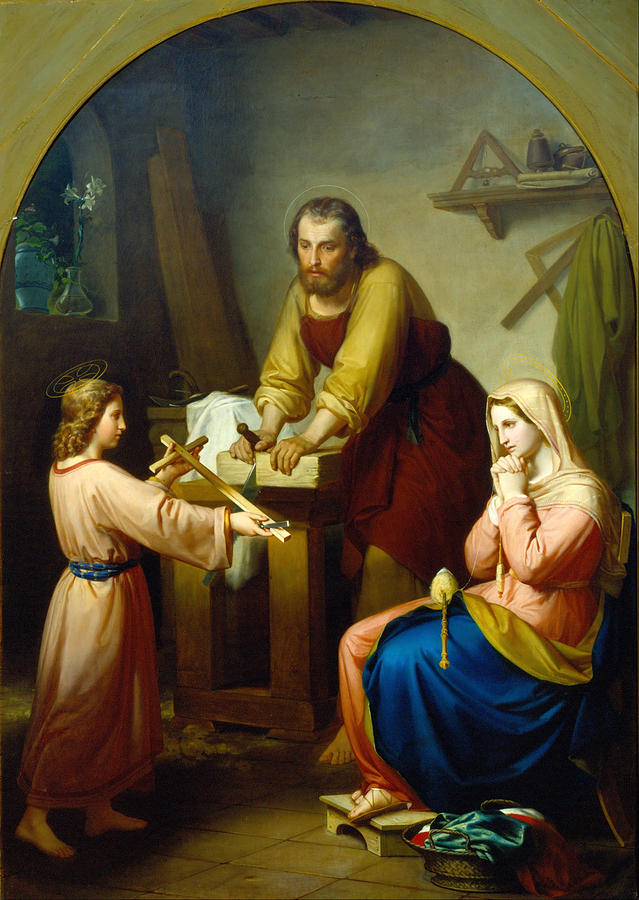
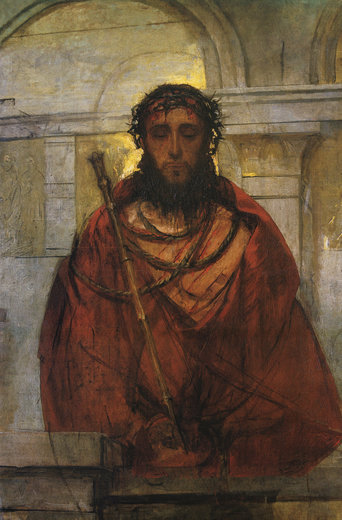
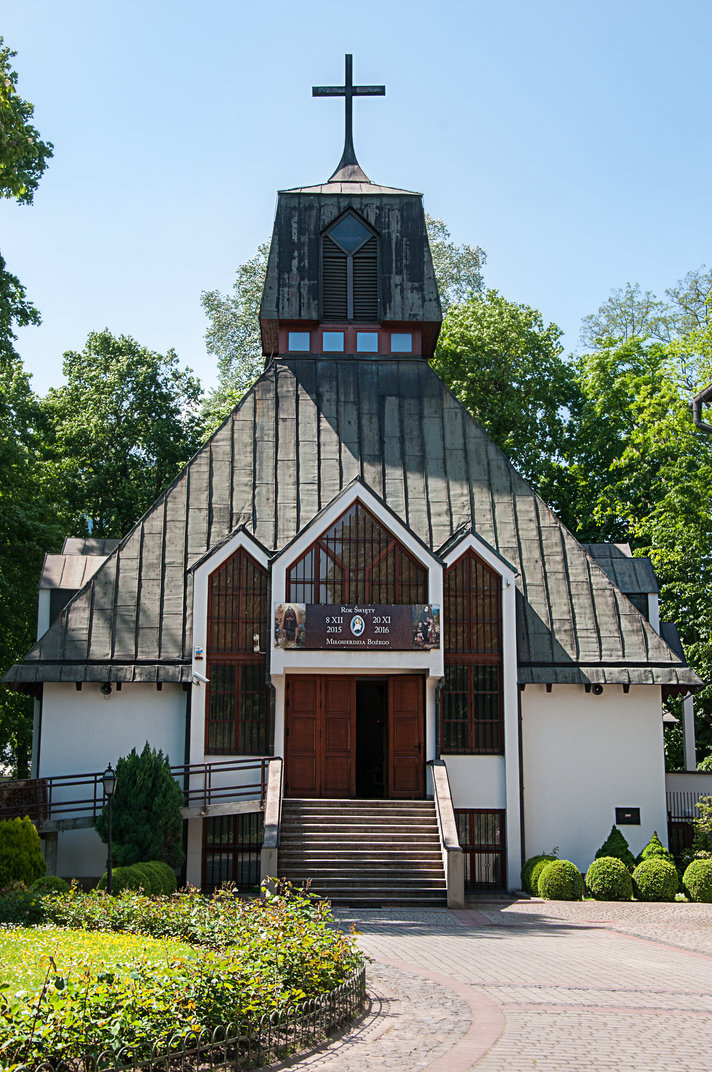
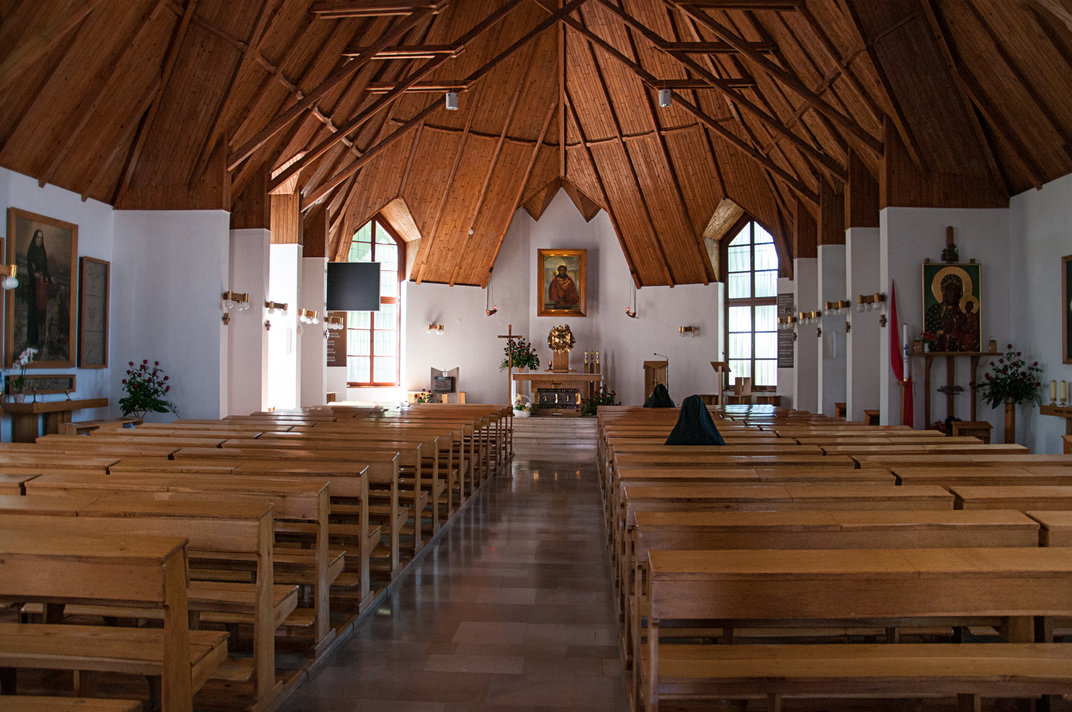
 Above, St. Albert; below images from the Albertine-run Ecce Homo Shrine and the saint's famous Ecce Homo. (photo: Public domain image/Wikipedia; church images, Dorota Neścior photos; <i>Ecce Homo</i>, public domain image courtesy of Albertine nuns at St. Albert shrine; )