Skip to comments.
Catholic Caucus: Daily Mass Readings xx-June-2023
Universalis/Jerusalem Bible ^
Posted on 06/10/2023 7:09:19 AM PDT by annalex
10 June 2023
Saturday of week 9 in Ordinary Time

L'Aquila, Cathedral of St Maximus. Main altarReadings at MassLiturgical Colour: Green. Year: A(I).
| First reading |
|---|
| Tobit 12:1,5-15,20 © |
|---|
'I am one of the seven angels who stand ever ready to enter the presence of the glory of the Lord'When the feasting was over, Tobit called his son Tobias and said, ‘My son, you ought to think about paying the amount due to your fellow traveller; give him more than the figure agreed on.’ So Tobias called his companion and said, ‘Take half of what you brought back, in payment for all you have done, and go in peace.’ Then Raphael took them both aside and said, ‘Bless God, utter his praise before all the living for all the favours he has given you. Bless and extol his name. Proclaim before all men the deeds of God as they deserve, and never tire of giving him thanks. It is right to keep the secret of a king, yet right to reveal and publish the works of God. Thank him worthily. Do what is good, and no evil can befall you. ‘Prayer with fasting and alms with right conduct are better than riches with iniquity. Better to practise almsgiving than to hoard up gold. Almsgiving saves from death and purges every kind of sin. Those who give alms have their fill of days; those who commit sin and do evil, bring harm on themselves. ‘I am going to tell you the whole truth, hiding nothing from you. I have already told you that it is right to keep the secret of a king, yet right too to reveal in worthy fashion the works of God. So you must know that when you and Sarah were at prayer, it was I who offered your supplications before the glory of the Lord and who read them; so too when you were burying the dead. When you did not hesitate to get up and leave the table to go and bury a dead man, I was sent to test your faith, and at the same time God sent me to heal you and your daughter-in-law Sarah. I am Raphael, one of the seven angels who stand ever ready to enter the presence of the glory of the Lord. ‘Now bless the Lord on earth and give thanks to God. I am about to return to him above who sent me.’
| Responsorial Psalm | Tobit 13:2,6-8 © |
|---|
Blessed be God, who lives for ever. By turns he punishes and pardons; he sends men down to the depths of the underworld and draws them up from supreme Destruction; no one can escape his hand. Blessed be God, who lives for ever. If you return to him with all your heart and all your soul, behaving honestly towards him, then he will return to you and hide his face from you no longer. Blessed be God, who lives for ever. Consider how well he has treated you; loudly give him thanks. Bless the Lord of justice and extol the King of the ages. Blessed be God, who lives for ever. I for my part sing his praise in the country of my exile; I make his power and greatness known to a nation that has sinned. Blessed be God, who lives for ever. Sinners, return to him; let your conduct be upright before him; perhaps he will be gracious to you and take pity on you. Blessed be God, who lives for ever.
| Gospel Acclamation | cf.Lk8:15 |
|---|
Alleluia, alleluia! Blessed are those who, with a noble and generous heart, take the word of God to themselves and yield a harvest through their perseverance. Alleluia! Alleluia, alleluia! How happy are the poor in spirit: theirs is the kingdom of heaven. Alleluia!
This poor widow has put in more than allIn his teaching Jesus said, ‘Beware of the scribes who like to walk about in long robes, to be greeted obsequiously in the market squares, to take the front seats in the synagogues and the places of honour at banquets; these are the men who swallow the property of widows, while making a show of lengthy prayers. The more severe will be the sentence they receive.’ He sat down opposite the treasury and watched the people putting money into the treasury, and many of the rich put in a great deal. A poor widow came and put in two small coins, the equivalent of a penny. Then he called his disciples and said to them, ‘I tell you solemnly, this poor widow has put more in than all who have contributed to the treasury; for they have all put in money they had over, but she from the little she had has put in everything she possessed, all she had to live on.’ Christian Art Each day, The Christian Art website gives a picture and reflection on the Gospel of the day. The readings on this page are from the Jerusalem Bible, which is used at Mass in most of the English-speaking world. The New American Bible readings, which are used at Mass in the United States, are available in the Universalis apps, programs and downloads.
You can also view this page with the Gospel in Greek and English. |
TOPICS: Catholic; General Discusssion; Prayer; Worship
KEYWORDS: catholic; mk12; ordinarytime; prayer
For your reading, reflection, faith-sharing, comments, questions, discussion.
1
posted on
06/10/2023 7:09:19 AM PDT
by
annalex
To: All
KEYWORDS: catholic; mk12; ordinarytime; prayer
2
posted on
06/10/2023 7:09:50 AM PDT
by
annalex
(fear them not)
To: nickcarraway; NYer; ELS; Pyro7480; livius; ArrogantBustard; Catholicguy; RobbyS; marshmallow; ...

Alleluia Ping Please FReepmail me to get on/off the Alleluia Ping List.
3
posted on
06/10/2023 7:13:16 AM PDT
by
annalex
(fear them not)
To: annalex
4
posted on
06/10/2023 7:13:59 AM PDT
by
annalex
(fear them not)
To: annalex
| Mark |
| | English: Douay-Rheims | Latin: Vulgata Clementina | Greek NT: Byzantine/Majority Text (2000) |
| | Mark 12
|
| 38. | And he said to them in his doctrine: Beware of the scribes, who love to walk in long robes, and to be saluted in the marketplace, | Et dicebat eis in doctrina sua : Cavete a scribis, qui volunt in stolis ambulare, et salutari in foro, | και ελεγεν αυτοις εν τη διδαχη αυτου βλεπετε απο των γραμματεων των θελοντων εν στολαις περιπατειν και ασπασμους εν ταις αγοραις |
| 39. | And to sit in the first chairs, in the synagogues, and to have the highest places at suppers: | et in primis cathedris sedere in synagogis, et primos discubitus in cœnis : | και πρωτοκαθεδριας εν ταις συναγωγαις και πρωτοκλισιας εν τοις δειπνοις |
| 40. | Who devour the houses of widows under the pretence of long prayer: these shall receive greater judgment. | qui devorant domos viduarum sub obtentu prolixæ orationis : hi accipient prolixius judicium. | οι κατεσθιοντες τας οικιας των χηρων και προφασει μακρα προσευχομενοι ουτοι ληψονται περισσοτερον κριμα |
| 41. | And Jesus sitting over against the treasury, beheld how the people cast money into the treasury, and many that were rich cast in much. | Et sedens Jesus contra gazophylacium, aspiciebat quomodo turba jactaret æs in gazophylacium, et multi divites jactabant multa. | και καθισας ο ιησους κατεναντι του γαζοφυλακιου εθεωρει πως ο οχλος βαλλει χαλκον εις το γαζοφυλακιον και πολλοι πλουσιοι εβαλλον πολλα |
| 42. | And there came a certain poor widow, and she cast in two mites, which make a farthing. | Cum venisset autem vidua una pauper, misit duo minuta, quod est quadrans, | και ελθουσα μια χηρα πτωχη εβαλεν λεπτα δυο ο εστιν κοδραντης |
| 43. | And calling his disciples together, he saith to them: Amen I say to you, this poor widow hath cast in more than all they who have cast into the treasury. | et convocans discipulos suos, ait illis : Amen dico vobis, quoniam vidua hæc pauper plus omnibus misit, qui miserunt in gazophylacium. | και προσκαλεσαμενος τους μαθητας αυτου λεγει αυτοις αμην λεγω υμιν οτι η χηρα αυτη η πτωχη πλειον παντων βεβληκεν των βαλλοντων εις το γαζοφυλακιον |
| 44. | For all they did cast in of their abundance; but she of her want cast in all she had, even her whole living. | Omnes enim ex eo, quod abundabat illis, miserunt : hæc vero de penuria sua omnia quæ habuit misit totum victum suum. | παντες γαρ εκ του περισσευοντος αυτοις εβαλον αυτη δε εκ της υστερησεως αυτης παντα οσα ειχεν εβαλεν ολον τον βιον αυτης |
5
posted on
06/10/2023 7:14:23 AM PDT
by
annalex
(fear them not)
To: annalex

Catena Aurea by St. Thomas Aguinas
38. And he said unto them in his doctrine, Beware of the scribes, which love to go in long clothing, and love salutations in the marketplaces,
39. And the chief seats in the synagogues, and the uppermost rooms at feasts:
40. Which devour widows’ houses, and for a pretence make long prayers: these shall receive greater damnation.
PSEUDO-JEROME. After confuting the Scribes and Pharisees, He burns up as a fire their dry and withered examples; wherefore it is said, And he said unto them in his doctrine, Beware of the Scribes, which love to go in long clothing.
BEDE. (ubi sup.) To walk in long clothing is to go forth into public clad in garments too much ornamented, in which amongst other things, that rich man, who fared sumptuously every day, is said to have sinned.
THEOPHYLACT. But they used to walk in honourable garments, because they wished to be highly esteemed for it, and in like manner they desired other things, which lead to glory. For it goes on: And love salutations in the marketplaces, and the chief seats in the synagogues, and the uppermost rooms at feasts.
BEDE. (ubi sup.) We must observe that He does not forbid that those, to whom it falls by the rule of their office, should be saluted in the marketplace, or have chief seats and places at feasts, but He teaches that those who love those things unduly, whether they have them or no, are to be avoided by the faithful as wicked men: that is, He blames the intention and not the office; although this too is culpable, that the very men who wish to be called masters of the synagogue in Moses’ seat, should have to do with lawsuits in the marketplace. We are in two ways ordered to beware of those who are desirous of vain glory; first, we should not be seduced by their hypocrisy into thinking that what they do is good; nor secondly, should we be excited to imitate them, through a vain rejoicing in being praised for those virtues which they affect.
THEOPHYLACT. He also especially teaches the Apostles, not to have any communication with the scribes, but to imitate Christ Himself; and in ordaining them to be masters in the duties of life, He places others under themv.
BEDE. (ubi sup.) But they do not only seek for praise from men, but also for gain. Wherefore there follows, Which devour widows’ houses, under the pretence of long prayers. For there are men who pretending to be just hesitate not to receive money from persons who are troubled in conscience, as though they would be their advocates in the judgment. A hand stretched out to the poor is always an accompaniment to prayer, but these men pass the night in prayer, that they may take away money from the poor.
THEOPHYLACT. But the Scribes used to come to women, who were left without the protection of their husbands, as though they were their protectors; and by a pretence of prayer, a reverend exterior and hypocrisy, they used to deceive widows, and thus also devour the houses of the rich. It goes on, These shall receive a greater damnation, that is, than the other Jews, who sinned.
12:41–44
41. And Jesus sat over against the treasury, and beheld how the people cast money into the treasury: and many that were rich cast in much.
42. And there came a certain poor widow, and she threw in two mites, which make a farthing.
43. And he called unto him his disciples, and saith unto them, Verily I say unto you, That this poor widow hath cast more in, than all they which have cast into the treasury:
44. For all they did cast in of their abundance; but she of her want did cast in all that she had, even all her living.
BEDE. (ubi sup.) The Lord, who had warned them to avoid the desire of high place and vain glory, now distinguishes by a sure test those who brought in gifts. Wherefore it is said, And Jesus sat over against the treasury, and beheld how the people cast money into the treasury. In the Greek language, phylassein means to keep, and gaza is a Persian word for treasure; wherefore the word gazophylacium. which is here used means a place where riches are kept, which name also was applied to the chest in which the offerings of the people were collected, for the necessary uses of the temple, and to the porch in which they were kept. You have a notice of the porch in the Gospel, These words spake Jesus in the treasury as He taught in the temple; and of the chest in the book of Kings, But Jehoiada the priest took a chest. (John 8:20. 2 Kings 12:9)
THEOPHYLACT. Now there was a praiseworthy custom amongst the Jews, that those who were able and willing should put something into the treasury, for the maintenance of the priests, the poor, and the widows; wherefore there is added, And many that were rich cast in much. But whilst many people were so engaged, a poor widow came up, and shewed her love by offering money according to her ability; wherefore it is said, And there came a certain poor widow, and she threw in two mites, which make a farthing.
BEDE. (ubi sup.) Reckoners use the word ‘quadrans’ for the fourth part of any thing, be it place, money, or time. Perhaps then in this place is meant the fourth part of a shekel, that is, five pence. It goes on, And he called unto him his disciples, and saith unto them, Verily I say unto you, That this poor widow hath cast more in, than all they which have cast into the treasury: for God does not weigh the property but the conscience of those who offer; nor did He consider the smallness of the sum in her offering, but what was the store from which it came. Wherefore He adds, For all they did cast in of their abundance, but she of her want did cast in all that she had, even all her living.
PSEUDO-JEROME. But in a mystical sense, they are rich, who bring forth from the treasure of their heart things new and old, which are the obscure and hidden things of Divine wisdom in both testaments; but who is the poor woman, if it be not I and those like me, who cast in what I can, and have the will to explain to you, where I have not the power. For God does not consider how much ye hear, but what is the store from which it comes; but each at all events can bring his farthing, that is, a ready will, which is called a farthing, because it is accompanied by three things, that is, thought, word, and deed. And in that it is said that she cast in all her living, it is implied that all that the body wants is that by which it lives1; wherefore it is said, All the labour of man is for his mouth. (Eccl. 6:7)
THEOPHYLACT. Or else; That widow is the soul of man, which leaving Satan to which it had been joined, casts into the temple two mites, that is, the flesh and the mind, the flesh by abstinence, the mind by humility, that so it may be able to hear that it has cast away all its living, and has consecrated it, leaving nothing for the world of all that it possessed.
BEDE. (ubi sup) Again, in an allegorical way, the rich men, who cast gifts into the treasury, point out the Jews puffed up with the righteousness of the law; the poor widow is the simplicity of the Church: poor indeed, because she has cast away the spirit of pride and of the desires of worldly things; and a widow, because Jesus her husband has suffered death for her. She casts two mites into the treasury, because she brings the love of God and of her neighbour, or the gifts of faith and prayer; which are looked upon as mites in their own insignificance, but measured by the merit of a devout intention are superior to all the proud works of the Jews. The Jew sends of his abundance into the treasury, because he presumes on his own righteousness; but the Church sends her whole living into God’s treasury, because she understands that even her very living is not of her own desert, but of Divine grace.
Catena Aurea Mark 12
6
posted on
06/10/2023 7:14:55 AM PDT
by
annalex
(fear them not)
To: annalex
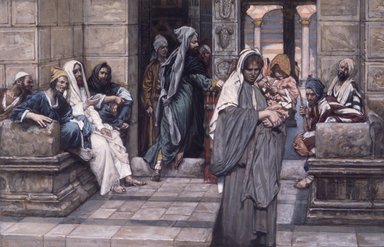
The Widow's Mite
James Tissot
1886-1894
Brooklyn Museum
7
posted on
06/10/2023 7:19:18 AM PDT
by
annalex
(fear them not)
To: annalex
Maximus of Aquila or Aveia
St Maximus (Died ca. 250 AD) was born in Aveia. He was ordained a Deacon and lived during the rule of Emperor Decius who relentlessly persecuted Christians hoping to introduce paganism.
St Maximus, refusing to deny his Christian faith, was tortured and then martyred by being thrown over a cliff-edge to his death.
St Maximus is Patron Saint of L’Aquila, Italy. His Feast Day is the 10th June.
St Maximus of Aquila:
Pray for us that we will remain faithful to the teachings of the Catholic Church.
daily-prayers.org
8
posted on
06/10/2023 7:24:45 AM PDT
by
annalex
(fear them not)
To: annalex
9
posted on
06/10/2023 7:28:26 AM PDT
by
annalex
(fear them not)
To: annalex
NAVARRE BIBLE COMMENTARY (RSV)
Ad Majorem Dei Gloriam (To the Greater Glory of God)
From: Tobit 12:1-20
The Archangel Raphael reveals himself
--------------------------------------------------------
[1] Tobit then called his son Tobias and said to him, “My son, see to the wages of the man who went with you; and he must also be given more.” [2] He replied, “Father it would do me no harm to give him half of what I have brought back. [3] For he has led me back to you safely, he cured my wife, he obtained the money for me, and he also healed you.” [4] The old man said, “He deserves it.” [5] So he called the angel and said to him, “Take half of all that you two have brought back.”
[6] Then the angel called the two of them privately and said to them: “Praise God and give thanks to him; exalt him and give thanks to him in the presence of all the living for what he has done for you. It is good to praise God and to exalt his name, worthily declaring the works of God. Do not be slow to give him thanks. [7] It is good to guard the secret of a king, but gloriously to reveal the works of God. Do good, and evil will not overtake you. [8] Prayer is good when accompanied by fasting, almsgiving, and righteousness. A little with righteousness is better than much with wrongdoing. It is better to give alms than to treasure up gold. [9] For almsgiving delivers from death, and it will purse away every sin. Those who perform deeds of charity and of righteousness will have fullness of life; [10] but those who commit sin are the enemies of their own lives.
[11] I will not conceal anything from you. I have said, ‘It is good to guard the secret of a king, but gloriously to reveal the works of God.’ [12] And so, when you and your daughter-in-law Sarah prayed, I brought a reminder of your prayer before the Holy One; and when you buried the dead, I was likewise present with you. [13] When you did not hesitate to rise and leave your dinner in order to go and lay out the dead, your good deed was not hidden from your daughter-in-law Sarah. [15] I am Raphael, one of the seven holy angels who present the prayers of the saints and enter into the presence of the glory of the Holy One.”
[16] They were both alarmed; and they fell upon their faces, for they were afraid. [17] But he said to them, “Do not be afraid; you will be safe. But praise God for ever. [18] For I did not come as a favour on my part, but by the will of our God. Therefore praise him for ever. [19] All these days I merely appeared to you and did not eat or drink, but you were seeing a vision. [20] And now give thanks to God, for I am ascending to him who sent me. Write in a book everything that has happened.”
****************************************************
Commentary:
12:1-22. Giving the angels half the money brought from Media shows Tobit’s great generosity and Tobias’ appreciation of the angel’s good offices. The young man attributes all the various favours to the angel (v. 3). But now the focus turns to what Raphael has to say – angelic words and therefore of special significance. Commenting on this book, St. Ambrose highlights the virtues that make Tobit a model of righteousness and good works: “But that holy man Tobit [. . .] understood that the servant too must be paid a just wage. He offered half of what he owned, and it is no coincidence that the servant he hired was an angel. As for you, if you deny a just man his due reward, or worse still a weak man – Woe to him who scandalizes one of these, the least of my little ones – how do you know that you are not defrauding an angel? From the moment that Christ became a child, it became impossible for us to doubt that our servant could be an angel. Give your servant his due, do not deprive him of the reward for his labour, because you yourself are a servant of Christ, who has brought you into his vineyard and has prepared a place in heaven for you” (St. Ambrose, De Tobia, 24, 91-92). Tobit and his son feel a reverential fear on finding themselves in the presence of an angel, but Raphael puts them at ease, telling them not to be afraid and showing them that it has all been by the will of God: they should praise God, and put the whole story down in writing (vv. 17-21). Tobit and Tobias do confess the wonderful works of God (v. 22) and the sacred author has done the writing.
Many psalms in the Bible, particularly those of thanksgiving, bear witness to what God has done in the personal life of the psalmist, but the most splendid instance of all is to be found in the Magnificat, the Virgin Mary’s prayer of praise after the Annunciation (cf. Lk 1:46-55).
10
posted on
06/10/2023 10:42:14 AM PDT
by
fidelis
(👈 Under no obligation to respond to rude, ignorant, abusive, bellicose, and obnoxious posts.)
To: fidelis
From: Mark 12:38-44Jesus Censures the Scribes
--------------------------
[38] And in His (Jesus') teaching He said, "Beware of the scribes, who like to go about in long robes, and to have salutations in the market places [39] and the best seats in the synagogues and the places of honor at feasts, [40] who devour widow's houses and for a pretense make long prayers. They will receive the greater condemnation."
The Widow's Mite
----------------
[41] And He sat down opposite the treasury, and watched the multitude putting money into the treasury. Many rich people put in large sums. [42] And a poor widow came, and put in two copper coins, which make a penny. [43] And He called His disciples to Him, and said to them, "Truly, I say to you, this poor widow has put in more than all those who are contributing to the treasury. [44] For they all contributed out of their abundance; but she out of her poverty has put in everything she had, her whole living."
***********************************************************************
Commentary:
38-40. Our Lord reproves disordered desire for human honors: "We should notice that salutations in the marketplace are not forbidden, nor people taking the best seats if that befits their position; rather, the faithful are warned to avoid, as they would evil men, those who set too much store by such honors" (St. Bede, "In Marci Evangelium Expositio, in loc."). See also notes on Matthew 23:2-3, 5, 11 and 14.
Notes on Matthew 23:2-3, 5, 11 and 14: 2-3. Moses passed on to the people the Law received from God. The scribes, who for the most part sided with the Pharisees, had the function of educating the people in the Law of Moses; that is why they were said to "sit on Moses' seat". Our Lord recognized that the scribes and Pharisees did have authority to teach the Law; but He warns the people and His disciples to be sure to distinguish the Law as read out and taught in the synagogues from the practical interpretations of the Law to be seen in their leaders' lifestyles. Some years later, St. Paul--a Pharisee like his father before him--faced his former colleagues with exactly the same kind of accusations as Jesus makes here: "You then who teach others, will you not teach yourself? While you preach against stealing, do you steal? You who say that one must not commit adultery, do you commit adultery? You who abhor idols, do you rob temples? You who boast in the law, do you dishonor God by breaking the law? For, as it is written, `The name of God is blasphemed among the Gentiles because of you'" (Romans 2:21-24).
5. "Phylacteries": belts or bands carrying quotations from sacred Scripture which the Jews used to wear fastened to their arms or foreheads. To mark themselves out as more religiously observant than others, the Pharisees used to wear broader phylacteries. The fringes were light-blue stripes on the hems of cloaks; the Pharisees ostentatiously wore broader fringes.
11. The Pharisees were greedy for honor and recognition: our Lord insists that every form of authority, particularly in the context of religion, should be exercised as a form of service to others; it must not be used to indulge personal vanity or greed. "He who is the greatest among you shall be your servant".
14. As the RSV points out, "other authorities add here (or after verse 12) verse 14, "Woe to you, scribes and Pharisees, hypocrites! For you devour widows' houses and for a pretense you make long prayers; therefore you will receive greater condemnation." Our Lord is not reproaching them for praying long prayers but for their hypocrisy and cupidity. By going in for a lot of external religious practices, the Pharisees wanted to be recognized as devout men and then trade on that reputation particularly with vulnerable people. Widows, for example, would ask them to say prayers; the Pharisees in turn would ask for alms. What Jesus means here is that prayer should always come from an upright heart and a generous spirit. ]
41-44. Our Lord uses this little event to teach us the importance of things which apparently are insignificant. He puts it somewhat paradoxically; the poor widow has contributed more than all the rich. In God's sight the value of such an action lies more in upright intention and generosity of spirit than in the quantity one gives.
"Didn't you see the light in Jesus' eyes as the poor widow left her little alms in the temple? Give Him what you can: the merit is not in whether it is big or small, but in the intention with which you give it" (St J. Escriva, "The Way", 829).
By the same token, our actions are pleasing to God even if they are not as perfect as we would like. St. Francis de Sales comments: "Now as among the treasures of the temple, the poor widow's mite was much esteemed, so the least little good works, even though performed somewhat coldly and not according to the whole extent of the charity which is in us, are agreeable to God, and esteemed by Him; so that though of themselves they cannot cause and increase in the existing love [...] yet Divine Providence, counting on them and, out of His goodness, valuing them, forthwith rewards them with increase in charity for the present, and assigns to them a greater Heavenly glory for the future" (St. Francis de Sales, "Treatise on the Love of God", Book 3, Chapter 2).
11
posted on
06/10/2023 10:42:46 AM PDT
by
fidelis
(👈 Under no obligation to respond to rude, ignorant, abusive, bellicose, and obnoxious posts.)
To: fidelis
12
posted on
06/10/2023 10:43:30 AM PDT
by
fidelis
(👈 Under no obligation to respond to rude, ignorant, abusive, bellicose, and obnoxious posts.)
Disclaimer:
Opinions posted on Free Republic are those of the individual
posters and do not necessarily represent the opinion of Free Republic or its
management. All materials posted herein are protected by copyright law and the
exemption for fair use of copyrighted works.
FreeRepublic.com is powered by software copyright 2000-2008 John Robinson