
Free Republic
Browse · Search
Religion
Topics · Post Article

Skip to comments.

Catholic Caucus: Daily Mass Readings xx-May-2023
Universalis/Jerusalem Bible ^

Posted on 05/30/2023 4:58:45 AM PDT by annalex

30 May 2023

Tuesday of week 8 in Ordinary Time


Saint Joan of Arc Catholic Church, Powell, Ohio

Readings at Mass

Liturgical Colour: Green. Year: A(I).


First reading
Ecclesiasticus 35:2-15 ©

Give to the Most High as he has given to you

A man multiplies offerings by keeping the Law;
  he offers communion sacrifices by following the commandments.
By showing gratitude he makes an offering of fine flour,
  by giving alms he offers a sacrifice of praise.
Withdraw from wickedness and the Lord will be pleased,
  withdraw from injustice and you make atonement.
Do not appear empty-handed in the Lord’s presence;
  for all these things are due under the commandment.
A virtuous man’s offering graces the altar,
  and its savour rises before the Most High.
A virtuous man’s sacrifice is acceptable,
  its memorial will not be forgotten.
Honour the Lord with generosity,
  do not stint the first-fruits you bring.
Add a smiling face to all your gifts,
  and be cheerful as you dedicate your tithes.
Give to the Most High as he has given to you,
  generously as your means can afford;
for the Lord is a good rewarder,
  he will reward you seven times over.
Offer him no bribe, he will not accept it,
  do not put your faith in an unvirtuous sacrifice;
since the Lord is a judge
  who is no respecter of personages.

Responsorial Psalm
Psalm 49(50):5-8,14,23 ©
I will show God’s salvation to the upright.
‘Summon before me my people
  who made covenant with me by sacrifice.’
The heavens proclaim his justice,
  for he, God, is the judge.
I will show God’s salvation to the upright.
‘Listen, my people, I will speak;
  Israel, I will testify against you,
for I am God, your God.
  I accuse you, lay the charge before you.
I find no fault with your sacrifices,
  your offerings are always before me.
I will show God’s salvation to the upright.
Pay your sacrifice of thanksgiving to God
  and render him your votive offerings.
A sacrifice of thanksgiving honours me
  and I will show God’s salvation to the upright.’
I will show God’s salvation to the upright.

Gospel AcclamationPh2:15-16
Alleluia, alleluia!
You will shine in the world like bright stars
because you are offering it the word of life.
Alleluia!
Or:Mt11:25
Alleluia, alleluia!
Blessed are you, Father,
Lord of heaven and earth,
for revealing the mysteries of the kingdom
to mere children.
Alleluia!

GospelMark 10:28-31 ©

Whoever has left everything for the sake of the gospel will be repaid

At that time Peter began to tell Jesus, ‘What about us? We have left everything and followed you.’ Jesus said, ‘I tell you solemnly, there is no one who has left house, brothers, sisters, father, children or land for my sake and for the sake of the gospel who will not be repaid a hundred times over, houses, brothers, sisters, mothers, children and land – not without persecutions – now in this present time and, in the world to come, eternal life.
  ‘Many who are first will be last, and the last first.’

Christian Art

Illustration

Each day, The Christian Art website gives a picture and reflection on the Gospel of the day.

The readings on this page are from the Jerusalem Bible, which is used at Mass in most of the English-speaking world. The New American Bible readings, which are used at Mass in the United States, are available in the Universalis apps, programs and downloads.

You can also view this page with the Gospel in Greek and English.


TOPICS: Catholic; General Discusssion; Prayer; Worship
KEYWORDS: catholic; easter; mk10; ordinarytime; prayer
For your reading, reflection, faith-sharing, comments, questions, discussion.

1 posted on 05/30/2023 4:58:45 AM PDT by annalex
[ Post Reply | Private Reply | View Replies]

To: All

KEYWORDS: catholic; mk10; ordinarytime; prayer


2 posted on 05/30/2023 5:00:10 AM PDT by annalex (fear them not)
[ Post Reply | Private Reply | To 1 | View Replies]

To: nickcarraway; NYer; ELS; Pyro7480; livius; ArrogantBustard; Catholicguy; RobbyS; marshmallow; ...

Alleluia Ping

Please FReepmail me to get on/off the Alleluia Ping List.


3 posted on 05/30/2023 5:00:52 AM PDT by annalex (fear them not)
[ Post Reply | Private Reply | To 2 | View Replies]

To: annalex
Mark
 English: Douay-RheimsLatin: Vulgata ClementinaGreek NT: Byzantine/Majority Text (2000)
 Mark 10
28And Peter began to say unto him: Behold, we have left all things, and have followed thee. Et cœpit ei Petrus dicere : Ecce nos dimisimus omnia, et secuti sumus te.ηρξατο ο πετρος λεγειν αυτω ιδου ημεις αφηκαμεν παντα και ηκολουθησαμεν σοι
29Jesus answering, said: Amen I say to you, there is no man who hath left house or brethren, or sisters, or father, or mother, or children, or lands, for my sake and for the gospel, Respondens Jesus, ait : Amen dico vobis : Nemo est qui reliquerit domum, aut fratres, aut sorores, aut patrem, aut matrem, aut filios, aut agros propter me et propter Evangelium,αποκριθεις [δε] ο ιησους ειπεν αμην λεγω υμιν ουδεις εστιν ος αφηκεν οικιαν η αδελφους η αδελφας η πατερα η μητερα η γυναικα η τεκνα η αγρους ενεκεν εμου και [ενεκεν] του ευαγγελιου
30Who shall not receive an hundred times as much, now in this time; houses, and brethren, and sisters, and mothers, and children, and lands, with persecutions: and in the world to come life everlasting. qui non accipiat centies tantum, nunc in tempore hoc : domos, et fratres, et sorores, et matres, et filios, et agros, cum persecutionibus, et in sæculo futuro vitam æternam.εαν μη λαβη εκατονταπλασιονα νυν εν τω καιρω τουτω οικιας και αδελφους και αδελφας και μητερας και τεκνα και αγρους μετα διωγμων και εν τω αιωνι τω ερχομενω ζωην αιωνιον
31But many that are first, shall be last: and the last, first. Multi autem erunt primi novissimi, et novissimi primi.πολλοι δε εσονται πρωτοι εσχατοι και [οι] εσχατοι πρωτοι

4 posted on 05/30/2023 5:03:22 AM PDT by annalex (fear them not)
[ Post Reply | Private Reply | To 3 | View Replies]

To: annalex

Catena Aurea by St. Thomas Aguinas

10:28–31

28. Then Peter began to say unto him, Lo, we have left all, and have followed thee.

29. And Jesus answered and said, Verily I say unto you, There is no man that hath left house, or brethren, or sisters, or father, or mother, or wife, or children, or lands, for my sake, and the Gospel’s,

30. But he shall receive an hundredfold now in this time, houses, and brethren, and sisters, and mothers, and children, and lands, with persecutions; and in the world to come eternal life.

31. But many that are first shall be last; and the last first.

GLOSS. (non occ.) Because the youth, on hearing the advice of our Saviour concerning the casting away of his goods, had gone away sorrowful, the disciples of Christ, who had already fulfilled the foregoing precept, began to question Him concerning their reward, thinking that they had done a great thing, since the young man, who had fulfilled the commandments of the law, had not been able to hear it without sadness. Wherefore Peter questions the Lord for himself and the others, in these words, Then Peter began to say unto him, Lo, we have left all, and have followed thee.

THEOPHYLACT. Although Peter had left but few things, still he calls these his all; for even a few things keep us by the bond of affection, so that he shall be beatified who leaves a few things.

BEDE. (ubi sup.) And because it is not sufficient to have left all, he adds that which makes up perfection, and have followed thee. As if he said, We have done what Thou hast commanded. What reward therefore wilt Thou give us?1 But while Peter asks only concerning the disciples, our Lord makes a general answer; wherefore it goes on: Jesus answered and said, Verily I say unto you, There is no one that hath left house, or brethren, or sisters, or father, or mother, or children, or lands. But in saying this, He does not mean that we should leave our fathers, without helping them, or that we should separate ourselves from our wives; but He instructs us to prefer the glory of God to the things of this world.

CHRYSOSTOM. (Hom. in Matt. 64) But it seems to me that by these words He intended covertly to proclaim that there were to be persecutions, as it would come to pass that many fathers would allure their sons to impiety, and many wives their husbands.1 Again He delays not to say, for my name’s sake and the Gospel’s, as Mark says, or for the kingdom of God, as Luke says; the name of Christ is the power of the Gospel, and of His kingdom; for the Gospel is received in the name of Jesus Christ, and the kingdom is made known, and comes by His name.

BEDE. Some, however, taking occasion from this saying, in which it is announced that he shall receive an hundredfold now in this time, teach that Jewish fable of a thousand years after the resurrection of the just, when all that we have left for the Lord’s sake is to be restored with manifold usury, besides which we are to receive the crown of everlasting life. These persons do not perceive, that although the promise in other respects be honourable, yet in the hundred wives, which the other Evangelists mention, its foulness is made manifest: particularly when the Lord testifies that there shall be no marriage in the resurrection, and asserts that those things which are put away from us for His sake are to be received again in this life with persecutions, which, as they affirm, will not take place in their thousand yearss.

PSEUDO-CHRYSOSTOM. (Cat. in Marc. Oxon.) This hundredfold reward therefore must be in participation, not in possession, for the Lord fulfilled this to them not carnally, but spiritually.

THEOPHYLACT. For a wife is busied in a house about her husband’s food and raiment. See also how this is the case with the Apostles; for many women busied themselves about their food and their clothing, and ministered unto them. In like manner the Apostles had many fathers and mothers, that is, persons who loved them; as Peter, for instance, leaving one house, had afterwards the houses of all the disciples. And what is more wonderful, they are to be persecuted and oppressed, for it is with persecutions that the Saints are to possess all things, for which reason there follows, But many that are first shall be last, and the last first. For the Pharisees who were first became the last; but those who left all and followed Christ were last in this world through tribulation and persecutions, but shall be first by the hope which is in God.

BEDE. (ubi sup.) This which is here said, shall receive an hundredfold, may be understood in a higher sense1. For the number a hundred which is reckoned by changing from the left to the right hand, although it has the same appearance in the bending of the fingers as the ten had on the left, nevertheless is increased to a much greater quantity. This means, that all who have despised temporal things for the sake of the kingdom of heaven through undoubting faith, taste the joy of the same kingdom in this life which is full of persecutions, and in the expectation of the heavenly country, which is signified by the right hand, have a share in the happiness of all the elect. But because all do not accomplish a virtuous course of life with the same ardour as they began it, it is presently added, But many that are first shall be last, and the last first; for we daily see many persons who, remaining in a lay habit, are eminent for their meritorious life; but others, who from their youth have been ardent in a spiritual profession, at last wither away in the sloth of ease, and with a lazy folly finish in the flesh, what they had begun in the Spirit.

Catena Aurea Mark 10

5 posted on 05/30/2023 5:04:47 AM PDT by annalex (fear them not)
[ Post Reply | Private Reply | To 4 | View Replies]

To: annalex


Christ Taking Leave of his Mother

Lorenzo Lotto

1521
Oil on canvas, 126 x 99 cm
Staatliche Museen, Berlin

6 posted on 05/30/2023 5:05:15 AM PDT by annalex (fear them not)
[ Post Reply | Private Reply | To 5 | View Replies]

To: annalex

Who Was Joan of Arc?

August 13, 2022

Visited by St. Michael the Archangel and commissioned by God at the age of 13 to lead the army of France and bring an end to the bloodiest war in European history up to that point, Joan of Arc seems more legend than history. 

Here are some of the questions people ask about the Maid of Orléans:

Who was Joan of Arc, and what did she do? When and where did she live?

Joan of Arc was a young French peasant, born in 1412, 90 years into the Hundred Years’ War, in the small village of Domremy in eastern France. Destined to save the French from English incursion, she was burnt at the stake in 1431 at the age of 19 after a corrupt Church trial found her guilty of heresy. The trial would later be nullified by the Church; and 500 years later, in 1920, Joan of Arc was declared a saint by Pope Benedict XV.

Did Joan of Arc hear voices?

At the age of 13, Joan of Arc had locutions — an interior, mystical phenomenon that involves hearing a divine voice — and reportedly heard the voices of St. Michael the Archangel, St. Margaret of Antioch and St. Catherine of Alexandria. These three informed her of a special mission given her by God to crown the rightful king of France and thereby end the dynastic dispute that undergirded the Hundred Years’ War. 

Along the way, she convinced lords, soldiers and the French heir to the throne, Charles VII, of her mission. After a lengthy interrogation, she was given charge of the army and successfully lifted the siege of Orléans — on which the fate of the entire war hung — and then freed several towns along the route to crowning Charles VII in the cathedral of Rheims.

Is the story of Joan of Arc a true story?

The story of Joan of Arc is true and historically documented. For this reason, she is among the most famous heroines of history. The task given her by God was so exceptional that it would lead atheist Mark Twain, who wrote a book on her life, to earnestly but exaggeratedly call her “by far the most extraordinary person the human race has ever produced.”

Was Joan of Arc a knight?

Joan of Arc was neither a knight nor a trained soldier, but when she mounted a horse for the first time she was so natural on it that the duke of Lorraine gifted it to her

Who were Joan of Arc's parents?

Joan of Arc’s parents were simple peasants, Jacque d’Arc and Isabel Romée. They were farmers and owned sheep, which Joan of Arc tended in her youth.

Did Joan of Arc have any siblings? Does she have any living descendants?

Joan of Arc had three brothers named Jacquemin, Pierre and Jean, and one sister, Catherine. Both Pierre and Jean accompanied Joan in her quest and fought alongside her. 

While Joan of Arc did not have descendants, her entire family was elevated to nobility after Charles VII was crowned, and her village was dispensed from paying taxes for 300 years by the crown. 

What was Joan of Arc's nickname?

Joan of Arc’s nickname was “La Pucelle” or the Maid, in reference to an old French prophecy that held that a virgin from Lorraine would save the people of France after an immoral woman, later held to be Isabella of Bavaria, jeopardized the crown. 

Could Joan of Arc read and write?

Joan of Arc could neither read nor write, and she did not know how to wield a sword before she began her mission. This makes her military success, where hardened commanders failed, even more extraordinary — an act of God, as the people saw it. 
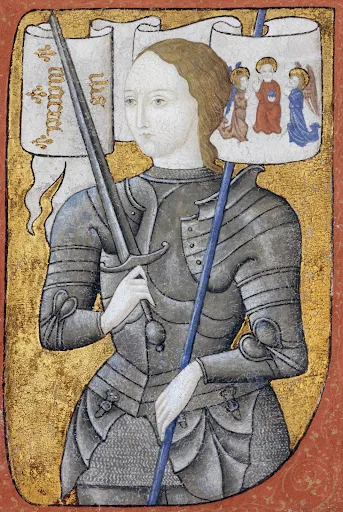
One of the three earliest paintings of St. Joan of Arc, dated to 1450, from the Archives Nationales in France. Wiki Commons

One of the three earliest paintings of St. Joan of Arc, dated to 1450, from the Archives Nationales in France. | Wiki Commons, public domain

How did Joan of Arc die?

Joan of Arc was executed by the Catholic Church after a sham trial condemned her of relapsed heresy. The trial was conducted by Church authorities sympathetic to the English who hoped to see her claims of heavenly assistance to end the war with a French king on the throne discredited. Convicted of heresy, she was taken to the stake to be burned, at which point, under penalty of death, she signed a paper renouncing her visions and agreeing never to wear men’s clothing. Four days later, Joan of Arc confessed to being afraid of her death, said that the visions were true, and donned men’s clothing once again, all of which constituted her supposed relapse to heresy. She was burned at the stake, clutching a crucifix to her body and proclaiming the name “Jesus” as she died, prompting an onlooker to say, “We have burned a saint.”

Where is Joan of Arc buried?

Joan of Arc’s body was incinerated at the stake, but her heart remained intact after her execution. The soldiers threw the heart in the Seine River so that no one would be able to venerate her remains.

What did Joan of Arc look like?

Joan of Arc scholar Regine Pernoud noted that Joan of Arc was barely over 5 feet tall, based upon a robe ordered for Joan during her imprisonment by the duke of Orléans.

How did Joan of Arc change the world and become a saint?

Joan of Arc was not canonized for her ability to free the French from English domination, but for her heroic dedication to the will of God and personal holiness. While Joan commanded the army of France, she drove prostitutes from camp, refused to allow soldiers to rape and pillage the towns that gave them entrance, encouraged confession before battle, and sharply reduced the cussing and oath-swearing of the men under her charge. 

She remained committed to a life of contemplation and prayer amid the battles she oversaw, never once lifting her sword against anyone save to chase out a prostitute. Her faith and insights became evident at her trial, forming the foundation of several summaries of theology in the Catechism of the Catholic Church, and her confidence in Jesus and the Catholic Church remained unshaken, even after being wrongly condemned to death by the Church. 

What is Joan of Arc the patron saint of?

Joan of Arc is the patron saint of France, soldiers, prisoners, those in need of courage, those ridiculed for their faith and youth, among other patronages. 

When is Joan of Arc's feast day?

Joan of Arc’s feast day is May 30. 


ncregister.com

7 posted on 05/30/2023 5:12:23 AM PDT by annalex (fear them not)
[ Post Reply | Private Reply | To 6 | View Replies]

To: annalex


Joan of Arc enters Orléans

Jean-Jacques Scherrer, 1887

8 posted on 05/30/2023 5:15:44 AM PDT by annalex (fear them not)
[ Post Reply | Private Reply | To 7 | View Replies]

To: annalex; All
NAVARRE BIBLE COMMENTARY (RSV)

Ad Majorem Dei Gloriam (To the Greater Glory of God)

From: Sirach 35:1-12

Worship Pleasing to God (Continuation)
--------------------------------------
[1] He who keeps the law makes many offerings; he who heeds the commandments sacrifices a peace offering. [2] He who returns a kindness offers fine flour, and he who gives alms sacrifices a thank offering. [3] To keep from wickedness is pleasing to the Lord, and to forsake unrighteousness is atonement. [4] Do not appear before the Lord empty-handed; [5] for all these things are to be done because of the commandment. [6] The offering of a righteous man anoints the altar, and its pleasing odor rises before the Most High. [7] The sacrifice of a righteous man is acceptable, and the memory of it will not be forgotten. [8] Glorify the Lord generously, and do not stint the first fruits of your hands. [9] With every gift show a cheerful face, and dedicate your tithe with gladness. [10] Give to the Most High as he has given, and as generously as your hand has found. [11] For the Lord is the one who repays, and he will repay you sevenfold. [12] Do not offer him a bribe, for he will not accept it; and do not trust to an unrighteous sacrifice; for the Lord is the judge, and with him is no partiality.

***********************************************************************
Commentary:

34:18-35:20. These verses contain Ben Sirach's teaching about the worship of God. The predominant idea is that the worship that is pleasing to God is not mere liturgical ritual: true adoration must be backed up by righteous living. The passage begins with maxims reminiscent of the prophets' teaching on social justice and religious worship (34:18-22).

More than one of the counsels contained here was used by the Fathers of the Church as a basis for instructing the faithful on worship pleasing to the Lord. For example, St Gregory the Great takes to task those who use ill-gotten gains to pay for Church services: "Many of them often offer to God what they have stolen from the poor. But as a wise man once said: In his anger God will reject them. What could be worse in the eyes of a father than the death of his son? We can see in this question the anger with which God would view any offering of that kind" ("Regula Pastoralis, 3,21). It can never be said often enough that "to take away a neighbor's living is to murder him"(34:22; cf. Jas 5:4). A worker indeed has a right to be properly paid for his work. "Remuneration for work should guarantee man the opportunity to provide a dignified livelihood for himself and his family on the material, social, cultural and spiritual level to correspond to the role and the productivity of each, the relevant economic factors in his employment and the common good" ("Gaudium Et Spes", 67).

The passage goes on to stress that fasting and prayer is to be genuine person must sincerely repent his sins (34:23-26), and then it goes back to the subject of acts of religious worship (35:1-11). Ben Sirach has nothing against religious ceremonies; on the contrary: the Law prescribes the offerings that should be made to God, and it should be generously adhered to (cf. 35:10). However, he has three very clear things to say that help to personalize religious worship: almsgiving is an act of worship (35:2); an upright life, that keeps to the Law, is an offering pleasing to God (35:3); and offerings to the Lord should be generously and gladly made (35:4-10).

From 35:11 on, the Lord is the subject of the sentences. Ben Sirach tells us God is: he pays well (35:11), he is a judge (35:11-15), who rewards a person according to his works; and he identifies the person whom God listens to--the generous giver (35:11), the one who is wronged (35 13), the orphan and the widow (35:14), the one who serves Him (35:16), the humble person (35:17). Most of these qualities (those of God as well as those of people who have recourse to him) can be found, all together, in Jesus' attitude to the sick, to sinners and to the poor.

9 posted on 05/30/2023 6:42:05 AM PDT by fidelis (👈 Under no obligation to respond to rude, ignorant, abusive, bellicose, and obnoxious posts.)
[ Post Reply | Private Reply | To 3 | View Replies]

To: fidelis
From: Mark 10:28-31

Poverty and Renunciation (Continuation)
---------------------------------------
[28] Peter began to say to Him (Jesus), "Lo, we have left everything and followed You." [29] Jesus said, "Truly, I say to you, there is no one who has left house or brothers or sisters or mother or father or children or lands, for My sake and for the Gospel, [30] who will not receive a hundredfold now in this time, houses and brothers and sisters and mothers and children and lands, with persecutions, and in the age to come eternal life. [31] But many that are first will be last, and the last first."

***********************************************************************
Commentary:

28-30. Jesus Christ requires every Christian to practise the virtue of poverty: He also requires us to practise real and effective austerity in the possession and use of material things. But of those who have received a specific call to apostolate--as in the case, here, of the Twelve--He requires absolute detachment from property, time, family, etc. so that they can be fully available, imitating Jesus Himself who, despite being Lord of the universe, became so poor that He had nowhere to lay His head (cf. Matthew 8:20). Giving up all these things for the sake of the Kingdom of Heaven also relieves us of the burden they involve: like a soldier shedding some encumbrance before going into action, to be able to move with more agility. This gives one a certain lordship over all things: no longer the slave of things, one experiences that feeling St. Paul referred to: "As having nothing, and yet possessing everything" (2 Corinthians 6:10). A Christian who sheds his selfishness in this way has acquired charity and, having charity, he has everything: "All are yours; you are Christ's; and Christ is God's" (1 Corinthians 3:22-23).

The reward for investing completely in Christ will be fully obtained in eternal life: but we will also get it in this life. Jesus says that anyone who generously leaves behind his possessions will be rewarded a hundred times over in this life. He adds "with persecutions" (v. 30) because opposition is part of the reward for giving things up out of love for Jesus Christ: a Christian's glory lies in becoming like the Son of God, sharing in His cross so as later to share in His glory: "provided we suffer with Him in order that we may also be glorified with Him (Romans 8:17); "all who desire to live a godly life in Christ Jesus will be persecuted' (2 Timothy 3:12).

29. These words of our Lord particularly apply to those who by divine vocation embrace celibacy, giving up their right to form a family on earth. By saying "for My sake and for the Gospel" Jesus indicates that His example and the demands of His teaching give full meaning to this way of life: "This, then, is the mystery of the newness of Christ, of all that He is and stands for; it is the sum of the highest ideals of the Gospel and of the Kingdom; it is a particular manifestation of grace, which springs from the paschal mystery of the Savior and renders the choice of celibacy desirable and worthwhile on the part of those called by our Lord Jesus. Thus, they intend not only to participate in Christ's priestly office, but also to share with Him His very condition of living" (Paul VI, "Sacerdotalis Coelibatus", 23).

10 posted on 05/30/2023 6:42:35 AM PDT by fidelis (👈 Under no obligation to respond to rude, ignorant, abusive, bellicose, and obnoxious posts.)
[ Post Reply | Private Reply | To 9 | View Replies]

To: fidelis
Click here to go to the My Catholic Life! Devotional thread for today’s Gospel Reading
11 posted on 05/30/2023 6:45:08 AM PDT by fidelis (👈 Under no obligation to respond to rude, ignorant, abusive, bellicose, and obnoxious posts.)
[ Post Reply | Private Reply | To 10 | View Replies]

Disclaimer: Opinions posted on Free Republic are those of the individual posters and do not necessarily represent the opinion of Free Republic or its management. All materials posted herein are protected by copyright law and the exemption for fair use of copyrighted works.

Free Republic
Browse · Search
Religion
Topics · Post Article

FreeRepublic, LLC, PO BOX 9771, FRESNO, CA 93794
FreeRepublic.com is powered by software copyright 2000-2008 John Robinson