Skip to comments.
Catholic Caucus: Daily Mass Readings 21-May-2023
Universalis/Jerusalem Bible ^
Posted on 05/21/2023 9:27:23 AM PDT by annalex
Sunday 21 May 2023
The Ascension of the Lord
Solemnity

St Godric of Finchale Priory, Durham, England Readings at MassLiturgical Colour: White. Year: A(I). These readings are for the Vigil Mass on the evening before the feast These readings are for the day of the feast itself
These readings are for the Vigil Mass on the evening before the feast:
| First reading | Acts 1:1-11 © |
|---|
Jesus was lifted up while they looked onIn my earlier work, Theophilus, I dealt with everything Jesus had done and taught from the beginning until the day he gave his instructions to the apostles he had chosen through the Holy Spirit, and was taken up to heaven. He had shown himself alive to them after his Passion by many demonstrations: for forty days he had continued to appear to them and tell them about the kingdom of God. When he had been at table with them, he had told them not to leave Jerusalem, but to wait there for what the Father had promised. ‘It is’ he had said ‘what you have heard me speak about: John baptised with water but you, not many days from now, will be baptised with the Holy Spirit.’ Now having met together, they asked him, ‘Lord, has the time come? Are you going to restore the kingdom to Israel?’ He replied, ‘It is not for you to know times or dates that the Father has decided by his own authority, but you will receive power when the Holy Spirit comes on you, and then you will be my witnesses not only in Jerusalem but throughout Judaea and Samaria, and indeed to the ends of the earth.’ As he said this he was lifted up while they looked on, and a cloud took him from their sight. They were still staring into the sky when suddenly two men in white were standing near them and they said, ‘Why are you men from Galilee standing here looking into the sky? Jesus who has been taken up from you into heaven, this same Jesus will come back in the same way as you have seen him go there.’
| Responsorial Psalm |
|---|
| Psalm 46(47):2-3,6-9 © |
|---|
God goes up with shouts of joy; the Lord goes up with trumpet blast. or Alleluia! All peoples, clap your hands, cry to God with shouts of joy! For the Lord, the Most High, we must fear, great king over all the earth. God goes up with shouts of joy; the Lord goes up with trumpet blast. or Alleluia! God goes up with shouts of joy; the Lord goes up with trumpet blast. Sing praise for God, sing praise, sing praise to our king, sing praise. God goes up with shouts of joy; the Lord goes up with trumpet blast. or Alleluia! God is king of all the earth, sing praise with all your skill. God is king over the nations; God reigns on his holy throne. God goes up with shouts of joy; the Lord goes up with trumpet blast. or Alleluia!
| Second reading |
|---|
| Ephesians 1:17-23 © |
|---|
God made him sit at his right hand in heavenMay the God of our Lord Jesus Christ, the Father of glory, give you a spirit of wisdom and perception of what is revealed, to bring you to full knowledge of him. May he enlighten the eyes of your mind so that you can see what hope his call holds for you, what rich glories he has promised the saints will inherit and how infinitely great is the power that he has exercised for us believers. This you can tell from the strength of his power at work in Christ, when he used it to raise him from the dead and to make him sit at his right hand, in heaven, far above every Sovereignty, Authority, Power, or Domination, or any other name that can be named not only in this age but also in the age to come. He has put all things under his feet and made him, as the ruler of everything, the head of the Church; which is his body, the fullness of him who fills the whole creation.
| Gospel Acclamation | Mt28:19,20 |
|---|
Alleluia, alleluia! Go, make disciples of all the nations. I am with you always; yes, to the end of time. Alleluia!
Go and make disciples of all nationsThe eleven disciples set out for Galilee, to the mountain where Jesus had arranged to meet them. When they saw him they fell down before him, though some hesitated. Jesus came up and spoke to them. He said, ‘All authority in heaven and on earth has been given to me. Go, therefore, make disciples of all the nations; baptise them in the name of the Father and of the Son and of the Holy Spirit, and teach them to observe all the commands I gave you. And know that I am with you always; yes, to the end of time.’
These readings are for the day of the feast itself:
| First reading | Acts 1:1-11 © |
|---|
Jesus was lifted up while they looked onIn my earlier work, Theophilus, I dealt with everything Jesus had done and taught from the beginning until the day he gave his instructions to the apostles he had chosen through the Holy Spirit, and was taken up to heaven. He had shown himself alive to them after his Passion by many demonstrations: for forty days he had continued to appear to them and tell them about the kingdom of God. When he had been at table with them, he had told them not to leave Jerusalem, but to wait there for what the Father had promised. ‘It is’ he had said ‘what you have heard me speak about: John baptised with water but you, not many days from now, will be baptised with the Holy Spirit.’ Now having met together, they asked him, ‘Lord, has the time come? Are you going to restore the kingdom to Israel?’ He replied, ‘It is not for you to know times or dates that the Father has decided by his own authority, but you will receive power when the Holy Spirit comes on you, and then you will be my witnesses not only in Jerusalem but throughout Judaea and Samaria, and indeed to the ends of the earth.’ As he said this he was lifted up while they looked on, and a cloud took him from their sight. They were still staring into the sky when suddenly two men in white were standing near them and they said, ‘Why are you men from Galilee standing here looking into the sky? Jesus who has been taken up from you into heaven, this same Jesus will come back in the same way as you have seen him go there.’
| Responsorial Psalm |
|---|
| Psalm 46(47):2-3,6-9 © |
|---|
God goes up with shouts of joy; the Lord goes up with trumpet blast. or Alleluia! All peoples, clap your hands, cry to God with shouts of joy! For the Lord, the Most High, we must fear, great king over all the earth. God goes up with shouts of joy; the Lord goes up with trumpet blast. or Alleluia! God goes up with shouts of joy; the Lord goes up with trumpet blast. Sing praise for God, sing praise, sing praise to our king, sing praise. God goes up with shouts of joy; the Lord goes up with trumpet blast. or Alleluia! God is king of all the earth, sing praise with all your skill. God is king over the nations; God reigns on his holy throne. God goes up with shouts of joy; the Lord goes up with trumpet blast. or Alleluia!
| Second reading |
|---|
| Ephesians 1:17-23 © |
|---|
God made him sit at his right hand in heavenMay the God of our Lord Jesus Christ, the Father of glory, give you a spirit of wisdom and perception of what is revealed, to bring you to full knowledge of him. May he enlighten the eyes of your mind so that you can see what hope his call holds for you, what rich glories he has promised the saints will inherit and how infinitely great is the power that he has exercised for us believers. This you can tell from the strength of his power at work in Christ, when he used it to raise him from the dead and to make him sit at his right hand, in heaven, far above every Sovereignty, Authority, Power, or Domination, or any other name that can be named not only in this age but also in the age to come. He has put all things under his feet and made him, as the ruler of everything, the head of the Church; which is his body, the fullness of him who fills the whole creation.
| Gospel Acclamation | Mt28:19,20 |
|---|
Alleluia, alleluia! Go, make disciples of all the nations. I am with you always; yes, to the end of time. Alleluia!
Go and make disciples of all nationsThe eleven disciples set out for Galilee, to the mountain where Jesus had arranged to meet them. When they saw him they fell down before him, though some hesitated. Jesus came up and spoke to them. He said, ‘All authority in heaven and on earth has been given to me. Go, therefore, make disciples of all the nations; baptise them in the name of the Father and of the Son and of the Holy Spirit, and teach them to observe all the commands I gave you. And know that I am with you always; yes, to the end of time.’ Christian Art Each day, The Christian Art website gives a picture and reflection on the Gospel of the day. The readings on this page are from the Jerusalem Bible, which is used at Mass in most of the English-speaking world. The New American Bible readings, which are used at Mass in the United States, are available in the Universalis apps, programs and downloads.
You can also view this page with the Gospel in Greek and English. |
TOPICS: Catholic; General Discusssion; Prayer; Worship
KEYWORDS: catholic; easter; mt28; prayer
For your reading, reflection, faith-sharing, comments, questions, discussion.
1
posted on
05/21/2023 9:27:23 AM PDT
by
annalex
To: annalex
NOTE:
In the provinces of Boston, Hartford, New York, Newark, Philadelphia, and Omaha, Ascension Day is observed on it's proper day, and this Sunday is observed as the Seventh Sunday of Easter.
thesacredpagearchive.blogspot.com
2
posted on
05/21/2023 9:28:56 AM PDT
by
annalex
(fear them not)
To: All
KEYWORDS: catholic; easter; mt28; prayer
3
posted on
05/21/2023 9:29:29 AM PDT
by
annalex
(fear them not)
To: nickcarraway; NYer; ELS; Pyro7480; livius; ArrogantBustard; Catholicguy; RobbyS; marshmallow; ...

Alleluia Ping Please FReepmail me to get on/off the Alleluia Ping List.
4
posted on
05/21/2023 9:31:18 AM PDT
by
annalex
(fear them not)
To: annalex
5
posted on
05/21/2023 9:31:46 AM PDT
by
annalex
(fear them not)
To: annalex
| Matthew |
| | English: Douay-Rheims | Latin: Vulgata Clementina | Greek NT: Byzantine/Majority Text (2000) |
| | Matthew 28
|
| 16. | And the eleven disciples went into Galilee, unto the mountain where Jesus had appointed them. | Undecim autem discipuli abierunt in Galilæam in montem ubi consituerat illis Jesus. | οι δε ενδεκα μαθηται επορευθησαν εις την γαλιλαιαν εις το ορος ου εταξατο αυτοις ο ιησους |
| 17. | And seeing them they adored: but some doubted. | Et videntes eum adoraverunt : quidam autem dubitaverunt. | και ιδοντες αυτον προσεκυνησαν αυτω οι δε εδιστασαν |
| 18. | And Jesus coming, spoke to them, saying: All power is given to me in heaven and in earth. | Et accedens Jesus locutus est eis, dicens : Data est mihi omnis potestas in cælo et in terra : | και προσελθων ο ιησους ελαλησεν αυτοις λεγων εδοθη μοι πασα εξουσια εν ουρανω και επι γης |
| 19. | Going therefore, teach ye all nations; baptizing them in the name of the Father, and of the Son, and of the Holy Ghost. | euntes ergo docete omnes gentes : baptizantes eos in nomine Patris, et Filii, et Spiritus Sancti : | πορευθεντες μαθητευσατε παντα τα εθνη βαπτιζοντες αυτους εις το ονομα του πατρος και του υιου και του αγιου πνευματος |
| 20. | Teaching them to observe all things whatsoever I have commanded you: and behold I am with you all days, even to the consummation of the world. | docentes eos servare omnia quæcumque mandavi vobis : et ecce ego vobiscum sum omnibus diebus, usque ad consummationem sæculi. | διδασκοντες αυτους τηρειν παντα οσα ενετειλαμην υμιν και ιδου εγω μεθ υμων ειμι πασας τας ημερας εως της συντελειας του αιωνος αμην |
6
posted on
05/21/2023 9:35:47 AM PDT
by
annalex
(fear them not)
To: annalex

Catena Aurea by St. Thomas Aguinas
28:16–20
16. Then the eleven disciples went away into Galilee, into a mountain where Jesus had appointed them.
17. And when they saw him, they worshipped him: but some doubted.
18. And Jesus came and spake unto them, saying, All power is given unto me in heaven and in earth.
19. Go ye therefore, and teach all nations, baptizing them in the name of the Father, and of the Son, and of the Holy Ghost:
20. Teaching them to observe all things whatsoever I have commanded you: and, lo, I am with you alway, even unto the end of the world. Amen.
BEDE. ‘Beda, in Hom.’ non occ.) When Saint Matthew has vindicated the Lord’s Resurrection as declared by the Angel, he relates the vision of the Lord which the disciples had, Then the eleven disciples went into Galilee into a mountain where Jesus had appointed them. For when coming to His Passion the Lord had said to His disciples, After I am risen I will go before you into Galilee; (Matt. 26:32.) and the Angel said the same to the women. Therefore the disciples obey the command of their Master. Eleven only go, for one had already perished.
JEROME. After His Resurrection, Jesus is seen and worshipped in the mountain in Galilee; though some doubt, their doubting confirms our faith.
REMIGIUS. This is more fully told by Luke; how when the Lord after the Resurrection appeared to the disciples, in their terror they thought they saw a spirit.
BEDE. (Hom. Æst. in Fer. vi. Pasch.)b. The Lord appeared to them in the mountain to signify, that His Body which at His Birth He had taken of the common dust of the human race, He had by His Resurrection exalted above all earthly things; and to teach the faithful that if they desire there to see the height of His Resurrection, they must endeavour here to pass from low pleasures to high desires. And He goes before His disciples into Galilee, because Christ is risen from the dead, the first fruits of them that slept. (1 Cor. 15:20.) And they that are Christ’s follow Him, and pass in their order from death to life, contemplating Him as He appears with His proper Divinity. And it agrees with this that Galilee is interpreted ‘revelation.’
AUGUSTINE. (de Cons. Ev. iii. 25.) But it is to be considered, how the Lord could be seen bodily in Galilee. For that it was not the day of the Resurrection is manifest; for He was seen that day in Jerusalem in the beginning of the night, as Luke and John evidently agree. Nor was it in the eight following days, after which John says that the Lord appeared to His disciples, and when Thomas first saw Him, who had not seen Him on the day of the Resurrection. For if within these eight days the eleven had seen Him on a mountain in Galilee, Thomas, who was one of the eleven, could not have seen Him first after the eight days. Unless it be said, that the eleven there spoken of were eleven out of the general body of the disciples, and not the eleven Apostles. But there is another difficulty. John having related that the Lord was seen not in the mountain, but at the sea of Tiberias, by seven who were fishing, adds, This is now the third time that Jesus shewed himself to his disciples after he was risen from the (John 21:14.) dead. (Mark 16:14.) So that if we understand the Lord to have been seen within those eight days by eleven of the disciples, this manifestation at the sea of Tiberias will be the fourth, and not the third, appearance. Indeed, to understand John’s account at all it must be observed, that he computes not each appearance, but each day on which Jesus appeared, though He may have appeared more than once on the same day; as He did three times on the day of His Resurrection. We are then obliged to understand that this appearance to the eleven disciples on the mountain in Galilee took place last of all. In the four Evangelists we find in all ten distinct appearances of Our Lord after His Resurrection. 1. At the sepulchre to the women. 2. To the same women on their way back from the sepulchre. 3. To Peter. 4. To two disciples as they went into the country. 5. To many together in Jerusalem; 6. when Thomas was not with them. 7. At the sea of Tiberias. 8. At the mountain in Galilee, according to Matthew. 9. To the eleven as they sat at meat, because they should not again eat with Him upon earth, related by Mark. 10. On the day of His Ascension, no longer on the earth, but raised aloft in a cloud, as related by both Mark and Luke. But all is not written, as John confesses, for He had much conversation with them during forty days before His ascension, being seen of them, and speaking unto them of the things pertaining to the kingdom of God. (Acts 1:3.)
REMIGIUS. The disciples then, when they saw Him, knew the Lord; and worshipped Him, bowing their faces to the ground. And He their affectionate and merciful Master, that He might take away all doubtfulness from their hearts, coming to them, strengthened them in their belief; as it follows, And Jesus came and spake to them, saying, All power is given unto me in heaven and in earth.
JEROME. Power is given to Him, Who but a little before was crucified, Who was buried, but Who afterwards rose again.
BEDE. (ubi sup.) This He speaks not from the Deity coeternal with the Father, but from the Humanity which He took upon Him, according to which He was made a little lower than the Angels. (Heb. 2:9.)
CHRYSOLOGUS. (Serm. 80.) The Son of God conveyed to the Son of the Virgin, the God to the Man, the Deity to the Flesh, that which He had ever together with the Father.
JEROME. Power is given in heaven and in earth, that He who before reigned in heaven, should now reign on earth by the faith of the believers.
REMIGIUS. What the Psalmist says of the Lord at His rising again, Thou madest him to have dominion over the works of thy hands (Ps. 8:6.), this the Lord now says of Himself, All power is given unto me in heaven and in earth. And here it is to be noted, that even before His resurrection the Angels knew that they were subjected to the man Christ. Christ then desiring that it should be also known to men that all power was committed to Him in heaven and in earth, sent preachers to make known the word of life to all nations; whence it follows, Go ye therefore, and teach all nations.
BEDE. (‘Beda; in Hom.’ non occ.) He who before His Passion had said, Go not into the way of the Gentiles, (Matt. 10:5.) now, when rising from the dead, says, Go and teach all nations. Hereby let the Jews be put to silence, who say that Christ’s coming is to be for their salvation only. Let the Donatists also blush, who, desiring to confine Christ to one place, have said that He is in Africa only, and not in other countries.
JEROME. They first then teach all nations, and when taught dip them in water. For it may not be that the body receive the sacrament of Baptism, unless the soul first receive the truth of the Faith. In the name of the Father, the Son, and the Holy Ghost, that they whose Godhead is one should be conferred at once, to name this Trinity, being to name One God.
CHRYSOLOGUS. (Serm. 80.) Thus all nations are created a second time to salvation by that one and the same Power, which created them to being.
JEROME. (Didymi Lib. ii. de Spir. Sanct.) And though some one there may be of so averse a spirit as to undertake to baptize in such sort as to omit one of these names, therein contradicting Christ Who ordained this for a law, his baptism will effect nothing; those who are baptized by him will not be at all delivered from their sins. From these words we gather how undivided is the substance of the Trinity, that the Father is verily the Father of the Son, and the Son verily the Son of the Father, and the Holy Spirit the Spirit of both the Father and the Son, and also the Spirit of wisdom and of truth, that is, of the Son of God. This then is the salvation of them that believe, and in this Trinity is wrought the perfect communication of ecclesiastical discipline.
HILARY. (de Trin. ii. 1 &c.) For what part of the salvation of men is there that is not contained in this Sacrament? All things are full and perfect, as proceeding from Him who is full and perfect. The nature of His relation is expressed in the title Father; but He is nothing but Father; for not after the manner of men does He derive from somewhat else that He is Father, being Himself Unbegotten, Eternal, and having the source of His being in Himself, known to none, save the Son. The Son is the Offspring of the Unbegotten, One of the One, True of the True, Living of the Living, Perfect of the Perfect, Strength of Strength, Wisdom of Wisdom, Glory of Glory; the Image of the Unseen God, the Form of the Unbegotten Father. Neither can the Holy Spirit be separated from the confession of the Father and the Son. And this consolation of our longing desires is absent from no place. He is the pledge of our hope in the effects of His gifts, He is the light of our minds, He shines in our souls. These things as the heretics cannot change, they introduce into them their human explanations. As Sabellius who identifies the Father with the Son, thinking the distinction to be made rather in name than in person, and setting forth one and the same Person as both Father and Son. As Ebion, who deriving the beginning of His existence from Mary, makes Him not Man of God, but God of man. As the Arians, who derive the form, the power, and the wisdom of God out of nothing, and in time. What wonder then that men should have diverse opinions about the Holy Spirit, who thus rashly after their own pleasure create and change the Son, by whom that Spirit is bestowed?
JEROME. Observe the order of these injunctions. He bids the Apostles first to teach all nations, then to wash them with the sacrament of faith, and after faith and baptism then to teach them what things they ought to observe; Teaching them to observe all things whatsoever I have commanded you.
RABANUS. For as the body without the spirit is dead, so faith without works is dead also. (James 2:26.)
CHRYSOSTOM. And because what He had laid upon them was great, therefore to exalt their spirits He adds, And, lo, I am with you alway, even unto the end of the world. As much as to say, Tell Me not of the difficulty of these things, seeing I am with you, Who can make all things easy. A like promise He often made to the Prophets in the Old Testament, to Jeremiah who pleaded his youth, to Moses, and to Ezekiel, when they would have shunned the office imposed upon them. And not with them only does He say that He will be, but with all who shall believe after them. For the Apostles were not to continue till the end of the world, but He says this to the faithful as to one body.
RABANUS. Hence we understand that to the end of the world shall not be wanting those who shall be worthy of the Divine indwelling.
CHRYSOSTOM. He brings before them the end of the world, that He may the more draw them on, and that they may not look merely to present inconveniences, but to the infinite goods to come. As much as to say, The grievous things which you shall undergo, terminate with this present life, seeing that even this world shall come to an end, but the good things which ye shall enjoy endure for ever.
BEDE. (‘Beda in Hom.’ non occ.) It is made a question how He says here, I am with you, John 16:5. when we read elsewhere that He said, I go unto him that sent me. What is said of His human nature is distinct from what is said of His divine nature. He is going to His Father in His human nature, He abides with His disciples in that form in which He is equal with the Father. When He says, to the end of the world, He expresses the infinite by the finite; for He who remains in this present world with His elect, protecting them, the same will continue with them after the end, rewarding them.
JEROME. He then who promises that He will be with His disciples to the end of the world, shews both that they shall live for ever, and that He will never depart from those that believe.
LEO. (Serm. 72. 3.) For by ascending into heaven He does not desert His adopted; but from above strengthens to endurance, those whom He invites upwards to glory.
Of which glory may Christ make us partakers,
Who is the King of glory,
God blessed for ever,
AMEN.
Catena Aurea Matthew 28
7
posted on
05/21/2023 9:38:09 AM PDT
by
annalex
(fear them not)
To: annalex

Christ Appearing to the Apostles after the Resurrection
Szymon Czechowicz
1758
National Museum in Kraków
8
posted on
05/21/2023 9:38:35 AM PDT
by
annalex
(fear them not)
To: annalex
Born at Walpole, Norfolk, England, c. 1065; died in Finchale, County Durham, May 21, c. 1170.
[NB: This is a saint outside our timeframe of interest and post-schism]
I came upon a contemporary biography of Godric, written by Reginald of Durham, which I'm sending in a separate post, and below I've taken excerpts from this and other biographies detailing some of the unusual stories about the saint.
The short version is that Godric was a peddler who travelled extensively and, like Saint Brendan, was eventually attracted to the sea for 16 years. He managed to purchase part ownership in several ships and even to captain one. One historian indicates that he may be the Gudericus pirate who carried Baldwain to Jaffa in 1102. In short, his life was not always a holy one. Having experienced many difficulties at sea, Godric was forever troubled on stormy night for ships at sea, even when he lived inland.
His conversion apparently came when he visited Lindisfarne and was touched by an account of the life of Saint Cuthbert. Thereafter he changed his ways. He immediately went on a pilgrimage to Jerusalem, where he visited the Holy Sepulchre. Coming out of the Jordan River, and looking down at his feet, he vowed,
Lord, for love of Your name, Who for men's salvation walked barefoot through the world, and did not deny to have Your naked feet struck through with nails for me: From this day I shall put no shoes upon these feet.
He kept this vow until his death, even in the snow.
Returning to England via Santiago de Compostella, he became a house steward until he realised that the landowner was acting unjustly toward his poorer neighbours. Upon resigning he went on a pilgrimage to the shrine of Saint Giles in Provence and to Rome with his mother.
In Cumberland he acquired a Psalter, which became his most valued possession, and learned it by heart. In 1105, he sold all his goods and travelled to Walsingham, where he joined up with an elderly hermit named Aelric, with whom he spent two years. After Aelric's death, Godric made another pilgrimage to Jerusalem, where he lived for a time with the hermits of Saint John the Baptist and worked in a hospital for several months.
In a vision, Saint Cuthbert promised Godric a hermitage in England, so he returned and spent some time in Eskedale and Durham, where he acted as a sacristan and went to school with the choirboys at Saint Mary-le-Bow. Then he found his hermitage in Bishop Flambard's hunting grounds on the River Wear near Durham.
He spent the next 60 years in the Finchale forest living an austere life of mortification. At first he lived on berries and roots, but later he grew vegetables and milled and baked his own barley. He wore a hair shirt under a metal breastplate. Godric built a wattle oratory and later a small stone church dedicated to Saint Mary. Twice he nearly died, once when he was caught in a flood, and once when Scottish soldiers beat him on the assumption that he had hidden valuables.
He lived mainly alone under the guidance of the prior of Durham, who supplied him with a priest to offer the Holy Sacrifice in his chapel and would send strangers to him to ask his advice. These visitors included Aelred and Robert of Newminster, and the monk named Reginald who wrote the included biography. Thomas a Becket and Pope Alexander III also sought his advice. Godric's sister Burchwen lived with him for a time but then became a sister in the hospital at Durham.
Godric had the gift of prophecy. He foretold the death of Bishop William of Durham and Thomas a Becket--whom he had never met. He often saw visions of scenes occurring at a distance and was known to stop mid-sentence to pray for ships in danger of shipwreck.
He suffered a long illness during which the monks of Durham nursed him, but he died after foretelling his own death. His biographer, Reginald, recorded four songs that Godric said had been taught to him in visions of the Blessed Virgin, his dead sister, and others. They are the oldest pieces of English verse of which the musical settings survive, and are the oldest to show the use of devices of rhyme and measure instead of alliteration.
Godric was remarkable for his austerities, supernatural gifts, and his familiarity with wild animals (
Benedictines,
Delaney,
White).
Saint Godric at Finchale
Finchale is difficult to find: in a valley bound by the teeming Wear River on the east, north, and west, and by a dense wood in the south. In this valley "the man of God began to build the tiny habitations of his going out and coming in . . .[At his first coming he had built an oratory, and one day saw above the altar two young and very lovely maids: the one of them, Mary Magdalene, the other the Mother of God: and the Mother of God put her hand upon his head and taught him to sing after her this prayer:
Mary Holy Virgin, mother of Jesus Christ of Nazareth, Hold, shield and help thy Godric, Take him, bring him soon to the Kingdom of God with thee.
"Thereafter with more devotion than ever he served the Lord: and called upon the most blessed Mother of God, even as he had promised her, in all distress that came about him, and found her most swift to aid. A long time thus spent in solitude, his friends compelled him to take some one to wait on him, and have a better care of his outward affairs. For so intent was he upon his prayer, meditation, and contemplation that he would spend no labour on things out of doors.
"At first, therefore, a little boy, his brother's son, came to wait upon him, and was with him for 11 years. At that time the only living thing he had about him was a single cow; and because the boy was yet but small and of very tender years, he would often be so drowsy with sleep in the mornings that he would forget to take the beast to pasture, or fetch her again in the evenings; or indeed perhaps the familiar task became a weariness to him.
"So one day the man of God went up to the creature, and putting his girdle about her neck, spoke to her as if to one that had reason and intelligence. 'Come,' said he, 'follow me, and go on with me to thy pasture.' She went on, and the youngster, looking and listening, followed after them. And again the saint spoke. 'I command thee, in the Lord's name,' said he, 'that every day at sunrise thou shalt go forth alone, with no guide, to thy pasture; and every noon and evening at the fitting time, come home, with no servant to lead thee; and when thine udder with fullness of milk needs easing come to me, wherever I shall be, and when thou art milked, go lightened back to thy pasture, if yet there is time.'
"And, marvel as it is, from that day and thence forward, the cow went and came at the proper hour, and whenever through the day she was heavy with milk she would come to him; and if by chance he were in church she would stand outside, by the door, lowing and complaining, calling him. And he, his hour of prayer ended, would come out and milk her, and she then go away, wherever he bade her. The boy who saw this, told it; for he grew up, and is now a very old man.
"In after days, a little lad came to serve in the house of the man of God, and was set to these outside tasks. And not knowing that the cow was accustomed to obey the Saint's command, and finding her one day grazing in the meadow, he began to harry her and prod her with a goad. And she, incensed, turned on the youngster and catching him between her horns, charged off with him in a great heat of indignation, to the door of the house where the man of God was busy within. He came out, took the boy in his arms and lifted him from between her horns, rescuing him unhurt from the wrath of the irate beast.
"In this are three works of God which we find singularly admirable: first, that the animal feared to injure or inflict any wound on the servant of her master, but, nonetheless, by terrifying his boldness and presumption, administered well-deserved punishment; second, that Christ Himself would not have the guileless and ignorant youngster killed, but preserved him by the help of His servant; third, that He made manifest to us the merits of the man of God, in that by his intervention he saved one set amid death from death's very jaws.
This same youngster, now indeed an old man, would often tell the story with thankfulness, praising God who so marvellously deigned to snatch him by the merits of his master from sudden destruction
(Reginald of Durham).
Saint Godric's Garden and the Wild Deer
There are other stories written of Godric. As a break from prayer, Godric grafted some cuttings from visitors' fruit trees to create an enclosed orchard. The sweetness of the crop drew all the local animals, who nibbled away at the tender shoots and destroyed Godric's painstaking work. "So one day coming out of his oratory he saw a wild stag from the wood cropping the tender leafage of his trees, scattering and spoiling with all its heart; and making his way towards the creature, he bade it with a crook of his finger not to run away from the spot, but to wait till he came, without stirring. Oh strange and stupendous mystery! The stag, this wild thing of the woods, that knew no discretion, understood the will of the man of God from his gesture alone, and standing still it began trembling all over, as if it knew that it had offended the soul of the man of God.
"Its extreme tremor and fear went to his heart, and he checked the wrath in his mind and the blows he had meant to inflict; and the creature dropped on its knees as he came, and bowed its head, to ask pardon as best it could for its bold trespass. He ungirt his belt, and put it round the neck of the kneeling animal, and so led him beyond the bounds of his orchard, and there releasing him bade him go free wherever he willed. . . .
"It was not long after when lo! a herd of the woodland creatures came crowding again; they leapt across the fence, they tore off the tender flowers and delicate leaves, and every one of the slips of apple trees that he had watched over from the beginning and planted or grafted in his garden, they set themselves to root up and break off and trample underfoot.
"He came out of the house, and ordered the whole mob to leave the place; and seizing a rod, he struck one of them thrice on the flank and leading her to the trees that lay along the ground, he showed her rather by signs than by any spoken word what damage her herd had done to his planting.
"Then, raising both hand and voice, 'In the name of Jesus of Nazareth,' said he, 'be off and away as quickly as ye may, nor be so bold as to come near this garden of mine to its hurt, until these trees are full grown; for the slips of fruit trees that I have grafted on these trunks I meant for the food of men and not of beasts.' And so saying, he threatened the rest of the dumb creatures with the rod that he held in his hand. And thereupon the whole herd, with heads down bent and stepping delicately, went out; and where they had rioted, prancing here and there, and leapt in great bounds, they now went forth stepping as it were on tiptoe, with swift-hurrying hoofs.
"He drove the whole herd to the depth of the forest; and such as lagged behind in weariness, he set his arms about and gently brought them out, making a way for them by lifting a hurdle from his fence. From that time forth never any forest creature dared to trespass the bounds which he had fixed. . . .
Bears, too, would come from the depths of the forest to eat the honey of his bees, and he would find them out and chastise them with the stick that he always carried in his hand. And at a word from him the unwieldy creatures would roar and run, and creatures that no steel blade could daunt would go in terror of a blow from his light rod
(Reginald of Durham).
Saint Godric and Saint John the Baptist's Salmon
"It was the serene and joyous weather of high summer, and the turning of the year brought nigh the solemn feast of Saint John the Baptist. And because the man of God had begged it, and it was the familiar custom, two brothers from the monastery at Durham were sent out to him to celebrate the divine office with all due honour. The office reverently said, and this most solemn Mass ended, the folk who had come for the Feast made their way home; and the brethren came to him to ask his blessing, and leave to return to their monastery. 'Ye may have God's blessing,' said he, 'but when Saint Cuthbert's sons have come to visit me, they must not go home without their dinner.' And, calling his serving-man, 'Quick, beloved,' said he, 'and set up the table, for these brethren are to eat with us this day.'
"The table was set up, and oat cake laid upon it, such as he had, and bowls of good milk. Yet when he looked at the feast, it seemed to him but poor, and he bade the serving-man bring fish as well.
"'Master,' said he in amaze, 'where should we get fish at a time like this, in all this heat and drought, when we can see the very bottom of the river? We can cross dry shod where we used to spread the seine and the nets.' But he answered, 'Go quickly and spread my seine in the same dry pool.' The man went out and did as he was told; but with no hope of any sort of catch.
"He came back, declaring that the pool had dried up till the very sands of it were parched; and his master bade him make haste to fill the cauldron with water, and set it on the hearth to heat, and this was done. After a little while he bade his man go to the bank and bring back his catch; the man went and looked, and came back empty-handed; he did it again a second time; and then in disgust, refused to go any more. For a little while the man of God held his peace, and then spoke. 'Now go this time,' said he, 'for this very hour the fish has come into the net, that Saint John the Baptist promised me; for never could he break a promise by not doing what he said, although our sluggish faith deserved it little. And look you,' said he, 'but that salmon that is now caught in the seine is a marvellous fine one.'
"So in the end his man went off, and found even as he had been told; and drawing it out of the net he brought the fish alive to where his master sat in the oratory, and laid it at his feet. Then as he was bidden, he cut it into pieces and put it into the pot now boiling on the hearth, and cooked it well, and brought it and set it before the brethren at table, and well were they fed and mightily amazed.
For they marvelled how a fish could come swimming up a river of which the very sands were dry; and, above al, how the man of God, talking with them and sitting in the oratory could have seen, by the revelation of the spirit, the very hour when the fish entered the meshes of the net. To which he made reply, 'Saint John the Baptist never deserts his own, but sheds the blessing of his great kindness on those that trust in him.' And so he sent them home, well fed and uplifted at so amazing a miracle; praising and glorifying God, Who alone doeth marvels, for all that they had seen and heard
(Reginald of Durham).
Saint Godric and the Hare
To feed the poor Godric had planted vegetables, which a little hare used to devour stealthily. One day Godric tracked down the culprit and bade the hare to stop as tried to bolt away. He chastised the trembling animal, bound a bundle of vegetables on its shoulder and sent it off with a warning, 'See to it that neither thyself nor any of thy acquaintance come to this place again; nor dare to encroach on what was meant for the need of the poor.' And so it happened (Geoffrey).
Godric's kindness, however, extended even to the reptiles. "For in winter when all about was frozen stiff in the cold, he would go out barefoot, and if he lighted on any animal helpless with misery of the cold, he would set it under his armpit or in his bosom to warm it. Many a time would the kind soul go spying under the thick hedges or tangled patches of briars, and if haply he found a creature that had lost its way, or cowed with the harshness of the weather, or tired, or half dead, he would recover it with all the healing art he had. . . .
"And if anyone in his service had caught a bird or little beast in a snare or a trap or a noose, as soon as he found it he would snatch it from their hands and let it go free in the fields or the glades of the wood. So that many a time they would hide their captive spoils under a corn measure or a basket or some more secret hiding-place still; but even so they could never deceive him or keep it hidden. For without telling, and indeed with his serving- man disavowing and protesting, he would go straight to the place where the creatures had been hidden; and while the man would stand by crimson with fear and confusion, he would lift them out and set them free.
"So, too, hares and other beasts fleeing from the huntsmen he would take in, and house them in his hut; and when the ravagers, their hope frustrated, would be gone, he would send them away to their familiar haunts. Many a time the dumb creatures of the wood would swerve aside from where the huntsmen lay in wait, and take shelter in the safety of his hut; for it may be that by some divine instinct they knew that a sure refuge abided their coming" (Reginald).
Saint Godric and the Hunted Stag
"In the time of Rainulf, Bishop of Durham, certain of his household had come out for a day's hunting, with their hounds, and were following a stag which they had singled out for its beauty. The creature, hard pressed by the clamour and the baying, made for Godric's hermitage, and seemed by its plaintive cries to beseech his help. "The old man came out, saw the stag shivering and exhausted at his gate, and moved with pity bade it hush its moans, and opening the door of his hut, let it go in. The creature dropped at the good father's feet but he, feeling that the hunt was coming near, came out, shut the door behind him and sat down in the open; while the dogs, vexed at the loss of their quarry, turned back with a mighty baying upon their masters.
"They, nonetheless, following on the track of the stag, circled round about the place, plunging through the well-nigh impenetrable brushwood of thorns and briars; and hacking a path with their blades, came upon the man of God in his poor rags.
"They questioned him about the stag; but he would not be the betrayer of his guest, and he made prudent answer, 'God knows where he may be.' They looked at the angelic beauty of his countenance, and in reverence for his holiness, they fell before him and asked his pardon for their bold intrusion.
"Many a time afterwards they would tell what had befallen them there, and marvel at it, and by their oft telling of it, the thing was kept in memory by those that came after. But the stag kept house with Godric until the evening; and then he let it go free. But for years thereafter it would turn from its way to visit him, and lie at his feet, to show what gratitude it could for its deliverance" (Reginald).
In art, Saint Godric is depicted as a very old hermit dressed in white, kneeling on grass, with a stag by him (
Roeder,
White). He is venerated especially at Finchdale, County Durham, and Walpole, Norfolk, England (
Roeder).
celticsaints.org
9
posted on
05/21/2023 9:47:23 AM PDT
by
annalex
(fear them not)
To: annalex
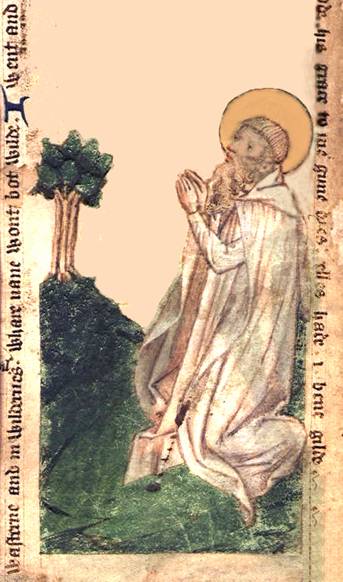
Illuminated manuscript, illustration of St Godric kneeling in prayer with rosary (undisplayed upper portion shows Virgin and Child, teaching Godric her song)
10
posted on
05/21/2023 9:50:02 AM PDT
by
annalex
(fear them not)
To: annalex
The song the Virgin taught him:
I. St Mary, Virgin,
Mother of Jesus Christ the Nazarene,
Receive, shield, help your Godric,
When received, bring him solemnly
With you into God's kingdom.
II. Saint Mary, Christ's bower,
Maiden's purity, mother's flower,
Destroy my sin, reign in my heart,
Bring me to bliss with the very same God.
11
posted on
05/21/2023 9:53:02 AM PDT
by
annalex
(fear them not)
To: annalex; All
NAVARRE BIBLE COMMENTARY (RSV)
Ad Majorem Dei Gloriam (To the Greater Glory of God)
From: Acts 1:1-11
Prologue
--------
[1] In the first book, O Theophilus, I have dealt with all that Jesus began to do and teach, [2] until the day when he was taken up, after he had given commandment through the Holy Spirit to the apostles whom he had chosen. [3] To them he presented himself alive after his passion by many proofs, appearing to them during forty days, and speaking of the kingdom of God. [4] And while staying with them he charged them not to depart from Jerusalem, but to wait for the promise of the Father, which, he said, "you heard from me, [5] for John baptized with water, but before many days you shall be baptized with the Holy Spirit."
The Ascension
-------------
[6] So when they had come together, they asked him, "Lord, will you at this time restore the kingdom of Israel?" [7] He said to them, "It is not for you to know times or seasons which the Father has fixed by his own authority. [8] But you shall receive power when the Holy Spirit has come upon you; and you shall be my witnesses in Jerusalem and in all Judea and Samaria and to the end of the earth." [9] And when he had said this, as they were looking on, he was lifted up, and a cloud took him out of their sight. [10] And while they were gazing into heaven as he went, behold, two men stood by them in white robes, [11] and said, "Men of Galilee, why do you stand looking into heaven? This Jesus, who was taken up from you into heaven, will come in the same way as you saw him go into heaven."
*************************************
Commentary:
1-5. St Luke is the only New Testament author to begin his book with a prologue, in the style of secular historians. The main aim of this preface is to convey to the reader the profoundly religious character of the book which he is holding in his hands. It is a work which will give an account of events marking the fulfillment of the promises made by the God of Israel the Creator and Savior of the world. Under the inspiration of the Holy Spirit, into his book St Luke weaves quotations from the Psalms, Isaiah, Amos and Joel; it both reflects the Old Testament and interprets it in the light of its fulfillment in Jesus Christ.
The prologue refers to St Luke's Gospel as a "first book". It mentions the last events of our Lord's life on earth--the appearances of the risen Christ and his ascension into heaven--and links them up with the account which is now beginning.
St Luke's aim is to describe the origins and the early growth of this Christianity, of which the main protagonist of this book, the Holy Spirit, has been the cause. Yet this is not simply an historical record: the Acts of the Apostles, St Jerome explains, "seems to be a straightforward historical account of the early years of the nascent Church. But if we bear in mind it is written by Luke the physician, who is praised in the Gospel (cf. 2 Cor 8: 18), we will realize that everything he says is medicine for the ailing soul" ("Epistle" 53, 9).
The spiritual dimension of this book, which is one of a piece with the Third Gospel, nourished the soul of the first generations of Christians, providing them with a chronicle of God's faithful and loving support of the new Israel. "This book", St John Chrysostom writes at the start of his great commentary, "will profit us no less than the Gospels, so replete is it with Christian wisdom and sound doctrine. It offers an account of the numerous miracles worked by the Holy Spirit. It contains the fulfillment of the prophecies of Jesus Christ recorded in the Gospel; we can observe in the very facts the bright evidence of Truth which shines in them, and the mighty change which is taking place in the Apostles: they become perfect men, extraordinary men, now that the Holy Spirit has come upon them. All Christ's promises and predictions--He who believes in me will do these and even greater works, you will be dragged before tribunals and kings and beaten in the synagogues, and will suffer grievous things, and yet you will overcome your persecutors and executioners and will bring the Gospel to the ends of the earth--all this, how it came to pass, may be seen in this admirable book. Here you will see the Apostles speeding their way overland and sea as if on wings. These Galileans, once so timorous and obtuse, we find suddenly changed into new men, despising wealth and honor, raised above passion and concupiscence" ("Hom. on Acts", 1).
St Luke dedicates this book to Theophilus--as he did his Gospel. The dedication suggests that Theophilus was an educated Christian, of an upper-class background, but he may be a fictitious person symbolizing "the beloved of God", which is what the name means. It also may imply that Acts was written quite soon after the third Gospel.
1. "To do and teach": these words very concisely sum up the work of Jesus Christ, reported in the Gospels. They describe the way in which God's saving Revelation operates: God lovingly announces and reveals himself in the course of human history through his actions and through his words. "The economy of Revelation is realized by deeds and words, which are intrinsically bound up with each other", Vatican II teaches. "As a result, the works performed by God in the history of salvation show forth and bear out the doctrine and realities signified by the words; the words, for their part, proclaim the works, and bring to light the mystery they contain. The most intimate truth which this revelation gives us about God and the salvation of man shines forth in Christ, who is himself both the mediator and the sum total of Revelation" ("Dei Verbum", 2).
The Lord "proclaimed the kingdom of the Father both by the testimony of his life and by the power of his word" (Vatican II, "Lumen Gentium", 35). He did not limit himself to speech, to being simply the Teacher whose words opened man's minds to the truth. He was, above all, the Redeemer, able to save fallen man through the divine efficacy of each and every moment of his life on earth.
"Our Lord took on all our weaknesses, which proceed from sin—with the exception of sin itself. He experienced hunger and thirst, sleep and fatigue, sadness and tears. He suffered in every possible way, even the supreme suffering of death. No one could be freed from the bonds of sinfulness had he who alone was totally innocent not been ready to die at the hands of impious men. Therefore, our Savior, the Son of God, has left all those who believe in him an effective source of aid, and also an example. The first they obtain by being reborn through grace, the second by imitating his life" (St Leo the Great, "Twelfth Homily on the Passion").
Jesus' redemptive action--his miracles, his life of work, and the mystery of his death, resurrection and ascension, whose depth and meaning only faith can plumb--also constitute a simple and powerful stimulus for our everyday conduct. Faith should always be accompanied by works, by deeds, that is, our humble and necessary cooperation with God's saving plans.
"Don't forget that doing must come before teaching. 'Coepit facere et docere', the holy Scripture says of Jesus Christ: 'He began to do and to teach. ' "First deeds: so that you and I might learn" (St J. Escriva, "The Way", 342).
3. This verse recalls the account in Luke 24:13-43 of the appearances of the risen Jesus to the disciples of Emmaus and to the Apostles in the Cenacle. It stresses the figure of forty days. This number may have a literal meaning and also a deeper meaning. In Sacred Scripture periods of forty days or forty years have a clearly salvific meaning: they are periods during which God prepares or effects important stages in his plans. The great flood lasted forty days (Gen 7:17); the Israelites journeyed in the wilderness for forty years on their way to the promised land (Ps 95:10); Moses spent forty days on Mount Sinai to receive God's revelation of the Covenant (Ex 24:18); on the strength of the bread sent by God Elisha walked forty days and forty nights to reach his destination (1 Kings 19:8); and our Lord fasted in the wilderness for forty days in preparation for his public life (Mt 4:2).
5. "You shall be baptized with the Holy Spirit": this book has been well described as the "Gospel of the Holy Spirit". "There is hardly a page in the Acts of the Apostles where we fail to read about the Spirit and the action by which he guides, directs and enlivens the life and work of the early Christian community. It is he who inspires the preaching of St Peter (cf. Acts 4:8), who strengthens the faith of the disciples (cf. Acts 4:31), who confirms with his presence the calling of the Gentiles (cf. Acts 10:44-47), who sends Saul and Barnabas to distant lands, where they will open new paths for the teaching of Jesus (cf. Acts 13:2-4). In a word, his presence and doctrine are everywhere" (St J. Escriva, "Christ Is Passing By", 127).
6-8. The Apostles' question shows that they are still thinking in terms of earthly restoration of the Davidic dynasty. It would seem that for them --as for many Jews of their time--eschatological hope in the Kingdom extended no further than expectation of world-embracing Jewish hegemony.
"It seems to me", St John Chrysostom comments, "that they had not any clear notion of the nature of the Kingdom, for the Spirit had not yet instructed them. Notice that they do not ask when it shall come but 'Will you at this time restore the Kingdom to Israel?', as if the Kingdom were something that lay in the past. This question shows that they were still attracted by earthly things, though less than they had been" ("Hom. on Acts", 2).
Our Lord gives an excellent and encouraging reply, patiently telling them that the Kingdom is mysterious in character, that it comes when one least expects, and that they need the help of the Holy Spirit to be able to grasp the teaching they have received. Jesus does not complain about their obtuseness; he simply corrects their ideas and instructs them.
8. The outline of Acts is given here: the author plans to tell the story of the growth of the Church, beginning in Jerusalem and spreading through Judea and Samaria to the ends of the earth. This is the geographical structure of St Luke's account. In the Third Gospel Jerusalem was the destination point of Jesus' public life (which began in Galilee); here it is the departure point.
The Apostles' mission extends to the whole world. Underlying this verse we can see not so much a "geographical" dimension as the universalist aspirations of the Old Testament, articulated by Isaiah: "It shall come to pass in the latter days that the mountain of the house of the Lord shall be established as the highest of the mountains, and shall be raised above the hills; and all the nations shall flow to it, and many peoples shall come, and say: 'Come, let us go up to the mountain of the Lord, to the house of the God of Jacob; that he may teach us his ways and that we may walk in his paths. For out of Zion shall go forth the law, and the word of the Lord from Jerusalem" (Is 2:2-3).
9. Jesus' life on earth did not end with his death on the Cross but with his ascension into heaven. The ascension, reported here, is the last event, the last mystery of our Lord's life on earth (cf. also 24:50-53)—and also it concerns the origins of the Church. The ascension scene takes place, so to speak, between heaven and earth. "Why did a cloud take him out of the Apostles' sight?", St John Chrysostom asks. "The cloud was a sure sign that Jesus had already entered heaven; it was not a whirlwind or a chariot of fire, as in the case of the prophet Elijah (cf. 2 Kings 2: l 1), but a cloud, which was a symbol of heaven itself" ("Hom. on Acts", 2). A cloud features in theophanies--manifestations of God—in both the Old Testament (cf. Ex 13:22) and the New (cf. Lk 9:34f).
Our Lord's ascension is one of the actions by which Jesus redeems us from sin and gives us the new life of grace. It is a redemptive mystery "What we have already taught of the mystery of his death and resurrection the faithful should deem not less true of his ascension. For although we owe our redemption and salvation to the passion of Christ, whose merits opened heaven to the just, yet his ascension is not only proposed to us as a model, which teaches us to look on high and ascend in spirit into heaven, but it also imparts to us a divine virtue which enables us to accomplish what it teaches" ("St Pius V Catechism" I, 7, 9).
Our Lord's going up into heaven is not simply something which stirs us to lift up our hearts--as we are invited to do at the preface of the Mass, to seek and love the "things that are above" (cf. Col 3:1-2); along with the other mysteries of his life, death and resurrection, Christ's ascension saves us. "Today we are not only made possessors of paradise", St Leo says, "but we have ascended with Christ, mystically but really, into the highest heaven, and through Christ we have obtained a more ineffable grace than that which we lost through the devil's envy" ("First Homily on the Ascension").
The ascension is the climax of Christ's exaltation, which was achieved in the first instance by his resurrection and which--along with his passion and death--constitutes the paschal mystery. The Second Vatican Council expresses this as follows: "Christ our Lord redeemed mankind and gave perfect glory to God [...]. principally by the paschal mystery of his blessed passion, resurrection from the dead, and glorious ascension" ("Sacrosanctum Concilium", 5; cf. "Dei Verbum", 19).
Theology has suggested reasons why it was very appropriate for the glorified Lord to go up into heaven to be "seated at the right hand of the Father." "First of all, he ascended because the glorious kingdom of the highest heavens, not the obscure abode of this earth, presented a suitable dwelling place for him whose body, rising from the tomb, was clothed with the glory of immortality. He ascended, however, not only to possess the throne of glory and the kingdom which he had merited by his blood, but also to attend to whatever regards our salvation. Again, he ascended to prove thereby that his kingdom is not of this world" ("St Pius V Catechism", I, 7, 5; cf. "Summa Theologiae", III, q. 57, a. 6).
The ascension marks the point when the celestial world celebrates the victory and glorification of Christ: "It is fitting that the sacred humanity of Christ should receive the homage, praise and adoration of all the hierarchies of the Angels and of all the legions of the blessed in heaven" (J. Escriva, "Holy Rosary", second glorious mystery).
11. The angels are referring to the Parousia--our Lord's second coming, when he will judge the living and the dead. "They said to them, What are you doing here, looking into heaven? These words are full of solicitude, but they do not proclaim the second coming of the Savior as imminent. The angels simply assert what is most important, that is, that Jesus Christ will come again and the confidence with which we should await his return" (St John Chrysostom, "Hom. on Acts", 2).
We know for a certainty that Christ will come again at the end of time. We confess this in the Creed as part of our faith. However, we know "neither the day nor the hour" (Mt 25: 13) of his coming. We do not need to know it. Christ is always imminent. We must always be on the watch, that is, we should busy ourselves in the service of God and of others, which is where our sanctification lies.
12
posted on
05/21/2023 12:45:16 PM PDT
by
fidelis
(👈 Under no obligation to respond to rude, ignorant, abusive, bellicose, and obnoxious posts.)
To: fidelis
From: Ephesians 1:15-23Thanksgiving. The Supremacy of Christ
-------------------------------------
[15] For this reason, because I have heard of your faith in the Lord Jesus and your love toward all the saints, [16] I do not cease to give thanks for you, remembering you in my prayers, [17] that the God of our Lord Jesus Christ, the Father of glory, give you a spirit of wisdom and of revelation in the knowledge of him, [18] having the eyes of your hearts enlightened, that you may know what is the hope to which he has called you, what are the riches of his glorious inheritance in the saints, [19] and what is the immeasurable greatness of his power in us who believe, according to the working of his great might [20] which he accomplished in Christ when he raised him from the dead and made him sit at the right hand in the heavenly places, [2I] far above all rule and authority and power and dominion, and above every name that is named, not only in this age but also in that which is to come; [22] and he has put all things under his feet and has made him the head over all things for the church, [23] which is his body, the fullness of him who fills all in all.
********************************************************
Commentary:
15-23. The news the Apostle has received moves him to thanksgiving and prayer (vv. 15-16). But he immediately returns to contemplate how wonderful it is to know God's goodness, and he asks God to give this gift to the readers of his letter (vv. 17-19). His petition hinges on Jesus Christ, through whom God has revealed his power by giving him dominion (vv. 20-21) and establishing him as head of the Church (vv. 22-23).
15-16. St Paul's solicitude sets a wonderful example, especially for those whose responsibility it is to give Christian instruction to others. Like him, they should pray for those entrusted to their care; they should thank God for their spiritual progress and ask the Holy Spirit to give them the gift of wisdom and understanding. "Fulfill the task entrusted to you with all diligence of body and soul", St Ignatius of Antioch exhorts Polycarp. "Pay special attention to unity for there is nothing more important than this. Make yourself the support of all and sundry, as the Lord is to you. Bear lovingly with them all, as you are doing at present. Pray constantly and beg for ever greater gifts of wisdom. Be watchful and always awake in spirit. Address yourself to people personally, as is the way of God himself' ("Letter to Polycarp", I, 2-3).
This "faith in the Lord Jesus" is not just a matter of believing in Jesus Christ full stop; it is a complete system of belief which is founded on Jesus Christ: those who have received the gift of faith live in Christ, and this life in Christ means that their faith is truly a living faith, one which expresses itself in "love towards all the saints". Faith makes us discover that every baptized person is a son or daughter of God, and thus Christians' fraternal love is a logical consequence of this insight.
17. The God whom St Paul addresses is "the God of our Lord Jesus Christ", that is, the God who has revealed himself through Christ and to whom Jesus himself, as man, prays and asks for help (cf. Lk 22:42). The same God as was described in the Old Testament as "the God of Abraham, of Isaac and of Jacob" is now defined as "the God of our Lord Jesus Christ". He is the personal God recognized by his relationship with Christ, his Son, who as mediator of the New Covenant obtains from God the Father everything he asks for. This will be our own experience too if we are united to Christ, for he promised that "if you ask anything of the Father, he will give it to you in my name" (Jn 16:23; 15:16).
The founder of Opus Dei reminds us that "Jesus is the way, the mediator. In him are all things; outside of him is nothing. In Christ, taught by him, we dare to call Almighty God 'our Father': he who created heaven and earth is a loving Father" ("Christ Is Passing By", 91).
The Apostle also calls God "the Father of glory". The glory of God means his greatness, his power, the infinite richness of his personality, which when it is revealed inspires man with awe. Already, in the history of Israel, God revealed himself through his saving actions in favor of his people. Asking God to glorify his name is the same as asking him to show himself as our Savior and to give us his gifts. But the greatest manifestation of God's glory, of his power, was the raising of Jesus from the dead, and the raising, with him, of the Christian (cf. Rom 6:4; 1 Cor 6:14). In this passage St Paul asks God "the Father of glory" to grant Christians supernatural wisdom to recognize the greatness of the blessings he has given them through his Son; that is, to acknowledge that he is their Father and the origin of glory. By asking for a "spirit of wisdom and revelation" the Apostle is seeking special gifts--on the one hand, wisdom, that gift of the Holy Spirit which enables one to penetrate the mystery of God: "Who has learned thy counsel, unless thou hast given wisdom and sent thy holy Spirit from on high?" (Wis 9:17). This wisdom which the Church has been given (cf. Eph l:8) can be communicated to Christians in a special way, as a special gift or charism of the Holy Spirit. The Apostle also asks God to give them a spirit "of revelation", that is, the grace of personal revelations, such as he himself (cf. 1 Cor 14:6) and other Christians (cf. 1 Cor 14:26) received. It is not a matter of revelation or recognition of new truths, but rather of special light from the Holy Spirit so as to have a deeper appreciation of the truth of faith, or of the will of God in a particular situation.
18-19. Along with this deeper knowledge of God, St Paul asks that Christians be given a fuller and livelier hope, because God and hope are inseparable. He recognizes the faith and charity of the faithful to whom he is writing (cf. 1:15); now he wants hope to shine more brightly for them; he wants God to enlighten their minds and make them realize the consequences of their election, their calling, to be members of the holy people of God, the Church. Hope, therefore, is a gift from God. "Hope is a supernatural virtue, infused by God into our soul, by which we desire and expect eternal life, promised by God to his servants, and the means necessary to obtain it" ("St Pius X Catechism", 893).
The ground for hope lies in God's love and power which have been manifested in the resurrection of Christ. This same power is at work in the Christian. Because God's plan for our salvation is an eternal one, he who has called us will lead us to an immortal life in heaven. The fact that God's power is at work in us (cf. Rom 5:5) does not mean that we encounter no difficulties. Monsignor Escriva reminds us that "as we fight this battle, which will last until the day we die, we cannot exclude the possibility that enemies both within and without may attack with violent force. As if that were not enough, you may at times be assailed by the memory of your own past errors, which may have been very many. I tell you now, in God's name: do not despair. Should this happen (it need not happen; nor will it usually happen), then turn it into another motive for uniting yourself more closely to the Lord, for he has chosen you as his child and he will not abandon you. He has allowed this trial to befall you so as to have you love him the more and discover even more clearly his constant protection and love" ("Friends of God", 214).
20-21. The Apostle is in awe at the marvels which God's power has worked in Jesus Christ. He sees Christ as the source and model of our hope. "For, just as Christ's life is the model and exemplar of our holiness, so is the glory and exaltation of Christ the form and exemplar of our glory and exaltation" (St Thomas Aquinas, "Commentary on Eph, ad. Ioc".).
As elsewhere in the New Testament (cf. Acts 7:56; Heb 1:3; 1 Pet 3:22), the fact that the risen Christ is seated "at the right hand" of the Father means that he shares in God's kingly authority. The Apostle is using a comparison with which people of his time were very familiar--that of the emperor seated on his throne. The throne has always been the symbol of supreme authority and power. Thus, the "St Pius V Catechism" explains that being seated at the right hand "does not imply position or posture of body, but expresses the firm and permanent possession of royal and supreme power and glory, which he received from the Father" (I, 7, 3).
Christ's pre-eminence is absolute: he is Lord of all creation, material as well as spiritual, earthly as well as heavenly. "All rule and authority and power and dominion": this refers to the angelic spirits (cf. note on Eph 3:10), whom the false preachers were presenting as superior to Christ. St Paul argues against them: Jesus Christ at his resurrection was raised by God above all created beings.
22-23. In previous letters St Paul described the Church as a body (cf. Rom 12:4f; 1 Cor 12:12ff). Here, and in Colossians 1:18, he pursues this comparison and says that it is the body of Christ, and that Christ is its head. He returns to this teaching elsewhere in the Captivity Epistles (cf. Col 1:18; Eph 5:23f). The image of body and head highlights the life-giving and salvific influence of Christ on the Church, and at the same time emphasizes his supremacy over the Church (cf. St Thomas Aquinas, "Commentary on Eph, ad loc.", and also the note on Col 1:18). This fact fills Christians with joy: by joining the Church through Baptism, they have become truly members of our Lord's body. "No, it is not pride", Paul VI says, " nor arrogance nor obstinacy nor stupidity nor folly that makes us so sure of being living, genuine members of Christ's body, the authentic heirs of his Gospel" ("Ecclesiam Suam", 33).
This image also reveals Christ's close union with his Church and his deep love for her: "he loved her so much", St John of Avila observes, "that although what normally happens is that a person raises his arm to take a blow and protect his head, this blessed Lord, who is the head, put himself forward to receive the blow of divine justice, and died on the Cross to give life to his body, that is, us. And after giving us life, through penance and the sacraments, he endows us, defends and keeps us as something so very much his own, that he is not content with calling us his servants, friends, brethren or children: the better to show his love and render us honor, he gives us his name. For, by means of this ineffable union of Christ the head with the Church his body, he and we are together called 'Christ"' ("Audi, Filia", chap. 84).
The Apostle also describes the Church, the body of Christ (cf. 1 Cor 12:12) as his "fullness" (cf. note on Col 1:19). What he means is that, through the Church, Christ becomes present in and fills the entire universe and extends to it the fruits of his redemptive activity. By being the vehicle which Christ uses to distribute his grace to all, the Church is different from the Israel of the Old Testament: it is not confined to a particular geographical location.
Because the Church has limitless grace, its call is addressed to all mankind: all men are invited to attain salvation in Christ. "For many centuries now, the Church has been spread throughout the world," Monsignor Escriva comments, "and it numbers persons of all races and walks of life. But the universality of the Church does not depend on its geographical extension, even though that is a visible sign and a motive of credibility. The Church was catholic already at Pentecost; it was born catholic from the wounded heart of Jesus, as a fire which the Holy Spirit enkindles [...]. 'We call it catholic', writes St Cyril, 'not only because it is spread throughout the whole world, from one extreme to the other, but because in a universal way and without defect it teaches all the dogmas which men ought to know, of both the visible and the invisible, the celestial and the earthly. Likewise, because it draws to true worship all types of men, those who govern and those who are ruled, the learned and the ignorant. And finally, because it cures and makes healthy all kinds of sins, whether of the soul or of the body, possessing in addition--by whatever name it may be called—all the forms of virtue, in deeds and in words and in every kind of spiritual gift' ("Catechesis", 18, 23)" ("In Love with the Church", 9).
All grace reaches the Church through Christ. The Second Vatican Council reminds us: "He continually endows his body, that is, the Church, with gifts of ministries through which, by his power, we serve each other unto salvation so that, carrying out the truth in love, we may through all things grow into him who is our head" ("Lumen Gentium", 7). This is why St Paul calls the Church the "body" of Christ; and it is in this sense that it is the "fullness" ("pleroma") of Christ--not because it in any way fills out or completes Christ but because it is filled with Christ, full of Christ, forming a single body with him, a single spiritual organism, whose unifying and life-giving principle is Christ, its head. This demonstrates Christ's absolute supremacy; his unifying and life-giving influence extends from God to Christ, from Christ to the Church, and from the Church to all men. It is he in fact who fills all in all (cf. Eph 4:10; Col 1:17-19; 2:9f).
The fact that the Church is the body of Christ is a further reason why we should love it and serve it. As Pope Pius XII wrote: "To ensure that this genuine and whole-hearted love will reign in our hearts and grow every day, we must accustom ourselves to see Christ himself in the Church. For it is indeed Christ who lives in the Church, and through her teaches, governs and sanctifies; and it is also Christ who manifests himself in manifold disguise in the various members of his society" ("Mystici Corporis", 43).
13
posted on
05/21/2023 12:45:57 PM PDT
by
fidelis
(👈 Under no obligation to respond to rude, ignorant, abusive, bellicose, and obnoxious posts.)
To: fidelis
From: Matthew 28:16-20Appearance in Galilee. The Mission to the World
-----------------------------------------------
[16] Now the eleven disciples went to Galilee, to the mountain to which Jesus had directed them. [17] And when they saw him they worshipped him; but some doubted. [18] And Jesus came and said to them, "All authority in heaven and on earth has been given to me. [19] Go therefore and make disciples of all nations, baptizing them in the name of the Father and of the Son and of the Holy Spirit, [20] teaching them to observe all that I have commanded you; and lo, I am with you always, to the close of the age."
***********************************************************************
Commentary:
16-20. This short passage, which brings to a close the Gospel of St Matthew, is of great importance. Seeing the risen Christ, the disciples adore him, worshipping him as God. This shows that at last they are fully conscious of what, from much earlier on, they felt in their heart and confessed by their words--that their Master is the Messiah, the Son of God (cf. Mt 16:18; Jn 1:49). They are overcome by amazement and joy at the wonder their eyes behold: it seems almost impossible, were he not before their very eyes. Yet he is completely real, so their fearful amazement gives way to adoration. The Master addresses them with the majesty proper to God: "All authority in heaven and on earth has been given to me." Omnipotence, an attribute belonging exclusively to God, belongs to him: he is confirming the faith of his worshippers; and he is also telling them that the authority which he is going to give them to equip them to carry out their mission to the whole world, derives from his own divine authority.
On hearing him speak these words, we should bear in mind that the authority of the Church, which is given it for the salvation of mankind, comes directly from Jesus Christ, and that this authority, in the sphere of faith and morals, is above any other authority on earth.
The Apostles present on this occasion, and after them their lawful successors, receive the charge of teaching all nations what Jesus taught by word and work: he is the only path that leads to God. The Church, and in it all Christian faithful, have the duty to proclaim until the end of time, by word and example, the faith that they have received. This mission belongs especially to the successors of the Apostles, for on them devolves the power to teach with authority, "for, before Christ ascended to his Father after his resurrection, he [...] entrusted them with the mission and power to proclaim to mankind what they had heard, what they had seen with their eyes, what they had looked upon and touched with their hands, concerning the Word of Life (1 Jn 1: 1). He also entrusted them with the mission and power to explain with authority what he had taught them, his words and actions, his signs and commandments. And he gave them the Spirit to fulfill their mission" (John Paul II, "Catechesi Tradendae", 1). Therefore, the teachings of the Pope and of the Bishops united to him should always be accepted by everyone with assent and obedience.
Here Christ also passes on to the Apostles and their successors the power to baptize, that is, to receive people into the Church, thereby opening up to them the way to personal salvation.
The mission which the Church is definitively given here at the end of St Matthew's Gospel is one of continuing the work of Christ—teaching men and women the truths concerning God and the duty incumbent on them to identify with these truths, to make them their own by having constant recourse to the grace of the sacraments. This mission will endure until the end of time and, to enable it to do this work, the risen Christ promises to stay with the Church and never leave it. When Sacred Scripture says that God is with someone, this means that that person will be successful in everything he undertakes. Therefore, the Church, helped in this way by the presence of its divine Founder, can be confident of never failing to fulfill its mission down the centuries until the end of time.
14
posted on
05/21/2023 12:46:23 PM PDT
by
fidelis
(👈 Under no obligation to respond to rude, ignorant, abusive, bellicose, and obnoxious posts.)
To: fidelis
15
posted on
05/21/2023 12:49:01 PM PDT
by
fidelis
(👈 Under no obligation to respond to rude, ignorant, abusive, bellicose, and obnoxious posts.)
To: fidelis
For the Seventh Sunday of Easter NAVARRE BIBLE COMMENTARY (RSV)
Ad Majorem Dei Gloriam (To the Greater Glory of God)
From: Acts 1:12-14
The Apostolic College
---------------------
[12] Then they returned to Jerusalem from the mount called Olivet, which is near Jerusalem, a sabbath day's journey away; [13] and when they had entered, they went up to the upper room, where they were staying, Peter and John and James and Andrew, Philip and Thomas, Bartholomew and Matthew, James the son of Alphaeus and Simon the Zealot and Judas the son of James. [14] All these with one accord devoted themselves to prayer, together with the women and Mary the mother of Jesus, and with his brethren.
***********************************************************************
Commentary:
13-14. St Luke mentions the twelve Apostles by name, with the exception of Judas Iscariot.
This is the first passage which tells of the spiritual life and devout practices of the disciples. Significantly it places the emphasis on prayer, in keeping with our Lord's own practice and with his constant recommendation to his followers (cf. Mt 6:5, 14:23; ctc).
"Prayer is the foundation of the spiritual edifice. Prayer is all-powerful" ([St] J. Escriv?, "The Way", 83). It can truly be said that prayer is the bedrock of the Church, which will be made manifest with the coming of the Holy Spirit. The prayer of the disciples, including the women, in the company of Mary would have been a supplication of entreaty and praise and thanksgiving to God. This union of hearts and feelings produced by prayer is a kind of anticipation of the gifts the Holy Spirit will bring.
"We are told this time and again in the passage narrating the lives of the first followers of Christ. 'All these with one accord devoted themselves to prayer (Acts 1:14). [...] Prayer was then, as it is today, the only weapon, the most powerful means, for winning the battles of our interior struggle" (St J. Escriva, "Friends of God", 242).
Here we see Mary as the spiritual center round which Jesus' intimate friends gather: tradition has meditated on this "tableau", and found it to depict our Lady's motherhood over the whole Church, both at its beginning and over the course of the centuries.
On 21 November 1964, at the closing of the third session of Vatican II, Paul VI solemnly proclaimed Mary Mother of the Church: "Our vision of the Church must include loving contemplation of the marvels which God worked in his holy Mother. And knowledge of the true Catholic doctrine about Mary will always be the key to correct understanding of the mystery of Christ and of the Church.
Reflection on the close ties linking Mary and the Church, so clearly indicated by the present constitution ["Lumen Gentium"], allows us to think this is the most appropriate moment to satisfy a desire which, as we pointed out at the end of the last session, many council Fathers have made their own, calling insistently for an explicit declaration during this council of the maternal role which the Blessed Virgin exercises towards the Christian people. To this end we have considered it opportune to dedicate a title in honor of the Virgin which has been proposed in different parts of the Catholic world and which we find particularly touching, for it sums up in a wonderfully succinct way the privileged position which this council has recognized the Blessed Virgin to have in the Church.
"And so, for the glory of the Virgin and for our consolation, we proclaim Mary Most Holy to be the Mother of the Church, that is, Mother of the entire people of God, faithful as well as pastors, who call her loving Mother, and we desire that from now on she be honored and invoked by the entire people of God under this most pleasing title."
The text makes reference to Jesus' "brethren", an expression which also appears in the Gospels. Given that the Christian faith teaches us that the Virgin Mary had no children other than Jesus, whom she conceived by the action of the Holy Spirit and without intervention of man, this expression cannot mean that Jesus had blood brothers or sisters.
The explanation lies in the peculiarities of Semitic languages. The word used in the New Testament translates a Hebrew term which applied to all the members of a family group and was used for even distant cousins (cf. Lev 10:4) and for nephews (Gen 13:8). See note on Mt 12:46-47. In the New Testament then; the word "brethren" has a very wide meaning--as happens, also, for example, with the word "apostle."
At one point Jesus describes those who hear and keep his word as his "brethren" (Lk 8:21), which seems to imply that, in addition to meaning belonging to the same family group, the word "brother" in the New Testament may be a designation for certain disciples who were particularly loyal to our Lord.
St Paul, for his part, uses this term for all Christians (cf., for example, 1 Cor 1:10; etc), as does St Peter, according to Acts 12:17.
16
posted on
05/21/2023 12:50:41 PM PDT
by
fidelis
(👈 Under no obligation to respond to rude, ignorant, abusive, bellicose, and obnoxious posts.)
To: fidelis
From: 1 Peter 4:13-16The Christian Meaning of Suffering (Continuation)
-------------------------------------------------
[13] But rejoice in so far as you share Christ's sufferings, that you may also rejoice and be glad when his glory is revealed. [14] If you are reproached for the name of Christ, you are blessed, because the spirit of glory and of God rests upon you. [15] But let none of you suffer as a murderer, or a thief, or a wrongdoer, or a mischief-maker; [16] yet if one suffers as a Christian, let him not be ashamed, but under that name let him glorify God.
***********************************************************************
Commentary:
12-19. St Peter now returns to the main theme of this part of the letter (3:13-4:19)--the trials Christians unjustly suffer on account of being followers of Christ (cf. 1:6-7; 2:18-25; 3:13-17). They should not be surprised or ashamed by this; rather, it should make them happy and lead them to glorify God, for if they share in Christ's suffering it means they will also share in his exaltation. St John of Avila wrote: "God wants to open our eyes and have us realize what favors are being done us in things the world regards as disadvantages, and how honored we are to be scoffed at for seeking the honor of God, and what great reward awaits us for our present depression, and how God's gentle, sweet and loving arms are opened wide to receive those wounded in doing battle on his behalf' ("Letter", 58).
Moreover, the "spirit of God" will rest on them (v. 14): our Lord promised the special assistance of the Holy Spirit to persecuted Christians hauled before courts on account of their faith (cf. Mt 10:19-20); St Peter here calls him "the spirit of glory", because his indwelling in the Christian is a guarantee and an anticipation of eternal glory (cf. 2 Cor 1:22).
Before the divine judgment which lies ahead (it is one of the frequent themes of the letter) no one can be complacent (vv. 17-18). The Apostle's severe warnings are reminiscent of those Jesus gave the women of Jerusalem on his way to Calvary: "if they do this when the wood is green, what will happen when it is dry?" (Lk 23:31). However, if one has suffered on Christ's account in this life it is clear that one can approach the judgment with greater confidence (cf. Mt 5:11-12; 10:32).
13. "To the prospect of the Kingdom of God," Pope John Paul II teaches, " is linked hope in that glory which has its beginning in the Cross of Christ. The Resurrection revealed this glory--eschatological glory--which in the Cross of Christ was completely obscured by the immensity of suffering. Those who share in the suffering of Christ are also called, through their own sufferings, to share in glory" ("Salvfici Doloris", 22).
16. This is one of the three places in the New Testament in which Christ's 'disciples are described as "Christians" (cf. Acts 11:26; 26:28). As St Luke explains in Acts, they were first given this name in Antioch, the capital of the Roman province of Syria (cf. Acts 11:26).
Being a Christian should never cause one to be cowed or ashamed; it should be a motive for gratitude to God and for holy pride: "Christians who become cowed or inhibited or envious in the face of the licentious behavior of those who have not accepted the Word of God, show that they have a very poor idea of the faith. If we truly keep the law of Christ--that is, if we make the effort to do so, because we will not always fully succeed--we will find ourselves endowed with a wonderful gallantry of spirit that does not need to look elsewhere to discover the full meaning of human dignity" (St J. Escriva, Friends of God, 38).
17
posted on
05/21/2023 12:51:16 PM PDT
by
fidelis
(👈 Under no obligation to respond to rude, ignorant, abusive, bellicose, and obnoxious posts.)
To: fidelis
From: John 17:1-11aThe Priestly Prayer of Jesus
----------------------------
[1] When Jesus had spoken these words, He lifted His eyes to Heaven and said, "Father, the hour has come; glorify Thy Son that the Son may glorify Thee, [2] since Thou hast given Him power over all flesh, to give eternal life to all whom Thou hast given Him. [3] And this is eternal life, that they know Thee the only true God, and Jesus Christ whom Thou hast sent. [4] I glorified Thee on earth, having accomplished the work which Thou gavest Me to do; [5] and now, Father, glorify Thou Me in Thy own presence with the glory which I had with Thee before the world was made.
[6] "I have manifested Thy name to the men who Thou gavest Me out of the world; Thine they were, and Thou gavest them to Me, and they have kept Thy word. [7] Now they know that everything Thou hast given Me is from Thee; [8] for I have given them the words which Thou gavest Me, and they have received them and know in truth that I came from Thee; and they have believed that thou didst send Me. [9] I am praying for them; I am not praying for the world but for those whom Thou hast given Me, for they are Thine; [10] all Mine are Thine, and Thine are Mine, and I am glorified in them. [11a] And now I am no more in the world, but they are in the world, and I am coming to Thee."
***********************************************************************
Commentary:
1-26. At the end of the discourse of the Last Supper (Chapters 13-16) begins what is called the Priestly Prayer of Jesus, which takes up all of Chapter 17. It is given that name because Jesus addresses His Father in a very moving dialogue in which, as Priest, He offers Him the imminent sacrifice of His passion and death. It shows us the essential elements of His redemptive mission and provides us with teaching and a model for our own prayer. "The Lord, the Only-begotten and co-eternal with the Father, could have prayed in silence if necessary, but He desired to show Himself to the Father in the attitude of a supplicant because He is our Teacher. [...] Accordingly this prayer for His disciples was useful not only to those who heard it, but to all who would read it" (St. Augustine, "In Ioann. Evang.", 104, 2).
The Priestly Prayer consists of three parts: in the first (verses 1-5) Jesus asks for the glorification of His holy human nature and the acceptance, by His Father, of His sacrifice on the cross. In the second part (verses 6-19) He prays for His disciples, whom He is going to send out into the world to proclaim the redemption which He is now about to accomplish. And then (verses 20-26) He prays for unity among all those who will believe in Him over the course of the centuries, until they achieve full union with Him in Heaven.
1-5. The word "glory" here refers to the splendor, power and honor which `belong to God'. The Son is God equal to the Father, and from the time of His Incarnation and birth and especially through His death and resurrection His divinity has been made manifest. "We have beheld His glory, glory as the only Son from the Father" (John 1:14). The glorification of Jesus has three dimensions to it. 1) It promotes the glory of the Father, because Christ, in obedience to God's redemptive decree (cf. Philippians 2:6), makes the Father known and so brings God's saving work to completion. 2) Christ is glorified because His divinity, which He has voluntarily disguised, will eventually be manifested through His human nature which will be seen after the Resurrection invested with the very authority of God Himself over all creation (verses 2, 5). 3) Christ, through His glorification, gives man the opportunity to attain eternal life, to know God the Father and Jesus Christ, His only Son: this in turn redounds to the glorification of the Father and of Jesus Christ while also involving man's participation in divine glory (verse 3).
"The Son glorifies You, making You known to all those You have given Him. Furthermore, if the knowledge of God is life eternal, we the more tend to life, the more we advance in this knowledge. [...] There shall the praise of God be without end, where there shall be full knowledge of God; and because in Heaven this knowledge shall be full, there shall glorifying be of the highest" (St. Augustine, "In Ioann. Evang.", 105, 3).
6-8. Our Lord has prayed for Himself; now He prays for His Apostles, who will continue His redemptive work in the world. In praying for them, Jesus describes some of the prerogatives of those who will form part of the Apostolic College.
First, there is the prerogative of being chosen by God: "Thine they were...". God the Father chose them from all eternity (cf. Ephesians 1:3-4) and in due course Jesus revealed this to them: "The Lord Jesus, having prayed at length to the Father, called to Himself those whom He willed and appointed twelve to be with Him, whom He might send to preach the Kingdom of God (cf. Mark 3:13-19; Matthew 10:1-42). These apostles (cf. Luke 6:13) He constituted in the form of a college or permanent assembly, at the head of which He placed Peter, chosen from among them (cf. John 21:15-17)" (Vatican II, "Lumen Gentium", 19). Also, the Apostles enjoy the privilege of hearing God's teaching direct from Jesus. From this teaching, which they accept with docility, they learn that Jesus came from the Father and that therefore He is God's envoy (verse 8): that is, they are given to know the relationships that exist between the Father and the Son.
The Christian, who also is a disciple of Jesus, gradually acquires knowledge of God and of divine things through living a life of faith and maintaining a personal relationship with Jesus Christ.
"Recalling this human refinement of Christ, who spent His life in the service of others, we are doing much more than describing a pattern of human behavior; we are discovering God. Everything Christ did has a transcendental value. It shows us the nature of God and beckons us to believe in the love of God who created us and wants us to share His intimate life" (St J. Escriva, "Christ Is Passing By", 109).
11-19. Jesus now asks the Father to give His disciple four things--unity, perseverance, joy and holiness. By praying Him to keep them in His name (verse 11) He is asking for their perseverance in the teaching He has given them (cf. verse 6) and in communion with Him. An immediate consequence of this perseverance is unity: "that they may be one, even as We are one"; this unity which He asks for His disciples is a reflection of the unity of the Three Divine Persons.
He also prays that none of them should be lost, that the Father should guard and protect them, just as He Himself protected them while He was with them. Thirdly, as a result of their union with God and perseverance they will share in the joy of Christ (verse 13): in this life, the more we know God and the more closely we are joined to Him, the happier will we be; in eternal life our joy will be complete, because our knowledge and love of God will have reached its climax.
Finally, He prays for those who, though living in the world, are not of the world, that they may be truly holy and carry out the mission He has entrusted to them, just as He did the work His Father gave Him to do.
18
posted on
05/21/2023 12:51:35 PM PDT
by
fidelis
(👈 Under no obligation to respond to rude, ignorant, abusive, bellicose, and obnoxious posts.)
To: fidelis
19
posted on
05/21/2023 12:53:53 PM PDT
by
fidelis
(👈 Under no obligation to respond to rude, ignorant, abusive, bellicose, and obnoxious posts.)
Disclaimer:
Opinions posted on Free Republic are those of the individual
posters and do not necessarily represent the opinion of Free Republic or its
management. All materials posted herein are protected by copyright law and the
exemption for fair use of copyrighted works.
FreeRepublic.com is powered by software copyright 2000-2008 John Robinson