Skip to comments.
Catholic Caucus: Daily Mass Readings 25-April-2023
Universalis/Jerusalem Bible ^
Posted on 04/25/2023 6:05:01 AM PDT by annalex
Tuesday 25 April 2023
Saint Mark, Evangelist
Feast

Entry to the presbytery of St Mark's Basilica, Venice Readings at MassLiturgical Colour: Red. Year: A(I).
| First reading | 1 Peter 5:5-14 © |
|---|
My son, Mark, sends you greetingsAll wrap yourselves in humility to be servants of each other, because God refuses the proud and will always favour the humble. Bow down, then, before the power of God now, and he will raise you up on the appointed day; unload all your worries on to him, since he is looking after you. Be calm but vigilant, because your enemy the devil is prowling round like a roaring lion, looking for someone to eat. Stand up to him, strong in faith and in the knowledge that your brothers all over the world are suffering the same things. You will have to suffer only for a little while: the God of all grace who called you to eternal glory in Christ will see that all is well again: he will confirm, strengthen and support you. His power lasts for ever and ever. Amen. I write these few words to you through Silvanus, who is a brother I know I can trust, to encourage you never to let go this true grace of God to which I bear witness. Your sister in Babylon, who is with you among the chosen, sends you greetings; so does my son, Mark. Greet one another with a kiss of love.
| Responsorial Psalm |
|---|
| Psalm 88(89):2-3,6-7,16-17 © |
|---|
I will sing for ever of your love, O Lord. or Alleluia! I will sing for ever of your love, O Lord; through all ages my mouth will proclaim your truth. Of this I am sure, that your love lasts for ever, that your truth is firmly established as the heavens. I will sing for ever of your love, O Lord. or Alleluia! The heavens proclaim your wonders, O Lord; the assembly of your holy ones proclaims your truth. For who in the skies can compare with the Lord or who is like the Lord among the sons of God? I will sing for ever of your love, O Lord. or Alleluia! Happy the people who acclaim such a king, who walk, O Lord, in the light of your face, who find their joy every day in your name, who make your justice the source of their bliss. I will sing for ever of your love, O Lord. or Alleluia!
| Gospel Acclamation | 1Co1:23-24 |
|---|
Alleluia, alleluia! We are preaching a crucified Christ, who is the power and the wisdom of God. Alleluia!
Go out to the whole world; proclaim the Good NewsJesus showed himself to the Eleven and said to them: ‘Go out to the whole world; proclaim the Good News to all creation. He who believes and is baptised will be saved; he who does not believe will be condemned. These are the signs that will be associated with believers: in my name they will cast out devils; they will have the gift of tongues; they will pick up snakes in their hands, and be unharmed should they drink deadly poison; they will lay their hands on the sick, who will recover.’ And so the Lord Jesus, after he had spoken to them, was taken up into heaven: there at the right hand of God he took his place, while they, going out, preached everywhere, the Lord working with them and confirming the word by the signs that accompanied it. Christian Art Each day, The Christian Art website gives a picture and reflection on the Gospel of the day. The readings on this page are from the Jerusalem Bible, which is used at Mass in most of the English-speaking world. The New American Bible readings, which are used at Mass in the United States, are available in the Universalis apps, programs and downloads.
You can also view this page with the Gospel in Greek and English. |
TOPICS: Catholic; General Discusssion; Prayer; Worship
KEYWORDS: catholic; easter; mk16; prayer
For your reading, reflection, faith-sharing, comments, questions, discussion.
1
posted on
04/25/2023 6:05:01 AM PDT
by
annalex
To: All
KEYWORDS: catholic; easter; mk16; prayer
2
posted on
04/25/2023 6:05:42 AM PDT
by
annalex
(fear them not)
To: nickcarraway; NYer; ELS; Pyro7480; livius; ArrogantBustard; Catholicguy; RobbyS; marshmallow; ...

Alleluia Ping Please FReepmail me to get on/off the Alleluia Ping List.
3
posted on
04/25/2023 6:06:42 AM PDT
by
annalex
(fear them not)
To: annalex
4
posted on
04/25/2023 6:07:03 AM PDT
by
annalex
(fear them not)
To: annalex
| Mark |
| | English: Douay-Rheims | Latin: Vulgata Clementina | Greek NT: Byzantine/Majority Text (2000) |
| | Mark 16
|
| 15. | And he said to them: Go ye into the whole world, and preach the gospel to every creature. | Et dixit eis : Euntes in mundum universum prædicate Evangelium omni creaturæ. | και ειπεν αυτοις πορευθεντες εις τον κοσμον απαντα κηρυξατε το ευαγγελιον παση τη κτισει |
| 16. | He that believeth and is baptized, shall be saved: but he that believeth not shall be condemned. | Qui crediderit, et baptizatus fuerit, salvus erit : qui vero non crediderit, condemnabitur. | ο πιστευσας και βαπτισθεις σωθησεται ο δε απιστησας κατακριθησεται |
| 17. | And these signs shall follow them that believe: In my name they shall cast out devils: they shall speak with new tongues. | Signa autem eos qui crediderint, hæc sequentur : in nomine meo dæmonia ejicient : linguis loquentur novis : | σημεια δε τοις πιστευσασιν ταυτα παρακολουθησει εν τω ονοματι μου δαιμονια εκβαλουσιν γλωσσαις λαλησουσιν καιναις |
| 18. | They shall take up serpents; and if they shall drink any deadly thing, it shall not hurt them: they shall lay their hands upon the sick, and they shall recover. | serpentes tollent : et si mortiferum quid biberint, non eis nocebit : super ægros manus imponent, et bene habebunt. | οφεις αρουσιν καν θανασιμον τι πιωσιν ου μη αυτους βλαψη επι αρρωστους χειρας επιθησουσιν και καλως εξουσιν |
| 19. | And the Lord Jesus, after he had spoken to them, was taken up into heaven, and sitteth on the right hand of God. | Et Dominus quidem Jesus postquam locutus est eis, assumptus est in cælum, et sedet a dextris Dei. | ο μεν ουν κυριος μετα το λαλησαι αυτοις ανεληφθη εις τον ουρανον και εκαθισεν εκ δεξιων του θεου |
| 20. | But they going forth preached every where: the Lord working withal, and confirming the word with signs that followed. | Illi autem profecti prædicaverunt ubique, Domino cooperante, et sermonem confirmante, sequentibus signis. | εκεινοι δε εξελθοντες εκηρυξαν πανταχου του κυριου συνεργουντος και τον λογον βεβαιουντος δια των επακολουθουντων σημειων αμην |
5
posted on
04/25/2023 6:09:24 AM PDT
by
annalex
(fear them not)
To: annalex

Catena Aurea by St. Thomas Aguinas
16:14–18
14. Afterward he appeared unto the eleven as they sat at meat, and upbraided them with their unbelief and hardness of heart, because they believed not them which had seen him after he was risen.
15. And he said unto them, Go ye into all the world, and preach the Gospel to every creature.
16. He that believeth and is baptized shall be saved; but he that believed not shall be damned.
17. And these signs shall follow them that believe; In my name shall they cast out devils; they shall speak with new tongues;
18. They shall take up serpents; and if they drink any deadly thing, it shall not hurt them; they shall lay hands on the sick, and they shall recover.
GLOSS. (non occ.) Mark, when about to finish his Gospel, relates the last appearance of our Lord to His disciples after His resurrection, saying,1 For the last time he appeared unto the eleven as they sat at meat. (Acts 1:4, 9)
GREGORY. (ubi sup.) We should observe that Luke says in the Acts, As he2 was eating with them he commanded that they should not depart from Jerusalem, and shortly afterwards, while they beheld he was taken up. For He ate, and then ascended, that by the act of eating, the truth of the flesh might be declared; wherefore it is also here said, that he appeared to them for the last time as they sat at meat.
PSEUDO-JEROME. But He appeared when all the eleven were together, that all might be witnesses, and relate to all men what they had seen and heard in common. It goes on: And upbraided them with their unbelief and hardness of heart, because they believed not them who had seen him after his resurrection.
AUGUSTINE. (ubi sup.) But how was this done the last time? The last occasion on which the Apostles saw the Lord upon earth happened forty days after the resurrection; but would He then have upbraided them for not believing those who had seen Him risen, when they themselves had so often seen Him after His resurrection? It remains therefore that we should understand that Mark wished to say it in few words, and said for the last time, because it was the last time that He shewed Himself that day, as night was coming on, when the disciples returned from the country into Jerusalem, and found, as Luke says (Luke 24:33.), the eleven and those who were with them, speaking together concerning the resurrection of our Lord. But there were some there who did not believe; when these then were sitting at meat, (as Mark says,) and were still speaking, (as Luke relates,) The Lord stood in the midst of them, and saith unto them, Peace be unto you; (Luke 24:36) as Luke and John say. (John 20:19) The rebuke therefore which Mark here mentions, must have been amongst those words, which Luke and John say, that the Lord at that time spoke to the disciples. But another question is raised, how Mark says that He appeared when the eleven sat at meat, if the time was the first part of the night on the Lord’s day, when John plainly says that Thomas was not with them, who, we believe, had gone out, before the Lord came in to them, after those two had returned from the village, and spoken with the eleven, as we find in Luke’s Gospel. But Luke in his relation leaves room for supposing that Thomas went out first, while they spoke these things, and that the Lord entered afterwards; Mark however from his saying, for the last time he appeared to the eleven as they sat at meat, forces us to believe that he was there, unless indeed, though one of them was absent, he chose to call them the eleven, because the company of the Apostles was then called by this number, before Matthias was chosen into the place of Judas. Or if this be a harsh way of understanding it, let us understand that it means that after many appearances, He shewed Himself for the last time, that is, on the fortieth day, to the Apostles, as they sat at meat, and that since He was about to ascend from them, He rather wished on that day to reprove them for not having believed those who had seen Him risen before seeing Him themselves, because after His ascension even the Gentiles on their preaching were to believe a Gospel, which they had not seen. And so the same Mark immediately after that rebuke says, And he said unto them, Go ye into all the world, and preach the Gospel to every creature. And lower down, He that believeth not shall be condemned. Since then they were to preach this, were not they themselves to be first rebuked, because before they saw the Lord they had not believed those to whom He had first appeared?
GREGORY. (ubi sup.) Another reason also why our Lord rebuked His disciples, when He left them as to His bodily presence, was, that the words which He spoke on leaving them might remain more deeply impressed upon the hearts of His hearers.
PSEUDO-JEROME. But He rebukes their want of faith, that faith might take its place; He rebukes the hardness of their stony heart, that the fleshy heart, full of love, might take its place.
GREGORY. (ubi sup.) After rebuking the hardness of their hearts, let us hear the words of advice which He speaks. For it goes on: Go ye into all the world, and preach the Gospel to every creature. Every man must be understood by every creature; for man partakes something of every creature; he has existence as have stones, life as trees, feeling as animals, understanding as have Angels. For the Gospel is preached to every creature, because he is taught by it, for whose sake all are created, whom all things are in some way like, and from whom therefore they are not alien. By the name of every creature also every nation of the Gentiles may be meant. For it had been said before, Go not into the way of the Gentiles. (Matt. 10:5) But now it is said, Preach the Gospel to every creature, so that the preaching of the Apostles which was thrust aside by Judæa, might be an assistance to us, since Judæa had haughtily rejected it, thus witnessing to her own damnation.
THEOPHYLACT. Or else; to every creature, that is, whether believing or unbelieving. It goes on: He that believeth and is baptized shall be saved. For it is not enough to believe, for he who believeth and is not baptized, but is a catechumen, has not yet attained to perfect salvation.
GREGORY. (ubi sup.) But perhaps some one may say in himself, I have already believed, I shall be saved. He says what is true, if he keeps his faith by works; for that is a true faith, which does not contradict by its deeds what it says in words. There follows: But he that believeth not shall be damned.
BEDE. (ubi sup.) What shall we say here about infants, who by reason of their age cannot yet believe; for as to older persons there is no question. In the Church then of our Saviour children believe by others, as also they drew from others the sins which are remitted to them in baptism. It goes on: And these signs shall follow them that believe; In my name shall they cast out devils; they shall speak with new tongues; they shall take up serpents.
THEOPHYLACT. That is, they shall scatter before them serpents, whether intellectual or sensible, as it is said, Ye shall tread upon serpents and scorpions, which is understood spiritually. But it may also mean sensible serpents, as when Paul received no hurt from the viper. There follows: And if they drink any deadly thing, it shall not hurt them. (Luke 10:19) We read of many such cases in history, for many persons have drank poison unhurt, by guarding themselves with the sign of Christ. It goes on: They shall lay hands on the sick, and they shall recorer.
GREGORY. (ubi sup.) Are we then without faith because we cannot do these signs? Nay, but these things were necessary in the beginning of the Church, for the faith of believers was to be nourished by miracles, that it might increase. Thus we also, when we plant groves, pour water upon them, until we see that they have grown strong in the earth; but when once they have firmly fixed their roots, we leave off irrigating them. These signs and miracles have other things which we ought to consider more minutely. For Holy Church does every day in spirit what then the Apostles did in body; for when her Priests by the grace of exorcism lay their hands on believers, and forbid the evil spirits to dwell in their minds, what do they, but cast out devils? And the faithful who have left earthly words, and whose tongues sound forth the Holy Mysteries, speak a new language; they who by their good warnings take away evil from the hearts of others, take up serpents; and when they are hearing words of pestilent persuasion, without being at all drawn aside to evil doing, they drink a deadly thing, but it will never hurt them; whenever they see their neighbours growing weak in good works, and by their good example strengthen their life, they lay their hands on the sick, that they may recover. And all these miracles are greater in proportion as they are spiritual, and by them souls and not bodies are raised.
16:19–20
19. So then after the Lord had spoken unto them, he was received up into heaven, and sat on the right hand of God.
20. And they went forth, and preached every where, the Lord working with them, and confirming the word with signs following. Amen.
PSEUDO-JEROME. The Lord Jesus, who had descended from heaven to give liberty to our weak nature, Himself also ascended above the heavens; wherefore it is said, So then after the Lord had spoken unto them, he was received up into heaven.
AUGUSTINE. (ubi sup.) By which words He seems to shew clearly enough that the foregoing discourse was the last that He spake to them upon earth, though it does not appear to bind us down altogether to this opinion. For He does not say, After He had thus spoken unto them, wherefore it admits of being understood not as if that was the last discourse, but that the words which are here used, After the Lord had spoken unto them, he was received into heaven, might belong to all His other discourses. But since the arguments which we have used above make us rather suppose that this was the last time, therefore we ought to believe that after these words, together with those which are recorded in the Acts of the Apostles, our Lord ascended into heaven.
GREGORY. (ubi sup.) We have seen in the Old Testament that Elias was taken up into heaven. But the ethereal heaven is one thing, the aerial is another. The aerial heaven is nearer the earth, Elias then was raised into the aerial heaven, that he might be carried off suddenly into some secret region of the earth, there to live in great calmness of body and spirit, until he return at the end of the world, and pay the debt of death. We may also observe that Elias mounted up in a chariot, that by this they might understand that a mere man requires help from without. But our Redeemer, as we read, was not carried up by a chariot, not by angels, because He who had made all things was borne over all by His own power. We must also consider what Mark subjoins, And sat at the right hand of God, since Stephen says, I see the heavens opened, and the Son of Man standing at the right hand of God. Now sitting is the attitude of a judge, standing of one fighting or helping. Therefore Stephen, when toiling in the contest, saw Him standing, whom he had for his helper; but Mark describes Him as sitting after His assumption into heaven, because after the glory of His assumption, He will in the end be seen as a judge.
AUGUSTINE. (de Symbolo, 4) Let us not therefore understand this sitting as though He were placed there in human limbs, as if the Father sat on the left, the Son on the right, but by the right hand itself we understand the power which He as man received from God, that He should come to judge, who first had come to be judged. For by sitting we express habitation, as we say of a person, he sat himself down in that country for many years; in this way then believe that Christ dwells at the right hand of God the Father. For He is blessed and dwells in blessedness, which is called the right hand of the Father; for all is right hand there, since there is no misery. It goes on: And they went forth and preached every where, the Lord working with than, and confirming the word with signs and wonders.
BEDE. (ubi sup.) Observe that in proportion as Mark began his history later, so he makes it reach in writing to more distant times, for he began from the commencement of the preaching of the Gospel by John, and he reaches in his narrative those times in which the Apostles sowed the same word of the Gospel throughout the world.
GREGORY. (ubi sup.) But what should we consider in these words, if it be not that obedience follows the precept and signs follow the obedience? For the Lord had commanded them, Go into all the world preaching the Gospel, and, Ye shall be witnesses even unto the ends of the earth.
AUGUSTINE. (Epist. cxcix. 12.) (Acts 1:8) But how was this preaching fulfilled by the Apostles, since there are many nations in which it has just begun, and others in which it has not yet begun to be fulfilled? Truly then this precept was not so laid upon the Apostles by our Lord, as though they alone to whom He then spoke were to fulfil so great a charge; in the same way as He says, Behold, I am with you always, even unto the end of the world, apparently to them alone; but who does not understand that the promise is made to the Catholic Church, which though some are dying, others are born, shall be here unto the end of the world?
THEOPHYLACT. But we must also know from this that words are confirmed by deeds as then in the Apostles works confirmed their words, for signs followed. Grant then, O Christ, that the good words which we speak may be confirmed by works and deeds, so that at the last, Thou working with us in word and in deed, we may be perfect, for Thine as is fitting is the glory both of word and deed. Amen.
Catena Aurea Mark 16
6
posted on
04/25/2023 6:11:43 AM PDT
by
annalex
(fear them not)
To: annalex
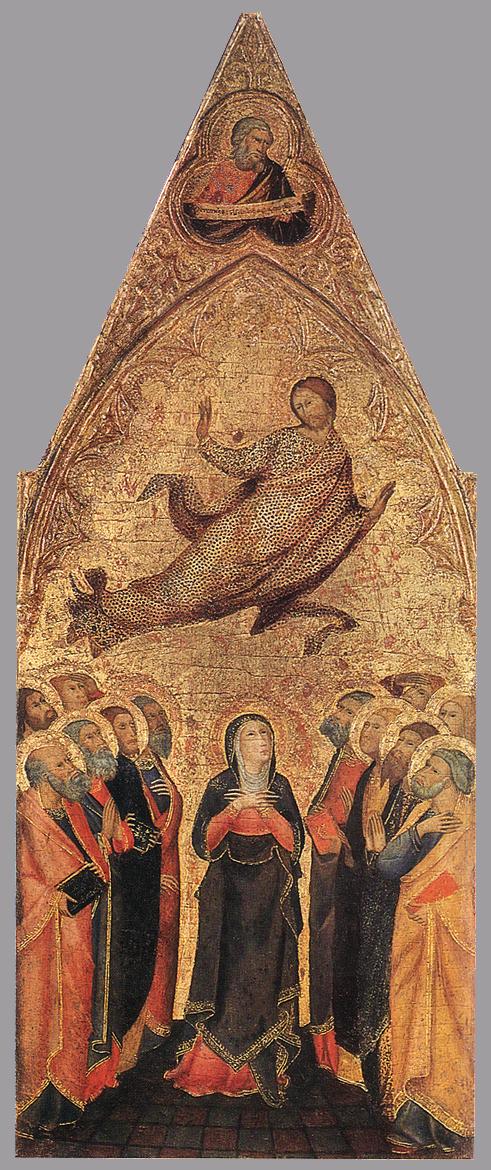
Ascension of Christ
Andrea di Vanni
1355-60
Tempera on wood, 68 x 28 cm
The Hermitage, St. Petersburg
7
posted on
04/25/2023 6:12:07 AM PDT
by
annalex
(fear them not)
To: annalex
NAVARRE BIBLE COMMENTARY (RSV)
Ad Majorem Dei Gloriam (To the Greater Glory of God)
From: 1 Peter 5:5b-14
To the Faithful
---------------
[5b] Clothe yourselves, all of you, with humility toward one another, for "God opposes the proud, but gives grace to the humble."
[6] Humble yourselves therefore under the mighty hand of God, that in due time He may exalt you. [7] Cast all your anxieties on Him, for He cares about you. [8] Be sober, be watchful. Your adversary the devil prowls around like a roaring lion, seeking some one to devour. [9] Resist him, firm in your faith, knowing that the same experience of suffering is required of your brotherhood throughout the world. [10] And after you have suffered a little while, the God of all grace, who has called you to His eternal glory in Christ, will Himself restore, establish and strengthen you. [11] To Him be the dominion for ever and ever. Amen.
Epilogue
--------
[12] By Silvanus, a faithful brother as I regard him, I have written briefly to you, exhorting and declaring that this is the true grace of God; stand fast in it. [13] She who is at Babylon, who is likewise chosen, sends you greetings; and so does my son Mark. [14] Greet one another with the kiss of love.
Peace to all of you that are in Christ.
***********************************************************************
Commentary:
5-11. The Apostle concludes his exhortation with a call to humility, which should express itself in complete docility in the face of the trials God permits (verses 6-7). This last piece of advice is often found in Sacred Scripture: "Cast your burden on the Lord, and He will sustain you" (Psalm 55:22); Jesus also teaches that we should trust in God's fatherly providence (cf. Matthew 6:19-34). "You have such care for each one of us", St. Augustine exclaims, "as if you had no offers to care for" ("Confessions", 3, 11).
However, abandonment in God does not mean irresponsibility, so St. Peter reminds them there is always need to be watchful against the assaults of the devil, who will pounce on us if we lower our guard (verse 8).
The description of the devil (etymologically the word means liar, detractor: cf. Revelation 12:9-10) as a roaring lion seeking someone to devour has often been taken up by the Saints. "He moves round each one of us", St. Cyprian says, "like an enemy who has us surrounded and is checking the walls to see if there is some weak, unsecured part, where he can get in" ("De Zelo Et Livore").
Christians "firm in the faith" will resist the attacks of the devil. The trials they suffer (cf. 1:6-7; 4:13; 5:1-4) serve to purify them and are a pledge of the glory God will give them: "For this momentary affliction is preparing for us an eternal weight of glory beyond all comparisons" (2 Corinthians 4:17). "So great is the good that I hope for, that any pain is for me a pleasure" (St. Francis of Assisi, "Reflections on Christ's Wounds", 1).
5. "You who are younger": it is not clear whether he is addressing people who are young in age or Christians who are not "elders" (priests), that is, lay people.
"God opposes the proud, but gives grace to the humble": a quotation from Proverbs (cf. James 4:6 and note on same), containing an idea which runs right through the Old Testament (cf., e.g., Job 12:19; Psalm 18:88; 31:34) and the teachings of Christ (cf., e.g., Luke 14:11). The Blessed Virgin proclaims this truth in the "Magnificat": "He has put down the mighty from their thrones, and exalted those of low degree" (Luke 1:52).
"Humility is the source and foundation of every kind of virtue," the Cure of Ars teaches; "it is the door by which all God-given graces enter; it is what seasons all our actions, making them so valuable and so pleasing to God. Finally, it makes us masters of God's heart, to the point, so to speak, of making Him our servant; for God has never been able to resist a humble heart" ("Selected Sermons", Tenth Sunday after Pentecost).
8. For the third time, St. Peter exhorts the faithful to be sober; earlier he referred to the importance of sobriety so as to put one's hope in Heavenly things (1:13) and to help one to pray (4:7). Now he stresses that it puts us on guard against the devil.
Man should use the goods of this world in a balanced, temperate way, so as to avoid being ensnared by them, thereby forgetting his eternal destiny: "Detach yourself from the goods of the world. Love and practice poverty of spirit: be content with what enables you to live a simple and sober life. Otherwise, you will never be an apostle" (St J. Escriva, "The Way", 631).
12. Silvanus, called Silas in the Acts of the Apostles (Acts 15:22), accompanied St. Paul on his second apostolic journey through Asia Minor and Greece (cf. Acts 15:36-18:22); he was therefore well known to the Christians addressed in this letter.
From the reference St. Peter makes to him here, it is not possible to say for sure whether Silvanus was simply the bearer of the letter, or acted as an amanuensis who took down the Apostle's dictation, or was an editor or redactor of ideas the Apostle gave him (on this subject, see the Introduction to this Letter).
13. "Babylon": this is a symbolic way of referring to Rome, the prototype of the idolatrous and worldly city of the era. Some centuries earlier Babylon had been the subject of severe reproaches and threats by the prophets (cf., e.g., Isaiah 13:47; Jeremiah 50-51). In the Book of Revelation Rome is also referred to by this name (cf. e.g., Revelation 17-18).
The Mark referred to is the author of the second Gospel. Tradition says that he acted as St. Peter's interpreter in Rome. The Apostle calls him "son", meaning that he was spiritually his son, and implying that they had been close to each other for a long time (cf. "The Navarre Bible: St. Mark", pp. 56-57).
14. "The kiss of love": St. Paul also, at the end of some of his letters, refers to the "holy kiss" (cf. Romans 16:16; 1 Corinthians 16:20; 2 Corinthians 13:12; 1 Thessalonians 5:26), a mark of supernatural charity and shared faith. With this meaning the gesture passed into primitive eucharistic liturgy (cf. note on 1 Corinthians 16:20).
The final words, "Peace to all of you that are in Christ", are similar to the way St. Paul ends many of his letters; since the first age of the Church it has been used in liturgical celebrations. St. Cyril of Jerusalem, for example, ends his baptismal catechism with these words: "May the God of peace hallow you entirely, and your body and your soul remain unsullied until the coming of the Lord Jesus Christ, to whom be glory for ever and ever. Amen" ("Mystagogical Catechesis", 5, 23).
8
posted on
04/25/2023 6:14:37 AM PDT
by
fidelis
(👈 Under no obligation to respond to rude, ignorant, abusive, bellicose, and obnoxious posts.)
To: fidelis
From: Mark 16:15-20The Apostle's Mission
---------------------
[15] And He (Jesus) said to them, "Go into all the world and preach the Gospel to the whole creation. [16] He who believes and is baptized will be saved; but he who does not believe will be condemned. [17] And these signs will accompany those who believe: in My name they will cast out demons; they will speak in new tongues; [18] they will pick up serpents, and if they drink any deadly thing, it will not hurt them; they will lay their hands on the sick, and they will recover."
The Ascension
-------------
[19] So then the Lord Jesus, after He had spoken to them, was taken up into Heaven, and sat down at the right hand of God.
The Apostles Go Forth and Preach
--------------------------------
[20] And they went forth and preached everywhere, while the Lord worked with them and confirmed the message by the signs that attended it. Amen.
***********************************************************************
Commentary:
15. This verse contains what is called the "universal apostolic mandate" (paralleled by Matthew 28:19-20 and Luke 24:46-48). This is an imperative command from Christ to His Apostles to preach the Gospel to the whole world. This same apostolic mission applies, especially, to the Apostles' successors, the bishops in communion with Peter's successor, the Pope.
But this mission extends further: the whole "Church was founded to spread the Kingdom of Christ over all the Earth for the glory of God the Father, to make all men partakers in redemption and salvation.... Every activity of the Mystical Body with this in view goes by the name of `apostolate'; the Church exercises it through all its members, though in various ways. In fact, the Christian vocation is, of its nature, a vocation to the apostolate as well. In the organism of a living body no member plays a purely passive part, sharing in the life of the body it shares at the same time in its activity. The same is true for the body of Christ, the Church: `the whole body achieves full growth in dependence on the full functioning of each part' (Ephesians 4:16). Between the members of this body there exists, further, such a unity and solidarity (cf. Ephesians 4:16) that a member who does not work at the growth of the body to the extent of his possibilities must be considered useless both to the Church and to himself.
"In the Church there is diversity of ministry but unity of mission. To the Apostles and their successors Christ has entrusted the office of teaching, sanctifying and governing in His name and by His power. But the laity are made to share in the priestly, prophetical and kingly office of Christ; they have therefore, in the Church and in the world, their own assignment in the mission of the whole people of God" (Vatican II, "Apostolicam Actuositatem", 2).
It is true that God acts directly on each person's soul through grace, but it must also be said that it is Christ's will (expressed here and elsewhere) that men should be an instrument or vehicle of salvation for others.
Vatican II also teaches this: "On all Christians, accordingly, rests the noble obligation of working to bring all men throughout the whole world to hear and accept the divine message of salvation" ("ibid"., 3).
16. This verse teaches that, as a consequence of the proclamation of the Good News, faith and Baptism are indispensable pre-requisites for attaining salvation. Conversion to the faith of Jesus Christ should lead directly to Baptism, which confers on us "the first sanctifying grace, by which original sin is forgiven, and which also forgives any actual sins there may be; it remits all punishment due for these sins; it impresses on the soul the mark of the Christian; it makes us children of God, members of the Church and heirs to Heaven, and enables us to receive the other sacraments" ("St. Pius X Catechism", 553).
Baptism is absolutely necessary for salvation, as we can see from these words of the Lord. But physical impossibility of receiving the rite of Baptism can be replaced by either martyrdom (called, therefore "baptism of blood") or by a perfect act of love of God and of contrition, together with an at least implicit desire to be baptized: this is called "baptism of desire" (cf. "ibid"., 567-568).
Regarding infant Baptism, St. Augustine taught that "the custom of our Mother the Church of infant Baptism is in no way to be rejected or considered unnecessary; on the contrary, it is to be believed on the ground that it is a tradition from the Apostles" ("De Gen. ad litt"., 10, 23, 39). The new "Code of Canon Law" also stresses the need to baptize infants: "Parents are obliged to see that their infants are baptized within the first few weeks. As soon as possible after the birth, indeed even before it, they are to approach the parish priest to ask for the sacrament for their child, and to be themselves duly prepare for it" (Canon 867).
Another consequence of the proclamation of the Gospel, closely linked with the previous one, is that "the Church is necessary", as Vatican II declares: "Christ is the one mediator and way of salvation; He is present to us in His body which is the Church. He Himself explicitly asserted the necessity of faith and baptism (cf. Mark 16:16; John 3:5), and thereby affirmed at the same time the necessity of the Church which men enter through baptism as through a door. Hence they could not be saved who, knowing that the Church was founded as necessary by God through Christ, would refuse to enter it, or to remain in it" ("Lumen Gentium", 14; cf. "Presbyterorum Ordinis", 4; "Ad Gentes", 1-3; "Dignitatis Humanae", 11).
17-18. In the early days of the Church, public miracles of this kind happened frequently. There are numerous historical records of these events in the New Testament (cf., e.g., Acts 3:1-11; 28:3-6) and in other ancient Christian writings. It was very fitting that this should be so, for it gave visible proof or the truth of Christianity. Miracles of this type still occur, but much more seldom; they are very exceptional. This, too, is fitting because, on the one hand, the truth of Christianity has been attested to enough; and, on the other, it leaves room for us to merit through faith. St. Jerome comments: "Miracles were necessary at the beginning to confirm people in the faith. But, once the faith of the Church is confirmed, miracles are not necessary" ("Comm. in Marcum, in loc."). However, God still works miracles through saints in every generation, including our own.
19. The Lord's ascension into Heaven and His sitting at the right hand of the Father is the sixth article of faith confessed in the Creed. Jesus Christ went up into Heaven body and soul, to take possession of the Kingdom He won through His death, to prepare for us a place in Heaven (cf. Revelation 3:21) and to send the Holy Spirit to His Church (cf. "St. Pius X Cathechism", 123).
To say that He "sat at the right hand of God" means that Jesus Christ, including His humanity, has taken eternal possession of Heaven and that, being the equal of His Father in that He is God, He occupies the place of highest honor beside Him in His human capacity (cf. "St. Pius V Catechism", I, 7, 2-3). Already in the Old Testament the Messiah is spoken of as seated at the right hand of the Almighty, thereby showing the supreme dignity of Yahweh's Anointed (cf. Psalm 110:1). The New Testament records this truth here and also in many other passages (cf. Ephesians 1:20-22; Hebrews 1:13).
As the "St. Pius V Catechism" adds, Jesus went up to Heaven by His own power and not by any other. Nor was it only as God that He ascended, but also as man.
20. Inspired by the Holy Spirit, the evangelist attests that the words of Christ have already begun to be fulfilled by the time of writing. The Apostles, in other words, were faithfully carrying out the mission of our Lord entrusted to them. They begin to preach the Good News of salvation throughout the known world. Their preaching was accompanied by the signs and wonders the Lord had promised, which lent authority to their witness and their teaching. Yet, we know that their apostolic work was always hard, involving much effort, danger, misunderstanding, persecution and even martyrdom--like our Lord's own life.
Thanks to God and also to the Apostles, the strength and joy of our Lord Jesus Christ has reached as far as us. But every Christian generation, every man and woman, has to receive the preaching of the Gospel and, in turn, pass it on. The grace of God will always be available to us: "Non est abbreviata manus Domini" (Isaiah 59:1), the power of the Lord has not diminished.
9
posted on
04/25/2023 6:14:54 AM PDT
by
fidelis
(👈 Under no obligation to respond to rude, ignorant, abusive, bellicose, and obnoxious posts.)
To: fidelis
10
posted on
04/25/2023 6:15:45 AM PDT
by
fidelis
(👈 Under no obligation to respond to rude, ignorant, abusive, bellicose, and obnoxious posts.)
To: annalex
St. Mark The Apostle and Evangelist
Preacher of The Christian Faith in Africa
St. Mark was a native of the North Africa county of Libya. He was born in the city of Cyrene in Pentapolis, the western part of Libya, west of the border of Egypt. St. Mark was born of Jewish parents several years after the birth of our Lord and Savior, Jesus Christ. His original name was John and his surname was Mark : "And when he (Peter) came to himself... he {Peter} came to the house of Mary the mother of John, whose surname was Mark, where many gathered together praying" (Acts 12:11-12); and " Barnabas determined to take with them John, whose surname was Mark" (Acts 15:37); "And Barnabas and Saul returned from Jerusalem, when they had fulfilled their ministry, and took with them John, whose surname was Mark" (Acts 12:25). St. Mark's parents, Aristopolos his father and Mary his mother, migrated to Palestine shortly after the birth of St. Mark because of the Berber attacks on their town and property. They settled in Cana of Galilee not far from Jerusalem. A few years later, St. Mark's father died and Peter Simon (St. Peter), who was married to a relative of St. Mark's father took care of St. Mark and considered him a son: "The Church that is in Babylon, elected together with you, salutes you and so does Marcus (Mark) my son"; (1 Peter 5:13). Peter Simon saw to it that St. Mark received a good education. St. Mark studied law and the classics.
Church Traditions state that Mary, St. Mark's mother, was an admirer of Jesus Christ and followed Him everywhere and that St. Mark was one of the attendants who served at the feast in Cana of Galilee at which Jesus Christ turned the waster into wine: "And the third day there was a marriage in Cana of Galilee... and both Jesus and was called and his disciples, to the marriage... when the ruler of the feast had tasted the water that was made wine... This was the first miracle Jesus did." (John 2:1-11)
Quick Facts
+ He was born in the Pentapolis or Qairawan (Now Tunisia or Libya according to other sources) approximately 15 years after our Lord was born.
+ He witnessed the preaching of our Lord in Palestine as well as his passion.
+ He is the author of the earliest Gospel to be written (it was written in Greek).
+ He was the founder of Christianity in Egypt or in Alexandria at least. He came to Alexandria approximately 48 AD. Foot Note: According to some sources, St. Peter preached in Babylon about the same time St. Mark was in Alexandria, however he focussed on the Jews of Babylon (A city near Memphis, Cairo now ).
+ He was martyred in 68 AD when pagans of Serapis (the Serapion-Abbis Greek Egyptian god ) tied him to a horse's tail and dragged him through the streets of Alexandria's district of Bokalia for two days until his body was torn to pieces.
+ The Church celebrates his martyrdom on the 8th of May (*) each year.
+ His head is in a church named after him in Alexandria, and parts of his relics is in St. Mark's Cairo's Cathedral. The rest of his relics are in the San Marco Cathedral in Venice, Italy.
+ Of his titles are : The Evangelist, the Apostle, the Witness and the Martyr.
(*) In the Coptic Church
copticchurch.net
11
posted on
04/25/2023 6:16:52 AM PDT
by
annalex
(fear them not)
To: annalex

Saint Mark
Guido Reni
1621
Bob Jones University, Greenville, South Carolina
12
posted on
04/25/2023 6:21:00 AM PDT
by
annalex
(fear them not)
Disclaimer:
Opinions posted on Free Republic are those of the individual
posters and do not necessarily represent the opinion of Free Republic or its
management. All materials posted herein are protected by copyright law and the
exemption for fair use of copyrighted works.
FreeRepublic.com is powered by software copyright 2000-2008 John Robinson