Skip to comments.
Catholic Caucus: Daily Mass Readings 10-February-2023
Universalis/Jerusalem Bible ^
Posted on 02/10/2023 4:09:32 AM PST by annalex
10 February 2023
Saint Scholastica, Virgin
on Friday of week 5 in Ordinary Time
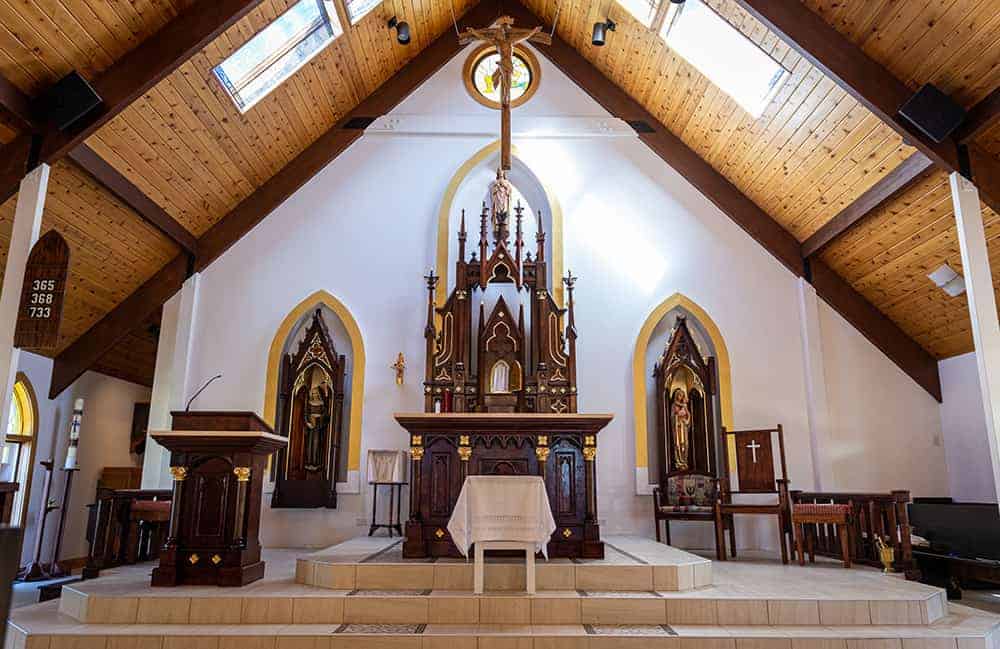
St. Scholastica, Erie, Colorado Readings at MassLiturgical Colour: White. Year: A(I). Readings for the feria Readings for the memorial These are the readings for the feria
| First reading | Genesis 3:1-8 © |
|---|
The fall of manThe serpent was the most subtle of all the wild beasts that the Lord God had made. It asked the woman, ‘Did God really say you were not to eat from any of the trees in the garden?’ The woman answered the serpent, ‘We may eat the fruit of the trees in the garden. But of the fruit of the tree in the middle of the garden God said, “You must not eat it, nor touch it, under pain of death.”’ Then the serpent said to the woman, ‘No! You will not die! God knows in fact that on the day you eat it your eyes will be opened and you will be like gods, knowing good and evil.’ The woman saw that the tree was good to eat and pleasing to the eye, and that it was desirable for the knowledge that it could give. So she took some of its fruit and ate it. She gave some also to her husband who was with her, and he ate it. Then the eyes of both of them were opened and they realised that they were naked. So they sewed fig-leaves together to make themselves loin-cloths. The man and his wife heard the sound of the Lord God walking in the garden in the cool of the day, and they hid from the Lord God among the trees of the garden.
| Responsorial Psalm |
|---|
| Psalm 31(32):1-2,5-7 © |
|---|
Happy the man whose offence is forgiven. Happy the man whose offence is forgiven, whose sin is remitted. O happy the man to whom the Lord imputes no guilt, in whose spirit is no guile. Happy the man whose offence is forgiven. But now I have acknowledged my sins; my guilt I did not hide. I said: ‘I will confess my offence to the Lord.’ And you, Lord, have forgiven the guilt of my sin. Happy the man whose offence is forgiven. So let every good man pray to you in the time of need. The floods of water may reach high but him they shall not reach. Happy the man whose offence is forgiven. You are my hiding place, O Lord; you save me from distress. You surround me with cries of deliverance. Happy the man whose offence is forgiven.
| Gospel Acclamation | cf.Jn6:63,68 |
|---|
Alleluia, alleluia! Your words are spirit, Lord, and they are life; you have the message of eternal life. Alleluia! Alleluia, alleluia! Open our heart, O Lord, to accept the words of your Son. Alleluia!
'He makes the deaf hear and the dumb speak'Returning from the district of Tyre, Jesus went by way of Sidon towards the Sea of Galilee, right through the Decapolis region. And they brought him a deaf man who had an impediment in his speech; and they asked him to lay his hand on him. He took him aside in private, away from the crowd, put his fingers into the man’s ears and touched his tongue with spittle. Then looking up to heaven he sighed; and he said to him, ‘Ephphatha’, that is, ‘Be opened.’ And his ears were opened, and the ligament of his tongue was loosened and he spoke clearly. And Jesus ordered them to tell no one about it, but the more he insisted, the more widely they published it. Their admiration was unbounded. ‘He has done all things well,’ they said ‘he makes the deaf hear and the dumb speak.’ Continue These are the readings for the memorial
| First reading |
|---|
| Song of Songs 8:6-7 © |
|---|
The flash of love is a flame of the Lord himselfSet me like a seal on your heart, like a seal on your arm. For love is strong as Death, jealousy as relentless as Sheol. The flash of it is a flash of fire, a flame of the Lord himself. Love no floods can quench, no torrents drown. Were a man to offer all the wealth of his house to buy love, contempt is all he would purchase.
| Responsorial Psalm |
|---|
| Psalm 148:1-2,11-14 © |
|---|
Your glory fills all heaven and earth. or Alleluia! Praise the Lord from the heavens, praise him in the heights. Praise him, all his angels, praise him, all his host. Your glory fills all heaven and earth. or Alleluia! All earth’s kings and peoples, earth’s princes and rulers, young men and maidens, old men together with children. Your glory fills all heaven and earth. or Alleluia! Let them praise the name of the Lord for he alone is exalted. The splendour of his name reaches beyond heaven and earth. Your glory fills all heaven and earth. or Alleluia! He exalts the strength of his people. He is the praise of all his saints, of the sons of Israel, of the people to whom he comes close. Your glory fills all heaven and earth. or Alleluia!
| Gospel Acclamation | Jn14:23 |
|---|
Alleluia, alleluia! If anyone loves me he will keep my word, and my Father will love him, and we shall come to him. Alleluia!
Martha works; Mary listensJesus came to a village, and a woman named Martha welcomed him into her house. She had a sister called Mary, who sat down at the Lord’s feet and listened to him speaking. Now Martha who was distracted with all the serving said, ‘Lord, do you not care that my sister is leaving me to do the serving all by myself? Please tell her to help me.’ But the Lord answered: ‘Martha, Martha,’ he said ‘you worry and fret about so many things, and yet few are needed, indeed only one. It is Mary who has chosen the better part; it is not to be taken from her.’ Continue Christian Art Each day, The Christian Art website gives a picture and reflection on the Gospel of the day. The readings on this page are from the Jerusalem Bible, which is used at Mass in most of the English-speaking world. The New American Bible readings, which are used at Mass in the United States, are available in the Universalis apps, programs and downloads.
You can also view this page with the Gospel in Greek and English. |
TOPICS: Catholic; General Discusssion; Prayer; Worship
KEYWORDS: catholic; mk7; ordinarytime; prayer
For your reading, reflection, faith-sharing, comments, questions, discussion.
1
posted on
02/10/2023 4:09:32 AM PST
by
annalex
To: All
KEYWORDS: catholic; mk7; ordinarytime; prayer
2
posted on
02/10/2023 4:10:00 AM PST
by
annalex
(fear them not)
To: nickcarraway; NYer; ELS; Pyro7480; livius; ArrogantBustard; Catholicguy; RobbyS; marshmallow; ...

Alleluia Ping Please FReepmail me to get on/off the Alleluia Ping List.
3
posted on
02/10/2023 4:11:00 AM PST
by
annalex
(fear them not)
To: annalex
4
posted on
02/10/2023 4:11:28 AM PST
by
annalex
(fear them not)
To: annalex
| Mark |
| | English: Douay-Rheims | Latin: Vulgata Clementina | Greek NT: Byzantine/Majority Text (2000) |
| | Mark 7
|
| 31. | And again going out of the coasts of Tyre, he came by Sidon to the sea of Galilee, through the midst of the coasts of Decapolis. | Et iterum exiens de finibus Tyri, venit per Sidonem ad mare Galilææ inter medios fines Decapoleos. | και παλιν εξελθων εκ των οριων τυρου και σιδωνος ηλθεν προς την θαλασσαν της γαλιλαιας ανα μεσον των οριων δεκαπολεως |
| 32. | And they bring to him one deaf and dumb; and they besought him that he would lay his hand upon him. | Et adducunt ei surdum, et mutum, et deprecabantur eum, ut imponat illi manum. | και φερουσιν αυτω κωφον μογγιλαλον και παρακαλουσιν αυτον ινα επιθη αυτω την χειρα |
| 33. | And taking him from the multitude apart, he put his fingers into his ears, and spitting, he touched his tongue: | Et apprehendens eum de turba seorsum, misit digitos suos in auriculas ejus : et exspuens, tetigit linguam ejus : | και απολαβομενος αυτον απο του οχλου κατ ιδιαν εβαλεν τους δακτυλους αυτου εις τα ωτα αυτου και πτυσας ηψατο της γλωσσης αυτου |
| 34. | And looking up to heaven, he groaned, and said to him: Ephpheta, which is, Be thou opened. | et suscipiens in cælum, ingemuit, et ait illi : Ephphetha, quod est, Adaperire. | και αναβλεψας εις τον ουρανον εστεναξεν και λεγει αυτω εφφαθα ο εστιν διανοιχθητι |
| 35. | And immediately his ears were opened, and the string of his tongue was loosed, and he spoke right. | Et statim apertæ sunt aures ejus, et solutum est vinculum linguæ ejus, et loquebatur recte. | και ευθεως διηνοιχθησαν αυτου αι ακοαι και ελυθη ο δεσμος της γλωσσης αυτου και ελαλει ορθως |
| 36. | And he charged them that they should tell no man. But the more he charged them, so much the more a great deal did they publish it. | Et præcepit illis ne cui dicerent. Quanto autem eis præcipiebat, tanto magis plus prædicabant : | και διεστειλατο αυτοις ινα μηδενι ειπωσιν οσον δε αυτος αυτοις διεστελλετο μαλλον περισσοτερον εκηρυσσον |
| 37. | And so much the more did they wonder, saying: He hath done all things well; he hath made both the deaf to hear, and the dumb to speak. | et eo amplius admirabantur, dicentes : Bene omnia fecit : et surdos fecit audire, et mutos loqui. | και υπερπερισσως εξεπλησσοντο λεγοντες καλως παντα πεποιηκεν και τους κωφους ποιει ακουειν και τους αλαλους λαλειν |
5
posted on
02/10/2023 4:13:41 AM PST
by
annalex
(fear them not)
To: annalex

Catena Aurea by St. Thomas Aguinas
Mark CHAP. 7
7:31–37
31. And again, departing from the coasts of Tyre and Sidon, he came unto the sea of Galilee, through the midst of the coasts of Decapolis.
32. And they bring unto him one that was deaf, and had an impediment in his speech; and they beseech him to put his hand upon him.
33. And he took him aside from the multitude, and put his fingers into his ears, and he spit, and touched his tongue;
34. And looking up to heaven, he sighed, and saith unto him, Ephphatha, that is, Be opened.
35. And straightway his ears were opened, and the string of his tongue was loosed, and he spake plain.
36. And he charged them that they should tell no man: but the more he charged them, so much the more a great deal they published it;
37. And were beyond measure astonished, saying, He hath done all things well: he maketh both the deaf to hear, and the dumb to speak.
THEOPHYLACT. The Lord did not wish to stay in the parts of the Gentiles, lest He should give the Jews occasion to say, that they esteemed Him a transgressor of the law, because He held communion with the Gentiles, and therefore He immediately returns; wherefore it is said, And again departing from the coasts of Tyre, he came through Sidon, to the sea of Galilee, through the midst of the borders of Decapolis.
BEDE. (in Marc. 2, 31) Decapolis is a region of ten cities, across the Jordan, to the east, over against Galilee.c When therefore it is said that the Lord came to the sea of Galilee, through the midst of the borders of Decapolis, it does not mean that He entered the confines of Decapolis themselves; for He is not said to have crossed the sea, but rather to have come to the borders of the sea, and to have reached quite up to the place, which was opposite to the midst of the coasts of Decapolis, which were situated at a distance across the sea. It goes on, And they bring him one that was deaf and dumb, and they besought him to lay hands upon him.
THEOPHYLACT. Which is rightly placed after the deliverance of one possessed with a devil, for such an instance of suffering came from the devil. There follows, And he took him aside from the multitude, and put his fingers into his ears.
PSEUDO-CHRYSOSTOM. (Vict. Ant. e Cat. in Marc.) He takes the deaf and dumb man who was brought to Him apart from the crowd, that He might not do His divine miracles openly; teaching us to cast away vain glory and swelling of heart, for no one can work miracles as he can, who loves humility and is lowly in his conduct. But He puts His fingers into his ears, when He might have cured him with a word, to shew that His body, being united to Deity, was consecrated by Divine virtue, with all that He did. For since on account of the transgression of Adam, human nature had incurred much suffering and hurt in its members and senses, Christ coming into the world shewed the perfection of human nature in Himself, and on this account opened ears with His fingers, and gave the power of speech by His spittle. Wherefore it goes on, And spit, and touched his tongue.
THEOPHYLACT. That He might shew that all the members of His sacred body are divine and holy, even the spittle which loosed the string of the tongue. For the spittle is only the superfluous moisture of the body, but in the Lord all things are divine. It goes on, And looking up to heaven, he groaned, and saith unto him, Ephphatha, that is, Be opened.
BEDE. (ubi sup.) He looked up to heaven, that He might teach us that thence is to be procured speech for the dumb, hearing for the deaf, health for all who are sick. And He sighed, not that it was necessary for Him to beg any thing from His Father with groaning, for He, together with the Father, gives all things to them who ask, but that He might give us an example of sighing, when for our own errors and those of our neighbours, we invoke the guardianship of the Divine mercy.
PSEUDO-CHRYSOSTOM. (Vict. Ant. e Cat. in Marc.) He at the same time also groaned, as taking our cause upon Himself, and pitying human nature, seeing the misery into which it had fallen.
BEDE. (ubi sup.) But that which He says, Ephphatha, that is, Be opened, belongs properly to the ears, for the ears are to be opened for hearing, but the tongue to be loosed from the bonds of its impediment, that it may be able to speak. Wherefore it goes on, And straightway his ears were opened, and the string of his tongue was loosed, and he spake plain. Where each nature of one and the same Christ is manifestly distinct, looking up indeed into Heaven as man, praying unto God, He groaned, but presently with one word, as being strong in the Divine Majesty, He healed. It goes on, And he charged them that they should tell no man.
PSEUDO-CHRYSOSTOM. (Vict. Ant. e Cat. in Marc.) By which He has taught us not to boast in our powers, but in the cross and humiliation. He also bade them conceal the miracle, lest He should excite the Jews by envy to kill Him before the time.
PSEUDO-JEROME. A city, however, placed on a hill cannot be hid, and lowliness always comes before glory. Wherefore it goes on, But the more he charged them, so much the more a great deal they published it.
THEOPHYLACT. By this we are taught, when we confer benefits on any, by no means to seek for applause and praise; but when we have received benefits, to proclaim and praise our benefactors, even though they be unwilling.
AUGUSTINE. (ap. Aug. non occ. sed ap. Bed. ubi sup.) If however He, as one Who knew the present and the future wills of men, knew that they would proclaim Him the more in proportion as He forbade them, why did He give them this command? If it were not that He wished to prove to men who are idle, how much more joyfully, with how much greater obedience, they whom He commands to proclaim Him should preach, when they who were forbidden could not hold their peace.
GLOSS. (non occ.) From the preaching however of those who were healed by Christ, the wonder of the multitude, and their praise of the benefits of Christ, increased. Wherefore it goes on, And they were beyond measure astonished, saying, He hath done all things well; he maketh the deaf to hear, and the dumb to speak.
PSEUDO-JEROME. Mystically, Tyre is interpreted narrowness, and signifies Judæa, to which the Lord said, (v. Isa. 28:20) “For the bed is grown too narrow,” and from which he turns himself to the Gentiles. Sidon means ‘hunting,’ for our race is like an untamed beast, and ‘sea,’ which means a wavering inconstancy. Again, the Saviour comes to save the Gentiles in the midst of the coasts of Decapolis, which may be interpreted, as the commands of the Decalogue. Further, the human race throughout its many members is reckoned as one man, eaten up by varying pestilence, in the first created man; it is blinded, that is, its eye is evil; it becomes deaf, when it listens to, and dumb when it speaks, evil. And they prayed Him to lay His hand upon him, because many just men, and patriarchs, wished and longed for the time when the Lord should come in the flesh.
BEDE. (ubi sup.) Or he is deaf and dumb, who neither has ears to hear the words of God, nor opens his mouth to speak them, and such must be presented to the Lord for healing, by men who have already learned to hear and speak the divine oracles.
PSEUDO-JEROME. Further, he who obtains healing is always drawn aside from turbulent thoughts, disorderly actions, and incoherent speeches. And the fingers which are put into the ears are the words and the gifts of the Holy Ghost, of whom it is said, This is the finger of God. (Exod. 8:19) The spittle is heavenly wisdom, which loosens the sealed lips of the human race, so that it can say, I believe in God, the Father Almighty, and the rest of the Creed. And looking up to heaven, he groaned, (Cf. Mat. 12:20. Luke 11:20) that is, He taught us to groan, and to raise up the treasures of our hearts to the heavens; because by the groaning of hearty compunction, the silly joy of the flesh is purged away. But the ears are opened to hymns, and songs, and psalms; and He looses the tongue, that it may pour forth the good word, which neither threats nor stripes can restrain.
Catena Aurea Mark 7
6
posted on
02/10/2023 4:15:06 AM PST
by
annalex
(fear them not)
To: annalex
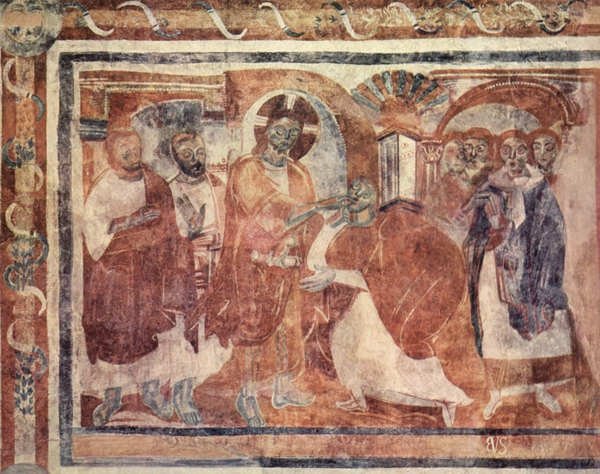
Christ healing a deaf-mute
The Convent of Saint John
ca. 800
Müstair village, Switzerland
7
posted on
02/10/2023 4:15:22 AM PST
by
annalex
(fear them not)
To: annalex
| Luke |
| | English: Douay-Rheims | Latin: Vulgata Clementina | Greek NT: Byzantine/Majority Text (2000) |
| | Luke 10
|
| 38. | Now it came to pass as they went, that he entered into a certain town: and a certain woman named Martha, received him into her house. | Factum est autem, dum irent, et ipse intravit in quoddam castellum : et mulier quædam, Martha nomine, excepit illum in domum suam, | εγενετο δε εν τω πορευεσθαι αυτους και αυτος εισηλθεν εις κωμην τινα γυνη δε τις ονοματι μαρθα υπεδεξατο αυτον εις τον οικον αυτης |
| 39. | And she had a sister called Mary, who sitting also at the Lord's feet, heard his word. | et huic erat soror nomine Maria, quæ etiam sedens secus pedes Domini, audiebat verbum illius. | και τηδε ην αδελφη καλουμενη μαρια η και παρακαθισασα παρα τους ποδας του ιησου ηκουεν τον λογον αυτου |
| 40. | But Martha was busy about much serving. Who stood and said: Lord, hast thou no care that my sister hath left me alone to serve? speak to her therefore, that she help me. | Martha autem satagebat circa frequens ministerium : quæ stetit, et ait : Domine, non est tibi curæ quod soror mea reliquit me solam ministrare ? dic ergo illi ut me adjuvet. | η δε μαρθα περιεσπατο περι πολλην διακονιαν επιστασα δε ειπεν κυριε ου μελει σοι οτι η αδελφη μου μονην με κατελειπεν διακονειν ειπε ουν αυτη ινα μοι συναντιλαβηται |
| 41. | And the Lord answering, said to her: Martha, Martha, thou art careful, and art troubled about many things: | Et respondens dixit illis Dominus : Martha, Martha, sollicita es, et turbaris erga plurima, | αποκριθεις δε ειπεν αυτη ο ιησους μαρθα μαρθα μεριμνας και τυρβαζη περι πολλα |
| 42. | But one thing is necessary. Mary hath chosen the best part, which shall not be taken away from her. | porro unum est necessarium. Maria optimam partem elegit, quæ non auferetur ab ea. | ενος δε εστιν χρεια μαρια δε την αγαθην μεριδα εξελεξατο ητις ουκ αφαιρεθησεται απ αυτης |
8
posted on
02/10/2023 4:17:39 AM PST
by
annalex
(fear them not)
To: annalex
Catena Aurea by St. Thomas Aguinas
10:38–42
38. Now it came to pass, as they went, that he entered into a certain village: and a certain woman named Martha received him into her house.
39. And she had a sister called Mary, which also sat at Jesus’ feet, and heard his word.
40. But Martha was cumbered about much serving, and came to him, and said, Lord, dost thou not care that my sister hath left me to serve alone? bid her therefore that she help me.
41. And Jesus answered and said unto her, Martha, Martha, thou art careful and troubled about many things:
42. But one thing is needful: and Mary hath chosen that good part, which shall not be taken away from her.
BEDE. The love of God and our neighbour, which was contained above in words and parables, is here set forth in very deed and reality; for it is said, Now it came to pass, as they went, that he entered into a certain village.
ORIGEN. The name of which village Luke indeed here omits, but John mentions, calling it Bethany. (John 11.)
AUGUSTINE. (Ser. 103.) But the Lord, who came to his own, and his own received him not, (John 1:12.) was received as a guest, for it follows, And a certain woman named Martha received him into her house, &c. as strangers are accustomed to be received. But still a servant received her Lord, the sick her Saviour, the creature her Creator. But if any should say, “O blessed are they who have been thought worthy to receive Christ into their houses,” grieve not thou, for He says, For inasmuch as ye have done it to the least of my brethren, ye have done it unto me. (Matt. 25:40.) But taking the form of a servant, He wished therein to be fed by servants, by reason of His condescension, not His condition. He had a body in which He was hungry and thirsty, but when He was hungry in the desert, Angels ministered to Him. (Matt. 4:11.) In wishing therefore to be fed, He came Himself to the feeder. Martha then, setting about and preparing to feed our Lord, was occupied in serving; but Mary her sister chose rather to be fed by the Lord, for it follows, And she had a sister called Mary, which also sat at Jesus’ feet, and heard his word.
CHRYSOSTOM. It is not said of Mary simply that she sat near Jesus, but at His feet, to shew her diligence, stedfastness, and zeal, in hearing, and the great reverence which she had for our Lord.
AUGUSTINE. (ubi sup.) Now as was her humility in sitting at His feet, so much the more did she receive from Him. For the waters pour down to the lowest part of the valley, but flow away from the rising of the hill.
BASIL. (Const. Mon. c. 1.) Now every work and word of our Saviour is a rule of piety and virtue. For to this end did He put on our body, that as much as we can we might imitate His conversation.
CYRIL OF ALEXANDRIA. By His own example then He teaches His disciples how they ought to behave in the houses of those who receive them, namely, when they come to a house, they should not remain idle, but rather fill the minds of those who receive them with sacred and divine teaching. But let those who make ready the house, go to meet their guests gladly and earnestly, for two reasons. First, indeed, they will be edified by the teaching of those whom they receive; next also they will receive the reward of charity. And hence it follows here, But Martha was cumbered about much serving, &c.
AUGUSTINE. (ubi sup.) Martha was well engaged in ministering to the bodily wants or wishes of our Lord, as of one who was mortal, but He who was clothed in mortal flesh; in the beginning was the Word. Behold then what Mary heard, The Word was made flesh. Behold then Him to whom Martha ministered. The one was labouring, the other at rest. But yet Martha, when much troubled in her occupation and business of serving, interrupted our Lord, and complained of her sister. For it follows, And said, Lord, dost thou not care that my sister hath left me to serve alone? For Mary was absorbed in the sweetness of our Lord’s words; Martha was preparing a feast for our Lord, in whose feast Mary was now rejoicing. While then she was listening with delight to those sweet words, and was feeding on them with the deepest affection, our Lord was interrupted by her sister. What must we suppose was her alarm, lest the Lord should say to her, “Rise, and help thy sister?” Our Lord therefore, who was not at a loss, for He had shewn He was the Lord, answered as follows, And Jesus answered and said unto her, Martha, Martha. The repetition of the name is a mark of love, or perhaps of drawing the attention, that she should listen more earnestly. When twice called, she hears, Thou art troubled about many things, that is, thou art busied about many things. For man wishes to meet with something when he is serving, and can not; and thus between seeking what is wanting and preparing what is at hand, the mind is distracted. For if Martha had been sufficient of herself, she would not have required the aid of her sister. There are many, there are diverse things, which are carnal, temporal, but one is preferred to many. For one is not from many, but many from one. Hence it follows, But one thing is needful. Mary wished to be occupied about one, according to that, It is good for me to cling close unto the Lord. (Ps. 73:28.) The Father, the Son, the Holy Spirit, are one. To this one he does not bring us, unless we being many have one heart. (Acts 4:32.)
CYRIL OF ALEXANDRIA. Or else, when certain brethren have received God, they will not be anxious about much service, nor ask for those things which are not in their hands, and are beyond their needs. For every where and in every thing that which is superfluous is burdensome. For it begets weariness in those who are wishing to bestow it, while the guests feel that they are the cause of trouble.
BASIL. (in reg. fus. int. 19.) It is foolish also to take food for the support of the body, and thereby in return to hurt the body, and to hinder it in the performance of the divine command. If then a poor man come, let him receive a model and example of moderation in food, and let us not prepare our own tables for their sakes, who wish to live luxuriously. For the life of the Christian is uniform, ever tending to one object, namely, the glory of God. But the life of those who are without is manifold and vacillating, changed about at will. And how in truth canst thou, when thou settest thy table before thy brother with profusion of meats, and for the pleasure of feasting sake, accuse him of luxury, and revile him as a glutton, censuring his indulgence in that which thou thyself affordest him? Our Lord did not commend Martha when busied about much serving.
AUGUSTINE. (Serm. 104.) What then? Must we think that blame was cast upon the service of Martha, who was engaged in the cares of hospitality, and rejoiced in having so great a guest? If this be true, let men give up ministering to the needy; in a word, let them be at leisure, intent only upon getting wholesome knowledge, taking no care what stranger is in the village in want of bread; let works of mercy be unheeded, knowledge only be cultivated.
THEOPHYLACT. Our Lord does not then forbid hospitality, but the troubling about many things, that is to say, hurry and anxiety. And mark the wisdom of our Lord, in that at first He said nothing to Martha, but when she sought to tear away her sister from hearing, then the Lord took occasion to reprove her. For hospitality is ever honoured as long as it keeps us to necessary things. But when it begins to hinder us from attending to what is of more importance, then it is plain that the hearing of the divine word is the more honourable.
AUGUSTINE. (Serm. 104.) Our Lord then does not blame the actions, but distinguishes between the duties. For it follows, Mary hath chosen that good part, &c. Not thine a bad one, but hers a better. Why a better? because it shall not be taken away from her. From thee the necessary burden of business shall one time be taken away. For when thou comest into that country, thou wilt find no stranger to receive with hospitality. But for thy good it shall be taken away, that what is better may be given thee. Trouble shall be taken away, that rest may be given. Thou art yet at sea; she is in port. For the sweetness of truth is eternal, yet in this life it is increased, and in the next it will be made perfect, never to be taken away.
AMBROSE. May you then like Mary be influenced by the desire of wisdom. For this is the greater, this the more perfect work. Nor let the care of ministering to others turn thy mind from the knowledge of the heavenly word, nor reprove or think indolent those whom thou seest seeking after wisdom.
AUGUSTINE. (de Qu. Evang. l. ii. q. 30.) Now mystically, by Martha’s receiving our Lord into her house is represented the Church which now receives the Lord into her heart. Mary her sister, who sat at Jesus’ feet and heard His word, signifies the same Church, but in a future life, where ceasing from labour, and the ministering to her wants, she shall delight in Wisdom alone. But by her complaining that her sister did not help her, occasion is given for that sentence of our Lord, in which he shews that Church to be anxious and troubled about much service, when there is but one thing needful, which is yet attained through the merits of her service; but He says that Mary hath chosen the good part, for through the one the other is reached, which shall not be taken away.
GREGORY. (6. Mor. c. 18.) Or by Mary who sat and heard our Lord’s words, is signified the contemplative life; by Martha engaged in more outward services, the active life. Now Martha’s care is not blamed, but Mary is praised, for great are the rewards of an active life, but those of a contemplative are far better. Hence Mary’s part it is said will never be taken away from her, for the works of an active life pass away with the body, but the joys of the contemplative life the rather begin to increase from the end.
Catena Aurea Luke 10
9
posted on
02/10/2023 4:18:45 AM PST
by
annalex
(fear them not)
To: annalex

Christ in the House of Martha and Mary
Johannes Vermeer (1632–1675)
160 × 142 cm (63 × 55.9 in)
National Gallery of Scotland
10
posted on
02/10/2023 4:19:36 AM PST
by
annalex
(fear them not)
To: annalex
Saint of the Day for February 10
(c. 480 – February 10, 542)
Saint Scholastica’s Story
Twins often share the same interests and ideas with an equal intensity. Therefore, it is no surprise that Scholastica and her twin brother, Benedict, established religious communities within a few miles from each other.
Born in 480 of wealthy parents, Scholastica and Benedict were brought up together until he left central Italy for Rome to continue his studies.
Little is known of Scholastica’s early life. She founded a religious community for women near Monte Cassino at Plombariola, five miles from where her brother governed a monastery.
The twins visited each other once a year in a farmhouse because Scholastica was not permitted inside the monastery. They spent these times discussing spiritual matters.
According to the Dialogues of St. Gregory the Great, the brother and sister spent their last day together in prayer and conversation. Scholastica sensed her death was close at hand and she begged Benedict to stay with her until the next day.
He refused her request because he did not want to spend a night outside the monastery, thus breaking his own Rule. Scholastica asked God to let her brother remain and a severe thunderstorm broke out, preventing Benedict and his monks from returning to the abbey.
Benedict cried out, “God forgive you, Sister. What have you done?” Scholastica replied, “I asked a favor of you and you refused. I asked it of God and he granted it.”
Brother and sister parted the next morning after their long discussion. Three days later, Benedict was praying in his monastery and saw the soul of his sister rising heavenward in the form of a white dove. Benedict then announced the death of his sister to the monks and later buried her in the tomb he had prepared for himself.
Reflection
Scholastica and Benedict gave themselves totally to God and gave top priority to deepening their friendship with him through prayer. They sacrificed some of the opportunities they would have had to be together as brother and sister in order better to fulfill their vocation to the religious life. In coming closer to Christ, however, they found they were also closer to each other. In joining a religious community, they did not forget or forsake their family but rather found more brothers and sisters.
Saint Scholastica is the Patron Saint of:
Cloistered Nuns
franciscanmedia.org
11
posted on
02/10/2023 4:22:58 AM PST
by
annalex
(fear them not)
To: annalex

Death of Saint Scholastica.
Johann Baptist Wenzel Bergl
1765
Basilica of Kleinmariazell (Lower Austria)
12
posted on
02/10/2023 4:26:33 AM PST
by
annalex
(fear them not)
To: annalex
NAVARRE BIBLE COMMENTARY (RSV)
Ad Majorem Dei Gloriam (To the Greater Glory of God)
From: Genesis 3:1-8
Temptation and the First Sins
-----------------------------
[1] The serpent was more subtle than any other wild creature that the Lord God had made. He said to the woman, "Did God say, 'You shall not eat of any tree of the garden'?" [2] And the woman said to the serpent, "We may eat of the fruit of the trees of the garden; [3] but God said, 'You shall not eat of the fruit of the tree which is in the midst of the garden, neither shall you touch it, lest you die.'" [4] But the serpent said to the woman, "You will not die. [5] For God knows that when you eat of it your eyes will be opened, and you will be like God, knowing good and evil." [6] So when the woman saw that the tree was good for food, and that it was a delight to the eyes, and that the tree was to be desired to make one wise, she took of its fruit and ate; and she also gave some to her husband, and he ate. [7] Then the eyes of both were opened, and they knew that they were naked; and they sewed fig leaves together and made themselves aprons.
[8] And they heard the sound of the Lord God walking in the garden in the cool of the day, and the man and his wife hid themselves from the presence of the Lord God among the trees of the garden.
***********************************************************************
Commentary:
3:1-24. "The account of the fall in Genesis 3 uses figurative language, but affirms a primeval event, a deed that took place "at the beginning of the history of man". Revelation gives us the certainty of faith that the whole of human history is marked by the original fault freely committed by our first parents" ("Catechism of the Catholic Church", 390). The Bible is teaching us here about the origin of evil--of all the evils mankind experiences, and particularly the evil of death. Evil does not come from God (he created man to live a happy life and to be his friend); it comes from sin, that is, from the fact that man broke the divine commandment, thereby destroying the happiness he was created for, and his harmony with God, with himself, and with creation in general. "Man, tempted by the devil, let his trust in his Creator die in his heart and, abusing his freedom, disobeyed God's command. This is what man's first sin consisted of. All subsequent sin would be disobedience toward God and lack of trust in his goodness" ("Catechism of the Catholic Church", 397).
In his description of that original sin and its consequences, the sacred writer uses symbolic language (garden, tree, serpent) in order to convey an important historical and religious truth--that no sooner did he walk the earth than man disobeyed God, and therein lies the cause of evil. We can also see here how every sin happens and what results from it: "The eyes of our soul grow dull. Reason proclaims itself sufficient to understand everything, without the aid of God. This is a subtle temptation, which hides behind the power of our intellect, given by our Father God to man so that he might know and love him freely. Seduced by this temptation, the human mind appoints itself the center of the universe, being thrilled with the prospect that 'you shall be like gods' (Gen 3:15). So filled with love for itself, it turns its back on the love of God" (St. J. Escrivá, "Christ Is Passing By", 6).
3:1. The serpent symbolizes the devil, a personal being who tries to frustrate God's plans and draw man to perdition. "Behind the disobedient choice of our first parents lurks a seductive voice, opposed to God, which makes them fall into death out of envy (Wis 2:24). Scripture and the Church's Tradition see in this being a fallen angel, called 'Satan' or the 'devil'. The Church teaches what Satan was at first a good angel, made by God: 'The devil and the other demons were indeed created naturally good by God, but they became evil by their own doing' (Fourth Vatican Council)" ("Catechism of the Catholic Church", 391.).
3:2-5. The devil's temptation strategy is very realistically described here: he falsifies what God has said, raises suspicions about God's plans and intentions, and, finally, portrays God as man's enemy. "The analysis of sin in its original dimension indicates that, through the influence of the 'father of lies', "throughout the history of humanity there will be a constant pressure on man to reject God", even to the point of hating him: 'Love of self to the point of contempt for God,' as St Augustine puts it (cf. "De Civitate Dei", 14, 28). Man will be inclined to see in God primarily a limitation of himself, and not the source of his own freedom and the fullness of good. We see this confirmed in the modern age, when the atheistic ideologies seek "to root out religion" on the grounds that religion causes the radical "'alienation' of man", as if man were dispossessed of his own humanity when, accepting the idea of God, he attributes to God what belongs to man, and exclusively to man! Hence a process of thought and historico-sociological practice in which the rejection of God has reached the point of declaring his 'death'. An absurdity, both in concept and expression!" (John Paul II, "Dominum Et Vivificantem", 38).
3:6 And so both of them, the man and the woman, disobeyed God's commandment. Genesis refers not to an apple but to a mysterious fruit: eating it symbolizes Adam and Eve's sin--one of disobedience.
The sacred writer leads us to the denouement by giving a masterly psychological description of temptation, dialogue with the tempter, doubt about God's truthfulness, and then yielding to one's sensual appetites. This sin, Pope John Paul II also commented, "constitutes "the principle and root of all the others". We find ourselves faced with the original reality of sin in human story and at the same time in the whole of the economy of salvation. [...] This original disobedience presupposes "a rejection", or at least "a turning away from the truth contained in the Word of God", who creates the world. [...] 'Disobedience' means precisely going beyond that limit, which remains impassable to the will and the freedom of man as a created being. For God the Creator is the one definitive source of the moral order in the world created by him. Man cannot decide by himself what is good and what is evil -- cannot 'know good and evil, like God'. In the created world "God" indeed remains the first and sovereign source "for deciding about good and evil", through the intimate truth of being, which is the reflection "of the Word", the eternal son, consubstantial with the Father. To man, created to the image of God, the Holy Spirit gives the gift of "conscience", so that in this conscience the image may faithfully reflect its model, which is both Wisdom and eternal Law, the source of the moral order in man and in the world. 'Disobedience', as the original dimension of sin, means the "rejection of this source", through man's claim to become an independent and exclusive source for deciding about good and evil" ("Dominum Et Vivificantem", 33-36).
3:7-13. This passage begins the description of the effects of the original sin. Man and woman have come to know evil, and it shows, initially, in a most direct way--in their own bodies. The inner harmony described in Genesis 2:25 is broken, and concupiscence rears its head. Their friendship with God is also broken, and they flee from his presence, to avoid their nakedness being seen. As if his Creator could not see them! The harmony between man and woman is also fractured: he puts the blame on her, and she puts it on the serpent. But all three share in the responsibility, and therefore all three are going to pay the penalty.
"The harmony in which they found themselves, thanks to original justice, is now destroyed: the control of the soul's spiritual faculties over the body is shattered; the union of man and woman becomes subject to tensions (cf. Gen 3:7-16), their relations henceforth marked by lust and domination. Harmony with creation is broken: visible creation has become alien and hostile to man (cf. Gen 3:17, 19). Because of man, creation is now subject 'to its bondage to decay' (Rom 8:21). Finally, the consequence explicitly foretold for this disobedience will come true: man will 'return to the ground' (Gen 3:19), for out of it he was taken. "Death makes its entrance into human history" (cf. Rom 5:12)" ("Catechism of the Catholic Church", 400).
13
posted on
02/10/2023 7:17:33 AM PST
by
fidelis
(👈 Under no obligation to respond to rude, ignorant, abusive, bellicose, and obnoxious posts.)
To: fidelis
From: Mark 7:31-37The Curing of a Deaf Man
------------------------
[31] Then He (Jesus) returned from the region of Tyre, and went through Sidon to the Sea of Galilee, through the region of the Decapolis. [32] And they brought Him a man who was deaf and had an impediment in his speech; and they besought Him to lay His hand upon him. [33] And taking him aside from the multitude privately, He put His fingers into his ears, and He spat and touched his tongue; [34] and looking up to Heaven, He sighed and said to him, "Ephphatha," that is, "Be opened." [35] And his ears were opened, his tongue was released, and he spoke plainly. [36] And He charged them to tell no one; but the more He charged them, the more zealously they proclaimed it. [37] And they were astonished beyond measure, saying, "He has done all things well; He even makes the deaf hear and the dumb speak."
***********************************************************************
Commentary:
32-33. Sacred Scripture quite often shows the laying on of hands as a gesture indicating the transfer of power or blessing (cf. Genesis 48:14ff; 2 Kings 5:11; Luke 13:13). Everyone knows that saliva can help heal minor cuts. In the language of Revelation fingers symbolized powerful Divine action (cf. Exodus 8:19; Psalm 8:4; Luke 11:20). So Jesus uses signs which suit in some way the effect He wants to achieve, though we can see from the text that the effect--the instantaneous cure of the deaf and dumb man--far exceeds the sign used.
In the miracle of the deaf and dumb man we can see a symbol of the way God acts on souls: for us to believe, God must first open our heart so we can listen to His word. Then, like the Apostles, we too can proclaim the "magnalia Dei", the mighty works of God (cf. Acts 2:11). In the Church's liturgy (cf. the hymn "Veni Creator") the Holy Spirit is compared to the finger of the right hand of God the Father ("Digitus paternae dexterae"). The Consoler produces in our souls, in the supernatural order, effects comparable to those which Christ produces in the body of the deaf and dumb man.
Source: Daily Word for Reflection—Navarre Bible
14
posted on
02/10/2023 7:17:51 AM PST
by
fidelis
(👈 Under no obligation to respond to rude, ignorant, abusive, bellicose, and obnoxious posts.)
To: fidelis
15
posted on
02/10/2023 7:20:02 AM PST
by
fidelis
(👈 Under no obligation to respond to rude, ignorant, abusive, bellicose, and obnoxious posts.)
Disclaimer:
Opinions posted on Free Republic are those of the individual
posters and do not necessarily represent the opinion of Free Republic or its
management. All materials posted herein are protected by copyright law and the
exemption for fair use of copyrighted works.
FreeRepublic.com is powered by software copyright 2000-2008 John Robinson