NAVARRE BIBLE COMMENTARY (RSV)
Ad Majorem Dei Gloriam (To the Greater Glory of God)
From: Revelation 20:1-4, 11-21:2
The Thousand-Year Reign of Christ and His People
------------------------------------------------
[1] Then I saw an angel coming down from heaven, holding in his hand the key of the bottomless pit and a great chain. [2] And he seized the dragon, that ancient serpent, who is the Devil and Satan, and bound him for a thousand years, [3] and threw him into the pit, and shut it and sealed it over him, that he should deceive the nations no more, till the thousand years were ended. After that he must be loosed for a little while.
[4] Then I saw thrones, and seated on them were those to whom judgment was committed. Also I saw the souls of those who had been beheaded for their testimony to Jesus and for the word of God, and who had not worshipped the beast or its image and had not received its mark on their foreheads or their hands. They came to life, and reigned with Christ a thousand years.
The Last Judgment of the Living and Dead
----------------------------------------
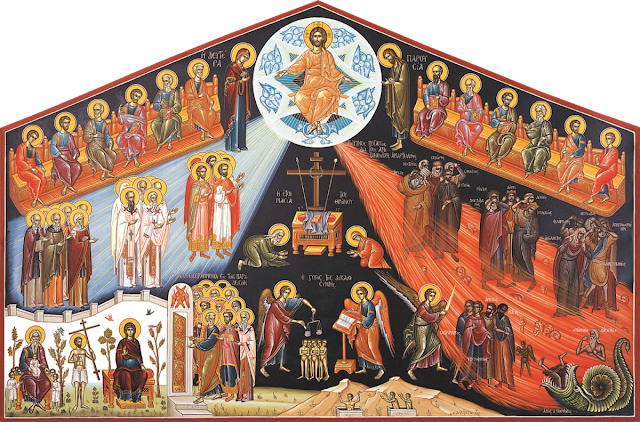
[11] Then I saw a great white throne and him who sat upon it; from his presence earth and sky fled away, and no place was found for them. [12] And I saw the dead, great and small, standing before the throne, and books were opened. Also another book was opened, which is the book of life. And the dead were judged by what was written in the books, by what they had done. [13] And the sea gave up the dead in it, Death and Hades gave up the dead in them, and all were judged by what they had done. [14] Then Death and Hades were thrown into the lake of fire. This is the second death, the lake of fire; [15] and if any one's name was not found written in the book of life, he was thrown into the lake of fire.
A New World Comes into Being. The New Jerusalem
-----------------------------------------------
[1] Then I saw a new heaven and a new earth; for the first heaven and the first earth had passed away, and the sea was no more.
***********************************************************************
Commentary:
1-3. The victory of the Lamb is manifested by the fact that Rome, the great harlot, has been destroyed (chap. 18); then the beast and its prophet are overcome (chap. 19); there remains the dragon whom we saw in chapter 12 and whose defeat marks the final outcome of the war referred to in that chapter.
The battle between Satan and God is described in two scenes; the first tells of how Satan is brought under control and deprived of his power for a time (vv. 1-3); the second describes his last assault on the Church and what happens to him in the end (vv. 7-10). Between these two scenes comes the reign of Christ and his followers for a thousand years (vv. 4-6). At the end of the second scene comes the General Judgment, with the reprobate being damned (vv. 11-18) and a new world coming into being (21:1-8).
The bottomless pit, or abyss, refers to a mysterious place, different from the lake of fire, or hell. Satan is also called the "ancient serpent" because it was he who seduced our first parents at the dawn of history (cf. Gen 3:1-19). The period during which Satan is held captive coincides with the reign of Christ and his saints--one thousand years (cf. v. 4)—and contrasts with the "little while" during which he is given further scope to act. This contrast is very significant and it may simply be a symbolic way of showing that Christ's power is vastly greater than Satan's and that the devil's power is doomed to perish even though on occasions it may emerge with unsuspected force.
4-6. The power to judge belongs to Jesus Christ in his own right because he has been given it by the Father (cf., e.g., Jn 5 :22; 9:39; Acts 10:42). However, our Lord gives a share in his power to the Apostles, whom he promised would sit on twelve thrones judging the tribes of Israel (cf. Mt 19:28). All other Christians will also share in Christ's power (cf. 1 Cor 6:2-3).
Various interpretations have been offered for this "thousand years". The "millenarian" interpretation, supported by some early writers, takes the passage literally and says that after the resurrection of the dead Christ will reign on earth for a thousand years; the Church has never accepted this interpretation. Like the other numbers mentioned in the Book of Revelation, the number of one thousand should be taken as more symbolic than arithmetic. It may be a reference to the period that runs from the incarnation of Christ to the end of time. It is also possible to see this millennium as a reference to a world of the future after the second coming of Christ; or simply as a symbolically long time contrasting with the "little while". It could also be that the author is fusing two notions current in Judaism in his time--one which saw the end of time as a messianic kingdom on earth, and the other which saw that End as a future which transcends this world, with the new appearance a new world--a new heaven and a new earth.
Our Lord Jesus Christ depicts the establishment of the messianic Kingdom as happening in two stages--his first coming, in which he demonstrates his power over the devil and inaugurates the Kingdom of God; and his second coming at the end of time, when that kingdom will be established in its full finished form. That is why we see St Augustine's explanation of the millennium as the most satisfactory. According to him, this millennium covers the time between the incarnation of the Son of God and his coming at the end of the world. During this period the activity of the devil is to some degree restricted; he is in some way enchained. Christ reigns fully in the Church triumphant and he reigns in the Church militant in an incomplete way. The power of the devil is no longer sovereign, which means that man is able to elude him. So, although "he desires to do us harm, he cannot do so because his power is subject to another's power [...]. He who gives him the ability to tempt, also gives his mercy to the one who is tempted. He has restricted the devil's ability to tempt people" (St Augustine, "Dei Serm. Dom. In Monte", II, 9, 34). In fact, the Cure of Ars used to say, "the devil is a big dog on a chain, who threatens and makes a lot of noise but who only bites those who go too near him" ("Selected Sermons", First Sunday of Lent).
According to this interpretation, the "first resurrection" should be understood in a spiritual sense; it is Baptism, which regenerates man and gives him new life by freeing him from sin and making him a son of God. The second resurrection is the one which will take place at the end of time, when the body is brought back to life and the human being, body and soul, enters into everlasting joy. The "rest of the dead" are those who did not receive Baptism. They too will rise again on the last day, to be judged according to their deeds.
On the priesthood referred to in v. 6, see the note on 1:6.
[Note on 1:6. Not content with setting us free from our sins, our Lord gave us a share in his kingship and priesthood. "Christ the Lord, high priest taken from among men (cf. Heb 5:1-5), made the new people 'a kingdom of priests to his God and Father' (Rev 1:6; cf. 5:9-10). The baptized, by regeneration and the anointing of the Holy Spirit, are consecrated to be a spiritual house and a holy priesthood, that through all the works of Christian men and women they may offer spiritual sacrifices and proclaim the perfection of him who has called them out of darkness into his marvelous light (cf. 1 Pet 2:4-10)" (Vatican II, "Lumen Gentium", 10).]
11-15. Now that the devil, the root of all evil, is removed from the scene, we are shown (as we were after the previous battle) the resurrection of the dead and the General Judgment. The white throne symbolizes the power of God, who judges the living and the dead. Other New Testament texts tell us that the supreme Judge is Christ, who has been charged with this task by the Father (cf., e.g., Mt 16:27; 25:31- 46; Acts 17:31; 2 Cor 5:10). The "flight of earth and sky" mean that they disappear (for even non-rational created things have been contaminated by sin: cf. Rom 8:19ff) to make way for a new heaven and a new earth (21:1; cf. 2 Pet 3:13; Rom 8:23).
The author then turns his attention to the resurrection, when all men will be judged according to their works. He describes this by using the metaphor of two books. One of these records the actions of men (as in Daniel 7:10 and other passages of the Old Testament, cf., e.g., Is 65: 6; Jer 22:30). The second book contains the names of those predestined to eternal life (an idea inspired by Daniel 12:1: cf. also, e.g., Ex 32: 32). This is a way of showing that man cannot attain salvation by his own efforts alone: it is God who saves him; however, he needs to act in such a way that he responds to the destiny God has marked out for him; if he fails to do that he runs the risk of having his name blotted out of the book of life (cf. Rev 3:5), that is, of being damned. By using this metaphor, the author of Revelation is teaching us two truths which are always mysteriously connected--1) that we are free and 2) that there is a grace of predestination.
Regarding Hades or hell, it should be pointed out that this does not refer to hell in the strict sense, but to "sheol", the name the Jews gave to the gloomy abode of the dead.
The Last Judgment is a truth of faith concerning which Paul VI says: "He ascended to heaven, and he will come again, this time in glory, to judge the living and the dead each according to his merits; those who have responded to the love and compassion of God going to eternal life, those who have refused them to the end going to the fire that is not extinguished [...]. We believe in the life eternal. We believe that the souls of all those who die in the grace of Christ, whether they must still be purified in purgatory, or whether from the moment they leave their bodies Jesus takes them to paradise as he did for the Good Thief, are the people of God in the eternity beyond death, which will be finally conquered on the day of the Resurrection when these souls will be reunited with their bodies" ("Creed of the People of God", 12 and 28).
21:1 - 22:15. Now that all the forces of evil, including death, have been vanquished the author turns to contemplate the establishment of the Kingdom of God in all its fullness. Thus, the climax of the book shows a new world inhabited by a new race--the new Jerusalem (cf. 21: 1-4); a world guaranteed by the eternal and almighty Word of God to last forever (cf. 21:5-8).
The focus of attention now becomes the people of God; the new Jerusalem is portrayed as the Bride of the Lamb; a detailed description shows it to be a wonderful city of great beauty ruled over by God the Father and Christ (21:9-2:6). The contrast between this and the pilgrim Church in its present circumstances is so great that the new city can be discerned only if one puts one's faith in what God's messengers reveal (cf. 22:6-9). Faith is also an effective stimulus to the Christian to continue to strive for holiness and the reward of eternal life (cf. 22: 10-15).
1-4. The prophet Isaiah depicted the messianic times as a radical change in the fortunes of the people of Israel--so radical that, as he put it, God was going to create new heavens and a new earth, a new Jerusalem full of joy, where the sound of weeping would never more be heard, where God would make himself plain for all to see and where everything would be as it was in paradise before sin (cf. Is 65:12-25). The author of the Apocalypse uses this same format to describe the future Kingdom of God. The imagery of a new heaven and a new earth (taken in a physical sense) was very much in vogue in Jewish writing around the time of the Apocalypse (cf. 1 Enoch 72:1; 91:16), and is probably reflected also in 2 Peter 3:10-13 and Matthew 19:28. Scripture nowhere indicates what form the new heaven and the new earth will take. However, what is clear is that there will be a radical "renewal" of the present cosmos, contaminated as it is by the sin of man and the powers of evil (cf. Gen 2:8-3:24: Rom 8:9-13): through this renewal all creation will be "recapitulated" in Christ (cf. Eph 1:10; Col 1:16:20). No reference is made to the sea, probably because in Jewish literature it symbolized the abyss, the abode of demonic powers hostile to God.
Those who will inhabit this new world (symbolized by the Holy City, the new Jerusalem) are the entire assembly of the saved, the entire people of God (cf. vv. 12-14)—a holy people disposed to live in loving communion with God (as reflected by the image of the adorned bride: cf. vv. 2, 9). The promise of a new covenant (Ezek 37:27) will be fulfilled to the letter: God will see to it that none of the evil, suffering or pain found in this world will find its way into the new world.
This passage of the Book of Revelation strengthens the faith and hope of the Church--not only St John's own generation but all generations down the ages for as long as the Church makes its way through this valley of tears. The Second Vatican Council says: "We know neither the moment of the consummation of the earth and of man nor the way the universe will be transformed. The form of this world, distorted by sin, is passing away and we are taught that God is preparing a new dwelling and a new earth in which righteousness dwells, whose happiness will fill and surpass all the desires of peace arising in the hearts of men. Then with death conquered the children of God will be raised in Christ and what was sown in weakness and dishonor will put on the imperishable: charity and its works will remain, and all of creation, which God made for man, will be set free from its bondage to decay" ("Gaudium Et Spes", 39).
From: Luke 21:29-33Discourse on the Destruction of Jerusalem
and the End of the World (Continuation)
-----------------------------------------
[29] And He (Jesus) told them a parable: "Look at the fig tree, and all the trees; [30] as soon as they come out in leaf, you see for yourselves and know that the summer is already near. [31] So also, when you see these things taking place, you know that the Kingdom of God is near. [32] Truly, I say to you, this generation will not pass away till all has taken place. [33] Heaven and earth will pass away, but My words will not pass away."
***********************************************************************
Commentary:
31. The Kingdom of God, announced by John the Baptist (cf. Matthew 3:2) and described by our Lord in so many parables (cf. Matthew 13; Luke 13:18-20), is already present among the Apostles (Luke 17:20-21), but it is not yet fully manifest. Jesus here describes what it will be like when the Kingdom comes in all its fullness, and He invites us to pray for this very event in the Our Father: "Thy Kingdom come." "The Kingdom of God, which had its beginnings here on earth in the Church of Christ, is not of this world, whose form is passing, and its authentic development cannot be measured by the progress of civilization, of science and of technology. The true growth of the Kingdom of God consists in an ever-deepening knowledge of the unfathomable riches of Christ, in an ever stronger hope in eternal blessings, in an ever more fervent response to the love of God, and in an ever more generous acceptance of grace and holiness by men" ("Creed of the People of God", 27). At the end of the world everything will be subjected to Christ and God will reign for ever more (cf. 1 Corinthians 15:24, 28).
32. Everything referring to the destruction of Jerusalem was fulfilled some forty years after our Lord's death--which meant that Jesus' contemporaries would be able to verify the truth of this prophecy. But the destruction of Jerusalem is a symbol of the end of the world; therefore, it can be said that the generation to which our Lord refers did see the end of the world, in a symbolic way. This verse can also be taken to refer to the generation of believers, that is, not just the particular generation of those Jesus was addressing (cf. note on Matthew 24:32-35).
[The note on Matthew 24:32-35 states: 32-35. Seeing in the destruction of Jerusalem a symbol of the end of the world, St. John Chrysostom applies to it this parable of the fig tree: "Here He also foretells a spiritual spring and a calm which, after the storm of the present life, the righteous will experience; whereas for sinners there will be a winter after the spring they have had [...]. But this was not the only reason why He put before them the parable of the fig tree, to tell them of the interval before His coming; He wanted to show them that His word would assuredly come true. As sure as the coming of spring is the coming of the Son of Man" ("Hom. on St. Matthew", 77).
"This generation": this verse is a clear example of what we say in the note on Matthew 24:1 about the destruction of Jerusalem being itself a symbol. "This generation" refers firstly to the people alive at the time of the destruction of Jerusalem. But, since that event is symbolic of the end of the world, we can say with St. John Chrysostom that "the Lord was speaking not only of the generation then living, but also of the generation of the believers; for He knows that a generation is distinguished not only by time but also by its mode of religious worship and practice: this is what the Psalmist means when he says that `such is the generation of those who seek Him' (Psalm 24:6)" ("Hom. On St. Matthew", 77).]
Source: Daily Word for Reflection—Navarre Bible