
Posted on 11/09/2022 5:58:28 PM PST by MurphsLaw
32nd Week of Ordinary Time
John 2:13-22
Friends, when reading today’s Gospel passage,
we shouldn’t be surprised that Jesus,
at the climax of his life, came into the temple and made a ruckus.
He was not just being a rabble-rouser.
He was rectifying the temple so as to rectify the people Israel.
When pressed for a sign,
he said that he would tear the Temple down and rebuild it in three days.
He was talking, as John tells us,
of the Temple of his body.
He was saying that this old temple, which had served its purpose relatively well,
would now give way to a new and definitive Temple.
His own body, his own person,
would be the place where divinity
and humanity meet and hence the place of right praise.
Barron: “Yes…the Catholic view…go back to the 2nd Vatican Council says it very clearly….I mean Christ is the privileged route to salvation…that is the privileged route….However, Vatican II clearly teaches that someone outside the explicitly Christian faith can be saved….it might be received according to your conscience….Now that doesn’t conduce to a complete relativism…We would still say the privileged route and the route that God has offered to humanity is the route of His Son…but no, you can be saved..uh…even Vatican II says that an Atheist of good will can be saved…..because in following his conscience…John Henry Newman said the conscience is the aboriginal Vicar of Christ in the soul…it is in fact the voice of Christ…when I follow my conscience, I’m following Him..whether I know it explicitly or not…so even the atheist of good will can be saved”.
Catechism of Pope Saint Pius X
25 Q. Who are the living members of the Church?
A. The living members of the Church are the just, and the just alone, that is, those who are actually in the grace of God.
27 Q. Can one be saved outside the Catholic, Apostolic and Roman Church?
A. No, no one can be saved outside the Catholic, Apostolic Roman Church, just as no one could be saved from the flood outside the Ark of Noah, which was a figure of the Church.
Your Boobie states even an atheist can go to Heaven.
How can an atheist love God if he rejects His existence, Murph?
The pastor should also teach that he who says, I believe, besides declaring the inward assent of the mind, which is an internal act of faith, should also openly profess and with alacrity acknowledge and proclaim what he inwardly and in his heart believes. For the faithful should be animated by the same spirit that spoke by the lips of the Prophet when he said: I believe; and therefore did I speak, and should follow the example of the Apostles who replied to the princes of the people: We cannot but speak the things which we have seen and heard. They should be encouraged by these noble words of St. Paul: I am not ashamed of the gospel. For it is the power of God unto salvation to every one that believeth; and likewise by those other words; in which the truth of this doctrine is expressly confirmed: With the heart we believe unto justice; but with the mouth confession is made unto salvation.
Here's the rest of the Bible passage that you had chosen to omit:
[24] God, who made the world, and all things therein; he, being Lord of heaven and earth, dwelleth not in temples made with hands; [25] Neither is he served with men's hands, as though he needed any thing; seeing it is he who giveth to all life, and breath, and all things:
[24] "Dwelleth not in temples": God is not contained in temples; so as to need them for his dwelling, or any other uses, as the heathens imagined. Yet by his omnipresence, he is both there and everywhere.
[26] And hath made of one, all mankind, to dwell upon the whole face of the earth, determining appointed times, and the limits of their habitation. [27] That they should seek God, if happily they may feel after him or find him, although he be not far from every one of us: [28] For in him we live, and move, and are; as some also of your own poets said: For we are also his offspring. [29] Being therefore the offspring of God, we must not suppose the divinity to be like unto gold, or silver, or stone, the graving of art, and device of man. [30] And God indeed having winked at the times of this ignorance, now declareth unto men, that all should everywhere do penance.
[31] Because he hath appointed a day wherein he will judge the world in equity, by the man whom he hath appointed; giving faith to all, by raising him up from the dead. [32] And when they had heard of the resurrection of the dead, some indeed mocked, but others said: We will hear thee again concerning this matter. [33] So Paul went out from among them. [34] But certain men adhering to him, did believe; among whom was also Dionysius, the Areopagite, and a woman named Damaris, and others with them.
So God is known, Murph.
1.From the first centuries to the present day, the Church has professed the truths of her faith in Christ and the mystery of his redemption. These truths were subsequently gathered into the Symbols of the faith, today known and proclaimed in common by the faithful in the solemn and festive celebration of Mass as the Apostles’ Creed or the Nicene-Constantinopolitan Creed.
This same Nicene-Constantinopolitan Creed is contained in the Profession of faith developed by the Congregation for the Doctrine of the Faith,(1) which must be made by specific members of the faithful when they receive an office, that is directly or indirectly related to deeper investigation into the truths of faith and morals, or is united to a particular power in the governance of the Church.(2)
2. The Profession of faith, which appropriately begins with the Nicene-Constantinopolitan Creed, contains three propositions or paragraphs intended to describe the truths of the Catholic faith, which the Church, in the course of time and under the guidance of the Holy Spirit “who will teach the whole truth” (Jn 16:13), has ever more deeply explored and will continue to explore.(3)
The first paragraph states: “With firm faith, I also believe everything contained in the word of God, whether written or handed down in Tradition, which the Church either by a solemn judgment or by the ordinary and universal Magisterium sets forth to be believed as divinely revealed.”(4) This paragraph appropriately confirms and is provided for in the Church’s universal legislation, in canon 750 of the Code of Canon Law(5) and canon 598 of the Code of the Canons of the Eastern Churches.(6)
The third paragraph states: “Moreover I adhere with submission of will and intellect to the teachings which either the Roman Pontiff or the College of Bishops enunciate when they exercise their authentic Magisterium, even if they do not intend to proclaim these teachings by a definitive act.”(7) This paragraph has its corresponding legislative expression in canon 752 of the Code of Canon Law(8) and canon 599 of the Code of Canons of the Eastern Churches.(9)
3. The second paragraph, however, which states “I also firmly accept and hold each and everything definitively proposed by the Church regarding teaching on faith and morals,”(10) has no corresponding canon in the Codes of the Catholic Church. This second paragraph of the Profession of faith is of utmost importance since it refers to truths that are necessarily connected to divine revelation. These truths, in the investigation of Catholic doctrine, illustrate the Divine Spirit’s particular inspiration for the Church’s deeper understanding of a truth concerning faith and morals, with which they are connected either for historical reasons or by a logical relationship.
4. Moved therefore by this need, and after careful deliberation, we have decided to overcome this lacuna in the universal law in the following way:
A) Canon 750 of the Code of Canon Law will now consist of two paragraphs; the first will present the text of the existing canon; the second will contain a new text. Thus, canon 750, in its complete form, will read:
Canon 750 – § 1. Those things are to be believed by divine and catholic faith which are contained in the word of God as it has been written or handed down by tradition, that is, in the single deposit of faith entrusted to the Church, and which are at the same time proposed as divinely revealed either by the solemn Magisterium of the Church, or by its ordinary and universal Magisterium, which in fact is manifested by the common adherence of Christ’s faithful under the guidance of the sacred Magisterium. All are therefore bound to avoid any contrary doctrines.
§ 2. Furthermore, each and everything set forth definitively by the Magisterium of the Church regarding teaching on faith and morals must be firmly accepted and held; namely, those things required for the holy keeping and faithful exposition of the deposit of faith; therefore, anyone who rejects propositions which are to be held definitively sets himself against the teaching of the Catholic Church.
Canon 1371, n. 1 of the Code of Canon Law, consequently, will receive an appropriate reference to canon 750 § 2, so that it will now read:
Canon 1371 – The following are to be punished with a just penalty:
1° a person who, apart from the case mentioned in canon 1364 § 1, teaches a doctrine condemned by the Roman Pontiff, or by an Ecumenical Council, or obstinately rejects the teachings mentioned in canon 750 § 2 or in canon 752 and, when warned by the Apostolic See or by the Ordinary, does not retract;
2° a person who in any other way does not obey the lawful command or prohibition of the Apostolic See or the Ordinary or Superior and, after being warned, persists in disobedience.
B) Canon 598 of the Code of Canons of the Eastern Churches will now have two paragraphs: the first will present the text of the existing canon and the second will contain a new text. Thus canon 598, in its complete form, will read as follows:
Canon 598 – § 1. Those things are to be believed by divine and catholic faith which are contained in the word of God as it has been written or handed down by tradition, that is, in the single deposit of faith entrusted to the Church, and which are at the same time proposed as divinely revealed either by the solemn Magisterium of the Church, or by its ordinary and universal Magisterium, which in fact is manifested by the common adherence of Christ’s faithful under the guidance of the sacred Magisterium. All Christian faithful are therefore bound to avoid any contrary doctrines.
§ 2. Furthermore, each and everything set forth definitively by the Magisterium of the Church regarding teaching on faith and morals must be firmly accepted and held; namely, those things required for the holy keeping and faithful exposition of the deposit of faith; therefore, anyone who rejects propositions which are to be held definitively sets himself against the teaching of the Catholic Church.
Canon 1436 § 2 of the Code of Canons of the Eastern Churches, consequently, will receive an appropriate reference to canon 598 § 2, so that it will now read:
Canon 1436 – § 1. Whoever denies a truth which must be believed with divine and catholic faith, or who calls into doubt, or who totally repudiates the Christian faith, and does not retract after having been legitimately warned, is to be punished as a heretic or an apostate with a major excommunication; a cleric moreover can be punished with other penalties, not excluding deposition.
§ 2. In addition to these cases, whoever obstinately rejects a teaching that the Roman Pontiff or the College of Bishops, exercising the authentic Magisterium, have set forth to be held definitively, or who affirms what they have condemned as erroneous, and does not retract after having been legitimately warned, is to be punished with an appropriate penalty.
5. We order that everything decreed by us in this Apostolic Letter, given motu proprio, be established and ratified, and we prescribe that the insertions listed above be introduced into the universal legislation of the Catholic Church, that is, into the Code of Canon Law and into the Code of Canons of the Eastern Churches, all things to the contrary notwithstanding.
Given in Rome, at St Peter’s, on 18 May, in the year 1998,
the twentieth of our Pontificate.
JOHN PAUL II
John Paul II invoked Saint John the Baptist to protect Islam.
He kissed their Koran.
He allowed altar chicks.
He initiated the heretical Assisi group hugs.
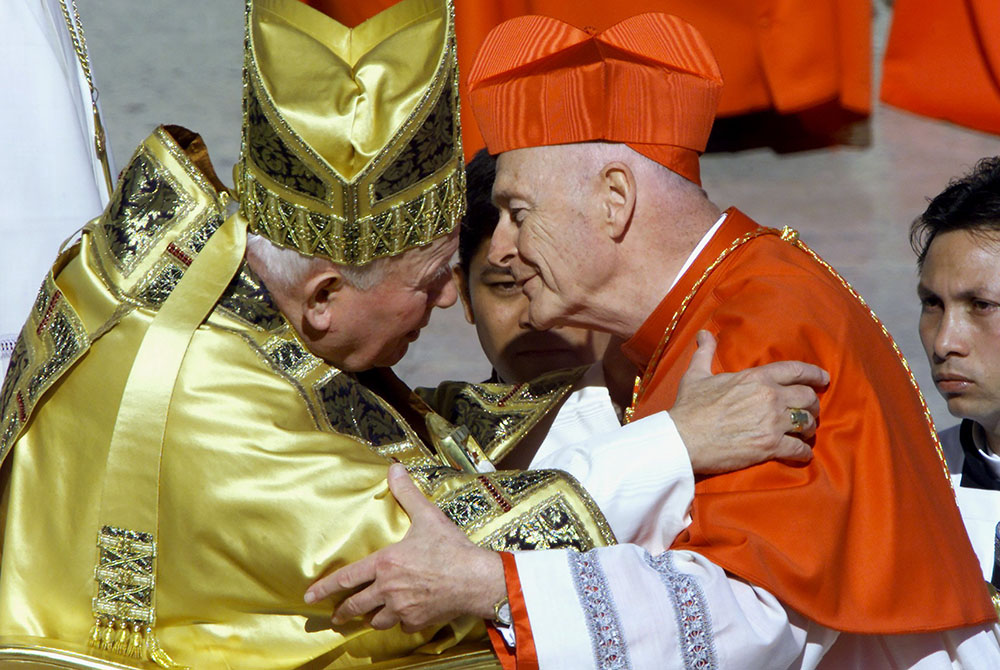
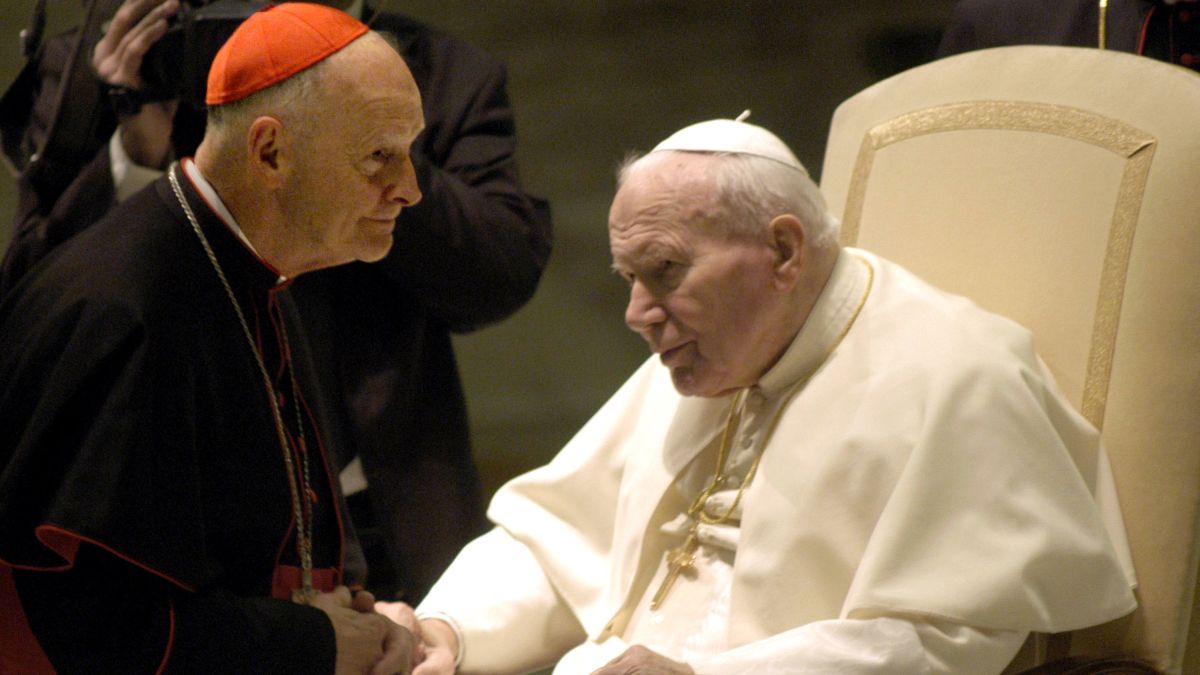
JP II elevated Joseph “Seamless Garment” Bernardin, “Uncle” Teddy McCarrick, Roger “the Dodger” Mahoney, and Humble Jorge to the college of cardinals.
And look where we are today, Murph.
The worst of the above is now a pope.
Except for Jorge Bergoglio who condones Holy Communion for adulterers, homosexuals, non-Catholics. Who worships a pachamama idol over the tomb of St. Peter. Who declares God wills multiple religions. Who now questions JP II's Humanae Vitae on birth control and now claims he's listening to the Holy Ghost with his wicked Sin-Nods.
It was JP II, no one else, who elevated McCarrick to the college of cardinals.
JP II kissing the Koran
How do you know when McCarrick became a homo?
Or do you, like most modernists, excuse their sins by claiming there’re born as homos?
Disclaimer: Opinions posted on Free Republic are those of the individual posters and do not necessarily represent the opinion of Free Republic or its management. All materials posted herein are protected by copyright law and the exemption for fair use of copyrighted works.
