Skip to comments.
Catholic Caucus: Daily Mass Readings 2-November-2022
Universalis/Jerusalem Bible ^
Posted on 11/02/2022 4:16:46 AM PDT by annalex
Wednesday 2 November 2022
All Souls

Mission San Juan Capistrano, San Juan Capistrano CA Readings at MassLiturgical Colour: Violet or Black. Year: C(II). (The following psalms and readings are selected from the many options for this day.)
| First reading | Wisdom 3:1-9 © |
|---|
The souls of the virtuous are in the hands of GodThe souls of the virtuous are in the hands of God, no torment shall ever touch them. In the eyes of the unwise, they did appear to die, their going looked like a disaster, their leaving us, like annihilation; but they are in peace. If they experienced punishment as men see it, their hope was rich with immortality; slight was their affliction, great will their blessings be. God has put them to the test and proved them worthy to be with him; he has tested them like gold in a furnace, and accepted them as a holocaust. When the time comes for his visitation they will shine out; as sparks run through the stubble, so will they. They shall judge nations, rule over peoples, and the Lord will be their king for ever. They who trust in him will understand the truth, those who are faithful will live with him in love; for grace and mercy await those he has chosen.
| Responsorial Psalm | Psalm 22(23) © |
|---|
The Lord is my shepherd: there is nothing I shall want. or If I should walk in the valley of darkness, no evil would I fear, for you are there with me. The Lord is my shepherd; there is nothing I shall want. Fresh and green are the pastures where he gives me repose. Near restful waters he leads me, to revive my drooping spirit. The Lord is my shepherd: there is nothing I shall want. or If I should walk in the valley of darkness, no evil would I fear, for you are there with me. He guides me along the right path; he is true to his name. If I should walk in the valley of darkness no evil would I fear. You are there with your crook and your staff; with these you give me comfort. The Lord is my shepherd: there is nothing I shall want. or If I should walk in the valley of darkness, no evil would I fear, for you are there with me. You have prepared a banquet for me in the sight of my foes. My head you have anointed with oil; my cup is overflowing. The Lord is my shepherd: there is nothing I shall want. or If I should walk in the valley of darkness, no evil would I fear, for you are there with me. Surely goodness and kindness shall follow me all the days of my life. In the Lord’s own house shall I dwell for ever and ever. The Lord is my shepherd: there is nothing I shall want. or If I should walk in the valley of darkness, no evil would I fear, for you are there with me.
| Second reading | Romans 5:5-11 © |
|---|
Now we have been reconciled by the death of his Son, surely we may count on being saved by the life of his SonHope is not deceptive, because the love of God has been poured into our hearts by the Holy Spirit which has been given us. We were still helpless when at his appointed moment Christ died for sinful men. It is not easy to die even for a good man – though of course for someone really worthy, a man might be prepared to die – but what proves that God loves us is that Christ died for us while we were still sinners. Having died to make us righteous, is it likely that he would now fail to save us from God’s anger? When we were reconciled to God by the death of his Son, we were still enemies; now that we have been reconciled, surely we may count on being saved by the life of his Son? Not merely because we have been reconciled but because we are filled with joyful trust in God, through our Lord Jesus Christ, through whom we have already gained our reconciliation.
Alleluia, alleluia! It is my Father’s will, says the Lord, that I should lose nothing of all he has given to me, and that I should raise it up on the last day. Alleluia!
The only son of his mother, and she a widowJesus went to a town called Nain, accompanied by his disciples and a great number of people. When he was near the gate of the town it happened that a dead man was being carried out for burial, the only son of his mother, and she was a widow. And a considerable number of the townspeople were with her. When the Lord saw her he felt sorry for her. ‘Do not cry’ he said. Then he went up and put his hand on the bier and the bearers stood still, and he said, ‘Young man, I tell you to get up.’ And the dead man sat up and began to talk, and Jesus gave him to his mother. Everyone was filled with awe and praised God saying, ‘A great prophet has appeared among us; God has visited his people.’ And this opinion of him spread throughout Judaea and all over the countryside. Christian Art Each day, The Christian Art website gives a picture and reflection on the Gospel of the day. The readings on this page are from the Jerusalem Bible, which is used at Mass in most of the English-speaking world. The New American Bible readings, which are used at Mass in the United States, are available in the Universalis apps, programs and downloads.
You can also view this page with the Gospel in Greek and English. |
TOPICS: Catholic; General Discusssion; Prayer; Worship
KEYWORDS: catholic; lk14; lk7; ordinarytime; prayer
For your reading, reflection, faith-sharing, comments, questions, discussion.
1
posted on
11/02/2022 4:16:46 AM PDT
by
annalex
To: All
KEYWORDS: catholic; lk7; ordinarytime; prayer;
2
posted on
11/02/2022 4:17:26 AM PDT
by
annalex
(fear them not)
To: nickcarraway; NYer; ELS; Pyro7480; livius; ArrogantBustard; Catholicguy; RobbyS; marshmallow; ...

Alleluia Ping Please FReepmail me to get on/off the Alleluia Ping List.
3
posted on
11/02/2022 4:18:50 AM PDT
by
annalex
(fear them not)
To: annalex
4
posted on
11/02/2022 4:19:21 AM PDT
by
annalex
(fear them not)
To: annalex
| Luke |
| | English: Douay-Rheims | Latin: Vulgata Clementina | Greek NT: Byzantine/Majority Text (2000) |
| | Luke 7
|
| 11. | And it came to pass afterwards, that he went into a city that is called Naim; and there went with him his disciples, and a great multitude. | Et factum est : deinceps ibat in civitatem quæ vocatur Naim : et ibant cum eo discipuli ejus et turba copiosa. | και εγενετο εν τω εξης επορευετο εις πολιν καλουμενην ναιν και συνεπορευοντο αυτω οι μαθηται αυτου ικανοι και οχλος πολυς |
| 12. | And when he came nigh to the gate of the city, behold a dead man was carried out, the only son of his mother; and she was a widow: and a great multitude of the city was with her. | Cum autem appropinquaret portæ civitatis, ecce defunctus efferebatur filius unicus matris suæ : et hæc vidua erat : et turba civitatis multa cum illa. | ως δε ηγγισεν τη πυλη της πολεως και ιδου εξεκομιζετο τεθνηκως υιος μονογενης τη μητρι αυτου και αυτη [ην] χηρα και οχλος της πολεως ικανος συν αυτη |
| 13. | Whom when the Lord had seen, being moved with mercy towards her, he said to her: Weep not. | Quam cum vidisset Dominus, misericordia motus super eam, dixit illi : Noli flere. | και ιδων αυτην ο κυριος εσπλαγχνισθη επ αυτη και ειπεν αυτη μη κλαιε |
| 14. | And he came near and touched the bier. And they that carried it, stood still. And he said: Young man, I say to thee, arise. | Et accessit, et tetigit loculum. (Hi autem qui portabant, steterunt.) Et ait : Adolescens, tibi dico, surge. | και προσελθων ηψατο της σορου οι δε βασταζοντες εστησαν και ειπεν νεανισκε σοι λεγω εγερθητι |
| 15. | And he that was dead, sat up, and began to speak. And he gave him to his mother. | Et resedit qui erat mortuus, et cœpit loqui. Et dedit illum matri suæ. | και ανεκαθισεν ο νεκρος και ηρξατο λαλειν και εδωκεν αυτον τη μητρι αυτου |
| 16. | And there came a fear on them all: and they glorified God, saying: A great prophet is risen up among us: and, God hath visited his people. | Accepit autem omnes timor : et magnificabant Deum, dicentes : Quia propheta magnus surrexit in nobis : et quia Deus visitavit plebem suam. | ελαβεν δε φοβος παντας και εδοξαζον τον θεον λεγοντες οτι προφητης μεγας εγηγερται εν ημιν και οτι επεσκεψατο ο θεος τον λαον αυτου |
| 17. | And this rumour of him went forth throughout all Judea, and throughout all the country round about. | Et exiit hic sermo in universam Judæam de eo, et in omnem circa regionem. | και εξηλθεν ο λογος ουτος εν ολη τη ιουδαια περι αυτου και εν παση τη περιχωρω |
5
posted on
11/02/2022 4:22:47 AM PDT
by
annalex
(fear them not)
To: annalex

Catena Aurea by St. Thomas Aguinas
7:11–17
11. And it came to pass the day after, that he went into a city called Nain; and many of his disciples went with him, and much people.
12. Now when he came nigh to the gate of the city, behold, there was a dead man carried out, the only son of his mother, and she was a widow: and much people of the city was with her.
13. And when the Lord saw her, he had compassion on her, and said unto her, Weep not.
14. And he came and touched the bier: and they that bare him stood still. And he said, Young man, I say unto thee, Arise.
15. And he that was dead sat up, and began to speak. And he delivered him to his mother.
16. And there came a fear on all: and they glorified God, saying, That a great prophet is risen up among us; and, That God hath visited his people.
17. And this rumour of him went forth throughout all Judæa, and throughout all the region round about.
CYRIL OF ALEXANDRIA. The Lord joins one miracle upon another. In the Former instance He came indeed when called for, but in this He came self-invited; as it is said, And it came to pass the day after that he went into a city called Nain.
BEDE. Nain is a city of Galilee, within two miles of mount Tabor. But by the divine counsel there were large multitudes accompanying the Lord, that there might be many witnesses of so great a miracle. Hence it follows, And his disciples went with him, and much people.
GREGORY OF NYSSA. (Tract. de Anima et Res. Post med.) Now the proof of the resurrection we learn not so much from the words as from the works of our Saviour, who, beginning His miracles with the less wonderful, reconciled our faith to far greater. First indeed in the grievous sickness of the centurion’s servant, He verged upon the power of resurrection; afterwards with a higher power he led men to the belief in a resurrection, when He raised the widow’s son, who was carried out to be buried; as it is said, Now when he came nigh to the gate of the city, behold, there was a dead man carried out, the only son of his mother.
TITUS BOSTRENSIS. But some one will say of the centurion’s servant, that he was not going to die. That such an one might restrain his rash tongue, the Evangelist explains that the young man whom Christ came upon was already dead, the only son of a widow. For it follows, And she was a widow, and much people of the city was. with her.
GREGORY OF NYSSA. (de hom. Opif. c. 25.) He has told us the sum of misery in a few words. The mother was a widow, and had no further hope of having children, she had no one upon whom she might look in the place of him that was dead. To him alone she had given suck, he alone made her home cheerful. All that is sweet and precious to a mother, was he alone to her.
CYRIL OF ALEXANDRIA. These were sufferings to excite compassion, and which might well affect to mourning and tears, as it follows, And when the Lord saw her, he had compassion on her, saying, Weep not.
BEDE. As if He said, Cease to weep for one as dead, whom you shall soon see rise again alive.
CHRYSOSTOM. (Tit. Bost.) But when He bids us cease from weeping Who consoles the sorrowful, He tells us to receive consolation from those who are now dead, hoping for their resurrection. But life meeting death stops the bier, as it follows, And he came.
CYRIL OF ALEXANDRIA. He performs the miracle not only in word, but also touches the bier, to the end that you might know that the sacred body of Christ is powerful to the saving of man. For it is the body of Life and the flesh of the Omnipotent Word, whose power it possesses. For as iron applied to fire does the work of fire, so the flesh, when it is united to the Word, which quickens all things, becomes itself also quickening, and the banisher of death.
TITUS BOSTRENSIS. (non occ.) But the Saviour is not like to Elias mourning over the son of the widow of Sarepta, (1 Kings 17) nor as Elisha who laid his own body upon the body of the dead, (2 Kings 4) nor as Peter who prayed for Tabitha, (Acts 9:40) but is none other than He who calls those things which be not, as though they were, who can speak to the dead as to the living, (Rom. 4:17) as it follows, And he said, Young man
GREGORY OF NYSSA. (ubi sup.) When He said, Young man, He signified that he was in the flower of his age, just ripening into manhood, who but a little while before was the sight of his mother’s eyes, just entering upon the time of marriage, the scion of her race, the branch of succession, the staff of her old age.
TITUS BOSTRENSIS. But straightway he arose to whom the command was made. For the Divine power is irresistible; there is no delay, no urgency of prayer, as it follows, And he that was dead sat up, and began to speak, and he gave him to his mother. These are the signs. of a true resurrection, for the lifeless body cannot speak, nor would the mother have carried back to her house her dead and lifeless son.
BEDE. But well does the Evangelist testify that the Lord is first moved with compassion for the mother, and then raises her son, that in the one case He might set before us for our imitation an example of piety, in the other He might build up our belief in His wonderful power. Hence it follows. And there came a fear upon all, and they glorified God, &c.
CYRIL OF ALEXANDRIA. This was a great thing in an insensible and ungrateful people. For in a short time afterward they would neither esteem Him as a prophet, nor allow that He did aught for the public good. But none of those that dwelt in Judæa were ignorant of this miracle, as it follows, And this rumour of him went forth throughout all Judæa.
MAXIMUS. (non occ.) But it is worthy of remark, that seven resurrections are related before our Lord’s, of which the first was that of the son of the widow of Sarepta, (1 Kings 17) the second of the Shunamite’s son, (2 Kings 4) the third which was caused by the remains of Elisha, (2 Kings 13) the fourth which took place at Nain, as is here related, the fifth of the ruler of the Synagogue’s daughter, (Mark 5) the sixth of Lazarus, (John 11) the seventh at Christ’s passion, for many bodies of the saints arose. (Mat. 27.) The eighth is that of Christ, who being free from death remained beyond for a sign that the general resurrection which is to come in the eighth age shall not be dissolved by death, but shall abide never to pass away.
BEDE. But the dead man who was carried without the gate of the city in the sight of many, signifies a man rendered senseless by the deadening power of mortal sin, and no longer concealing his soul’s death within the folds of his heart, but proclaiming it to the knowledge of the world, through the evidence of words or deeds as through the gate of the city. For the gate of the city, I suppose, is some one of the bodily senses. And he is well said to be the only son of his mother, for there is one mother composed of many individuals, the Church, but every soul that remembers that it is redeemed by the death of the Lord, knows the Church to be a widow.
AMBROSE. For this widow surrounded by a great multitude of people seems to be more than the woman who was thought worthy by her tears to obtain the resurrection of her only son, because the Church recalls the younger people from the funeral procession to life by the contemplation of her tears, who is forbid to weep for him to whom resurrection was promised.
BEDE. Or the dogma of Novatus is crushedb, who endeavouring to do away with the purifying of the penitent, denies that the mother Church, weeping for the spiritual extinction of her sons, ought to be consoled by the hope of their restoration to life.
AMBROSE. This dead man was borne on the bier by the four material elements to the grave, but there was a hope of his rising again because he was borne on wood, which though before it did not benefit us, yet after Christ had touched it, began to profit unto life, that it might be a sign that salvation was to be extended to the people by the wood of the cross. For we lie lifeless on the bier when either the fire of immoderate desire bursts forth, or the cold moisture breaks out, and through the sluggish state of our earthly body the vigour of our minds waxes dull.
BEDE. Or the coffin on which the dead is carried is the ill at ease conscience of a desperate sinner. But they who carry him to be buried are either unclean desires, or the allurements of companions, who stood when our Lord touched the bier, because the conscience, when touched by dread of the judgment from on high, often checking its carnal lusts, and those who unjustly praise, returns to itself, and answers its Saviour’s call to life.
AMBROSE. If then thy sin is so heavy that by thy penitential tears thou canst not thyself wash it out, let the mother Church weep for thee, the multitude standing by; soon shalt thou rise from the dead and begin to speak the words of life; they all shall fear, (for by the example of one all are corrected;) they shall also praise God who has given us such great remedies for escaping death.
BEDE. But God has visited His people not only by the one incarnation of His Word, but by ever sending It into our hearts.
THEOPHYLACT. By the widow also you may understand a soul that has lost her husband in the divine word. Her son is the understanding, which is carried out beyond the city of the living. Its coffin is the body, which some indeed have called the tomb. But the Lord touching him raises him up, causing him to become young, and rising from sin he begins to speak and teach others. For before he would not have been believed.
Catena Aurea Luke 7
6
posted on
11/02/2022 4:23:27 AM PDT
by
annalex
(fear them not)
To: annalex
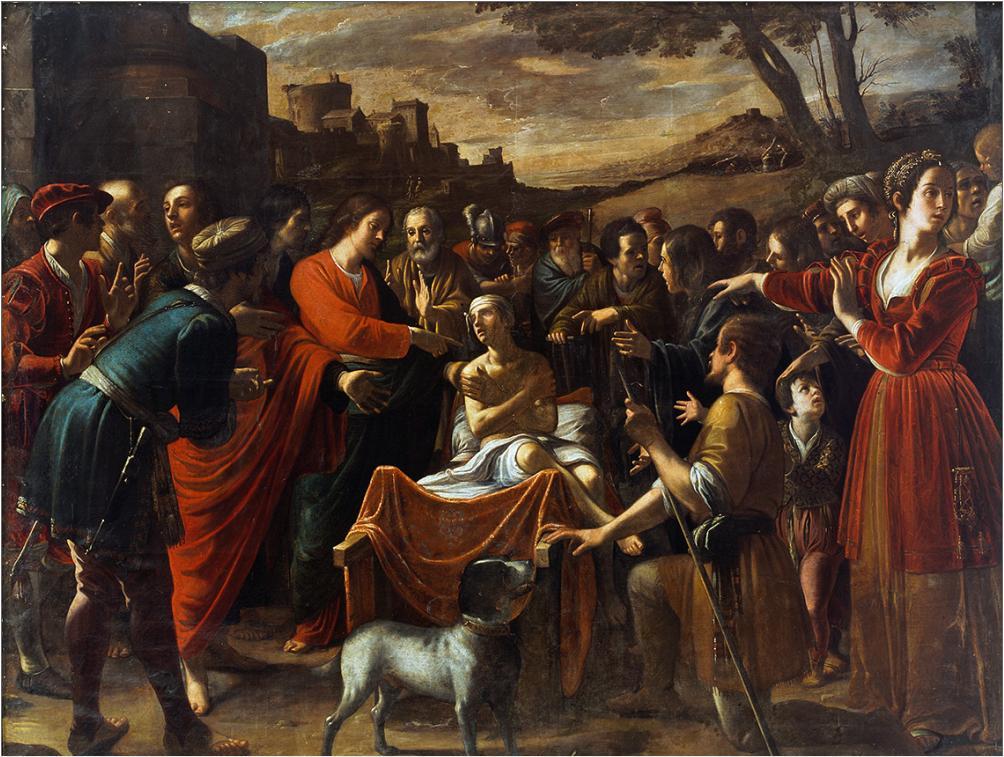
Miracle at Nain
Mario Minniti
1620
7
posted on
11/02/2022 4:24:16 AM PDT
by
annalex
(fear them not)
To: annalex
Why do Catholics celebrate All Souls Day?
The Church is composed of the faithful living upon the earth and those who have gone before us. The latter includes the Saints in Heaven and the faithful Souls being purified in Purgatory. Just as on November 1st we honor those who are with God, on November 2nd Catholics celebrate a Commemoration of All the Faithful Departed. Also known as All Souls Day, on this day we honor them for their fidelity in life, as well as pray for them, since they are being purified before entering the All Holy Presence of God. As Revelation 21:27 says of the Heavenly Jerusalem, “… nothing unclean shall enter in.”
ewtn.com
8
posted on
11/02/2022 4:27:35 AM PDT
by
annalex
(fear them not)
To: annalex

The Day of the Dead
William-Adolphe Bouguereau (1825–1905)
Musée des Beaux-Arts de Bordeaux
9
posted on
11/02/2022 4:30:08 AM PDT
by
annalex
(fear them not)
To: annalex
You can spot a Pre-Raphaelite a mile away. Love their work.
10
posted on
11/02/2022 4:35:27 AM PDT
by
Sirius Lee
(They intend to murder us. Prep if you want to live and live like you are prepping for eternal life)
To: annalex
NAVARRE BIBLE COMMENTARY (RSV)
Ad Majorem Dei Gloriam (To the Greater Glory of God)
From: Wisdom 3:1-9
The death of the righteous
----------------------------------
[1] But the souls of the righteous are in the hand of God, and no torment will ever touch them. [2] In the eyes of the foolish they seemed to have died, and their departure was thought to be an affliction. [3] and their going from us to be their destruction; but they are at peace. [4] For though in the sight of men they were punished, their hope is full of immortality. [5] Having been disciplined a little, they will receive great good, because God tested them and found them worthy of himself; [6] like gold in the furnace he tried them, and like a sacrificial burnt offering he accepted them. [7] In the time of their visitation they will shine forth, and will run like sparks through the stubble. [8] They will govern nations and rule over peoples, and the Lord will reign over them for ever. [9] Those who trust in him will understand truth, and the faithful will abide with him in love, because grace and mercy are upon his elect, and he watches over his holy ones.
*********************************************
Commentary:
3:1-4:20. This passage describes at some length the contrasting situations of the righteous and the ungodly in this life, in death, and beyond the grave. The author has consoling things to say to the righteous as regards afflictions; they have every reason to hope. But evildoers he describes as foolish; theirs is a fundamental error which will cause them grief now; any suffering they experience will do them no good; their death is grievous and so is what lies beyond it: “Two possibilities are laid open to us at the same time: life and death – and each person will come to the end that befits him. Life and death are like type types of coin, one belongs to God and the other to this world, each with its own hallmark: unbelievers deal in the currency of this world, and those who have remained faithful through love carry the coin of God the Father, which is marked with Jesus Christ. If we are not ready to die for him or to imitate his passion, we will not have his life within us” (St Ignatius of Antioch, Ad Magnesios, 5, 2).
3:1-9. These very poetic lines convey very well the notion of the reward that awaits the just in the after-life, but they are not very specific about it. The author uses expressions that correspond to the time in history and Revelation in which he lives, but they do enable us to get an idea of the state of the blessed: “The souls of the righteous are in the hands of God, and no torment will ever touch them” (v. 1); the righteous dead are “at peace” (v. 3), that is, in the sphere proper to God; they can be sure of immortality, athanasia (v. 4). They will abide in the Kingdom of God forever and share in God’s power to judge and rule (v. 8; cf. Mt 19:28) – a pointer to their power of intercession. One could say that the most encouraging line of all is, “the faithful will abide with him in love” (v. 9). Still to come is the explicit New Testament revelation which tells us that the blessed “shall see God as he is” (1 Jn 3:2), not as in a (dull) mirror but “face to face”; they will know him as he knows them (cf. 1 Cor 13:12) and they will be with Christ for- ever in heaven (cf. 1 Thess 4:17).
11
posted on
11/02/2022 7:37:45 AM PDT
by
fidelis
(👈 Under no obligation to respond to rude, ignorant, abusive, bellicose, and obnoxious posts.)
To: fidelis
From: Romans 6:3-11Baptism (Continuation)
-----------------------------
[3] Do you not know that all of us who have been baptized into Christ Jesus were baptized into His death? [4] We were buried therefore with Him by baptism into death, so that as Christ was raised from the dead by the glory of the Father, we too might walk in newness of life.
[5] For if we have been united with Him in a death like His, we shall certainly be united with Him in a resurrection like His. [6] We know that our old self was crucified with Him so that the sinful body might be destroyed, and we might no longer be enslaved to sin. [7] For He who has died is freed from sin. [8] But if we have died with Christ, we believe that we shall also live with Him. [9] For we know that Christ being raised from the dead will never die again; death no longer has dominion over him.
*******************************************************************
Commentary:
1-11. The universal dominion of sin, which began with the sin of Adam, is not the only event to be reckoned with. When sin reached its full extent, the grace brought by Jesus Christ came in superabundance. Through Baptism this grace reaches each of us and frees us from the control of sin. When we receive this Sacrament we die: that is to say, our blameworthiness is destroyed, we renounce sin once and for all, and are born again into a new life.
"The Lord", St. Ambrose tells the newly baptized, "who wanted His benefactions to endure, the serpent's plans to be turned to naught, and the harm done to be put right, delivered a sentence to mankind: 'You are dust, and to dust you shall return' (Genesis 3:19), and made man subject to death [...]. The remedy was given him: man would die and rise again [...]. You ask me how? [...] Pay attention. So that in this world too the devil's snare would be broken, a rite was instituted whereby man would die, being alive, and rise again, being alive [...].Through immersion in water the sentence is blotted out: 'You are dust, and to dust you shall return'" ("De Sacramentis", II, 6).
This passage of the epistle, which reveals the key truths concerning Baptism, also reminds us of the profound meaning of this rite which Christ established, its spiritual effects in Christians and its far-reaching effects with respect to the Christian life. Thus, we can apply to Baptism what St. Thomas Aquinas says about all the sacraments: "Three aspects of sanctification may be considered--its very cause, which is Christ's Passion; its form, which is grace and the virtues; and its ultimate end, which is eternal life. And all these are signified by the sacraments. Consequently, a sacrament is a sign which is both a reminder of the past, that is, of the Passion of Christ, and an indication of what is effected in us by Christ's Passion, and a foretelling and pledge of future glory" ("Summa Theologiae", III, q. 60, a. 3).
In the specific case of Baptism, the various things which the Sacrament implies carry a special nuance--a new birth which presupposes a symbolic death. It reproduces in us not only the Passion, Death and burial of Christ, symbolized by immersion in water (verses 3-4, 6), but also new life, the life of grace which pours into the soul, enabling the person to share in the Resurrection of Christ (verses 4-5). This sharing in Christ's Resurrection to immortal life is a kind of seed which will ultimately produce the glorious resurrection of our bodies.
The baptized person is, therefore, someone newly created, someone born into a new life, someone who has moved out of darkness into light. The white garment used at Baptism symbolizes innocence and grace; the burning candle, the light of Christ--two symbols the Church uses in the baptismal liturgy to signify what is happening.
Thus, in Baptism, God "removes every trace of sin, whether original or personal" ("The Rite of Baptism", Introduction, 5) and also remits the penalties that these sins incur. On being baptized in the name of the Three Divine Persons, the Christian is shown God the Father's love for him (a love he has not merited), is given a share in the Paschal Mystery of the Son, and to him is communicated new life in the Spirit (cf. "Instruction on Infant Baptism", 20 October 1980, 9). Baptism, which is also described as "the door of the spiritual life", unites a person to Christ and to the Church by means of grace, which makes us children of God and heirs to Heaven. Finally, in addition to the infused virtues and supernatural gifts, the person is given "the graces necessary to live in a Christian way, and on his soul is impressed the sacramental character which makes him a Christian for evermore" ("St. Pius X Catechism", 250).
Baptism, which confers a "character", that is, a kind of seal confirming our Christian calling, gives us a share in Christ's priesthood and makes us capable of receiving the other sacraments.
4. It is easier to grasp the symbolism of burial and resurrection if one remembers that in earlier times, and particularly in the apostolic period, Baptism was usually administered by immersion in water--in some cases by total immersion, up to three times, with one Person of the Blessed Trinity being invoked each time. "They asked you, 'Do you believe in God the Father almighty?' You said, 'I believe', and you were immersed, that is, you were buried. Again they asked you, 'Do you believe in our Lord Jesus Christ and in His Cross?' You said, 'I believe', and you were again immersed. This time you have been buried with Christ, and he who is buried with Christ rises with Christ. For a third time you were asked, 'Do you believe in the Holy Spirit?' You said, 'I believe', and for a third time you were immersed, so that by this three-fold confession you might be loosed of your many attachments to your past life" (St. Ambrose, "De Sacramentis", II, 7).
Today Baptism is normally administered by pouring water over the head-- a method also used in apostolic times and which gradually came into general use because it was found more convenient.
5. Just as the ingraft and the plant form a single thing and make a single principle of life, Christians by being grafted onto or incorporated into Christ through Baptism form one single thing with Him and begin to draw on His divine life. We are also "united with Him in a death like His": Christ suffered physical death; we, in Baptism, die spiritually to the life of sin. St. John Chrysostom explains this as follows: "Baptism is for us what the Cross and burial were for Christ; but with this difference: the Savior died physically, He was physically buried, whereas we ought to die spiritually. That is why the Apostle does not say we are 'united with Him with His death', but 'in a death LIKE HIS'" ("Hom. on Rom.", 10).
9-10. Jesus Christ chose to bear all the consequences of sin, even though He was sinless. His voluntary death on the Cross and His glorious Resurrection broke the bonds of death, for Himself and for all His own. Death no longer shall have dominion: "[Christ died] that through death He might destroy him who has the power of death, that is, the devil, and deliver all those who through fear of death were subject to lifelong bondage" (Hebrews 2:14-15). And as a consequence He won, for His own human nature and for us, a new life.
In all those who have been baptized these same events in Christ's life are in some way reproduced. "Our past sins have been wiped out by the action of grace. Now, so as to stay dead to sin after Baptism, personal effort is called for, although God's grace continues to be with us, providing us with great help" (Chrysostom, "Hom. on Rom.", 11). This personal effort might be encapsulated in a resolution: "May we never die through sin; may our spiritual resurrection be eternal" (St J. Escriva, "Holy Rosary", 1st Glorious Mystery).
12
posted on
11/02/2022 7:38:19 AM PDT
by
fidelis
(👈 Under no obligation to respond to rude, ignorant, abusive, bellicose, and obnoxious posts.)
To: fidelis
From: John 6:35-40The Discourse on the Bread of Life (Continuation)
---------------------------------------------------------------
[35] Jesus said to them, "I am the bread of life; he who comes to Me shall not hunger, and he who believes in Me shall never thirst. [36] But I said to you that you have seen Me and yet do not believe. [37] All that the Father gives Me will come to Me; and him who comes to Me I will not cast out. [38] For I have come down from Heaven, not to do My own will, but the will of Him who sent Me; [39] and this is the will of Him who sent Me, that I should lose nothing of all that He has given Me, but raise it up on the last day. [40] For this is the will of My Father, that every one who sees the Son and believes in Him should have eternal life; and I will raise him up at the last day."
***********************************************************************
Commentary:
35. Going to Jesus means believing in Him, for it is through faith that we approach our Lord. Jesus uses the metaphor of food and drink to show that He is the one who really meets all man's noblest aspirations: "How beautiful is our Catholic faith! It provides a solution for all our anxieties, calms our minds and fills our hearts with hope" (St J. Escriva, "The Way", 582).
37-40. Jesus clearly reveals that He is the one sent by the Father. This is something St. John the Baptist proclaimed earlier on (Jn 3:33-36), and Jesus Himself stated it in His dialogue with Nicodemus (Jn 3:17-21) and announced publicly to the Jews in Jerusalem (Jn 5:20-30). Since Jesus is the one sent by the Father, the bread of life come down from Heaven to give life to the world, everyone who believes in Him has eternal life, for it is God's will that everyone should be saved through Jesus Christ. These words of Jesus contain three mysteries: 1) that of faith in Jesus Christ, which means "going to Jesus", accepting His miracles (signs) and His words; 2) the mystery of the resurrection of believers, something which begins in this life through faith and becomes fully true in Heaven; 3) the mystery of predestination, the will of our Father in Heaven that all men be saved. These solemn words of our Lord fill the believer with hope.
St. Augustine, commenting on vv. 37 and 38, praises the humility of Jesus, the perfect model for the humility of the Christian: Jesus chose not to do His own will but that of the Father who sent Him: "Humbly am I come, to teach humility am I come, as the master of humility am I come; he who comes to Me is incorporated in Me; he who comes to Me, becomes humble; he who cleaves to Me will be humble, for he does not his will but God's" ("In Ioann. Evang.", 25, 15 and 16).
Source: Daily Word for Reflection—Navarre Bible
13
posted on
11/02/2022 7:38:32 AM PDT
by
fidelis
(👈 Under no obligation to respond to rude, ignorant, abusive, bellicose, and obnoxious posts.)
To: fidelis
14
posted on
11/02/2022 7:43:31 AM PDT
by
fidelis
(👈 Under no obligation to respond to rude, ignorant, abusive, bellicose, and obnoxious posts.)
To: All
Just for added interest today, here are readings as rendered in the Knox Translation:
From: Wisdom 3:1-9
1 But the souls of the just are in God’s hands, and no torment, in death itself, has power to reach them. 2 Dead? Fools think so; think their end loss, 3 their leaving us, annihilation; but all is well with them. 4 The world sees nothing but the pains they endure; they themselves have eyes only for what is immortal; 5 so light their suffering, so great the gain they win! God, all the while, did but test them, and testing them found them worthy of him. 6 His gold, tried in the crucible, his burnt-sacrifice, graciously accepted, they do but wait for the time of their deliverance; 7 then they will shine out, these just souls, unconquerable as the sparks that break out, now here, now there, among the stubble. 8 Theirs to sit in judgement on nations, to subdue whole peoples, under a Lord whose reign shall last for ever. 9 Trust him if thou wilt, true thou shalt find him; faith waits for him calmly and lovingly; who claims his gift, who shall attain peace, if not they, his chosen servants?
From: Psalm 23[22]:1-6:
1 (A psalm. Of David.) The Lord is my shepherd; how can I lack anything? 2 He gives me a resting-place where there is green pasture, leads me out to the cool water’s brink, refreshed and content. 3 As in honour pledged, by sure paths he leads me; 4 dark be the valley about my path, hurt I fear none while he is with me; thy rod, thy crook are my comfort. 5 Envious my foes watch, while thou dost spread a banquet for me; richly thou dost anoint my head with oil, well filled my cup. All my life thy loving favour pursues me; through the long years the Lord’s house shall be my dwelling-place.
From: Romans 6:3-9:
3 You know well enough that we who were taken up into Christ by baptism have been taken up, all of us, into his death. 4 In our baptism, we have been buried with him, died like him, that so, just as Christ was raised up by his Father’s power from the dead, we too might live and move in a new kind of existence. 5 We have to be closely fitted into the pattern of his resurrection, as we have been into the pattern of his death; 6 we have to be sure of this, that our former nature has been crucified with him, and the living power of our guilt annihilated, so that we are the slaves of guilt no longer.✻ 7 Guilt makes no more claim on a man who is dead. 8 And if we have died with Christ, we have faith to believe that we shall share his life. 9 We know that Christ, now he has risen from the dead, cannot die any more; death has no more power over him;
From: John 6:37-40:
37 All that the Father has entrusted to me will come to me, and him who comes to me I will never cast out. 38 It is the will of him who sent me, not my own will, that I have come down from heaven to do; 39 and he who sent me would have me keep without loss, and raise up at the last day, all he has entrusted to me. 40 Yes, this is the will of him who sent me, that all those who believe in the Son when they see him should enjoy eternal life; I am to raise them up at the last day.
Source
15
posted on
11/02/2022 1:16:41 PM PDT
by
fidelis
(👈 Under no obligation to respond to rude, ignorant, abusive, bellicose, and obnoxious posts.)
Disclaimer:
Opinions posted on Free Republic are those of the individual
posters and do not necessarily represent the opinion of Free Republic or its
management. All materials posted herein are protected by copyright law and the
exemption for fair use of copyrighted works.
FreeRepublic.com is powered by software copyright 2000-2008 John Robinson