Skip to comments.
Catholic Caucus: Daily Mass Readings 04-September-2022
Universalis/Jerusalem Bible ^
Posted on 09/03/2022 4:56:31 AM PDT by annalex
4 September 2022
23rd Sunday in Ordinary Time

St. Rose of Viterbo Convent, La Crosse, Wisconsin Readings at MassLiturgical Colour: Green. Year: C(II).
| First reading | Wisdom 9:13-18 © |
|---|
Who can divine the will of God?What man indeed can know the intentions of God? Who can divine the will of the Lord? The reasonings of mortals are unsure and our intentions unstable; for a perishable body presses down the soul, and this tent of clay weighs down the teeming mind. It is hard enough for us to work out what is on earth, laborious to know what lies within our reach; who, then, can discover what is in the heavens? As for your intention, who could have learnt it, had you not granted Wisdom and sent your holy spirit from above? Thus have the paths of those on earth been straightened and men been taught what pleases you, and saved, by Wisdom.
| Responsorial Psalm |
|---|
| Psalm 89(90):3-6,12-14,17 © |
|---|
O Lord, you have been our refuge from one generation to the next. You turn men back to dust and say: ‘Go back, sons of men.’ To your eyes a thousand years are like yesterday, come and gone, no more than a watch in the night. O Lord, you have been our refuge from one generation to the next. You sweep men away like a dream, like the grass which springs up in the morning. In the morning it springs up and flowers: by evening it withers and fades. O Lord, you have been our refuge from one generation to the next. Make us know the shortness of our life that we may gain wisdom of heart. Lord, relent! Is your anger for ever? Show pity to your servants. O Lord, you have been our refuge from one generation to the next. In the morning, fill us with your love; we shall exult and rejoice all our days. Let the favour of the Lord be upon us: give success to the work of our hands. O Lord, you have been our refuge from one generation to the next.
| Second reading |
|---|
| Philemon 9-10,12-17 © |
|---|
He is a slave no longer, but a dear brother in the LordThis is Paul writing, an old man now and, what is more, still a prisoner of Christ Jesus. I am appealing to you for a child of mine, whose father I became while wearing these chains: I mean Onesimus. I am sending him back to you, and with him – I could say – a part of my own self. I should have liked to keep him with me; he could have been a substitute for you, to help me while I am in the chains that the Good News has brought me. However, I did not want to do anything without your consent; it would have been forcing your act of kindness, which should be spontaneous. I know you have been deprived of Onesimus for a time, but it was only so that you could have him back for ever, not as a slave any more, but something much better than a slave, a dear brother; especially dear to me, but how much more to you, as a blood-brother as well as a brother in the Lord. So if all that we have in common means anything to you, welcome him as you would me.
| Gospel Acclamation | Jn15:15 |
|---|
Alleluia, alleluia! I call you friends, says the Lord, because I have made known to you everything I have learnt from my Father. Alleluia! Alleluia, alleluia! Let your face shine on your servant; and teach me your decrees. Alleluia!
Anyone who does not carry his cross and follow me cannot be my discipleGreat crowds accompanied Jesus on his way and he turned and spoke to them. ‘If any man comes to me without hating his father, mother, wife, children, brothers, sisters, yes and his own life too, he cannot be my disciple. Anyone who does not carry his cross and come after me cannot be my disciple. ‘And indeed, which of you here, intending to build a tower, would not first sit down and work out the cost to see if he had enough to complete it? Otherwise, if he laid the foundation and then found himself unable to finish the work, the onlookers would all start making fun of him and saying, “Here is a man who started to build and was unable to finish.” Or again, what king marching to war against another king would not first sit down and consider whether with ten thousand men he could stand up to the other who advanced against him with twenty thousand? If not, then while the other king was still a long way off, he would send envoys to sue for peace. So in the same way, none of you can be my disciple unless he gives up all his possessions.’ The readings on this page are from the Jerusalem Bible, which is used at Mass in most of the English-speaking world. The New American Bible readings, which are used at Mass in the United States, are available in the Universalis apps, programs and downloads.
You can also view this page with the Gospel in Greek and English. |
TOPICS: Catholic; General Discusssion; Prayer; Worship
KEYWORDS: catholic; lk14; ordinarytime; prayer
Check the date: posting early For your reading, reflection, faith-sharing, comments, questions, discussion.
1
posted on
09/03/2022 4:56:31 AM PDT
by
annalex
To: All
KEYWORDS: catholic; lk14; ordinarytime; prayer
2
posted on
09/03/2022 4:59:27 AM PDT
by
annalex
(fear them not)
To: nickcarraway; NYer; ELS; Pyro7480; livius; ArrogantBustard; Catholicguy; RobbyS; marshmallow; ...
Alleluia Ping Please FReepmail me to get on/off the Alleluia Ping List.
3
posted on
09/03/2022 5:00:01 AM PDT
by
annalex
(fear them not)
To: annalex
4
posted on
09/03/2022 5:00:30 AM PDT
by
annalex
(fear them not)
To: annalex
| Luke |
| | English: Douay-Rheims | Latin: Vulgata Clementina | Greek NT: Byzantine/Majority Text (2000) |
| | Luke 14
|
| 25. | And there went great multitudes with him. And turning, he said to them: | Ibant autem turbæ multæ cum eo : et conversus dixit ad illos : | συνεπορευοντο δε αυτω οχλοι πολλοι και στραφεις ειπεν προς αυτους |
| 26. | If any man come to me, and hate not his father, and mother, and wife, and children, and brethren, and sisters, yea and his own life also, he cannot be my disciple. | Si quis venit ad me, et non odit patrem suum, et matrem, et uxorem, et filios, et fratres, et sorores, adhuc autem et animam suam, non potest meus esse discipulus. | ει τις ερχεται προς με και ου μισει τον πατερα αυτου και την μητερα και την γυναικα και τα τεκνα και τους αδελφους και τας αδελφας ετι δε και την εαυτου ψυχην ου δυναται μου μαθητης ειναι |
| 27. | And whosoever doth not carry his cross and come after me, cannot be my disciple. | Et qui non bajulat crucem suam, et venit post me, non potest meus esse discipulus. | και οστις ου βασταζει τον σταυρον αυτου και ερχεται οπισω μου ου δυναται ειναι μου μαθητης |
| 28. | For which of you having a mind to build a tower, doth not first sit down, and reckon the charges that are necessary, whether he have wherewithal to finish it: | Quis enim ex vobis volens turrim ædificare, non prius sedens computat sumptus, qui necessarii sunt, si habeat ad perficiendum, | τις γαρ εξ υμων ο θελων πυργον οικοδομησαι ουχι πρωτον καθισας ψηφιζει την δαπανην ει εχει τα εις απαρτισμον |
| 29. | Lest, after he hath laid the foundation, and is not able ti finish it, all that see it begin to mock him, | ne, posteaquam posuerit fundamentum, et non potuerit perficere, omnes qui vident, incipiant illudere ei, | ινα μηποτε θεντος αυτου θεμελιον και μη ισχυοντος εκτελεσαι παντες οι θεωρουντες αρξωνται εμπαιζειν αυτω |
| 30. | Saying: This man began to build, and was not able to finish. | dicentes : Quia hic homo cœpit ædificare, et non potuit consummare ? | λεγοντες οτι ουτος ο ανθρωπος ηρξατο οικοδομειν και ουκ ισχυσεν εκτελεσαι |
| 31. | Or what king, about to go to make war against another king, doth not first sit down, and think whether he be able, with ten thousand, to meet him that, with twenty thousand, cometh against him? | Aut quis rex iturus committere bellum adversus alium regem, non sedens prius cogitat, si possit cum decem millibus occurrere ei, qui cum viginti millibus venit ad se ? | η τις βασιλευς πορευομενος συμβαλειν ετερω βασιλει εις πολεμον ουχι καθισας πρωτον βουλευεται ει δυνατος εστιν εν δεκα χιλιασιν απαντησαι τω μετα εικοσι χιλιαδων ερχομενω επ αυτον |
| 32. | Or else, whilst the other is yet afar off, sending an embassy, he desireth conditions of peace. | Alioquin adhuc illo longe agente, legationem mittens rogat ea quæ pacis sunt. | ει δε μηγε ετι πορρω αυτου οντος πρεσβειαν αποστειλας ερωτα τα προς ειρηνην |
| 33. | So likewise every one of you that doth not renounce all that he possesseth, cannot be my disciple. | Sic ergo omnis ex vobis, qui non renuntiat omnibus quæ possidet, non potest meus esse discipulus. | ουτως ουν πας εξ υμων ος ουκ αποτασσεται πασιν τοις εαυτου υπαρχουσιν ου δυναται μου ειναι μαθητης |
|
5
posted on
09/03/2022 5:01:31 AM PDT
by
annalex
(fear them not)
To: annalex

Catena Aurea by St. Thomas Aguinas
14:2527
25. And there went great multitudes with him: and he turned, and said unto them,
26. If any man come to me, and hate not his father, and mother, and wife, and children, and brethren, and sisters, yea, and his own life also, he cannot be my disciple.
27. And whosoever doth not bear his cross, and come after me, cannot be my disciple.
GREGORY. (in Hom. 37. in Ev.) The mind is kindled, when it hears of heavenly rewards, and already desires to be there, where it hopes to enjoy them without ceasing; but great rewards cannot be reached except by great labours. Therefore it is said, And there went great multitudes with him: and he turned to them, and said, &c.
THEOPHYLACT. For because many of those that accompanied Him followed not with their whole heart, but lukewarmly, He shews what kind of a man his disciple ought to be.
GREGORY. (in Hom. ut sup.) But it may be asked, how are we bid to hate our parents and our relations in the flesh, who are commanded to love even our enemies? But if we weigh the force of the command we are able to do both, by rightly distinguishing them so as both to love those who are united to us by the bond of the flesh, and whom we acknowledge our relations, and by hating and avoiding not to know those whom we find our enemies in the way of God. For he is as it were loved by hatred, who in his carnal wisdom, pouring into our ears his evil sayings, is not heard.
AMBROSE. For if for thy sake the Lord renounces His own mother, saying, Who is my mother? and who are my brethren? (Matt. 12:48, Mark 3:33.) why dost thou deserve to be preferred to thy Lord? But the Lord will have us neither be ignorant of nature, nor be her slaves, but so to submit to nature, that we reverence the Author of nature, and depart not from God out of love to our parents.
GREGORY. (in Hom. ut sup.) Now to shew that this hatred towards relations proceeds not from inclination or passion, but from love, our Lord adds, yea, and his own life also. It is plain therefore that a man ought to hate his neighbour, by loving as himself him who hated him. For then we rightly hate our own soul when we indulge not its carnal desires, when we subdue its appetites, and wrestle against its pleasures. That which by being despised is brought to a better condition, is as it were loved by hatred.
CYRIL OF ALEXANDRIA. But life must not be renounced, which both in the body and the soul the blessed Paul also preserved, that yet living in the body he might preach Christ. But when it was necessary to despise life so that he might finish his course, he counts not his life dear unto him. (Acts 20:24.)
GREGORY. (in Hom. ut sup.) How the hatred of life ought to be shewn He declares as follows; Whosoever bears not his cross, &c.
CHRYSOSTOM. He means not that we should place a beam of wood on our shoulders, but that we should ever have death before our eyes. As also Paul died daily and despised death. (1 Cor. 15:31.)
BASIL. By bearing the cross also he announced the death of his Lord, saying, The world is crucified to me, and I to the world, (Gal. 6:14.) which we also anticipate at our very baptism, in which our old man is crucified, that the body of sin may be destroyed.
GREGORY. (in Hom. 37. in Ev.) Or because the cross is so called from torturing. In two ways we bear our Lords cross, either when by abstinence we afflict our bodies, or when through compassion of our neighbour we think all his necessities our own. But because some exercise abstinence of the flesh not for Gods sake but for vain-glory, and shew compassion, not spiritually but carnally, it is rightly added, And, cometh after me. For to bear His cross and come after the Lord, is to use abstinence of the flesh, or compassion to our neighbour, from the desire of an eternal gain.
14:2833
28. For which of you, intending to build a tower, sitteth not down first, and counteth the cost, whether he have sufficient to finish it?
29. Lest haply, after he hath laid the foundation, and is not able to finish it, all that behold it begin to mock him,
30. Saying, This man began to build, and was not able to finish.
31. Or what king, going to make war against another king, sitteth not down first, and consulteth whether he be able with ten thousand to meet him that cometh against him with twenty thousand?
32. Or else, while the other is yet a great way off, he sendeth an ambassage, and desireth conditions of peace.
33. So likewise, whosoever he be of you that for-saketh not all that he hath, he cannot be my disciple.
GREGORY. (37. in Ev.) Because He had been giving high and lofty precepts, immediately follows the comparison of building a tower, when it is said, For which of you intending to build a tower does not first count &c. For every thing that we do should be preceded by anxious consideration. If then we desire to build a tower of humility, we ought first to brace ourselves against the ills of this world.
BASIL. (in Esai. 2.) Or the tower is a lofty watch-tower fitted for the guardianship of the city and the discovery of the enemys approach. In like manner was our understanding given us to preserve the good, to guard against the evil. For the building up whereof the Lord bids us sit down and count our means if we have sufficient to finish.
GREGORY OF NYSSA. (lib. de Virg. 17.) For we must be ever pressing onward that we may reach the end of each difficult undertaking by successive increases of the commandments of God, and so to the completion of the divine work. For neither is one stone the whole fabric of the tower, nor does a single command lead to the perfection of the soul. But we must lay the foundation, and according to the Apostle, thereupon must be placed store of gold, silver, and precious stones. (1 Cor. 3:12.) Whence it is added, Lest haply after he hath laid the foundation, &c.
THEOPHYLACT. For we ought not to lay a foundation, i. e. begin to follow Christ, and not bring the work to an end, as those of whom St. John writes, That many of his disciples went backward. (John 6:66.) Or by the foundation understand the word of teaching, as for instance concerning abstinence. There is need therefore of the above-mentioned foundation, that the building up of our works be established, a tower of strength from the face of the enemy. (Ps. 61:3.) Otherwise, man is laughed at by those who see him, men as well as devils.
GREGORY. (ubi sup.) For when occupied in good works, unless we watch carefully against the evil spirits, we find those our mockers who are persuading us to evil. But another comparison is added proceeding from the less to the greater, in order that from the least things the greatest may be estimated. For it follows, Or what king, going to make war against another king, sitteth not down first, and consultelh whether he be able with ten thousand to meet him that cometh against him with twenty thousand?
CYRIL OF ALEXANDRIA. For we fight against spiritual wickedness in high places; (Eph. 6:12.) but there presses upon us a multitude also of other enemies, fleshly lust, the law of sin raging in our members, and various passions, that is, a dreadful multitude of enemies.
AUGUSTINE. Or the ten thousand of him who is going to fight with the king who has twenty, signify the simplicity of the Christian about to contend with the subtlety of the devil.
THEOPHYLACT. The king is sin reigning in our mortal body; (Rom. 6:12.) but our understanding also was created king. If then he wishes to fight against sin, let him consider with his whole mind. For the devils are the satellites of sin, which being twenty thousand, seem to surpass in number our ten thousand, because that being spiritual compared to us who are corporeal, they are come to have much greater strength.
AUGUSTINE. (ut sup.) But as with respect to the unfinished tower, he alarms us by the reproaches of those who say, The man began to build, and was not able to finish, so with regard to the king with whom the battle was to be, he reproved even peace, adding, Or else, while the other is yet a great way off, he sendeth an ambassage, and desireth conditions of peace; signifying that those also who forsake all they possess cannot endure from the devil the threats of even coming temptations, and make peace with him by consenting unto him to commit sin.
GREGORY. (in Hom. ut sup.) Or else, in that awful trial we come not to the judgment a match for our king, for ten thousand are against twenty thousand, two against one. He comes with a double army against a single. For while we are scarcely prepared in deeds only, he sifts us at once both in thought and deed. While then he is yet afar off, who though still present in judgment, is not seen, let us send him an embassy, our tears, our works of mercy, the propitiatory victim. This is our message which appeases the coming king.
AUGUSTINE. Now to what these comparisons refer, He on the same occasion sufficiently explained, when he said, So likewise whosoever he be of you that forsaketh not all that he hath, he cannot be my disciple. The cost therefore of building the tower, and the strength of the ten thousand against the king who has twenty thousand, mean nothing else than that each one should forsake all that he hath. The foregoing introduction tallies then with the final conclusion. For in the saying that a man forsakes all that he hath, is contained also that he hates his father and mother, his wife and children, brothers and sisters, yea and his own wife also. For all these things are a mans own, which entangle him, and hinder him from obtaining not those particular possessions which will pass away with time, but those common blessings which will abide for ever.
BASIL. But our Lords intention in the above-mentioned example is not indeed to afford occasion or give liberty to any one to become His disciple or not, as indeed it is lawful not to begin a foundation, or not to treat of peace, but to shew the impossibility of pleasing God, amidst those things which distract the soul, and in which it is in danger of becoming an easy prey to the snares and wiles of the devil.
BEDE. But there is a difference between renouncing all things and leaving all things. For it is the way of few perfect men to leave all things, that is, to cast behind them the cares of the world, but it is the part of all the faithful to renounce all things, that is, so to hold the things of the world as by them not to be held in the world.
Catena Aurea Luke 14
6
posted on
09/03/2022 5:02:03 AM PDT
by
annalex
(fear them not)
To: annalex
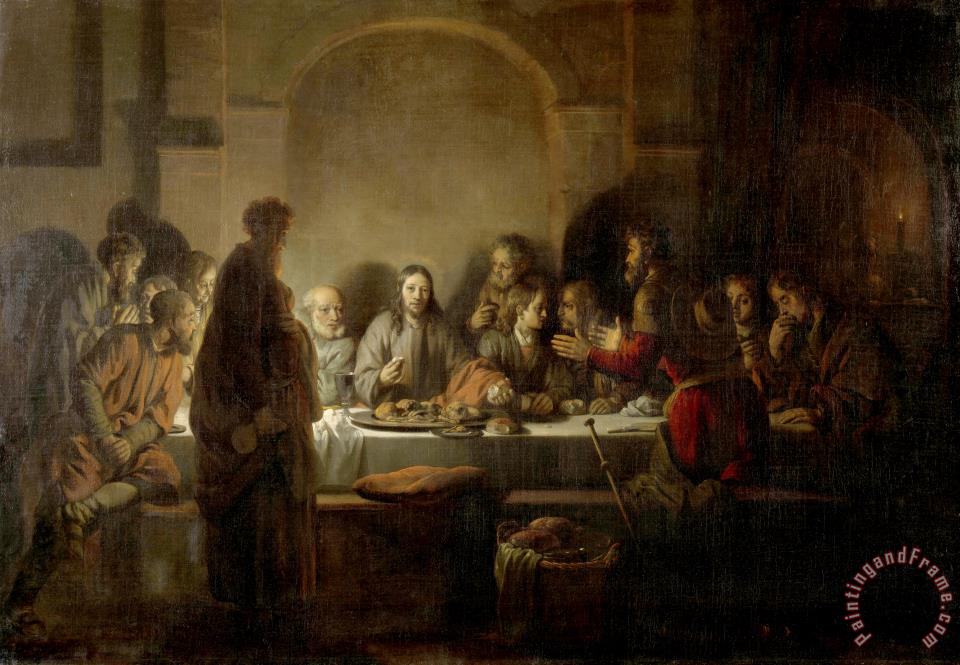
Last Supper
Gerbrand Van Den Eeckhout
1621-1674
7
posted on
09/03/2022 5:03:10 AM PDT
by
annalex
(fear them not)
To: annalex
Saint of the Day for September 4
(1233 - March 6, 1251)
Saint Rose of Viterbo's Story
Even as a child, Rose had a great desire to pray and to aid the poor. While still very young, she began a life of penance in her parents’ house. She was as generous to the poor as she was strict with herself. At the age of 10, she became a Secular Franciscan and soon began preaching in the streets about sin and the sufferings of Jesus.
Viterbo, her native city, was then in revolt against the pope. When Rose took the pope’s side against the emperor, she and her family were exiled from the city. When the pope’s side won in Viterbo, Rose was allowed to return. Her attempt at age 15 to found a religious community failed, and she returned to a life of prayer and penance in her father’s home, where she died in 1251. Rose was canonized in 1457.
Reflection
The list of Franciscan saints seems to have quite a few men and women who accomplished nothing very extraordinary. Rose is one of them. She did not influence popes and kings, did not multiply bread for the hungry, and never established the religious order of her dreams. But she made a place in her life for God’s grace, and like Saint Francis before her, saw death as the gateway to new life.
Saint Rose of Viterbo is the Patron Saint of:
Florists
Flower Growers
franciscanmedia.org
8
posted on
09/03/2022 5:08:01 AM PDT
by
annalex
(fear them not)
To: annalex

Communion of St. Rose of Viterbo
Juan Antonio de Frías y Escalante (1633–1669)
Prado
9
posted on
09/03/2022 5:11:37 AM PDT
by
annalex
(fear them not)
To: annalex
NAVARRE BIBLE COMMENTARY (RSV)
Ad Majorem Dei Gloriam (To the Greater Glory of God)
From: Wisdom 9:13-18
Wisdom essential for discerning God’s will
-------------------------------------------------------------
[13] For what man can learn the counsel of God? Or who can discern what the Lord wills? [14] For the reasoning of mortals is worthless, and our designs are likely to fail, [15] for a perishable body weighs down the soul, and this earthly tent burdens the thoughtful mind. [16] We can hardly guess at what is on earth, and what is at hand we find with labour; but who has traced out what is in the heavens? [17] Who has learned thy counsel, unless thou hast given wisdom and sent thy holy Spirit from on high? [18] And thus the paths of those on earth were set right, and men were taught what pleases thee, and were saved by wisdom.”
******************************************************
Commentary:
9:13-18. These verses conclude the survey of wisdom, which as we saw is sometimes identified with the “holy Spirit” that God sends from on high (v. 17). The last verse says that thanks to wisdom men are saved (v. 18), for through it they have learned to understand God’s purposes. Left to himself, man cannot attain wisdom because his reasoning powers are quite limited and he is often side-tracked (v. 14); moreover, the cares of life get in the way (v. 15); in the last analysis, man is really quite limited (v. 16). In speaking like this, the writer is not saying that we cannot discover truth; all he means is that God’s purposes, the Wisdom of God, cannot be discovered by man on his own. But now that the Word has become man, we can manage to know the mystery of God: “Because God did not wish to be known any longer through the image and sign of living wisdom to be found in created things, as happened in former times, it was his will that Wisdom itself would become flesh, and that, having been made man, he would suffer death on the cross; so that in all the days to come, everyone who believed in him could be saved through their faith in the cross. In former times, the Wisdom of God stamped his seal on all created things – and the presence of his sign is the reason why we called them ‘created’ – to reveal himself and so make his Father known. But later, this same Wisdom, who is the Word, was made flesh, as St John says; and having overcome death and saved the human race, he revealed himself in a clearer way and, through himself, revealed the Father” (St Athanasius, Contra arianos, 2, 81-82).
Verse 15 seems to contain the Platonic idea of the body being the prison of the soul, but the sacred writer does not think that the soul pre-existed the body: all he is doing is making the point that the physical part of man blinds him to spiritual things. St Paul will expand on this when he talks about how his members contend with his “inmost self”: “Wretched man that I am! Who will deliver me from this body of death?” (Rom 7:24).
10
posted on
09/03/2022 7:04:44 AM PDT
by
fidelis
(👈 Under no obligation to respond to rude, ignorant, abusive, bellicose, and obnoxious posts.)
To: fidelis
From: Philemon 9-10, 12-17A Plea on Onesimus' Behalf
--------------------------
[9] Yet for love's sake I prefer to appeal to you—I, Paul, an ambassador and now a prisoner also for Christ Jesus—[10] I appeal to you for my, child, Onesimus, whose father I have become in my imprisonment.
[12] I am sending him back to you, sending my very heart. [13] I would have been glad to keep him with me, in order that he might serve me on your behalf during my imprisonment for the gospel; [14] but I preferred to do nothing without your consent in order that your goodness might not be by compulsion but of your own free will.
[15] Perhaps this is why he was parted from you for a while, that you might have him back for ever, [16] no longer as a slave but more than a slave, as a beloved brother, especially to me but how much more to you, both in the flesh and in the Lord. [17] So if you consider me your partner, receive him as you would receive me.
***********************************************************************
Commentary:
8-12. At this point St Paul gives his main reason for writing—to intercede for Onesimus. Typically, he appeals to Philemon's charity, rather than demanding his cooperation (cf. 2 Cor 1:23), and to support this appeal he refers to his (Paul's) being "an old man" and a "prisoner" for love of Jesus Christ (v. 9).
The Apostle's generosity of spirit is plain to see: in spite of being imprisoned he is self-forgetful and he uses every opportunity that presents itself to win converts--as was the case with Onesimus; and now he intercedes on his behalf. If once he was "useless" to his master, Onesimus can now be very "useful"; there is here a play on words, because the name Onesimus means "useful": it is as if he were saying that maybe Onesimus did not formerly live up to his name, but now he does; he has been very useful to Paul and now that he is going back he will also be useful to Philemon, who should receive him as if he were the Apostle himself (v. 12).
We should never have fixed ideas about people; despite mistakes and shortcomings, everyone can improve and, with God's grace, undergo a true change of heart.
The New Testament writings clearly show that the first Christians' apostolate extended to all sectors of society with the result that Christians were to be found everywhere. St John Chrysostom points this out as follows: "Aquila worked at a manual wade; the lady who sold purple ran a workshop, another [Christian] was in charge of a gaol; another a centurion, like Cornelius; another was sick, like Timothy; another, Onesimus, was a slave and a fugitive; yet none of them found any of this an obstacle, and all shone for their holiness--men and women, young and old, slaves and free, soldiers and civilians" ("Hom. on St Matthew", 43).
13-14. This is another example of the Apostle's typical refinement. Although his first idea was to keep Onesimus with him to help him during his imprisonment, he prefers that he who has the force of law on his side (Roman law, in this instance) should freely decide what action to take (cf. his approach to making collections: 2 Cor 9:7).
In line with the teaching of Christ and his Apostles, the Second Vatican Council "urges everyone, especially those responsible for educating others, to try to form men and women with a respect for the moral order and who will obey lawful authority and be lovers of true freedom--men, and women, who direct their activities with a sense of responsibility, and strive for what is true and just in willing cooperation with others" ("Dignitatis Humanae", 8).
St Paul's refinement was not inspired only by reasons of friendship nor was it a mere tactic: he wants people--in this case, Philemon--to come to free personal decisions, for freedom is a great gift which God has given to every person. "If only we lived like this, if only we knew how to imbue our behavior with generosity, with a desire for understanding and peace! We would encourage the rightful independence of all. Everyone would take a responsible approach to the tasks that correspond to him in temporal matters" (St J. Escriva, "Christ Is Passing By", 124).
15-16. At this point Paul's thinking becomes exceptionally theological and incisive. What at first sight could have been seen as something bad--Onesimus' running away--can now be viewed in another light, the sharper light of divine providence: God can draw good out of evil, for "in everything, God works for good with those who love him" (Rom 8:28); he has allowed this incident to happen so as to give Onesimus the chance to discover the Christian faith.
Therefore, Philemon should now recognize him as a brother, for faith in Jesus Christ makes us all children of the same Father (cf. Gal 3:27- 28; Eph 6:9). "Look at Paul writing on behalf of Onesimus, a runaway slave; he is not ashamed to call him his child, his very heart, his brother, his partner. What can I say?", St John Chrysostom asks; "Jesus Christ lowered himself to the point of making our slaves his brothers. If they are brothers of Jesus Christ, then they are also our brothers" ("Hom. on Philem", 2, ad loc.).
Due to this teaching slavery gradually died out. The teaching of the Church's Magisterium has contributed to a growing realization that all workers have innate dignity and rights as men and as sons and daughters of God. In an early encyclical of modern times Leo XIII called on employers to see that "it is truly shameful and inhuman to misuse men< BR>as though they were mere things designed just to be used in the pursuit of gain", and reminded them of their duties never "to look upon workers as their bondsmen but to respect in every man his dignity and worth as a man and a Christian" ("Rerum Novarum", 16).
Christianity, then, elevates and gives a new dignity to interpersonal relationships, thereby helping produce changes and improvements in social structures. Every Christian insofar as he can should contribute to bringing these changes about, but the methods used to do so must always be moral. Neglect to play one's part in social reform could even constitute a grave sin, a "social" sin against the virtue of justice.
John Paul II teaches that "the term 'social' applies to every sin against justice in interpersonal relationships, committed either by the individual against the community or by the community against the individual. Also 'social' is every sin against the rights of th e human person, beginning with the right to life and including the life of the unborn, or against a person's physical integrity. Likewise 'social' is every sin against others' freedom, especially against the supreme freedom to believe in God and adore him; 'social' is every sin against the dignity and honor of one's neighbor. Also 'social' is every sin against the common good and its exigencies in relation to the whole broad spectrum of the rights and duties of citizens. The term 'social' can be applied to sins of commission or omission--on the part of political, economic or trade union leaders, who though in a position to do so do not work diligently and wisely for the improvement and transformation of society according to the requirements and potential of the given historic moment; as also on the part of workers who through absenteeism or non-cooperation fail to ensure that their industries can continue to advance the well-being of the workers themselves, of their families, and of the whole of society" ("Reconciliatio Et Paenitentia", 16).
17. Paul identifies himself with Onesimus because they share the same faith--and Paul is an extremely generous person. Here we can clearly see his great charity which leads him to love everyone much more than is his strict duly. "Be convinced that justice alone is never enough to solve the great problems of mankind. When justice alone is done, do not be surprised if people are hurt: the dignity of man, who is a son of God, requires much more. Charity must penetrate and accompany justice because it sweetens and deifies everything: 'God is love' (1 Jn 4:16). Our motive in everything we do should be the Love of God, which makes it easier for us to love our neighbor and which purifies all earthly love and raises it on to a higher level" (St J. Escriva, "Friends of God", 172).
11
posted on
09/03/2022 7:05:23 AM PDT
by
fidelis
(👈 Under no obligation to respond to rude, ignorant, abusive, bellicose, and obnoxious posts.)
To: fidelis
From: Luke 14:25-33Conditions For Following Jesus
---------------------------------------------
[25] Now great multitudes accompanied Him (Jesus); and He turned and said to them, [26] "If any one comes to Me and does not hate his own father and mother and wife and children and brothers and sisters, yes, and even his own life, he cannot be My disciple. [27] Whoever does not bear his own cross and come after Me, cannot be My disciple. [28] For which of you, desiring to build a tower, does not first sit down and count the cost, whether he has enough to complete it? [29] Otherwise, when he has laid a foundation, and is not able to finish, all who see it begin to mock him, [30] saying, 'This man began to build, and was not able to finish.' [31] Or what king, going to encounter another king in a war, will not sit down first and take counsel whether he is able with ten thousand to meet him who comes against him with twenty thousand? [32] And if not, while the other is yet a great way off, he sends an embassy and asks terms of peace. [33] So therefore, whoever of you does not renounce all that he has cannot be My disciple."
******************************************
Commentary:
26. These words of our Lord should not disconcert us. Love for God and for Jesus should have pride of place in our lives and we should keep away from anything which obstructs this love: "In this world let us love everyone," St. Gregory the Great comments, "even though he be our enemy; but let us hate him who opposes us on our way to God, though he be our relative [...]. We should then, love, our neighbor; we should have charity towards all -- towards relative and towards strangers -- but without separating ourselves from the love of God out of love for them" ("In Evangelia Homiliae", 37, 3). In the last analysis, it is a matter of keeping the proper hierarchy of charity: God must take priority over everything.
This verse must be understood, therefore, in the context of all of our Lord's teachings (cf. Luke 6:27-35). These are "hard words. True, 'hate' does not exactly express what Jesus meant. Yet He did put it very strongly, because He doesn't just mean 'love less,' as some people interpret it in an attempt to tone down the sentence. The force behind these vigorous words does not lie in their implying a negative or pitiless attitude, for the Jesus who is speaking here is none other than that Jesus who commands us to love others as we love ourselves and who gives up His life for mankind. These words indicate simply that we cannot be half-hearted when it comes to loving God. Christ's words could be translated as 'love more, love better', in the sense that a selfish or partial love is not enough: we have to love others with the love of God" (St. J. Escriva, "Christ Is Passing By", 97). See the notes on Matthew 10:34-37; Luke 2:49.
As the Second Vatican Council explains, Christians "strive to please God rather than men, always ready to abandon everything for Christ" (Vatican II, "Apostolicam Actuositatem", 4).
27. Christ "by suffering for us not only gave us an example so that we might follow in His footsteps, but He also opened up a way. If we follow that way, life and death becomes holy and acquire a new meaning" (Vatican II, "Gaudium Et Spes", 22).
The way the Christian follows is that of imitating Christ. We can follow Him only if we help Him bear His cross. We all have experience of suffering, and suffering leads to unhappiness unless it is accepted with a Christian outlook. The Cross is not a tragedy: it is God's way of teaching us that through sin we can be sanctified, becoming one with Christ and winning Heaven as a reward. This is why it is so Christian to love pain: "Let us bless pain. Love pain. Sanctify pain.... Glorify pain!" (St. J. Escriva, "The Way", 208).
28-35. Our Lord uses different examples to show that if mere human prudence means that a person should try to work out in advance the risks he may run, with all the more reason should a Christian embrace the cross voluntarily and generously, because there is no other way he can follow Jesus Christ. "'Quia hic homo coepit aedificare et non potuit consummare! He started to build and was unable to finish!' A sad commentary which, if you don't want, need be made about you: for you possess everything necessary to crown the edifice of your sanctification -- the grace of God and your own will." (St. J. Escriva, "The Way", 324).
33. Earlier our Lord spoke about "hating" one's parents and one's very life; now He equally vigorously requires us to be completely detached from possessions. This verse is a direct application of the two foregoing parables: just as a king is imprudent if he goes to war with an inadequate army, so anyone is foolish who thinks he can follow our Lord without renouncing all his possessions. This renunciation should really bite: our heart has to be unencumbered by anything material if we are able to follow in our Lord's footsteps. The reason is, as He tells us later on, that it is impossible to "serve God and Mammon" (Luke 16:13). Not infrequently our Lord asks a person to practice total, voluntary poverty; and He asks everyone to practice genuine detachment and generosity in the use of material things. If a Christian has to be ready to give up even life itself, with all the more reason should he renounce possessions: If you are a man of God, you will seek to despise riches as intensely as men of the world seek to possess them" (St. J. Escriva, "The Way", 633). See the note on Luke 12:33-34.
Besides, for a soul to become filled with God it must first be emptied of everything that could be an obstacle to God's indwelling: "The doctrine that the Son of God came to teach was contempt for all things in order to receive as a reward the Spirit of God in himself. For, as long as the soul does not reject all things, it has no capacity to receive the Spirit of God in pure transformation" (St. John of the Cross, "Ascent of Mount Carmel", Book 1, Chapter 5, 2).
Source: Daily Word for Reflection—Navarre Bible Commentary
12
posted on
09/03/2022 7:05:38 AM PDT
by
fidelis
(👈 Under no obligation to respond to rude, ignorant, abusive, bellicose, and obnoxious posts.)
To: fidelis
13
posted on
09/03/2022 7:13:59 AM PDT
by
fidelis
(👈 Under no obligation to respond to rude, ignorant, abusive, bellicose, and obnoxious posts.)
To: fidelis
This week’s
Sunday Scripture Study for Catholics downloadable resource for personal, small group, or family reflection:
23rd Sunday in Ordinary Time, Year C
SSSC video presentations on the readings can be found here.
(Main SSSC page can be found here.)
14
posted on
09/03/2022 7:21:59 AM PDT
by
fidelis
(👈 Under no obligation to respond to rude, ignorant, abusive, bellicose, and obnoxious posts.)
Disclaimer:
Opinions posted on Free Republic are those of the individual
posters and do not necessarily represent the opinion of Free Republic or its
management. All materials posted herein are protected by copyright law and the
exemption for fair use of copyrighted works.
FreeRepublic.com is powered by software copyright 2000-2008 John Robinson