Skip to comments.
Catholic Caucus: Daily Mass Readings 30-August-2022
Universalis/Jerusalem Bible ^
Posted on 08/30/2022 6:04:31 AM PDT by annalex
30 August 2022
Tuesday of week 22 in Ordinary Time
/cloudfront-us-east-1.images.arcpublishing.com/eluniverso/VXWQ2VJKBFE55DFQ24WH65BIDA.jpg)
The remains of Saint Narcisa de Jesús rest in her sanctuary located in the Nobol canton, Ecuador, her homeland Readings at MassLiturgical Colour: Green. Year: C(II).
| First reading |
|---|
| 1 Corinthians 2:10-16 © |
|---|
The Spirit reaches even the depths of GodThe Spirit reaches the depths of everything, even the depths of God. After all, the depths of a man can only be known by his own spirit, not by any other man, and in the same way the depths of God can only be known by the Spirit of God. Now instead of the spirit of the world, we have received the Spirit that comes from God, to teach us to understand the gifts that he has given us. Therefore we teach, not in the way in which philosophy is taught, but in the way that the Spirit teaches us: we teach spiritual things spiritually. An unspiritual person is one who does not accept anything of the Spirit of God: he sees it all as nonsense; it is beyond his understanding because it can only be understood by means of the Spirit. A spiritual man, on the other hand, is able to judge the value of everything, and his own value is not to be judged by other men. As scripture says: Who can know the mind of the Lord, so who can teach him? But we are those who have the mind of Christ.
| Responsorial Psalm |
|---|
| Psalm 144(145):8-14 © |
|---|
The Lord is just in all his ways. The Lord is kind and full of compassion, slow to anger, abounding in love. How good is the Lord to all, compassionate to all his creatures. The Lord is just in all his ways. All your creatures shall thank you, O Lord, and your friends shall repeat their blessing. They shall speak of the glory of your reign and declare your might, O God, to make known to men your mighty deeds and the glorious splendour of your reign. The Lord is just in all his ways. Yours is an everlasting kingdom; your rule lasts from age to age. The Lord is faithful in all his words and loving in all his deeds. The Lord supports all who fall and raises all who are bowed down. The Lord is just in all his ways.
| Gospel Acclamation | Heb4:12 |
|---|
Alleluia, alleluia! The word of God is something alive and active: it can judge secret emotions and thoughts. Alleluia! Alleluia, alleluia! A great prophet has appeared among us; God has visited his people. Alleluia!
'I know who you are: the Holy One of God'Jesus went down to Capernaum, a town in Galilee, and taught them on the sabbath. And his teaching made a deep impression on them because he spoke with authority. In the synagogue there was a man who was possessed by the spirit of an unclean devil, and it shouted at the top of its voice, ‘Ha! What do you want with us, Jesus of Nazareth? Have you come to destroy us? I know who you are: the Holy One of God.’ But Jesus said sharply, ‘Be quiet! Come out of him!’ And the devil, throwing the man down in front of everyone, went out of him without hurting him at all. Astonishment seized them and they were all saying to one another, ‘What teaching! He gives orders to unclean spirits with authority and power and they come out.’ And reports of him went all through the surrounding countryside. The readings on this page are from the Jerusalem Bible, which is used at Mass in most of the English-speaking world. The New American Bible readings, which are used at Mass in the United States, are available in the Universalis apps, programs and downloads.
You can also view this page with the Gospel in Greek and English. |
TOPICS: Catholic; General Discusssion; Prayer; Worship
KEYWORDS: catholic; lk4; ordinarytime; prayer
For your reading, reflection, faith-sharing, comments, questions, discussion.
1
posted on
08/30/2022 6:04:31 AM PDT
by
annalex
To: All
KEYWORDS: catholic; lk4; ordinarytime; prayer
2
posted on
08/30/2022 6:04:55 AM PDT
by
annalex
(fear them not)
To: nickcarraway; NYer; ELS; Pyro7480; livius; ArrogantBustard; Catholicguy; RobbyS; marshmallow; ...
Alleluia Ping Please FReepmail me to get on/off the Alleluia Ping List.
3
posted on
08/30/2022 6:05:37 AM PDT
by
annalex
(fear them not)
To: annalex
4
posted on
08/30/2022 6:06:02 AM PDT
by
annalex
(fear them not)
To: annalex
| Luke |
| | English: Douay-Rheims | Latin: Vulgata Clementina | Greek NT: Byzantine/Majority Text (2000) |
| | Luke 4
|
| 31. | And he went down into Capharnaum, a city of Galilee, and there he taught them on the sabbath days. | Et descendit in Capharnaum civitatem Galilææ, ibique docebat illos sabbatis. | και κατηλθεν εις καπερναουμ πολιν της γαλιλαιας και ην διδασκων αυτους εν τοις σαββασιν |
| 32. | And they were astonished at his doctrine: for his speech was with power. | Et stupebant in doctrina ejus, quia in potestate erat sermo ipsius. | και εξεπλησσοντο επι τη διδαχη αυτου οτι εν εξουσια ην ο λογος αυτου |
| 33. | And in the synagogue there was a man who had an unclean devil, and he cried out with a loud voice, | Et in synagoga erat homo habens dæmonium immundum, et exclamavit voce magna, | και εν τη συναγωγη ην ανθρωπος εχων πνευμα δαιμονιου ακαθαρτου και ανεκραξεν φωνη μεγαλη |
| 34. | Saying: Let us alone, what have we to do with thee, Jesus of Nazareth? art thou come to destroy us? I know thee who thou art, the holy one of God. | dicens : Sine, quid nobis et tibi, Jesu Nazarene ? venisti perdere nos ? scio te quis sis, Sanctus Dei. | λεγων εα τι ημιν και σοι ιησου ναζαρηνε ηλθες απολεσαι ημας οιδα σε τις ει ο αγιος του θεου |
| 35. | And Jesus rebuked him, saying: Hold thy peace, and go out of him. And when the devil had thrown him into the midst, he went out of him, and hurt him not at all. | Et increpavit illum Jesus, dicens : Obmutesce, et exi ab eo. Et cum projecisset illum dæmonium in medium, exiit ab illo, nihilque illum nocuit. | και επετιμησεν αυτω ο ιησους λεγων φιμωθητι και εξελθε εξ αυτου και ριψαν αυτον το δαιμονιον εις μεσον εξηλθεν απ αυτου μηδεν βλαψαν αυτον |
| 36. | And there came fear upon all, and they talked among themselves, saying: What word is this, for with authority and power he commandeth the unclean spirits, and they go out? | Et factus est pavor in omnibus, et colloquebantur ad invicem, dicentes : Quod est hoc verbum, quia in potestate et virtute imperat immundis spiritibus, et exeunt ? | και εγενετο θαμβος επι παντας και συνελαλουν προς αλληλους λεγοντες τις ο λογος ουτος οτι εν εξουσια και δυναμει επιτασσει τοις ακαθαρτοις πνευμασιν και εξερχονται |
| 37. | And the fame of him was published into every place of the country. | Et divulgabatur fama de illo in omnem locum regionis. | και εξεπορευετο ηχος περι αυτου εις παντα τοπον της περιχωρου |
5
posted on
08/30/2022 6:08:57 AM PDT
by
annalex
(fear them not)
To: annalex

Catena Aurea by St. Thomas Aguinas
4:31–37
31. And came down to Capernaum, a city of Galilee, and taught them on the sabbath days.
32. And they were astonished at his doctrine: for his word was with power.
33. And in the synagogue there was a man, which had a spirit of an unclean devil, and cried out with a loud voice,
34. Saying, Let us alone; what have we to do with thee, thou Jesus of Nazareth? art thou come to destroy us? I know thee who thou art; the Holy One of God.
35. And Jesus rebuked him, saying, Hold thy peace, and come out of him. And when the devil had thrown him in the midst, he came out of him, and hurt him not.
36. And they were all amazed, and spake among themselves, saying, What a word is this! for with authority and power he commandeth the unclean spirits, and they come out.
37. And the fame of him went out into every place of the country round about.
AMBROSE. Neither indignation at their treatment, nor displeasure at their wickedness, caused our Lord to abandon Judæa, but unmindful of His injuries, and remembering mercy, at one time by teaching, at another by healing, He softens the hearts of this unbelieving people, as it is said, And he went down to Capernaum.
CYRIL OF ALEXANDRIA. For although He knew that they were disobedient and hard of heart, He nevertheless visits them, as a good Physician tries to heal those who are suffering from a mortal disease. But He taught them boldly in the synagogues, as Esaias saith, I have not spoken in secret, in a dark place of the earth. (Isa. 45:19.) On the sabbath day also He disputed with them, because they were at leisure. They wondered therefore at the mightiness of His teaching, His virtue, and His power, as it follows, And they were astonished at his doctrine, for his word was with power. That is, not soothing, but urging and exciting them to seek salvation. Now the Jews supposed Christ to be one of the saints or prophets. But in order that they might esteem Him higher, He passes beyond the prophetic limits. For he said not, “Thus saith the Lord,” but being the Master of the Law, He uttered things which were above the Law, changing the letter to the truth, and the figures to the spiritual meaning.
BEDE. The word of the teacher is with power, when he performs that which he teaches. But he who by his actions belies what he preaches is despised.
CYRIL OF ALEXANDRIA. But He generally intermingles with His teaching the performance of mighty works. For those whose reason does not incline to knowledge, are roused by the manifestation of miracles. Hence it follows, And there was in the synagogue a man which had a devil.
AMBROSE. The work of divine healing commenced on the sabbath, signifying thereby that he began anew where the old creation ceased, in order that He might declare at the very beginning that the Son of God was not under the Law, but above the Law. Rightly also He began on the sabbath, that He might shew Himself the Creator, who interweaves His works one within another, and follows up that which He had before begun; just as a builder determining to reconstruct a house, begins to pull down the old one, not from the foundation, but from the top, so as to apply his hand first to that part, where he had before left off. Holy men may through the word of God deliver from evil spirits, but to bid the dead rise again, is the work of Divine power alone.
CYRIL OF ALEXANDRIA. But the Jews spoke falsely of the glory of Christ, saying, He casteth out devils by Beelzebub the prince of the devils. To remove this charge, when the devils came beneath His invincible power, and endured not the Divine Presence, they sent forth a savage cry, as it follows: And he cried with a loud voice, saying, Let us alone; what have we to do with thee, &c.
BEDE. As if he said, Abstain a while from troubling me, thou who hast no fellowship with our designs.
AMBROSE. It ought not to shock any one that the devil is mentioned in this book as the first to have spoken the name of Jesus of Nazareth. For Christ received not from him that name which an Angel brought down from heaven to the Virgin. The devil is of such effrontery, that he is the first to use a thing among men and bring it as something new to them, that he may strike people with terror at his power. Hence it follows: For I know thee who thou art, the Holy One of God.
ATHANASIUS. (ad Epise. Æg. et Lib.) He spoke of Him not as a Holy One of God, as if He were like to the other saints, but as being in a remarkable manner the Holy One, with the addition of the article. For He is by nature holy by partaking of whom all others are called holy. Nor again did He speak this as if He knew it, but He pretended to know it.
CYRIL OF ALEXANDRIA. (et Tit. Bost.) For the devils thought by praises of this sort to make Him a lover of vainglory, that He might be induced to abstain from opposing or destroying them by way of grateful return.
CHRYSOSTOM. The devil wished also to disturb the order of things, and to deprive the Apostles of their dignity, and to incline the many to obey Him.
ATHANASIUS. (ut sup.) Although he confessed the truth he controlled his tongue, lest with the truth he should also publish his own disgrace, which should teach us not to care for such, although they speak the truth, for we who know the divine Scripture, must not be taught by the devil, as it follows: And Jesus rebuked him, saying, Be silent, &c.
BEDE. But by the permission of God, the man who was to be delivered from the devil is thrown into the midst, that the power of the Saviour being manifested might bring over many to the way of salvation. As it follows: And when he had thrown him in the midst. But this seems to be opposed to Mark, who says, And the unclean spirit tearing him, and crying with a loud voice, went out of him, unless we understand that Mark meant by tearing him the same as Luke by these words, And when he had thrown him in the midst, so that what follows, and hurt him not, might be understood to mean, that that twisting of limbs, and sore troubling, did not weaken him, as is often the case when devils depart from a man, leaving him with limbs cut and torn off. Well then do they wonder at such complete restoration of health. For it follows: And fear came upon all.
THEOPHYLACT. As if they said, What is this word by which he commands, Go out, and he went out?
BEDE. Holy men were able by the word of God to cast out devils, but the Word Himself does mighty works by His own power.
AMBROSE. In a mystery, the man in the synagogue with the unclean spirit is the Jewish people, which being fast bound in the wiles of the devil, defiled its vaunted cleanliness of body by the pollution of the heart. And truly it had an unclean spirit, because it had lost the Holy Spirit. For the devil entered whence Christ had gone out.
THEOPHYLACT. We must know also that many now have devils, namely, such as fulfil the desires of devils, as the furious have the dæmon of anger; and so of the rest. But the Lord came into the synagogue when the thoughts of the man were collected, and then says to the dæmon that dwelt there, Hold thy peace, and immediately throwing him into the middle he departs out of him. For it becomes not a man always to be angry, (that is, like the brutes,) nor always to be without anger, (for that is want of feeling,) but he must take the middle path, and have anger against what is evil; and so the man is thrown into the midst when the unclean spirit departs from him.
Catena Aurea Luke 4
6
posted on
08/30/2022 6:09:56 AM PDT
by
annalex
(fear them not)
To: annalex
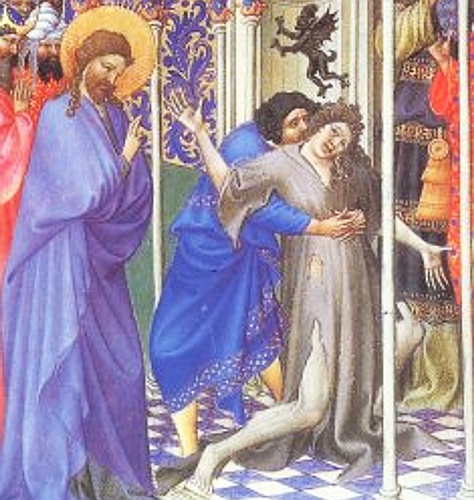
Exorcism of the demon-possessed in Capernaum
Très Riches Heures du Duc de Berry
ca. 1410
7
posted on
08/30/2022 6:10:29 AM PDT
by
annalex
(fear them not)
To: annalex
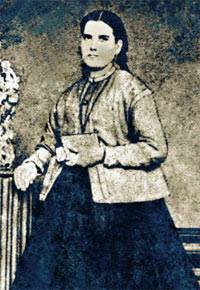
Narcisa de Jesús Martillo Morán (1832-1869) Photo NARCISA DE JESÚS MARTILLO MORÁN was born in 1832 in the hamlet of St Joseph in Nobol, Daule, Ecuador. The Dominicans had been looking after the parish for almost three hundred years. She was the daughter of Peter Martillo and Josephine Morán, landowners, modest people with a deep faith. Her father, who had a lively intelligence and was a great worker, amassed considerable wealth. He was very devoted to the future saint Marianna of Jesus and Saint Hyacinth of Poland who is venerated fervently throughout the province of Guayas. They had nine children, who grew healthy and strong. Narcisa was the sixth. In 1838, when she was six, her mother died. Helped by a teacher and an older sister she learnt to read, write, sing, play the guitar, sew (a skill she really mastered), weave, embroider and cook. She had great qualities, with a particular bent for music. Often, her prayer became song, and her song was intimate and devout, reaching the heart of Him who well deserved it, as a song which she loved to sing in her youth said. She had a clear perception of her call to sanctity, especially from when she received confirmation, aged seven, on 16th September 1839. She grew into the habit of withdrawing frequently in a small wood near her home to give herself freely to the contemplation of divine realities. The tree of Guayabo, near which she prayed, is today the destination for large pilgrimages. She turned a small room in her house into a domestic chapel. She decided to imitate Saint Marianna of Jesus, identifying with the vocation of a victim. She undertook a demanding path of penance to unite herself more closely with the suffering Christ and cooperate in the redemption of the world. She helped with the domestic chores and out in the fields. She was a young, thoughtful, lovable, happy girl with a sweet and peaceful character, extremely good and obedient, generous, compassionate towards the poor, very devout, loved by all the neighbours. She was a very attractive young woman, blonde with blue eyes, tall, strong and agile. She showed herself to be an excellent catechist. She could not do without communicating the fire of divine love to her family and to the children of the neighbourhood. In January 1852 her father, a good man, died. Narcisa, who was then 19, moved to Guayaquil to stay with a very well-known family who lived near the cathedral. She stayed in this city until 1868, except for those months she lived in the city of Cuenca. She moved house a number of times to preserve her privacy and to dedicate herself with greater freedom to prayer and penance, earning her living by doing tailoring work. She helped the poor and the sick. She was docile to the instructions of her spiritual directors and shared ideals, and sometimes a house, with the Blessed Mercedes of Jesus Molina. Driven by a desire for greater perfection, and advised by a Franciscan religious, she set off in June 1868 for Lima (Perù) and lived as a lay member in the Dominican convent of Patrocinio, founded in 1688, in the area where Saint John Macias used to graze his flock. The Lord favoured her with extraordinary gifts, and showed her how pleasing her life was, in the midst of trials of the spirit. Towards the end of September 1869, she had high fevers. Medical remedies could do little, but she kept up her normal rhythm of life, ending with a novena and the celebration of the Eucharist, with great joy, dressed in white, on the solemnity of the Immaculate Conception of Mary, 8th December 1869, the same day on which Blessed Pius IX opened in Rome Vatican Council I. At the end of the day she took leave of the sisters, saying she was going on a journey very far. This was taken as a joke, but not long after, one of the sisters, charged with blessing the cells, noticed a splendour and a special scent in NarcisaÂ’s cell. The community gathered and they saw that she was dead. She was 37 years old. Afterwards, it became known that she had made a private vow of perpetual virginity, poverty, obedience, enclosure, eremitical life, fasting on bread and water, daily Communion, confession, mortification and prayer. All these vows she kept faithfully. She lived in continuous union with Jesus Christ. Her mortifications were very severe. She carried constantly on her body the signs of the LordÂ’s crucifixion. She had a firm faith and admirable hope. The doctors were amazed that she could have lived so long with so little food. Her body remained supple for a long time and from it came a pleasant scent, and in front of it many graces were granted. The city of Lima acclaimed her as a saint, as did the people of Guayaquil and Nobol. The Dominican Sisters of Patrocinio guarded the memory of her virtues and her tomb with great veneration until her body, practically incorrupt, was transferred to Guayaquil in 1955. The documents of the diocesan process of canonization were handed over to the Congregation for the Causes of Saints in 1964. Pope John Paul II beatified her on 25th October 1992. On 22nd August 1998 they dedicated a shrine in her honour in Nobol, where her incorrupt body is at present. Devotion to the "Niña Narcisa" shows the spontaneous identification of ordinary people with this woman from the Ecuadorian coast. The example of her life, pure and pious, of work and apostolate, sends out a very topical message. |
vatican.va
8
posted on
08/30/2022 6:16:59 AM PDT
by
annalex
(fear them not)
To: annalex
9
posted on
08/30/2022 6:19:21 AM PDT
by
annalex
(fear them not)
To: annalex
NAVARRE BIBLE COMMENTARY (RSV)
Ad Majorem Dei Gloriam (To the Greater Glory of God)
From: 1 Corinthians 2:10b-16
Divine Wisdom
-------------
[10b] For the Spirit searches everything, even the depths of God. [11] For what person knows a man's thoughts except the spirit of the man which is in him? So also no one comprehends the thoughts of God except the Spirit of God. [12] Now we have received not the spirit of the world, but the Spirit which is from God, that we might understand the gifts bestowed on us by God. [13] And we impart this in words not taught by human wisdom but taught by the Spirit, interpreting spiritual truths to those who possess the Spirit.
[14] The unspiritual man does not receive the gifts of the Spirit of God, for they are folly to him, and he is not able to understand them because they are spiritually discerned. [15] The spiritual man judges all things, but is himself to be judged by no one. [16] "For who has known the mind of the Lord so as to instruct him?" But we have the mind of Christ.
***********************************************************************
Commentary:
10-12. "God has revealed to us through the Spirit": meaning the Holy Spirit, the third person of the Blessed Trinity, "which is from God" (v. 12) and knows the very depths of God (vv. 10-11). These words reveal to us the divinity of the Holy Spirit; knowing a person implies having intimacy with him; the Holy Spirit knows the depths of God because by nature he is God, equal to the Father and the Son (cf. Mt 11:25). "The Holy Spirit is equally God with the Father and the Son, equally omnipotent and eternal, infinitely perfect, the supreme good, infinitely wise, and of the same nature as the Father and the Son [...]. Scripture also attributes to him the power to sanctify, to vivify, to search the depths of God, to speak through the Prophets, and to be present in all places--all of which can be attributed to God alone" ("St Pius V Catechism", I, 9, 4).
Jesus had told his Apostles that "when the Spirit of truth comes, he will guide you into all truth" (Jn 16:13); and on the day of Pentecost the Holy Spirit did open their minds to understand the truth revealed by Jesus Christ. The Holy Spirit also acted in St Paul, so that he had the same knowledge of Revelation as the other Apostles (cf. Gal 2:1-10). The same Spirit continues to act in the Church: "The Holy Spirit, who is the spirit of truth, because he proceeds from the Father, eternal Truth, and the Son, substantial truth, receives from each of them, along with his essence, all truth, which he then communicates to the Church, helping never to err" (Leo XIII, "Divinum Illud Munus", 7).
13. The handing on of the faith calls for great care in the terminology used: "The Church, with the long labor of centuries and not without the help of the Holy Spirit, has established a rule of language and confirmed it with the authority of the Councils. This rule, which has more than once been the watchword and banner of orthodox faith, must be religiously preserved, and let no one presume to change it at his own pleasure or under the pretext of new science" (Paul VI, "Mysterium Fidei", 3).
The Church has always been concerned about this need to explain the deposit of faith accurately: "You have received gold," St Vincent of Lerins comments, "let you therefore give gold. I do not want you to give one thing instead of another. I do not want you to be so shameless and deceptive that you give me lead or bronze in place of gold; I do not want something that looks like gold: I want pure gold" ("Commonitorium", 22).
The last part of this verse is unclear and can be translated in various ways as the RSV text and note show.
14-16. The original text says "psychikos". This is not easy to translate. Some versions say "natural man", others "animal man", which is literally what the New Vulgate says. What it means is the person who acts only by using his or her human faculties (intelligence and will) and who therefore can be wise only in the things of this world. The spiritual man is the Christian reborn by the grace of God; grace elevates his faculties to enable him to perform actions which have a supernatural value--acts of faith, hope and charity. A person who is in the state of grace is able to perceive the things of God, because he carries with him the Spirit in his soul in grace, and he has Christ's mind, Christ's attitude. "We have no alternative", St J. Escriva teaches. "There are only two possible ways of living on this earth: either we live a supernatural life, or we live an animal life. And you and I can only live the life of God, a supernatural life" ("Friends of God", 200).
St John Chrysostom very graphically contrasts the capacity of the spiritual man and that of the unspiritual man as far as understanding God's plan of salvation is concerned: "He who has sight sees everything, including the person who has no sight; but the sightless person cannot see the things of the person who has sight. We Christians know what our own situation is, and we also know the situation of unbelievers; the unbelievers, however, do not understand ours. Like them we know--and we know better than they do--the nature of things present; unbelievers do not know the sublimity of things to come, whereas we already see what will some day become of the world, and what sinners will suffer, and the righteous enjoy" ("Hom. on 1 Cor", 7, "ad loc."). And St Thomas Aquinas: "A conscious person rightly perceives both that he is awake and that the other person is asleep; but the person who is asleep cannot form a correct judgment concerning either himself or the one who is awake. Therefore, things are not the way they are seen by someone asleep: they are as they appear to be to a conscious person [...]. And so the Apostle says that 'the spiritual man judges all things': for a person whose understanding is enlightened and whose affections are regulated by the Holy Spirit forms correct judgments on particular matters to do with salvation. He who is unspiritual has a darkened understanding and disordered affection as far as spiritual things are concerned, and therefore the spiritual man cannot be judged by the unspiritual man, just as the sleeping person cannot judge the one who is awake" ("Commentary on 1 Cor, ad loc.").
10
posted on
08/30/2022 7:07:26 AM PDT
by
fidelis
(👈 Under no obligation to respond to rude, ignorant, abusive, bellicose, and obnoxious posts.)
To: fidelis
From: Luke 4:31-37Jesus Preaches in Capernaum
---------------------------
[31] And He (Jesus) went down to Capernaum, a city of Galilee. And He was teaching them on the Sabbath; [32]and they were astonished at His teaching, for His word was with authority.
The Cure of the Demoniac
------------------------
[33] And in the synagogue there was a man who had the spirit of an unclean demon; and he cried out with a loud voice, [34] "Ah! What have You to do with us, Jesus of Nazareth? Have You come to destroy us? I know who You are, the Holy One of God." [35] But Jesus rebuked him, saying, "Be silent, and come out of him!" And when the demon had thrown him down in the midst, he came out of him, having done him no harm. [36]And they were all amazed and said to one another, "What is this word? For with authority and power He commands the unclean spirits, and they come out." [37] And reports of Him went out into every place in the surrounding region.
***********************************************************************
Commentary:
33-37. Jesus now demonstrates by His actions that authority which was evident in His words.
34. The demons tells the truth here when he calls Jesus "the Holy One of God", but Jesus does not accept this testimony from the "father of lies" (John 8:44). This shows that the devil usually says something partially true in order to disguise untruth; by sowing confusion in this way, he can more readily deceive people. By silencing and expelling the demon, Jesus teaches us to be prudent and not let ourselves by deceived by half-truths
Source: Daily Word for Reflection—Navarre Bible Commentary
11
posted on
08/30/2022 7:08:22 AM PDT
by
fidelis
(👈 Under no obligation to respond to rude, ignorant, abusive, bellicose, and obnoxious posts.)
To: All
MEDITATION OF THE DAYAuthority over the Unclean Spirits
I went to bed, I slept, and slept well. After a quarter of an hour, for my sleep is always brief, I saw at the foot of my bed, on the ground, that usual ominous black creature, very black, very small. I knew who it was and said, “Have you begun again the business of not letting me sleep?”
He began to give me blows until he jumped up suddenly and rolled on the ground. I do not know what happened, but I smiled for I did not have any fear of him today. He said, “Today I can do nothing to you but I’ll take care of you another time.” I asked him: “Why can’t you? If you can do it other times, why can’t you now? I know. I am the same, but I have Jesus [a relic of the cross] on my neck.” After this, I smiled at him as he stood there devoured with rage. He told me that I would suffer all the more. “It doesn’t matter,” I said, “I suffer for Jesus.” In short, I was much entertained by him. I saw him very angry; he has sworn to make me pay for it….
It happened again as usual. I had gone to bed, in fact I was asleep, but the devil did not wish this. He presented himself in a disgusting manner; he tempted me but I was strong. I commended myself to Jesus asking that he take my life rather than have me offend him. What horrible temptations those were! Afterward he left me in peace and the guardian angel came and assured me that I had not done anything wrong. I complained somewhat, because I wished his help at such times, and he said that whether I saw him or not, he would be always above my head. Also, yesterday he promised that in the evening Jesus would come to see me. Yesterday evening I waited with impatience for the moment to go to my room. I took the crucifix and went to bed. I felt myself becoming recollected. Jesus came and stood by my side. What beautiful moments those were! I asked him if he would love me always, and he replied with these words: “My daughter, I have enriched you with so many beautiful things without any merit on your part, and you ask me if I love you?” Finally I commended a poor sinner to him. He blessed me and in going away said to me: “Remember that I have created you for heaven.”
Saint Gemma Galgani
————————————————————————
Saint Gemma Galgani († 1903), from Lucca, Italy, had many mystical experiences, such as seeing her guardian angel. She died at age 25 and is called the “Flower of Lucca” and “Daughter of the Passion.” / From The Diary of Saint Gemma Galgani.
12
posted on
08/30/2022 8:23:01 AM PDT
by
fidelis
(👈 Under no obligation to respond to rude, ignorant, abusive, bellicose, and obnoxious posts.)
Disclaimer:
Opinions posted on Free Republic are those of the individual
posters and do not necessarily represent the opinion of Free Republic or its
management. All materials posted herein are protected by copyright law and the
exemption for fair use of copyrighted works.
FreeRepublic.com is powered by software copyright 2000-2008 John Robinson