Skip to comments.
Catholic Caucus: Daily Mass Readings 26-July-2022; Saint Joachim and Saint Anne
Universalis/Jerusalem Bible ^
Posted on 07/26/2022 5:13:50 AM PDT by annalex
26 July 2022
Saint Joachim and Saint Anne,
parents of the Blessed Virgin Mary
on Tuesday of week 17 in Ordinary Time

Sts. Anne & Joachim Catholic Church, Fargo Readings at MassLiturgical Colour: White. Year: C(II). Readings for the feria Readings for the memorial These are the readings for the feria
| First reading |
|---|
| Jeremiah 14:17-22 © |
|---|
We confess our wickedness; you, God, are our hopeThe Lord said to me: Say this word to the people: ‘Tears flood my eyes night and day, unceasingly, since a crushing blow falls on the daughter of my people, a most grievous injury. If I go into the countryside, there lie men killed by the sword; if I go into the city, I see people sick with hunger; even prophets and priests plough the land: they are at their wit’s end.’ ‘Have you rejected Judah altogether? Does your very soul revolt at Zion? Why have you struck us down without hope of cure? We were hoping for peace – no good came of it! For the moment of cure – nothing but terror! Lord, we do confess our wickedness and our fathers’ guilt: we have indeed sinned against you. For your name’s sake do not reject us, do not dishonour the throne of your glory. Remember us; do not break your covenant with us. Can any of the pagan Nothings make it rain? Can the heavens produce showers? No, it is you, Lord. O our God, you are our hope, since it is you who do all this.’
| Responsorial Psalm |
|---|
| Psalm 78(79):8-9,11,13 © |
|---|
Rescue us, O Lord, for the glory of your name. Do not hold the guilt of our fathers against us. Let your compassion hasten to meet us; we are left in the depths of distress. Rescue us, O Lord, for the glory of your name. O God our saviour, come to our help. Come for the sake of the glory of your name. O Lord our God, forgive us our sins; rescue us for the sake of your name. Rescue us, O Lord, for the glory of your name. Let the groans of the prisoners come before you; let your strong arm reprieve those condemned to die. But we, your people, the flock of your pasture, will give you thanks for ever and ever. We will tell your praise from age to age. Rescue us, O Lord, for the glory of your name.
Alleluia, alleluia! The word of the Lord remains for ever: What is this word? It is the Good News that has been brought to you. Alleluia! Alleluia, alleluia! The seed is the word of God, Christ the sower; whoever finds this seed will remain for ever. Alleluia!
As the darnel is gathered up and burnt, so it will be at the end of timeLeaving the crowds, Jesus went to the house; and his disciples came to him and said, ‘Explain the parable about the darnel in the field to us.’ He said in reply, ‘The sower of the good seed is the Son of Man. The field is the world; the good seed is the subjects of the kingdom; the darnel, the subjects of the evil one; the enemy who sowed them, the devil; the harvest is the end of the world; the reapers are the angels. Well then, just as the darnel is gathered up and burnt in the fire, so it will be at the end of time. The Son of Man will send his angels and they will gather out of his kingdom all things that provoke offences and all who do evil, and throw them into the blazing furnace, where there will be weeping and grinding of teeth. Then the virtuous will shine like the sun in the kingdom of their Father. Listen, anyone who has ears!’ Continue These are the readings for the memorial
| First reading |
|---|
| Ecclesiasticus 44:1,10-15 © |
|---|
Their name lives on for all generationsLet us praise illustrious men, our ancestors in their successive generations. Here is a list of generous men whose good works have not been forgotten. In their descendants there remains a rich inheritance born of them. Their descendants stand by the covenants and, thanks to them, so do their children’s children. Their offspring will last for ever, their glory will not fade. Their bodies have been buried in peace, and their name lives on for all generations. The peoples will proclaim their wisdom, the assembly will celebrate their praises.
| Responsorial Psalm |
|---|
| Psalm 131(132):11,13-14,17-18 © |
|---|
The Lord God will give him the throne of his father David. The Lord swore an oath to David; he will not go back on this word: ‘A son, the fruit of your body, will I set upon your throne.’ The Lord God will give him the throne of his father David. For the Lord has chosen Zion; he has desired it for his dwelling: ‘This is my resting-place for ever; here have I chosen to live. The Lord God will give him the throne of his father David. ‘There David’s stock will flower; I will prepare a lamp for my anointed. I will cover his enemies with shame but on him my crown shall shine.’ The Lord God will give him the throne of his father David.
| Gospel Acclamation | cf.Lk2:25 |
|---|
Alleluia, alleluia! They looked forward to Israel’s comforting and the Holy Spirit rested upon them. Alleluia!
Prophets and holy men longed to hear what you hearJesus said to his disciples: ‘Happy are your eyes because they see, your ears because they hear! I tell you solemnly, many prophets and holy men longed to see what you see, and never saw it; to hear what you hear, and never heard it.’ The readings on this page are from the Jerusalem Bible, which is used at Mass in most of the English-speaking world. The New American Bible readings, which are used at Mass in the United States, are available in the Universalis apps, programs and downloads.
You can also view this page with the Gospel in Greek and English. |
TOPICS: Catholic; General Discusssion; Prayer; Worship
KEYWORDS: catholic; mt13; ordinarytime; prayer
For your reading, reflection, faith-sharing, comments, questions, discussion.
1
posted on
07/26/2022 5:13:50 AM PDT
by
annalex
To: All
KEYWORDS: catholic; mt13; ordinarytime; prayer
2
posted on
07/26/2022 5:14:17 AM PDT
by
annalex
(fear them not)
To: nickcarraway; NYer; ELS; Pyro7480; livius; ArrogantBustard; Catholicguy; RobbyS; marshmallow; ...
Alleluia Ping Please FReepmail me to get on/off the Alleluia Ping List.
3
posted on
07/26/2022 5:15:12 AM PDT
by
annalex
(fear them not)
To: annalex
4
posted on
07/26/2022 5:15:45 AM PDT
by
annalex
(fear them not)
To: annalex
| Matthew |
| | English: Douay-Rheims | Latin: Vulgata Clementina | Greek NT: Byzantine/Majority Text (2000) |
| | Matthew 13
|
| 36. | Then having sent away the multitudes, he came into the house, and his disciples came to him, saying: Expound to us the parable of the cockle of the field. | Tunc, dimissis turbis, venit in domum : et accesserunt ad eum discipuli ejus, dicentes : Edissere nobis parabolam zizaniorum agri. | τοτε αφεις τους οχλους ηλθεν εις την οικιαν ο ιησους και προσηλθον αυτω οι μαθηται αυτου λεγοντες φρασον ημιν την παραβολην των ζιζανιων του αγρου |
| 37. | Who made answer and said to them: He that soweth the good seed, is the Son of man. | Qui respondens ait illis : Qui seminat bonum semen, est Filius hominis. | ο δε αποκριθεις ειπεν αυτοις ο σπειρων το καλον σπερμα εστιν ο υιος του ανθρωπου |
| 38. | And the field, is the world. And the good seed are the children of the kingdom. And the cockle, are the children of the wicked one. | Ager autem est mundus. Bonum vero semen, hi sunt filii regnum. Zizania autem, filii sunt nequam. | ο δε αγρος εστιν ο κοσμος το δε καλον σπερμα ουτοι εισιν οι υιοι της βασιλειας τα δε ζιζανια εισιν οι υιοι του πονηρου |
| 39. | And the enemy that sowed them, is the devil. But the harvest is the end of the world. And the reapers are the angels. | Inimicus autem, qui seminavit ea, est diabolus. Messis vero, consummatio sæculi est. Messores autem, angeli sunt. | ο δε εχθρος ο σπειρας αυτα εστιν ο διαβολος ο δε θερισμος συντελεια του αιωνος εστιν οι δε θερισται αγγελοι εισιν |
| 40. | Even as cockle therefore is gathered up, and burnt with fire: so shall it be at the end of the world. | Sicut ergo colliguntur zizania, et igni comburuntur : sic erit in consummatione sæculi. | ωσπερ ουν συλλεγεται τα ζιζανια και πυρι καιεται ουτως εσται εν τη συντελεια του αιωνος τουτου |
| 41. | The Son of man shall send his angels, and they shall gather out of his kingdom all scandals, and them that work iniquity. | Mittet Filius hominis angelos suos, et colligent de regno ejus omnia scandala, et eos qui faciunt iniquitatem : | αποστελει ο υιος του ανθρωπου τους αγγελους αυτου και συλλεξουσιν εκ της βασιλειας αυτου παντα τα σκανδαλα και τους ποιουντας την ανομιαν |
| 42. | And shall cast them into the furnace of fire: there shall be weeping and gnashing of teeth. | et mittent eos in caminum ignis. Ibi erit fletus et stridor dentium. | και βαλουσιν αυτους εις την καμινον του πυρος εκει εσται ο κλαυθμος και ο βρυγμος των οδοντων |
| 43. | Then shall the just shine as the sun, in the kingdom of their Father. He that hath ears to hear, let him hear. | Tunc justi fulgebunt sicut sol in regno Patris eorum. Qui habet aures audiendi, audiat. | τοτε οι δικαιοι εκλαμψουσιν ως ο ηλιος εν τη βασιλεια του πατρος αυτων ο εχων ωτα ακουειν ακουετω |
5
posted on
07/26/2022 5:20:19 AM PDT
by
annalex
(fear them not)
To: annalex

Catena Aurea by St. Thomas Aguinas
13:36–43
36. Then Jesus sent the multitude away, and went into the house: and his disciples came unto him, saying, Declare unto us the parable of the tares of the field.
37. He answered and said unto them, He that soweth the good seed is the Son of man;
38. The field is the world; the good seed are the children of the kingdom; but the tares are the children of the wicked one;
39. The enemy that sowed them is the devil; the harvest is the end of the world; and the reapers are the angels.
40. As therefore the tares are gathered and burned in the fire; so shall it be in the end of this world.
41. The Son of man shall send forth his angels, and they shall gather out of his kingdom all things that offend, and them which do iniquity;
42. And shall cast them into a furnace of fire: there shall be wailing and gnashing of teeth.
43. Then shall the righteous shine forth as the sun in the kingdom of their Father. Who hath ears to hear, let him hear.
CHRYSOSTOM. The Lord had spoken to the multitude in parables, that He might induce them to ask Him of their meaning; yet, though He had spoken so many things in parables, no man had yet asked Him aught, and therefore He sends them away; Then Jesus sent the multitude away, and went into the house. None of the Scribes followed Him here, from which it is clear that they followed Him for no other purpose than that they might catch Him in His discourse.
JEROME. The Lord sends away the multitude, and enters the house that His disciples might come to Him and ask Him privately of those things which the people neither deserved to hear, nor were able.
RABANUS. Figuratively; Having sent away the multitude of unquiet Jews, He enters the Church of the Gentiles, and there expounds to believers heavenly sacraments, whence it follows, And his disciples came to him, saying, Explain to us the parable of the tares of the field.
CHRYSOSTOM. Before, though desirous to learn, they had feared to ask; but now they ask freely and confidently because they had heard, To you it is given to know the mystery of the kingdom of heaven; and therefore they ask when alone, not envying the multitude to whom it was not so given. They pass over the parables of the leaven and the mustard-seed as plain; and ask concerning the parable of the tares, which has some agreement with the foregoing parable concerning the seed, and shews somewhat more than that. And accordingly the Lord expounds it to them, as it follows, He answered and said unto them, He that sows the good seed is the Son of man.
REMIGIUS. The Lord styles Himself the Son of Man, that in that title He might set an example of humility; or perhaps because it was to come to pass that certain heretics would deny Him to be really man; or that through belief in His Humanity we might ascend to knowledge of His Divinity.
CHRYSOSTOM. The field is the world. Seeing it is He that sows His own field, it is plain that this present world is His. It follows, The good seed are the children of the kingdom.
REMIGIUS. That is, the saints, and elect men, who are counted as sons.
AUGUSTINE. (cont. Faust. xviii. 7.) The tares the Lord expounds to mean, not as Manichæus interprets, certain spurious parts inserted among the true Scriptures, but all the children of the Evil one, that is, the imitators of the fraud of the Devil. As it follows, The tares are the children of the evil one, by whom He would have us understand all the wicked and impious.
AUGUSTINE. (Quæst. Ev. i. 10.) For all weeds among corn are called tares. It follows, The enemy who sowed this is the Devil.
CHRYSOSTOM. For this is part of the wiles of the Devil, to be ever mixing up truth with error. The harvest is the end of the world. In another place He says, speaking of the Samaritans, Lift up your eyes, and consider the fields that they are already white for the harvest; (John 4:35.) and again, The harvest truly is great, but the labourers are few, (Luke 10:2.) in which words He speaks of the harvest as being already present. How then does He here speak of it as something yet to come? Because He has used the figure of the harvest in two significations as He says there that it is one that soweth, and another that reapeth; but here it is the same who both sows and reaps; indeed there He brings forward the Prophets, not to distinguish them from Himself, but from the Apostles, for Christ Himself by His Prophets sowed among the Jews and Samaritans. The figure of harvest is thus applied to two different things. Speaking of first conviction and turning to the faith, He calls that the harvest, as that in which the whole is accomplished; but when He enquires into the fruits ensuing upon the hearing the word of God, then He calls the end of the world the harvest, as here.
REMIGIUS. By the harvest is denoted the day of judgment, in which the good are to be separated from the evil; which will be done by the ministry of Angels, as it is said below, that the Son of Man shall come to judgment with His Angels. As then the tares are gathered and burned in the fire, so shall it be in the end of this world. The Son of man shall send forth his Angels, and they shall gather out of his kingdom all offences, and them which do iniquity.
AUGUSTINE. (De Civ. Dei. xx. 9.) Out of that kingdom in which are no offences? The kingdom then is His kingdom which is here, namely, the Church.
AUGUSTINE. (Quæst. Ev. i. 10.) That the tares are first separated, signifies that by tribulation the wicked shall be separated from the righteous; and this is understood to be performed by good Angels, because the good can discharge duties of punishment with a good spirit, as a judge, or as the Law, but the wicked cannot fulfil offices of mercy.
CHRYSOSTOM. Or we may understand it of the kingdom of the heavenly Church; and then there will be held out here a two-fold punishment; first that they fall from glory as that is said, And they shall gather out of his kingdom all offences, to the end, that no offences should be seen in His kingdom; and then that they are burned. And they shall cast them into a furnace of fire.
JEROME. The offences are to be referred to the tares.
GLOSS. (non occ.) The offences, and, them that do iniquity, are to be distinguished as heretics and schismatics; the offences referring to heretics; while by them that do iniquity are to be understood schismatics. Otherwise; By offences may be understood those that give their neighbour an occasion of falling, by those that do iniquity all other sinners.
RABANUS. Observe, He says, Those that do iniquity, not, those who have done; because not they who have turned to penitence, but they only that abide in their sins are to be delivered to eternal torments.
CHRYSOSTOM. Behold the unspeakable love of God towards men! He is ready to shew mercy, slow to punish; when He sows, He sows Himself; when He punishes, He punishes by others, sending His Angels to that. It follows, There shall be weeping and gnashing of teeth.
REMIGIUS. In these words is shewn the reality of the resurrection of the body; and further, the twofold pains of hell, extreme heat, and extreme cold. And as the offences are referred to the tares, so the righteous are reckoned among the children of the kingdom; concerning whom it follows, Then the righteous shall shine as the sun in the kingdom of their Father. For in the present world the light of the saints shines before men, but after the consummation of all things, the righteous themselves shall shine as the sun in the kingdom of their Father.
CHRYSOSTOM. Not that they shall not shine with higher brightness, but because we know no degree of brightness that surpasses that of the sun, therefore He uses an example adapted to our understanding.
REMIGIUS. That He says, Then shall they shine, implies that they now shine for an example to others, but they shall then shine as the sun to the praise of God. He that hath ears to hear, let him hear.
RABANUS. That is, Let him understand who has understanding, because all these things are to be understood mystically, and not literally.
Catena Aurea Matthew 13
6
posted on
07/26/2022 5:20:53 AM PDT
by
annalex
(fear them not)
To: annalex
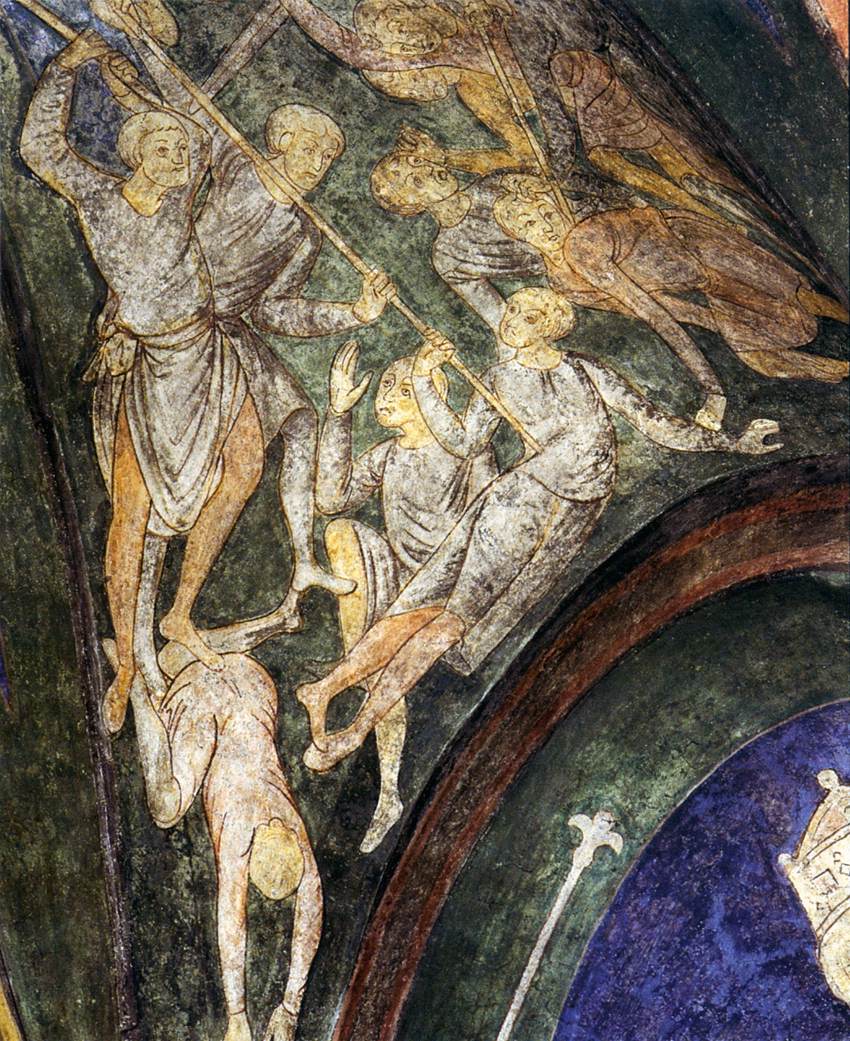
Last Judgment (detail)
c. 1180
Fresco
Doppelkirche, Schwarzrheindorf
7
posted on
07/26/2022 5:21:23 AM PDT
by
annalex
(fear them not)
To: annalex
| Matthew |
| | English: Douay-Rheims | Latin: Vulgata Clementina | Greek NT: Byzantine/Majority Text (2000) |
| | Matthew 13
|
| 16. | But blessed are your eyes, because they see, and your ears, because they hear. | Vestri autem beati oculi quia vident, et aures vestræ quia audiunt. | υμων δε μακαριοι οι οφθαλμοι οτι βλεπουσιν και τα ωτα υμων οτι ακουει |
| 17. | For, amen, I say to you, many prophets and just men have desired to see the things that you see, and have not seen them, and to hear the things that you hear and have not heard them. | Amen quippe dico vobis, quia multi prophetæ et justi cupierunt videre quæ videtis, et non viderunt : et audire quæ auditis, et non audierunt. | αμην γαρ λεγω υμιν οτι πολλοι προφηται και δικαιοι επεθυμησαν ιδειν α βλεπετε και ουκ ειδον και ακουσαι α ακουετε και ουκ ηκουσαν |
8
posted on
07/26/2022 5:26:20 AM PDT
by
annalex
(fear them not)
To: annalex
Catena Aurea by St. Thomas Aguinas
13:10–17
10. And the disciples came, and said unto him, Why speakest thou unto them in parables?
11. He answered and said unto them, Because it is given unto you to know the mysteries of the kingdom of heaven, but to them it is not given.
12. For whosoever hath, to him shall be given, and he shall have more abundance: but whosoever hath not, from him shall be taken away even that he hath.
13. Therefore speak I to them in parables: because they seeing see not; and hearing they hear not, neither do they understand.
14. And in them is fulfilled the prophecy of Esaias, which saith, By hearing ye shall hear, and shall not understand; and seeing ye shall see, and shall not perceive:
15. For this people’s heart is waxed gross, and their ears are dull of hearing, and their eyes they have closed: lest at any time they should see with their eyes, and hear with their ears, and should understand with their heart, and should be converted, and I should heal them.
16. But blessed are your eyes, for they see: and your ears, for they hear.
17. For verily I say unto you, That many prophets and righteous men have desired to see those things which ye see, and have not seen them; and to hear those things which ye hear, and have not heard them.
GLOSS. (ap. Anselm.) The disciples understanding that the things which were spoken by the Lord to the people were obscure, desired to hint to Him that He should not speak in parables to them. And his disciples came to him, and said, Why speakest thou to them in parables?
CHRYSOSTOM. (Hom, xlv.) Wherein it is worthy admiration, that the disciples who desire to learn of Him, know when they ought to ask Him, for they do not this before the multitude. This Matthew declares, when he says, And they came to him; (Mark 4:10) and Mark more expressly says, that they came to him when he was alone.
JEROME. We must enquire how they could come to Him at that time when Jesus was sitting in the ship; we may understand that they had at the first entered into the ship, and standing there, made this enquiry of Him.
REMIGIUS. The Evangelist therefore says, came to him, to express that they eagerly enquired of Him; or they might indeed approach Him bodily, though the space between them was small.
CHRYSOSTOM. And observe moreover their goodness, how great their thought for others, that they enquire about what concerns others, before what relates to themselves. For they say not, ‘Why speakest thou to us in parables?’ but to them. And he answered and said unto them, Because it is given to you to know the mystery of the kingdom of heaven.
REMIGIUS. To you, I say, who adhere to Me, and believe in Me. By the mystery of the kingdom of heaven, He intends the Gospel doctrine. To them, that is, to them that are without, and who would not believe on Him, the Scribes namely and Pharisees, and to the rest who continue in unbelief, it is not given. Let us then, with the disciples, come unto the Lord with a pure heart, that He may think us worthy to interpret to us the evangelic teaching; according to that, They who draw near to his feet, shall receive of his doctrine. (Deut. 33:3)
CHRYSOSTOM. In saying this, He does not imply any necessity or fate, but shews at once, that they, to whom it is not given, are the cause of all their own miseries, and yet that the knowledge of the Divine mysteries is the gift of God, and a grace given from above. Yet this does not destroy free will, as is manifest from what follows, for to prevent that either these should despair, or those be remiss, when they hear that to you it is given, He shews that the beginning of all lays with ourselves, and then He adds, For whoso hath, to him shall be given, and he shall abound; and whoso hath not, from him shall be taken what he hath. As much as to say, Whoso has the desire and the zeal, to him shall be given all those things which are of God; but whoso lacketh these, and does not contribute that part that pertains to him, to him neither are the things which are of God given, but even those things that he hath are taken from him; not because God takes them away, but because he hath made himself unworthy of those that he has. Wherefore we also, if we see any hearkening carelessly, and having exhorted him to attend, he do not heed us, let us be silent; for should we persevere in urging him, his sloth-fulness will be the more charged against him. But him that is zealous to learn, we draw onwards, pouring forth many things. And He well said according to another Evangelist, That which he seemeth to have; (Luke 8:18.) for, in truth, he has not even that he has.
REMIGIUS. He that has a desire to read, shall have given to him power to understand, and whoso has not desire to read, that understanding which by the bounty of nature he seems to have, even that shall be taken from him. Or, whoso has charity, to him shall be given the other virtues also; and from him who has not charity, the other virtues likewise shall be taken away, for without charity there can be nothing good.
JEROME. Or, To the Apostles who believe in Christ there is given, but from the Jews who believed not on the Son of God there is taken away, even whatever good they might seem to have by nature. For they cannot understand any thing with wisdom, seeing they have not the head of wisdom.
HILARY. For the Jews not having faith, have lost also the Law which they had; and Gospel faith has the perfect gift, inasmuch as if received it enriches with new fruit, if rejected it subtracts from the riches of ancient possession.
CHRYSOSTOM. But that what He had said might be made more manifest He adds, Therefore speak I unto them in parables, because seeing they see not, and hearing they hear not, neither do they understand. Had this been a natural blindness, He ought to have opened their eyes; but forasmuch as it is voluntary, therefore He said not simply, ‘They see not,’ but, Seeing they see not. For they had seen the dæmons going out, and they said, He casts out dæmons by Beelzebub; they heard that He drew all men to God, and they say, This man is not of God. (John 9:16) Therefore because they spake the very contrary to what they saw and heard, to see and to hear is taken from them; for they profit nothing, but rather fall under judgment. For this reason He spake to them at first not in parables, but with much clearness; but because they perverted all they saw and heard, He now speaks in parables.
REMIGIUS. And it should be noted, that not only what He spake, but also what He did, were parables, that is, signs of things spiritual, which He clearly shews when He says, That seeing they may not see; but words are heard and not seen.
JEROME. This He says of those who were standing on the shore, and separated from Jesus, and who because of the dashing of the waves heard not distinctly what was said.
CHRYSOSTOM. And that they should not say, He slanders us as an enemy, He brings forward the Prophet declaring the same opinion, as it follows, That there might be fulfilled in them the prophecy of Isaiah, who said, With the hearing ye shall hear and shall not understand, and seeing ye shall see and shall not behold. (Is. 6:9)
GLOSS. (non occ.) That is; With the hearing ye shall hear words, but shall not understand the hidden meaning of those words; seeing ye shall see My flesh indeed, but shall not discern the divinity.
CHRYSOSTOM. This He said because they had taken away their own sight and hearing, shutting their eyes, and hardening their hearts. For not only did they not hear at all, but they heard obtusely, as it follows, The heart of this people is waxed gross, and they have heard hardly with their ears.
RABANUS. The heart of the Jews is made gross with the grossness of wickedness, and through the abundance of their sins they hear hardly the Lord’s words, because they have received them ungratefully.
JEROME. And that we should not suppose that this grossness of the heart and heaviness of the ears is of nature, and not of choice, He adds the fruit of their own wilfulness, For they have shut their eyes.
CHRYSOSTOM. Herein He points out how extreme their wickedness, how determined their aversion. Again to draw them towards Him, He adds, And be converted, and I should heal them; which shews that if they would be converted, they should be healed. As if one should say, If he would ask me I would immediately forgive him, this would point out how he might be reconciled; so here when He says, Lest they should he converted and I should heal them, He, shews that it was possible they should be converted, and having done penitence should be saved.
AUGUSTINE. (Quæst. in Matt. q. 14.) Otherwise; They have shut their eyes lest they should see with their eyes, that is, themselves were the cause that God shut their eyes. For another Evangelist says, We hath blinded their eyes. But is this to the end that they should never see? Or that they should not see so much as this, that becoming discontent with their own blindness and bewailing themselves, should so be humbled, and moved to confession of their sins and pious seeking after God. For Mark thus expresses the same thing, Lest they should be converted, and their sins should be forgiven them. From which we learn, that by their sins they deserved not to understand; and that yet this was allowed them in mercy that they should confess their sins, and should turn, and so merit to be forgiven. But when John relating this expresses it thus, Therefore they could not believe because Esaias said again, He hath blinded their eyes and hardened their heart, that they should not see with their eyes, and understand with their heart, and be converted, and I should heal them, (John 12:39) this seems to be opposed to this interpretation, and to compel us to take what is here said, Lest they should see with their eyes, not as though they might come to see after this fashion, but that they should never see at all; for he says it plainly, That they should not see with their eyes. And that he says, Therefore they could not believe, sufficiently shows that the blindness was not inflicted, to the end that moved thereby, and grieving that they understood not, they should be converted through penitence; for that they could not, unless they had first believed, and by believing had been converted, and by conversion had been healed, and having been healed understood; but it rather shews that they were therefore blinded that they should not believe. For he speaks most clearly, Therefore they could not believe. But if it be so, who would not rise up in defence of the Jews, and pronounce them to be free from all blame for their unbelief? For, Therefore they could not believe, because he hath blinded their eyes. But because we must rather believe God to be without fault, we are driven to confess that by some other sins they had thus deserved to be blinded, and that indeed this blinding prevented them from believing; for the words of John are these, They could not believe, because that Esaias said again, He hath blinded their eyes. It is in vain then to endeavour to understand it that they were therefore blinded that they should be converted; seeing they could not be converted because they believed not; and they could not believe because they were blinded. Or perhaps we should not say amiss thus—that some of the Jews were capable of being healed, but that being puffed up with so great swelling pride, it was good for them at first that they should not believe, that they might understand the Lord speaking in parables, which if they did not understand they would not believe; and thus not believing on Him, they together with the rest who were past hope crucified Him; and at length after His resurrection, they were converted, when humbled by the guilt of His death they loved Him the more because of the heavy guilt which had been forgiven them; for their so great pride needed such an humiliation to overcome it. This might indeed be thought an inconsistent explanation, did we not plainly read in the Acts of the Apostles that thus it was. This then that John says, Therefore they could not believe, because he hath blinded their eyes that they should not see, (Acts 2:37) is not repugnant to our holding that they were therefore blinded that they should be converted; that is to say, that the Lord’s meaning was therefore purposely clothed in the obscurities of parables, that after His resurrection they might turn them to wisdom with a more healthy penitence. For by reason of the darkness of His discourse, they being blinded did not understand the Lord’s sayings, and not understanding them, they did not believe on Him, and not believing on Him they crucified Him; thus after His resurrection, terrified by the miracles that were wrought in His name, they had the greater compunction for their great sin, and were more prostrated in penitence; and accordingly after indulgence granted they turned to obedience with a more ardent affection. Notwithstanding, some there were to whom this blinding profited not to conversion.
REMIGIUS. In all the clauses the word ‘not’ must be understood; thus; That they should not see with their eyes, and should not hear with their ears, and should not understand with their heart, and should not be converted, and I should heal them.
GLOSS. (ap. Anselm.) so then the eyes of them that see, and will not believe, are miserable, but your eyes are blessed; whence it follows; Blessed are your eyes, for they see, and your ears, for they hear.
JEROME. If we had not read above that invitation to his hearers to understand, when the Saviour said, He that hath, ears to hear let him hear, we might here suppose that the eyes and ears which are now blessed are those of the body. But I think that those eyes are blessed which can discern Christ’s sacraments, and those ears of which Isaiah speaks, The Lord hath given me an ear. (Is. 50:4)
GLOSS. (ord.) The mind is called an eye, because it is intently directed upon what is set before it to understand it; and an ear, because it learns from the teaching of another.
HILARY. Or, He is speaking of the blessedness of the Apostolic times, to whose eyes and ears it was permitted to see and to hear the salvation of God, many Prophets and just men having desired to see and to hear that which was destined to be in the fulness of times; whence it follows; Verily I say unto you, that many Prophets and just men have desired to see the things that ye see, and to hear the things that ye hear, and have not heard them.
JEROME. This place seems to be contradicted by what is said elsewhere. Abraham rejoiced to see my day, and he saw it, and was glad. (John 8:56)
RABANUS. Also Isaiah and Micah, and many other Prophets, saw the glory of the Lord; and were thence called ‘seers.’
JEROME. But He said not, ‘The Prophets and the just men,’ but many; for out of the whole number, it may be that some saw, and others saw not. But as this is a perilous interpretation, that we should seem to be making a distinction between the merits of the saints, at least as far as the degree of their faith in Christ, therefore we may suppose that Abraham saw in enigma, and not in substance. But ye have truly present with you, and hold, your Lord, enquiring of Him at your will, and eating with Him.1
CHRYSOSTOM. These things then which the Apostles saw and heard, are such as His presence, His voice, His teaching. And in this He sets them before not the evil only, but even before the good, pronouncing them more blessed than even the righteous men of old. For they saw not only what the Jews saw not, but also what the righteous men and Prophets desired to see, and had not seen. For they had beheld these things only by faith, but these by sight, and even yet more clearly. You see how He identifies the Old Testament with the New, for had the Prophets been the servants of any strange or hostile Deity, they would not have desired to see Christ.
Catena Aurea Matthew 13
9
posted on
07/26/2022 5:27:46 AM PDT
by
annalex
(fear them not)
To: annalex

The Twelve Apostles
Commentary on the Apocalypse of St John by Beatus of Liébana
776.
10
posted on
07/26/2022 5:34:34 AM PDT
by
annalex
(fear them not)
To: annalex
Saints of the Day for July 26
(c. 1st century)
Saints Joachim and Anne's Story
In the Scriptures, Matthew and Luke furnish a legal family history of Jesus, tracing ancestry to show that Jesus is the culmination of great promises. Not only is his mother’s family neglected, we also know nothing factual about them except that they existed. Even the names “Joachim” and “Anne” come from a legendary source written more than a century after Jesus died.
The heroism and holiness of these people however, is inferred from the whole family atmosphere around Mary in the Scriptures. Whether we rely on the legends about Mary’s childhood or make guesses from the information in the Bible, we see in her a fulfillment of many generations of prayerful persons, herself steeped in the religious traditions of her people.
The strong character of Mary in making decisions, her continuous practice of prayer, her devotion to the laws of her faith, her steadiness at moments of crisis, and her devotion to her relatives—all indicate a close-knit, loving family that looked forward to the next generation even while retaining the best of the past.
Joachim and Anne—whether these are their real names or not—represent that entire quiet series of generations who faithfully perform their duties, practice their faith, and establish an atmosphere for the coming of the Messiah, but remain obscure.
Reflection
This is the “feast of grandparents.” It reminds grandparents of their responsibility to establish a tone for generations to come: They must make the traditions live and offer them as a promise to little children. But the feast has a message for the younger generation as well. It reminds the young that older people’s greater perspective, depth of experience, and appreciation of life’s profound rhythms are all part of a wisdom not to be taken lightly or ignored.
Saints Joachim and Anne are the Patron Saints of:
Grandparents
Saint Anne is the Patron Saint of:
Mothers
Women in Labor
franciscanmedia.org
11
posted on
07/26/2022 5:39:31 AM PDT
by
annalex
(fear them not)
To: annalex

St. Joachim and St. Anne at the Golden Gate
Ambrosius Benson (circa 1495 –1550)
Prado
12
posted on
07/26/2022 5:42:34 AM PDT
by
annalex
(fear them not)
To: annalex
NAVARRE BIBLE COMMENTARY (RSV)
Ad Majorem Dei Gloriam (To the Greater Glory of God)
From: Jeremiah 14:17-22
Oracles in a time of drought
----------------------------------------
[And the Lord said to me:] [17] "You shall say to them this word: 'Let my eyes run down with tears night and day, and let them not cease, for the virgin daughter of my people is smitten with a great wound, with avery grievous blow. [18] If I go out into the field, behold, those slain by the sword! And if I enter the city, behold, the diseases of famine! For both prophet and priest ply their trade through the land, and have no knowledge.'"
[19] Hast thou utterly rejected Judah? Does thy soul loathe Zion? Why hast thou smitten us so that there is no healing for us? We looked for peace, but no good came; for a time of healing, but behold, terror. [20] We acknowledge our wickedness. O Lord, and the iniquity of our fathers, for we have sinned against thee. [21] Do not spurn us, for thy name's sake; do not dishonour thy glorious throne; remember and do not break thy covenant with us.
[22] Are there any among the false gods of the nations that can bring rain? Or can the heavens give showers? Art thou not he, O Lord our God? We set our hope on thee, for thou doest all these things.
********************************************************************************
Commentary:
14:1-15:9. This highly dramatic passage is made up of poems and dialogues between God and Jeremiah. It paints a picture of anguish, hunger and death – a desperate attempt to provoke repentance. "The prophet includes here a prayer to God on behalf of his chosen people, so that having punished them he will also show them his mercy" (St Thomas Aquinas, Postilla super Jeremiam, 14, 1).
What Jeremiah had been saying about the evils that would befall Jerusalem was all coming true. After the attack on the city in 597 and the deportation that ensued, the situation was terrible. The affliction suffered by the city was compounded by a terrible drought which made its plight and that of all Judah even worse (14:1-6; cf. 8:18-23). In their extremity the people cry out to God, begging him not to treat them like strangers (14:7-9). The Lord replies through his prophet, and and despite Jeremiah's attempts to excuse his fellow citizens, he does not mince his words: all these disasters are due to the faults and sins of the people (14:10-12), who made the mistake of relying on false prophets who put their minds at ease with promises of peace and prosperity (14:13-16). Jeremiah is deeply distressed by the whole situation, and he again begs God not to punish Judah (14:17-19); and the people again entreat God, their only hope (14:20-22). But the Lord has already promulgated his sentence. He will not go back on it -- not even if the nation's great mediators, Moses and Samuel, were to speak on its behalf (15:1-4; cf. Ex 32:11-14; 1 Sam 7:8-12). Its wickedness dates back a long time -- certainly to the reign of Manasseh (698-642), the son of Hezekiah (15:4), who tolerated and even promoted impiety and idolatry (2 Kings 21:1-18). So, the Lord had no option but to carry out his sentence (15:5-9): Judah had "rejected" him (cf. 15:6). This last part of the oracle is very severe and shows the profound pain felt by the prophet, for there is nothing he can do to ward off this great misfortune.
The words of 15:2 (cf. 43:11) are quoted in the book of Revelation (13:10) with reference to the latter days, to exhort readers to accept the truth of God's message and bear persecution with endurance and faith.
13
posted on
07/26/2022 6:39:54 AM PDT
by
fidelis
(👈 Under no obligation to respond to rude, ignorant, abusive, bellicose, and obnoxious posts.)
To: fidelis
From: Matthew 13:36-43The Parable of the Weeds Explained
----------------------------------
[36] Then He (Jesus) left the crowds and went into the house. And His disciples came to Him, saying, "Explain to us the parable of the weeds of the field." [37] He answered, "He who sows the good seed is the Son of Man; [38] the field is the world, and the good seed means the sons of the Kingdom; the weeds are the sons of the evil one, [39] and the enemy who sowed them is the devil; the harvest is the close of the age, and the reapers are angels. [40] Just as the weeds are gathered and burned with fire, so will it be at the close of the age. [41] The Son of Man will send His angels, and they will gather out of His Kingdom all causes of sin and evildoers, [42] and throw them out into the furnace of fire; there men will weep and gnash their teeth. [43] Then the righteous will shine like the sun in the Kingdom of their Father. He who has ears, let him hear."
***********************************************************************
Commentary:
36-43. While making its way on earth, the Church is composed of good and bad people, just men and sinners: they are mixed in with one another until the harvest time, the end of the world, when the Son of Man, in His capacity as Judge of the living and the dead, will divide the good from the bad at the Last Judgment--the former going to eternal glory, the inheritance of the saints; the latter, to the eternal fire of Hell. Although the just and the sinners are now side by side, the Church has the right and the duty to exclude those who cause scandal, especially those who attack its doctrine and unity; this is can do through ecclesiastical excommunication and other canonical penalties. However, excommunication has a medicinal and pastoral function—to correct those who are obstinate in error, and to protect others from them.
Source: Daily Word for Reflection—Navarre Bible Commentary
14
posted on
07/26/2022 6:40:13 AM PDT
by
fidelis
(👈 Under no obligation to respond to rude, ignorant, abusive, bellicose, and obnoxious posts.)
To: fidelis
For the memorial: From: Sirach 44:1, 8-15
Prologue
--------
[1] Let us now praise famous men, and our fathers in their generations.
[8] There are some of them who have left a name, so that men declare their praise. [9] And there are some who have no memorial, who have perished as though they had not lived; they have become as though they had not been born, and so have their children after them. [10] But these were men of mercy, whose righteous deeds have not been forgotten; [11] their prosperity will remain with their descendants, and their inheritance to their children's children. [12] Their descendants stand by the covenants; their children also, for their sake. [13] Their posterity will continue for ever, and their glory will not be blotted out. [14] Their bodies were buried in peace, and their name lives to all generations.[15] Peoples will declare their wisdom, and the congregation proclaims their praise.
***********************************************************************
Commentary:
44:1-50:29. This eulogy of ancestors begins with a short prologue (44:1-15), which summarizes Ben Sirach' teachings. What it says about them is what we have read elsewhere in the book about wise people, people who were loyal to the Law: they "have left a name" (44:8; cf. 41:12-13), whereas the ungodly "have no memorial" (44:9; cf. 41:11); "their righteous deeds have not been forgotten" and they have left an "inheritance" to their descendants (44:10-11; cf. 23:25-26); their name "lives to all generations", in all peoples and in the praise of the "congregation" (44:14-15; cf. 39:10-11). But these admirable lives are, in the last analysis, further evidence of the greatness of God (44:2). In the Church this same teaching applies in the case of saints.. In their memory we remind God that "You are glorified in your saints, for their glory is the crowning of your gifts. In their lives on earth you gave us an example. In our communion with them, you give us their friendship. In their prayer for the Church you give us strength and protection. This great company of witnesses spurs us on to victory, to share their prize of lasting glory" ("Roman Missal", Preface of the holy men and women).
The author goes on to survey sacred history from Enoch (44:16) to the priest Simon (50:1-21), In fact he goes right back to Adam, because Adam stands at the very origin of man (cf. 49:16). In this survey one can see the author's teaching is close to the the Deuteronomic Tradition-fidelity to the Covenant with God, adherence to the Law, the temple as the sole place of divine worship. The only three kings given praise in Deuteronomic history (David, Hezekiah and Josiah) are lauded here too (cf. 49:4). Even Solomon, despite all his wisdom, despite the fact that he built the temple, put a stain on the honor of God (47:20) and as a consequence (in line with Ben Sirach's persistent message) his son Rehoboam was ample in folly" (47:23).
The list of people praised also includes the main judges and prophets. However, one cannot help noticing the somewhat overgenerous amount of space given to Aaron (45:6-22). In fact what Sirach praises is not just Aaron himself; he revels in the magnificence of Aaron's sacred vestments, thereby emphasizing the reverence that is due to priests and to things to do 'with the liturgy. The last person to be eulogized, the high priest Simon: 50:1-21 really marks the climax of all this praise: Simon in some way embodies all the very best to be learned from these great ancestors.
From: Matthew 13:16-17
Parable of the Sower
--------------------
[16] But blessed are your eyes, for they see, and your ears, for they hear. [17] Truly, I say to you, many prophets and righteous men longed to see what you see, and did not see it, and to hear what you hear, and did not hear it."
*************************************
Commentary:
16-17. In contrast with the closed attitude of many Jews who witnessed Jesus' life but did not believe in Him, the disciples are praised by our Lord for their docility to grace, their openness to recognizing Him as the Messiah and to accepting His teaching.
He calls His disciples blessed, happy. As He says, the prophets and just men and women of the Old Testament had for centuries lived in hope of enjoying one day the peace the future Messiah would bring, but they had died without experiencing this good fortune. Simeon, towards the end of his long life, was filled with joy on seeing the infant Jesus when He was presented in the temple: "He took Him up in his arms and blessed God and said, `Lord now lettest Thou Thy servant depart in peace, according to Thy word; for mine eyes have seen Thy salvation'" (Luke 2:28-30). During our Lord's public life, His disciples were fortunate enough to see and be on close terms with Him; later they would recall that incomparable gift, and one of them would begin his first letter in these words: "That which was from the beginning, which we have heard, which we have seen with our own eyes, which we have looked upon and touched with our hands, concerning the word of life; [...] that which we have seen and heard we proclaim also to you, so that you may have fellowship with us; and our fellowship is with the Father and with His Son Jesus Christ. And we are writing this that our [or: your] joy may be complete (1 John 1:1-4).
This exceptional good fortune was, obviously, not theirs but of special merit: God planned it; it was He who decided that the time had come for the Old Testament prophecies to be fulfilled. In any event, God gives every soul opportunities to meet Him: each of us has to be sensitive enough to grasp them and not let them pass. There were many men and women in Palestine who saw and heard the incarnate Son of God but did not have the spiritual sensitivity to see in Him what the Apostles and disciples saw.
Source: Daily Word for Reflection—Navarre Bible Commentary
15
posted on
07/26/2022 6:50:18 AM PDT
by
fidelis
(👈 Under no obligation to respond to rude, ignorant, abusive, bellicose, and obnoxious posts.)
To: fidelis
For the memorial: From: Sirach 44:1, 8-15
Prologue
--------
[1] Let us now praise famous men, and our fathers in their generations.
[8] There are some of them who have left a name, so that men declare their praise. [9] And there are some who have no memorial, who have perished as though they had not lived; they have become as though they had not been born, and so have their children after them. [10] But these were men of mercy, whose righteous deeds have not been forgotten; [11] their prosperity will remain with their descendants, and their inheritance to their children's children. [12] Their descendants stand by the covenants; their children also, for their sake. [13] Their posterity will continue for ever, and their glory will not be blotted out. [14] Their bodies were buried in peace, and their name lives to all generations.[15] Peoples will declare their wisdom, and the congregation proclaims their praise.
***********************************************************************
Commentary:
44:1-50:29. This eulogy of ancestors begins with a short prologue (44:1-15), which summarizes Ben Sirach' teachings. What it says about them is what we have read elsewhere in the book about wise people, people who were loyal to the Law: they "have left a name" (44:8; cf. 41:12-13), whereas the ungodly "have no memorial" (44:9; cf. 41:11); "their righteous deeds have not been forgotten" and they have left an "inheritance" to their descendants (44:10-11; cf. 23:25-26); their name "lives to all generations", in all peoples and in the praise of the "congregation" (44:14-15; cf. 39:10-11). But these admirable lives are, in the last analysis, further evidence of the greatness of God (44:2). In the Church this same teaching applies in the case of saints.. In their memory we remind God that "You are glorified in your saints, for their glory is the crowning of your gifts. In their lives on earth you gave us an example. In our communion with them, you give us their friendship. In their prayer for the Church you give us strength and protection. This great company of witnesses spurs us on to victory, to share their prize of lasting glory" ("Roman Missal", Preface of the holy men and women).
The author goes on to survey sacred history from Enoch (44:16) to the priest Simon (50:1-21), In fact he goes right back to Adam, because Adam stands at the very origin of man (cf. 49:16). In this survey one can see the author's teaching is close to the the Deuteronomic Tradition-fidelity to the Covenant with God, adherence to the Law, the temple as the sole place of divine worship. The only three kings given praise in Deuteronomic history (David, Hezekiah and Josiah) are lauded here too (cf. 49:4). Even Solomon, despite all his wisdom, despite the fact that he built the temple, put a stain on the honor of God (47:20) and as a consequence (in line with Ben Sirach's persistent message) his son Rehoboam was ample in folly" (47:23).
The list of people praised also includes the main judges and prophets. However, one cannot help noticing the somewhat overgenerous amount of space given to Aaron (45:6-22). In fact what Sirach praises is not just Aaron himself; he revels in the magnificence of Aaron's sacred vestments, thereby emphasizing the reverence that is due to priests and to things to do 'with the liturgy. The last person to be eulogized, the high priest Simon: 50:1-21 really marks the climax of all this praise: Simon in some way embodies all the very best to be learned from these great ancestors.
From: Matthew 13:16-17
Parable of the Sower
--------------------
[16] But blessed are your eyes, for they see, and your ears, for they hear. [17] Truly, I say to you, many prophets and righteous men longed to see what you see, and did not see it, and to hear what you hear, and did not hear it."
*************************************
Commentary:
16-17. In contrast with the closed attitude of many Jews who witnessed Jesus' life but did not believe in Him, the disciples are praised by our Lord for their docility to grace, their openness to recognizing Him as the Messiah and to accepting His teaching.
He calls His disciples blessed, happy. As He says, the prophets and just men and women of the Old Testament had for centuries lived in hope of enjoying one day the peace the future Messiah would bring, but they had died without experiencing this good fortune. Simeon, towards the end of his long life, was filled with joy on seeing the infant Jesus when He was presented in the temple: "He took Him up in his arms and blessed God and said, `Lord now lettest Thou Thy servant depart in peace, according to Thy word; for mine eyes have seen Thy salvation'" (Luke 2:28-30). During our Lord's public life, His disciples were fortunate enough to see and be on close terms with Him; later they would recall that incomparable gift, and one of them would begin his first letter in these words: "That which was from the beginning, which we have heard, which we have seen with our own eyes, which we have looked upon and touched with our hands, concerning the word of life; [...] that which we have seen and heard we proclaim also to you, so that you may have fellowship with us; and our fellowship is with the Father and with His Son Jesus Christ. And we are writing this that our [or: your] joy may be complete (1 John 1:1-4).
This exceptional good fortune was, obviously, not theirs but of special merit: God planned it; it was He who decided that the time had come for the Old Testament prophecies to be fulfilled. In any event, God gives every soul opportunities to meet Him: each of us has to be sensitive enough to grasp them and not let them pass. There were many men and women in Palestine who saw and heard the incarnate Son of God but did not have the spiritual sensitivity to see in Him what the Apostles and disciples saw.
Source: Daily Word for Reflection—Navarre Bible Commentary
16
posted on
07/26/2022 6:50:18 AM PDT
by
fidelis
(👈 Under no obligation to respond to rude, ignorant, abusive, bellicose, and obnoxious posts.)
Disclaimer:
Opinions posted on Free Republic are those of the individual
posters and do not necessarily represent the opinion of Free Republic or its
management. All materials posted herein are protected by copyright law and the
exemption for fair use of copyrighted works.
FreeRepublic.com is powered by software copyright 2000-2008 John Robinson