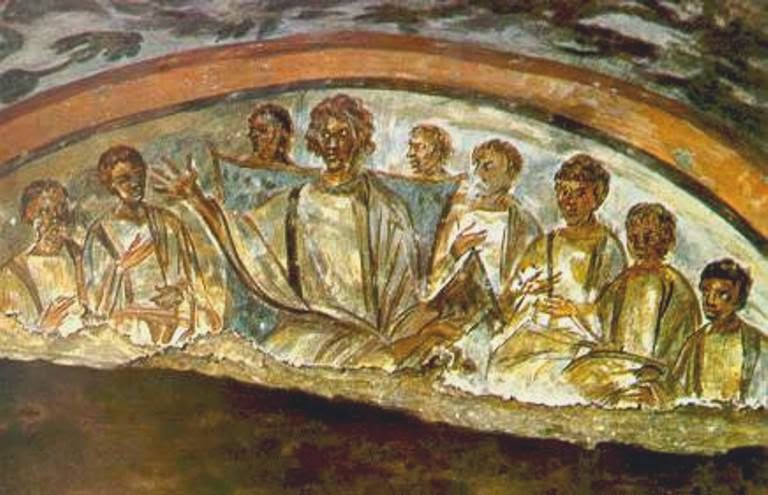
Catena Aurea by St. Thomas Aguinas
5:13
13. Ye are the salt of the earth: but if the salt have lost his savour, wherewith shall it be salted? it is thenceforth good for nothing, but to be cast out, and to be trodden under foot of men.
CHRYSOSTOM. When He had delivered to His Apostles such sublime precepts, so much greater than the precepts of the Law, that they might not be dismayed and say, How shall we be able to fulfil these things? He sooths their fears by mingling praises with His instructions, saying, Ye are the salt of the earth. This shews them how necessary were these precepts for them. Not for your own salvation merely, or for a single nation, but for the whole world is this doctrine committed to you. It is not for you then to flatter and deal smoothly with men, but, on the contrary, to be rough and biting as salt is. When for thus offending men by reproving them ye are reviled, rejoice; for this is the proper effect of salt to be harsh and grating to the depraved palate. Thus the evil-speaking of others will bring you no inconvenience, but will rather be a testimony of your firmness.
HILARY. There may be here seen a propriety in our Lord’s language which may be gathered by considering the Apostles’ office, and the nature of salt. This, used as it is by men for almost every purpose, preserves from decay those bodies which are sprinkled with it; and in this, as well as in every sense of its flavour as a condiment, the parallel is most exact. The Apostles are preachers of heavenly things, and thus, as it were, salters with eternity; rightly called the salt of the earth, as by the virtue of their teaching, they, as it were, salt and preserve bodies for eternity.
REMIGIUS. Moreover, salt is changed into another kind of substance by three means, water, the heat of the sun, and the breath of the wind. Thus Apostolical men also were changed into spiritual regeneration by the water of baptism, the heat of love, and the breath of the Holy Spirit. That heavenly wisdom also, which the Apostles preached, dries up the humours of carnal works, removes the foulness and putrefaction of evil conversation, kills the work of lustful thoughts, and also that worm of which it is said their worm dieth not. (Is. 66:24.)
REMIGIUS. The Apostles are the salt of the earth, that is, of worldly men who are called the earth, because they love this earth.
JEROME. Or, because by the Apostles the whole human race is seasoned.
PSEUDO-CHRYSOSTOM. A doctor when he is adorned with all the preceding virtues, then is like good salt, and his whole people are salted by seeing and hearing him.
REMIGIUS. It should be known, that in the Old Testament no sacrifice was offered to God unless it were first sprinkled with salt, for none can present an acceptable sacrifice to God without the flavour of heavenly wisdom.
HILARY. And because man is ever liable to change, He therefore warns the Apostles, who have been entitled the salt of the earth, to continue stedfast in the might of the power committed to them, when He adds, If the salt have lost its savour, wherewith shall it be salted?
JEROME. That is, if the doctor have erred, by what other doctor shall he be corrected?
AUGUSTINE. (Serm. in Mont. i. 6.) If you by whom the nations are to be salted shall lose the kingdom of heaven through fear of temporal persecution, who are they by whom your error shall be corrected. Another copy has, If the salt have lost all sense, shewing that they must be esteemed to have lost their sense, who cither pursuing abundance, or fearing lack of temporal goods, lose those which are eternal, and which men can neither give nor take away.
HILARY. But if the doctors having become senseless, and having lost all the savour they once enjoyed, are unable to restore soundness to things corrupt, they are become useless; and are thenceforth fit only to be cast out and trodden by men.
JEROME. The illustration is taken from husbandry. Salt, though it be necessary for seasoning of meats and preserving flesh, has no further use. Indeed we read in Scripture of vanquished cities sown with salt by the victors, that nothing should thenceforth grow there.
GLOSS. (ap. Anselm.) When then they who are the heads have fallen away, they are fit for no use but to be cast out from the office of teacher.
HILARY. Or even cast out from the Church’s store rooms to be trodden under foot by those that walk.
AUGUSTINE. (ubi sup.) Not he that suffers persecution is trodden under foot of men, but he who through fear of persecution falls away. For we can tread only on what is below us; but he is no way below us, who however much he may suffer in the body, yet has his heart fixed in heaven.
5:14
14. Ye are the light of the world. A city that is set on an hill cannot be hid.
GLOSS. As the doctors by their good conversation are the salt with which the people is salted; so by their word of doctrine they are the light by which the ignorant are enlightened.
PSEUDO-CHRYSOSTOM. But to live well must go before to teach well; hence after He had called the Apostles the salt, He goes on to call them the light of the world. Or, for that salt preserves a thing in its present state that it should not change for the worse, but that light brings it into a better state by enlightening it; therefore the Apostles were first called salt with respect to the Jews and that Christian body which had the knowledge of God, and which they keep in that knowledge; and now light with respect to the Gentiles whom they bring to the light of that knowledge.
AUGUSTINE. (ubi sup.) By the world here we must not understand heaven and earth, but the men who are in the world; or those who love the world for whose enlightenment the Apostles were sent.
HILARY. It is the nature of a light to emit its rays whithersoever it is carried about, and when brought into a house to dispel the darkness of that house. Thus the world, placed beyond the pale of the knowledge of God, was held in the darkness of ignorance, till the light of knowledge was brought to it by the Apostles, and thenceforward the knowledge of God shone bright, and from their small bodies, whithersoever they went about, light is ministered to the darkness.
REMIGIUS. For as the sun sends forth his beams, so the Lord, the Sun of righteousness, sent forth his Apostles to dispel the night of the human race.
CHRYSOSTOM. Mark how great His promise to them, men who were scarce known in their own country that the fame of them should reach to the ends of the earth. The persecutions which He had foretold, were not able to dim their light, yea they made it but more conspicuous.
JEROME. He instructs them what should be the boldness of their preaching, that as Apostles they should not be hidden through fear, like lamps under a corn-measure, but should stand forth with all confidence, and what they have heard in the secret chambers, that declare upon the house tops.
CHRYSOSTOM. Thus shewing them that they ought to be careful of their own walk and conversation, seeing they were set in the eyes of all, like a city on a hill, or a lamp on a stand.
PSEUDO-CHRYSOSTOM. This city is the Church of which it is said, Glorious things are spoken of thee, thou city of God. (Ps. 87:3.) Its citizens are all the faithful, of whom the Apostle speaks, Ye are fellow-citizens of the saints. (Eph. 2:19.) It is built upon Christ the hill, of whom Daniel thus, A stone hewed without hands (Dan. 2:34.) became a great mountain.
AUGUSTINE. (ubi sup.) Or, the mountain is the great righteousness, which is signified by the mountain from which the Lord is now teaching.
PSEUDO-CHRYSOSTOM. A city set on a hill cannot be hidden though it would; the mountain which bears makes it to be seen of all men; so the Apostles and Priests who are founded on Christ cannot be hidden even though they would, because Christ makes them manifest.
HILARY. Or, the city signifies the flesh which He had taken on Him; because that in Him by this assumption of human nature, there was as it were a collection of the human race, and we by partaking in His flesh become inhabitants of that city. He cannot therefore be hid, because being set in the height of God’s power, He is offered to be contemplated of all men in admiration of his works.
PSEUDO-CHRYSOSTOM. How Christ manifests His saints, suffering them not to be hid, He shews by another comparison, adding, Neither do men light a lamp to put it under a corn-measure, but on a stand.
CHRYSOSTOM. Or, in the illustration of the city, He signified His own power, by the lamp He exhorts the Apostles to preach with boldness; as though He said, ‘I indeed have lighted the lamp, but that it continue to burn will be your care, not for your own sakes only, but both for others who shall receive its light and for God’s glory.’
PSEUDO-CHRYSOSTOM. The lamp is the Divine word, of which it is said, Thy word is a lamp unto my feet. (Ps. 119:105.) They who light this lamp are the Father, the Son, and the Holy Spirit.
AUGUSTINE. (ubi sup.) With what meaning do we suppose the words, to put it under a corn-measure, were said? To express concealment simply, or that the corn-measure has a special signification? The putting the lamp under the corn-measure means the preferring bodily ease and enjoyment to the duty of preaching the Gospel, and hiding the light of good teaching under temporal gratification. The corn-measure aptly denotes the things of the body, whether because our reward shall be measured out to us, as each one shall receive the things done in the body; (2 Cor. 5:10.) or because worldly goods which pertain to the body come and go within a certain measure of time, which is signified by the corn-measure, whereas things eternal and spiritual are contained within no such limit. He places his lamp upon a stand, who subdues his body to the ministry of the word, setting the preaching of the truth highest, and subjecting the body beneath it. For the body itself serves to make doctrine shine more clear, while the voice and other motions of the body in good works serve to recommend it to them that learn.
PSEUDO-CHRYSOSTOM. Or, men of the world may be figured in the corn-measure as these are empty above, but full beneath, so worldly men are foolish in spiritual things, but wise in earthly things, and therefore like a corn-measure they keep the word of God hid, whenever for any worldly cause he had not dared to proclaim the word openly, and the truth of the faith. The stand for the lamp is the Church which bears the word of life, and all ecclesiastical persons. (vid. Phil. 2:15.)
HILARY. Or, the Lord likened the Synagogue to a corn-measure, which only receiving within itself such fruit as was raised, contained a certain measure of limited obedience.
AMBROSE. (non occ.) And therefore let none shut up his faith within the measure of the Law, but have recourse to the Church in which the grace of the sevenfold Spirit shines forth.
BEDE. (in loc. quoad sens.) Or, Christ Himself has lighted this lamp, when He filled the earthen vessel of human nature with the fire of His Divinity, which He would not either hide from them that believe, nor put under a bushel that is shut up under the measure of the Law, or confine within the limits of any one oration. The lampstand is the Church, on which He set the lamp, when He affixed to our foreheads the faith of His incarnation.
HILARY. Or, the lamp, i. e. Christ Himself, is set on its stand when He was suspended on the Cross in His passion, to give light for ever to those that dwell in the Church; to give light, He says, to all that are in the house.
AUGUSTINE. For it is not absurd if any one will understand the house to be the Church. Or, the house may be the world itself, according to what He said above, Ye are the light of the world.
HILARY. He instructs the Apostles to shine with such a light, that in the admiration of their work God may be praised, Let your light so shine before men, that they may see your good works.
PSEUDO-CHRYSOSTOM. That is, teaching with so pure a light, that men may not only hear your words, but see your works, that those whom as lamps ye have enlightened by the word, as salt ye may season by your example. For by those teachers who do as well as teach, God is magnified; for the discipline of the master is seen in the behaviour of the family. And therefore it follows, and they shall glorify your Father which is in heaven.
AUGUSTINE. (Serm. in Mont. i. 7.) Had He only said, That they may see your good works, He would have seemed to have set up as an end to be sought the praises of men, which the hypocrites desire; but by adding, and glorify your Father, he teaches that we should not seek as an end to please men with our good works, but referring all to the glory of God, therefore seek to please men, that in that God may be glorified.
HILARY. He means not that we should seek glory of men, but that though we conceal it, our work may shine forth in honour of God to those among whom we live.
Catena Aurea Matthew 5
St. Robert of Newminster
He was a native of Yorkshire, and even in his childhood an enemy to the usual amusements of that age, loving only prayer, serious reading, and useful and pious employments. Having finished his studies, he was ordained priest, and instituted to a rectorship of a parish in the diocese of York; but after discharging that office some time with great assiduity and zeal, he resigned that living, and took the religious habit in the Benedictine monastery of our Lady in York. Richard, the prior of this house, and twelve others, desiring to serve God according to the primitive institute of the Benedictine Order, left the monastery, with leave of the abbot, and endeavoring to execute their project, struggled with incredible hardships; till Thurstan, the pious archbishop of York, gave them a desert valley, called Scheldale, with the town of Sutton, where, in the midst of winter, and in extreme poverty they founded the celebrated abbey which, from certain springs, was called Fountains, in 1132 (*). The Cistercian Order, which had been lately introduced into England, and settled at Rievalle, was perfectly agreeable to the fervent dispositions of this holy colony; and at their request the monastery of Fountains was received into it by St. Bernard, who in his letters extols the perfection and sanctity of this new nursery of saints, which, from the beginning, was a model to the whole order for devotion, austerity in fasts, labor, by which all the monks procured their subsistence, fervor in all religious exercises, and cheerfulness in singing assiduously the divine praises. No murmur or sadness was known among them; nor any strife or contention ever heard of, unless of charity or humility: they never yielded to rest, till fatigued with labor; and always came hungry from their slender table, which was chiefly furnished with pulse and roots from their garden. St. Robert seemed so far to eclipse the rest of this holy company by the lustre of his piety, that they all had their eyes on him in their religions duties, and studied to transcribe his fervor in their actions. Ranulph of Merley, baron of Morpeth, paying a visit to the monastery of Fountains five years after its foundation, was so struck with the edifying deportment of the terrestrial angels who inhabited it, that he obtained of the abbot Richard a certain number of those monks, and built for them a monastery called Newminster, near Morpeth, in Northumberland, in 1137, of which St. Robert was appointed abbot.
The saint in his new dignity thought it his duty not only to walk before his brethren, but to go beyond them all in every religious observance; and all his virtues seemed to receive new vigor, and a new degree of perfection in this eminent station. His affection to holy prayer is not to be expressed. He recommended to God continually those committed to his care, and with many tears poured forth his soul for them night and day. He was favored with the gift of prophecy and miracles. He founded another monastery a Pipinelle, or Rivebelle, in Northamptonshire, and lived in the strictest union of holy friendship with St. Bernard; also with St. Godric, a holy hermit in those parts, illiterate as to secular learning, but a most spiritual man. St. Robert finished his course by a happy death on the 7th of June, 1159. Miracles attested his sanctity to the world. He is named in the Roman Martyrology.
ewtn.com(*) Dissolved and desecrated by order of Henry VIII, in 1539
From: Matthew 5:13-16Salt of the Earth and Light of the World
----------------------------------------
(Jesus said to the multitude:) [13] "You are the salt of the earth; but if salt has lost its taste, how shall its saltness be restored? It is no longer good for anything except to be thrown out and trodden under foot by men.
[14] "You are the light of the world. A city set on a hill cannot be hid. [15] Nor do men light a lamp and put it under a bushel, but on a stand, and it gives light to all in the house. [16] Let your light so shine before men, that they may see your good works and give glory to your Father who is in Heaven."
***********************************************************************
Commentary:
13-16. These verses are a calling to that apostolate which is part and parcel of being a Christian. Every Christian has to strive for personal sanctification, but he also has to seek the sanctification of others. Jesus teaches us this, using the very expressive simile of salt and light. Salt preserves food from corruption; it also brings out its flavor and makes it more pleasant; and it disappears into the food; the Christian should do the same among the people around him.
"You are salt, apostolic soul. `Bonum est sal': salt is a useful thing', we read in the holy Gospel; `si autem sal evanuerit': but if the salt loses its taste', it is good for nothing, neither for the land nor for the manure heap; it is thrown out as useless. You are salt, apostolic soul. But if you lose your taste..." (St J. Escriva, "The Way", 921).
Good works are the fruit of charity, which consists in loving others as God loves us (cf. John 15:12). "I see now", St. Therese of Lisieux writes, "that true charity consists in bearing with the faults of those about us, never being surprised at their weaknesses, but edified at the least sign of virtue. I see above all that charity must not remain hidden in the bottom of our hearts: `nor do men light a lamp and put it under a bushel, but on a stand, and it gives light to all in the house.' It seems to me that this lamp is the symbol of charity; it must shine out not only to cheer those we love best but all in the house" ("The Autobiography of a Saint", Chapter 9).
Apostolate is one of the clearest expressions of charity. The Second Vatican Council emphasized the Christian's duty to be apostolic. Baptism and Confirmation confer this duty, which is also a right (cf. "Lumen Gentium", 33), so much so that, because the Christian is part of the mystical body, "a member who does not work at the growth of the body to the extent of his possibilities must be considered useless both to the Church and to himself" ("Apostolicam Actuositatem", 2). "Laymen have countless opportunities for exercising the apostolate of evangelization and sanctification. The very witness of a Christian life, and good works done in a supernatural spirit, are effective in drawing men to the faith and to God; and that is what the Lord has said: "Let your light so shine before men, that they may see your good works and give glory to your Father who is in Heaven" ("Apostolicam Actuositatem", 6).
"The Church must be present to these groups [those who do not even believe in God] through those of its members who live among them or have been sent to them. All Christians by the example of their lives and witness of their word, wherever they live, have an obligation to manifest the new man which they put on in Baptism, and to reveal the power of the Holy Spirit by whom they were strengthened at Confirmation, so that others, seeing their good works, might glorify the Father and more perfectly perceive the true meaning of human life and the universal solidarity of mankind" ("Ad Gentes", 11; cf. 36).
Source: Daily Word for Reflection—Navarre Bible Commentary