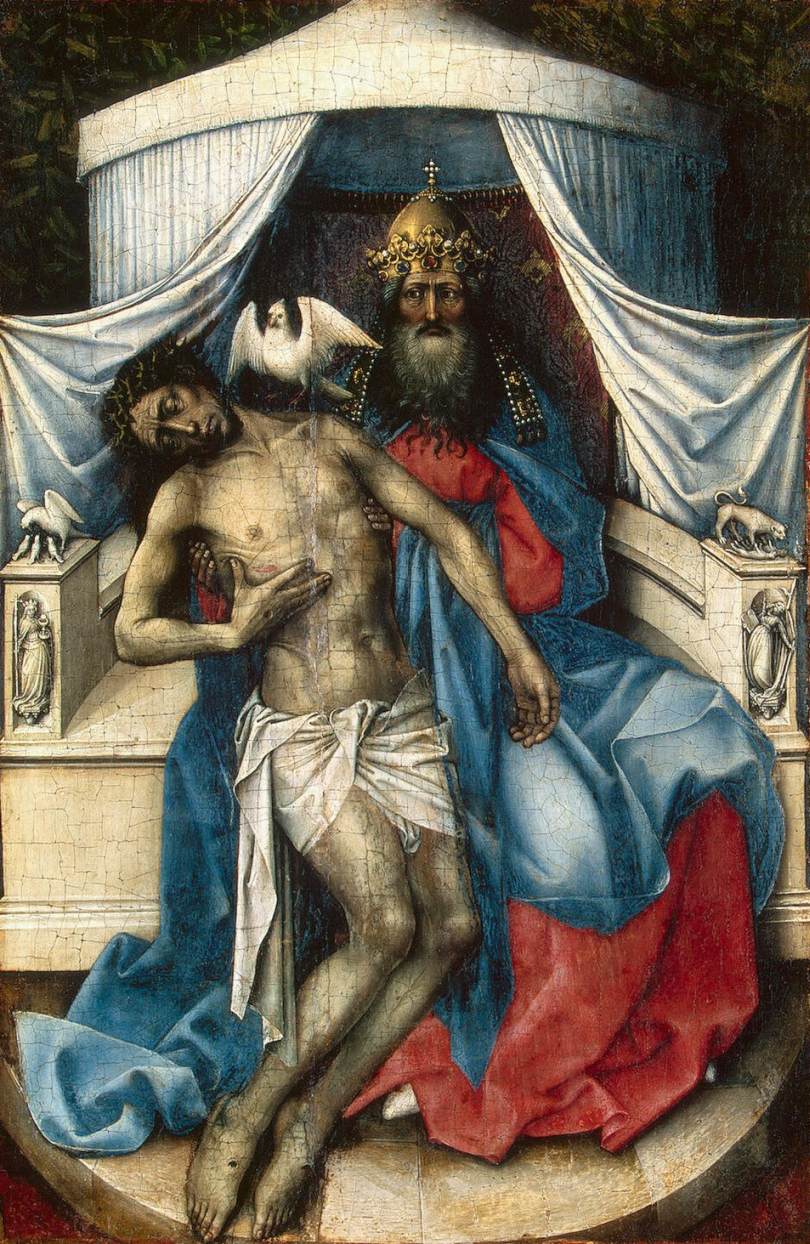
Catena Aurea by St. Thomas Aguinas
14:5–7
5. Thomas saith unto him, Lord, we know not whither thou goest; and how can we know the way?
6. Jesus saith unto him, I am the way, the truth, and the life: no man cometh unto the Father, but by me.
7. If ye had known me, ye should have known My Father also; and from henceforth ye know him, and have seen him.
CHRYSOSTOM. (Hom. lxxiii. 2) If the Jews, who wished to be separated from Christ, asked whither He was going, much more would the disciples, who wished never to be separated from Him, be anxious to know it. So with much love, and, at the same time, fear, they proceed to ask: Thomas saith unto Him, Lord, we know not whither Thou goest; and how can we know the way?
AUGUSTINE. (Tr. lxix. 1) Our Lord had said that they knew both, Thomas says that they knew neither. Our Lord cannot lie; they knew not that they did know. Our Lord proves that they did: Jesus saith unto Him, I am the way, the truth, and the life.
AUGUSTINE. (de Verb. Dom. s. liv) As if He said, I am the way, whereby thou wouldest go; I am the truth, whereto thou wouldest go; I am the life, in which thou wouldest abide. The truth and the life every one understands (capit); but not every one hath found the way. Even the philosophers of the world have seen that God is the life eternal, the truth which is the end of all knowledge. And the Word of God, which is truth and life with the Father, by taking upon Him human nature, is made the way. Walk by the Man, and thou wilt arrive at God. For it is better to limp on the right way, than to walk ever so stoutly by the wrong.
HILARY. (vii. de Trin) For He who is the way doth not lead us into devious courses out of the way; nor does He who is the truth deceive us by falsehoods; nor does He who is the life leave us in the darkness of death.
THEOPHYLACT. When thou art engaged in the practical, He is made thy way; when in the contemplative, He is made thy truth. And to the active and the contemplative is joined life: for we should both act and contemplate with reference to the world to come.
AUGUSTINE. (Tr. lxix. 2) They knew then the way, because they knew He was the way. But what need to add, the truth, and the life? Because they were yet to be told whither He went. He went to the truth; He went to the life. He went then to Himself, by Himself. But didst Thou leave Thyself, O Lord, to come to us? (c. 3.). I know that Thou tookest upon Thee the form of a servant; by the flesh Thou camest, remaining where Thou wast; by that Thou returnedst, remaining where Thou hadst come to. If by this then Thou camest, and returnedst, by this Thou wast the way, not only to us, to come to Thee, but also to Thyself to come, and to return again. And when Thou wentest to life, which is Thyself, Thou raisedst that same flesh of Thine from death to life. Christ therefore went to life, when His flesh arose from death to life. And since the Word is life, Christ went to Himself; Christ being both, in one person, i. e. Word-flesh. Again, by the flesh God came to men, the truth to liars; for God is true, but every man a liar. When then He withdrew Himself from men, and lifted up His flesh to that place in which no liar is, the same Christ, by the way, by which He being the Word became flesh, by Himself, i. e. by His flesh, by the same returned to Truth, which is Himself, which truth, even amongst the liars He maintained unto death. Behold I myself1, if I make you understand what I say, do in a certain sense go to you, though I do not leave myself. And when I cease speaking, I return to myself, but remain with you, if ye remember what ye have heard. If the image which God hath made can do this, how much more the Image which God hath begotten? Thus He goes by Himself, to Himself and to the Father, and we by Him, to Him and to the Father.
CHRYSOSTOM. (Hom. lxxiii. 2) For if, He says, ye have Me for your guide to the Father, ye shall certainly come to Him. Nor can ye come by any other way. (c. 6:44) Whereas He had said above, No man can come to Me, except the Father draw him, now He says, No man cometh unto the Father but by Me, thus equalling Himself to the Father. The next words explain, Whither I go ye know, and the way ye know. If ye had known Me, He says, ye should have known My Father also; i. e. If ye had known My substance and dignity, ye would have known the Father’s. They did know Him, but not as they ought to do. Nor was it till afterwards, when the Spirit came, that they were fully enlightened. On this account He adds, And from henceforth ye know Him, know Him, that is, spiritually. And have seen Him, i. e. by Me; meaning that he who had seen Him, had seen the Father. They saw Him, however, not in His pure substance, but clothed in flesh.
BEDE. How can our Lord say, If ye had known Me, ye should have known My Father also; when He has just said, Whither I go ye know, and the way ye know? We must suppose that some of them knew, and others not: among the latter, Thomas.
HILARY. (vii. de Trin) Or thus: When it is said that the Son is the way to the Father, is it meant that He is so by His teaching, or by His nature? We shall be able to see from what follows: If ye had known Me, ye should have known My Father also. In His incarnation asserting His Divinity, He maintained a certain order of sight and knowledge: separating the time of seeing from that of knowing. For Him, who He saith must be known, He speaks of as already seen: that henceforward they might from this revelation have knowledge of the Divine Nature which they had all along seen in Him.
14:8–11
8. Philip saith unto him, Lord, shew us the Father, and it sufficeth us.
9. Jesus saith unto him, Have I been so long time with you, and yet hast thou not known me, Philip? he that hath seen me hath seen the Father; and how sayest thou then, Shew us the Father?
10. Believest thou not that I am in the Father, and the Father in me? the words that I speak unto you I speak not of myself: but the Father that dwelleth in me, he doeth the works.
11. Believe me that I am in the Father, and the Father in me: or else believe me for the very works’ sake.
HILARY. (vii. de Trin) A declaration so new startled Philip. Our Lord is seen to be man. He confesses Himself to be the Son of God, declares that, if He were known, the Father would be known, that, if He is seen, the Father is seen. The familiarity of the Apostle therefore breaks forth into questioning our Lord, Philip saith unto Him, Lord, shew us the Father, and it sufficeth us.He did not deny He could be seen (non visum negavit), but wished to be shewn him; nor did he wish to see with his bodily eyes, but that He whom he had seen might be made manifest to his understanding. He had seen the Son in the form of man, but how through that form He saw the Father, he did not know. This he wants to be shewn him, shewn to his understanding, not set before his eyes; and then he will be satisfied: And it sufficeth us.
AUGUSTINE. (i. de Trin. c. viii) For to that joy of beholding His face, nothing can be added. Philip understood this, and said, Lord, shew us the Father, and it sufficeth us. But he did not yet understand that he could in the same way have said, Lord, shew us Thyself, and it sufficeth us. But our Lord’s answer enlightens him, Jesus saith unto him, Have I been so long with you, and yet hast thou not known Me, Philip?
AUGUSTINE. (Tr. lxx. 1) But how is this, when our Lord said that they knew whither He was going, and the way, because they knew Him? The question is easily settled by supposing that some of them knew, and others not; among the latter, Philip.
HILARY. (vii. de Trin) He reproves the ignorance of Philip in this respect. For whereas his actions had been strictly divine, such as walking on the water, commanding the winds, remitting sins, raising the dead, He complained that in His assumed humanity, the Divine nature was not discerned. Accordingly to Philip’s request, to be shewn the Father, Our Lord answers, He that hath seen Me, hath seen the Father.
AUGUSTINE. (Tr. lxx) When two persons are very like each, we say, If you have seen the one, you have seen the other. So here, He that hath seen Me, hath seen the Father; not that He is both the Father, and the Son, but that the Son is an absolute likeness of the Father.
HILARY. (vii. de Trin) He does not mean the sight of the bodily eye: for His fleshly part, born of the Virgin, doth not avail towards contemplating the form and image of God in Him; but the Son of God being known with the understanding, it follows that the Father is known also, forasmuch as He is the image of God, not differing from but expressing His Author1. For our Lord’s expressions do not speak of one person solitary and without relationship, but teach us His birth. The Father also excludes the supposition of a single solitary person, and leaves us no other doctrine but that the Father is seen in the Son, by the incommunicable likeness of birth.
AUGUSTINE. (Tr. lxx. 3) But is he to be reproved, who, when he has seen the likeness, wishes to see the man of whom he is the likeness? No: our Lord rebuked the question, only with reference to the mind of the asker. Philip asked, as if the Father were better than the Son; and so shewed that He did not know the Son. Which opinion our Lord corrects: Believest thou not that I am in the Father, and the Father in Me? as if He said, If it is a great wish with thee to see the Father, at any rate believe what thou dost not see.
HILARY. (vii. de Trin) For what excuse was there for ignorance of the Father, or what necessity to shew Him, when the Father was seen in the Son by His essential nature2, while by the identity of unity, the Begotten and the Begetter are one: Believest thou not that I am in the Father and the Father in Me?
AUGUSTINE. (i. de. Trin. 8) He wished him to live by faith, before he had sight, and therefore says, Believest thou not? Spiritual vision is the reward of faith, vouchsafed to minds purified by faith.
HILARY. (vii. de Trin) But the Father is in the Son, and the Son in the Father, not by a conjunction of two harmonizing essences3, nor by a nature grafted into a more capacious substance as in material bodies, in which it is impossible that what is within can be made external to that which contains it; but by the birth of a nature which is life from life; forasmuch as from God nothing but God can be born.
HILARY. (v. de Trin) The unchangeable God follows, so to speak, His own nature, by begetting unchangeable God. Nor does the perfect birth of unchangeable God from unchangeable God forsake His own nature. We understand then here the nature of God subsisting in Him, since God is in God, nor besides Him who is God, can any other be God.
CHRYSOSTOM. (Hom. lxxiv. 1) Or thus: Philip, because [he thought] he had seen the Son with his bodily eye, wished to see the Father in the same way; perhaps too remembering what the Prophet said, I saw the Lord, and therefore he says, Shew us the Father. (Isa. 6:1) The Jews had asked, who was His Father; and Peter and Thomas, whither He went; and neither were told plainly. Philip therefore, that he might not seem burdensome, after saying, Shew us the Father, adds, And it sufficeth us: i. e. we seek for no more. Our Lord in reply does not say, that he asked an impossible thing, but that he had not seen the Son to begin with, for that if he had seen Him, he would have seen the Father: Have I been so long time with you, and yet hast thou not known Me? He does not say, not seen Me, but, not known Me; not known that the Son, being what the Father is, does in Himself fitly shew the Father. Then dividing the Persons, He says, He that hath seen Me hath seen the Father; that none might maintain that He was both the Father and the Son. The words shew too that even the Son was not seen in a bodily sense. So if any one takes seeing here, for knowing, I will not contradict him, but will take the sentence as if it was, He that hath known Me, hath known the Father. He shews here His consubstantiality with the Father: He that hath seen My substance, hath seen the Father. Whence it is evident He is not a creature: for all know and see the creature, but not all God; Philip, for instance, who wished to see the substance of the Father. If Christ then had been of another substance from the Father, He would never have said, He that hath seen Me, hath seen the Father. A man cannot see the substance of gold in silver: one nature cannot be made apparent by another.
AUGUSTINE. (Tr. lxx. 3. and lxxi. 1) He then addresses all of them, not Philip only: The word that I speak unto you, I speak not of Myself. What is, I speak not of Myself, but, I that speak am not of Myself? He attributes what He does to Him, from whom He Himself, the doer, is.
HILARY. (vii. de Trin) Wherein He neither desires Himself to be the Son, nor hides the existence1 of His Father’s power in Him. In that He speaks, it is Himself that speaks in His own person; in that He speaks not of Himself, He witnesseth His nativity, that He is God from God.
CHRYSOSTOM. (Hom. lxxiv. 2) Mark the abundant proof of the unity of substance. For He continues; But the Father that dwelleth in Me, He doeth the works. As if He said, My Father and I act together, not differently from each other; agreeing with what He said below: If I do not the works of My Father, believe Me not. But why does He pass from words to works? Why does He not say as we might have expected, He speaketh the words? Because He means to apply what He says both to His doctrine, and to His miracles; or because His words are themselves works.
AUGUSTINE. (Tr. lxx. 1, 2) For he that edifieth his neighbour by speaking, doth a good work. These two sentences are brought against us by different sects of heretics; the Arians saying that the Son is unequal to the Father, because He does not speak of Himself; the Sabellians, that the same who is the Father is the Son. For what is meant, they ask, by, The Father that dwelleth in Me, He doeth the works, but, I that dwell in Myself, do these works.
HILARY. (vii. de Trin) That the Father dwells in the Son, shews that He is not single, or solitary; that the Father works by the Son, shews that He is not different or alien. As He is not solitary who doth not speak from Himself, so neither is He alien and separable who speaketh by Him. Having shewn then that the Father spoke and worked in Him, He formally states this union: Believe Me that I am in the Father, and the Father in Me: that they might not think that the Father worketh and speaketh in the Son as by a mere agent or instrument, not by the unity of nature implied in His Divine birth.
AUGUSTINE. (Tr. lxxi. 2) Philip alone was reproved before.
CHRYSOSTOM. (Hom. lxxiv. 2) But if this does not suffice to shew ray consubstantiality, at least learn it from My works: Or else believe Me for the very works’ sake. Ye have seen My miracles, and all the proper signs of My divinity; works which the Father alone worketh, sins remitted, life restored, and the like.
AUGUSTINE. (Tr. lxxi. 2) Believe then for My works’ sake, that I am in the Father, and the Father in Me; for, were we separated, we could not be working together.
14:12–14
12. Verily, verily, I say unto you, He that believeth on me, the works that I do shall he do also: and greater works than these shall he do; because I go unto my Father.
13. And whatsoever ye shall ask in my name, that will I do, that the Father may be glorified in the Son.
14. If ye shall ask any thing in my name, I will do it.
CHRYSOSTOM. (Hom. lxxiv. 2) Having said, Believe for the works’ sake, our Lord goes on to declare that He can do much greater than these, and what is more wonderful, give others the power of working them. Verily, verily, I say unto you, He that believeth on Me, the works that I do, shall he do also; and greater works than these shall he do.
AUGUSTINE. (Tr. lxxi. 3) But what are these greater works? Is it that the shadow of the Apostles, as they passed, by, healed the sick? It is indeed a greater thing that a shadow should heal, than that the border of a garment should. Nevertheless, by works here our Lord refers to His words. For when He says, My Father that dwelleth in Me, He doeth the works, what are these works but the words which He spoke? And the fruit of those words was their faith. But these were but few converts in comparison with what those disciples made afterwards by their preaching: they converted the Gentiles to the faith. Did not the rich man go away sorrowful from His words? And yet that which one did not do at His own exhortation, many did afterwards when He preached through the disciples. He did greater works when preached by the believing, than when speaking to men’s ears. (lxxii. 2). Still these greater works He did by His Apostles, whereas He includes others besides them, when He says, He that believeth on Me. Are we not to compute any one among the believers in Christ, who does not do greater works than Christ? This sounds harsh if not explained. The Apostle says, To him that believeth on Him that justifieth the ungodly, his faith is counted for righteousness. (Rom. 4:5) By this work then we shall do the works of Christ, the very believing in Christ being the work of Christ, for He worketh this in us, though not without us. Attend then’; He that believeth on Me, the works that I do, shall he do also. First I do them, then he will do them: I do them, that he may do them. Do what works but this, viz. that a man, from being a sinner, become just? which thing Christ worketh in us, though not without us. This in truth I call a greater work to do, than to create the heaven and the earth; for heaven and earth shall pass away, but the salvation and justification of the predestinated shall remain. (c. 3.). However, the Angels in heaven are the work of Christ; shall he who worketh with Christ for his own justification, do greater even than these? Judge any one which be the greater work, to create the just, or to justify the ungodly? At least, if both be of equal power, the latter hath more of mercy. But it is not necessary to understand all the works of Christ, when He says, greater works than these shall he do. These perhaps refers to the works He had done that hour. He had then been instructing them in the faith1. And surely it is a less work to preach righteousness, which He did without us, than to justify the ungodly, which He so does in us, as that we do it ourselves. Great things truly did our Lord promise His people, when He went to His Father: Because I go unto My Father.
CHRYSOSTOM. (Hom. lxxiv. 2) i. e. I shall not perish, but shall remain in My proper dignity, in heaven. Or He means: It is your part henceforth to work miracles, since I am going.
AUGUSTINE. (Tract. lxxiii. 2) And that no one might attribute the merit to himself, He shews, that even those greater works were His own doing: And whatsoever ye shall ask in My name, that will I do. Before it was, He shall do, now, I will do: as if He said, Let not this appear impossible to you. He that believeth in Me, will not be greater than I; but I shall do greater works then than now; greater by him that believeth on Me, than now by Myself; which will not be a failing, but a condescension.
CHRYSOSTOM. (Hom. lxxiv. 2) In My name, He says. Thus the Apostles; In the name of Jesus of Nazareth, arise and walk. (Acts 3:6) All the miracles that they did, He did: the hand of the Lord was with them.
THEOPHYLACT. This is an explanation of the doctrine of miracles. It is by prayer, and invocation of His name, that a man is able to work miracles.
AUGUSTINE. (Tract. lxxii. 2) Whatsoever ye shall ask. Then why do we often see believers asking, and not receiving? Perhaps it is that they ask amiss. When a man would make a bad use of what he asks for, God in His mercy does not grant him it. Still if God even in kindness often refuses the requests of believers, how are we to understand, Whatsoever ye shall ask in My name, I will do? Was this said to the Apostles only? No. He says above, He that believeth on Me, the works that I do shall he do also. And if we go to the lives of the Apostles themselves, we shall find that he who laboured more than they all, prayed that the messenger of Satan might depart from him, but was not granted his request. But attend: does not our Lord lay down a certain condition? In My name, which is Christ Jesus. Christ signifies King, Jesus, Saviour. Therefore whatever we ask for that would hinder our salvation, we do not ask in our Saviour’s name: and yet He is our Saviour, not only when He does what we ask, but also when He does not. When He sees us ask any thing to the disadvantage of our salvation, He shews Himself our Saviour by not doing it. The physician knows whether what the sick man asks for is to the advantage or disadvantage of his health; and does not allow what would be to his hurt, though the sick man himself desires it; but looks to his final cure. And some things we may even ask in His name, and He will not grant them us at the time, though He will some time. What we ask for is deferred, not denied. He adds, that the Father may be glorified in the Son. The Son does not do any thing without the Father, inasmuch as He does it in order that the Father may be glorified in Him.
CHRYSOSTOM. (Hom. lxxiv. 2) For when the great power of the Son is manifested, He that begat Him is glorified. He introduces this last, to confirm the truth of what He has said.
THEOPHYLACT. Observe the order (ἀκολουθίαν) in which the glorifying of the Father comes. In the name of Jesus miracles were done, by which men were made to believe the Apostles’ preaching. This brought them to the knowledge of the Father, and thus the Father was glorified in the Son.
Catena Aurea John 14
NAVARRE BIBLE COMMENTARY (RSV)
Ad Majorem Dei Gloriam (To the Greater Glory of God)
From: 1 Corinthians 15:1-8
Christ's Resurrection and His Appearances
-----------------------------------------
[1] Now I would remind you, brethren, in what terms I preached to you the gospel, which you received, in which you stand, [2] by which you are saved, if you hold it fast--unless you believed in vain.
[3] For I delivered to you as of first importance what I also received, that Christ died for our sins in accordance with the scriptures, [4] that he was buried, that he was raised on the third day in accordance with the scriptures, [5] and that he appeared to Cephas, then to the twelve. [6] Then he appeared to more than five hundred brethren at one time, most of whom are still alive, though some have fallen asleep. [7] Then he appeared to James, then to all the apostles. [8] Last of all, as to one untimely born, he appeared also to me.
***********************************************************************
Commentary:
1-58. Some of the Corinthian Christians were objecting to the doctrine of the resurrection of the dead, because this was a belief with which Greeks were unfamiliar, even those Greeks who held that the soul was immortal. Given the great importance of this doctrine, St Paul replies at length, pointing first to the historical fact of Christ's resurrection (vv. 1-11) and how it necessarily connects up with the resurrection of the dead in general (vv. 12-34). He then goes on to discuss what form this resurrection will take (vv. 35-58). This epistle, which began with an exposition on Jesus Christ crucified, the power and wisdom of God (cf. 1:18-2:5), ends with a development of doctrine on the resurrection of Christ and the consequent resurrection of the members of his mystical body.
To understand what St Paul is saying it is useful to bear in mind that here he is referring only to the glorious resurrection of the just. Elsewhere in Sacred Scripture it is clearly stated that all men will rise from the dead (cf., e.g., Jn 5:28-29; Acts 24:15).
1-11. The resurrection of Jesus Christ is one of the essential doctrines of the Catholic faith, explicitly stated in the first creeds or symbols of the faith. It is in fact the supreme argument in favor of the divinity of Jesus and his divine mission: our Lord proclaimed it many times (cf., e.g., Mt 16:21-28; 17:22-27; 20:17-19), and by rising from the dead he provided the sign which he had promised those who did not believe him (cf. Mt 12:38-40).
This point is so important that the primary role of the Apostles is to bear witness to Christ's resurrection (cf. Acts 1:22; 2:32; 3:15; etc.); the proclamation of the resurrection of the Lord is the very core of apostolic catechesis (cf., e.g., the discourses of St Peter and St Paul reported in the Acts of the Apostles).
3-8. On the verbs "deliver" and "receive" see the note on 1 Cor 11:23-26. St Paul reminds the Corinthians of certain basic points in his preaching--that Jesus Christ died for our sins; "that he was buried, that he was raised on the third day in accordance with the scriptures" (a statement which has passed directly into the Creed) and was seen by many people.
It should be pointed out that the Greek verb translated as "appeared" refers to being seen by the eye. This is relevant to studying the nature of the appearances of the risen Jesus: St Paul is speaking of true, ocular, sight; there seems to be no way this can be identified with imagination or intellectual vision.
The appearances of the risen Christ are a direct proof of the historical fact of his resurrection. This argument gains special force when one remembers that at the time this letter was written many people who had seen the risen Lord were still alive (v. 6). Some of the appearances referred to by St Paul are also mentioned in the Gospels and in Acts--that to Peter (cf. Lk 24:34), those to the Apostles (cf., e.g., Lk 24:36-49; Jn 20:19-29), that to St Paul himself (cf. Acts 9:1-6); others--that to James and to the five hundred brethren—are mentioned only here.
The importance of this passage is enhanced by the fact that it is the earliest documentary record earlier than the Gospels--of our Lord's resurrection, which had taken place scarcely twenty years earlier.
4. "Was buried": in recounting the death of Christ, all four evangelists expressly mention that his body was buried (cf. Mt 27:57-61 and par.). St Paul also confirms the fact in this letter, written very soon after the time, thereby confirming a tradition which had come down from the beginning (v. 3). The fact that Christ's body was buried eliminates any doubt about his death, and underlines the miracle of the Resurrection: Jesus Christ rose by his own power, rejoining his soul with his body, and leaving the tomb with the same human body (not merely the appearance of a body) as died and was buried, although now that body was glorified and had certain special properties (cf. note on 15:42-44). The Resurrection, therefore, is an objective, physical event, witnessed to by the empty tomb (cf. Mt 28:1ff and par) and by Christ's appearances.
"He was raised on the third day": Jesus died and was buried on the evening of Good Friday; his body lay in the tomb the entire sabbath, and rose on the Sunday. It is correct to say that he rose on the third day after his death, even though it was not a full seventy-two hours later.
"According to the scriptures": St Paul may be referring to certain passages of the Old Testament which--"after" the event--were seen to foreshadow the Resurrection--for example, the episode of Jonah (chaps.1-2), which Jesus in fact applied to himself (cf. Mt 12:39-40; cf. also Hos 6:1-2 and Ps 16:9-10).