Skip to comments.
Catholic Caucus: Daily Mass Readings 10-March-2022
Universalis/Jerusalem Bible ^
Posted on 03/10/2022 4:56:11 AM PST by annalex
10 March 2022
Thursday of the 1st week of Lent

Chapel and park of the Castle of Prieisch, Basse-Rentgen (France) Readings at MassLiturgical Colour: Violet.
| First reading | Esther 4:17 © |
|---|
I am alone, Lord, and have no-one but youQueen Esther took refuge with the Lord in the mortal peril which had overtaken her. She besought the Lord God of Israel in these words: ‘My Lord, our King, the only one, come to my help, for I am alone and have no helper but you and am about to take my life in my hands. ‘I have been taught from my earliest years, in the bosom of my family, that you, Lord, chose Israel out of all the nations and our ancestors out of all the people of old times to be your heritage for ever; and that you have treated them as you promised. ‘Remember, Lord; reveal yourself in the time of our distress. ‘As for me, give me courage, King of gods and master of all power. Put persuasive words into my mouth when I face the lion; change his feeling into hatred for our enemy, that the latter and all like him may be brought to their end. ‘As for ourselves, save us by your hand, and come to my help, for I am alone and have no one but you, Lord.’
| Responsorial Psalm |
|---|
| Psalm 137(138):1-3,7-8 © |
|---|
On the day I called, you answered me, O Lord. I thank you, Lord, with all my heart: you have heard the words of my mouth. In the presence of the angels I will bless you. I will adore before your holy temple. On the day I called, you answered me, O Lord. I thank you for your faithfulness and love, which excel all we ever knew of you. On the day I called, you answered; you increased the strength of my soul. On the day I called, you answered me, O Lord. You stretch out your hand and save me, your hand will do all things for me. Your love, O Lord, is eternal, discard not the work of your hands. On the day I called, you answered me, O Lord.
| Gospel Acclamation | Joel2:12-13 |
|---|
Glory to you, O Christ, you are the Word of God! Now, now – it is the Lord who speaks – come back to me with all your heart, for I am all tenderness and compassion. Glory to you, O Christ, you are the Word of God! Glory to you, O Christ, you are the Word of God! A pure heart create for me, O God, and give me again the joy of your help. Glory to you, O Christ, you are the Word of God!
Ask, and it will be given to you; search, and you will findJesus said to his disciples, ‘Ask, and it will be given to you; search, and you will find; knock, and the door will be opened to you. For the one who asks always receives; the one who searches always finds; the one who knocks will always have the door opened to him. Is there a man among you who would hand his son a stone when he asked for bread? Or would hand him a snake when he asked for a fish? If you, then, who are evil, know how to give your children what is good, how much more will your Father in heaven give good things to those who ask him! ‘So always treat others as you would like them to treat you; that is the meaning of the Law and the Prophets.’ The readings on this page are from the Jerusalem Bible, which is used at Mass in most of the English-speaking world. The New American Bible readings, which are used at Mass in the United States, are available in the Universalis apps, programs and downloads.
You can also view this page with the Gospel in Greek and English. |
TOPICS: Catholic; General Discusssion; Prayer; Worship
KEYWORDS: catholic; mt7; ordinarytime; prayer
For your reading, reflection, faith-sharing, comments, questions, discussion.
1
posted on
03/10/2022 4:56:11 AM PST
by
annalex
To: All
KEYWORDS: catholic; mt7; ordinarytime; prayer
2
posted on
03/10/2022 4:56:48 AM PST
by
annalex
(fear them not)
To: nickcarraway; NYer; ELS; Pyro7480; livius; ArrogantBustard; Catholicguy; RobbyS; marshmallow; ...
Alleluia Ping Please FReepmail me to get on/off the Alleluia Ping List.
3
posted on
03/10/2022 4:57:50 AM PST
by
annalex
(fear them not)
To: annalex
4
posted on
03/10/2022 4:58:14 AM PST
by
annalex
(fear them not)
To: annalex
| Matthew |
| | English: Douay-Rheims | Latin: Vulgata Clementina | Greek NT: Byzantine/Majority Text (2000) |
| | Matthew 7
|
| 7. | Ask, and it shall be given you: seek, and you shall find: knock, and it shall be opened to you. | Petite, et dabitur vobis : quærite, et invenietis : pulsate, et aperietur vobis. | αιτειτε και δοθησεται υμιν ζητειτε και ευρησετε κρουετε και ανοιγησεται υμιν |
| 8. | For every one that asketh, receiveth: and he that seeketh, findeth: and to him that knocketh, it shall be opened. | Omnis enim qui petit, accipit : et qui quærit, invenit : et pulsanti aperietur. | πας γαρ ο αιτων λαμβανει και ο ζητων ευρισκει και τω κρουοντι ανοιγησεται |
| 9. | Or what man is there among you, of whom if his son shall ask bread, will he reach him a stone? | Aut quis est ex vobis homo, quem si petierit filius suus panem, numquid lapidem porriget ei ? | η τις εστιν εξ υμων ανθρωπος ον εαν αιτηση ο υιος αυτου αρτον μη λιθον επιδωσει αυτω |
| 10. | Or if he shall ask him a fish, will he reach him a serpent? | aut si piscem petierit, numquid serpentem porriget ei ? | και εαν ιχθυν αιτηση μη οφιν επιδωσει αυτω |
| 11. | If you then being evil, know how to give good gifts to your children: how much more will your Father who is in heaven, give good things to them that ask him? | Si ergo vos, cum sitis mali, nostis bona data dare filiis vestris : quanto magis Pater vester, qui in cælis est, dabit bona petentibus se ? | ει ουν υμεις πονηροι οντες οιδατε δοματα αγαθα διδοναι τοις τεκνοις υμων ποσω μαλλον ο πατηρ υμων ο εν τοις ουρανοις δωσει αγαθα τοις αιτουσιν αυτον |
| 12. | All things therefore whatsoever you would that men should do to you, do you also to them. For this is the law and the prophets. | Omnia ergo quæcumque vultis ut faciant vobis homines, et vos facite illis. Hæc est enim lex, et prophetæ. | παντα ουν οσα αν θελητε ινα ποιωσιν υμιν οι ανθρωποι ουτως και υμεις ποιειτε αυτοις ουτος γαρ εστιν ο νομος και οι προφηται |
5
posted on
03/10/2022 5:01:50 AM PST
by
annalex
(fear them not)
To: annalex

Catena Aurea by St. Thomas Aguinas
7:7–8
7. Ask, and it shall be given you; seek, and ye shall find; knock, and it shall be opened unto you:
8. For every one that asketh receiveth; and he that seeketh findeth; and to him that knocketh it shall be opened.
JEROME. Having before forbidden us to pray for things of the flesh, He now shews what we ought to ask, saying, Ask, and it shall be given you.
AUGUSTINE. (ubi sup.) Otherwise; when He commanded not to give the holy thing to dogs, and not to cast pearls before swine, the hearer conscious of his own ignorance might say, Why do you thus bid me not give the holy thing to dogs, when as yet I see not that I have any holy thing? He therefore adds in good season, Ask, and ye shall receive.
PSEUDO-CHRYSOSTOM. Otherwise; Having given them some commands for the sanctification of prayer, saying, Judge not, He adds accordingly, Ask, and it shall be given unto you, as though He were to say, If ye observe this mercy towards your enemies, whatever seems to you shut, knock, and it shall be opened to you. Ask therefore in prayer, praying day and night; seek with care and toil; for neither by toiling only in the Scriptures do we gain knowledge without God’s grace, nor do we attain to grace without study, lest the gift of God should be bestowed on the careless. But knock with prayer, and fasting, and alms. For as one who knocks at a door, not only cries out with his voice, but strikes with his hand, so he who does good works, knocks with his works. But you will say, this is what I pray that I may know and do, how then can I do it, before I receive? Do what you can that you may become able to do more, and keep what you know that you may come to know more. Or otherwise; having above commanded all men to love their enemies, and after enjoined that we should not under pretext of love give holy things to dogs; He here gives good counsel, that they should pray God for them, and it shall be granted them; let them seek out those that are lost in sins, and they shall find them; let them knock at those who are shut up in errors, and God shall open to them that their word may have access to their souls. Or otherwise; Since the precepts given above were beyond the reach of human virtue, He sends them to God to whose grace nothing is impossible, saying, Ask, and it shall be given you, that what cannot be performed by men may be fulfilled through the grace of God. For when God furnished the other animals with swift foot, or swift wing, with claws, teeth, or horns, He so made man that He Himself should be man’s only1 strength, that forced by reason of his own weakness, he might always have need of his Lord.
GLOSS. (ord.) We ask with faith, we seek with hope, we knock with love. You must first ask that you may have; after that seek that you may find; and lastly, observe what you have found that you may enter in.
AUGUSTINE. (Serm. in Mont. ii. 21.) Asking, is that we may get healthiness of soul that we may be able to fulfil the things commanded us; seeking, pertains to the discovery of the truth. But when any has found the true way, he will then come into actual possession, which however is only opened to him that knocks.
AUGUSTINE. (Retract. i. 19.) How these three differ from one another, I have thought good to unfold with this travail; but it were better to refer them all to instant prayer; wherefore He afterwards concludes, saving, He will give good things to them that ask him.
CHRYSOSTOM. And in that He adds seek, and knock, He bids us ask with much importunateness and strength. For one who seeks, casts forth all other things from his mind, and is turned to that thing singly which he seeks; and he that knocks comes with vehemence and warm soul.
PSEUDO-CHRYSOSTOM. He had said, Ask, and ye shall receive; which sinners hearing might perchance say, The Lord herein exhorts them that are worthy, but we are unworthy. Therefore He repeats it that He may commend the mercy of God to the righteous as well as to sinners; and therefore declares that every one that asketh receiveth; that is, whether he be righteous or a sinner, let him not hesitate to ask; that it may be fully seen that none is neglected but he who hesitates to ask of God. For it is not credible that God should enjoin on men that work of piety which is displayed in doing good to our enemies, and should not Himself (being good) act so.
AUGUSTINE. (Tract. in Joan. 44. 13.) Wherefore God hears sinners; for if He do not hear sinners, the Publican said in vain, Lord, be merciful to me a sinner; (Luke 18:13.) and by that confession merited justification.
AUGUSTINE. (Prosper, Sent. 212.) He who in faith offers supplication to God for the necessities of this life is heard mercifully, and not heard mercifully. For the physician knows better than the sick man what is good for his sickness. But if he asks that which God both promises and commands, his prayer shall be granted, for love shall receive what truth provides.
AUGUSTINE. (Ep. 31. 1.) But the Lord is good, who often gives us not what we would, that He may give us what we should rather prefer.
AUGUSTINE. (Serm. in Mont. ii. 21.) There is need moreover of perseverance, that we may receive what we ask for.
AUGUSTINE. (Serm. 61. 5.) In that God sometimes delays His gifts, He but recommends, and does not deny them. For that which is long looked for is sweeter when obtained; but that is held cheap, which comes at once. Ask then and seek things righteous. For by asking and seeking grows the appetite of taking. God reserves for you those things which He is not willing to give you at once, that you may learn greatly to desire great things. Therefore we ought always to pray and not to fail.
7:9–11
9. Or what man is there of you, whom if his son ask bread, will he give him a stone?
10. Or if he ask a fish, will he give him a serpent?
11. If ye then, being evil, know how to give good gifts unto your children, how much more shall your Father which is in heaven give good things to them that ask him?
AUGUSTINE. (Serm. in Mont. ii. 21.) As above He had cited the birds of the air and the lilies of the field, that our hopes may rise from the less to the greater; so also does He in this place, when He says, Or what man among you?
PSEUDO-CHRYSOSTOM. Lest perchance any one considering how great is the difference between God and man, and weighing his own sins should despair of obtaining, and so never take in hand to ask; therefore He proposes a comparison of the relation between father and son; that should we despair because of our sins, we may hope because of God’s fatherly goodness.
CHRYSOSTOM. There are two things behoveful for one that prays; that he ask earnestly; and that he ask such things as he ought to ask. And those are spiritual things; as Solomon, because he asked such things as were right, received speedily.
PSEUDO-CHRYSOSTOM. And what are the things that we ought to ask, he shews under the likeness of a loaf, and a fish. The loaf is the word concerning the knowledge of God the Father. The stone is all falsehood that has a stumbling-block of offence to the soul.
REMIGIUS. By the fish we may understand the word concerning Christ, by the serpent the Devil himself. Or by the loaf may be understood spiritual doctrine; by the stone ignorance; by the fish the water of Holy Baptism; by the serpent the wiles of the Devil, or unbelief.
RABANUS. Or; bread which is the common food signifies charity, without which the other virtues are of no avail. The fish signifies faith, which is born of the water of baptism, is tossed in the midst of the waves of this life and yet lives. Luke adds a third thing, an egg, (Luke 11:12.) which signifies hope; for an egg is the hope of the animal. To charity, He opposes a stone, that is, the hardness of hatred; to faith, a serpent, that is, the venom of treachery; to hope, a scorpion, that is, despair, which stings backward, as the scorpion.
REMIGIUS. The sense therefore is; we need not fear that should we ask of God our Father bread, that is doctrine or love, He will give us a stone; that is, that He will suffer our heart to be contracted either by the frost of hatred or by hardness of soul; or that when we ask for faith, He will suffer us to die of the poison of unbelief. Thence it follows, If then ye being evil.
CHRYSOSTOM. This He said not detracting from human nature, nor confessing the whole human race to be evil; but He calls paternal love evil when compared with His own goodness. Such is the superabundance of His love towards men.
PSEUDO-CHRYSOSTOM. Because in comparison of God who is preeminently good, all men seem to be evil, as all light shews dark when compared with the sun.
JEROME. Or perhaps he called the Apostles evil, in their person condemning the whole human race, whose heart is set to evil from his infancy, as we read in Genesis. Nor is it any wonder that He should call this generation evil, (Gen. 8:22.) as the Apostle also speaks, Seeing the days are evil.
AUGUSTINE. (ubi sup.) Or; He calls evil (Eph. 5:16.) those who are lovers of this age; whence also the good things which they give are to be called good according to their sense who esteem them as good; nay, even in the nature of things they are goods, that is, temporal goods, and such as pertain to this weak life.
AUGUSTINE. (Serm. 61, 3.) For that good thing which makes men good is God. Gold and silver are good things not as making you good, but as with them you may do good. If then we be evil, yet as having a Father who is good let us not remain ever evil.
AUGUSTINE. (Serm. in Mont. ii. 21.) If then we being evil, know how to give that which is asked of us, how much more is it to be hoped that God will give us good things when we ask Him?
PSEUDO-CHRYSOSTOM. He says good things, because God does not give all things to them that ask Him, but only good things.
GLOSS. (ord.) For from God we receive only such things as are good, of what kind soever they may seem to us when we receive them; for all things work together for good to His beloved.
REMIGIUS. And be it known that where Matthew says, He shall give good things, Luke has, shall give his Holy Spirit. (Luke 11:13.) But this ought not to seem contrary, because all the good things which man receives from God, are given by the grace of the Holy Spirit.
7:12
12. Therefore all things whatsoever ye would that men should do to you, do ye even so to them: for this is the Law and the Prophets.
AUGUSTINE. (ubi sup.) Firmness and strength of walking by the way of wisdom in good habits is thus set before us, by which men are brought to purity and simplicity of heart; concerning which having spoken a long time, He thus concludes, All things whatsoever ye would, &c. For there is no man who would that another should act towards him with a double heart.
PSEUDO-CHRYSOSTOM. Otherwise; He had above commanded us in order to sanctify our prayers that men should not judge those who sin against them. Then breaking the thread of his discourse He had introduced various other matters, wherefore now when He returns to the command with which He had begun, He says, All things whatsoever ye would, &c. That is; I not only command that ye judge not, but All things whatsoever ye would that men should do unto you, do ye unto them; and then you will be able to pray so as to obtain.
GLOSS. (ord.) Otherwise; The Holy Spirit is the distributor of all spiritual goods, that the deeds of charity may be fulfilled; whence He adds, All things therefore &c.
CHRYSOSTOM. Otherwise; The Lord desires to teach that men ought to seek aid from above, but at the same time to contribute what lays in their power; wherefore when He had said, Ask, seek, and knock, He proceeds to teach openly that men should be at pains for themselves, adding, Whatsoever ye would &c.
AUGUSTINE. (Serm. 61. 7.) Otherwise; The Lord had promised that He would give good things to them that ask Him. But that He may own his petitioners, let us also own ours. For they that beg are in every thing, save having of substance, equal to those of whom they beg. What face can you have of making request to your God, when you do not acknowledge your equal? This is that is said in Proverbs, Whoso stoppeth his ear to the cry of the poor, he shall cry and shall not be heard. (Prov. 21:13.) What we ought to bestow on our neighbour when he asks of us, that we ourselves may be heard of God, we may judge by what we would have others bestow upon us; therefore He says, All things whatsoever ye would.
CHRYSOSTOM. He says not, All things whatsoever, simply, but All things therefore, as though He should say, If ye will be heard, besides those things which I have now said to you, do this also. And He said not, Whatsoever you would have done for you by God, do that for your neighbour; lest you should say, But how can I? but He says, Whatsoever you would have done to you by your fellow-servant, do that also to your neighbour.
AUGUSTINE. (Serm. in Mont. ii. 22.) Some Latin copies add here, good thingsb, which I suppose was inserted to make the sense more plain. For it occurred that one might desire some crime to be committed for his advantage, and should so construe this place, that he ought first to do the like to him by whom he would have it done to him. It were absurd to think that this man had fulfilled this command. Yet the thought is perfect, even though this be not added. For the words, All things whatsoever ye would, are not to be taken in their ordinary and loose signification, but in their exact and proper sense. For there is no will but only in the good; (but vid. Retract. i. 9. n. 4.) in the wicked it is rather named desire, and not will. Not that the Scriptures always observe this propriety; but where need is, there they retain the proper word so that none other need be understood.
CYPRIAN. (Tr. vii.) Since the Word of God, the Lord Jesus Christ came to all men, He summed up all his commands in one precept, Whatsoever ye would that men should do to you, do ye also to them; and adds, for this is the Law and the Prophets.
PSEUDO-CHRYSOSTOM. For whatsoever ever the Law and the Prophets contain up and down through the whole Scriptures, is embraced in this one compendious precept, as the innumerable branches of a tree spring from one root.
GREGORY. (Mor. x. 6.) He that thinks he ought to do to another as he expects that others will do to him, considers verily how he may return good things for bad, and better things for good.
CHRYSOSTOM. Whence what we ought to do is clear, as in our own cases we all know what is proper, and so we cannot take refuge in our ignorance.
AUGUSTINE. (Serm. in Mont. ii. 22.) This precept seems to refer to the love of our neighbour, not of God, as in another place He says, there are two commandments on which hang the Law and the Prophets. But as He says not here, The whole Law, as He speaks there, He reserves a place for the other commandment respecting the love of God.
AUGUSTINE. (De Trin. viii. 7.) Otherwise; Scripture does not mention the love of God, where it says, All things whatsoever ye would; because he who loves his neighbour must consequently love Love itself above all things; but God is Love; therefore he loves God above all things.
Catena Aurea Matthew 7
6
posted on
03/10/2022 5:02:56 AM PST
by
annalex
(fear them not)
To: annalex

Blessing Christ
Giovanni Bellini
c. 1460
Tempera on wood, 58 x 44 cm
Musée du Louvre, Paris
7
posted on
03/10/2022 5:03:22 AM PST
by
annalex
(fear them not)
To: annalex
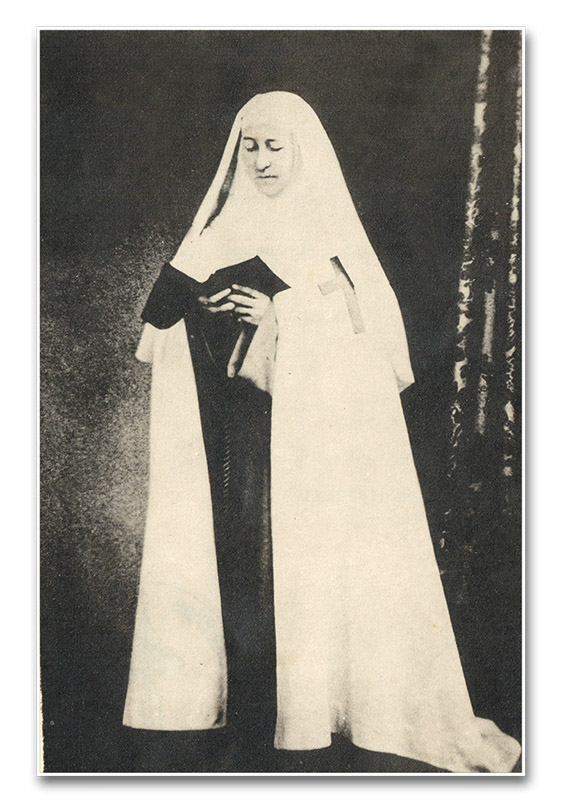
St. Marie Eugénie of Jesus – A Strong Woman
This young foundress, with a resolute soul pervaded with faith, neither feared nor fled the sufferings and hardships inherent to the consolidation of the work that Providence had entrusted to her. “Discouragement, my father, is far from my spirit. […] Finally, believe that we are strongly convinced that we do not have the holiness required for the works of God and, therefore, for my part, I will not be surprised with any kind of failure.”
These categorical words, worthy of a battle veteran, flowed from the pen of a young woman of 24 years… She had just been forsaken by her spiritual director and was being counselled by the ecclesiastical superior to suppress the religious congregation that she had founded, but she treated the matter with extraordinary detachment and nobility of spirit.
Where did such fortitude come from?
Having grown up in settings that were indifferent or opposed to religion, this young foundress clearly saw the emptiness and instability of the things of this life—wealth or poverty, intelligence, pleasure and even family ties—, when the essential, faith, is lacking.
Strengthened by this principle which had been branded on her soul, St. Marie Eugénie of Jesus erected a magnificent work at the price of great suffering. Her integrity in facing difficulties was so remarkable that Pope Pius XII categorically qualified her as a “strong woman, mulier fortis, in every sense of the term: she always stood at the beck and call of the divine will; her soul was passionately devout, her heart overflowed with love of Christ, her broad, luminous, and expansive intelligence and steadfast and resolute character, was always riveted on the goal that had been set.”
A motto forgotten by the Millerets
Nihil sine fide — nothing without faith; not coincidentally, this was the motto of the family into which Anne Eugénie Milleret de Brou was born, on August 25, 1817. But, at the dawn of the nineteenth century, this motto would become nothing more than an evocative phrase engraved on the family insignia. Jacques Milleret, father of our Saint, chose to guide himself by the impious doctrines of Voltaire. His wife Eleonore Eugénie de Brou, descendant of nobility from Belgium and Luxembourg, seemed equally uncommitted to reviving this ideal.
The childhood of Anne Eugénie unfolded amid serene plenty in Metz, her birthplace. Her father owned a mansion there and was also deputy for Moselle, the owner of three banks and of a large property in Preisch, where the lush countryside served as the milieu for pleasant excursions. The child frolicked freely with her siblings, and benefited from a solid education in keeping with her social standing. She spoke fluent French and German, and was instructed by her mother in the practice of the natural virtues, taking her to visit the poor and sick, and teaching her to be honest and generous.
The whole family attended some Church ceremonies together—which, at that time, was virtually a social obligation—and her life of piety consisted of little more than this. The children received the Sacraments, but their religious education was neglected. “My ignorance of the dogmas and teachings of the Church was inconceivable. All the same, I participated in the catechism classes with the other children, made my First Communion with love, and God even granted me graces which were, together with your words, the basis for my salvation,” she would later write to Fr. Lacordaire.
One of these graces was granted when she received the Eucharistic Jesus for the first time. At that moment, she felt the triviality of worldly trappings, and she interiorly heard these prophetic words: “You will lose your mother, but I will be more than a mother for you. The day will come in which you will leave everything that you love to glorify Me and to serve that Church which you do not know.” A vigorous seed had been planted in the soul of the young aristocrat. Years later she would see it blossom.
Radical change in family life
Anne Eugénie experienced the bitterness of grief when two of her brothers died young. But in 1830, a family tragedy produced a radical change in the life of the Millerets. As the result of unwise transactions, Jacques lost the family fortune, and was obliged to sell his property and possessions. The glittering life was over; at age 13, Anne Eugénie was obliged to leave for Paris with her mother, while her father remained in Metz with her brother Louis—only two years her senior, and to whom she was deeply attached.
Other misfortunes followed. In 1832, a cholera epidemic swept Paris, taking the life of Anne Eugénie’s mother within the space of few hours. She died without the Last Sacraments.
Orphaned at 15, she was taken in by a friend of her mother, Madame Doulcet, whose husband was the general tax collector in Châlons. Once again, she found herself in the lap of luxury. Her virtue of faith, so little nourished, wavered in a setting of chronic anticlerical conversation. But the light that had penetrated her soul at Baptism and with the reception of the Eucharist still glimmered. “God, in His goodness, left me a link of love. I may have doubted the immortality of the soul, but spontaneously rejected everything that attacked the Sacrament of the Altar.”
By 18 years of age, diversions no longer satisfied her. Her keen intelligence helped her to perceive that life should not be so hollow and senseless. “My thoughts are a turbulent sea which tire me, and weigh upon me. Such instability and restlessness—ardour that surpasses the limits of the possible. At times, I am absorbed by questions well beyond my reach and upon which it would be better not to dwell: the loftiest questions of the world. I want to know everything, analyse everything, and delve into intimidating realms; I boldly question everything, pursued by some sort of incessant desire for knowledge and truth, which nothing can satisfy.”
“I was truly converted”
At the end of 1835, her father sent her to the home of a cousin, Madame Foulon. Both she and her daughters were very devout, a fact that perhaps placed the young Milleret at greater risk of losing her faith, for they “were tedious, they seemed narrow-minded to me,” the Saint would comment.
Nevertheless, it was at this juncture that Providence would strike. Following the Parisian custom in vogue, they attended the Sunday sermons of Fr. Henri Lacordaire in Notre-Dame Cathedral. He was at the height of his fame as a preacher, and his sermons deeply touched the young girl. “Your words”—she would write years later to the Dominican priest—“responded to all my thoughts, explained the best of my instincts, rounded out my understanding of things and revived in me the notion of duty and the desire for good, on the verge of expiring in my soul; in short, you gave me a new generosity, a faith that nothing could ever shake again.”
Anne Eugénie had found the axis of her existence. “My vocation was born in Notre-Dame,” she was fond of saying. Had the trials ended? No! On the contrary, they would only intensify over the course of her life; but she had founded her faith upon the eternal rock and nothing could shake it. “I was truly converted and I was seized by a longing to devote all my strength or rather all my weakness to the Church which, from that moment, I saw as alone holding the key to the knowledge and achievement of all that is good.”
The young woman communicated her aspirations to Father Lacordaire and he replied: “Pray and wait.” Anne Eugénie obeyed.
Dawning of the foundation
During this wait, she endeavoured “to be a man, in order to be, like them, entirely useful.” This young woman, “her gaze suffused at once with virile vigour and feminine acuity,” had deeply analysed the evils of the laicized society in which she lived and lamented the absence of religious formation for so many youths of the liberal aristocracy of the time: “Born into a family that was barely Christian, and educated in a society that was even less so, I was bereft of my mother at age 15 and because of circumstances of life and position, had far wider contact with and knowledge of the world than one normally has at this age. I could easily grasp the hapless state of the social class to which I belonged, and I confess to you that until this day I do not have a sadder recollection than this. It seems to me that any soul who loves the Church a little, and is aware of the deep irreligiousness of three-quarters of the wealthy and influential families of Paris, should feel impelled to do everything to make Jesus Christ penetrate among them.”
By now consumed with the desire to save souls, Anne Eugénie encountered, in the Church of St. Eustace, another preacher whose zeal impressed her and whom she asked for counsel: Fr. Théodore Combalot. The latter desired to found a congregation under the auspices of Our Lady of the Assumption, committed to the education of young girls, as the basis for the regeneration of society, and he saw in that 20-year-old all the qualities required of a foundress. Actually, his intentions were much bolder. He explained to her that he desired to erect a work dedicated to “rebuilding everything in Christ, to make Him and His Church known, and to extend the frontiers of His Kingdom.”
While touched by this proposal, she hesitated and objected: “I am unfamiliar with religious life. I have to learn everything. I am incapable of founding anything within the Church of God.” To this, the priest replied, with conviction: “Jesus Christ will be the Founder of our Association; we will be mere instruments, and in God’s hands, the weakest are the strongest.”
After some resistance, Anne Eugénie acquiesced to come under the direction of Fr. Combalot and, following his guidance, she waited, among the Benedictines nuns, to reach the age of majority, 21 at that time. After travelling to Lorraine to bid her family farewell, she completed her novitiate with the Visitandines and, with three other women, recruited by the same priest, began the work of the Assumption in 1839.
Comprehensive education united with faith
In the midst of the intense study program established by the Father Director, Mother Marie Eugénie of Jesus—her religious name—was convinced that contemplation was the wellspring of wisdom for the new congregation. “Education is our duty, religious life our attraction,” she would say.
Having personally experienced the void that an education dissociated from faith leaves in the soul, she wanted the future educators of the Assumption to teach with their testimony of life more than by words. “Faith affords more wisdom than age,” she affirmed. “It is necessary to form strong characters […]. Our mission: dynamic faith, faith dominating the reason, the inclinations, and the affections.”
The charism of the institute was dedication to a comprehensive education, which leads to “concern for the formation of criteria, of the critical sense, of right thinking, principally in relation to faith and confidence in grace.” On the occasion of her beatification, these principles caused Paul VI to exclaim: “What a light for us Christians, who are at times tempted, in a secularized world, to separate human education from faith!”
Surrender to the divine will
With the long-desired foundation of the work underway, Mother Marie Eugénie was unknowingly steeling herself for the greatest sufferings of her life, coming from the seemingly least likely source—Fr. Combalot himself!
Although he was a person of generous impulses, he was a very volatile character. “He changed his mind about everything each fortnight,” the Saint wrote. A case in point was his order to study the Psalms and St. Augustine, followed by a command to forsake all reading; to that of eating meat every day he juxtaposed harsh penances, interspersed with severe reprimands. Mother Marie Eugénie humbly and obediently complied with each of these directives.
Although submissive to orders, grace inspired her not to leave the direction of the foundation in the hands of so inconsistent an individual. She conveyed the situation to the Archbishop of Paris, Most Rev. Denis-Auguste Affre. The prelate was well acquainted with Fr. Combalot—whom he described as a man “of noble heart, but a hot head” —and he immediately understood what was happening.
To resolve the problem, he designated a superior for the community, whose appointment the impetuous priest did not accept. In fact, he decreed that the foundress and the nuns should accompany him to Brittany, to distance them from the authority of the Archbishop. The situation became very tense; on May 3 of 1841, Fr. Combalot gathered up his books and letters, and abandoned the community, never to make a reappearance.
“May God’s will be done!” exclaimed the young foundress who, at 24, now found herself without the customary support, obliged to carry forward the undertaking that had been initiated. Seeking refuge in faith, she concluded: “God does not take something away without giving Himself more fully to replace it… He has shown us that the work was His and He alone wishes to accomplish it.”
But Providence sent her new assistance in the person of Fr. Emmanuel d’Alzon, the young Vicar-General of Nîmes, with whom she exchanged a prolific correspondence. Both desired to bring the presence of Christ to laicized society and exchanged mutual counsels in this regard. He would later found the masculine branch of the Assumption.
“I do not believe I have another vocation”
Giving new proofs of his inconstancy, Fr. Combalot sent a letter to Archbishop Affre, “as moving as it was disconcerting, asking him to take charge of the work” of the Assumption. Accordingly, the Archbishop took the community under his patronage and designated Msgr. Jean-Nicaise Gros—later Bishop of Versailles—as its ecclesiastical superior. Under his orientation the constitutions and rules were drawn up, and the nuns received the definitive habit of the professed and made their first vows in his hands, on August 15 of that same year of 1841.
But a new storm was soon unleashed upon the fragile vessel. Witnessing the natural difficulties of a community that had still not attained full maturity, Msgr. Gros feared for its future and counselled the foundress to return to the Visitation Order where she had made her novitiate and which had made a favourable impression on her. As for the other sisters, each would be free to choose the religious institute to which she seemed best suited.
Mother Marie Eugénie kept her composure. She requested a brief period for reflection, after which she wrote a respectful, but forthright letter, explaining the goals, the spirit, and the characteristics of the Assumption. In closing, she declared: “I make bold to say that personal satisfaction has never crossed our mind. Our courage arose from hearing from the very lips of Monsignor the testimony that our rule was good and edifying, and from having received from his hands the holy habit, which we wear with joy and love. I do not know what we have done, in the practice of this rule, to lose the benevolence granted by your person; but if we are considered unworthy, and if this work of zeal in which we wish to labour be not accomplished by us, pardon me for taking the liberty to say it: it is a work so necessary that, sooner or later, it will be accomplished by holier hands. For my part, I believe that my vocation is none other than to belong to it, regardless of the sufferings and hardships that may ensue.”
Msgr. Gros’ reply was not long in coming. He showed himself to be entirely won over regarding the providential nature of the work, and affirmed: “I can only thank God for the graces He has given you.”
The congregation develops
At last, the Assumption had been definitively founded upon the faith and steadfastness of Mother Marie Eugénie of Jesus. The girls came, the schools spread and the congregation developed, to “form true mothers of families, to give women the broad knowledge and simple habits without which they will not know how to exercise the influence which Christianity should give them,” reported the Gazette de France, evincing the hopes pinned on the new religious institution.
With the same mettle, the tireless foundress confronted other acute sufferings and obtained many victories, such as the pontifical approval of the constitutions of the Assumption, her sights ever fixed on the implantation of the Reign of Christ. Little over a century since her death on March 10, 1898, the Religious of the Assumption have communities in various countries of Europe, Africa, Asia and the three Americas, dedicated to the education of girls from all social classes.
Of this holy and fruitful life we can say with the psalmist: “Those who trust in the Lord are like Mount Zion, which cannot be moved, but abides for ever” (Ps 125:1). She was unshakable, for she trusted in the Lord! ◊
catholicmagazine.news. Footnotes at source.
8
posted on
03/10/2022 5:33:34 AM PST
by
annalex
(fear them not)
To: annalex
9
posted on
03/10/2022 5:34:29 AM PST
by
annalex
(fear them not)
To: annalex
NAVARRE BIBLE COMMENTARY (RSV)
Ad Majorem Dei Gloriam (To the Greater Glory of God)
From: Esther C:12, 14-16, 23-25 (New American Bible)
Esther 14:1, 3-5, 12-15a (Revised Standard Version)
Esther’s Prayer
----------------
[1] And Esther the queen seized with deathly anxiety, fled to the Lord; [3] And she prayed to the Lord God of Israel, and said: “0 my Lord, thou art our King; help me, who am alone and have no helper but thee, [4] for my danger is in my hand. [5] Ever since I was born I have heard in the tribe of my family that thou, 0 Lord, didst take Israel out of all the nations, and our fathers from among all their ancestors, for an everlasting inheritance, and that thou didst do for them all that thou didst promise. [12] Remember, 0 Lord; make thyself known in this time of our affliction, and give me courage, 0 King of the Gods and Master of all dominion! [13] Put eloquent speech in my mouth before the lion, and turn his heart to hate the man who is fighting against us, so that there may be an end of him and those who agree with him. [14] But save us by thy hand, and help me, who am alone and have no helper but thee, 0 Lord. [15a] Thou hast knowledge of all things."
***********************************************************************
Commentary:
14:1-19. Esther’s prayer is an example of the new tone of trusting prayer noticeable in this book and which is quite close to the New Testament style of prayer. Also, there is a kind of litany in it reminiscent of the style of Psalm 136. In all simplicity, Esther implores God’s help, confident that he who has done so much for his people over the course of history will not leave them unprotected in their present need.
10
posted on
03/10/2022 6:05:02 AM PST
by
fidelis
(Ecce Crucem Domi/i><p>! Fugite partes adversae! Vicit Leo de tribu Juda, Radix David! Alleluia! )
To: fidelis
From: Matthew 7:7-12The Effectiveness of Prayer
---------------------------
(Jesus told His disciples,) [7] "Ask, and it will be given you; seek, and you will find; knock, and it will be opened to you. [8] For every one who asks receives, and he who seeks finds, and to him who knocks it will be opened. [9] Or what man of you, if his son asks him for bread, will give him a stone? [10] Or if he asks for a fish, will give him a serpent? [11] If you then, who are evil, know how to give good gifts to your children, how much more will your Father who is in Heaven give good things to those who ask Him!
The Golden Rule
---------------
[12] "So whatever you wish that men would do to you, do so to them; for this is the law and the prophets."
***********************************************************************
Commentary:
7-11. Here the Master teaches us in a number of ways about the effectiveness of prayer. Prayer is a raising of mind and heart to God to adore Him, to praise Him, to thank Him and to ask Him for what we need (cf. "St. Pius X Catechism", 255). Jesus emphasizes the need for petitionary prayer, which is the first spontaneous movement of a soul who recognizes God as his Creator and Father. As God's creature and child, each of us needs to ask Him humbly for everything.
In speaking of the effectiveness of prayer, Jesus does not put any restriction: "Every one who asks receives", because God is our Father. St. Jerome comments: "It is written, to everyone who asks it will be given; so, if it is not given to you, it is not given to you because you do not ask; so, ask and you will receive" ("Comm. in Matth.", 7). However, even though prayer in itself is infallible, sometimes we do not obtain what we ask for. St. Augustine says that our prayer is not heard because we ask "aut mali, aut male, aut mala." "Mali" (= evil people): because we are evil, because our personal dispositions are not good; "male" (= badly): because we pray badly, without faith, not persevering, not humbly; "mala" (= bad things): because we ask for bad things, that is, things which are not good for us, things which can harm us (cf. "De Civitate Dei, XX", 22 and 27; "De Serm. Dom. In Monte", II, 27, 73). In the last analysis, prayer is ineffective when it is not true prayer. Therefore, "Pray. In what human venture could you have greater guarantee of success?" (St J. Escriva, "The Way", 96).
12. This "golden rule" gives us a guideline to realize our obligations towards and the love we should have for others. However, if we interpreted it superficially it would become a selfish rule; it obviously does not mean "do utdes" ("I give you something so that you will give me something") but that we should do good to others unconditionally: we are clever enough not to put limits on how much we love ourselves. This rule of conduct will be completed by Jesus' "new commandment" (John 13:34), where He teaches us to love others as He Himself has loved us.
Source: Daily Word for Reflection—Navarre Bible Commentary
11
posted on
03/10/2022 6:05:18 AM PST
by
fidelis
(Ecce Crucem Domi/i><p>! Fugite partes adversae! Vicit Leo de tribu Juda, Radix David! Alleluia! )
Disclaimer:
Opinions posted on Free Republic are those of the individual
posters and do not necessarily represent the opinion of Free Republic or its
management. All materials posted herein are protected by copyright law and the
exemption for fair use of copyrighted works.
FreeRepublic.com is powered by software copyright 2000-2008 John Robinson