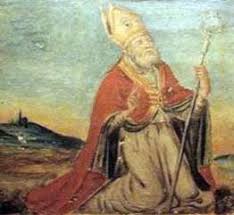
Catena Aurea by St. Thomas Aguinas
CHAP. 9
9:1–8
1. And he said unto them, Verily I say unto you, That there be some of them that stand here, which shall not taste of death, till they have seen the kingdom of God come with power.
2. And after six days Jesus taketh with him Peter, and James, and John, and leadeth them up into an high mountain apart by themselves: and he was transfigured before them.
3. And his raiment became shining, exceeding white as snow; so as no fuller on earth can white them.
4. And there appeared unto them Elias with Moses: and they were talking with Jesus.
5. And Peter answered and said to Jesus, Master, it is good for us to be here: and let us make three tabernacles; one for thee, and one for Moses, and one for Elias.
6. For he wist not what to say; for they were sore afraid.
7. And there was a cloud that overshadowed them; and a voice came out of the cloud, saying, This is my beloved Son: hear him.
8. And suddenly, when they had looked round about, they saw no man any more, save Jesus only with themselves.
PSEUDO-JEROME. After the consummation of the cross, the glory of the resurrection is shewn, that they, who were to see with their own eyes the glory of the resurrection to come, might not fear the shame of the cross; wherefore it is said, And after six days Jesus taketh with him Peter, and James, and John, and led them up into an high mountain apart by themselves, and he was transfigured before them.
CHRYSOSTOM. (Hom. in Matt. 65) Luke in saying, After eight days, does not contradict this; for he reckoned in both the day on which Christ had spoken what goes before, and the day on which he took them up. And the reason that he took them up after six days, was that they might be filled with a more eager desire during the space of these days, and with a watchful and anxious mind attend to what they saw.
THEOPHYLACT. And He takes with Him the three chiefs of the Apostles, Peter, as confessing and loving him, John, as the beloved one, James, as being sublime in speech and as a divine; for so displeasing was he to the Jews, that Herod wishing to please the Jews slew him.
PSEUDO-CHRYSOSTOM. (Vict. Ant. e Cat. in Marc.) He does not however shew His glory in a house, but He takes them up into a high mountain, for the loftiness of the mountain was adapted to shewing forth the loftiness of His glory.
THEOPHYLACT. And He took them apart, because He was about to reveal mysteries to them. We must also understand by transfiguration not the change of His features, but that, whilst His features remained as before, there was added unto Him a certain ineffable brightness.
PSEUDO-CHRYSOSTOM. (Vict. Ant. e Cat. in Marc.) It is not therefore fitting that in the kingdom of God any change of feature should take place, either in the Saviour Himself, or in those who are to be made like unto him, but only an addition of brightness.
BEDE. (in Marc. 3, 37) Our Saviour then when transfigured did not lose the substance of real flesh, but shewed forth the glory of His own or of our future resurrection; for such as He then appeared to the Apostles, He will after the judgment appear to all His elect. It goes on, And his raiment became shining.
GREGORY. (Mor. 32, 6) Because, in the height of the brightness of heaven above, they who shine in righteousness of life, will cling to Him; for by the name of garments, He means the just whom He joins to Himself. There follows, And there appeared unto them Elias with Moses, and they were talking with Jesus.
CHRYSOSTOM. (Hom. in Matt. 56) He brings Moses and Elias before them; first, indeed, because the multitudes said that Christ was Elias, and one of the Prophets, He shews Himself to the Apostles with them, that they might see the difference between the Lord, and His servants. And again because the Jews accused Christ of transgressing the law, and thought Him a blasphemer, as if He arrogated to Himself the glory of His Father, He brought before them those who shone conspicuous in both ways; for Moses gave the Law, and Elias was zealous for the glory of God; for which reason neither would have stood near Him, if He had been opposed to God and to His law. And that they might know that He holds the power of life and of death, He brings before them both Moses who was dead, and Elias who had not yet suffered death. Furthermore He signified by this that the doctrine of the Prophets was the schoolmaster to the doctrine of Christ. He also signified the junction of the New and Old Testament, and that the Apostles shall be joined in the resurrection with the Prophets, and both together shall go forth to meet their common King. It goes on, And Peter answered and said to Jesus, Master, it is good for us to be here; and let us make three tabernacles, one for thee, and one for Moses, and one for Elias.
BEDE. (ubi sup.) If the transfigured humanity of Christ and the society of but two saints seen for a moment, could confer delight to such a degree that Peter would, even by serving them, stay their departure, how great a happiness will it be to enjoy the vision of Deity amidst choirs of Angels for ever? It goes on, For he wist not what to say; although, however, Peter from the stupor of human frailty knew not what to say, still he gives a proof of the feelings which were within him; for the cause of his not knowing what to say, was his forgetting that the kingdom was promised to the Saints by the Lord not in any earthly region, but in heaven; he did not remember that he and his fellow-Apostles were still hemmed in by mortal flesh and could not bear the state of immortal life, to which his soul had already carried him away, because in our Father’s house in heaven, a house made with hands is not needed. But again even up to this time he is pointed at, as an ignorant man, who wishes to make three tabernacles for the Law, the Prophets, and the Gospel, since they in no way can be separated from each other.
CHRYSOSTOM.f Again, Peter neither comprehended that the Lord worked His transfiguration for the shewing forth of His true glory, nor that He did this in order to teach men, nor that it was impossible for them to leave the multitude and dwell in the mountain. It goes on, For they were sore afraid. But this fear of theirs was one by which they were raised from their usual state of mind to one higher, and they recognised that those who appeared to them were Moses and Elias. The soul also was drawn on to a state of heavenly feeling, as though carried away from human sense by the heavenly vision.
THEOPHYLACT. Or else, Peter, fearing to come down from the mount because he had now a presentiment that Christ must be crucified, said, It is good for us to be here, and not to go down there, that is, in the midst of the Jews; but if they who are furious against Thee come hither, we have Moses who beat down the Egyptians, we have also Elias, who brought fire down from heaven and destroyed the five hundred.
ORIGEN. (in Matt tom. xii. 40) Mark says in his own person, For he wist not what to say. Where it is matter for, consideration, whether perchance Peter spoke this in the confusion of his mind, by the motion of a spirit not his own; whether perchance that spirit himself who wished, as far as in him lay, to be a stumbling-block to Christ, so that He might shrink from that Passion, which was the saving of all men, did not here work as a seducer and wish under the colour of good to prevent Christ from condescending to men, from coming to them, and taking death upon Himself for their sakes.
BEDE. (ubi sup.) Now because Peter sought for a material tabernacle, he was covered with the shadow of the cloud, that he might learn that in the resurrection they are to be protected not by the covering of houses, but by the glory of the Holy Ghost; wherefore it goes on, There was a cloud that overshadowed them. And the reason why they obtained no answer from the Lord was, that they asked unadvisedly; but the Father answered for the Son, wherefore there follows, And a voice came out of the cloud, saying, This is my beloved Son, in whom I am well pleased.
CHRYSOSTOM. (Hom. in Matt. 56) The voice proceeded from a cloud in which God is wont to appear, that they might believe that the voice was sent forth from God. But in that He says, This is my beloved Son, He declares that the will of the Father and the Son is one, and that, save in that He is the Son, He is in all things One with Him who begot Him.
BEDE. (ubi sup.) He then whose preaching, as Moses foretold, every soul that wished to be saved should hear when He came in the flesh, He now come in the flesh is proclaimed by God the Father to the disciples as the one whom they were to hear. There follows, And suddenly, when they had looked round about, they saw no man any more, save Jesus only with themselves; for as soon as the Son was proclaimed, at once the servants disappeared, lest the voice of the Father should seem to have been sent forth to them.
THEOPHYLACT. Again mystically; after the end of this world, which was made in six days, Jesus will take us up (if we be His disciples) into an high mountain, that is, into heaven, where we shall see His exceeding glory.
BEDE. (ubi sup.) And by the garments of the Lord are meant His saints, who will shine with a new whiteness. By the fuller we must understand Him, to whom the Psalmist says, (Ps. 51) Wash me throughly from my wickedness, and cleanse me from my sin; for He cannot give to His faithful ones upon earth that glory which remains laid up for them in heaven.
REMIGIUS. Or else, by the fuller are meant holy preachers and purifiers of the soul, none of whom in this life can so live as not to be stained with some spots of sin; but in the coming resurrection all the saints shall be purged from every stain of sin. Therefore the Lord will make them such as neither they themselves by taking vengeance on their own members, nor any preacher by his example and doctrine, can make.
CHRYSOSTOM. Or else, white garments are the writings of Evangelists and Apostles, the like to which no interpreter can frame.
ORIGEN. (in Matt. tom. xii. 39) Or else, fullers upon earth may by a moral interpretation be considered to be the wise of this world, who are thought to adorn even their foul understandings and doctrines with a false whitening drawn from their own minds. But their skill as fullers cannot produce any thing like a discourse which shews forth the brightness of spiritual conceptions in the unpolished words of Scripture, which by many are despised.
BEDE. (ubi. sup.) Moses and Elias, of whom one, as we read, died, the other was carried away to heaven, signify the coming glory of all the Saints, that is, of all who in the judgment-time are either to be found alive in the flesh, or to be raised up from that death of which they tasted, and who are all equally to reign with Him.
THEOPHYLACT. Or else it means, that we are to see in glory both the Law and the Prophets speaking with Him, that is, we shall then find that all those things which were spoken of Him by Moses and the other prophets agree with the reality; then too we shall hear the voice of the Father, revealing to us the Son of the Father, and saying, This is my beloved Son, and the cloud, that is, the Holy Ghost, the fount of truth, will overshadow us.
BEDE. (ubi sup.) And we must observe, that, as when the Lord was baptized in Jordan, so on the mountain, covered with brightness, the whole mystery of the Holy Trinity is declared, because we shall see in the resurrection that glory of the Trinity which we believers confess in baptism, and shall praise it all together. Nor is it without reason that the Holy Ghost appeared here in a bright cloud, there in the form of a dove; because he who now with a simple heart keeps the faith which he hath embraced, shall then contemplate what he had believed with the brightness of open vision. But when the voice had been heard over the Son, He was found Himself alone, because when He shall have manifested Himself to His elect, God shall be all in all, yea Christ with His own, as the Head with the body, shall shine through all things. (1 Cor. 15:28).
9:9–13
9. And as they came down from the mountain, he charged them that they should tell no man what things they had seen, till the Son of man were risen from the dead.
10. And they kept that saying with themselves, questioning one with another what the rising from the dead should mean.
11. And they asked him, saying, Why say the Scribes that Elias must first come?
12. And he answered and told them, Elias verily cometh first, and restoreth all things; and how it is written of the Son of man, that he must suffer many things, and be set at nought.
13. But I say unto you, That Elias is indeed come, and they have done unto him whatsoever they listed, as it is written of him.
ORIGEN. (in Matt. tom. xii. 43) After the shewing of the mystery on the mount, the Lord commanded His disciples, as they were coming down from the mount, not to reveal His transfiguration, before the glory of His Passion and Resurrection; wherefore it is said, And as they came down from the mountain, he charged them that they should tell no man what things they had seen, till the Son of man were risen from the dead.
CHRYSOSTOM. (Hom in Matt. 56) Where He not only orders them to be silent, but mentioning His Passion, He implies the cause why they were to be silent.
THEOPHYLACT. Which He did lest men should be offended, hearing such glorious things of Him Whom they were about to see crucified. It was not therefore fitting to say such things of Christ before He suffered, but after His resurrection they were likely to be believed.
PSEUDO-CHRYSOSTOM. (Vict. Ant. e Cat. in Marc.) But they, being ignorant of the mystery of the resurrection, took hold of that saying, and disputed one with another; wherefore there follows, And they kept that saying with themselves, questioning one with another what the rising from the dead should, mean.
PSEUDO-JEROME. This, which is peculiar to Mark, means, that when death shall have been swallowed up in victory, we shall have no memory for the former things. It goes on, And they asked him, saying, Why say the Scribes that Elias must first come.
CHRYSOSTOM. (non occ.) The design of the disciples in asking this question seems to me to be this. We indeed have seen Elias with Thee, and have seen Thee before seeing Elias, but the Scribes say that Elias cometh first; we therefore believe that they have lied.
BEDE. (ubi sup.) Or thus; the disciples thought that the change which they had seen in Him in the mount, was His transformation to glory; and they say, If Thou hast already come in glory, wherefore doth not Thy forerunner appear? chiefly because they had seen Elias go away.
CHRYSOSTOM. (Hom. in Matt. 57) But what Christ answered to this, is seen by what follows, And he answered and told them, Elias verily cometh first, and restoreth all things; in which He shews that Elias will come before His second advent. For the Scriptures declare two advents of Christ, namely, one which has taken place, and another which is to come; but the Lord asserts that Elias is the forerunner of the second advent.
BEDE. (ubi sup.) Again, He will restore all things, that is to say, those things which Malachi points out, saying, Behold, I will send you Elijah the prophet, and he shall turn the heart of the fathers to the children, and the heart of the children to their fathers; (Mal. 4:5, 6) he will yield up also to death that debt, which by his prolonged life he has delayed to render.
THEOPHYLACT. Now the Lord puts this forward to oppose the notion of the Pharisees, who held that Elias was the forerunner of the first advent, shewing that it led them to a false conclusion; wherefore he subjoins, And how it is written of the Son of man, that he must suffer many things, and be set at nought. As if He had said, When Elias the Tishbite cometh, he will pacify the Jews, and will bring them to the faith, and thus be the forerunner of the second advent. If then Elias is the forerunner of the first advent, how is it written that the Son of man must suffer? One of these two things therefore will follow; either that Elias is not the forerunner of the first advent, and thus the Scripture will be true; or that he is the forerunner of the first advent, and then the Scriptures will not be true, which say that Christ must suffer; for Elias must restore all things, in which case there will not be an unbelieving Jew, but all, whosoever hear him, must believe on his preaching.
BEDE. (ubi sup.) Or this, And how it is written: that is, in the same way as the prophets have written many things in various places concerning the Passion of Christ, Elias also, when he comes, is to suffer many things, and to be despised by the wicked.
CHRYSOSTOM. (ubi sup.) Now as the Lord asserted that Elias was to be the forerunner of the second advent, so consequently He asserted that John was the forerunner of the first; wherefore He subjoins, But I say unto you, that Elias is indeed come.
GLOSS. (non in Gloss. sed ap. Chrys ubi sup.) He calls John Elias, not because he was Elias in person, but because he fulfilled the ministry of Elias; for as the latter will be the forerunner of the second advent, so the former has been that of the first.
THEOPHYLACT. For again, John rebuked vice, and was a zealous man, and a hermit like Elias; but they heard him not, as they will hear Elias, but killed him in wicked sport, and cut off his head; wherefore there follows, And they have done unto him whatsoever they listed, as it is written of him.
PSEUDO-CHRYSOSTOM. (Vict. Ant. e Cat. in Marc.) Or else, the disciples asked Jesus, how it was written that the Son of man must suffer? Now in answer to this, He says, As John came in the likeness of Elias, and they evil intreated him, so according to the Scriptures must the Son of man suffer.
Catena Aurea Mark 9
NAVARRE BIBLE COMMENTARY (RSV)
Ad Majorem Dei Gloriam (To the Greater Glory of God)
From: James 3:1-10
Controlling One's Tongue
------------------------
[1] Let not many of you become teachers, my brethren, for you know that we who teach shall be judged with greater strictness. [2] For we all make many mistakes, and if any one makes no mistakes in what he says he is a perfect man, able to bridle the whole body also. [3] If we put bits into the mouths of horses that they may obey us, we guide their whole bodies. [4] Look at the ships also; though they are so very great and are driven by strong winds, they are guided by a very small rudder wherever the will of the pilot directs. [5] So the tongue is a little member and boasts of great things. How great a forest is set ablaze by a small fire!
[6] And the tongue is a fire. The tongue is an unrighteous world among our members, staining the whole body, setting on fire the cycle of nature, and set on fire by Hell. [7] For every kind of beast and bird, of reptile and sea creature, can be tamed and has been tamed by humankind, [8] but no human being can tame the tongue--a restless evil, full of deadly poison. [9] With it we bless the Lord and Father, and with it we curse men, who are made in the likeness of God. [10] From the same mouth come blessing and cursing. My brethren, this ought not to be so.
***********************************************************************
Commentary:
1-18. There is now an apparently sudden change of subject; but in fact the themes dealt with in the letter from this point onwards are practical applications of the principle outlined in the second section (consistently between faith and works). Firstly, it deals with control of the tongue, prudent speech; after warning of occupational hazards of teachers (verses 1-2), it denounces the sins the tongue can cause (verses 2-12), and goes on to describe the characteristics of true and false wisdom.
1-2. St. James draws attention to the responsibility that goes with holding a position of authority: all those who are teachers, in addition to answering to God for their own actions, are responsible to some degree for the actions of their disciples. That is why the Church has always encouraged prayer for those whose job it is to guide their brethren: "Nor should (lay people) fail to commend to God in their prayers those who have been placed over them, who indeed keep watch as having to render an account for our souls, that they may do this with joy and not with grief (cf. Hebrews 13:17)") (Vatican II, "Lumen Gentium", 37).
"We all make many mistakes": Sacred Scripture repeatedly draws attention to the sinful condition of man and the frequency with which he offends God (cf., e.g., Psalm 19:13; 51:3ff; Proverbs 20:9; 1 John 1:8). The Council of Trent recalls these words of St. James when it teaches that no one can go through life without committing some venial sin, "except by a special privilege granted by God, as the Church teaches happened in the case of the Blessed Virgin" ("De Iustificatione", Canon 23; Chapter 16).
The great Saints, from whom we can learn much, have attained holiness because they recognized that they were sinners. "I shall love you, Lord, and shall give thanks to You and confess Your name," St. Augustine exclaims, because "You have forgiven me such great sins and evil deeds [...]: for what might I have not done, seeing that I loved evil solely because it was evil? I confess that You have forgiven all alike--the sins I committed on my own motion, the sins I would have committed but for Your grace [...]. If any man has heard Your voice and followed it and done none of the things he finds me here recording and confessing, still he must not scorn me: for I am healed by the same Doctor who preserved him from falling into sickness, or at least into such grievous sickness. But let him love You even more--seeing me rescued out of such sickness of sin, and himself saved from falling into such sickness of sin, by the one same Savior" ("Confessions", 2, 7).
2-12. The sacred writer focuses on sins of the tongue, possibly because of their frequency. In the Wisdom books of the Old Testament these sins are referred to particularly often (cf., e.g., Proverbs 10:11-21; Sirach 5:9-15; 28:13-26).
He basically makes three points--first, a positive point, by way of summing up what follows: "If any one makes no mistakes in what he says he is a perfect man" (verse 2). Then with three graphic comparisons (typical of this Letter) he shows how difficult it is to control the tongue (verses 3-6), but controlled it must be, otherwise great harm will be done (verses 7-12).
"A perfect man" (verse 2): this does not mean that he cannot commit other sins; it implies that if one succeeds in restraining one's tongue one has self-control, which means that one is putting up good resistance to temptation.
3-6. Three simple, easy-to-understand examples (used also by other ancient writers in Greco-Latin and Jewish literature) show how something small--a horse's bit, a boat's rudder, a small fire--can have very big effects; the tongue has a similar influence in social life.
The "St. Pius V Catechism", recalling this teaching, says: "From these words we learn two truths. The fact is that sins of the tongue are very prevalent [...]. The other truth is that the tongue is a source of innumerable evils. Through the fault of the evil-speaker are often lost the property, the reputation, the life, and salvation of the injured person, or of him who inflicts the injury. The injured person, unable to bear patiently the contumely, avenges it without restraint. The offender, on the other hand, deterred by a perverse shame and a false idea of what is called honor, cannot be induced to make reparation to him whom he has offended" (III, 9, 1). It should be remembered that if one unfairly damages another's reputation one has an obligation to make reparation by doing what one can to restore his or her good name.
"Do you know what damage you may cause by throwing stones with your eyes blindfolded? Neither do you know the harm you cause--and at times it is very great--by letting drop uncharitable remarks that to you seem trifling, because your eyes are blinded by thoughtlessness or passion" (St J. Escriva, "The Way", 455).
6. St. James uses this graphic language to emphasize that if one does not control one's tongue it can cause much evil, affecting one's entire life. In itself very useful, the tongue can wreak havoc, so it is not surprising that the enemies of our sanctification seek to get control of it: "though their voices sound like cracked bells, that have not been cast from good metal and have a very different tone from the shepherd's whistle call, they so distort speech, which is one of the most precious talents ever bestowed on men by God, a most beautiful gift for the expression of deep thoughts of love and friendship towards the Lord and His creatures, that one comes to understand why St. James says that the tongue is `an unrighteous world' (James 3:6). So great is the harm it can do--lies, slander, dishonor, trickery, insults, tortuous insinuations" (St J. Escriva, "Friends of God", 298).
9-12. The sacred writer uses further examples, equally simple and familiar to his readers, to stress the need for control of the tongue. Experience shows that it is as easy to put it to a good purpose as to an evil one. Besides, misuse of the tongue is a sign that one's heart is not in the right place: as our Lord already warned us, "out of the abundance of the heart the mouth speaks" (Matthew 12:34).
From: Mark 9:2-13The Transfiguration
-------------------
[2] And after six days Jesus took with Him Peter and James and John, and led them up a high mountain apart by themselves; and He was transfigured before them, [3] and His garments became glistening, intensely white, as no fuller on earth bleach them. [4] And there appeared to them Elijah with Moses; and they were talking to Jesus. [5] And Peter said to Jesus, "Master, it is well that we are here; let us make three booths, one for You and one for Moses and one for Elijah." [6] For he did not know what to say, for they were exceedingly afraid. [7] And a cloud overshadowed them, and a voice came out of the cloud, "This is My beloved Son; listen to Him." [8] And suddenly looking around they no longer saw any one with them but Jesus only. [9] And as they were coming down the mountain, He charged them to tell no one what they had seen, until the Son of Man should have risen from the dead. [10] So they kept the matter to themselves, questioning what the rising from the dead meant. [11] And they asked Him, "Why do the scribes say that first Elijah must come?" [12] And He said to them, "Elijah does come first to restore all things; and how is it written of the Son of Man, that He should suffer many things and be treated with contempt? [13] But I tell you that Elijah has come, and they did to him whatever they pleased, as it is written of him."
***********************************************************************
Commentary:
2-10. We contemplate in awe this manifestation of the glory of the Son of God to three of His disciples. Ever since the Incarnation, the divinity of our Lord has usually been hidden behind His humanity. But Christ wishes to show, to these favorite disciples, who will later be pillars of the Church, the splendor of His divine glory, in order to encourage them to follow the difficult way that lies ahead, fixing their gaze on the happy goal which is awaiting them at the end. This is why, as St. Thomas comments (cf. "Summa Theologia", III, q. 45, a. 1), it was appropriate for Him to give them an insight into His glory. The fact that the Transfiguration comes immediately after the first announcement of His passion, and His prophetic words about how His followers would also have to carry His cross, shows us that "through many tribulations we must enter the kingdom of God" (Acts 14:22).
What happened at the Transfiguration? To understand this miraculous event in Christ's life, we must remember that in order to redeem us by His passion and death our Lord freely renounced divine glory and became man, assuming flesh which was capable of suffering and which was not glorious, becoming like us in every way except sin (cf. Hebrew 4:15). In the Transfiguration, Jesus Christ willed that the glory which was His as God and which His soul had from the moment of the Incarnation, should miraculously become present in His body. "We should learn from Jesus' attitude in these trials. During His life on earth He did not even want the glory that belong to Him. Though He had the right to be treated as God, He took the form of a servant, a slave (cf. Philippians 2:6)" ([St] J. Escriva, "Christ Is Passing By", 62). Bearing in mind WHO became man (the divinity of the person and the glory of His soul), it was appropriate for His body to be glorious; given the PURPOSE of His Incarnation, it was not appropriate, usually, for His glory to be evident. Christ shows His glory in the Transfiguration in order to move us to desire the divine glory which will be given us so that, having this hope, we too can understand "that the sufferings of this present time are not worth comparing with the glory that is to be revealed to us" (Romans 8:18).
2. According to Deuteronomy (19:15), to bear witness to anything the evidence of two or three much concur. Perhaps this is why Jesus wanted three Apostles to be present. It should be pointed out that these three Apostles were specially loved by Him; they were with Him also at the raising of the daughter of Jairus (Mark 5:37) and will also be closest to Him during His agony at Gethsemane (Mark 14:33). Cf. note on Matthew 17:1-13.
7. This is how St. Thomas Aquinas explains the meaning of the Transfiguration: "Just as in Baptism, where the mystery of the first regeneration was proclaimed, the operation of the whole Trinity was made manifest, because the Son Incarnate was there, the Holy Spirit appeared under the form of a dove, and the Father made Himself known in the voice; so also in the Transfiguration, which is the sign of the second regeneration [the Resurrection], the whole Trinity appears—the Father in the voice, the Son in the man, the Holy Spirit in the bright cloud; for just as in Baptism He confers innocence, as signified by the simplicity of the dove, so in the Resurrection will He give His elect the clarity of glory and the refreshment from every form of evil, as signified by the bright cloud" ("Summa Theologiae", III, q. 45, 1.4 ad 2). For, really, the Transfiguration was in some way an anticipation not only of Christ's glorification but also of ours. As St. Paul says, "it is the same Spirit Himself bearing witness with our spirit that we are children of God, and if children, then heirs, heirs of God and fellow heirs with Christ, provided we suffer with Him in order that we may also be glorified with Him" (Romans 8:16-17).
10. That the dead would rise was already revealed in the Old Testament (cf. Daniel 12:2-3; 2 Maccabees 7:9; 12:43) and was believed by pious Jews (cf. John 11:23-25). However, they were unable to understand the profound truth of the death and Resurrection of the Lord: they expected a glorious and triumphant Messiah, despite the prophecy that He would suffer and die (cf. Isaiah 53). Hence the Apostles' oblique approach; they too do not dare to directly question our Lord about His Resurrection.
11-13. The scribes and Pharisees interpret the messianic prophecy in Malachi (3:1-2) as meaning that Elijah will appear in person, dramatically, to be followed by the all-triumphant Messiah, with no shadow of pain or humiliation. Jesus tells them that Elijah has indeed come, in the person of John the Baptist (Matthew 17:13) and has prepared the way of the Messiah, a way of pain and suffering.
Verse 12 is a question which Jesus puts to His disciples, but they should really have asked it themselves, had they realized that Christ's Resurrection presupposed the Messiah's suffering and death. Since they fail to ask it, Jesus does, to teach them that He like Elijah (that is, John the Baptist) must experience suffering before entering His glory.
Source: Daily Word for Reflection—Navarre Bible Commentary