Catena Aurea by St. Thomas Aguinas
3:15–17
15. And as the people were in expectation, and all men mused in their hearts of John, whether he were the Christ, or not;
16. John answered, saying unto them all, I indeed baptize you with water; but one mightier than I cometh, the latchet of whose shoes I am not worthy to unloose: he shall baptize you with the Holy Ghost and with fire.
17. Whose fan is in his hand, and he will throughly purge his floor, and will gather the wheat into his garner; but the chaff he will burn with fire unquenchable.
ORIGEN. It was meet that more deference should be paid to John than to other men, for he lived such as no other man. Wherefore indeed most rightly did they regard him with affection, only they kept not within due bounds; hence it is said, But while the people were expecting whether he were the Christ.
AMBROSE. Now what could be more absurd than that he who was fancied to be in another should not be believed in his own person? He whom they thought to have come by a woman, is not believed to have come by a virgin; while in fact the sign of the Divine coming was placed in the childbearing of a virgin, not of a woman.
ORIGEN. But love is dangerous when it is uncontrolled. For he who loves any one ought to consider the nature and causes of loving, and not to love more than the object deserves. For if he pass the due measure and bounds of love, both he who loves, and he who is loved, will be in sin.
GREEK EXPOSITOR. (Metaphrastes.) And hence John gloried not in the estimation in which all held him, nor in any way seemed to desire the deference of others, but embraced the lowest humility. Hence it follows, John answered.
BEDE. But how could he answer them who in secret thought that he was Christ, except it was that they not only thought, but also (as another Evangelist declares) sending Priests and Levites to him asked him whether he was the Christ or not?
AMBROSE. Or: John saw into the secrets of the heart; but let us remember by whose grace, for it is of the gift of God to reveal things to man, not of the virtue of man, which is assisted by the Divine blessing, rather than capable of perceiving by any natural power of its own. But quickly answering them, he proved that he was not the Christ, for his works were by visible operations. For as man is compounded of two natures, i. e. soul and body, the visible mystery is made holy by the visible, the invisible by the invisible; for by water the body is washed, by the Spirit the soul is cleansed of its stains. It is permitted to us also in the very water to have the sanctifying influence of the Deity breathed upon us. And therefore there was one baptism of repentance, another of grace. The latter was by both water and Spirit, the former by one only; the work of man is to bring forth repentance for his sin, it is the gift of God to pour in the grace of His mystery. Devoid therefore of all envy of Christ’s greatness, he declared not by word but by work that he was not the Christ. Hence it follows, There cometh after me one mightier than I. In those words, mightier than I, he makes no comparison, for there can be none between the Son of God and man, but because there are many mighty, no one is mightier but Christ. So far indeed was he from making comparison, that he adds, Whose shoes latchet I am not worthy to unloose.
AUGUSTINE. (de Cons. Evang. lib. ii. 12.) Matthew says, Whose shoes I am not worthy to bear. If therefore it is worth while to understand any difference in these expressions, we can only suppose that John said one at one time, another at another, or both together, To bear his shoes, and to loose the latchet of his shoes, so that though one Evangelist may have related this, the others that, yet all have related the truth. But if John intended no more when he spoke of the shoes of our Lord but His excellence and his own humility, whether he said loosing the latchet of the shoes, or bearing them, they have still kept the same sense who by the mention of shoes have in their own words expressed the same signification of humility.
AMBROSE. By the words, Whose shoes I am not worthy to bear, he shews that the grace of preaching the Gospel was conferred upon the Apostles, who were shod for the Gospel. (Eph. 6:15.) He seems however to say it, because John frequently represented the Jewish people.
GREGORY. (Hom. 7. in Evan.) But John denounces himself as unworthy to loose the latchet of Christ’s shoes: as if he openly said, I am not able to disclose the footsteps of my Redeemer, who do not presume unworthily to take unto myself the name of bridegroom, for it was an ancient custom thata when a man refused to take to wife her whom he ought, whoever should come to her betrothed by right of kin, was to loose his shoe. Or because shoes are made from the skins of dead animals, our Lord being made flesh appeared as it were with shoes, as taking upon Himself the carcase of our corruption. The latchet of the shoe is the connexion of the mystery. John therefore can not loose the latchet of the shoe, because neither is he able to fathom the mystery of the Incarnation, though he acknowledged it by the Spirit of prophecy.
CHRYSOSTOM. (ubi sup.) And having said that his own baptism was only with water, he next shews the excellence of that baptism which was brought by Christ, adding, He shall baptize you with the Holy Spirit, and fire, signifying by the very metaphor which he uses the abundance of grace. For he says not, “He shall give you the Holy Spirit,” but He shall baptize you. And again, by the addition of fire, he shews the power of grace. And as Christ calls the grace of the Spirit, water, (John 4:14; 7:38.) meaning by water the purity resulting from it, and the abundant consolation which is brought to minds which are capable of receiving Him; so also John, by the word fire, expresses the fervour and uprightness of grace, as well as the consuming of sins.
BEDE. The Holy Spirit also may be understood by the word fire, for He kindles with love and enlightens with wisdom the hearts which He fills. Hence also the Apostles received the baptism of the Spirit in the appearance of fire. There are some who explain it, that now we are baptized with the Spirit, hereafter we shall be with fire, that as in truth we are now born again to the remission of our sins by water and the Spirit, so then we shall be cleansed from certain lighter sins by the baptism of purifying fire.
ORIGEN. And as John was waiting by the river Jordan for those who came to his baptism, and some he drove away, saying, Generation of vipers, but those who confessed their sins he received, so shall the Lord Jesus stand in the fiery stream with the flaming sword, that whoever after the close of this life desires to pass over to Paradise and needs purification, He may baptize him with this laver, and pass him over to paradise, but whoso has not the seal of the former baptisms, him He shall not baptize with the laver of fire.
BASIL. (lib. de Spir. Sanct. c. 12.) But because he says, He shall baptize you with the Holy Spirit, let no one admit that baptism to be valid in which the name of His Spirit only has been invoked, for we must ever keep undiminished that tradition which has been sealed to us in quickening grace. To add or take away ought thereof excludes from eternal life.
GREEK EXPOSITOR. (ubi sup.) By these words then, He shall baptize with the Holy Spirit, He signifies the abundance of His grace, the plenteousness of His mercy; but lest any should suppose that while to bestow abundantly is both in the power and will of the Creator, He will have no occasion to punish the disobedient, he adds, whose fan is in his hand, shewing that He is not only the rewarder of the righteous, but the avenger of them that speak lies. But the fan expresses the promptitude of His judgment. For not with the process of passing sentence on trial, but in an instant and without any interval he separates those that are to be condemned from the company of those that are to be saved.
CYRIL OF ALEXANDRIA. (Chrys. in Thes. lib. ii. c. 4.) By the following words, And he shall thoroughly purge his floor, the Baptist signifies that the Church belongs to Christ as her Lord.
BEDE. For by the floor is represented the present Church, in which many are called but few are chosen. The purging of which floor is even now carried on individually, when every perverse offender is either cast out of the Church for his open sins, (by the hands of the Priesthood,) or for his secret sins is after death condemned by Divine judgment. And at the end of the world it will be accomplished universally, when the Son of Man shall send His angels, and they shall gather out of His kingdom every thing that has offended.
AMBROSE. By the sign of a fan then the Lord is declared to possess the power of discerning merits, since when the corn is winnowed in the threshing floor, the full cars are separated from the empty by the trial of the wind blowing them. Hence it follows, And he shall gather the wheat into his barn. By this comparison, the Lord shews that on the day of judgment He will discern the solid merits and fruits of virtue from the unfruitful lightness of empty boasting and vain deeds, about to place the men of more perfect righteousness in His heavenly mansion. For that is indeed the more perfect fruit which was thought worthy to be like to Him who fell as a grain of wheat, that He might bring forth fruit in abundance. (John 12:24.)
CYRIL OF ALEXANDRIA. But the chaff signifies the trifling and empty, blown about and liable to be carried away by every blast of sin.
BASIL. (non occ.) But they are mixed up with those who are worthy of the kingdom of heaven, as the chaff with the wheat. This is not however from consideration of their love of God and their neighbour, nor from their spiritual gifts or temporal blessings.
ORIGEN. Or, because without the wind the wheat and chaff cannot be separated, therefore He has the fan in His hand, which shews some to be chaff, some wheat; for when you were as the light chaff; (i. e. unbelieving,) temptation shewed you to be what you knew not; but when you shall bravely endure temptation, the temptation will not make you faithful and enduring, but it will bring to light the virtue which was hid in you.
GREGORY OF NYSSA. (non occ.) But it is well to know, that the treasures, which according to the promises are laid up for those who live honestly, are such as the words of man cannot express, as eye hath not seen, nor the ear heard, nor hath it entered into the heart of man to conceive. And the punishments which await sinners bear no proportion to any of those things which now affect the senses. And although some of those punishments are called by our names, yet their difference is very great. For when you hear of fire, you are taught to understand something else from the expression which follows, that is not quenched, beyond what comes into the idea of other fire.
GREGORY. (Mor. 15. sup. Job 20.) The fire of hell is here wonderfully expressed, for our earthly fire is kept up by heaping wood upon it, and cannot live unless supplied with fuel, but on the contrary the fire of hell, though a bodily fire, and burning bodily the wicked who are put into it, is not kept up by wood, but once made remains unquenchable.
[...]
3:21–22
21. Now when all the people were baptized, it came to pass, that Jesus also being baptized, and praying, the heaven was opened,
22. And the Holy Ghost descended in a bodily shape like a dove upon him, and a voice came from heaven, which said, Thou art my beloved Son; in thee I am well pleased.
AMBROSE. In a matter which has been related by others, Luke has rightly given us only a summary, and has left more to be understood than expressed in the fact, that our Lord was baptized by John. As it is said, Now when all were baptized, it came to pass. Our Lord was baptized not that He might be cleansed by the waters but to cleanse them, that being purified by the flesh of Christ who knew no sin, they might possess the power of baptism.
GREGORY NAZIANZEN. (in Orat. 39.) Christ comes also to baptism perhaps to sanctify baptism, but doubtless to bury the old Adam in water.
AMBROSE. But the cause of our Lord’s baptism He Himself declares when He says, Thus it becomes us to fulfil all righteousness. But what is righteousness, except that what you would have another do to you, you should first begin yourself, and so by your example encourage others? Let none then avoid the laver of grace, since Christ avoided not the laver of repentance.
CHRYSOSTOM. Now there was a Jewish baptism which removed the pollutions of the flesh, not the guilt of the conscience; but our baptism parts us from sin, washes the soul, and gives us largely the outpouring of the Spirit. But John’s baptism was more excellent than the Jewish; for it did not bring men to the observance of bodily purifications, but taught them to turn from sin to virtue. But it was inferior to our baptism, in that it conveyed not the Holy Spirit, nor shewed forth the remission which is by grace, for there was a certain end as it were of each baptism. But neither by the Jewish nor our own baptism was Christ baptized, for He needed not the pardon of sins, nor was that flesh destitute of the Holy Spirit which from the very beginning was conceived by the Holy Spirit; He was baptized by the baptism of John, that from the very nature of the baptism, you might know that He was not baptized because He needed the gift of the Spirit. But he says, being baptized and praying, that you might consider how fitting to one who has received baptism is constant prayer.
BEDE. Because though all sins are forgiven in baptism, not as yet is the weakness of this fleshly substance made strong. For we rejoice at the overwhelming of the Egyptians having now crossed the Red sea, but in the wilderness of worldly living there meet us other foes, who, the grace of Christ directing us, may by our exertions be subdued until we come to our own country.
CHRYSOSTOM. But he says, The heavens opened, as if till then they had been shut. But now the higher and the lower sheep-fold being brought into one, and there being one Shepherd of the sheep, the heavens opened, and man was incorporated a fellow citizen with the Angels.
BEDE. For not then were the heavens opened to Him whose eyes scanned the innermost parts of the heaven, but therein is shewn the virtue of baptism, that when a man comes forth from it the gates of the heavenly kingdom are opened to him, and while his flesh is bathed unharmed in the cold waters, which formerly dreaded their hurtful touch, the flaming sword is extinguished.
CHRYSOSTOM. The Holy Spirit descended also upon Christ as upon the Founder of our race, that He might be in Christ first of all who received Him not for Himself, but rather for us. Hence it follows: And the Holy Spirit descended. Let not any one imagine that He received Him because He had Him not. For He as God sent Him from above, and as man received Him below. Therefore from Him the Spirit fled down to Him, i. e. from His deity to His humanity.
AUGUSTINE. But it is most strange that He should receive the Spirit when He was thirty years old. But as without sin He came to baptism, so not without the Holy Spirit. For if it was written of John, He shall be filled with the Spirit from his mother’s womb, (Luke 1:15.) what must we believe of the man Christ, the very conception of whose flesh was not carnal but spiritual. Therefore He condescended now to prefigure His body, i. e. the Church, in which the baptized especially receive the Holy Spirit.
CHRYSOSTOM. That baptism savoured partly of antiquity, partly of novelty. For that He should receive baptism from a Prophet shewed antiquity, but the Spirit’s descent denoted something new.
AMBROSE. Now the Spirit rightly shewed Himself in the form of a dove, for He is not seen in His divine substance. Let us consider the mystery why like a dove? Because the grace of baptism requires innocence, that we should be innocent as doves. The grace of baptism requires peace, which under the emblem of an olive branch the dove once brought to that ark which alone escaped the deluge.
CHRYSOSTOM. Or to shew the meekness of the Lord, the Spirit now appears in the form of a dove, but at Pentecost like fire, to signify punishment. For when He was about to pardon offences, gentleness was necessary; but having obtained grace, there remaineth for us the time of trial and judgment.
CYPRIAN. (De unit. Eccles.) the dove is a harmless and pleasant creature, with no bitterness of gall, no fierceness of bite, no violence of rending talons; they love the abodes of men, consort within one home, when they have young nurturing them together, when they fly abroad, hanging side by side upon the wing, leading their life in mutual intercourse, giving with their bills a sign of their peaceful harmony, and fulfilling a law of unanimity in every way.
CHRYSOSTOM. Christ indeed had already manifested Himself at His birth by many oracles, but because men would not consult them, He who had in the mean time remained secret, again more clearly revealed Himself in a second birth. For formerly a star in the heavens, now the Father at the waves of Jordan declared Him, and as the Spirit descended upon Him, pouring forth that voice over the head of Him who was baptized, as it follows, And a voice came from heaven, Thou art my beloved Son.
AMBROSE. We have seen the Spirit, but in a bodily shape, and the Father whom we cannot see we may hear. He is invisible because He is the Father, the Son also is invisible in His divinity, but He wished to manifest Himself in the body. And because the Father did not take the body, He wished therefore to prove to us that He was present in the Son, by saying, Thou art my Son.
ATHANASIUS. (De Dec. Nic. Syn.) The holy Scriptures by the name of Son set forth two meanings; one similar to that spoken of in the Gospel, He gave to them power that they should become the sons of God; another according to which Isaac is the son of Abraham. Christ is not then simply called a Son of God, but the article is prefixed, that we should understand that He alone is really and by nature the Son; and hence He is said to be the Only begotten. For if according to the madness of Arius He is called Son, as they are called who obtain the name through grace, He will seem in no way to differ from us. It remains therefore that in another respect we must confess Christ to be the Son of God, even as Isaac is acknowledged to be the son of Abraham. For that which is naturally begotten of another, and takes not its origin from any thing besides nature, accounts a son. But it is said, Was then the birth of the Son with suffering as of a man? By no means. God since He cannot be divided is without suffering the Father of the Son. Hence He is called the Word of the Father, because neither is the word of man even produced with suffering, and since God is by nature one, He is the Father of one only Son, and therefore it is added, Beloved. For when a man has only one son, he loves him very much, but if he becomes father of many, his affection is divided by being distributed.
ATHANASIUS. But as the prophet had before announced the promise of God, saying, I will send Christ my son, that promise being now as it were accomplished at Jordan, He rightly adds, In thee I am well pleased.
BEDE. As if He said, In Thee have I appointed My good pleasure, i. e. to carry on by Thee what seems good to Me.
GREGORY. (sup. Ezech. Hom. 8.) Or else, Every one who by repentance corrects any of his actions, by that very repentance shews that he has displeased himself, seeing he amends what he has done. And since the Omnipotent Father spoke of sinners after the manner of men, saying, It repents me that I have made man, (Gen. 6:7.) He (so to speak) displeased Himself in the sinners whom He had created. But in Christ alone He pleased Himself, for in Him alone He found no fault that He should blame Himself, as it were, by repentance.
AUGUSTINE. (de Con. Ev. lib. ii. c. 14.) But the words of Matthew, This is my beloved Son, and those of Luke, Thou art my beloved Son, convey the same meaning; for the heavenly voice spoke one of these. But Matthew wished to shew that by the words, This is my beloved Son, it was meant rather to declare to the hearers, that He was the Son of God. For that was not revealed to Christ which He knew, but they heard it who were present, and for whom the voice came.
Catena Aurea Luke 3
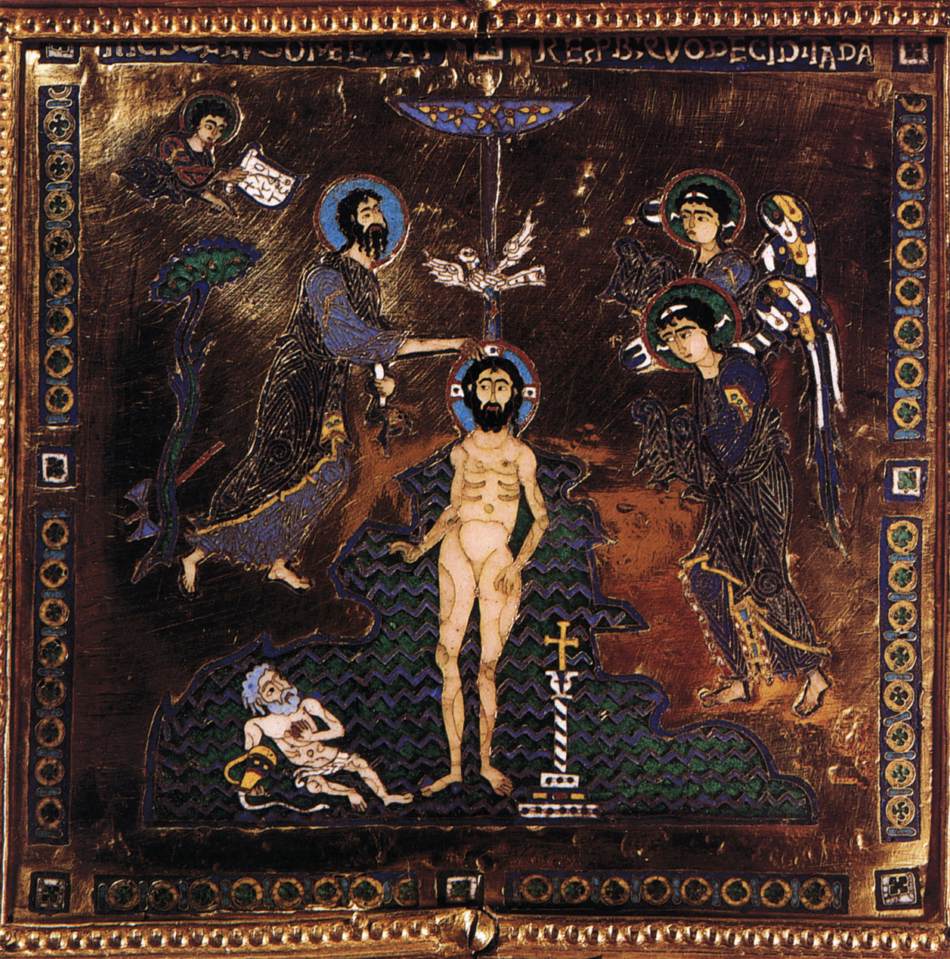
Today the Church celebrates the Feast of the Baptism of Our Lord. This brings to an end the season of Christmas. The Church recalls Our Lord's second manifestation or epiphany which occurred on the occasion of His baptism in the Jordan. Jesus descended into the River to sanctify its waters and to give them the power to beget sons of God. The event takes on the importance of a second creation in which the entire Trinity intervenes.
In the Eastern Church this feast is called Theophany because at the baptism of Christ in the River Jordan God appeared in three persons. The baptism of John was a sort of sacramental preparatory for the Baptism of Christ. It moved men to sentiments of repentance and induced them to confess their sins. Christ did not need the baptism of John. Although He appeared in the "substance of our flesh" and was recognized "outwardly like unto ourselves", He was absolutely sinless and impeccable. He conferred upon the water the power of the true Baptism which would remove all the sins of the world: "Behold the Lamb of God, behold Him Who takes away the sin of the world".
Many of the incidents which accompanied Christ's baptism are symbolical of what happened at our Baptism. At Christ's baptism the Holy Spirit descended upon Him; at our Baptism the Trinity took its abode in our soul. At His baptism Christ was proclaimed the "Beloved Son" of the Father; at our Baptism we become the adopted sons of God. At Christ's baptism the heavens were opened; at our Baptism heaven was opened to us. At His baptism Jesus prayed; after our Baptism we must pray to avoid actual sin.
— Excerpted from Msgr. Rudolph G. Bandas
Customs on the Feast of the Baptism of the Lord
In the Ukraine the faithful gather in the front of the church where a cross of ice is placed. Since there are no rivers near churches, a tub is filled with water and is placed in front of the ice cross. During special and very unique services the water is blessed and brought home. This is taken in before breakfast is eaten. The remains are kept during the year to keep the home safe from fire, lightening and sickness.
The priest visits his parishioners to bless their homes with the holy water that the New Year may be one of cooperation with the gift of God; His Son and the participation in the Life He has come to lead us in toward Salvation. The evening meal is very much a repeat of the Holy Supper except that there are no restrictions on meat and dairy products. It starts with Kutia, which has been saved from Christmas Eve.

Feast of the Baptism of Christ - Day Sixteen
 Today we celebrate the baptism of Christ in the Jordan. This is the second epiphany, or manifestation, of the Lord. The past, the present, and the future are made manifest in this epiphany.
The most holy one placed Himself among us, the unclean and sinners. The Son of God freely humbled Himself at the hand of the Baptist. By His baptism in the Jordan, Christ manifests His humility and dedicates Himself to the redemption of man. He takes upon Himself the sins of the whole world and buries them in the waters of the Jordan. — The Light of the World by Benedict Baur, O.S.B.
The Feast of the Baptism of the Lord
 The mystery of Christ’s baptism in the Jordan by St John, the Precursor, proposes the contemplation of an already adult Jesus. This mystery is infinitely linked to the Solemnities of the Lord’s birth and the Epiphany that we have just celebrated, as in some ways it takes up and represents their significance to us.
At Christmas we have contemplated the human birth of the Word incarnate by the Virgin Mary. In the 4th century, the Fathers of the Church deepened the understanding of the faith with regard to the Christmas mystery in the light of Jesus’ Humanity. They spoke of the Incarnation of the Word already working like the ‘Christification’ of that humanity that he had assumed from His mother. Or put in simpler terms: Jesus is the Christ from the first instant of conception in Mary’s spotless womb because He Himself, with His Divine Power, consecrated, anointed and ‘Christified’ that human nature with which He became incarnate.
In the mystery of the Epiphany, we then meditated on Christ’s manifestation to all nations that was represented by the Magi, the wise men from the East, who came to adore the Child.
Now, in the mystery of Christ’s Baptism in the Jordan River, we again encounter and represent the truth of the Lord’s incarnation and His manifestation as the Christ. Jesus’ Baptism is in fact His definitive manifestation as the Messiah or Christ to Israel, and as the Son of the Father to the entire world. Here we find the dimension of the Epiphany which was His manifestation to all nations. The Father’s voice from heaven shows that Jesus of Nazareth is the eternal Son and the descent of the Holy Spirit in the form of a dove shows the Trinitarian nature of the Christian God. The true and unique God, Father, Son, and Holy Spirit, shows Himself in Christ, through Him, with Him and in Him.
The Baptism in the Jordan returns to the great Christmas theme of ‘Christification,’ Jesus of Nazareth's spiritual anointing, His presentation as the Anointed One par excellence, the Messiah or the One sent by the Father for the salvation of mankind. The Spirit that descended on Jesus shows and seals in an incontrovertible way the ‘Christification’ of Jesus’ humanity that the Word had already fulfilled from the first moment of His miraculous conception by Mary. Jesus, from the very beginning, was always the Lord’s Christ, He was always God. Yet, His one, true humanity, that which is perfect in every way, as the Gospel records, constantly grew in natural and supernatural perfection. ‘And Jesus increased in wisdom, in stature, and in favour with God and with men’ (Lk2:52). In Israel at 30 years of age, one reached full maturity and therefore could become a master. Jesus came of age and the Spirit, descending and remaining on Him, definitively consecrated His whole being as the Christ.
The same Spirit, that descended on the water of the River Jordan wafted over the waters during the first creation (Gen 1:2). Therefore, the Baptism in the Jordan presents yet another truth: that Jesus has started a new creation. He is the second man (1 Cor 15:47) or the last Adam (1 Cor 15:45), that comes to repair the first Adam’s guilt. He does this as the Lamb of God that takes away our sins. ‘Looking at the events in light of the Cross and Resurrection, the Christian people realised what happened: Jesus loaded the burden of all mankind’s guilt upon His shoulders; he bore it down into the depths of the Jordan. He inaugurated his public activity by stepping into the place of sinners’ (Joseph Ratzinger, Jesus of Nazareth, Bloomsbury 2007, p 18).
--Excerpted from the Congregation for the Clergy
catholicculture.org
NAVARRE BIBLE COMMENTARY (RSV)
Ad Majorem Dei Gloriam (To the Greater Glory of God)
From: Isaiah 40:1-5, 9-11
Prologue: Promise of Deliverance
--------------------------------
[1] Comfort, comfort my people, says your God. [2] Speak tenderly to Jerusalem, and cry to her that her warfare is ended, that her iniquity is pardoned, that she has received from the Lord’s hand double for all her sins. [3] A voice cries: “In the wilderness prepare the way of the Lord, make straight in the desert a highway for our God. Every valley shall be lifted up, and every mountain and hill be made low; the uneven ground shall become level, and the rough places a plain. [5] And the glory of the Lord shall be revealed, and all flesh shall see it together, for the mouth of the Lord has spoken.”
[9] Get you up to a high mountain, O Zion, herald of good tidings; lift up your voice with strength, O Jerusalem, herald of good tidings, lift it up, fear not; say to the cities of Judah, “Behold your God!” [10] Behold, the Lord God comes with might, and his arm rules for him; behold, his reward is with him, and his recompense before him. [11] He will feed his flock like a shepherd, he will gather the lambs in his arms, he will carry them in his bosom, and gently lead those that are with young.
***********************************************************************
Commentary:
40:1-55:13. These chapters make up the second part of the book of Isaiah, also known as “Second Isaiah” or “Deutero-Isaiah”. Almost everything here refers to a period of history one or two centuries later than that of “First Isaiah”. The oppressor is no longer Assyria but Babylon, which conquered Jerusalem in 587-586 BC, and then began a series of deportations that sent the upper classes of Jerusalem and Judah into exile. Many years later (539 BC), Cyrus, king of the Persians, conquered the Babylonians and issued a decree allowing those deportees who so wished to return home. These events are echoed in Second Isaiah’s oracles, songs, lamentations and denunciations, and the prophetic visions of the final, enduring deliverance and restoration of the chosen people and the city of Zion.
The various literary units in this part of the book are grouped into two sections more or less by subject. The first (40:1-48:22) implies that the Jews are still held against their will in Babylon. Their deliverance is announced, thanks to the power of the Lord, who rules the world and determines the course of human affairs; he has chosen Cyrus, king of Persia, called here his “anointed”, his messiah, to redeem Israel from exile (44:24-45:25).
This section, too, contains the announcement that God will choose a “servant”, whom he will send empowered by the Spirit to establish law and justice (42:1-9, the first “song of the Servant”).
The second section celebrates the glorious restoration of the people of God on Zion; in this, too, the “Servant of the Lord” will play the key role; the section contains the last three “songs of the Servant” (49: 1-6; 50:4-9; 52:13-53:12).
40:1-48:22. The historical background to these chapters is the time immediately after the return of the exiles from Babylon, which is depicted as a “new exodus”. The exodus from Egypt was the prototype of all God’s interventions on his people’s behalf: now we hear of another one, “new” because the power with which God, the Creator of all things, acts now surpasses that to be seen in the exodus. The news that deliverance is at hand greatly consoles the people: we are told this at the start, and it is repeated in the oracles that follow. For this reason, this part of the book of Isaiah is usually called the “Book of Consolation", and it has been interpreted as an anticipation of the consolation that Christ will bring: “The true consolation, balm and release from all human ills is the Incarnation of our God and Saviour” (Theodoret of Cyrus, "Commentaria In Isaiam", 40, 3).
The section opens with a song of joy over the imminent release of the exiles (40:1-11). After this a number of oracles are grouped together which describe the reason why the people should hope in the Lord who is mighty and desires to save, who is ready to do so (42:1-25), to manifest himself as the Redeemer of Israel (43:1-44:23) and bring salvation to Jerusalem (44:24-48:19). The section ends with a prophecy of the redemption of his people and a call to leave Babylon (48:20-22).
40:1-11. The section begins on a formal note with an anonymous voice proclaiming the Lord's consolation (vv 1-5) The same voice calls on the prophet himself to proclaim that the word of God and his message of salvation will endure forever (vv. 6-11). The oracles are addressed to those people of Jerusalem who have been deported to Babylon. When they were first spoken, many decades had passed since these people and the previous generation were forced to leave the holy city. Those years of suffering and exile have more than atoned for their sins. The time comes for them, with the Lord’s help, to set out on the return journey. That journey is mentioned throughout this section. The voice speaking in the name of the Lord boosts their morale: it won’t be a difficult journey; they will find a way opened up for them which will bring them to the glory of the Lord. As in the exodus from Egypt, on the “way” from Babylon to Jerusalem they will see wonderful evidence of the power of God. The words spoken by the mysterious voice, inviting them to set out, fills the returnees with hope. The four Gospels see these words fulfilled in the ministry of John the Baptist, who is the voice crying in the wilderness, “Prepare the way of the Lord” (cf. v. 3). And, indeed, John, with his call to personal conversion and his baptism of repentance, does prepare the way for people to find Jesus (cf. Mt 3:3; Mk 1:3; Lk 3:4; Jn 1:23), whom the Gospels confess to be “the Lord” (cf. v. 3). John the Baptist is his herald, the “precursor”: “The voice commands that a way be opened for the Word of God, the path smoothed and all obstacles removed: when our God comes, he will be able to walk without hindrance. Prepare the way of the Lord: this means to preach the gospel and to offer consolation to his people, with the desire that the salvation of God embrace all mankind” (Eusebius of Caesarea, "Commentana In Isaiam", 40, 366). Hence, in Christian tradition, “John the Baptist is ‘more than a prophet’ (Lk 7:26). In him, the Holy Spirit concludes his speaking through the prophets. John completes the cycle of prophets begun by Elijah (cf. Mt 11:13-14). He proclaims the imminence of the consolation of Israel; he is the ‘voice’ of the Consoler who is coming (Jn 1:23; cf. Is 40:1-3)” ("Catechism of the Catholic Church", 719).
In the second part of the oracle, the anonymous voice asks the prophet to speak in the name of the Lord (vv. 6-8). Merely human plans can only go so far; but the word of God stands forever In the things that the voice says there must be an allusion to the might of Babylon, which withers like the “flower of the field” when the “breath of the Lord blows upon it”, because it challenged the goodness of God. The message to be given to the people speaks of trusting in the power of God, who comes not to lay waste but to protect and recompense those in his care (vv. 9-11). Here we find for the first time the simile of the “flock” being applied to the people of God, one of a number of figures of speech used in Holy Scripture to describe God’s tender care of his people (cf. Jer 23:3; Ezek 34:1ff; Ps 23:4) and which Christian tradition uses to explain the mystery of the Church: “The Church is a sheepfold whose one and indispensable door is Christ (Jn 10:1-10). It is a flock of which God himself foretold he would be the shepherd (Is 40:11; Ezek 34:11-31), and whose sheep, although ruled by human shepherds, are nevertheless continuously led and nourished by Christ himself, the Good Shepherd and the Prince of the shepherds (cf. Jn 10:11; 1 Pet 5:4), who gave his life for the sheep (cf. Jn 10:11-15)” (Vatican II, "Lumen Gentium", 6).
The words of vv. 6-8 will later be used in the First Letter of St Peter to confirm the validity of the precept of brotherly love (1 Pet 1:24-25).
From: Titus 2:11-14; 3:4-7The Incarnation, the Basis of Christian Ethics and Piety
--------------------------------------------------------
[11] For the grace of God has appeared for the salvation of all men, [12] training us to renounce irreligion and worldly passions, and to live sober, upright, and godly lives in this world, [13] awaiting our blessed hope, the appearing of the glory of our great God and Savior Jesus Christ, [14] who gave himself for us to redeem us from all iniquity and to purify for himself a people of his own who are zealous for good deeds.
[4] When the goodness and loving kindness of God our Savior appeared, [5] he saved us, not because of deeds done by us in righteousness, but in virtue of his own mercy, by the washing of regeneration and renewal in the Holy Spirit, [6] which he poured out upon us richly through Jesus Christ our Savior, [7] so that we might be justified by his grace and become heirs in hope of eternal life.
*************************************************
Commentary:
11-14. This section is almost like a hymn in praise of saving grace and God's loving kindness as manifested in Christ. The terse, sober style, with phrases piled on one another, and very few verbs, is typical of St. Paul. The duties just described (2L1-10)--of older men, women, young people and slaves--all point to Christians' having a common lifestyle, which is the fruit of grace. God is the source of that grace, and salvation its goal, and it is given to us through Jesus Christ.
Thus, divine grace manifested in the Incarnation is actively at work to redeem us; it brings salvation; it sanctifies us, enabling us to live godly lives; and it is the basis of our hope in the second coming of the Lord. All these dimensions of the action of grace summarize revealed doctrine on righteousness (justification) in Jesus Christ. Thus, in the Incarnation, God's salvific will, embracing all men, is manifested in a special way (cf. 1 Tim 2:4); in the Redemption, Christ, the only Mediator and Savior (cf. 1 Tim 2:5) obtains for us the gift of grace, whereby man becomes a sharer in the good things of salvation. Jesus is our model; by means of grace he instructs the Christian on how to control his defects and grow in virtue. The instruction we receive is not only an external one: God inwardly moves us to seek holiness (cf. Rom 5:1-5 and note). Grace also channels our hope, for Christians are motivated not only by the memory of a past event (our Lord's life on earth) but also, and especially, by the fact that Jesus is in the glory of heaven even now and that we are invited to share his inheritance (cf. 2 Pet 3:12-13).
13. "The glory of our great God and Savior Jesus Christ": an explicit confession of faith in the divinity of Jesus Christ, who is stated at one and at the same time (with only one article in the original Greek) to be God and Savior. This expression is the hinge on which the entire hymn turns: Jesus Christ our God is the one who came at the Incarnation, who will manifest himself fully at his second coming, and who through his work of redemption has made it possible for man to live a live pleasing to God.
This verse is reminiscent of Romans 9:5, where St. Paul wrote: "to them belong the patriarchs, and of their race according to the flesh is the Christ, who is God over all, blessed for ever. Amen."
14. The mention of Jesus Christ at the end of the previous verse leads St. Paul to summarize the doctrine of the Redemption in this lovely passage. Four essential elements in redemption are listed: Christ's self-giving; redemption from all iniquity; purification; and Christ's establishment of a people of his own dedicated to good deeds. The reference to Christ's self -giving clearly means whereby we are set free from the slavery of sin; Christ's sacrifice is the cause of the freedom of the children of God (analogously, God's action during the Exodus liberated the people of Israel). Purification, a consequence of redemption, enables a man to become part of God's own people (cf. Ezek 37-23). The expression "a people of his own" is a clear allusion to Exodus 19:5: through the covenant of Sinai God made Israel his own people, different from other nations; through the New Covenant of his blood Jesus forms his own people, the Church, which is open to all nations: "As Israel according to the flesh which wandered in the desert was already called the Church of God, so, too, the new Israel, which advances in this present era in search of a future and permanent city, is called also the Church of Christ. It is Christ indeed who has purchased it with his own blood; he has filled it with his Spirit; he has provided means adapted to its visible and social union [...]. Destined to extend to all regions of the earth, it enters into human history, though it transcends at once all times and all racial boundaries" ("Lumen Gentium", 9).
[T]he coming of Christ has opened up a new panorama (vv. 4-7). As elsewhere in these letters (cf. 1 Tim 3:15; Tit 2:11-14), we have here a hymn to Christ which may well have come from primitive Christian liturgy or from a confession of faith. It summarizes Christian teaching on the Incarnation, the Redemption and the application of salvation to the individual.
According to this text, the Incarnation is the revelation of God our Savior, who makes known his goodness ("benignity", a word which often occurs in the Old Testament and sometimes in the New: cf. Rom 2:4; 11: 22; Gal 5:22; Eph 2:7) and "loving goodness" (literally "philanthropy", a word taken from Greek). The Redemption is referred to in Old Testament language: "he saved us in virtue of his own mercy."
Finally, the Christian's access to salvation is something gratuitous: without any prior merit on our part, God's mercy has sought us out (v. 5; cf. note on Rom 27-31); Baptism is the door to salvation, for it is the sacrament of "regeneration and renewal" (cf. Eph 5:26); the Holy Spirit sent by Christ (cf. Jn 14:26) makes the waters of Baptism effective; his grace gives life to the soul and entitles it to eternal life (cf. Gal 4:7; Rom 8:16-17). The Council of Trent specified that "justification is not only the remission of sins, but sanctification and renovation of the interior man through the voluntary reception of grace and gifts whereby a man becomes just instead of unjust and a friend instead of an enemy, that he may be an heir in the hope of life everlasting" ("De Iustificatione", chap. 7).
The magnificent resume of faith in Christ contained in Titus 3:3-7 also helps Christians see how to approach their work and social involvement; the Second Vatican Council has reminded us once again that "the promised and hoped-for restoration has already begun in Christ. It is carried forward in the sending of the Holy Spirit and through him continues in the Church in which, through our faith, we learn the meaning of our earthly life, while we bring to term, with hope of future good, the task allotted to us in the world by the Father, and so work out our salvation" ("Lumen Gentium", 48).