Free Republic
Browse · Search
Religion
Topics · Post Article

Skip to comments.

Catholic Caucus: Daily Mass Readings 28-Aug-2021; memorial of Saint Augustine, Bishop, Doctor
Universalis/Jerusalem Bible ^

Posted on 08/28/2021 8:20:37 AM PDT by annalex

August 28, 2021

Saint Augustine, Bishop, Doctor on Saturday of week 21 in Ordinary Time


St. Augustine church in Philadelphia

Readings at Mass

Liturgical Colour: White.

Readings for the feria

Readings for the memorial

These are the readings for the feria


First reading
1 Thessalonians 4:9-11 ©

You have learnt from God how to love one another

As for loving our brothers, there is no need for anyone to write to you about that, since you have learnt from God yourselves to love one another, and in fact this is what you are doing with all the brothers throughout the whole of Macedonia. However, we do urge you, brothers, to go on making even greater progress and to make a point of living quietly, attending to your own business and earning your living, just as we told you to.

Responsorial Psalm
Psalm 97(98):1,7-9 ©
The Lord comes to rule the people with fairness.
Sing a new song to the Lord
  for he has worked wonders.
His right hand and his holy arm
  have brought salvation.
The Lord comes to rule the people with fairness.
Let the sea and all within it, thunder;
  the world, and all its peoples.
Let the rivers clap their hands
  and the hills ring out their joy
The Lord comes to rule the people with fairness.
at the presence of the Lord: for he comes,
  he comes to rule the earth.
He will rule the world with justice
  and the peoples with fairness.
The Lord comes to rule the people with fairness.

Gospel AcclamationPh2:15-16
Alleluia, alleluia!
You will shine in the world like bright stars
because you are offering it the word of life.
Alleluia!
Or:Jn13:34
Alleluia, alleluia!
I give you a new commandment:
love one another just as I have loved you,
says the Lord.
Alleluia!

Gospel
Matthew 25:14-30 ©

You have been faithful in small things: come and join in your master's happiness

Jesus spoke this parable to his disciples: ‘The kingdom of Heaven is like a man on his way abroad who summoned his servants and entrusted his property to them. To one he gave five talents, to another two, to a third one; each in proportion to his ability. Then he set out.
  ‘The man who had received the five talents promptly went and traded with them and made five more. The man who had received two made two more in the same way. But the man who had received one went off and dug a hole in the ground and hid his master’s money.
  ‘Now a long time after, the master of those servants came back and went through his accounts with them. The man who had received the five talents came forward bringing five more. “Sir,” he said “you entrusted me with five talents; here are five more that I have made.”
  ‘His master said to him, “Well done, good and faithful servant; you have shown you can be faithful in small things, I will trust you with greater; come and join in your master’s happiness.”
  ‘Next the man with the two talents came forward. “Sir,” he said “you entrusted me with two talents; here are two more that I have made.” His master said to him, “Well done, good and faithful servant; you have shown you can be faithful in small things, I will trust you with greater; come and join in your master’s happiness.”
  ‘Last came forward the man who had the one talent. “Sir,” said he “I had heard you were a hard man, reaping where you have not sown and gathering where you have not scattered; so I was afraid, and I went off and hid your talent in the ground. Here it is; it was yours, you have it back.” But his master answered him, “You wicked and lazy servant! So you knew that I reap where I have not sown and gather where I have not scattered? Well then, you should have deposited my money with the bankers, and on my return I would have recovered my capital with interest. So now, take the talent from him and give it to the man who has the five talents. For to everyone who has will be given more, and he will have more than enough; but from the man who has not, even what he has will be taken away. As for this good-for-nothing servant, throw him out into the dark, where there will be weeping and grinding of teeth.”’

Continue

These are the readings for the memorial


First reading1 John 4:7-16 ©

Let us love one another, since love comes from God

My dear people,
let us love one another
since love comes from God
and everyone who loves is begotten by God and knows God.
Anyone who fails to love can never have known God,
because God is love.
God’s love for us was revealed
when God sent into the world his only Son
so that we could have life through him;
this is the love I mean:
not our love for God,
but God’s love for us when he sent his Son
to be the sacrifice that takes our sins away.
My dear people,
since God has loved us so much,
we too should love one another.
No one has ever seen God;
but as long as we love one another
God will live in us
and his love will be complete in us.
We can know that we are living in him
and he is living in us
because he lets us share his Spirit.
We ourselves saw and we testify
that the Father sent his Son
as saviour of the world.
If anyone acknowledges that Jesus is the Son of God,
God lives in him, and he in God.
We ourselves have known and put our faith in
God’s love towards ourselves.
God is love
and anyone who lives in love lives in God,
and God lives in him.

Responsorial Psalm
Psalm 118(119):9-14 ©
Lord, teach me your statutes.
How shall the young remain sinless?
  By obeying your word.
I have sought you with all my heart;
  let me not stray from your commands.
Lord, teach me your statutes.
I treasure your promise in my heart
  lest I sin against you.
Blessed are you, O Lord;
  teach me your statutes.
Lord, teach me your statutes.
With my tongue I have recounted
  the decrees of your lips.
I rejoiced to do your will
  as though all riches were mine.
Lord, teach me your statutes.

Gospel AcclamationMt23:9,10
Alleluia, alleluia!
You have only one Father,
  and he is in heaven;
you have only one Teacher,
  the Christ.
Alleluia!

GospelMatthew 23:8-12 ©

The greatest among you must be your servant

Jesus said to his disciples, ‘You must not allow yourselves to be called Rabbi, since you have only one master, and you are all brothers. You must call no one on earth your father, since you have only one Father, and he is in heaven. Nor must you allow yourselves to be called teachers, for you have only one Teacher, the Christ. The greatest among you must be your servant. Anyone who exalts himself will be humbled, and anyone who humbles himself will exalted.’

The readings on this page are from the Jerusalem Bible, which is used at Mass in most of the English-speaking world. The New American Bible readings, which are used at Mass in the United States, are available in the Universalis apps, programs and downloads.

You can also view this page with the Gospel in Greek and English.


TOPICS: Catholic; General Discusssion; Prayer; Worship
KEYWORDS: catholic; mt2523; ordinarytime; prayer
For your reading, reflection, faith-sharing, comments, questions, discussion.

1 posted on 08/28/2021 8:20:37 AM PDT by annalex
[ Post Reply | Private Reply | View Replies]

To: All

KEYWORDS: catholic; mt2523; ordinarytime; prayer;


2 posted on 08/28/2021 8:21:13 AM PDT by annalex (fear them not)
[ Post Reply | Private Reply | To 1 | View Replies]

To: annalex
Prayer thread for Salvation's recovery
3 posted on 08/28/2021 8:21:36 AM PDT by annalex (fear them not)
[ Post Reply | Private Reply | To 2 | View Replies]

To: nickcarraway; NYer; ELS; Pyro7480; livius; ArrogantBustard; Catholicguy; RobbyS; marshmallow; ...
Alleluia Ping

Please FReepmail me to get on/off the Alleluia Ping List.


4 posted on 08/28/2021 8:23:11 AM PDT by annalex (fear them not)
[ Post Reply | Private Reply | To 1 | View Replies]

To: annalex
Matthew
 English: Douay-RheimsLatin: Vulgata ClementinaGreek NT: Byzantine/Majority Text (2000)
 Matthew 25
14For even as a man going into a far country, called his servants, and delivered to them his goods; Sicut enim homo peregre proficiscens, vocavit servos suos, et tradidit illis bona sua.ωσπερ γαρ ανθρωπος αποδημων εκαλεσεν τους ιδιους δουλους και παρεδωκεν αυτοις τα υπαρχοντα αυτου
15And to one he gave five talents, and to another two, and to another one, to every one according to his proper ability: and immediately he took his journey. Et uni dedit quinque talenta, alii autem duo, alii vero unum, unicuique secundum propriam virtutem : et profectus est statim.και ω μεν εδωκεν πεντε ταλαντα ω δε δυο ω δε εν εκαστω κατα την ιδιαν δυναμιν και απεδημησεν ευθεως
16And he that had received the five talents, went his way, and traded with the same, and gained other five. Abiit autem qui quinque talenta acceperat, et operatus est in eis, et lucratus est alia quinque.πορευθεις δε ο τα πεντε ταλαντα λαβων ειργασατο εν αυτοις και εποιησεν αλλα πεντε ταλαντα
17And in like manner he that had received the two, gained other two. Similiter et qui duo acceperat, lucratus est alia duo.ωσαυτως και ο τα δυο εκερδησεν και αυτος αλλα δυο
18But he that had received the one, going his way digged into the earth, and hid his lord's money. Qui autem unum acceperat, abiens fodit in terram, et abscondit pecuniam domini sui.ο δε το εν λαβων απελθων ωρυξεν εν τη γη και απεκρυψεν το αργυριον του κυριου αυτου
19But after a long time the lord of those servants came, and reckoned with them. Post multum vero temporis venit dominus servorum illorum, et posuit rationem cum eis.μετα δε χρονον πολυν ερχεται ο κυριος των δουλων εκεινων και συναιρει μετ αυτων λογον
20And he that had received the five talents coming, brought other five talents, saying: Lord, thou didst deliver to me five talents, behold I have gained other five over and above. Et accedens qui quinque talenta acceperat, obtulit alia quinque talenta, dicens : Domine, quinque talenta tradidisti mihi, ecce alia quinque superlucratus sum.και προσελθων ο τα πεντε ταλαντα λαβων προσηνεγκεν αλλα πεντε ταλαντα λεγων κυριε πεντε ταλαντα μοι παρεδωκας ιδε αλλα πεντε ταλαντα εκερδησα επ αυτοις
21His lord said to him: Well done, good and faithful servant, because thou hast been faithful over a few things, I will place thee over many things: enter thou into the joy of thy lord. Ait illi dominus ejus : Euge serve bone, et fidelis : quia super pauca fuisti fidelis, super multa te constituam ; intra in gaudium domini tui.εφη δε αυτω ο κυριος αυτου ευ δουλε αγαθε και πιστε επι ολιγα ης πιστος επι πολλων σε καταστησω εισελθε εις την χαραν του κυριου σου
22And he also that had received the two talents came and said: Lord, thou deliveredst two talents to me: behold I have gained other two. Accessit autem et qui duo talenta acceperat, et ait : Domine, duo talenta tradidisti mihi, ecce alia duo lucratus sum.προσελθων δε και ο τα δυο ταλαντα λαβων ειπεν κυριε δυο ταλαντα μοι παρεδωκας ιδε αλλα δυο ταλαντα εκερδησα επ αυτοις
23His lord said to him: Well done, good and faithful servant: because thou hast been faithful over a few things, I will place thee over many things: enter thou into the joy of thy lord. Ait illi dominus ejus : Euge serve bone, et fidelis : quia super pauca fuisti fidelis, super multa te constituam ; intra in gaudium domini tui.εφη αυτω ο κυριος αυτου ευ δουλε αγαθε και πιστε επι ολιγα ης πιστος επι πολλων σε καταστησω εισελθε εις την χαραν του κυριου σου
24But he that had received the one talent, came and said: Lord, I know that thou art a hard man; thou reapest where thou hast not sown, and gatherest where thou hast not strewed. Accedens autem et qui unum talentum acceperat, ait : Domine, scio quia homo durus es ; metis ubi non seminasti, et congregas ubi non sparsisti :προσελθων δε και ο το εν ταλαντον ειληφως ειπεν κυριε εγνων σε οτι σκληρος ει ανθρωπος θεριζων οπου ουκ εσπειρας και συναγων οθεν ου διεσκορπισας
25And being afraid I went and hid thy talent in the earth: behold here thou hast that which is thine. et timens abii, et abscondi talentum tuum in terra : ecce habes quod tuum est.και φοβηθεις απελθων εκρυψα το ταλαντον σου εν τη γη ιδε εχεις το σον
26And his lord answering, said to him: Wicked and slothful servant, thou knewest that I reap where I sow not, and gather where I have not strewed: Respondens autem dominus ejus, dixit ei : Serve male, et piger, sciebas quia meto ubi non semino, et congrego ubi non sparsi :αποκριθεις δε ο κυριος αυτου ειπεν αυτω πονηρε δουλε και οκνηρε ηδεις οτι θεριζω οπου ουκ εσπειρα και συναγω οθεν ου διεσκορπισα
27Thou oughtest therefore to have committed my money to the bankers, and at my coming I should have received my own with usury. oportuit ergo te committere pecuniam meam numulariis, et veniens ego recepissem utique quod meum est cum usura.εδει ουν σε βαλειν το αργυριον μου τοις τραπεζιταις και ελθων εγω εκομισαμην αν το εμον συν τοκω
28Take ye away therefore the talent from him, and give it to him that hath ten talents. Tollite itaque ab eo talentum, et date ei qui habet decem talenta :αρατε ουν απ αυτου το ταλαντον και δοτε τω εχοντι τα δεκα ταλαντα
29For to every one that hath shall be given, and he shall abound: but from him that hath not, that also which he seemeth to have shall be taken away. omni enim habenti dabitur, et abundabit : ei autem qui non habet, et quod videtur habere, auferetur ab eo.τω γαρ εχοντι παντι δοθησεται και περισσευθησεται απο δε του μη εχοντος και ο εχει αρθησεται απ αυτου
30And the unprofitable servant cast ye out into the exterior darkness. There shall be weeping and gnashing of teeth. Et inutilem servum ejicite in tenebras exteriores : illic erit fletus, et stridor dentium.και τον αχρειον δουλον εκβαλετε εις το σκοτος το εξωτερον εκει εσται ο κλαυθμος και ο βρυγμος των οδοντων

5 posted on 08/28/2021 8:25:07 AM PDT by annalex (fear them not)
[ Post Reply | Private Reply | To 4 | View Replies]

To: annalex

Catena Aurea by St. Thomas Aguinas

25:14–30

14. For the kingdom of heaven is as a man travelling into a far country, who called his own servants, and delivered unto them his goods.

15. And unto one he gave rive talents, to another two, and to another one; to every man according to his several ability; and straightway took his journey.

16. Then he that had received the five talents went and traded with the same, and made them other five talents.

17. And likewise he that had received two, he also gained other two.

18. But he that had received one went and digged in the earth, and hid his lord’s money.

19. After a long time the lord of those servants cometh, and reckoneth with them.

20. And so he that had received five talents came and brought other five talents, saying, Lord, thou deliveredst unto me five talents: behold, I have gained beside them five talents more.

21. His lord said unto him, Well done, thou good and faithful servant: thou hast been faithful over a few things, I will make thee ruler over many things: enter thou into the joy of thy lord.

22. He also that had received two talents came and said, Lord, thou deliveredst unto me two talents: behold, I have gained two other talents beside them.

23. His lord said unto him, Well done, good and faithful servant; thou hast been faithful over a few things, I will make thee ruler over many things: enter thou into the joy of thy lord.

24. Then he which had received the one talent came and said, Lord, I knew thee that thou art an hard man, reaping where thou hast not sown, and gathering where thou hast not strawed:

25. And I was afraid, and went and hid thy talent in the earth: lo, there thou hast that is thine.

26. His lord answered and said unto him, Thou wicked and slothful servant, thou knewest that I reap where I sowed not, and gather where I have not strawed:

27. Thou oughtest therefore to have put my money to the exchangers, and then at my coming I should have received my own with usury.

28. Take therefore the talent from him, and give it unto him which hath ten talents.

29. For unto every one that hath shall be given, and he shall have abundance: but from him that hath not shall be taken away even that which he hath.

30. And cast ye the unprofitable servant into outer darkness: there shall be weeping and gnashing of teeth.

GLOSS. (non occ.) In the foregoing parable is set forth the condemnation of such as have not prepared sufficient oil for themselves, whether by oil is meant the brightness of good works, or inward joy of conscience, or alms paid in money.

CHRYSOSTOM. This parable is delivered against those who will not assist their neighbours either with money, or words, or in any other way, but hide all that they have.

GREGORY. (Hom. in Ev. ix, l.) The man travelling into a far country is our Redeemer, who ascended into heaven in that flesh which He had taken upon Him. For the proper home of the flesh is the earth, and it, as it were, travels into a foreign country, when it is placed by the Redeemer in heaven.

ORIGEN. He travels, not according to His divine nature, but according to the dispensation of the flesh which He took upon Him. For He who says to His disciples, Lo, I am with you always, even unto the end of the world, (Mat. 28:20.) is the Only-Begotten God, who is not circumscribed by bodily form. By saying this, we do not disunite Jesus, but attribute its proper qualities to each constituent substance. We may also explain thus, that the Lord travels in a far country with all those who walk by faith and not by sight. And when we are absent from the body with the Lord, then will He also be with us. Observe that the turn of expression is not thus, I am like, or The Son of Man is like, a man travelling into a far country, because He is represented in the parable as travelling, not as the Son of God, but as man.

JEROME. Calling together the Apostles, He gave them the Gospel doctrine, to one more, to another less, not as of His own bounty or scanting, but as meeting the capacity of the receivers, as the Apostle says (1 Cor. 3:2.), that he fed with milk those that were unable to take solid food. In the five, two, and one talent, we recognise the diversity of gifts wherewith we have been entrusted.

ORIGEN. Whenever you see of those who have received from Christ a dispensation of the oracles of God that some have more and some less; that some have not in comparison of the better sort half an understanding of things; that others have still less; you will perceive the difference of those who have all of them received from Christ oracles of God. They to whom five talents were given, and they to whom two, and they to whom one, have divers degrees of capacity, and one could not hold the measure of another; he who received but one having received no mean endowment, for one talent of such a master is a great thing. His proper servants are three, as there are three sorts of those that bear fruit. He that received five talents, is he that is able to raise all the meanings of the Scriptures to their more divine significations; he that has two is he that has been taught carnal doctrine, (for two seems to be a carnal number,) and to the less strong the Master of the household has given one talent.

GREGORY. (ubi sup.) Otherwise; The five talents denote the gift of the five senses, that is, the knowledge of things without; the two signify understanding and action, the one talent understanding only.

GLOSS. (ord.) And straightway took his journey, not changing his place, but leaving them to their own freewill and choice of action.

JEROME. He that had received five talents, that is, having received his bodily senses, he doubled his knowledge of heavenly things, from the creature understanding the Creator, from earthly unearthly, from temporal the eternal.

GREGORY. (ubi sup.) There are also some who though they cannot pierce to things inward and mystical, yet for their measure of view of their heavenly country they teach rightly such things as they can, what they have gathered from things without, and while they keep themselves from wantonness of the flesh, and from ambition of earthly things, and from the delights of the things that are seen, they restrain others also from the same by their admonitions.

ORIGEN. Or, They that have their senses exercised by healthy conversation, both raising themselves to higher knowledge and zealous in teaching others, these have gained other five; because no one can easily have increase of any virtues that are not his own, and without he teaches others what he himself knows, and no more.

HILARY. Or, That servant who received five talents is the people of believers under the Law, who beginning with that, doubled their merit by the right obedience of an evangelic faith.

GREGORY. (ubi sup.) Again, there are some who by their understanding and their actions preach to others, and thence gain as it were a twofold profit in such merchandize. This their preaching bestowed upon both sexes is thus a talent doubled.

ORIGEN. Or, gained other two, that is, carnal instruction, and another yet a little higher.

HILARY. Or, the servant to whom two talents were committed is the people of the Gentiles justified by the faith and confession of the Son and of the Father, confessing our Lord Jesus Christ, to be both God and Man, both Spirit and Flesh. These are the two talents committed to this servant. But as the Jewish people doubled by its belief in the Gospel every Sacrament which it had learned in the Law, (i. e. its five talents,) so this people by its use of its two talents merited understanding and working.

GREGORY. (ubi sup.) To hide one’s talent in the earth is to devote the ability we have received to worldly business.

ORIGEN. Or otherwise; When you see one who has the power of teaching, and of benefitting souls, hiding this power, though he may have a certain religiousness of life, doubt not of such an one that he has received one talent and hides it in the earth.

HILARY. Or, This servant who has received one talent and hid it in the earth is the people that continue in the Law, who through jealousy of the salvation of the Gentiles hide the talent they have received in the earth. For to hide a talent in the earth is to hide the glory of the new preaching through offence at the Passion of His Body. His coming to reckon with them is the assize of the day of judgment.

ORIGEN. And note here that the servants do not come to the Lord to be judged, but the Lord shall come to them when the time shall be accomplished. After a long time, that is, when He has sent forth such as are fitted to bring about the salvation of souls, and perhaps for this reason it is not easy to find one who is quite fit to pass forthwith out of this life, as is manifest from this, that even the Apostles lived to old age; for example, it was said to Peter, When thou shalt be old, thou shall stretch forth thy hand; (John 21:18.) and Paul says to Philemon, Now as Paul the aged.

CHRYSOSTOM. Observe also that the Lord does not require the reckoning immediately, that you may learn His long suffering. To me He seems to say this covertly, alluding to the resurrection.

JEROME. After a long time, because there is a long interval between the Saviour’s ascension and His second coming.

GREGORY. (ubi sup.) This lesson from this Gospel warns us to consider whether those, who seem to have received more in this world than others, shall not be more severely judged by the Author of the world; the greater the gifts, the greater the reckoning for them. Therefore should every one be humble concerning his talents in proportion as he sees himself tied up with a greater responsibility.

ORIGEN. He who had received five talents comes first with boldness before his Lord.

GREGORY. (Hom. in Ev. ix. 2.) And bringing his talents doubled, he is commended by his Lord, and is sent into eternal happiness.

RABANUS. Well done is an interjection of joy; the Lord shewing us therein the joy with which He invites the servant who labours well to eternal bliss; of which the Prophet speaks, In thy presence is fulness of joy.

CHRYSOSTOM. Thou good servant, (Ps. 16:11.) this he means of that goodness which is shewn towards our neighbour.

GLOSS. (non occ.) Faithful, because he appropriated to himself none of those things which were his lord’s.

JEROME. He says, Thou wast faithful in a few things, because all that we have at present though they seem great and many, yet in comparison of the things to come are little and few.

GREGORY. (ubi sup.) The faithful servant is set over many things, when having overcome the afflictions of corruption, he joys with eternal joy in that heavenly seat. He is then fully admitted to the joy of his Lord, when taken in to that abiding country, and numbered among the companies of Angels, he has such inward joy for this gift, that there is no room for outward sorrow at his corruption.

JEROME. What greater thing can be given to a faithful servant than to be with his Lord, and to see his Lord’s joy?

CHRYSOSTOM. By this word joy He expresses complete blessedness.

AUGUSTINE. (de Trin. i. 8.) This will be our perfect joy, than which is none greater, to have fruition of that Divine Trinity in whose image we were made.

JEROME. The servant who of five talents had made ten, and he who of two had made four, are received with equal favour by the Master of the household, who looks not to the largeness of their profit, but to the disposition of their will.

ORIGEN. That He says of both these servants that they came, we must understand of their passing out of this world to Him. And observe that the same was said to them both; he that had less capacity, but that which he had, he exercised after such manner as he ought, shall have no whit less with God than he who has a greater capacity; for all that is required is that whatever a man has from God, he should use it all to the glory of God.

GREGORY. (Hom. in Ev. ix. 3.) The servant who would not trade with his talent returns to his Lord with words of excuse.

JEROME. For truly that which is written, To offer excuses excusing sins (Ps. 141:4.) happened to this servant, so that to slothfulness and idleness was added also the sin of pride. For he who ought to have honestly acknowledged his fault, and to have entreated the Master of the household, on the contrary cavils against him, and avers that he did it with provident design, lest while he sought to make profit he should hazard the capital.

ORIGEN. This servant seems to me to have been one of those who believe, but do not act honestly, concealing their faith, and doing every thing that they may not be known to be Christians. They who are such seem to me to have a fear of God, and to regard Him as austere and implacable. We indeed understand how the Lord reaps where He sowed not, because the righteous man sows in the Spirit, whereof he shall reap life eternal. Also He reaps where He sowed not, and gathers where he scattered not, because He counts as bestowed upon Himself all that is sown among the poor.

JEROME. Also, by this which this servant dared to say, Thou, reapest where thou sowedst not, we understand that the Lord accepts the good life of the Gentiles and of the Philosophers.

GREGORY. (ubi sup.) But there are many within the Church of whom this servant is a type, who fear to set out on the path of a better life, and yet are not afraid to continue in carnal indolence; they esteem themselves sinners, and therefore tremble to take up the paths of holiness, but fearlessly remain in their own iniquities.

HILARY. Or, By this servant is understood the Jewish people which continues in the Law, and says I was afraid of thee, as through fear of the old commandments abstaining from the exercise of evangelical liberty; and it says, Lo, there is that is thine, as though it had continued in those things which the Lord commanded, when yet it knew that the fruits of righteousness should be reaped there, where the Law had not been sown, and that there should be gathered from among the Gentiles some who were not scattered of the seed of Abraham.

JEROME. But what he thought would be his excuse is turned into his condemnation. He calls him wicked servant, because he cavilled against his Lord; and slothful, because he would not double his talent; condemning his pride in the one, and his idleness in the other. If you knew me to be hard and austere, and to seek after other men’s goods, you should also have known that I exact with the more rigour that is mine own, and should have given my money to the bankers; for the Greek word here (ἀζγύριον) means money. The words of the Lord are pure words, silver tried in the fire. (Ps. 12:6.) The money, or silver, then are the preaching of the Gospel and the heavenly word; which ought to be given to the bankers, that is, either to the other doctors, which the Apostles did when they ordained Priests and Bishops throughout the cities; or to all the believers, who can double the sum and restore it with usury by fulfilling in act what they have learned in word.

GREGORY. (Hom. in Ev. ix. 4.) So then we see as well the peril of the teachers if they withhold the Lord’s money, as that of the hearers from whom is exacted with usury that they have heard, namely, that from what they have heard they should strive to understand that they have not heard.

ORIGEN. The Lord did not allow that He was a hard man as the servant supposed, but He assented to all his other words. But He is indeed hard to those who abuse the mercy of God to suffer themselves to become remiss, and use it not to be converted.

GREGORY. (ubi sup.) Let us hear now the sentence by which the Lord condemns the slothful servant, Take away from him the talent, and give it to him that hath ten talents.

ORIGEN. The Lord is able by the might of His divinity to take away his ability from the man who is slack to use it, and to give it to him who has improved his own.

GREGORY. (Hom. in Ev. ix. 5.) It might seem more seasonable to have given it rather to him who had two, than to him who had five. But as the five talents denote the knowledge of things without, the two understanding and action, he who had the two had more than he who had the five talents; this man with his five talents merited the administration of things without, but was yet without any understanding of things eternal. The one talent therefore, which we say signifies the intellect, ought to be given to him who had administered well the things without which he had received; the same we see happen every day in the Holy Church, that they who administer faithfully things without, are also mighty in the in ward understanding.

JEROME. Or, it is given to him who had gained five talents, that we may understand that though the Lord’s joy over the labour of each be equal, of him who doubled the five as of him who doubled the two, yet is a greater reward due to him who laboured more in the Lord’s money.

GREGORY. (Hom. in Ev. ix. 6.) Then follows a general sentence, For to every one that hath shall be given, and he shall have abundance, but from him that hath not, even that which he seemeth to have shall be taken away. For whosoever has charity receives the other gifts also; but whosoever has not charity loses even the gifts which he seemed to have had.

CHRYSOSTOM. Also he who has the graces of eloquence and of teaching to profit withal, and uses it not, loses that grace; but he who does his endeavour in putting it to use acquires a larger share.

JEROME. Many also who are naturally clever and have sharp wit, if they become neglectful, and by disuse spoil that good they have by nature, these do, in comparison of him who being somewhat dull by nature compensates by industry and painstaking his backwardness, lose their natural gift, and see the reward promised them pass away to others. But it may also be understood thus; To him who has faith, and a right will in the Lord, even if he come in aught short in deed as being man, shall be given by the merciful Judge; but he who has not faith, shall lose even the other virtues which he seems to have naturally. And He says carefully, From him that hath not, shall be taken away even that which he seemeth to have, for whatsoever is without faith in Christ ought not to be imputed to him who uses it amiss, but to Him who gives the goods of nature even to a wicked servant.

GREGORY. (ubi sup.) Or, Whoso has not charity, loses even those things which he seems to have received.

HILARY. And on those who have the privilege of the Gospels, the honour of the Law is also conferred, but from him who has not the faith of Christ is taken away even that honour which seemed to be his through the Law.

CHRYSOSTOM. The wicked servant is punished not only by loss of his talent, but by intolerable infliction, and a denunciation in accusation joined therewith.

ORIGEN. Into outer darkness, where is no light, perhaps not even physical light; and where God is not seen, but those who are condemned thereto are condemned as unworthy the contemplation of God. We have also read some one before us expounding this of the darkness of that abyss which is outside the world, as though unworthy of the world, they were cast out into that abyss, where is darkness with none to lighten it.

GREGORY. (ubi sup.) And thus for punishment he shall be cast into outer darkness who has of his own free will fallen into inward darkness.

JEROME. What is weeping and gnashing of teeth we have said above.

CHRYSOSTOM. Observe that not only he who robs others, or who works evil, is punished with extreme punishment, but he also who does not good works.

GREGORY. (Hom. in Ev. ix. 7.) Let him then who has understanding look that he hold not his peace; let him who has affluence not be dead to mercy; let him who has the art of guiding life communicate its use with his neighbour; and him who has the faculty of eloquence intercede with the rich for the poor. For the very least endowment will be reckoned as a talent entrusted for use.

ORIGEN. If you are offended at this we have said, namely that a man shall be judged if he does not teach others, call to mind the Apostle’s words, Woe is unto me if I preach not the Gospel. (1 Cor. 9:16.)

Catena Aurea Matthew 25

6 posted on 08/28/2021 8:26:18 AM PDT by annalex (fear them not)
[ Post Reply | Private Reply | To 5 | View Replies]

To: annalex


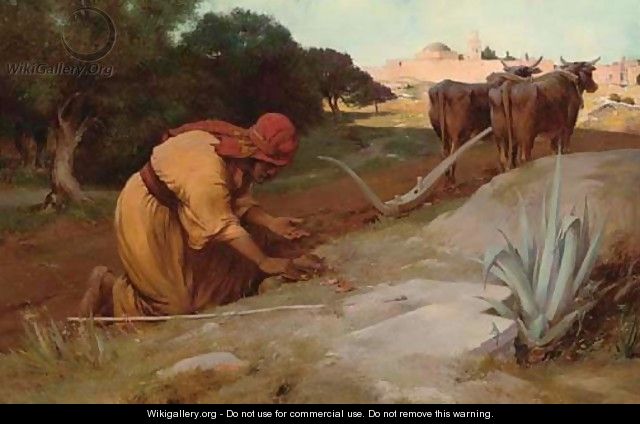
The parable of the talents

John Morgan (1822 – 1885)

Oil on Canvas

7 posted on 08/28/2021 8:27:02 AM PDT by annalex (fear them not)
[ Post Reply | Private Reply | To 6 | View Replies]

To: annalex
Saint Augustine's Story

A Christian at 33, a priest at 36, a bishop at 41: Many people are familiar with the biographical sketch of Augustine of Hippo, sinner turned saint. But to get to really know the man is a rewarding experience.

There quickly surfaces the intensity with which he lived his life, whether his path led away from or toward God. The tears of his mother, the instructions of Ambrose and, most of all, God himself speaking to him in the Scriptures, redirected Augustine’s love of life to a life of love.

Having been so deeply immersed in creature-pride of life in his early days and having drunk deeply of its bitter dregs, it is not surprising that Augustine should have turned, with a holy fierceness, against the many demon-thrusts rampant in his day. His times were truly decadent: politically, socially, morally. He was both feared and loved, like the Master. The perennial criticism leveled against him: a fundamental rigorism.

In his day, Augustine providentially fulfilled the office of prophet. Like Jeremiah and other greats, he was hard-pressed but could not keep quiet. “I say to myself, I will not mention him/I will speak in his name no more/But then it becomes like fire burning in my heart/imprisoned in my bones/I grow weary holding it in/I cannot endure it” (Jeremiah 20:9).


Reflection

Augustine is still acclaimed and condemned in our day. He is a prophet for today, trumpeting the need to scrap escapisms and stand face-to-face with personal responsibility and dignity.


Saint Augustine is a Patron Saint of:

Converts to Christianity
Printers
Theologians


franciscanmedia.org
8 posted on 08/28/2021 8:29:35 AM PDT by annalex (fear them not)
[ Post Reply | Private Reply | To 7 | View Replies]

To: annalex


Augustine of Hippo

6th-century fresco, Lateran, Rome

9 posted on 08/28/2021 8:33:06 AM PDT by annalex (fear them not)
[ Post Reply | Private Reply | To 8 | View Replies]

To: annalex; Cronos
NAVARRE BIBLE COMMENTARY (RSV)

Ad Majorem Dei Gloriam (To the Greater Glory of God)

From: 1 Thessalonians 4:9-11

Charity and Good Use of Time
--------------------------------------------
[9] But concerning love of the brethren you have no need to have any one write to you, for you yourselves have been taught by God to love one another; [10] and indeed you do love all the brethren throughout Macedonia. But we exhort you, brethren, to do so more and more, [11] to aspire to live quietly, to mind your own affairs, and to work with your hands, as we charged you; [12] so that you may command the respect of outsiders, and be dependent on nobody.

*************************************************
Commentary:

9-10. "The greatest commandment of the law is to love God with one's whole heart and one's neighbor as oneself (cf. Mt 22:37-40). Christ has made this love of neighbor his personal commandment and has enriched it with a new meaning when he willed himself, along with his brothers, to be the object of this charity, saying, 'When you did it to one of the least of these my brethren, you did it to me' (Mt. 25:40). In assuming human nature he has united to himself all mankind in a supernatural solidarity which makes of it one single family. He has made charity the distinguishing mark of his disciples, in the words: 'By this all men will know that you are my disciples, if you have love for one another' (Jn 13:35). In the early days the Church linked the 'agape' to the eucharistic supper, and by so doing showed itself as one body around Christ united by the bond of charity. So too, in all ages, love is its characteristic mark" (Vatican II, Apostolicam Actuositatem, 8). Love for the other members of the Church is fraternal love, a love which brothers and sisters should have for one another, for the Church is one large family. The Thessalonians practised this love not only among themselves but also with the other believers living in Macedonia; fraternal charity is absolutely necessary for the unity of Christians.

"No tongue can tell the heights to which love uplifts us", St Clement of Rome teaches. "Love unites us to God; love casts a veil over innumerable sins; there are no limits to love's endurance, no end to its patience. There is nothing base, nothing proud, about love [...] It was in love that all God's chosen ones were made perfect. Without love nothing is pleasing to God" (Letter to the Corinthians, 1, 49).

11-12. Everyone has certain obligations connected with his position in life which he should conscientiously fulfill. They include, particularly, duties to do with work and family, and they provide us with an opportunity for conversation with God. St John Chrysostom teaches, for example: "A woman working in the kitchen or doing some sewing can always raise her thoughts to heaven and fervently invoke the Lord. If someone is on the way to market or is traveling alone, he can easily pray attentively. Someone else who is in his wine-cellar, engaged in stitching wine skins, is free enough to raise his heart to the Master" (Fifth Homily on Anna, 4, 6).

Work is something of immense human and supernatural value, for it is a means readily at hand for personal sanctification and cooperation with others. It would be unworthy of a Christian to live an idle life and expect to be supported by the charity of others. St Paul counsels everyone who can to look after his family and "be dependent on nobody". And so we find the following in one of the very earliest Christian documents: "If someone wants to settle down among you, and is a skilled worker, let him find employment and earn his bread. If he knows no trade, use your discretion to make sure that he does not live in idleness on the strength of being a Christian. If he does not want to work, he is only trying to exploit Christ. Be on your guard against people of that sort" ("Didache", 12). So, a person cannot be regarded as a good Christian if he does not try to work well, for "our professional vocation is an essential and inseparable part of our condition as Christians. Our Lord wants you to be holy in the place where you are, in the job you have chosen" (St J. Escriva, Friends of God, 60).

In addition to promoting personal sanctification and cooperation with others, work gives the Christian a share in Christ's work of Redemption. "Sweat and toil, which work necessarily involves in the present condition of the human race, present the Christian and everyone who is called to follow Christ with the possibility of sharing lovingly in the work that Christ came to do (cf. Jn 17:4). This work of salvation came about through suffering and death on a Cross. By enduring the toil of work in union with Christ crucified for us, man in a way collaborates with the Son of God for the redemption of humanity. He shows himself a true disciple of Christ by carrying the cross in his turn every day (cf. Lk 9:23) in the activity that he is called upon to perform" (John Paul II, Laborem Exercens, 27).

10 posted on 08/28/2021 1:58:26 PM PDT by fidelis (Defeatism and despair are like poison to men's souls. If you can't be positive, at least be quiet.)
[ Post Reply | Private Reply | To 9 | View Replies]

To: fidelis
From: Matthew 25:14-30

The Parable of the Talents
--------------------------

(Jesus said to His disciples,) [14] "For it will be as when a man going on a journey called his servants and entrusted to them his property; [15] to one he gave five talents, to another two, to another one, to each according to his ability. Then he went away. [16] He who had received the five talents went at once and traded with them; and he made five talents more. [17] So also, he who had the two talents made two talents more. [18] But he who had received the one talent went and dug in the ground and hid his master's money.

[19] Now after a long time the master of those servants came and settled accounts with them. [20] And he who received the five talents came forward, bringing five talents more, saying, `Master, you delivered to me five talents; here I have made five talents more.' [21] His master said to him, `Well done, good and faithful servant; you have been faithful over a little, I will set you over much; enter into the joy of your master.' [22] And he also who had the two talents came forward, saying, `Master, you delivered to me two talents; here I have made two talents more.' [23] His master said to him, `Well done, good and faithful servant; you have been faithful over a little, I will set you over much; enter into the joy of your master.'

[24] He also who had received the one talent came forward, saying, `Master, I knew you to be a hard man, reaping where you did not sow, and gathering where you did not winnow; [25] so I was afraid, and I went and hid your talent in the ground. Here you have what is yours.' [26] But his master answered him, `You wicked and slothful servant! You knew that I reap where I have not sowed, and gather where I have not winnowed? [27] Then you ought to have invested my money with the bankers, and at my coming I should have received what was my own with interest. [28] So take the talent from him, and give it to him who has the ten talents. [29] For to every one who has will more be given, and he will have abundance; but from him who has not, even what he has will be taken away. [30] And cast the worthless servant into the outer darkness; there men will weep and gnash their teeth.'"

***********************************************************************
Commentary:

14-30. A talent was not any kind of coin but a measure of value worth about fifty kilos (one hundred pounds) of silver.

In this parable the main message is the need to respond to grace by making a genuine effort right through one's life. All the gifts of nature and grace which God has given us should yield a profit. It does not matter how many gifts we have received; what matters is our generosity in putting them to good use.

A person's Christian calling should not lie hidden and barren: it should be outgoing, apostolic and self-sacrificial. "Don't lose your effectiveness; instead, trample on your selfishness. You think your life is for yourself? Your life is for God, for the good of all men, though your love for our Lord. Your buried talent, dig it up again! Make it yield" (St J. Escriva, Friends of God, 47).

An ordinary Christian cannot fail to notice that Jesus chose to outline his teaching on response to grace by using the simile of men at work. Here we have a reminder that the Christian normally lives out his vocation in the context of ordinary, everyday affairs. "There is just one life, made of flesh and spirit. And it is this life which has to become, in both soul and body, holy and filled with God. We discover the invisible God in the most visible and material things. There is no other way. Either we learn to find our Lord in ordinary, everyday life, or else we shall never find Him" (St J. Escriva, Conversation", 114).

Daily Word for Reflection—Navarre Bible Commentary

11 posted on 08/28/2021 1:58:43 PM PDT by fidelis (Defeatism and despair are like poison to men's souls. If you can't be positive, at least be quiet.)
[ Post Reply | Private Reply | To 10 | View Replies]

Disclaimer: Opinions posted on Free Republic are those of the individual posters and do not necessarily represent the opinion of Free Republic or its management. All materials posted herein are protected by copyright law and the exemption for fair use of copyrighted works.

Free Republic
Browse · Search
Religion
Topics · Post Article

FreeRepublic, LLC, PO BOX 9771, FRESNO, CA 93794
FreeRepublic.com is powered by software copyright 2000-2008 John Robinson