Skip to comments.
Catholic Caucus: Daily Mass Readings 07-30-2021
Universalis/Jerusalem Bible ^
Posted on 07/30/2021 5:31:24 AM PDT by annalex
July 30, 2021
Friday of week 17 in Ordinary Time
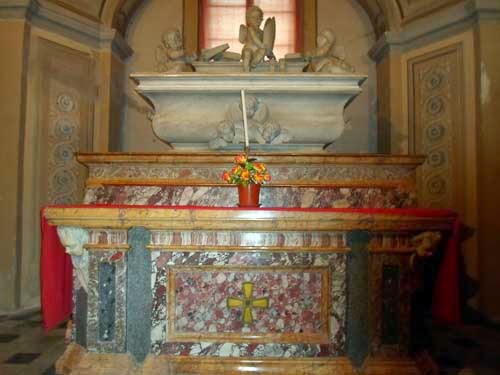
Cathedral of Saint Cassian Imola, Italy
The relics of St Peter Chrysologus are within the altar to the left. The more prominent central altar preserves a few bone fragments from the martyr St Cassian. Readings at MassLiturgical Colour: Green.
| First reading |
|---|
| Leviticus 23:1,4-11,15-16,27,34-37 © |
|---|
The law of the festivals of the LordThe Lord spoke to Moses. He said: ‘These are the Lord’s solemn festivals, the sacred assemblies to which you are to summon the sons of Israel on the appointed day. ‘The fourteenth day of the first month, between the two evenings, is the Passover of the Lord; and the fifteenth day of the same month is the feast of Unleavened Bread for the Lord. For seven days you shall eat bread without leaven. On the first day you are to hold a sacred assembly; you must do no heavy work. For seven days you shall offer a burnt offering to the Lord. The seventh day is to be a day of sacred assembly; you must do no work.’ The Lord spoke to Moses. He said: ‘Speak to the sons of Israel and say to them: ‘“When you enter the land that I give you, and gather in the harvest there, you must bring the first sheaf of your harvest to the priest, and he is to present it to the Lord with the gesture of offering, so that you may be acceptable. The priest shall make this offering on the day after the sabbath. ‘“From the day after the sabbath, the day on which you bring the sheaf of offering, you are to count seven full weeks. You are to count fifty days, to the day after the seventh sabbath, and then you are to offer the Lord a new oblation. ‘“The tenth day of the seventh month shall be the Day of Atonement. You are to hold a sacred assembly. You must fast, and you must offer a burnt offering to the Lord. ‘“The fifteenth day of this seventh month shall be the feast of Tabernacles for the Lord, lasting seven days. The first day is a day of sacred assembly; you must do no heavy work. For seven days you must offer a burnt offering to the Lord. On the eighth day you are to hold a sacred assembly, you must offer a burnt offering to the Lord. It is a day of solemn meeting; you must do no heavy work. ‘“These are the solemn festivals of the Lord to which you are to summon the children of Israel, sacred assemblies for the purpose of offering burnt offerings, holocausts, oblations, sacrifices and libations to the Lord, according to the ritual of each day.”’
| Responsorial Psalm |
|---|
| Psalm 80(81):3-6,10-11 © |
|---|
Ring out your joy to God our strength. Raise a song and sound the timbrel, the sweet-sounding harp and the lute; blow the trumpet at the new moon, when the moon is full, on our feast. Ring out your joy to God our strength. For this is Israel’s law, a command of the God of Jacob. He imposed it as a rule on Joseph, when he went out against the land of Egypt. Ring out your joy to God our strength. Let there be no foreign god among you, no worship of an alien god. I am the Lord your God, who brought you from the land of Egypt. Open wide your mouth and I will fill it. Ring out your joy to God our strength.
| Gospel Acclamation | cf.1Th2:13 |
|---|
Alleluia, alleluia! Accept God’s message for what it really is: God’s message, and not some human thinking. Alleluia! Alleluia, alleluia! The word of the Lord remains for ever: What is this word? It is the Good News that has been brought to you. Alleluia!
A prophet is only despised in his own countryComing to his home town, Jesus taught the people in their synagogue in such a way that they were astonished and said, ‘Where did the man get this wisdom and these miraculous powers? This is the carpenter’s son, surely? Is not his mother the woman called Mary, and his brothers James and Joseph and Simon and Jude? His sisters, too, are they not all here with us? So where did the man get it all?’ And they would not accept him. But Jesus said to them, ‘A prophet is only despised in his own country and in his own house’, and he did not work many miracles there because of their lack of faith. The readings on this page are from the Jerusalem Bible, which is used at Mass in most of the English-speaking world. The New American Bible readings, which are used at Mass in the United States, are available in the Universalis apps, programs and downloads.
You can also view this page with the Gospel in Greek and English. |
TOPICS: Catholic; General Discusssion; Prayer; Worship
KEYWORDS: catholic; mt13; ordinarytime; prayer
For your reading, reflection, faith-sharing, comments, questions, discussion.
1
posted on
07/30/2021 5:31:24 AM PDT
by
annalex
To: All
KEYWORDS: catholic; mt13; ordinarytime; prayer;
2
posted on
07/30/2021 5:31:56 AM PDT
by
annalex
(fear them not)
To: annalex
3
posted on
07/30/2021 5:32:27 AM PDT
by
annalex
(fear them not)
To: nickcarraway; NYer; ELS; Pyro7480; livius; ArrogantBustard; Catholicguy; RobbyS; marshmallow; ...
Alleluia Ping Please FReepmail me to get on/off the Alleluia Ping List.
4
posted on
07/30/2021 5:33:34 AM PDT
by
annalex
(fear them not)
To: annalex
| Matthew |
| | English: Douay-Rheims | Latin: Vulgata Clementina | Greek NT: Byzantine/Majority Text (2000) |
| | Matthew 13
|
| 54. | And coming into his own country, he taught them in their synagogues, so that they wondered and said: How came this man by this wisdom and miracles? | Et veniens in patriam suam, docebat eos in synagogis eorum, ita ut mirarentur, et dicerent : Unde huic sapientia hæc, et virtutes ? | και ελθων εις την πατριδα αυτου εδιδασκεν αυτους εν τη συναγωγη αυτων ωστε εκπληττεσθαι αυτους και λεγειν ποθεν τουτω η σοφια αυτη και αι δυναμεις |
| 55. | Is not this the carpenter's son? Is not his mother called Mary, and his brethren James, and Joseph, and Simon, and Jude: | Nonne hic est fabri filius ? nonne mater ejus dicitur Maria, et fratres ejus, Jacobus, et Joseph, et Simon, et Judas ? | ουχ ουτος εστιν ο του τεκτονος υιος ουχι η μητηρ αυτου λεγεται μαριαμ και οι αδελφοι αυτου ιακωβος και ιωσης και σιμων και ιουδας |
| 56. | And his sisters, are they not all with us? Whence therefore hath he all these things? | et sorores ejus, nonne omnes apud nos sunt ? unde ergo huic omnia ista ? | και αι αδελφαι αυτου ουχι πασαι προς ημας εισιν ποθεν ουν τουτω ταυτα παντα |
| 57. | And they were scandalized in his regard. But Jesus said to them: A prophet is not without honour, save in his own country, and in his own house. | Et scandalizabantur in eo. Jesus autem dixit eis : Non est propheta sine honore, nisi in patria sua, et in domo sua. | και εσκανδαλιζοντο εν αυτω ο δε ιησους ειπεν αυτοις ουκ εστιν προφητης ατιμος ει μη εν τη πατριδι αυτου και εν τη οικια αυτου |
| 58. | And he wrought not many miracles there, because of their unbelief. | Et non fecit ibi virtutes multas propter incredulitatem illorum. | και ουκ εποιησεν εκει δυναμεις πολλας δια την απιστιαν αυτων |
5
posted on
07/30/2021 5:34:47 AM PDT
by
annalex
(fear them not)
To: annalex

Catena Aurea by St. Thomas Aguinas
13:53–58
54. And when he was come into his own country, he taught them in their synagogue, insomuch that they were astonished, and said, Whence hath this man this wisdom, and these mighty works?
55. Is not this the carpenter’s son? is not his mother called Mary? and his brethren, James, and Joses, and Simon, and Judas?
56. And his sisters, are they not all with us? Whence then hath this man all these things?
57. And they were offended in him. But Jesus said unto them, A prophet is not without honour, save in his own country, and in his own house.
58. And he did not many mighty works there because of their unbelief.
CHRYSOSTOM. (Hom. xlviii.) By his own country here, He means Nazareth; for it was not there but in Capharnaum that, as is said below, He wrought so many miracles; but to these He shews His doctrine, causing no less wonder than His miracles.
REMIGIUS. He taught in their synagogues where great numbers were met, because it was for the salvation of the multitude that He came from heaven upon earth. It follows; So that they marvelled, and said, Whence hath this man this wisdom, and these many mighty works? His wisdom is referred to His doctrine, His mighty works to His miracles.
JEROME. Wonderful folly of the Nazarenes! They wonder whence Wisdom itself has wisdom, whence Power has mighty works! But the source of their error is at hand, because they regard Him as the Son of a carpenter; as they say, Is not this the carpenter’s son?
CHRYSOSTOM. Therefore were they in all things insensate, seeing they lightly esteemed Him on account of him who was regarded as His father, notwithstanding the many instances in old times of sons illustrious sprung from ignoble fathers; as David was the son of a husbandman, Jesse; Amos the son of a shepherd, himself a shepherd. And they ought to have given Him more abundant honour, because, that coming of such parents, He spake after such manner; clearly shewing that it came not of human industry, but of divine grace.
PSEUDO-AUGUSTINE. (non occ. cf. Serm. 135. App.) For the Father of Christ is that Divine Workman who made all these works of nature, who set forth Noah’s ark, who ordained the tabernacle of Moses, and instituted the Ark of the covenant; that Workman who polishes the stubborn mind, and cuts down the proud thoughts.
HILARY. And this was the carpenter’s son who subdues iron by means of fire, who tries the virtue of this world in the judgment, and forms the rude mass to every work of human need; the figure of our bodies, for example, to the divers ministrations of the limbs, and all the actions of life eternal.
JEROME. And when they are mistaken in His Father, no wonder if they are also mistaken in His brethren. Whence it is added, Is not his mother Mary, and his brethren, James, and Joseph, and Simon, and Judas? And his sisters, are they not all with us?
JEROME. (in Helvid. 14.) Those who are here called the Lord’s brethren, are the sons of a Mary, His Mother’s sister; she is the mother of this James and Joseph, that is to say, Mary the wife of Cleophas, and this is the Mary who is called the mother of James the Less.
AUGUSTINE. (Quæst. in Matt. q. 17.) No wonder then that any kinsmen by the mother’s side should be called the Lord’s brethren, when even by their kindred to Joseph some are here called His brethren by those who thought Him the son of Joseph.
HILARY. Thus the Lord is held in no honour by His own; and though the wisdom of His teaching, and the power of His working raised their admiration, yet do they not believe that He did these things in the name of the Lord, and they cast His father’s trade in His teeth. Amid all the wonderful works which He did, they were moved with the contemplation of His Body, and hence they ask, Whence hath this man these things? And thus they were offended in him.
JEROME. This error of the Jews is our salvation, and the condemnation of the heretics, for they perceived Jesus Christ to be man so far as to think Him the son of a carpenter.
CHRYSOSTOM. Observe Christ’s mercifulness; He is evil spoken of, yet He answers with mildness; Jesus said unto them, A prophet is not without honour, but in his own country, and in his own house.
REMIGIUS. He calls Himself a Prophet, as Moses also declares, when he says, A Prophet shall God raise up unto you of your brethren. (Deut. 18:18.) And it should be known, that not Christ only, who is the Head of all the Prophets, but Jeremiah, Daniel, and the other lesser Prophets, had more honour and regard among strangers than among their own citizens.
JEROME. For it is almost natural for citizens to be jealous towards one another; for they do not look to the present works of the man, but remember the frailties of his childhood; as if they themselves had not passed through the very same stages of age to their maturity.
HILARY. Further, He makes this answer, that a Prophet is without honour in his own country, because it was in Judæa that He was to be condemned to the sentence of the cross; and forasmuch as the power of God is for the faithful alone, He here abstained from works of divine power because of their unbelief; whence it follows, And he did not there many mighty works because of their unbelief.
JEROME. Not that because they did not believe He could not do His mighty works; but that He might not by doing them be condemning His fellow-citizens in their unbelief.
CHRYSOSTOM. But if His miracles raised their wonder, why did He not work many? Because He looked not to display of Himself, but to what would profit others; and when that did not result, He despised what pertained only to Himself that He might not increase their punishment. Why then did He even these few miracles? That they should not say, We should have believed had any miracles been done among us.
JEROME. Or we may understand it otherwise, that Jesus is despised in His own house and country, signifies in the Jewish people; and therefore He did among them few miracles, that they might not be altogether without excuse; but among the Gentiles He does daily greater miracles by His Apostles, not so much in healing their bodies, as in saving their souls.
Catena Aurea Matthew 13
6
posted on
07/30/2021 5:35:55 AM PDT
by
annalex
(fear them not)
To: annalex

The Holy Family
Francesco Albani
c. 1610
Oil on copper, 37,5 x 28,5 cm
Private collection
7
posted on
07/30/2021 5:36:43 AM PDT
by
annalex
(fear them not)
To: annalex
Saint Peter Chrysologus’ StoryA man who vigorously pursues a goal may produce results far beyond his expectations and his intentions. Thus it was with Peter ” of the Golden Words,” as he was called, who as a young man became bishop of Ravenna, the capital of the empire in the West.
At the time there were abuses and vestiges of paganism evident in his diocese, and these Peter was determined to battle and overcome. His principal weapon was the short sermon, and many of them have come down to us. They do not contain great originality of thought. They are, however, full of moral applications, sound in doctrine, and historically significant in that they reveal Christian life in fifth-century Ravenna. So authentic were the contents of his sermons that some 13 centuries later, he was declared a doctor of the Church by Pope Benedict XIII. He who had earnestly sought to teach and motivate his own flock was recognized as a teacher of the universal Church.
In addition to his zeal in the exercise of his office, Peter Chrysologus was distinguished by a fierce loyalty to the Church, not only in its teaching, but in its authority as well. He looked upon learning not as a mere opportunity but as an obligation for all, both as a development of God-given faculties and as a solid support for the worship of God.
Some time before his death around A.D. 450, Peter returned to his birthplace of Imola, in northern Italy. His liturgical feast is celebrated on July 30.
Reflection
Quite likely, it was Saint Peter Chrysologus’ attitude toward learning that gave substance to his exhortations. Next to virtue, learning, in his view, was the greatest improvement to the human mind and the support of true religion. Ignorance is not a virtue, nor is anti-intellectualism. Knowledge is neither more nor less a source of pride than physical, administrative, or financial prowess. To be fully human is to expand our knowledge—whether sacred or secular—according to our talent and opportunity.
franciscanmedia.org Patronage: Homilists
8
posted on
07/30/2021 5:39:10 AM PDT
by
annalex
(fear them not)
To: annalex
9
posted on
07/30/2021 5:45:35 AM PDT
by
annalex
(fear them not)
To: annalex
NAVARRE BIBLE COMMENTARY (RSV)
Ad Majorem Dei Gloriam (To the Greater Glory of God)
From: Leviticus 23:1, 4-11, 15-16, 27, 34b-37
Celebration of the Sabbath
--------------------------
[1] The Lord said to Moses, [4] "These are the appointed feasts of the Lord, the holy convocations, which you shall proclaim at the time appointed for them."
Celebration of the Passover and the Feast of the Unleavened Bread
-----------------------------------------------------------------
[5] "In the first month, on the fourteenth day of the month in the evening, is the Lord's passover. [6] And on the fifteenth day of the same month is the feast of unleavened bread to the Lord; seven days you shall eat unleavened bread. [7] 0n the first day you shall have a holy convocation; you shall do no laborious work. [8] But you shall present an offering by fire to the Lord seven days; on the seventh day is a holy convocation; you shall do no laborious work."
Celebration of the First Fruits
-------------------------------
[9] And the Lord said to Moses, [10] "Say to the people of Israel, When you come into the land which I give you and reap its harvest, you shall bring the sheaf of the first fruits of your harvest to the priest; [11] and he shall wave the sheaf before the Lord, that you may find acceptance; on the morrow after the sabbath the priest shall wave it."
Celebration of the Feast of Weeks
---------------------------------
[15] "And you shall count from the morrow after the sabbath, from the day that you brought the sheaf of the wave offering; seven full weeks shall they be, [16] counting fifty days to the morrow after the seventh sabbath; then you shall present a cereal offering of new grain to the Lord."
Celebration of the Day of Atonement
----------------------------------- [27] "On the tenth day of this seventh month is the day of atonement; it shall be for you a time of holy convocation, and you shall afflict yourselves and present an offering by fire to the Lord."
Celebration of the Feast of Tabernacles
---------------------------------------
[34b] "On the fifteenth day of this seventh month and for seven days is the feast of booths to the Lord. [35] On the first day shall be a holy convocation; you shall do no laborious work. [36] Seven days you shall present offerings by fire to the Lord; on the eighth day you shall hold a holy convocation and present an offering by fire to the LORD; it is a solemn assembly; you shall do no laborious work."
[37] "These are the appointed feasts of the Lord, which you shall proclaim as times of holy convocation, for presenting to the Lord offerings by fire, burnt offerings and cereal offerings, sacrifices and drink offerings, each on its proper day."
***********************************************************************
Commentary:
23:1-4. Some of the feats mentioned in this calendar are also to be found in other books (cf. Ex 23:14-19; 34:18-26; Deut 16:1). It deals first with the sabbath, which becomes the paradigm for all the other feasts, especially as far as rest is concerned. Such importance was given to what could or could not be done on the sabbath that all sorts of absurd and formalistic exaggerations developed. More than once Jesus criticized the severe interpretations devised by the scribes--a complicated and intolerable casuistry (cf. Mt 15:1-9; 23:41 Acts 15:10).
23:5-8. The Passover is also dealt with in Exodus 12:1-14:21-28 and 13:3-10. The first month was called Nisan; earlier on it was called Abib, "spring" or "ears (of grain)". The feast began at sundown. Here it is depicted as a preparation for the feast of the unleavened bread, which began the following day, 15 Nisan, and lasted seven days, during which bread was eaten unleavened. The religious assembly took place on the first day and the last. During these assemblies various sacrifices were offered and a sacred meal took place. We recall that it was during this feast that Jesus instituted the Eucharist, doing so in the context of the passover supper. And it was during the Passover that Jesus was sacrificed on the altar of the cross. St John tells us that the sacrifice of Christ began at the sixth hour on the day of Preparation, the exact time that the passover lambs were sacrificed. This makes the beginning of a new Passover, in which a new victim is sacrificed, the Lamb of God who takes away the sin of the world (cf. Jn 1:29, 36; 19:14).
23:9-14. The feast of the first fruits, although the date is not a fixed one, is connected with the Passover. In the Jordan valley grain was already ripe for harvest by this time (cf. Num 28:26-31). The offering of first fruits is based on the conviction that everything comes from God. In recognition of that divine sovereignty the first sheaf to ripen was offered in sacrifice--a tradition which developed to the point that no one could eat the crop without first making this offering to God. The "morrow" after the sabbath was thought by some to have been the first sabbath after 14 Nisan. Other scholars think that the sabbath was 15 Nisan and then the offering of the first fruits took place on 16 Nisan. The "morrow" was the base day for reckoning the start of feast of Pentecost, seven weeks later. The offering of the first sheaves was accompanied by the sacrifice of a year-old lamb and two tenths of an ephah of flour (cf. the note on Ex 29:38-46) that is, approximately 4.2 liters, and a quarter of a hin of wine (approximately one litre or two pints).
23:15-22. This feast, too, has elements connected with the grain harvest. Later on it became linked with the giving the Law at Sinai. It was called Pentecost because it came fifty days after Passover. In Hebrew it was called Aseret, the "great convocation" or assembly. Another name for it is the feast of Weeks (a reference to the seven weeks which had passed since the Passover). The offering of the loaves of bread made from the first sheaf expressed thanksgiving and joy for the harvest recently completed. The various sacrifices were offered as a sign of repentance for and as an act of adoration for the greatness of God who had blessed the work of his people.
From a Christian point of view, it is interesting that it was on the feast of Pentecost that the Holy Spirit came down on the apostles. For one thing, that Pentecost marked the start of a new stage with another Law, a much more perfect one, written not on stones but in the depths of men's hearts (cf. 2 Cor 3:3). For another, because it also seems significant that it was at the moment when the fruits of the earth were being harvested that the Church should receive the most precious fruit of Christ's death on the cross, the strength of the Spirit who purifies and sanctities men with his divine grace.
23:23-44. In the Bible the number seven had a sacred character; symbolizing in some way the perfection of God. Therefore the seventh month, as also the seventh year, had special significance in Israel. Thus, in the seventh month (in Hebrew, Tishre) three feasts were held. The first was the feast of Trumpets, which took place on the seventh day. It began with the sounding of trumpets; hence its name. Trumpets were also used to greet the appearance of the new moon. These details probably reflect traces of astral cults; however, by becoming incorporated into the liturgy, they became purified and raised to a new plane, to express at different times and different ways a deep feeling of attachment to the Creator of heaven and earth.
On the tenth of the same month the day of atonement was celebrated—Yom Kippur. It was a day of penance and expiation. It began at sundown, with the start of the sabbath rest. The grave penalties imposed for transgressions show the importance this day had, and still has today, in Jewish liturgy.
The other great feast is that of Tabernacles, celebrated over seven days, beginning on 15 Tisre. In the Code of the Covenant it is called the feast of ingathering (cf. Ex 23:16). The last of the harvest was saved around this time, particularly the grape harvest. The feast marked the close of the agricultural year; it was a most joyful least. It was also regarded as preparation for the new period which would start immediately with the new sowing. Prayers were offered for early rains, which were so crucial to starting the work. This was why the rite of water was so much to the fore. Water was borne in procession from the pool of Siloe and then poured round the altar of the temple. In Jesus' time a bunch of myrtle and acacia branches (from trees growing on the river bank) was shaken during the procession, thereby invoking the divine blessing of rain. In the times of Ezra and Nehemiah. in the middle of the 5th century BC, huts made from branches of trees were set up on the terraces of houses or in the countryside, and the people camped in them over the days of the feast, in memory of the pilgrimage of the people of Israel in the desert, when they lived in tents. This custom still survives in the Jewish religion.
The Gospel of St John has much to say about this feast and about Jesus' activity in connection with it (cf. Jn 7:2ff), including the, important revelations our Lord made apropos of its rites: it was on this feast that Jesus proclaimed that from his heart rivers of living water would flow, a reference to "the Spirit, which those who believed in him were to receive" (Jn 7:39).
10
posted on
07/30/2021 6:31:15 AM PDT
by
fidelis
(Defeatism and despair are like poison to men's souls. If you can't be positive, at least be quiet.)
To: fidelis
From: Matthew 13:54-58No One is a Prophet in His Own Country
--------------------------------------
[54] And coming to His (Jesus') own country He taught them in their synagogue, so that they were astonished, and said, "Where did this Man get this wisdom and these mighty works? [55] Is this not the carpenter's son? Is not His mother called Mary? And are not His brethren James and Joseph and Simon and Judas? [56] And are not all His sisters with us? Where then did this Man get all this?" [57] And they took offense at Him. But Jesus said to them, "A prophet is not without honor except in his own country and in his own house." [58] And He did not do many mighty works there, because of their unbelief.
***********************************************************************
Commentary:
53-58. The Nazarenes' surprise is partly due to people's difficulty in recognizing anything exceptional and supernatural in those with whom they have been on familiar terms. Hence the saying, "No one is a prophet in his own country." These old neighbors were also jealous of Jesus. Where did He acquire this wisdom? Why Him rather than us? They were unaware of the mystery of Jesus' conception; surprise and jealousy cause them to be shocked, to look down on Jesus and not to believe in Him: "He came to His own home, and His own people received Him not" (John 1:11).
"The carpenter's son": this is the only reference in the Gospel to St. Joseph's occupation (in Mark 6:3 Jesus Himself is described as a "carpenter"). Probably in a town like Nazareth the carpenter was a general tradesman who could turn his hand to jobs ranging from metalwork to making furniture or agricultural implements.
For an explanation of Jesus' "brethren", see the note on Matthew 12:46-47.
[The note of Matthew 12:46-47 states:
46-47. "Brethren": ancient Hebrew, Aramaic and other languages had no special words for different degrees of relationship, such as are found in more modern languages. In general, all those belonging to the same family, clan and even tribe were "brethren".
In the particular case we have here, we should bear in mind that Jesus had different kinds of relatives, in two groups--some on His mother's side, others on St. Joseph's. Matthew 13:55-56 mentions, as living in Nazareth, James, Joseph, Simon and Judas ("His brethren") and elsewhere there is reference to Jesus' "sisters" (cf. Matthew 6:3). But in Matthew 27:56 we are told that James and Joseph were sons of a Mary distinct from the Blessed Virgin, and that Simon and Judas were not brothers of James and Joseph, but seemingly children of a brother of St. Joseph.
Jesus, on the other hand, was known to everyone as "the son of Mary" (Mark 6:3) or "the carpenter's son" (Matthew 13:55).
The Church has always maintained as absolutely certain that Jesus had no brothers or sisters in the full meaning of the term: it is a dogma that Mary was ever-Virgin (cf. note on Matthew 1:25).]
Daily Word for Reflection—Navarre Bible Commentary
11
posted on
07/30/2021 6:31:51 AM PDT
by
fidelis
(Defeatism and despair are like poison to men's souls. If you can't be positive, at least be quiet.)
To: annalex
Hi.
Thanks for all you do.
Seems like we skipped over Leviticus 18.
5.56mm
12
posted on
07/30/2021 1:39:13 PM PDT
by
M Kehoe
(Quid Pro Joe and the Ho need to go.)
To: M Kehoe
Oh yes. Often verses are skipped:
[17] Out of all your dwellings, two loaves of the firstfruits, of two tenths of flour leavened, which you shall bake for the firstfruits of the Lord. [18] And you shall offer with the loaves seven lambs without blemish of the first year, and one calf from the herd, and two rams, and they shall be for a holocaust with their libations for a most sweet odour to the Lord. [19] You shall offer also a buck goat for sin, and two lambs of the first year for sacrifices of peace offerings. [20] And when the priest hath lifted them up with the loaves of the firstfruits before the Lord, they shall fall to his use. [21] And you shall call this day most solemn, and most holy. You shall do no servile work therein. It shall be an everlasting ordinance in all your dwellings and generations. [22] And when you reap the corn of your land, you shall not cut it to the very ground: neither shall you gather the ears that remain; but you shall leave them for the poor and for the strangers. I am the Lord your God. [23] And the Lord spoke to Moses, saying: [24] Say to the children of Israel: The seventh month, on the first day of the month, you shall keep a sabbath, a memorial, with the sound of trumpets, and it shall be called holy. [25] You shall do no servile work therein, and you shall offer a holocaust to the Lord.
[26] And the Lord spoke to Moses, saying:
and
[28] You shall do no servile work in the time of this day: because it is a day of propitiation, that the Lord your God may be merciful unto you. [29] Every soul that is not afflicted on this day, shall perish from among his people: [30] And every soul that shall do any work, the same will I destroy from among his people.
[31] You shall do no work therefore on that day: it shall be an everlasting ordinance unto you in all your generations, and dwellings. [32] It is a sabbath of rest, and you shall afflict your souls beginning on the ninth day of the month: from evening until evening you shall celebrate your sabbaths. [33] And the Lord spoke to Moses, saying:
All from Leviticus 23.
13
posted on
07/30/2021 3:56:09 PM PDT
by
annalex
(fear them not)
Disclaimer:
Opinions posted on Free Republic are those of the individual
posters and do not necessarily represent the opinion of Free Republic or its
management. All materials posted herein are protected by copyright law and the
exemption for fair use of copyrighted works.
FreeRepublic.com is powered by software copyright 2000-2008 John Robinson
