Skip to comments.
Catholic Caucus: Daily Mass Readings 6-5-2021, Saint Boniface, Bishop, Martyr
Universalis/Jerusalem Bible ^
Posted on 06/05/2021 7:35:48 AM PDT by annalex
June 5, 2021
Saint Boniface, Bishop, Martyr on Saturday of week 9 in Ordinary Time

St. Boniface Catholic Church, Scipio, Kansas Readings at MassLiturgical Colour: Red. Readings for the feria Readings for the memorial These are the readings for the feria
| First reading |
|---|
| Tobit 12:1,5-15,20 © |
|---|
'I am one of the seven angels who stand ever ready to enter the presence of the glory of the Lord'When the feasting was over, Tobit called his son Tobias and said, ‘My son, you ought to think about paying the amount due to your fellow traveller; give him more than the figure agreed on.’ So Tobias called his companion and said, ‘Take half of what you brought back, in payment for all you have done, and go in peace.’ Then Raphael took them both aside and said, ‘Bless God, utter his praise before all the living for all the favours he has given you. Bless and extol his name. Proclaim before all men the deeds of God as they deserve, and never tire of giving him thanks. It is right to keep the secret of a king, yet right to reveal and publish the works of God. Thank him worthily. Do what is good, and no evil can befall you. ‘Prayer with fasting and alms with right conduct are better than riches with iniquity. Better to practise almsgiving than to hoard up gold. Almsgiving saves from death and purges every kind of sin. Those who give alms have their fill of days; those who commit sin and do evil, bring harm on themselves. ‘I am going to tell you the whole truth, hiding nothing from you. I have already told you that it is right to keep the secret of a king, yet right too to reveal in worthy fashion the works of God. So you must know that when you and Sarah were at prayer, it was I who offered your supplications before the glory of the Lord and who read them; so too when you were burying the dead. When you did not hesitate to get up and leave the table to go and bury a dead man, I was sent to test your faith, and at the same time God sent me to heal you and your daughter-in-law Sarah. I am Raphael, one of the seven angels who stand ever ready to enter the presence of the glory of the Lord. ‘Now bless the Lord on earth and give thanks to God. I am about to return to him above who sent me.’
| Responsorial Psalm | Tobit 13:2,6-8 © |
|---|
Blessed be God, who lives for ever. By turns he punishes and pardons; he sends men down to the depths of the underworld and draws them up from supreme Destruction; no one can escape his hand. Blessed be God, who lives for ever. If you return to him with all your heart and all your soul, behaving honestly towards him, then he will return to you and hide his face from you no longer. Blessed be God, who lives for ever. Consider how well he has treated you; loudly give him thanks. Bless the Lord of justice and extol the King of the ages. Blessed be God, who lives for ever. I for my part sing his praise in the country of my exile; I make his power and greatness known to a nation that has sinned. Blessed be God, who lives for ever. Sinners, return to him; let your conduct be upright before him; perhaps he will be gracious to you and take pity on you. Blessed be God, who lives for ever.
| Gospel Acclamation | cf.Lk8:15 |
|---|
Alleluia, alleluia! Blessed are those who, with a noble and generous heart, take the word of God to themselves and yield a harvest through their perseverance. Alleluia! Alleluia, alleluia! How happy are the poor in spirit: theirs is the kingdom of heaven. Alleluia!
This poor widow has put in more than allIn his teaching Jesus said, ‘Beware of the scribes who like to walk about in long robes, to be greeted obsequiously in the market squares, to take the front seats in the synagogues and the places of honour at banquets; these are the men who swallow the property of widows, while making a show of lengthy prayers. The more severe will be the sentence they receive.’ He sat down opposite the treasury and watched the people putting money into the treasury, and many of the rich put in a great deal. A poor widow came and put in two small coins, the equivalent of a penny. Then he called his disciples and said to them, ‘I tell you solemnly, this poor widow has put more in than all who have contributed to the treasury; for they have all put in money they had over, but she from the little she had has put in everything she possessed, all she had to live on.’ Continue These are the readings for the memorial
| First reading | Acts 26:19-23 © |
|---|
I have stood firm to this day, testifying to great and small alikePaul said: ‘King Agrippa, I could not disobey the heavenly vision. On the contrary I started preaching, first to the people of Damascus, then to those of Jerusalem and all the countryside of Judaea, and also to the pagans, urging them to repent and turn to God, proving their change of heart by their deeds. This was why the Jews laid hands on me in the Temple and tried to do away with me. But I was blessed with God’s help, and so I have stood firm to this day, testifying to great and small alike, saying nothing more than what the prophets and Moses himself said would happen: that the Christ was to suffer and that, as the first to rise from the dead, he was to proclaim that light now shone for our people and for the pagans too.’
| Responsorial Psalm |
|---|
| Psalm 116(117):1-2 © |
|---|
Go out to the whole world; proclaim the Good News. or Alleluia! O praise the Lord, all you nations, acclaim him all you peoples! Go out to the whole world; proclaim the Good News. or Alleluia! Strong is his love for us; he is faithful for ever. Go out to the whole world; proclaim the Good News. or Alleluia!
| Gospel Acclamation | Jn10:14 |
|---|
Alleluia, alleluia! I am the good shepherd, says the Lord, I know my own sheep and my own know me. Alleluia!
The good shepherd is one who lays down his life for his sheepJesus said: ‘I am the good shepherd: the good shepherd is one who lays down his life for his sheep. The hired man, since he is not the shepherd and the sheep do not belong to him, abandons the sheep and runs away as soon as he sees a wolf coming, and then the wolf attacks and scatters the sheep; this is because he is only a hired man and has no concern for the sheep. ‘I am the good shepherd; I know my own and my own know me, just as the Father knows me and I know the Father; and I lay down my life for my sheep. And there are other sheep I have that are not of this fold, and these I have to lead as well. They too will listen to my voice, and there will be only one flock, and one shepherd.’ The readings on this page are from the Jerusalem Bible, which is used at Mass in most of the English-speaking world. The New American Bible readings, which are used at Mass in the United States, are available in the Universalis apps, programs and downloads.
You can also view this page with the Gospel in Greek and English. |
TOPICS: Catholic; General Discusssion; Prayer; Worship
KEYWORDS: catholic; mk12; ordinarytime; prayer
For your reading, reflection, faith-sharing, comments, questions, discussion.
1
posted on
06/05/2021 7:35:48 AM PDT
by
annalex
To: All
KEYWORDS: catholic; mk12; ordinarytime; prayer;
2
posted on
06/05/2021 7:36:26 AM PDT
by
annalex
(fear them not)
To: annalex
3
posted on
06/05/2021 7:36:56 AM PDT
by
annalex
(fear them not)
To: nickcarraway; NYer; ELS; Pyro7480; livius; ArrogantBustard; Catholicguy; RobbyS; marshmallow; ...
Alleluia Ping Please FReepmail me to get on/off the Alleluia Ping List.
4
posted on
06/05/2021 7:37:50 AM PDT
by
annalex
(fear them not)
To: annalex
| Mark |
| | English: Douay-Rheims | Latin: Vulgata Clementina | Greek NT: Byzantine/Majority Text (2000) |
| | Mark 12
|
| 38. | And he said to them in his doctrine: Beware of the scribes, who love to walk in long robes, and to be saluted in the marketplace, | Et dicebat eis in doctrina sua : Cavete a scribis, qui volunt in stolis ambulare, et salutari in foro, | και ελεγεν αυτοις εν τη διδαχη αυτου βλεπετε απο των γραμματεων των θελοντων εν στολαις περιπατειν και ασπασμους εν ταις αγοραις |
| 39. | And to sit in the first chairs, in the synagogues, and to have the highest places at suppers: | et in primis cathedris sedere in synagogis, et primos discubitus in cœnis : | και πρωτοκαθεδριας εν ταις συναγωγαις και πρωτοκλισιας εν τοις δειπνοις |
| 40. | Who devour the houses of widows under the pretence of long prayer: these shall receive greater judgment. | qui devorant domos viduarum sub obtentu prolixæ orationis : hi accipient prolixius judicium. | οι κατεσθιοντες τας οικιας των χηρων και προφασει μακρα προσευχομενοι ουτοι ληψονται περισσοτερον κριμα |
| 41. | And Jesus sitting over against the treasury, beheld how the people cast money into the treasury, and many that were rich cast in much. | Et sedens Jesus contra gazophylacium, aspiciebat quomodo turba jactaret æs in gazophylacium, et multi divites jactabant multa. | και καθισας ο ιησους κατεναντι του γαζοφυλακιου εθεωρει πως ο οχλος βαλλει χαλκον εις το γαζοφυλακιον και πολλοι πλουσιοι εβαλλον πολλα |
| 42. | And there came a certain poor widow, and she cast in two mites, which make a farthing. | Cum venisset autem vidua una pauper, misit duo minuta, quod est quadrans, | και ελθουσα μια χηρα πτωχη εβαλεν λεπτα δυο ο εστιν κοδραντης |
| 43. | And calling his disciples together, he saith to them: Amen I say to you, this poor widow hath cast in more than all they who have cast into the treasury. | et convocans discipulos suos, ait illis : Amen dico vobis, quoniam vidua hæc pauper plus omnibus misit, qui miserunt in gazophylacium. | και προσκαλεσαμενος τους μαθητας αυτου λεγει αυτοις αμην λεγω υμιν οτι η χηρα αυτη η πτωχη πλειον παντων βεβληκεν των βαλλοντων εις το γαζοφυλακιον |
| 44. | For all they did cast in of their abundance; but she of her want cast in all she had, even her whole living. | Omnes enim ex eo, quod abundabat illis, miserunt : hæc vero de penuria sua omnia quæ habuit misit totum victum suum. | παντες γαρ εκ του περισσευοντος αυτοις εβαλον αυτη δε εκ της υστερησεως αυτης παντα οσα ειχεν εβαλεν ολον τον βιον αυτης |
5
posted on
06/05/2021 7:39:14 AM PDT
by
annalex
(fear them not)
To: annalex

Catena Aurea by St. Thomas Aguinas
38. And he said unto them in his doctrine, Beware of the scribes, which love to go in long clothing, and love salutations in the marketplaces,
39. And the chief seats in the synagogues, and the uppermost rooms at feasts:
40. Which devour widows’ houses, and for a pretence make long prayers: these shall receive greater damnation.
PSEUDO-JEROME. After confuting the Scribes and Pharisees, He burns up as a fire their dry and withered examples; wherefore it is said, And he said unto them in his doctrine, Beware of the Scribes, which love to go in long clothing.
BEDE. (ubi sup.) To walk in long clothing is to go forth into public clad in garments too much ornamented, in which amongst other things, that rich man, who fared sumptuously every day, is said to have sinned.
THEOPHYLACT. But they used to walk in honourable garments, because they wished to be highly esteemed for it, and in like manner they desired other things, which lead to glory. For it goes on: And love salutations in the marketplaces, and the chief seats in the synagogues, and the uppermost rooms at feasts.
BEDE. (ubi sup.) We must observe that He does not forbid that those, to whom it falls by the rule of their office, should be saluted in the marketplace, or have chief seats and places at feasts, but He teaches that those who love those things unduly, whether they have them or no, are to be avoided by the faithful as wicked men: that is, He blames the intention and not the office; although this too is culpable, that the very men who wish to be called masters of the synagogue in Moses’ seat, should have to do with lawsuits in the marketplace. We are in two ways ordered to beware of those who are desirous of vain glory; first, we should not be seduced by their hypocrisy into thinking that what they do is good; nor secondly, should we be excited to imitate them, through a vain rejoicing in being praised for those virtues which they affect.
THEOPHYLACT. He also especially teaches the Apostles, not to have any communication with the scribes, but to imitate Christ Himself; and in ordaining them to be masters in the duties of life, He places others under themv.
BEDE. (ubi sup.) But they do not only seek for praise from men, but also for gain. Wherefore there follows, Which devour widows’ houses, under the pretence of long prayers. For there are men who pretending to be just hesitate not to receive money from persons who are troubled in conscience, as though they would be their advocates in the judgment. A hand stretched out to the poor is always an accompaniment to prayer, but these men pass the night in prayer, that they may take away money from the poor.
THEOPHYLACT. But the Scribes used to come to women, who were left without the protection of their husbands, as though they were their protectors; and by a pretence of prayer, a reverend exterior and hypocrisy, they used to deceive widows, and thus also devour the houses of the rich. It goes on, These shall receive a greater damnation, that is, than the other Jews, who sinned.
12:41–44
41. And Jesus sat over against the treasury, and beheld how the people cast money into the treasury: and many that were rich cast in much.
42. And there came a certain poor widow, and she threw in two mites, which make a farthing.
43. And he called unto him his disciples, and saith unto them, Verily I say unto you, That this poor widow hath cast more in, than all they which have cast into the treasury:
44. For all they did cast in of their abundance; but she of her want did cast in all that she had, even all her living.
BEDE. (ubi sup.) The Lord, who had warned them to avoid the desire of high place and vain glory, now distinguishes by a sure test those who brought in gifts. Wherefore it is said, And Jesus sat over against the treasury, and beheld how the people cast money into the treasury. In the Greek language, phylassein means to keep, and gaza is a Persian word for treasure; wherefore the word gazophylacium. which is here used means a place where riches are kept, which name also was applied to the chest in which the offerings of the people were collected, for the necessary uses of the temple, and to the porch in which they were kept. You have a notice of the porch in the Gospel, These words spake Jesus in the treasury as He taught in the temple; and of the chest in the book of Kings, But Jehoiada the priest took a chest. (John 8:20. 2 Kings 12:9)
THEOPHYLACT. Now there was a praiseworthy custom amongst the Jews, that those who were able and willing should put something into the treasury, for the maintenance of the priests, the poor, and the widows; wherefore there is added, And many that were rich cast in much. But whilst many people were so engaged, a poor widow came up, and shewed her love by offering money according to her ability; wherefore it is said, And there came a certain poor widow, and she threw in two mites, which make a farthing.
BEDE. (ubi sup.) Reckoners use the word ‘quadrans’ for the fourth part of any thing, be it place, money, or time. Perhaps then in this place is meant the fourth part of a shekel, that is, five pence. It goes on, And he called unto him his disciples, and saith unto them, Verily I say unto you, That this poor widow hath cast more in, than all they which have cast into the treasury: for God does not weigh the property but the conscience of those who offer; nor did He consider the smallness of the sum in her offering, but what was the store from which it came. Wherefore He adds, For all they did cast in of their abundance, but she of her want did cast in all that she had, even all her living.
PSEUDO-JEROME. But in a mystical sense, they are rich, who bring forth from the treasure of their heart things new and old, which are the obscure and hidden things of Divine wisdom in both testaments; but who is the poor woman, if it be not I and those like me, who cast in what I can, and have the will to explain to you, where I have not the power. For God does not consider how much ye hear, but what is the store from which it comes; but each at all events can bring his farthing, that is, a ready will, which is called a farthing, because it is accompanied by three things, that is, thought, word, and deed. And in that it is said that she cast in all her living, it is implied that all that the body wants is that by which it lives1; wherefore it is said, All the labour of man is for his mouth. (Eccl. 6:7)
THEOPHYLACT. Or else; That widow is the soul of man, which leaving Satan to which it had been joined, casts into the temple two mites, that is, the flesh and the mind, the flesh by abstinence, the mind by humility, that so it may be able to hear that it has cast away all its living, and has consecrated it, leaving nothing for the world of all that it possessed.
BEDE. (ubi sup) Again, in an allegorical way, the rich men, who cast gifts into the treasury, point out the Jews puffed up with the righteousness of the law; the poor widow is the simplicity of the Church: poor indeed, because she has cast away the spirit of pride and of the desires of worldly things; and a widow, because Jesus her husband has suffered death for her. She casts two mites into the treasury, because she brings the love of God and of her neighbour, or the gifts of faith and prayer; which are looked upon as mites in their own insignificance, but measured by the merit of a devout intention are superior to all the proud works of the Jews. The Jew sends of his abundance into the treasury, because he presumes on his own righteousness; but the Church sends her whole living into God’s treasury, because she understands that even her very living is not of her own desert, but of Divine grace.
Catena Aurea Mark 12
6
posted on
06/05/2021 7:40:10 AM PDT
by
annalex
(fear them not)
To: annalex
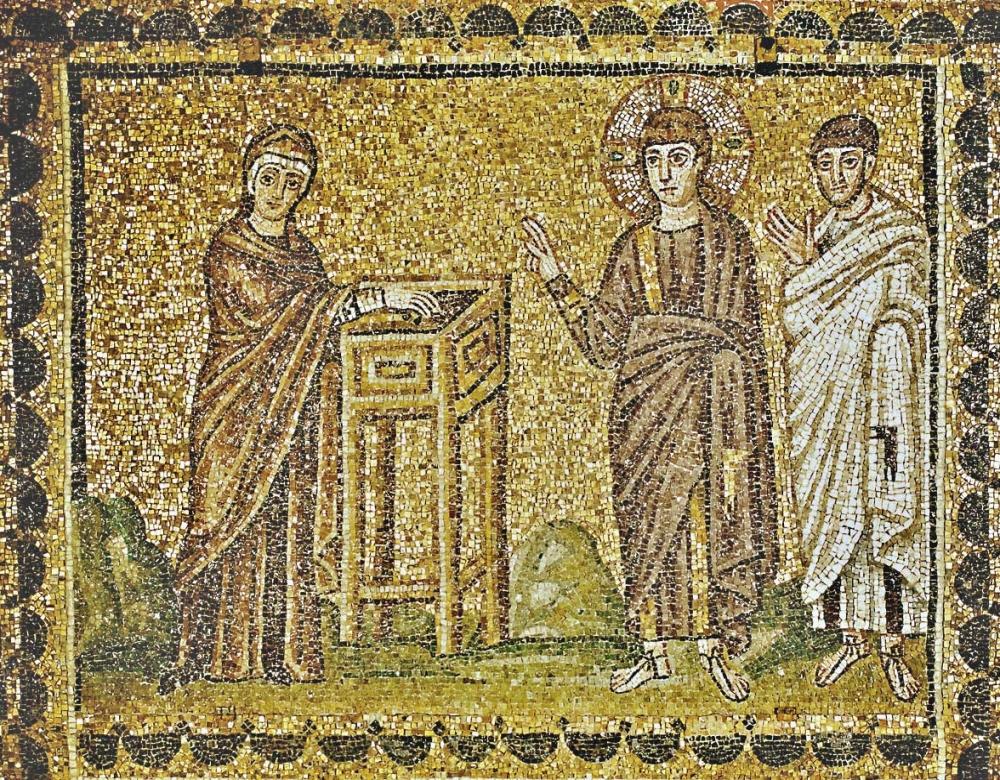
Basilica di Sant’Apollinare Nuovo
6th century
Ravenna, Italy
7
posted on
06/05/2021 7:40:44 AM PDT
by
annalex
(fear them not)
To: annalex
| John |
| | English: Douay-Rheims | Latin: Vulgata Clementina | Greek NT: Byzantine/Majority Text (2000) |
| | John 10
|
| 11. | I am the good shepherd. The good shepherd giveth his life for his sheep. | Ego sum pastor bonus. Bonus pastor animam suam dat pro ovibus suis. | εγω ειμι ο ποιμην ο καλος ο ποιμην ο καλος την ψυχην αυτου τιθησιν υπερ των προβατων |
| 12. | But the hireling, and he that is not the shepherd, whose own the sheep are not, seeth the wolf coming, and leaveth the sheep, and flieth: and the wolf catcheth, and scattereth the sheep: | Mercenarius autem, et qui non est pastor, cujus non sunt oves propriæ, videt lupum venientem, et dimittit oves, et fugit : et lupus rapit, et dispergit oves ; | ο μισθωτος δε και ουκ ων ποιμην ου ουκ εισιν τα προβατα ιδια θεωρει τον λυκον ερχομενον και αφιησιν τα προβατα και φευγει και ο λυκος αρπαζει αυτα και σκορπιζει τα προβατα |
| 13. | And the hireling flieth, because he is a hireling: and he hath no care for the sheep. | mercenarius autem fugit, quia mercenarius est, et non pertinet ad eum de ovibus. | ο δε μισθωτος φευγει οτι μισθωτος εστιν και ου μελει αυτω περι των προβατων |
| 14. | I am the good shepherd; and I know mine, and mine know me. | Ego sum pastor bonus : et cognosco meas, et cognoscunt me meæ. | εγω ειμι ο ποιμην ο καλος και γινωσκω τα εμα και γινωσκομαι υπο των εμων |
| 15. | As the Father knoweth me, and I know the Father: and I lay down my life for my sheep. | Sicut novit me Pater, et ego agnosco Patrem : et animam meam pono pro ovibus meis. | καθως γινωσκει με ο πατηρ καγω γινωσκω τον πατερα και την ψυχην μου τιθημι υπερ των προβατων |
| 16. | And other sheep I have, that are not of this fold: them also I must bring, and they shall hear my voice, and there shall be one fold and one shepherd. | Et alias oves habeo, quæ non sunt ex hoc ovili : et illas oportet me adducere, et vocem meam audient, et fiet unum ovile et unus pastor. | και αλλα προβατα εχω α ουκ εστιν εκ της αυλης ταυτης κακεινα με δει αγαγειν και της φωνης μου ακουσουσιν και γενησεται μια ποιμνη εις ποιμην |
8
posted on
06/05/2021 7:44:36 AM PDT
by
annalex
(fear them not)
To: annalex
Catena Aurea by St. Thomas Aguinas
10:11–13
11. I am the good shepherd: the good shepherd giveth his life for the sheep.
12. But he that is an hireling, and not the shepherd, whose own the sheep are not, seeth the wolf coming, and leaveth the sheep, and fleeth: and the wolf catcheth them, and scattereth the sheep.
13. The hireling fleeth, because he is an hireling, and careth not for the sheep.
AUGUSTINE. (Tr. xlvi. 1) Our Lord has acquainted us with two things which were obscure before; first, that He is the Door; and now again, that He is the Shepherd: I am the good Shepherd. (c. xlvii. 1, 3). Above He said that the shepherd entered by the door. If He is the Door, how doth He enter by Himself? Just as He knows the Father by Himself, and we by Him; so He enters into the fold by Himself, and we by Him. We enter by the door, because we preach Christ; Christ preaches Himself. A light shews both other things, and itself too. (Tr. xlvi. 5). There is but one Shepherd. For though the rulers of the Church, those who are her sons, and not hirelings, are shepherds, they are all members of that one Shepherd. (Tr. xlvii. 3). His office of Shepherd He hath permitted His members to bear. Peter is a shepherd, and all the other Apostles: all good Bishops are shepherds. But none of us calleth himself the door. He could not have added good, if there were not bad shepherds as well. They are thieves and robbers; or at least mercenaries.
GREGORY. (Hom. xiv. in Evang.) And He adds what that goodness (forma bonitatis) is, for our imitation: The good Shepherd giveth His life for the sheep. He did what He bade, He set the example of what He commanded: He laid down His life for the sheep, that He might convert His body and blood in our Sacrament, and feed with His flesh the sheep He had redeemed. A path is shewn us wherein to walk, despising death; a stamp is applied to us, and we must submit to the impression. Our first duty is to spend our outward possessions upon the sheep; our last, if it be necessary, is to sacrifice our life for the same sheep. Whoso doth not give his substance to the sheep, how can he lay down his life for them?
AUGUSTINE. (Tr. xlvii) Christ was not the only one who did this. And yet if they who did it are members of Him, one and the same Christ did it always. He was able to do it without them; they were not without Him.
AUGUSTINE. (de Verb. Dom. Serm. 1) All these however were good shepherds, not because they shed their blood, but because they did it for the sheep. For they shed it not in pride, but in love. Should any among the heretics suffer trouble in consequence of their errors and iniquities, they forthwith boast of their martyrdom; that they may be the better able to steal under so fair a cloak: for they are in reality wolves. But not all who give their bodies to be burned, are to be thought to shed their blood for the sheep; rather against the sheep; for the Apostle saith, Though I give my body to be burned, and have not charity, it profiteth me nothing. (1 Cor. 13:3) And how hath he even the smallest charity, who does not love connexion (convictus) with Christians? to command which, our Lord did not mention many shepherds, but one, I am the good Shepherd.
CHRYSOSTOM. (Hom. lx. 5) Our Lord shews here that He did not undergo His passion unwillingly; but for the salvation of the world. He then gives the difference between the shepherd and the hireling: But he that is an hireling, and not the shepherd, whose own the sheep are not, seeth the wolf coming, and leaveth the sheep, and fleeth.
GREGORY. (Hom. in Evang. xiv.) Some there are who love earthly possessions more than the sheep, and do not deserve the name of a shepherd. He who feeds the Lord’s flock for the sake of temporal hire, and not for love, is an hireling, not a shepherd. An hireling is he who holds the place of shepherd, but seeketh not the gain of souls, who panteth after the good things of earth, and rejoices in the pride of station.
AUGUSTINE. (de Verb. Dom. Serm. xlix) He seeketh therefore in the Church, not God, but something else. If he sought God he would be chaste; for the soul hath but one lawful husband, God. Whoever seeketh from God any thing beside God, seeketh unchastely.
GREGORY. (Hom. in Evang. xiv.) But whether a man be a shepherd or an hireling, cannot be told for certain, except in a time of trial. In tranquil times, the hireling generally stands watch like the shepherd. But when the wolf comes, then every one shews with what spirit he stood watch over the flock.
AUGUSTINE. (de Verb. Dom. Serm. xlix.) The wolf is the devil, and they that follow him; according to’ Matthew, Which come to you in sheeps’ clothing, but inwardly they are ravening wolves. (Matt. 7:15)
AUGUSTINE. (Tr. xlvi. 8) Lo, the wolf hath seized a sheep by the throat, the devil hath enticed a man into adultery. The sinner must be excommunicated. But if he is excommunicated, he will be an enemy, he will plot, he will do as much harm as he can. Wherefore thou art silent, thou dost not censure, thou hast seen the wolf coming, and fled. Thy body has stood, thy mind has fled. For as joy is relaxation, sorrow contraction, desire a reaching forward of the mind; so fear is the flight of the mind.
GREGORY. (Hom. in Evang. xiv.) The wolf too cometh upon the sheep, whenever any spoiler and unjust person oppresses the humble believers. And he who seems to be shepherd, but leaves the sheep and flees, is he who dares not to resist his violence, from fear of danger to himself. He flees not by changing place, but by withholding consolation from his flock. The hireling is inflamed with no zeal against this injustice. He only looks to outward comforts, and overlooks the internal suffering of his flock. The hireling fleeth, because he is an hireling, and careth not for the sheep. The only reason that the hireling fleeth, is because he is an hireling; as if to say, He cannot stand at the approach of danger, who doth not love the sheep that he is set over, but seeketh earthly gain. Such an one dares not face danger, for fear he should lose what he so much loves.
AUGUSTINE. (Tr. xlvi. 7) But if the Apostles were shepherds, not hirelings, why did they flee in persecution? And why did our Lord say, When they persecute you in this city, flee ye into another? (Mat. 10:23) Let us knock, then will come one, who will explain.
AUGUSTINE. (ad Honor. Ep. clxxx.) A servant of Christ, and minister of His Word and Sacraments, may flee from city to city, when he is specially aimed at by the persecutors, apart from his brethren; so that his flight does not leave the Church destitute. But when all, i. e. Bishops, Clerics, and Laics, are in danger in common, let not those who need assistance be deserted by those who should give it. Let all flee together if they can, to some place of security; but, if any are obliged to stay, let them not be forsaken by those who are bound to minister to their spiritual wants. Then, under pressing persecution, may Christ’s ministers flee from the place where they are, when none of Christ’s people remain to be ministered to, or when that ministry may be fulfilled by others who have not the same cause for flight. But when the people stay, and the ministers flee, and the ministry ceases, what is this but a damnable flight of hirelings, who care not for the sheep?
AUGUSTINE. (Tr. xlvi. 1) On the good side are the door, the porter, the shepherd, and the sheep; on the bad, the thieves, the robbers, the hirelings, the wolf.
AUGUSTINE. (de Verb. Dom. s. xlix) We must love the shepherd, beware of the wolf, tolerate the hireling. For the hireling is useful so long as he sees not the wolf, the thief, and the robber. When he sees them, he flees.
AUGUSTINE. (Tr. xlvi. 5) Indeed he would not be an hireling, did he not receive wages from the hirer. (c. 6). Sons wait patiently for the eternal inheritance of their father; the hireling looks eagerly for the temporal wages from his hirer; and yet the tongues of both speak abroad the glory of Christ. The hireling hurteth, in that he doeth wrong, not in that he speaketh right: the grape bunch hangeth amid thorns; pluck the grape, avoid the thorn. Many that seek temporal advantages in the Church, preach Christ, and through them Christ’s voice is heard; and the sheep follow not the hireling, but the voice of the Shepherd heard through the hireling.
10:14–21
14. I am the good shepherd, and know my sheep, and am known of mine.
15. As the Father knoweth me, even so know I the Father: and I lay down my life for the sheep.
16. And other sheep I have, which are not of this fold: them also I must bring, and they shall hear my voice; and there shall be one fold, and one shepherd.
17. Therefore doth my Father love me, because I lay down my life, that I might take it again.
18. No man taketh it from me, but I lay it down of myself. I have power to lay it down, and I have power to take it again. This commandment have I received of my Father.
CHRYSOSTOM. (Hom. lx. 1) Two evil persons have been mentioned, one that kills, and robs the sheep, another that doth not hinder: the one standing for those movers of seditions; the other for the rulers of the Jews, who did not take care of the sheep committed to them. Christ distinguishes Himself from both; from the one who came to do hurt by saying, I am come that they might have life; from those who overlook the rapine of the wolves, by saying that He giveth His life for the sheep. Wherefore He saith again, as He said before, I am the good Shepherd. And as He had said above that the sheep heard the voice of the Shepherd and followed Him, that no one might have occasion to ask, What sayest Thou then of those that believe not? He adds, And I know My sheep, and am known of Mine. (Rom. 11:12) As Paul too saith, God hath not cast away His people, whom He foreknew.
GREGORY. (Hom. in Evang. xiv.) As if He said, I love My sheep, and they love and follow Me. For he who loves not the truth, is as yet very far from knowing it.
THEOPHYLACT. Hence the difference of the hireling and the Shepherd. The hireling does not know his sheep, because he sees them so little. The Shepherd knows His sheep, because He is so attractive to them.
CHRYSOSTOM. (Hom. lx. 1) Then that thou mayest not attribute to the Shepherd and the sheep the same measure of knowledge, He adds, As the Father knoweth Me, even so know I the Father: i. e. I know Him as certainly as He knoweth Me. This then is a case of like knowledge, the other is not; as He saith, No man knoweth who the Son is, but the Father. (Luke 10:23)
GREGORY. (Hom. in Evang. xiv.) And I lay down My life for My sheep. As if to say, This is why I know My Father, and am known by the Father, because I lay down My life for My sheep; i. e. by My love for My sheep, I shew how much I love My Father.
CHRYSOSTOM. (Hom. lx. 1) He gives it too as a proof of His authority. In the same way the Apostle maintains his own commission in opposition to the false Apostles, by enumerating his dangers and sufferings.
THEOPHYLACT. For the deceivers did not expose their lives for the sheep, but, like hirelings, deserted their followers. Our Lord, on the other hand, protected His disciples: Let these go their way. (infr. 18:8)
GREGORY. (Hom. xiv.) But as He came to redeem not only the Jews, but the Gentiles, He adds, And other sheep I have, which are not of this fold.
AUGUSTINE. (de Verb. Dom. s. 1) The sheep hitherto spoken of are those of the stock of Israel according to the flesh. But there were others of the stock of Israel, according to faith, Gentiles, who were as yet out of the fold; predestinated, but not yet gathered together. They are not of this fold, because they are not of the race of Israel, but they will be of this fold: Them also I must bring.
CHRYSOSTOM. (Hom. lx. 2) What wonder that these should hear My voice, and follow Me, when others are waiting to do the same. Both these flocks are dispersed, and without shepherds; for it follows, And they shall hear My voice. And then He foretells their future union: And there shall be one fold and one Shepherd.
GREGORY. (Hom. Evang. xiv.) Of two flocks He maketh one fold, uniting the Jews and Gentiles in His faith.
THEOPHYLACT. For there is one sign of baptism for all, and one Shepherd, even the Word of God. Let the Manichean mark; there is but one fold and one Shepherd set forth both in the Old and New Testaments.
AUGUSTINE. (Tr. xlvii. 4) What does He mean then when He says, I am not sent but unto the lost sheep of the house of Israel? Only, that whereas He manifested Himself personally to the Jews, He did not go Himself to the Gentiles, but sent others.
CHRYSOSTOM. (Hom. lx) The word must here (I must bring) does not signify necessity, but only that the thing would take place. Therefore doth My Father love Me, because I lay down My life, that I might take it again. They had called Him an alien from His Father.
AUGUSTINE. (Tr. xlvii. 7) i. e. Because I die, to rise again. There is great force in, I lay down. Let not the Jews, He says, boast; rage they may, but if I should not choose to lay down My life, what will they do by raging?
THEOPHYLACT. The Father does not bestow His love on the Son as a reward for the death He suffered in our behalf; but He loves Him, as beholding in the Begotten His own essence, whence proceeded such love for mankind.
CHRYSOSTOM. (Hom. lx. 2) Or He says, in condescension to our weakness, Though there were nothing else which made Me love you, this would, that ye are so loved by My Father, that, by dying for you, I shall win His love. Not that He was not loved by the Father before, or that we are the cause of such love. For the same purpose He shews that He does not come to His Passion unwillingly: No man taketh it from Me, but I lay it down of Myself.
AUGUSTINE. (iv. de Trin. c. xiii.) Wherein He shewed that His natural death was not the consequence of sin in Him, but of His own simple will, which was the why, the when, and the how: I have power to lay it down.
CHRYSOSTOM. (Hom. lx. 2) As they had often plotted to kill Him, He tells them their efforts will be useless, unless He is willing. I have such power over My own life, that no one can take it from Me, against My will. This is not true of men. We have not the power of laying down our own lives, except we put ourselves to death. Our Lord alone has this power. And this being true, it is true also that He can take it again when He pleases: And I have power to take it again: which words declare beyond a doubt a resurrection. That they might not think His death a sign that God had forsaken Him, He adds, This commandment have I received from My Father; i. e. to lay down My life, and take it again. By which we must not understand that He first waited to hear this commandment, and had to learn His work; He only shows that that work which He voluntarily undertook, was not against the Father’s will.
THEOPHYLACT. He only means His perfect agreement with His Father.
ALCUIN. For the Word doth not receive a command by word, but containeth in Himself all the Father’s commandments. When the Son is said to receive what He possesseth of Himself, His power is not lessened, but only His generation declared. The Father gave the Son every thing in begetting Him. He begat Him perfect.
THEOPHYLACT. After declaring Himself the Master of His own life and death, which was a lofty assumption, He makes a more humble confession; thus wonderfully uniting both characters; shewing that He was neither inferior to or a slave of the Father on the one hand, nor an antagonist on the other; but of the same power and will.
AUGUSTINE. (Tr. xlvii) How doth our Lord lay down His own life? Christ is the Word, and man, i. e. in soul and body. Doth the Word lay down His life, and take it again; or doth the human soul, or doth the flesh? If it was the Word of God that laid down His soul1 and took it again, that soul was at one time separated from the Word. But, though death separated the soul and body, death could not separate the Word and the soul. It is still more absurd to say that the soul laid down itself; if it could not be separated from the Word, how could it be from itself? The flesh therefore layeth down its life and taketh it again, not by its own power, but by the power of the Word which dwelleth in it. This refutes the Apollinarians, who say that Christ had not a human, rational soul.
Catena Aurea John 10
9
posted on
06/05/2021 7:45:17 AM PDT
by
annalex
(fear them not)
To: annalex
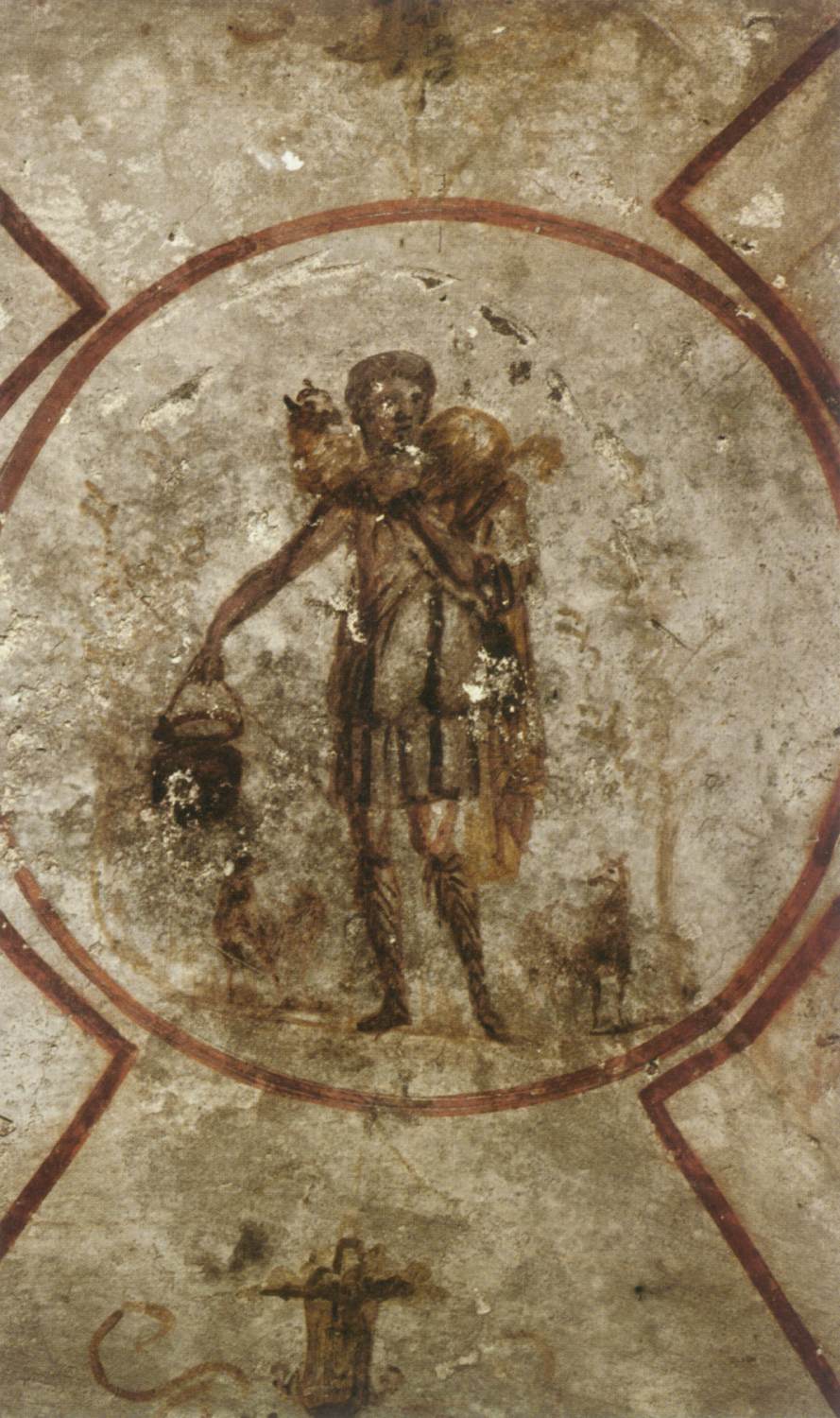
Christ the Good Shepherd
Crypts of Lucina, catacomb of Callixtus in Rome
mid-third century
10
posted on
06/05/2021 7:45:56 AM PDT
by
annalex
(fear them not)
To: annalex
Saturday, June 5, 2021
St. Boniface is called the Apostle of the Germans. He was a Benedictine monk in England. Instead of pursing a leadership position at the abbey, he desired to spread Christianity among the Germanic tribes.
On his first mission to Friesland (now the Netherlands) he was largely unsuccessful. During the eighth century, most of these tribes were pagans. Even those who professed Christianity did not truly practice it. Although the gospel had been preached there, the people had lapsed in their faith and an ongoing war between political factions forced him to leave.
He made a report to Rome and Pope Gregory II sent him back with letters of recommendation and instructions to reform the German Church. Now, having the authority of the pope to back him up, he set out again. He continued his missionary work in Friesland and Germany, this time with much greater success.
One story which is told is that he came across a huge oak tree which was a shrine to the pagan God Thor. He easily felled the giant tree with his ax. He did this to demonstrate that Christ is greater than pagan Gods. This story is often cited as the origin of the tradition of the Christmas tree.
Boniface was martyred in 754. While baptizing a group of converts in the river, he and his companions were killed by a group of raiders.
young-catholics.com
11
posted on
06/05/2021 7:48:57 AM PDT
by
annalex
(fear them not)
To: annalex
12
posted on
06/05/2021 7:50:34 AM PDT
by
annalex
(fear them not)
To: annalex
NAVARRE BIBLE COMMENTARY (RSV) Ad Majorem Dei Gloriam (To the Greater Glory of God) From: Tobit 12:1-20
The Archangel Raphael reveals himself
--------------------------------------------------------
[1] Tobit then called his son Tobias and said to him, “My son, see to the wages of the man who went with you; and he must also be given more.” [2] He replied, “Father it would do me no harm to give him half of what I have brought back. [3] For he has led me back to you safely, he cured my wife, he obtained the money for me, and he also healed you.” [4] The old man said, “He deserves it.” [5] So he called the angel and said to him, “Take half of all that you two have brought back.”
[6] Then the angel called the two of them privately and said to them: “Praise God and give thanks to him; exalt him and give thanks to him in the presence of all the living for what he has done for you. It is good to praise God and to exalt his name, worthily declaring the works of God. Do not be slow to give him thanks. [7] It is good to guard the secret of a king, but gloriously to reveal the works of God. Do good, and evil will not overtake you. [8] Prayer is good when accompanied by fasting, almsgiving, and righteousness. A little with righteousness is better than much with wrongdoing. It is better to give alms than to treasure up gold. [9] For almsgiving delivers from death, and it will purse away every sin. Those who perform deeds of charity and of righteousness will have fullness of life; [10] but those who commit sin are the enemies of their own lives.
[11] I will not conceal anything from you. I have said, ‘It is good to guard the secret of a king, but gloriously to reveal the works of God.’ [12] And so, when you and your daughter-in-law Sarah prayed, I brought a reminder of your prayer before the Holy One; and when you buried the dead, I was likewise present with you. [13] When you did not hesitate to rise and leave your dinner in order to go and lay out the dead, your good deed was not hidden from your daughter-in-law Sarah. [15] I am Raphael, one of the seven holy angels who present the prayers of the saints and enter into the presence of the glory of the Holy One.”
[16] They were both alarmed; and they fell upon their faces, for they were afraid. [17] But he said to them, “Do not be afraid; you will be safe. But praise God for ever. [18] For I did not come as a favour on my part, but by the will of our God. Therefore praise him for ever. [19] All these days I merely appeared to you and did not eat or drink, but you were seeing a vision. [20] And now give thanks to God, for I am ascending to him who sent me. Write in a book everything that has happened.”
****************************************************
Commentary:
12:1-22. Giving the angels half the money brought from Media shows Tobit’s great generosity and Tobias’ appreciation of the angel’s good offices. The young man attributes all the various favours to the angel (v. 3). But now the focus turns to what Raphael has to say – angelic words and therefore of special significance. Commenting on this book, St. Ambrose highlights the virtues that make Tobit a model of righteousness and good works: “But that holy man Tobit [. . .] understood that the servant too must be paid a just wage. He offered half of what he owned, and it is no coincidence that the servant he hired was an angel. As for you, if you deny a just man his due reward, or worse still a weak man – Woe to him who scandalizes one of these, the least of my little ones – how do you know that you are not defrauding an angel? From the moment that Christ became a child, it became impossible for us to doubt that our servant could be an angel. Give your servant his due, do not deprive him of the reward for his labour, because you yourself are a servant of Christ, who has brought you into his vineyard and has prepared a place in heaven for you” (St. Ambrose, De Tobia, 24, 91-92).
Tobit and his son feel a reverential fear on finding themselves in the presence of an angel, but Raphael puts them at ease, telling them not to be afraid and showing them that it has all been by the will of God: they should praise God, and put the whole story down in writing (vv. 17-21). Tobit and Tobias do confess the wonderful works of God (v. 22) and the sacred author has done the writing.
Many psalms in the Bible, particularly those of thanksgiving, bear witness to what God has done in the personal life of the psalmist, but the most splendid instance of all is to be found in the Magnificat, the Virgin Mary’s prayer of praise after the Annunciation (cf. Lk 1:46-55).
13
posted on
06/05/2021 8:44:20 AM PDT
by
fidelis
(Defeatism and despair are like poison to men's souls. If you can't be positive, at least be quiet.)
To: fidelis
From: Mark 12:38-44Jesus Censures the Scribes
--------------------------
[38] And in His (Jesus') teaching He said, "Beware of the scribes, who like to go about in long robes, and to have salutations in the market places [39] and the best seats in the synagogues and the places of honor at feasts, [40] who devour widow's houses and for a pretense make long prayers. They will receive the greater condemnation."
The Widow's Mite
----------------
[41] And He sat down opposite the treasury, and watched the multitude putting money into the treasury. Many rich people put in large sums. [42] And a poor widow came, and put in two copper coins, which make a penny. [43] And He called His disciples to Him, and said to them, "Truly, I say to you, this poor widow has put in more than all those who are contributing to the treasury. [44] For they all contributed out of their abundance; but she out of her poverty has put in everything she had, her whole living."
***********************************************************************
Commentary:
38-40. Our Lord reproves disordered desire for human honors: "We should notice that salutations in the marketplace are not forbidden, nor people taking the best seats if that befits their position; rather, the faithful are warned to avoid, as they would evil men, those who set too much store by such honors" (St. Bede, In Marci Evangelium Expositio, in loc.). See also notes on Matthew 23:2-3, 5, 11 and 14.
Notes on Matthew 23:2-3, 5, 11 and 14:
2-3. Moses passed on to the people the Law received from God. The scribes, who for the most part sided with the Pharisees, had the function of educating the people in the Law of Moses; that is why they were said to "sit on Moses' seat". Our Lord recognized that the scribes and Pharisees did have authority to teach the Law; but He warns the people and His disciples to be sure to distinguish the Law as read out and taught in the synagogues from the practical interpretations of the Law to be seen in their leaders' lifestyles. Some years later, St. Paul--a Pharisee like his father before him--faced his former colleagues with exactly the same kind of accusations as Jesus makes here: "You then who teach others, will you not teach yourself? While you preach against stealing, do you steal? You who say that one must not commit adultery, do you commit adultery? You who abhor idols, do you rob temples? You who boast in the law, do you dishonor God by breaking the law? For, as it is written, `The name of God is blasphemed among the Gentiles because of you'" (Romans 2:21-24).
5. "Phylacteries": belts or bands carrying quotations from sacred Scripture which the Jews used to wear fastened to their arms or foreheads. To mark themselves out as more religiously observant than others, the Pharisees used to wear broader phylacteries. The fringes were light-blue stripes on the hems of cloaks; the Pharisees ostentatiously wore broader fringes.
11. The Pharisees were greedy for honor and recognition: our Lord insists that every form of authority, particularly in the context of religion, should be exercised as a form of service to others; it must not be used to indulge personal vanity or greed. "He who is the greatest among you shall be your servant".
14. As the RSV points out, "other authorities add here (or after verse 12) verse 14, "Woe to you, scribes and Pharisees, hypocrites! For you devour widows' houses and for a pretense you make long prayers; therefore you will receive greater condemnation." Our Lord is not reproaching them for praying long prayers but for their hypocrisy and cupidity. By going in for a lot of external religious practices, the Pharisees wanted to be recognized as devout men and then trade on that reputation particularly with vulnerable people. Widows, for example, would ask them to say prayers; the Pharisees in turn would ask for alms. What Jesus means here is that prayer should always come from an upright heart and a generous spirit.]
41-44. Our Lord uses this little event to teach us the importance of things which apparently are insignificant. He puts it somewhat paradoxically; the poor widow has contributed more than all the rich. In God's sight the value of such an action lies more in upright intention and generosity of spirit than in the quantity one gives.
"Didn't you see the light in Jesus' eyes as the poor widow left her little alms in the temple? Give Him what you can: the merit is not in whether it is big or small, but in the intention with which you give it" (St J. Escriva, The Way, 829).
By the same token, our actions are pleasing to God even if they are not as perfect as we would like. St. Francis de Sales comments: "Now as among the treasures of the temple, the poor widow's mite was much esteemed, so the least little good works, even though performed somewhat coldly and not according to the whole extent of the charity which is in us, are agreeable to God, and esteemed by Him; so that though of themselves they cannot cause and increase in the existing love [...] yet Divine Providence, counting on them and, out of His goodness, valuing them, forthwith rewards them with increase in charity for the present, and assigns to them a greater Heavenly glory for the future" (St. Francis de Sales, Treatise on the Love of God, Book 3, Chapter 2).
Daily Word for Reflection—Navarre Bible Commentary
14
posted on
06/05/2021 8:45:24 AM PDT
by
fidelis
(Defeatism and despair are like poison to men's souls. If you can't be positive, at least be quiet.)
Disclaimer:
Opinions posted on Free Republic are those of the individual
posters and do not necessarily represent the opinion of Free Republic or its
management. All materials posted herein are protected by copyright law and the
exemption for fair use of copyrighted works.
FreeRepublic.com is powered by software copyright 2000-2008 John Robinson
