Skip to comments.
Catholic Caucus: Daily Mass Readings 05-13-2021, The Ascension of the Lord
Universalis/Jerusalem Bible ^
Posted on 05/13/2021 8:18:52 AM PDT by annalex
May 13, 2021
The Ascension of the Lord

Ascension of Our Lord
Schulenburg, Texas Readings at MassLiturgical Colour: White. These readings are for the Vigil Mass on the evening before the feast These readings are for the day of the feast itself
These readings are for the Vigil Mass on the evening before the feast:
| First reading | Acts 1:1-11 © |
|---|
Jesus was lifted up while they looked onIn my earlier work, Theophilus, I dealt with everything Jesus had done and taught from the beginning until the day he gave his instructions to the apostles he had chosen through the Holy Spirit, and was taken up to heaven. He had shown himself alive to them after his Passion by many demonstrations: for forty days he had continued to appear to them and tell them about the kingdom of God. When he had been at table with them, he had told them not to leave Jerusalem, but to wait there for what the Father had promised. ‘It is’ he had said ‘what you have heard me speak about: John baptised with water but you, not many days from now, will be baptised with the Holy Spirit.’ Now having met together, they asked him, ‘Lord, has the time come? Are you going to restore the kingdom to Israel?’ He replied, ‘It is not for you to know times or dates that the Father has decided by his own authority, but you will receive power when the Holy Spirit comes on you, and then you will be my witnesses not only in Jerusalem but throughout Judaea and Samaria, and indeed to the ends of the earth.’ As he said this he was lifted up while they looked on, and a cloud took him from their sight. They were still staring into the sky when suddenly two men in white were standing near them and they said, ‘Why are you men from Galilee standing here looking into the sky? Jesus who has been taken up from you into heaven, this same Jesus will come back in the same way as you have seen him go there.’
| Responsorial Psalm |
|---|
| Psalm 46(47):2-3,6-9 © |
|---|
God goes up with shouts of joy; the Lord goes up with trumpet blast. or Alleluia! All peoples, clap your hands, cry to God with shouts of joy! For the Lord, the Most High, we must fear, great king over all the earth. God goes up with shouts of joy; the Lord goes up with trumpet blast. or Alleluia! God goes up with shouts of joy; the Lord goes up with trumpet blast. Sing praise for God, sing praise, sing praise to our king, sing praise. God goes up with shouts of joy; the Lord goes up with trumpet blast. or Alleluia! God is king of all the earth, sing praise with all your skill. God is king over the nations; God reigns on his holy throne. God goes up with shouts of joy; the Lord goes up with trumpet blast. or Alleluia!
| Second reading |
|---|
| Ephesians 4:1-13 © |
|---|
We are all to come to unity, fully mature in the knowledge of the Son of GodI, the prisoner in the Lord, implore you to lead a life worthy of your vocation. Bear with one another charitably, in complete selflessness, gentleness and patience. Do all you can to preserve the unity of the Spirit by the peace that binds you together. There is one Body, one Spirit, just as you were all called into one and the same hope when you were called. There is one Lord, one faith, one baptism, and one God who is Father of all, over all, through all and within all. Each one of us, however, has been given his own share of grace, given as Christ allotted it. It was said that he would: When he ascended to the height, he captured prisoners, he gave gifts to men. When it says, ‘he ascended’, what can it mean if not that he descended right down to the lower regions of the earth? The one who rose higher than all the heavens to fill all things is none other than the one who descended. And to some, his gift was that they should be apostles; to some, prophets; to some, evangelists; to some, pastors and teachers; so that the saints together make a unity in the work of service, building up the body of Christ. In this way we are all to come to unity in our faith and in our knowledge of the Son of God, until we become the perfect Man, fully mature with the fullness of Christ himself.
| Gospel Acclamation | Mt28:19,20 |
|---|
Alleluia, alleluia! Go, make disciples of all the nations. I am with you always; yes, to the end of time. Alleluia!
Go out to the whole world; proclaim the Good NewsJesus showed himself to the Eleven and said to them: ‘Go out to the whole world; proclaim the Good News to all creation. He who believes and is baptised will be saved; he who does not believe will be condemned. These are the signs that will be associated with believers: in my name they will cast out devils; they will have the gift of tongues; they will pick up snakes in their hands, and be unharmed should they drink deadly poison; they will lay their hands on the sick, who will recover.’ And so the Lord Jesus, after he had spoken to them, was taken up into heaven: there at the right hand of God he took his place, while they, going out, preached everywhere, the Lord working with them and confirming the word by the signs that accompanied it.
These readings are for the day of the feast itself:
| First reading | Acts 1:1-11 © |
|---|
Jesus was lifted up while they looked onIn my earlier work, Theophilus, I dealt with everything Jesus had done and taught from the beginning until the day he gave his instructions to the apostles he had chosen through the Holy Spirit, and was taken up to heaven. He had shown himself alive to them after his Passion by many demonstrations: for forty days he had continued to appear to them and tell them about the kingdom of God. When he had been at table with them, he had told them not to leave Jerusalem, but to wait there for what the Father had promised. ‘It is’ he had said ‘what you have heard me speak about: John baptised with water but you, not many days from now, will be baptised with the Holy Spirit.’ Now having met together, they asked him, ‘Lord, has the time come? Are you going to restore the kingdom to Israel?’ He replied, ‘It is not for you to know times or dates that the Father has decided by his own authority, but you will receive power when the Holy Spirit comes on you, and then you will be my witnesses not only in Jerusalem but throughout Judaea and Samaria, and indeed to the ends of the earth.’ As he said this he was lifted up while they looked on, and a cloud took him from their sight. They were still staring into the sky when suddenly two men in white were standing near them and they said, ‘Why are you men from Galilee standing here looking into the sky? Jesus who has been taken up from you into heaven, this same Jesus will come back in the same way as you have seen him go there.’
| Responsorial Psalm |
|---|
| Psalm 46(47):2-3,6-9 © |
|---|
God goes up with shouts of joy; the Lord goes up with trumpet blast. or Alleluia! All peoples, clap your hands, cry to God with shouts of joy! For the Lord, the Most High, we must fear, great king over all the earth. God goes up with shouts of joy; the Lord goes up with trumpet blast. or Alleluia! God goes up with shouts of joy; the Lord goes up with trumpet blast. Sing praise for God, sing praise, sing praise to our king, sing praise. God goes up with shouts of joy; the Lord goes up with trumpet blast. or Alleluia! God is king of all the earth, sing praise with all your skill. God is king over the nations; God reigns on his holy throne. God goes up with shouts of joy; the Lord goes up with trumpet blast. or Alleluia!
| Second reading |
|---|
| Ephesians 4:1-13 © |
|---|
We are all to come to unity, fully mature in the knowledge of the Son of GodI, the prisoner in the Lord, implore you to lead a life worthy of your vocation. Bear with one another charitably, in complete selflessness, gentleness and patience. Do all you can to preserve the unity of the Spirit by the peace that binds you together. There is one Body, one Spirit, just as you were all called into one and the same hope when you were called. There is one Lord, one faith, one baptism, and one God who is Father of all, over all, through all and within all. Each one of us, however, has been given his own share of grace, given as Christ allotted it. It was said that he would: When he ascended to the height, he captured prisoners, he gave gifts to men. When it says, ‘he ascended’, what can it mean if not that he descended right down to the lower regions of the earth? The one who rose higher than all the heavens to fill all things is none other than the one who descended. And to some, his gift was that they should be apostles; to some, prophets; to some, evangelists; to some, pastors and teachers; so that the saints together make a unity in the work of service, building up the body of Christ. In this way we are all to come to unity in our faith and in our knowledge of the Son of God, until we become the perfect Man, fully mature with the fullness of Christ himself.
| Gospel Acclamation | Mt28:19,20 |
|---|
Alleluia, alleluia! Go, make disciples of all the nations. I am with you always; yes, to the end of time. Alleluia!
Go out to the whole world; proclaim the Good NewsJesus showed himself to the Eleven and said to them: ‘Go out to the whole world; proclaim the Good News to all creation. He who believes and is baptised will be saved; he who does not believe will be condemned. These are the signs that will be associated with believers: in my name they will cast out devils; they will have the gift of tongues; they will pick up snakes in their hands, and be unharmed should they drink deadly poison; they will lay their hands on the sick, who will recover.’ And so the Lord Jesus, after he had spoken to them, was taken up into heaven: there at the right hand of God he took his place, while they, going out, preached everywhere, the Lord working with them and confirming the word by the signs that accompanied it. The readings on this page are from the Jerusalem Bible, which is used at Mass in most of the English-speaking world. The New American Bible readings, which are used at Mass in the United States, are available in the Universalis apps, programs and downloads.
You can also view this page with the Gospel in Greek and English. |
TOPICS: Catholic; General Discusssion; Prayer; Worship
KEYWORDS: catholic; easter; mk16; prayer
For your reading, reflection, faith-sharing, comments, questions, discussion.
1
posted on
05/13/2021 8:18:52 AM PDT
by
annalex
To: All
KEYWORDS: catholic; easter; mk16; prayer
2
posted on
05/13/2021 8:19:56 AM PDT
by
annalex
(fear them not)
To: All
KEYWORDS: catholic; easter; mk16; prayer
3
posted on
05/13/2021 8:19:56 AM PDT
by
annalex
(fear them not)
To: annalex
4
posted on
05/13/2021 8:20:25 AM PDT
by
annalex
(fear them not)
To: nickcarraway; NYer; ELS; Pyro7480; livius; ArrogantBustard; Catholicguy; RobbyS; marshmallow; ...
Alleluia Ping Please FReepmail me to get on/off the Alleluia Ping List.
5
posted on
05/13/2021 8:21:32 AM PDT
by
annalex
(fear them not)
To: annalex
| Mark |
| | English: Douay-Rheims | Latin: Vulgata Clementina | Greek NT: Byzantine/Majority Text (2000) |
| | Mark 16
|
| 15. | And he said to them: Go ye into the whole world, and preach the gospel to every creature. | Et dixit eis : Euntes in mundum universum prædicate Evangelium omni creaturæ. | και ειπεν αυτοις πορευθεντες εις τον κοσμον απαντα κηρυξατε το ευαγγελιον παση τη κτισει |
| 16. | He that believeth and is baptized, shall be saved: but he that believeth not shall be condemned. | Qui crediderit, et baptizatus fuerit, salvus erit : qui vero non crediderit, condemnabitur. | ο πιστευσας και βαπτισθεις σωθησεται ο δε απιστησας κατακριθησεται |
| 17. | And these signs shall follow them that believe: In my name they shall cast out devils: they shall speak with new tongues. | Signa autem eos qui crediderint, hæc sequentur : in nomine meo dæmonia ejicient : linguis loquentur novis : | σημεια δε τοις πιστευσασιν ταυτα παρακολουθησει εν τω ονοματι μου δαιμονια εκβαλουσιν γλωσσαις λαλησουσιν καιναις |
| 18. | They shall take up serpents; and if they shall drink any deadly thing, it shall not hurt them: they shall lay their hands upon the sick, and they shall recover. | serpentes tollent : et si mortiferum quid biberint, non eis nocebit : super ægros manus imponent, et bene habebunt. | οφεις αρουσιν καν θανασιμον τι πιωσιν ου μη αυτους βλαψη επι αρρωστους χειρας επιθησουσιν και καλως εξουσιν |
| 19. | And the Lord Jesus, after he had spoken to them, was taken up into heaven, and sitteth on the right hand of God. | Et Dominus quidem Jesus postquam locutus est eis, assumptus est in cælum, et sedet a dextris Dei. | ο μεν ουν κυριος μετα το λαλησαι αυτοις ανεληφθη εις τον ουρανον και εκαθισεν εκ δεξιων του θεου |
| 20. | But they going forth preached every where: the Lord working withal, and confirming the word with signs that followed. | Illi autem profecti prædicaverunt ubique, Domino cooperante, et sermonem confirmante, sequentibus signis. | εκεινοι δε εξελθοντες εκηρυξαν πανταχου του κυριου συνεργουντος και τον λογον βεβαιουντος δια των επακολουθουντων σημειων αμην |
6
posted on
05/13/2021 8:23:00 AM PDT
by
annalex
(fear them not)
To: annalex

Catena Aurea by St. Thomas Aguinas
16:14–18
14. Afterward he appeared unto the eleven as they sat at meat, and upbraided them with their unbelief and hardness of heart, because they believed not them which had seen him after he was risen.
15. And he said unto them, Go ye into all the world, and preach the Gospel to every creature.
16. He that believeth and is baptized shall be saved; but he that believed not shall be damned.
17. And these signs shall follow them that believe; In my name shall they cast out devils; they shall speak with new tongues;
18. They shall take up serpents; and if they drink any deadly thing, it shall not hurt them; they shall lay hands on the sick, and they shall recover.
GLOSS. (non occ.) Mark, when about to finish his Gospel, relates the last appearance of our Lord to His disciples after His resurrection, saying,1 For the last time he appeared unto the eleven as they sat at meat. (Acts 1:4, 9)
GREGORY. (ubi sup.) We should observe that Luke says in the Acts, As he2 was eating with them he commanded that they should not depart from Jerusalem, and shortly afterwards, while they beheld he was taken up. For He ate, and then ascended, that by the act of eating, the truth of the flesh might be declared; wherefore it is also here said, that he appeared to them for the last time as they sat at meat.
PSEUDO-JEROME. But He appeared when all the eleven were together, that all might be witnesses, and relate to all men what they had seen and heard in common. It goes on: And upbraided them with their unbelief and hardness of heart, because they believed not them who had seen him after his resurrection.
AUGUSTINE. (ubi sup.) But how was this done the last time? The last occasion on which the Apostles saw the Lord upon earth happened forty days after the resurrection; but would He then have upbraided them for not believing those who had seen Him risen, when they themselves had so often seen Him after His resurrection? It remains therefore that we should understand that Mark wished to say it in few words, and said for the last time, because it was the last time that He shewed Himself that day, as night was coming on, when the disciples returned from the country into Jerusalem, and found, as Luke says (Luke 24:33.), the eleven and those who were with them, speaking together concerning the resurrection of our Lord. But there were some there who did not believe; when these then were sitting at meat, (as Mark says,) and were still speaking, (as Luke relates,) The Lord stood in the midst of them, and saith unto them, Peace be unto you; (Luke 24:36) as Luke and John say. (John 20:19) The rebuke therefore which Mark here mentions, must have been amongst those words, which Luke and John say, that the Lord at that time spoke to the disciples. But another question is raised, how Mark says that He appeared when the eleven sat at meat, if the time was the first part of the night on the Lord’s day, when John plainly says that Thomas was not with them, who, we believe, had gone out, before the Lord came in to them, after those two had returned from the village, and spoken with the eleven, as we find in Luke’s Gospel. But Luke in his relation leaves room for supposing that Thomas went out first, while they spoke these things, and that the Lord entered afterwards; Mark however from his saying, for the last time he appeared to the eleven as they sat at meat, forces us to believe that he was there, unless indeed, though one of them was absent, he chose to call them the eleven, because the company of the Apostles was then called by this number, before Matthias was chosen into the place of Judas. Or if this be a harsh way of understanding it, let us understand that it means that after many appearances, He shewed Himself for the last time, that is, on the fortieth day, to the Apostles, as they sat at meat, and that since He was about to ascend from them, He rather wished on that day to reprove them for not having believed those who had seen Him risen before seeing Him themselves, because after His ascension even the Gentiles on their preaching were to believe a Gospel, which they had not seen. And so the same Mark immediately after that rebuke says, And he said unto them, Go ye into all the world, and preach the Gospel to every creature. And lower down, He that believeth not shall be condemned. Since then they were to preach this, were not they themselves to be first rebuked, because before they saw the Lord they had not believed those to whom He had first appeared?
GREGORY. (ubi sup.) Another reason also why our Lord rebuked His disciples, when He left them as to His bodily presence, was, that the words which He spoke on leaving them might remain more deeply impressed upon the hearts of His hearers.
PSEUDO-JEROME. But He rebukes their want of faith, that faith might take its place; He rebukes the hardness of their stony heart, that the fleshy heart, full of love, might take its place.
GREGORY. (ubi sup.) After rebuking the hardness of their hearts, let us hear the words of advice which He speaks. For it goes on: Go ye into all the world, and preach the Gospel to every creature. Every man must be understood by every creature; for man partakes something of every creature; he has existence as have stones, life as trees, feeling as animals, understanding as have Angels. For the Gospel is preached to every creature, because he is taught by it, for whose sake all are created, whom all things are in some way like, and from whom therefore they are not alien. By the name of every creature also every nation of the Gentiles may be meant. For it had been said before, Go not into the way of the Gentiles. (Matt. 10:5) But now it is said, Preach the Gospel to every creature, so that the preaching of the Apostles which was thrust aside by Judæa, might be an assistance to us, since Judæa had haughtily rejected it, thus witnessing to her own damnation.
THEOPHYLACT. Or else; to every creature, that is, whether believing or unbelieving. It goes on: He that believeth and is baptized shall be saved. For it is not enough to believe, for he who believeth and is not baptized, but is a catechumen, has not yet attained to perfect salvation.
GREGORY. (ubi sup.) But perhaps some one may say in himself, I have already believed, I shall be saved. He says what is true, if he keeps his faith by works; for that is a true faith, which does not contradict by its deeds what it says in words. There follows: But he that believeth not shall be damned.
BEDE. (ubi sup.) What shall we say here about infants, who by reason of their age cannot yet believe; for as to older persons there is no question. In the Church then of our Saviour children believe by others, as also they drew from others the sins which are remitted to them in baptism. It goes on: And these signs shall follow them that believe; In my name shall they cast out devils; they shall speak with new tongues; they shall take up serpents.
THEOPHYLACT. That is, they shall scatter before them serpents, whether intellectual or sensible, as it is said, Ye shall tread upon serpents and scorpions, which is understood spiritually. But it may also mean sensible serpents, as when Paul received no hurt from the viper. There follows: And if they drink any deadly thing, it shall not hurt them. (Luke 10:19) We read of many such cases in history, for many persons have drank poison unhurt, by guarding themselves with the sign of Christ. It goes on: They shall lay hands on the sick, and they shall recorer.
GREGORY. (ubi sup.) Are we then without faith because we cannot do these signs? Nay, but these things were necessary in the beginning of the Church, for the faith of believers was to be nourished by miracles, that it might increase. Thus we also, when we plant groves, pour water upon them, until we see that they have grown strong in the earth; but when once they have firmly fixed their roots, we leave off irrigating them. These signs and miracles have other things which we ought to consider more minutely. For Holy Church does every day in spirit what then the Apostles did in body; for when her Priests by the grace of exorcism lay their hands on believers, and forbid the evil spirits to dwell in their minds, what do they, but cast out devils? And the faithful who have left earthly words, and whose tongues sound forth the Holy Mysteries, speak a new language; they who by their good warnings take away evil from the hearts of others, take up serpents; and when they are hearing words of pestilent persuasion, without being at all drawn aside to evil doing, they drink a deadly thing, but it will never hurt them; whenever they see their neighbours growing weak in good works, and by their good example strengthen their life, they lay their hands on the sick, that they may recover. And all these miracles are greater in proportion as they are spiritual, and by them souls and not bodies are raised.
16:19–20
19. So then after the Lord had spoken unto them, he was received up into heaven, and sat on the right hand of God.
20. And they went forth, and preached every where, the Lord working with them, and confirming the word with signs following. Amen.
PSEUDO-JEROME. The Lord Jesus, who had descended from heaven to give liberty to our weak nature, Himself also ascended above the heavens; wherefore it is said, So then after the Lord had spoken unto them, he was received up into heaven.
AUGUSTINE. (ubi sup.) By which words He seems to shew clearly enough that the foregoing discourse was the last that He spake to them upon earth, though it does not appear to bind us down altogether to this opinion. For He does not say, After He had thus spoken unto them, wherefore it admits of being understood not as if that was the last discourse, but that the words which are here used, After the Lord had spoken unto them, he was received into heaven, might belong to all His other discourses. But since the arguments which we have used above make us rather suppose that this was the last time, therefore we ought to believe that after these words, together with those which are recorded in the Acts of the Apostles, our Lord ascended into heaven.
GREGORY. (ubi sup.) We have seen in the Old Testament that Elias was taken up into heaven. But the ethereal heaven is one thing, the aerial is another. The aerial heaven is nearer the earth, Elias then was raised into the aerial heaven, that he might be carried off suddenly into some secret region of the earth, there to live in great calmness of body and spirit, until he return at the end of the world, and pay the debt of death. We may also observe that Elias mounted up in a chariot, that by this they might understand that a mere man requires help from without. But our Redeemer, as we read, was not carried up by a chariot, not by angels, because He who had made all things was borne over all by His own power. We must also consider what Mark subjoins, And sat at the right hand of God, since Stephen says, I see the heavens opened, and the Son of Man standing at the right hand of God. Now sitting is the attitude of a judge, standing of one fighting or helping. Therefore Stephen, when toiling in the contest, saw Him standing, whom he had for his helper; but Mark describes Him as sitting after His assumption into heaven, because after the glory of His assumption, He will in the end be seen as a judge.
AUGUSTINE. (de Symbolo, 4) Let us not therefore understand this sitting as though He were placed there in human limbs, as if the Father sat on the left, the Son on the right, but by the right hand itself we understand the power which He as man received from God, that He should come to judge, who first had come to be judged. For by sitting we express habitation, as we say of a person, he sat himself down in that country for many years; in this way then believe that Christ dwells at the right hand of God the Father. For He is blessed and dwells in blessedness, which is called the right hand of the Father; for all is right hand there, since there is no misery. It goes on: And they went forth and preached every where, the Lord working with than, and confirming the word with signs and wonders.
BEDE. (ubi sup.) Observe that in proportion as Mark began his history later, so he makes it reach in writing to more distant times, for he began from the commencement of the preaching of the Gospel by John, and he reaches in his narrative those times in which the Apostles sowed the same word of the Gospel throughout the world.
GREGORY. (ubi sup.) But what should we consider in these words, if it be not that obedience follows the precept and signs follow the obedience? For the Lord had commanded them, Go into all the world preaching the Gospel, and, Ye shall be witnesses even unto the ends of the earth.
AUGUSTINE. (Epist. cxcix. 12.) (Acts 1:8) But how was this preaching fulfilled by the Apostles, since there are many nations in which it has just begun, and others in which it has not yet begun to be fulfilled? Truly then this precept was not so laid upon the Apostles by our Lord, as though they alone to whom He then spoke were to fulfil so great a charge; in the same way as He says, Behold, I am with you always, even unto the end of the world, apparently to them alone; but who does not understand that the promise is made to the Catholic Church, which though some are dying, others are born, shall be here unto the end of the world?
THEOPHYLACT. But we must also know from this that words are confirmed by deeds as then in the Apostles works confirmed their words, for signs followed. Grant then, O Christ, that the good words which we speak may be confirmed by works and deeds, so that at the last, Thou working with us in word and in deed, we may be perfect, for Thine as is fitting is the glory both of word and deed. Amen.
Catena Aurea Mark 16
7
posted on
05/13/2021 8:24:02 AM PDT
by
annalex
(fear them not)
To: annalex
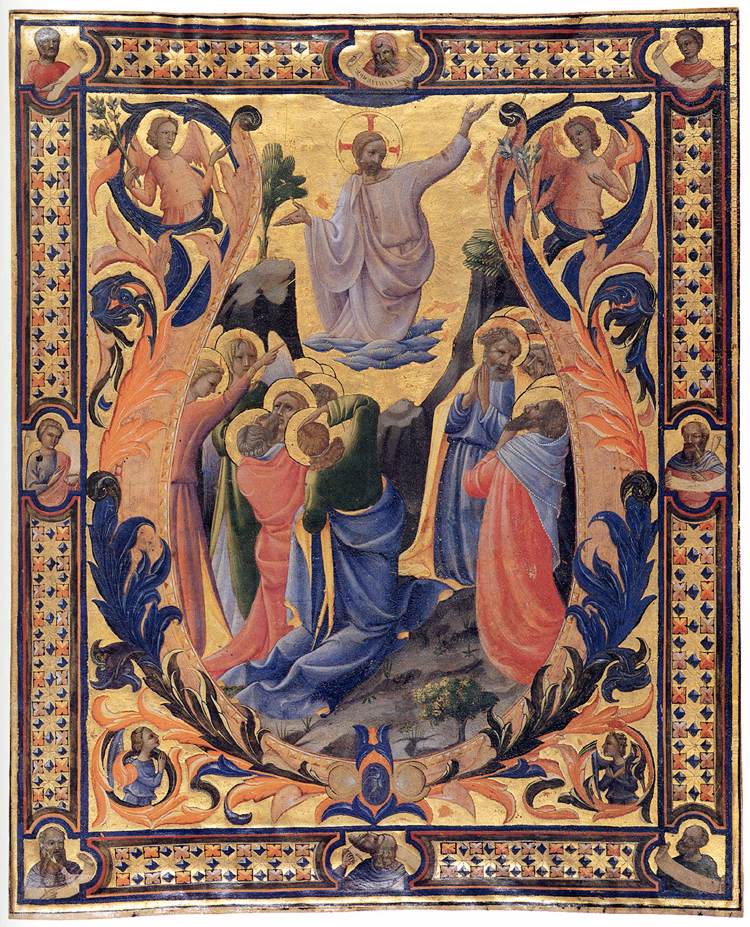
Antiphonary
Lorenzo Monaco
c. 1410
Tempera and gold on parchment, mounted on panel, 402 x 327 mm
Bernard H. Breslauer, New York
8
posted on
05/13/2021 8:24:44 AM PDT
by
annalex
(fear them not)
To: annalex
Antiphonary
Lorenzo Monaco
c. 1410
Tempera and gold on parchment, mounted on panel, 402 x 327 mm
Bernard H. Breslauer, New York
9
posted on
05/13/2021 8:24:44 AM PDT
by
annalex
(fear them not)
To: annalex
Saint Robert Bellarmine's StoryWhen Robert Bellarmine was ordained in 1570, the study of Church history and the fathers of the Church was in a sad state of neglect. A promising scholar from his youth in Tuscany, he devoted his energy to these two subjects, as well as to Scripture, in order to systematize Church doctrine against the attacks of the Protestant Reformers. He was the first Jesuit to become a professor at Louvain.
His most famous work is his three-volume Disputations on the Controversies of the Christian Faith. Particularly noteworthy are the sections on the temporal power of the pope and the role of the laity. Bellarmine incurred the anger of monarchists in England and France by showing the divine-right-of-kings theory untenable. He developed the theory of the indirect power of the pope in temporal affairs; although he was defending the pope against the Scottish philosopher Barclay, he also incurred the ire of Pope Sixtus V.
Bellarmine was made a cardinal by Pope Clement VIII on the grounds that “he had not his equal for learning.” While he occupied apartments in the Vatican, Bellarmine relaxed none of his former austerities. He limited his household expenses to what was barely essential, eating only the food available to the poor. He was known to have ransomed a soldier who had deserted from the army and he used the hangings of his rooms to clothe poor people, remarking, “The walls won’t catch cold.”
Among many activities, Bellarmine became theologian to Pope Clement VIII, preparing two catechisms which have had great influence in the Church.
The last major controversy of Bellarmine’s life came in 1616 when he had to admonish his friend Galileo, whom he admired. He delivered the admonition on behalf of the Holy Office, which had decided that the heliocentric theory of Copernicus was contrary to Scripture. The admonition amounted to a caution against putting forward—other than as a hypothesis—theories not yet fully proven. This shows that saints are not infallible.
Robert Bellarmine died on September 17, 1621. The process for his canonization was begun in 1627, but was delayed until 1930 for political reasons, stemming from his writings. In 1930, Pope Pius XI canonized him, and the next year declared him a doctor of the Church.
Reflection
The renewal in the Church sought by Vatican II was difficult for many Catholics. In the course of change, many felt a lack of firm guidance from those in authority. They yearned for the stone columns of orthodoxy and an iron command with clearly defined lines of authority. Vatican II assures us in The Church in the Modern World, “There are many realities which do not change and which have their ultimate foundation in Christ, who is the same yesterday and today, yes, and forever” (#10, quoting Hebrews 13:8).
Robert Bellarmine devoted his life to the study of Scripture and Catholic doctrine. His writings help us understand that the real source of our faith is not merely a set of doctrines, but rather the person of Jesus still living in the Church today.
Saint Robert Bellarmine is the Patron Saint of:
Catechists
Catechumens
franciscanmedia.org
Fuller list patronage: Bellarmine University; Bellarmine Preparatory School; Fairfield University; Bellarmine College Preparatory; St. Robert's School, Darjeeling; canonists; canon lawyers; catechists; Robert Barron (bishop); catechumens; Archdiocese of Cincinnati
10
posted on
05/13/2021 8:34:26 AM PDT
by
annalex
(fear them not)
To: annalex
11
posted on
05/13/2021 8:35:35 AM PDT
by
annalex
(fear them not)
To: annalex; All
NAVARRE BIBLE COMMENTARY (RSV) Ad Majorem Dei Gloriam (To the Greater Glory of God) From: Acts 1:1-11
Prologue
-------------
[1] In the first book, O Theophilus, I have dealt with all that Jesus began to do and teach, [2] until the day when he was taken up, after he had given commandment through the Holy Spirit to the apostles whom he had chosen. [3] To them he presented himself alive after his passion by many proofs, appearing to them during forty days, and speaking of the kingdom of God. [4] And while staying with them he charged them not to depart from Jerusalem, but to wait for the promise of the Father, which, he said, "you heard from me, [5] for John baptized with water, but before many days you shall be baptized with the Holy Spirit."
The Ascension
----------------------
[6] So when they had come together, they asked him, "Lord, will you at this time restore the kingdom of Israel?" [7] He said to them, "It is not for you to know times or seasons which the Father has fixed by his own authority. [8] But you shall receive power when the Holy Spirit has come upon you; and you shall be my witnesses in Jerusalem and in all Judea and Samaria and to the end of the earth." [9] And when he had said this, as they were looking on, he was lifted up, and a cloud took him out of their sight. [10] And while they were gazing into heaven as he went, behold, two men stood by them in white robes, [11] and said, "Men of Galilee, why do you stand looking into heaven? This Jesus, who was taken up from you into heaven, will come in the same way as you saw him go into heaven."
**********************************************************
Commentary:
1-5. St Luke is the only New Testament author to begin his book with a prologue, in the style of secular historians. The main aim of this preface is to convey to the reader the profoundly religious character of the book which he is holding in his hands. It is a work which will give an account of events marking the fulfillment of the promises made by the God of Israel the Creator and Savior of the world. Under the inspiration of the Holy Spirit, into his book St Luke weaves quotations from the Psalms, Isaiah, Amos and Joel; it both reflects the Old Testament and interprets it in the light of its fulfillment in Jesus Christ.
The prologue refers to St Luke's Gospel as a "first book". It mentions the last events of our Lord's life on earth--the appearances of the risen Christ and his ascension into heaven--and links them up with the account which is now beginning.
St Luke's aim is to describe the origins and the early growth of this Christianity, of which the main protagonist of this book, the Holy Spirit, has been the cause. Yet this is not simply an historical record: the Acts of the Apostles, St Jerome explains, "seems to be a straightforward historical account of the early years of the nascent Church. But if we bear in mind it is written by Luke the physician, who is praised in the Gospel (cf. 2 Cor 8: 18), we will realize that everything he says is medicine for the ailing soul" ("Epistle" 53, 9).
The spiritual dimension of this book, which is one of a piece with the Third Gospel, nourished the soul of the first generations of Christians, providing them with a chronicle of God's faithful and loving support of the new Israel. "This book", St John Chrysostom writes at the start of his great commentary, "will profit us no less than the Gospels, so replete is it with Christian wisdom and sound doctrine. It offers an account of the numerous miracles worked by the Holy Spirit. It contains the fulfillment of the prophecies of Jesus Christ recorded in the Gospel; we can observe in the very facts the bright evidence of Truth which shines in them, and the mighty change which is taking place in the Apostles: they become perfect men, extraordinary men, now that the Holy Spirit has come upon them. All Christ's promises and predictions--He who believes in me will do these and even greater works, you will be dragged before tribunals and kings and beaten in the synagogues, and will suffer grievous things, and yet you will overcome your persecutors and executioners and will bring the Gospel to the ends of the earth--all this, how it came to pass, may be seen in this admirable book. Here you will see the Apostles speeding their way overland and sea as if on wings. These Galileans, once so timorous and obtuse, we find suddenly changed into new men, despising wealth and honor, raised above passion and concupiscence" ("Hom. on Acts", 1).
St Luke dedicates this book to Theophilus--as he did his Gospel. The dedication suggests that Theophilus was an educated Christian, of an upper-class background, but he may be a fictitious person symbolizing "the beloved of God", which is what the name means. It also may imply that Acts was written quite soon after the third Gospel.
1. "To do and teach": these words very concisely sum up the work of Jesus Christ, reported in the Gospels. They describe the way in which God's saving Revelation operates: God lovingly announces and reveals himself in the course of human history through his actions and through his words. "The economy of Revelation is realized by deeds and words, which are intrinsically bound up with each other", Vatican II teaches. "As a result, the works performed by God in the history of salvation show forth and bear out the doctrine and realities signified by the words; the words, for their part, proclaim the works, and bring to light the mystery they contain. The most intimate truth which this revelation gives us about God and the salvation of man shines forth in Christ, who is himself both the mediator and the sum total of Revelation" ("Dei Verbum", 2).
The Lord "proclaimed the kingdom of the Father both by the testimony of his life and by the power of his word" (Vatican II, "Lumen Gentium", 35). He did not limit himself to speech, to being simply the Teacher whose words opened man's minds to the truth. He was, above all, the Redeemer, able to save fallen man through the divine efficacy of each and every moment of his life on earth.
"Our Lord took on all our weaknesses, which proceed from sin—with the exception of sin itself. He experienced hunger and thirst, sleep and fatigue, sadness and tears. He suffered in every possible way, even the supreme suffering of death. No one could be freed from the bonds of sinfulness had he who alone was totally innocent not been ready to die at the hands of impious men. Therefore, our Savior, the Son of God, has left all those who believe in him an effective source of aid, and also an example. The first they obtain by being reborn through grace, the second by imitating his life" (St Leo the Great, "Twelfth Homily on the Passion").
Jesus' redemptive action--his miracles, his life of work, and the mystery of his death, resurrection and ascension, whose depth and meaning only faith can plumb--also constitute a simple and powerful stimulus for our everyday conduct. Faith should always be accompanied by works, by deeds, that is, our humble and necessary cooperation with God's saving plans.
"Don't forget that doing must come before teaching. 'Coepit facere et docere', the holy Scripture says of Jesus Christ: 'He began to do and to teach. ' "First deeds: so that you and I might learn" (J. Escriva, "The Way", 342).
3. This verse recalls the account in Luke 24:13-43 of the appearances of the risen Jesus to the disciples of Emmaus and to the Apostles in the Cenacle. It stresses the figure of forty days. This number may have a literal meaning and also a deeper meaning. In Sacred Scripture periods of forty days or forty years have a clearly salvific meaning: they are periods during which God prepares or effects important stages in his plans. The great flood lasted forty days (Gen 7:17); the Israelites journeyed in the wilderness for forty years on their way to the promised land (Ps 95:10); Moses spent forty days on Mount Sinai to receive God's revelation of the Covenant (Ex 24:18); on the strength of the bread sent by God Elisha walked forty days and forty nights to reach his destination (1 Kings 19:8); and our Lord fasted in the wilderness for forty days in preparation for his public life (Mt 4:2).
5. "You shall be baptized with the Holy Spirit": this book has been well described as the "Gospel of the Holy Spirit". "There is hardly a page in the Acts of the Apostles where we fail to read about the Spirit and the action by which he guides, directs and enlivens the life and work of the early Christian community. It is he who inspires the preaching of St Peter (cf. Acts 4:8), who strengthens the faith of the disciples (cf. Acts 4:31), who confirms with his presence the calling of the Gentiles (cf. Acts 10:44-47), who sends Saul and Barnabas to distant lands, where they will open new paths for the teaching of Jesus (cf. Acts 13:2-4). In a word, his presence and doctrine are everywhere" (J. Escriva, "Christ Is Passing By", 127).
6-8. The Apostles' question shows that they are still thinking in terms of earthly restoration of the Davidic dynasty. It would seem that for them --as for many Jews of their time--eschatological hope in the Kingdom extended no further than expectation of world-embracing Jewish hegemony.
"It seems to me", St John Chrysostom comments, "that they had not any clear notion of the nature of the Kingdom, for the Spirit had not yet instructed them. Notice that they do not ask when it shall come but 'Will you at this time restore the Kingdom to Israel?', as if the Kingdom were something that lay in the past. This question shows that they were still attracted by earthly things, though less than they had been" ("Hom. on Acts", 2).
Our Lord gives an excellent and encouraging reply, patiently telling them that the Kingdom is mysterious in character, that it comes when one least expects, and that they need the help of the Holy Spirit to be able to grasp the teaching they have received. Jesus does not complain about their obtuseness; he simply corrects their ideas and instructs them.
8. The outline of Acts is given here: the author plans to tell the story of the growth of the Church, beginning in Jerusalem and spreading through Judea and Samaria to the ends of the earth. This is the geographical structure of St Luke's account. In the Third Gospel Jerusalem was the destination point of Jesus' public life (which began in Galilee); here it is the departure point.
The Apostles' mission extends to the whole world. Underlying this verse we can see not so much a "geographical" dimension as the universalist aspirations of the Old Testament, articulated by Isaiah: "It shall come to pass in the latter days that the mountain of the house of the Lord shall be established as the highest of the mountains, and shall be raised above the hills; and all the nations shall flow to it, and many peoples shall come, and say: 'Come, let us go up to the mountain of the Lord, to the house of the God of Jacob; that he may teach us his ways and that we may walk in his paths. For out of Zion shall go forth the law, and the word of the Lord from Jerusalem" (Is 2:2-3).
9. Jesus' life on earth did not end with his death on the Cross but with his ascension into heaven. The ascension, reported here, is the last event, the last mystery of our Lord's life on earth (cf. also 24:50-53)—and also it concerns the origins of the Church. The ascension scene takes place, so to speak, between heaven and earth. "Why did a cloud take him out of the Apostles' sight?", St John Chrysostom asks. "The cloud was a sure sign that Jesus had already entered heaven; it was not a whirlwind or a chariot of fire, as in the case of the prophet Elijah (cf. 2 Kings 2: l 1), but a cloud, which was a symbol of heaven itself" ("Hom. on Acts", 2). A cloud features in theophanies--manifestations of God—in both the Old Testament (cf. Ex 13:22) and the New (cf. Lk 9:34f).
Our Lord's ascension is one of the actions by which Jesus redeems us from sin and gives us the new life of grace. It is a redemptive mystery "What we have already taught of the mystery of his death and resurrection the faithful should deem not less true of his ascension. For although we owe our redemption and salvation to the passion of Christ, whose merits opened heaven to the just, yet his ascension is not only proposed to us as a model, which teaches us to look on high and ascend in spirit into heaven, but it also imparts to us a divine virtue which enables us to accomplish what it teaches" ("St Pius V Catechism" I, 7, 9).
Our Lord's going up into heaven is not simply something which stirs us to lift up our hearts--as we are invited to do at the preface of the Mass, to seek and love the "things that are above" (cf. Col 3:1-2); along with the other mysteries of his life, death and resurrection, Christ's ascension saves us. "Today we are not only made possessors of paradise", St Leo says, "but we have ascended with Christ, mystically but really, into the highest heaven, and through Christ we have obtained a more ineffable grace than that which we lost through the devil's envy" ("First Homily on the Ascension").
The ascension is the climax of Christ's exaltation, which was achieved in the first instance by his resurrection and which--along with his passion and death--constitutes the paschal mystery. The Second Vatican Council expresses this as follows: "Christ our Lord redeemed mankind and gave perfect glory to God [...]. principally by the paschal mystery of his blessed passion, resurrection from the dead, and glorious ascension" ("Sacrosanctum Concilium", 5; cf. "Dei Verbum", 19).
Theology has suggested reasons why it was very appropriate for the glorified Lord to go up into heaven to be "seated at the right hand of the Father." "First of all, he ascended because the glorious kingdom of the highest heavens, not the obscure abode of this earth, presented a suitable dwelling place for him whose body, rising from the tomb, was clothed with the glory of immortality. He ascended, however, not only to possess the throne of glory and the kingdom which he had merited by his blood, but also to attend to whatever regards our salvation. Again, he ascended to prove thereby that his kingdom is not of this world" ("St Pius V Catechism", I, 7, 5; cf. "Summa Theologiae", III, q. 57, a. 6).
The ascension marks the point when the celestial world celebrates the victory and glorification of Christ: "It is fitting that the sacred humanity of Christ should receive the homage, praise and adoration of all the hierarchies of the Angels and of all the legions of the blessed in heaven" (J. Escriva, "Holy Rosary", second glorious mystery).
11. The angels are referring to the Parousia--our Lord's second coming, when he will judge the living and the dead. "They said to them, What are you doing here, looking into heaven? These words are full of solicitude, but they do not proclaim the second coming of the Savior as imminent. The angels simply assert what is most important, that is, that Jesus Christ will come again and the confidence with which we should await his return" (St John Chrysostom, "Hom. on Acts", 2).
We know for a certainty that Christ will come again at the end of time. We confess this in the Creed as part of our faith. However, we know "neither the day nor the hour" (Mt 25: 13) of his coming. We do not need to know it. Christ is always imminent. We must always be on the watch, that is, we should busy ourselves in the service of God and of others, which is where our sanctification lies.
12
posted on
05/13/2021 9:40:53 AM PDT
by
fidelis
(Defeatism and despair are like poison to men's souls. If you can't be positive, at least be quiet.)
To: fidelis
From: Ephesians 1:15-23Thanksgiving. The Supremacy of Christ
-------------------------------------
[15] For this reason, because I have heard of your faith in the Lord Jesus and your love toward all the saints, [16] I do not cease to give thanks for you, remembering you in my prayers, [17] that the God of our Lord Jesus Christ, the Father of glory, give you a spirit of wisdom and of revelation in the knowledge of him, [18] having the eyes of your hearts enlightened, that you may know what is the hope to which he has called you, what are the riches of his glorious inheritance in the saints, [19] and what is the immeasurable greatness of his power in us who believe, according to the working of his great might [20] which he accomplished in Christ when he raised him from the dead and made him sit at the right hand in the heavenly places, [2I] far above all rule and authority and power and dominion, and above every name that is named, not only in this age but also in that which is to come; [22] and he has put all things under his feet and has made him the head over all things for the church, [23] which is his body, the fullness of him who fills all in all.
***********************************************************************
Commentary:
15-23. The news the Apostle has received moves him to thanksgiving and prayer (vv. 15-16). But he immediately returns to contemplate how wonderful it is to know God's goodness, and he asks God to give this gift to the readers of his letter (vv. 17-19). His petition hinges on Jesus Christ, through whom God has revealed his power by giving him dominion (vv. 20-21) and establishing him as head of the Church (vv. 22-23).
15-16. St Paul's solicitude sets a wonderful example, especially for those whose responsibility it is to give Christian instruction to others. Like him, they should pray for those entrusted to their care; they should thank God for their spiritual progress and ask the Holy Spirit to give them the gift of wisdom and understanding. "Fulfill the task entrusted to you with all diligence of body and soul", St Ignatius of Antioch exhorts Polycarp. "Pay special attention to unity for there is nothing more important than this. Make yourself the support of all and sundry, as the Lord is to you. Bear lovingly with them all, as you are doing at present. Pray constantly and beg for ever greater gifts of wisdom. Be watchful and always awake in spirit. Address yourself to people personally, as is the way of God himself' ("Letter to Polycarp", I, 2-3).
This "faith in the Lord Jesus" is not just a matter of believing in Jesus Christ full stop; it is a complete system of belief which is founded on Jesus Christ: those who have received the gift of faith live in Christ, and this life in Christ means that their faith is truly a living faith, one which expresses itself in "love towards all the saints". Faith makes us discover that every baptized person is a son or daughter of God, and thus Christians' fraternal love is a logical consequence of this insight.
17. The God whom St Paul addresses is "the God of our Lord Jesus Christ", that is, the God who has revealed himself through Christ and to whom Jesus himself, as man, prays and asks for help (cf. Lk 22:42). The same God as was described in the Old Testament as "the God of Abraham, of Isaac and of Jacob" is now defined as "the God of our Lord Jesus Christ". He is the personal God recognized by his relationship with Christ, his Son, who as mediator of the New Covenant obtains from God the Father everything he asks for. This will be our own experience too if we are united to Christ, for he promised that "if you ask anything of the Father, he will give it to you in my name" (Jn 16:23; 15:16).
The founder of Opus Dei reminds us that "Jesus is the way, the mediator. In him are all things; outside of him is nothing. In Christ, taught by him, we dare to call Almighty God 'our Father': he who created heaven and earth is a loving Father" ("Christ Is Passing By", 91).
The Apostle also calls God "the Father of glory". The glory of God means his greatness, his power, the infinite richness of his personality, which when it is revealed inspires man with awe. Already, in the history of Israel, God revealed himself through his saving actions in favor of his people. Asking God to glorify his name is the same as asking him to show himself as our Savior and to give us his gifts. But the greatest manifestation of God's glory, of his power, was the raising of Jesus from the dead, and the raising, with him, of the Christian (cf. Rom 6:4; 1 Cor 6:14). In this passage St Paul asks God "the Father of glory" to grant Christians supernatural wisdom to recognize the greatness of the blessings he has given them through his Son; that is, to acknowledge that he is their Father and the origin of glory. By asking for a "spirit of wisdom and revelation" the Apostle is seeking special gifts--on the one hand, wisdom, that gift of the Holy Spirit which enables one to penetrate the mystery of God: "Who has learned thy counsel, unless thou hast given wisdom and sent thy holy Spirit from on high?" (Wis 9:17). This wisdom which the Church has been given (cf. Eph l:8) can be communicated to Christians in a special way, as a special gift or charism of the Holy Spirit. The Apostle also asks God to give them a spirit "of revelation", that is, the grace of personal revelations, such as he himself (cf. 1 Cor 14:6) and other Christians (cf. 1 Cor 14:26) received. It is not a matter of revelation or recognition of new truths, but rather of special light from the Holy Spirit so as to have a deeper appreciation of the truth of faith, or of the will of God in a particular situation.
18-19. Along with this deeper knowledge of God, St Paul asks that Christians be given a fuller and livelier hope, because God and hope are inseparable. He recognizes the faith and charity of the faithful to whom he is writing (cf. 1:15); now he wants hope to shine more brightly for them; he wants God to enlighten their minds and make them realize the consequences of their election, their calling, to be members of the holy people of God, the Church. Hope, therefore, is a gift from God. "Hope is a supernatural virtue, infused by God into our soul, by which we desire and expect eternal life, promised by God to his servants, and the means necessary to obtain it" ("St Pius X Catechism", 893).
The ground for hope lies in God's love and power which have been manifested in the resurrection of Christ. This same power is at work in the Christian. Because God's plan for our salvation is an eternal one, he who has called us will lead us to an immortal life in heaven. The fact that God's power is at work in us (cf. Rom 5:5) does not mean that we encounter no difficulties. Monsignor Escriva reminds us that "as we fight this battle, which will last until the day we die, we cannot exclude the possibility that enemies both within and without may attack with violent force. As if that were not enough, you may at times be assailed by the memory of your own past errors, which may have been very many. I tell you now, in God's name: do not despair. Should this happen (it need not happen; nor will it usually happen), then turn it into another motive for uniting yourself more closely to the Lord, for he has chosen you as his child and he will not abandon you. He has allowed this trial to befall you so as to have you love him the more and discover even more clearly his constant protection and love" ("Friends of God", 214).
20-21. The Apostle is in awe at the marvels which God's power has worked in Jesus Christ. He sees Christ as the source and model of our hope. "For, just as Christ's life is the model and exemplar of our holiness, so is the glory and exaltation of Christ the form and exemplar of our glory and exaltation" (St Thomas Aquinas, "Commentary on Eph, ad. Ioc".).
As elsewhere in the New Testament (cf. Acts 7:56; Heb 1:3; 1 Pet 3:22), the fact that the risen Christ is seated "at the right hand" of the Father means that he shares in God's kingly authority. The Apostle is using a comparison with which people of his time were very familiar--that of the emperor seated on his throne. The throne has always been the symbol of supreme authority and power. Thus, the "St Pius V Catechism" explains that being seated at the right hand "does not imply position or posture of body, but expresses the firm and permanent possession of royal and supreme power and glory, which he received from the Father" (I, 7, 3).
Christ's pre-eminence is absolute: he is Lord of all creation, material as well as spiritual, earthly as well as heavenly. "All rule and authority and power and dominion": this refers to the angelic spirits (cf. note on Eph 3:10), whom the false preachers were presenting as superior to Christ. St Paul argues against them: Jesus Christ at his resurrection was raised by God above all created beings.
22-23. In previous letters St Paul described the Church as a body (cf. Rom 12:4f; 1 Cor 12:12ff). Here, and in Colossians 1:18, he pursues this comparison and says that it is the body of Christ, and that Christ is its head. He returns to this teaching elsewhere in the Captivity Epistles (cf. Col 1:18; Eph 5:23f). The image of body and head highlights the life-giving and salvific influence of Christ on the Church, and at the same time emphasizes his supremacy over the Church (cf. St Thomas Aquinas, "Commentary on Eph, ad loc.", and also the note on Col 1:18). This fact fills Christians with joy: by joining the Church through Baptism, they have become truly members of our Lord's body. "No, it is not pride", Paul VI says, " nor arrogance nor obstinacy nor stupidity nor folly that makes us so sure of being living, genuine members of Christ's body, the authentic heirs of his Gospel" ("Ecclesiam Suam", 33).
This image also reveals Christ's close union with his Church and his deep love for her: "he loved her so much", St John of Avila observes, "that although what normally happens is that a person raises his arm to take a blow and protect his head, this blessed Lord, who is the head, put himself forward to receive the blow of divine justice, and died on the Cross to give life to his body, that is, us. And after giving us life, through penance and the sacraments, he endows us, defends and keeps us as something so very much his own, that he is not content with calling us his servants, friends, brethren or children: the better to show his love and render us honor, he gives us his name. For, by means of this ineffable union of Christ the head with the Church his body, he and we are together called 'Christ"' ("Audi, Filia", chap. 84).
The Apostle also describes the Church, the body of Christ (cf. 1 Cor 12:12) as his "fullness" (cf. note on Col 1:19). What he means is that, through the Church, Christ becomes present in and fills the entire universe and extends to it the fruits of his redemptive activity. By being the vehicle which Christ uses to distribute his grace to all, the Church is different from the Israel of the Old Testament: it is not confined to a particular geographical location.
Because the Church has limitless grace, its call is addressed to all mankind: all men are invited to attain salvation in Christ. "For many centuries now, the Church has been spread throughout the world," Monsignor Escriva comments, "and it numbers persons of all races and walks of life. But the universality of the Church does not depend on its geographical extension, even though that is a visible sign and a motive of credibility. The Church was catholic already at Pentecost; it was born catholic from the wounded heart of Jesus, as a fire which the Holy Spirit enkindles [...]. 'We call it catholic', writes St Cyril, 'not only because it is spread throughout the whole world, from one extreme to the other, but because in a universal way and without defect it teaches all the dogmas which men ought to know, of both the visible and the invisible, the celestial and the earthly. Likewise, because it draws to true worship all types of men, those who govern and those who are ruled, the learned and the ignorant. And finally, because it cures and makes healthy all kinds of sins, whether of the soul or of the body, possessing in addition--by whatever name it may be called—all the forms of virtue, in deeds and in words and in every kind of spiritual gift' ("Catechesis", 18, 23)" ("In Love with the Church", 9).
All grace reaches the Church through Christ. The Second Vatican Council reminds us: "He continually endows his body, that is, the Church, with gifts of ministries through which, by his power, we serve each other unto salvation so that, carrying out the truth in love, we may through all things grow into him who is our head" ("Lumen Gentium", 7). This is why St Paul calls the Church the "body" of Christ; and it is in this sense that it is the "fullness" ("pleroma") of Christ--not because it in any way fills out or completes Christ but because it is filled with Christ, full of Christ, forming a single body with him, a single spiritual organism, whose unifying and life-giving principle is Christ, its head. This demonstrates Christ's absolute supremacy; his unifying and life-giving influence extends from God to Christ, from Christ to the Church, and from the Church to all men. It is he in fact who fills all in all (cf. Eph 4:10; Col 1:17-19; 2:9f).
The fact that the Church is the body of Christ is a further reason why we should love it and serve it. As Pope Pius XII wrote: "To ensure that this genuine and whole-hearted love will reign in our hearts and grow every day, we must accustom ourselves to see Christ himself in the Church. For it is indeed Christ who lives in the Church, and through her teaches, governs and sanctifies; and it is also Christ who manifests himself in manifold disguise in the various members of his society" ("Mystici Corporis", 43).
13
posted on
05/13/2021 9:41:43 AM PDT
by
fidelis
(Defeatism and despair are like poison to men's souls. If you can't be positive, at least be quiet.)
To: fidelis
From: Mark 16:15-20The Apostle's Mission
---------------------
[15] And He (Jesus) said to them, "Go into all the world and preach the Gospel to the whole creation. [16] He who believes and is baptized will be saved; but he who does not believe will be condemned. [17] And these signs will accompany those who believe: in My name they will cast out demons; they will speak in new tongues; [18] they will pick up serpents, and if they drink any deadly thing, it will not hurt them; they will lay their hands on the sick, and they will recover."
The Ascension
-------------
[19] So then the Lord Jesus, after He had spoken to them, was taken up into Heaven, and sat down at the right hand of God.
The Apostles Go Forth and Preach
--------------------------------
[20] And they went forth and preached everywhere, while the Lord worked with them and confirmed the message by the signs that attended it. Amen.
***********************************************************************
Commentary:
15. This verse contains what is called the "universal apostolic mandate" (paralleled by Matthew 28:19-20 and Luke 24:46-48). This is an imperative command from Christ to His Apostles to preach the Gospel to the whole world. This same apostolic mission applies, especially, to the Apostles' successors, the bishops in communion with Peter's successor, the Pope.
But this mission extends further: the whole "Church was founded to spread the Kingdom of Christ over all the Earth for the glory of God the Father, to make all men partakers in redemption and salvation.... Every activity of the Mystical Body with this in view goes by the name of `apostolate'; the Church exercises it through all its members, though in various ways. In fact, the Christian vocation is, of its nature, a vocation to the apostolate as well. In the organism of a living body no member plays a purely passive part, sharing in the life of the body it shares at the same time in its activity. The same is true for the body of Christ, the Church: `the whole body achieves full growth in dependence on the full functioning of each part' (Ephesians 4:16). Between the members of this body there exists, further, such a unity and solidarity (cf. Ephesians 4:16) that a member who does not work at the growth of the body to the extent of his possibilities must be considered useless both to the Church and to himself.
"In the Church there is diversity of ministry but unity of mission. To the Apostles and their successors Christ has entrusted the office of teaching, sanctifying and governing in His name and by His power. But the laity are made to share in the priestly, prophetical and kingly office of Christ; they have therefore, in the Church and in the world, their own assignment in the mission of the whole people of God" (Vatican II, "Apostolicam Actuositatem", 2).
It is true that God acts directly on each person's soul through grace, but it must also be said that it is Christ's will (expressed here and elsewhere) that men should be an instrument or vehicle of salvation for others.
Vatican II also teaches this: "On all Christians, accordingly, rests the noble obligation of working to bring all men throughout the whole world to hear and accept the divine message of salvation" ("ibid"., 3).
16. This verse teaches that, as a consequence of the proclamation of the Good News, faith and Baptism are indispensable pre-requisites for attaining salvation. Conversion to the faith of Jesus Christ should lead directly to Baptism, which confers on us "the first sanctifying grace, by which original sin is forgiven, and which also forgives any actual sins there may be; it remits all punishment due for these sins; it impresses on the soul the mark of the Christian; it makes us children of God, members of the Church and heirs to Heaven, and enables us to receive the other sacraments" ("St. Pius X Catechism", 553).
Baptism is absolutely necessary for salvation, as we can see from these words of the Lord. But physical impossibility of receiving the rite of Baptism can be replaced by either martyrdom (called, therefore "baptism of blood") or by a perfect act of love of God and of contrition, together with an at least implicit desire to be baptized: this is called "baptism of desire" (cf. "ibid"., 567-568).
Regarding infant Baptism, St. Augustine taught that "the custom of our Mother the Church of infant Baptism is in no way to be rejected or considered unnecessary; on the contrary, it is to be believed on the ground that it is a tradition from the Apostles" ("De Gen. ad litt"., 10, 23, 39). The new "Code of Canon Law" also stresses the need to baptize infants: "Parents are obliged to see that their infants are baptized within the first few weeks. As soon as possible after the birth, indeed even before it, they are to approach the parish priest to ask for the sacrament for their child, and to be themselves duly prepare for it" (Canon 867).
Another consequence of the proclamation of the Gospel, closely linked with the previous one, is that "the Church is necessary", as Vatican II declares: "Christ is the one mediator and way of salvation; He is present to us in His body which is the Church. He Himself explicitly asserted the necessity of faith and baptism (cf. Mark 16:16; John 3:5), and thereby affirmed at the same time the necessity of the Church which men enter through baptism as through a door. Hence they could not be saved who, knowing that the Church was founded as necessary by God through Christ, would refuse to enter it, or to remain in it" ("Lumen Gentium", 14; cf. "Presbyterorum Ordinis", 4; "Ad Gentes", 1-3; "Dignitatis Humanae", 11).
17-18. In the early days of the Church, public miracles of this kind happened frequently. There are numerous historical records of these events in the New Testament (cf., e.g., Acts 3:1-11; 28:3-6) and in other ancient Christian writings. It was very fitting that this should be so, for it gave visible proof or the truth of Christianity. Miracles of this type still occur, but much more seldom; they are very exceptional. This, too, is fitting because, on the one hand, the truth of Christianity has been attested to enough; and, on the other, it leaves room for us to merit through faith. St. Jerome comments: "Miracles were necessary at the beginning to confirm people in the faith. But, once the faith of the Church is confirmed, miracles are not necessary" ("Comm. in Marcum, in loc."). However, God still works miracles through saints in every generation, including our own.
19. The Lord's ascension into Heaven and His sitting at the right hand of the Father is the sixth article of faith confessed in the Creed. Jesus Christ went up into Heaven body and soul, to take possession of the Kingdom He won through His death, to prepare for us a place in Heaven (cf. Revelation 3:21) and to send the Holy Spirit to His Church (cf. "St. Pius X Cathechism", 123).
To say that He "sat at the right hand of God" means that Jesus Christ, including His humanity, has taken eternal possession of Heaven and that, being the equal of His Father in that He is God, He occupies the place of highest honor beside Him in His human capacity (cf. "St. Pius V Catechism", I, 7, 2-3). Already in the Old Testament the Messiah is spoken of as seated at the right hand of the Almighty, thereby showing the supreme dignity of Yahweh's Annointed (cf. Psalm 110:1). The New Testament records this truth here and also in many other passages (cf. Ephesians 1:20-22; Hebrews 1:13).
As the "St. Pius V Catechism" adds, Jesus went up to Heaven by His own power and not by any other. Nor was it only as God that He ascended, but also as man.
20. Inspired by the Holy Spirit, the evangelist attests that the words of Christ have already begun to be fulfilled by the time of writing. The Apostles, in other words, were faithfully carrying out the mission of our Lord entrusted to them. They begin to preach the Good News of salvation throughout the known world. Their preaching was accompanied by the signs and wonders the Lord had promised, which lent authority to their witness and their teaching. Yet, we know that their apostolic work was always hard, involving much effort, danger, misunderstanding, persecution and even martyrdom--like our Lord's own life.
Thanks to God and also to the Apostles, the strength and joy of our Lord Jesus Christ has reached as far as us. But every Christian generation, every man and woman, has to receive the preaching of the Gospel and, in turn, pass it on. The grace of God will always be available to us: "Non est abbreviata manus Domini" (Isaiah 59:1), the power of the Lord has not diminished.
Daily Word for Reflection—Navarre Bible Commentary
14
posted on
05/13/2021 9:42:33 AM PDT
by
fidelis
(Defeatism and despair are like poison to men's souls. If you can't be positive, at least be quiet.)
To: annalex
For those who live in dioceses not celebrating Ascension until this coming Sunday, here are the readings and Navarre Commentary for
May 13, Thursday of the Sixth Week of EasterNAVARRE BIBLE COMMENTARY (RSV)
Ad Majorem Dei Gloriam (To the Greater Glory of God)
From: Acts 18:1-8
Paul in Corinth, with Aquila and Priscilla
------------------------------------------
[1] After this he left Athens and went to Corinth. [2] And he found a Jew named Aquila, a native of Pontus, lately come from Italy with his wife Priscilla because Claudius had commanded all the Jews to leave Rome. And he went to see them; [3] and because he was of the same trade he stayed with them, and they worked, for by trade they were tentmakers. [4] And he argued in the synagogue every sabbath, and persuaded Jews and Greeks.
Preaching to Jews and Gentiles
------------------------------
[5] When Silas and Timothy arrived from Macedonia, Paul was occupied with preaching, testifying to the Jews that the Christ was Jesus. [6] And when they opposed and reviled him, he shook out his garments and said to them, "Your blood be upon your heads! I am innocent. From now on I will go to the Gentiles." [7] And he left there and went to the house of a man named Titius Justus, a worshipper of God; his house was next door to the synagogue. [8] Crispus, the ruler of the synagogue, believed in the Lord, together with all his household; and many of the Corinthians hearing Paul believed and were baptized.
***********************************************************************
Commentary:
1-11. St Paul must have arrived in Corinth very discouraged by what happened in Athens, and very short of money. Some time later he wrote: "And I was with you in weakness and in much fear and trembling; and my speech and my message were not in plausible words of wisdom, but in demonstration of the Spirit and power, that your faith might not rest in the wisdom of men but in the power of God..." (1 Cor 2:3-4). He would never forget his experience in the Areopagus before the Athenians, who "were friends of new speeches yet who paid no heed to them or what they said; all they wanted was to have something new to talk about" (Chrysostom, Hom. on Acts, 39).
Corinth was a very commercial, cosmopolitan city located on an isthmus between two gulfs (which are now joined). Ships came to Corinth from all over the world. Low moral standards, concentration on money-making and voluptuous worship of Aphrodite meant that Corinth did not seem the best ground for sowing the word of God; but the Lord can change people's hearts, especially if he has people as obedient and zealous as Paul, Silvanus, Timothy and the early Christians in general. The Athenians' intellectual pride proved to be a more formidable obstacle than the Corinthians' libertarian lifestyle.
Christians should not soft-pedal if they find themselves in situations where paganism and loose living seem to be the order of the day: indeed this should only spur them on. When addressing his Father at the Last Supper Jesus prayed: "I do not pray that thou shouldst take them out of the world, but that thou shouldst keep them from the evil one" (Jn 17:15).
2. This married couple were probably already Christians when they arrived in Corinth. Since they came from Rome, the indications are that there was a community of Christians in the capital from very early on. Aquila and Priscilla (the diminutive of Prisca) proved to be of great help to Paul from the very beginning of his work in Corinth.
Later on they both must have returned to Rome (cf. Rom 16:3); and it may well be that apostolic considerations dictated their movements, as would be the case with countless Christians after them. "The Christian family's faith and evangelizing mission also possesses this Catholic missionary inspiration. The sacrament of marriage takes up and reproposes the task of defending and spreading the faith, a task which has its roots in Baptism and Confirmation and makes Christian married couples and parents witnesses of Christ 'to the ends of the earth' (Acts 1:8) [...].
"Just as at the dawn of Christianity Aquila and Priscilla were presented as a missionary couple (cf. Acts 18; Rom 16:3f), so today the Church shows forth her perennial newness and fruitfulness by the presence of Christian couples who [...] work in missionary territories, proclaiming the Gospel and doing service to their fellowman for the love of Jesus Christ" (St John Paul II, Familiaris Consortio, 54).
The edict of Claudius (41-54 A.D.) expelling the Jews from Rome was issued before the year 50. It is referred to by Suetonius, the Roman historian, but the details of the decree are not known. We do know that Claudius had protected the Jews on a number of occasions. He gave them the right to appoint the high priest and to have charge of the temple. Apparently, conflict between Jews and Christians in Rome led him to expel some Jews from the city, on a temporary basis, or at least to advise them to leave.
3. St Paul earns his living and manages to combine this with all his preaching of the Gospel. "This teaching of Christ on work," John Paul II writes, "based on the example of his life during his years in Nazareth, finds a particularly lively echo in the teaching of the Apostle Paul. Paul boasts of working at his trade (he was probably a tent-maker: cf. Acts 18:3), and thanks to that work he was able even as an Apostle to earn his own bread" (Laborem Exercens, 26).
During this stay of a year and a half in Corinth St Paul wrote some rather severe letters to the Thessalonians, pointing out to them the need to work: "If any one will not work, let him not eat. [...] we command and exhort [idlers] in the Lord Jesus Christ to do their work in quietness and to earn their own living" (2 Thess 3:10, 12). St John Chrysostom, commenting on this passage of Acts, says that "Work is man's natural state. Idleness is against his nature. God has placed man in this world to work, and the natural thing for the soul is to be active and not passive" (Hom. on Acts, 35).
Taking Christ's own example, Monsignor Escriva points out that "Work is one of the highest human values and a way in which men contribute to the progress of society. But even more, it is a way to holiness" (Conversations, 24). In Jesus' hands, "a professional occupation, similar to that carried out by millions of people in the world, was turned into a divine task. It became a part of our redemption, a way to salvation" (ibid., 55).
In fact, it is in work, in the middle of ordinary activity, that most people can and should find Christ. God "is calling you to serve him in and from the ordinary, material and secular activities of human life. He waits for us everyday [...] in all the immense panorama of work" ("ibid"., 114). Man thereby finds God in the most visible, material things, and Christians can avoid the danger of what might be called "a double life: on one side, an interior life, a life of relation with God; and on the other, a separate and distinct professional, social and family life, full of small earthly realities" (ibid.).
Like most people Paul spent part of his day working to earn his living. When engaged in work he was still the Apostle of the Gentiles chosen by God, and his very work spoke to his companions and friends. We should not think that there was any split between his on-going personal relationship with God, and his apostolic activity or his work--or that he did not work in a concentrated or exemplary manner.
4. It is easy to imagine the hope and eagerness Paul felt when preaching the Gospel to his fellow Jews. He knew from experience the difficulties they had about recognizing Jesus as the Messiah and accepting the Good News. Paul feels both joy and sorrow: he is happy because the moment has arrived for the sons of Abraham to receive the Gospel as is their right by inheritance; but he also realizes that although it brings salvation to some, it spells rejection for those who refuse to accept it.
Origen spoke in similar terms: "I experience anxiety to speak and anxiety not to speak. I wish to speak for the benefit of those who are worthy, so that I may not be taken to task for refusing the word of truth to those who have the ability to grasp it. But I am afraid to speak in case I address those who are unworthy, because it means I am giving holy things to dogs and casting pearls before swine. Only Jesus was capable of distinguishing, among his listeners, those who were without from those who were within: he spoke in parables to the outsiders and explained the parables to those who entered with him into the house" (Dialogue with Heraclides, 15).
6. The blindness of the Jews once again causes Paul great sadness; here is further evidence of the mysterious resistance to faith of so many of the chosen people. As he did in Pisidian Antioch (cf. 13:51), the Apostle shakes the dust from his clothes to show his break from the Jews of Corinth: their apparent fidelity to the religion of their forefathers disguises their proud rejection of God's promises.
He finds himself confronted by the great enigma of salvation history, in which God dialogues with human freedom. As St Justin writes, "The Jews, in truth, who had the prophecies and always looked for the coming of Christ, not only did not recognize him, but, far beyond that, even mistreated him. But the Gentiles, who had never even heard anything of Christ until his Apostles went from Jerusalem and preached about him and gave them the prophecies, were filled with joy and faith, and turned away from their idols, and dedicated themselves to the Unbegotten God through Christ" (First Apology, 49, 5).
Paul's words on this occasion are addressed to the Jews of Corinth, not to Jews elsewhere. For a long time past he has directed his preaching to Gentiles as well as Jews. The phrase "From now on I will go to the Gentiles" does not mean that he will no longer address Jews, for in the course of his apostolic work he continues to evangelize Jews as well as Gentiles (cf. Acts 18:19; 28:17).
7. Titus Justus had a Roman name and was a Gentile, but the fact that he lived next door to the synagogue and, in particular, the Greek term used to identify him as a "worshipper" of God, indicates that he was a convert to Judaism. Cf. note on Acts 2:5-11.
----------------------------------------------------------
From: John 16:16-20
Fullness of Joy
---------------
(Jesus said to His disciples,) [16] "A little while, and you will see Me no more; again a little while, and you will see Me." [17] Some of His disciples said to one another, "What is this that He says to us, `A little while, and you will not see Me, and again a little while, and you will see Me'; and, `because I go to the Father'?" [18] They said, "What does He mean by `a little while'? We do not know what He means." [19] Jesus knew they wanted to ask Him; so He said to them, "Is this what you are asking yourselves, what I meant by saying, `A little while and you will not see Me, and again a little while, and you will see Me'? [20] Truly, truly, I say to you, you will weep and lament, but the world will rejoice; you will be sorrowful, but your sorrow will turn into joy."
***********************************************************************
Commentary:
16-20. Earlier our Lord consoled the disciples by assuring them that He would send them the Holy Spirit after He went away (verse 7). Now He gives them further consolation: He is not leaving them permanently, He will come back to stay with them. However, the Apostles fail to grasp what He means, and they ask each other what they make of it. Our Lord does not give them a direct explanation, perhaps because they would not understand what He meant (as happened before: cf. Matthew 16:21-23 and paragraph). But He does emphasize that though they are sad now they will soon be rejoicing: after suffering tribulation they will be filled with a joy they will never lose (cf. John 17:13). This is a reference primarily to the Resurrection (cf. Luke 24:41), but also to their definitive encounter with Christ in Heaven.
Daily Word for Reflection—Navarre Bible Commentary
15
posted on
05/13/2021 9:59:27 AM PDT
by
fidelis
(Defeatism and despair are like poison to men's souls. If you can't be positive, at least be quiet.)
To: fidelis
A lot to digest here. Thank you.
16
posted on
05/14/2021 5:34:03 AM PDT
by
annalex
(fear them not)
Disclaimer:
Opinions posted on Free Republic are those of the individual
posters and do not necessarily represent the opinion of Free Republic or its
management. All materials posted herein are protected by copyright law and the
exemption for fair use of copyrighted works.
FreeRepublic.com is powered by software copyright 2000-2008 John Robinson
