Skip to comments.
Catholic Caucus: Daily Mass Readings, 09-10-2020
USCCB/RNAB ^
Posted on 09/28/2020 5:05:19 AM PDT by annalex
September 28, 2020
Monday of the Twenty-sixth Sunday in Ordinary Time
Reading 1
One day, when the angels of God came to present themselves before the LORD,
Satan also came among them.
And the LORD said to Satan, “Whence do you come?”
Then Satan answered the LORD and said,
“From roaming the earth and patrolling it.”
And the LORD said to Satan, “Have you noticed my servant Job,
and that there is no one on earth like him,
blameless and upright, fearing God and avoiding evil?”
But Satan answered the LORD and said,
“Is it for nothing that Job is God-fearing?
Have you not surrounded him and his family
and all that he has with your protection?
You have blessed the work of his hands,
and his livestock are spread over the land.
But now put forth your hand and touch anything that he has,
and surely he will blaspheme you to your face.”
And the LORD said to Satan,
“Behold, all that he has is in your power;
only do not lay a hand upon his person.”
So Satan went forth from the presence of the LORD.
And so one day, while his sons and his daughters
were eating and drinking wine
in the house of their eldest brother,
a messenger came to Job and said,
“The oxen were ploughing and the asses grazing beside them,
and the Sabeans carried them off in a raid.
They put the herdsmen to the sword,
and I alone have escaped to tell you.”
While he was yet speaking, another came and said,
“Lightning has fallen from heaven
and struck the sheep and their shepherds and consumed them;
and I alone have escaped to tell you.”
While he was yet speaking, another messenger came and said,
“The Chaldeans formed three columns,
seized the camels, carried them off,
and put those tending them to the sword,
and I alone have escaped to tell you.”
While he was yet speaking, another came and said,
“Your sons and daughters were eating and drinking wine
in the house of their eldest brother,
when suddenly a great wind came across the desert
and smote the four corners of the house.
It fell upon the young people and they are dead;
and I alone have escaped to tell you.”
Then Job began to tear his cloak and cut off his hair.
He cast himself prostrate upon the ground, and said,
“Naked I came forth from my mother’s womb,
and naked shall I go back again.
The LORD gave and the LORD has taken away;
blessed be the name of the LORD!”
In all this Job did not sin,
nor did he say anything disrespectful of God.
R. (6)
Incline your ear to me and hear my word.Hear, O LORD, a just suit;
attend to my outcry;
hearken to my prayer from lips without deceit.
R.
Incline your ear to me and hear my word.From you let my judgment come;
your eyes behold what is right.
Though you test my heart, searching it in the night,
though you try me with fire, you shall find no malice in me.
R.
Incline your ear to me and hear my word.I call upon you, for you will answer me, O God;
incline your ear to me; hear my word.
Show your wondrous mercies,
O savior of those who flee
from their foes to refuge at your right hand.
R.
Incline your ear to me and hear my word.
R. Alleluia, alleluia.
The Son of Man came to serve
and to give his life as a ransom for many.
R. Alleluia, alleluia.
An argument arose among the disciples
about which of them was the greatest.
Jesus realized the intention of their hearts and took a child
and placed it by his side and said to them,
“Whoever receives this child in my name receives me,
and whoever receives me receives the one who sent me.
For the one who is least among all of you
is the one who is the greatest.”Then John said in reply,
“Master, we saw someone casting out demons in your name
and we tried to prevent him
because he does not follow in our company.”
Jesus said to him,
“Do not prevent him, for whoever is not against you is for you.”
TOPICS: Catholic; General Discusssion; Prayer; Worship
KEYWORDS: catholic; lk9; ordinarytime; prayer
For your reading, reflection, faith-sharing, comments, questions, discussion.
1
posted on
09/28/2020 5:05:19 AM PDT
by
annalex
To: All
KEYWORDS: catholic; lk9; ordinarytime; prayer;
2
posted on
09/28/2020 5:05:43 AM PDT
by
annalex
(fear them not)
To: annalex
3
posted on
09/28/2020 5:06:27 AM PDT
by
annalex
(fear them not)
To: nickcarraway; NYer; ELS; Pyro7480; livius; ArrogantBustard; Catholicguy; RobbyS; marshmallow; ...
Alleluia PingPlease FReepmail me to get on/off the Alleluia Ping List.
4
posted on
09/28/2020 5:07:12 AM PDT
by
annalex
(fear them not)
To: annalex
| Luke |
| |
English: Douay-Rheims |
Latin: Vulgata Clementina |
Greek NT: Byzantine/Majority Text (2000) |
| |
Luke 9
|
| 46. |
And there entered a thought into them, which of them should be greater. |
Intravit autem cogitatio in eos quis eorum major esset. |
εισηλθεν δε διαλογισμος εν αυτοις το τις αν ειη μειζων αυτων |
| 47. |
But Jesus seeing the thoughts of their heart, took a child and set him by him, |
At Jesus videns cogitationes cordis illorum, apprehendit puerum, et statuit illum secus se, |
ο δε ιησους ιδων τον διαλογισμον της καρδιας αυτων επιλαβομενος παιδιου εστησεν αυτο παρ εαυτω |
| 48. |
And said to them: Whosoever shall receive this child in my name, receiveth me; and whosoever shall receive me, receiveth him that sent me. For he that is the lesser among you all, he is the greater. |
et ait illis : Quicumque susceperit puerum istum in nomine meo, me recipit : et quicumque me receperit, recipit eum qui me misit. Nam qui minor est inter vos omnes, hic major est. |
και ειπεν αυτοις ος εαν δεξηται τουτο το παιδιον επι τω ονοματι μου εμε δεχεται και ος εαν εμε δεξηται δεχεται τον αποστειλαντα με ο γαρ μικροτερος εν πασιν υμιν υπαρχων ουτος εσται μεγας |
| 49. |
And John, answering, said: Master, we saw a certain man casting out devils in thy name, and we forbade him, because he followeth not with us. |
Respondens autem Joannes dixit : Præceptor, vidimus quemdam in nomine tuo ejicientem dæmonia, et prohibuimus eum : quia non sequitur nobiscum. |
αποκριθεις δε ο ιωαννης ειπεν επιστατα ειδομεν τινα επι τω ονοματι σου εκβαλλοντα δαιμονια και εκωλυσαμεν αυτον οτι ουκ ακολουθει μεθ ημων |
| 50. |
And Jesus said to him: Forbid him not; for he that is not against you, is for you. |
Et ait ad illum Jesus : Nolite prohibere : qui enim non est adversum vos, pro vobis est. |
και ειπεν προς αυτον ο ιησους μη κωλυετε ος γαρ ουκ εστιν καθ ημων υπερ ημων εστιν |
5
posted on
09/28/2020 5:08:18 AM PDT
by
annalex
(fear them not)
To: annalex
Catena Aurea by St. Thomas Aguinas
9:46–50
46. Then there arose a reasoning among them, which of them should be greatest.
47. And Jesus, perceiving the thought of their heart, took a child, and set him by him,
48. And said unto them, Whosoever shall receive this child in my name receiveth me: and whosoever shall receive me receiveth him that sent me: for he that is least among you all, the same shall be great.
49. And John answered and said, Master, we saw one casting out devils in thy name; and we forbad him, because he followeth not with us.
50. And Jesus said unto him, Forbid him not: for he that is not against us is for us.
CYRIL OF ALEXANDRIA. (non occ.) The devil lays plots of various kinds for them that love the best way of life. And if indeed by carnal allurements he can gain possession of a man’s heart, He sharpens his love of pleasure; but if a man has escaped these snares, he excites in him a desire of glory, and this passion for vain-glory had seized some one of His apostles. Hence it is said, Then there arose a reasoning among them, which of them should be the greatest. For to have such thoughts, belongs to him who desires to be superior to the rest; but I think it improbable that all the disciples gave way to this weakness; and therefore suppose that the Evangelist, not to seem to lay the charge to any individual, expresses himself indefinitely, saying, that there arose a reasoning among them.
THEOPHYLACT. Now it seems that this feeling was excited by the circumstance of their not being able to cure the demoniac. And while they were disputing thereupon, one said, It was not owing to my weakness, but another’s, that he could not be cured; and so thereby was kindled a strife among them, which was the greatest.
BEDE. Or, because they saw Peter, James, and John, taken apart to the mount, and the keys of the kingdom of heaven promised to Peter, they were angry that these three, or Peter, should have precedence over all; or because in the payment of the tribute they saw Peter made equal to the Lord, they supposed he was to be placed before the rest. But the attentive reader will find that the question was raised among them before the payment of the penny. For in truth Matthew relates that this took place at Capernaum; but Mark says, And he came to Capernaum, and being in the house, he asked them, What was it that ye disputed among yourselves in the way? But they held their peace; for by the way they had disputed among themselves who should be the greatest. (Mat. 18:24, Mark 9:33.)
CYRIL OF ALEXANDRIA. But our Lord, Who knew how to save, seeing in the hearts of the disciples the thought that had risen up thereupon as it were a certain root of bitterness, plucks it up by the roots before it received growth. For when passions first begin in us, they are easily subdued; but having gained strength, they are with difficulty eradicated. Hence it follows, And Jesus perceiving the thought of their heart, &c. Let him who thinks Jesus to be mere man, know that he has erred; for the Word, although made flesh, remained God. For it is God alone Who is able to search into the heart and reins. But in taking a child, and placing it beside Him, He did it for the Apostles’ sake and ours. For the disease of vain-glory feeds generally on those who have the preeminence among other men. But a child has a pure mind and unspotted heart, and abides in simplicity of thought; he courts not honours, nor knows the limits of each one’s power, nor shuns seeming to be inferior to others, bearing no moroseness in his mind or heart. Such the Lord embraces and loves, and thinks them worthy to be near Him, as those who had chosen to taste of the things which are His; for He says, Learn of me, for I am meek and lowly of heart. Hence it follows, And he says unto them, Whosoever shall receive a child in my name, receiveth me. As if He were to say, Seeing that there is one and the same reward to those that honour the saints, whether perchance such an one be the least, or one distinguished for honours and glory, for in him is Christ received, how vain is it to seek to have the preeminence?
BEDE. Now herein He either teaches, that the poor of Christ are to be received by those who wish to be greater simply for His honour, or He persuades men that they are children in malice. Hence when He said, Whoever shall receive that child, he adds, in my name; that in truth they may pursue with diligence and reason for Christ’s name that form of virtue which the child observes, with only nature for its guide. But because He also teaches that He is received in the child, and He Himself was born unto us a child; lest it should be thought that this was all which was seen, He subjoined, And whoever shall receive me, receiveth him that sent me; wishing verily to be believed, that as was the Father, such and so great was He.
AMBROSE. For he who receives the followers of Christ, receives Christ; and he who receives the image of God, receives God; but because we cannot see the image of God, it has been made present to us by the incarnation of the Word, that the divine nature which is above us, may be reconciled to us.
CYRIL OF ALEXANDRIA. Now He still more plainly conveys the meaning of the preceding words, saying, For he that is least among you all, the same shall be great; in which He speaks of the modest man who from honesty thinks nothing high of himself.
THEOPHYLACT. Because then our Lord had said, He who is least among you all, the same shall be great, John feared, lest perhaps they had done wrong in hindering a certain man by their own power. For a prohibition does not shew the probitor to be inferior, but to be one who thinks himself somewhat superior. Hence it is added, And John answered and said, Master, we saw one casting out devils in thy name, and we forbad him. Not indeed from envy, but to distinguish the working of miracles, for he had not received the power of working miracles with them, nor had the Lord sent him as He did them; nor did he follow Jesus in all things. Hence he adds, because he followeth not with us.
AMBROSE. For John loving much, and therefore much beloved, thinks that they should be excluded from the privilege who did not practise obedience.
CYRIL OF ALEXANDRIA. But we ought to consider not so much the worker of the miracles, as the grace which was in him, who, by the power of Christ, performed miracles. But what if there should be both those which be numbered together with the Apostles, and those who are crowned with the grace of Christ; there are many diversities in Christ’s gifts. But because the Saviour had given the Apostles power to cast out evil spirits, (Matt. 10:8.) they thought no one else but themselves alone was permitted to have this privilege granted to him, and therefore they come to enquire if it were lawful for others also to do this.
AMBROSE. Now John is not blamed, because he did this from love, but he is taught to know the difference between the strong and the weak. And therefore our Lord though He rewards the stronger, yet does not exclude the weak; as it follows, And Jesus said unto him, Forbid him not, for he that is not against you is for you. True, O Lord. For both Joseph and Nicodemus, through fear Thy secret disciples, when the time came, did not refuse their offices. But still since Thou saidst elsewhere, He that is not with me is against me, and he that gathereth not with me scattereth, (Luke 11:23.) explain unto us lest the two seem contrary to one another. And it seems to me, if any one considers the Searcher of hearts, he cannot doubt that every man’s action is distinguished by the motive of his heart.
CHRYSOSTOM. (Hom. 41. in Matt.) For in the other place when He said, He that is not with me is against me, He shews the Devil and the Jews to be opposed to Him; but here He shews that he who in Christ’s name cast out devils, is partly on their side.
CYRIL OF ALEXANDRIA. As if He said, On the side of you who love Christ, are all they who wish to follow those things which conduce to His glory, being crowned with His grace.
THEOPHYLACT. Marvel then at the power of Christ, how His grace works by means of the unworthy and those who are not His disciples: as also men are sanctified through the priests, although the priests be not holy.
AMBROSE. Now why does He in this place say that they are not to be hindered, who by the imposition of hands can subdue the unclean spirits, when according to Matthew, He says to these, I never knew you? (Matt. 7:23.) But we ought to perceive that there is no difference of opinion, but that the decision is this, that not only the official works but works of virtue are required in a priest, and that the name of Christ is so great, that even to the unholy it serves to give defence, but not grace. Let no one then claim to himself the grace of cleansing a man, because in him the power of the eternal Name has worked. For not by thy merits, but by his own hatred, the devil is conquered.
BEDE. Therefore in heretics and false catholics, it becomes us to abhor, and forbid not the common sacraments in which they are with us, and not against us, but the divisions contrary to peace and truth, wherein they are against us as following not the Lord.
Catena Aurea Luke 9
6
posted on
09/28/2020 5:11:38 AM PDT
by
annalex
(fear them not)
To: annalex
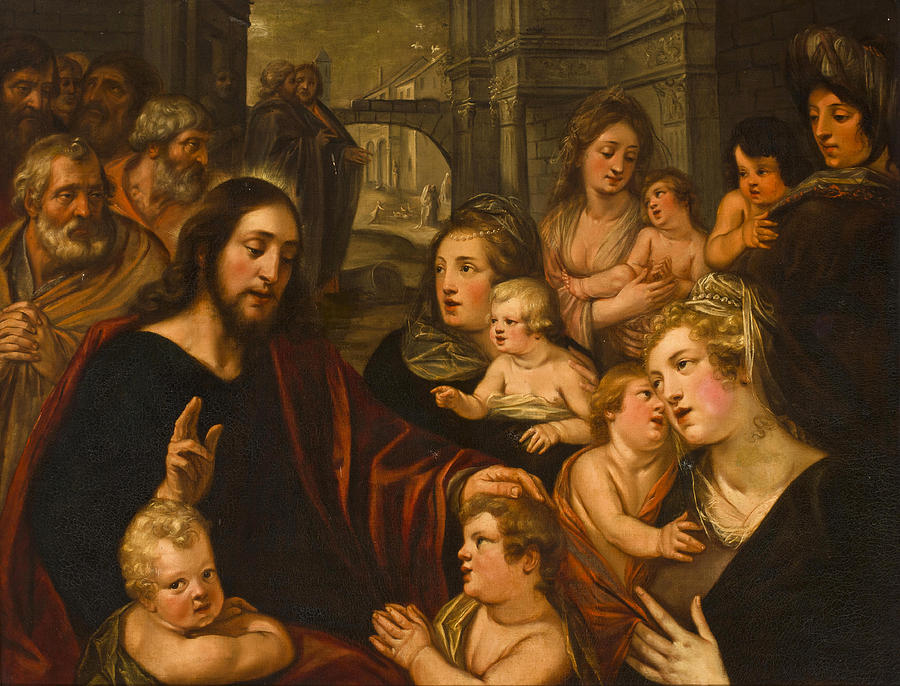
Christ Blessing The Children
Studio of Artus Wolfaerts (1581-1641)
7
posted on
09/28/2020 5:12:31 AM PDT
by
annalex
(fear them not)
To: annalex
Saint Wenceslaus’ Story
If saints have been falsely characterized as “other worldly,” the life of Wenceslaus stands as an example to the contrary: He stood for Christian values in the midst of the political intrigues which characterized 10th-century Bohemia.
Wenceslaus was born in 907 near Prague, son of the Duke of Bohemia. His saintly grandmother, Ludmilla, raised him and sought to promote him as ruler of Bohemia in place of his mother, who favored the anti-Christian factions. Ludmilla was eventually murdered, but rival Christian forces enabled Wenceslaus to assume leadership of the government.
His rule was marked by efforts toward unification within Bohemia, support of the Church, and peace-making negotiations with Germany, a policy which caused him trouble with the anti-Christian opposition. His brother Boleslav joined in the plotting, and in September of 929 invited Wenceslaus to Alt Bunglou for the celebration of the feast of Saints Cosmas and Damian. On the way to Mass, Boleslav attacked his brother, and in the struggle, Wenceslaus was killed by supporters of Boleslav.
Although his death resulted primarily from political upheaval, Wenceslaus was hailed as a martyr for the faith, and his tomb became a pilgrimage shrine. He is hailed as the patron of the Bohemian people and of the former Czechoslovakia.
Reflection
“Good King Wenceslaus” was able to incarnate his Christianity in a world filled with political unrest. While we are often victims of violence of a different sort, we can easily identify with his struggle to bring harmony to society. The call to become involved in social change and in political activity is addressed to Christians; the values of the gospel are sorely needed today.
Saint Wenceslaus is the Patron Saint of:
Bohemia
franciscanmedia.org
8
posted on
09/28/2020 5:16:10 AM PDT
by
annalex
(fear them not)
To: annalex

St. Wenceslas
Wenceslas Square, Prague
9
posted on
09/28/2020 5:20:14 AM PDT
by
annalex
(fear them not)
To: annalex
Saint Lorenzo Ruiz and Companions’ Story
Lorenzo was born in Manila of a Chinese father and a Filipino mother, both Christians. Thus he learned Chinese and Tagalog from them, and Spanish from the Dominicans whom he served as altar boy and sacristan. He became a professional calligrapher, transcribing documents in beautiful penmanship. He was a full member of the Confraternity of the Holy Rosary under Dominican auspices. He married and had two sons and a daughter.
Lorenzo’s life took an abrupt turn when he was accused of murder. Nothing further is known except the statement of two Dominicans that “he was sought by the authorities on account of a homicide to which he was present or which was attributed to him.”
At that time, three Dominican priests, Antonio Gonzalez, Guillermo Courtet, and Miguel de Aozaraza, were about to sail to Japan in spite of a violent persecution there. With them was a Japanese priest, Vicente Shiwozuka de la Cruz, and a layman named Lazaro, a leper. Lorenzo, having taken asylum with them, was allowed to accompany them. But only when they were at sea did he learn that they were going to Japan.
They landed at Okinawa. Lorenzo could have gone on to Formosa, but, he reported, “I decided to stay with the Fathers, because the Spaniards would hang me there.” In Japan they were soon found out, arrested, and taken to Nagasaki. The site of wholesale bloodshed when the atomic bomb was dropped had known tragedy before. The 50,000 Catholics who once lived there were dispersed or killed by persecution.
They were subjected to an unspeakable kind of torture: After huge quantities of water were forced down their throats, they were made to lie down. Long boards were placed on their stomachs and guards then stepped on the ends of the boards, forcing the water to spurt violently from mouth, nose and ears.
The superior, Fr. Gonzalez, died after some days. Both Fr. Shiwozuka and Lazaro broke under torture, which included the insertion of bamboo needles under their fingernails. But both were brought back to courage by their companions.
In Lorenzo’s moment of crisis, he asked the interpreter, “I would like to know if, by apostatizing, they will spare my life.” The interpreter was noncommittal, but in the ensuing hours Lorenzo felt his faith grow strong. He became bold, even audacious, with his interrogators.
The five were put to death by being hanged upside down in pits. Boards fitted with semi-circular holes were fitted around their waists and stones put on top to increase the pressure. They were tightly bound, to slow circulation and prevent a speedy death. They were allowed to hang for three days. By that time Lorenzo and Lazaro were dead. Still alive, the three priests were then beheaded.
In 1987, Pope John Paul II canonized these six and 10 others: Asians and Europeans, men and women, who spread the faith in the Philippines, Formosa, and Japan. Lorenzo Ruiz is the first canonized Filipino martyr. The Liturgical Feast of Saint Lorenzo Ruiz and Companions is September 28.
Reflection
We ordinary Christians of today—how would we stand up in the circumstances these martyrs faced? We sympathize with the two who temporarily denied the faith. We understand Lorenzo’s terrible moment of temptation. But we see also the courage—inexplainable in human terms—which surged from their store of faith. Martyrdom, like ordinary life, is a miracle of grace.
franciscanmedia.org
10
posted on
09/28/2020 5:23:47 AM PDT
by
annalex
(fear them not)
To: annalex
11
posted on
09/28/2020 5:25:48 AM PDT
by
annalex
(fear them not)
To: annalex
NAVARRE BIBLE COMMENTARY (RSV) ********************************************************************************
From: Job 1:6-22
Satan's Challenge
---------------------------
[6] Now there was a day when the sons of God came to present themselves before the LORD, and Satan also came among them. [7] The LORD said to Satan, "Whence have you come?" Satan answered the LORD, "From going to and fro on the earth, and from walking up and down on it." [8] And the LORD said to Satan, "Have you considered my servant Job, that there is none like him on the earth, a blameless and upright man, who fears God and turns away from evil?" [9] Then Satan answered the LORD, "Does Job fear God for naught? [10] Hast thou not put a hedge about him and his house and all that he has, on every side? Thou hast blessed the work of his hands, and his possessions have increased in the land. [11] But put forth thy hand now, and touch all that he has, and he will curse thee to thy face." [12] And the LORD said to Satan, "Behold, all that he has is in your power; only upon himself do not put forth your hand." So Satan went forth from the presence of the LORD.
Job is stripped of his property
-------------------------------------------
[13] Now there was a day when his sons and daughters were eating and drinking wine in their eldest brother's house; [14] and there came a messenger to Job, and said, "The oxen were plowing and the asses feeding beside them; [15] and the Sabeans fell upon them and took them, and slew the servants with the edge of the sword; and I alone have escaped to tell you." [16] While he was yet speaking, there came another, and said, "The fire of God fell from heaven and burned up the sheep and the servants, and consumed them; and I alone have escaped to tell you." [17] While he was yet speaking, there came another, and said, "The Chaldeans formed three companies, and made a raid upon the camels and took them, and slew the servants with the edge of the sword; and I alone have escaped to tell you." [18] While he was yet speaking, there came another, and said, "Your sons and daughters were eating and drinking wine in their eldest brother's house; [19] and behold, a great wind came across the wilderness, and struck the four corners of the house, and it fell upon the young people, and they are dead; and I alone have escaped to tell you."
[20] Then Job arose, and rent his robe, and shaved his head, and fell upon the ground, and worshipped. [21] And he said, "Naked I came from my mother's womb, and naked shall I return; the LORD gave, and the LORD has taken away; blessed be the name of the LORD."
[22] In all this Job did not sin or charge God with wrong.
*****************************************************************
Commentary:
1:6-12. The protagonists, God and Satan, act very much like human beings -- God like a great lord who summons his ministers to a meeting (v. 6); Satan like a spy who seems to be stalking a man who fears the Lord, but in fact he is trying to attack God himself, for he turns traditional teaching about rewards and punishment on its head: it is not true that God blesses a man because he is pious; rather, man behaves in a pious way because God blesses him (vv. 9-11). Man only seems to be obedient to God; his actions are really motivated by self-interest.
In this book 'Satan' does not yet mean the devil, the fallen angel who tempts man to do evil (cf. Rev 12:9-11). He is the prosecutor who denounces man to God for his sins (cf. Zech 3:1). For a fuller comment, see the note on 1 Chron 21:1.
Like Abraham when he was required to sacrifice his first-born son (cf. Gen 22:1-12), Job does not realize that his faith in and fear of the Lord are being put to the test. Yet in both cases, Abraham and Job, the initiative lies with God: he will not allow Abraham to perform the sacrifice, nor will he allow Job to be tested beyond the limit (v. 12).
"The sons of God" (v. 6), which the Septuagint translates as "the angels of God," are those who are subject to his commands.
1:13-22. Satan puts his plan into operation in just one day (v. 13) and Job's world crashes down around him. There are four separate calamities, each worse than the previous one, and in each case there is only one survivor left to tell the tale. First Job loses his oxen and asses, then his flocks, his camels, his children. All his property has been taken from him and he has no means of recovering it, and no children to help him. From being a wealthy, respected man, he has been reduced to utter misery. "The fire of God" (v. 16): this has no particular religious significance; it is just a popular expression for a bolt of lightning.
1:20-22. Job expresses his feelings in actions and words. As we can see elsewhere in the Bible (for example, in the case of Joseph, cf. Gen 37:34, and David, cf. 2 Sam 1:11; 13:31), rending of garments was a sign of profound sorrow. The words in v. 22 very poetically describe the human condition, its fragility and impotence. Job experiences complete deprivation; he is conscious too of the absolute sovereignty of God, who alone has power to give and to take away; and he fully accepts the will of God. St Gregory the Great draws attention to Job's good disposition when he comments that "If all the goods we have at our disposal in this life have been given to us by him (God), why should we complain if the same Judge asks for the return of what he has so generously granted to us?" (Moralia in lob, 2,31).
Just before the words "blessed be the name of the Lord" (v. 21), the Septuagint and the Vulgate add "As it has pleased God, so is it done" -- probably a later addition to draw a general lesson from the particular case of Job.
In Job's few words in v. 21, God's own name of Yhwh is mentioned three times; this indicates that the writer has a deep faith in the God of the Covenant and sincere respect for God's plans.
The first scene ends with Job the clear winner: Satan thought he would curse the Lord (v. 11), but in fact he openly praises him (v. 21). The sacred writer comes out on Job's side when he states that Job committed no sin nor even raised his voice against God. Satan has been proved wrong.
12
posted on
09/28/2020 7:04:15 AM PDT
by
fidelis
(Zonie and USAF Cold Warrior)
To: fidelis
Luke 9:46-50: Humility and Tolerance
----------------------
[46] And an argument arose among them (the disciples) as to which of them was the greatest. [47] But when Jesus perceived the thoughts of their hearts, He took a child and put him by His side, [48] and said to them, "Whoever receives this child in My name receives Me, and whoever receives Me receives Him who sent Me; for he who is least among you all is the one who is great."
[49] John answered, "Master, we saw a man casting out demons in Your name, and we forbade him, because he does not follow with us." [50] But Jesus said to him, "Do not forbid him; for he that is not against you is for you."
***********************************************************************
Commentary:
46-48. Jesus takes a child in His arms to give His Apostles example and to correct their too-human ambitions, thereby teaching all of us not to make ourselves important. "Don't try to be a grown-up. A child, always a child, even when you are dying of old age. When a child stumbles and falls, nobody is surprised; his father promptly lifts him up. When the person who stumbles and falls is older, the immediate reaction is one of laughter. Sometimes this first impulse passes and the laughter gives way to pity. But older people have to get up by themselves.
"Your sad experience of each day is full of stumbles and falls.—What would become of you if you were not continually more of a child? Don't want to be grown-up. Be a child; and when you stumble, may you be lifted by the hand of your Father-God" ([St] J. Escriva, The Way, 870).
49-50. Our Lord corrects the exclusivist and intolerant attitude of the Apostles. St. Paul later learned this lesson, as we can see from what he wrote during his imprisonment in Rome: "Some indeed preach Christ from envy and rivalry, but others from good will [...]. What then? Only that in every way, whether in pretense or in truth, Christ is proclaimed; and in that I rejoice" (Philippians 1:15, 18). "Rejoice, when you see others working in good apostolic activities. And ask God to grant them abundant grace and that they may respond to that grace. Then, you, on your way: convince yourself that it's the only way for you" ([St] J. Escriva, The Way, 965).
Daily Word for Reflection -- The Navarre Bible: Text and Commentaries
13
posted on
09/28/2020 7:04:53 AM PDT
by
fidelis
(Zonie and USAF Cold Warrior)
Disclaimer:
Opinions posted on Free Republic are those of the individual
posters and do not necessarily represent the opinion of Free Republic or its
management. All materials posted herein are protected by copyright law and the
exemption for fair use of copyrighted works.
FreeRepublic.com is powered by software copyright 2000-2008 John Robinson
