Skip to comments.
Catholic Caucus: Daily Mass Readings, 09-24-2020
USCCB/RNAB ^
Posted on 09/24/2020 6:13:20 AM PDT by annalex
September 24, 2020
Thursday of the Twenty-fifth Week in Ordinary Time
Reading 1
Vanity of vanities, says Qoheleth,
vanity of vanities! All things are vanity!
What profit has man from all the labor
which he toils at under the sun?
One generation passes and another comes,
but the world forever stays.
The sun rises and the sun goes down;
then it presses on to the place where it rises.
Blowing now toward the south, then toward the north,
the wind turns again and again, resuming its rounds.
All rivers go to the sea,
yet never does the sea become full.
To the place where they go,
the rivers keep on going.
All speech is labored;
there is nothing one can say.
The eye is not satisfied with seeing
nor is the ear satisfied with hearing.
What has been, that will be;
what has been done, that will be done.
Nothing is new under the sun.
Even the thing of which we say, “See, this is new!”
has already existed in the ages that preceded us.
There is no remembrance of the men of old;
nor of those to come will there be any remembrance
among those who come after them.
R. (1)
In every age, O Lord, you have been our refuge.You turn man back to dust,
saying, “Return, O children of men.”
For a thousand years in your sight
are as yesterday, now that it is past,
or as a watch of the night.
R.
In every age, O Lord, you have been our refuge.You make an end of them in their sleep;
the next morning they are like the changing grass,
Which at dawn springs up anew,
but by evening wilts and fades.
R.
In every age, O Lord, you have been our refuge.Teach us to number our days aright,
that we may gain wisdom of heart.
Return, O LORD! How long?
Have pity on your servants!
R.
In every age, O Lord, you have been our refuge.Fill us at daybreak with your kindness,
that we may shout for joy and gladness all our days.
Prosper the work of our hands for us!
Prosper the work of our hands!
R.
In every age, O Lord, you have been our refuge.
R. Alleluia, alleluia.
I am the way and the truth and the life, says the Lord;
no one comes to the Father except through me.
R. Alleluia, alleluia.
Herod the tetrarch heard about all that was happening,
and he was greatly perplexed because some were saying,
“John has been raised from the dead”;
others were saying, “Elijah has appeared”;
still others, “One of the ancient prophets has arisen.”
But Herod said, “John I beheaded.
Who then is this about whom I hear such things?”
And he kept trying to see him.
TOPICS: Catholic; General Discusssion; Prayer; Worship
KEYWORDS: catholic; lk9; ordinarytime; prayer
For your reading, reflection, faith-sharing, comments, questions, discussion.
1
posted on
09/24/2020 6:13:20 AM PDT
by
annalex
To: All
KEYWORDS: catholic; lk9; ordinarytime; prayer;
2
posted on
09/24/2020 6:13:48 AM PDT
by
annalex
(fear them not)
To: annalex
3
posted on
09/24/2020 6:14:17 AM PDT
by
annalex
(fear them not)
To: annalex
| Luke |
| |
English: Douay-Rheims |
Latin: Vulgata Clementina |
Greek NT: Byzantine/Majority Text (2000) |
| |
Luke 9
|
| 7. |
Now Herod, the tetrarch, heard of all things that were done by him; and he was in a doubt, because it was said |
Audivit autem Herodes tetrarcha omnia quæ fiebant ab eo, et hæsitabat eo quod diceretur |
ηκουσεν δε ηρωδης ο τετραρχης τα γινομενα υπ αυτου παντα και διηπορει δια το λεγεσθαι υπο τινων οτι ιωαννης εγηγερται εκ νεκρων |
| 8. |
By some, that John was risen from the dead: but by other some, that Elias had appeared; and by others, that one of the old prophets was risen again. |
a quibusdam : Quia Joannes surrexit a mortuis : a quibusdam vero : Quia Elias apparuit : ab aliis autem : Quia propheta unus de antiquis surrexit. |
υπο τινων δε οτι ηλιας εφανη αλλων δε οτι προφητης εις των αρχαιων ανεστη |
| 9. |
And Herod said: John I have beheaded; but who is this of whom I hear such things? And he sought to see him. |
Et ait Herodes : Joannem ego decollavit : quis est autem iste, de quo ego talia audio ? Et quærebat videre eum. |
και ειπεν ηρωδης ιωαννην εγω απεκεφαλισα τις δε εστιν ουτος περι ου εγω ακουω τοιαυτα και εζητει ιδειν αυτον |
(*) "υπο τινων οτι ιωαννης εγηγερται εκ νεκρων" begins verse 8 in the translations.
4
posted on
09/24/2020 6:17:38 AM PDT
by
annalex
(fear them not)
To: annalex
7. Now Herod the tetrarch heard of all that was done by him: and he was perplexed, because that it was said of some, that John was risen from the dead;
8. And of some, that Elias had appeared; and of others, that one of the old prophets was risen again.
9. And Herod said, John have I beheaded: but who is this, of whom I hear such things? And he desired to see him.
CHRYS. It was not till a long time had passed that Herod took notice of the things that were done by Jesus, (to show Ho you the pride of a tyrant,) for he did not acknowledge them at first, as it is said, Now Herod heard, &c.
THEOPHYL. Herod was the son of Herod the Great who slew the children, who was king, but this Herod was tetrarch. He inquired about Christ, who He was. Hence it follows, And he was perplexed.
CHRYS. For sinners fear both when they know, and when they are ignorant; they are afraid of shadows, are suspicious about every thing, and are alarmed at the slightest noise. Such in truth is sin; when no one blames or finds fault, it betrays a man, when no one accuses it condemns, and makes the offender timid and backward. But the cause of fear is stated afterwards, in the words, Because that it was said of some.
THEOPHYL. For the Jews expected a resurrection of the dead to a fleshly life, eating and drinking, but those that rise again will not be concerned with the deeds of the flesh.
CHRYS. When Herod then heard of the miracles which Jesus was performing, he says, John have I beheaded, which was not an expression of boasting, but by way of allaying his fears, and bringing his distracted soul to recollect that he had killed. And because he had beheaded John, he adds, but who is this.
THEOPHYL. If John is alive and has risen from the dead, I shall know him when I see him; as it follows, And he sought to see him.
AUG. Now Luke, though he keeps the same order in his narrative with Mark, does not oblige us to believe that the course of events was the same. In these words too, Mark testifies only to the fact that others (not Herod) said that John had risen from the dead, but since Luke has mentioned Herod's perplexity, we must suppose either that after that perplexity, he confirmed in his own mind what was said by others, since he says to his servants, (as Matthew relates,) This is John the Baptist, he is risen from the dead, or these words of Matthew must have been altered so as to signify that he was still doubting.
Catena Aurea by St. Thomas Aguinas
9:7–9
7. Now Herod the tetrarch heard of all that was done by him: and he was perplexed, because that it was said of some, that John was risen from the dead;
8. And of some, that Elias had appeared; and of others, that one of the old prophets was risen again.
9. And Herod said, John have I beheaded: but who is this, of whom I hear such things? And he desired to see him.
CHRYSOSTOM. (Hom. 48. in Matt.) It was not till a long time had passed that Herod took notice of the things that were done by Jesus, (to shew you the pride of a tyrant,) for he did not acknowledge them at first, as it is said, Now Herod heard, &c.
THEOPHYLACT. Herod was the son of Herod the Great who slew the children, who was king, but this Herod was tetrarch. He inquired about Christ, who He was. Hence it follows, And he was perplexed.
CHRYSOSTOM. For sinners fear both when they know, and when they are ignorant; they are afraid of shadows, are suspicious about every thing, and are alarmed at the slightest noise. Such in truth is sin; when no one blames or finds fault, it betrays a man, when no one accuses it condemns, and makes the offender timid and backward. But the cause of fear is stated afterwards, in the words, Because that it was said of some.
THEOPHYLACT. For the Jews expected a resurrection of the dead to a fleshly life, eating and drinking, but those that rise again will not be concerned with the deeds of the flesh.
CHRYSOSTOM. (ubi sup.) When Herod then heard of the miracles which Jesus was performing, he says, John have I beheaded, which was not an expression of boasting, but by way of allaying his fears, and bringing his distracted soul to recollect that he had killed. And because he had beheaded John, he adds, but who is this.
THEOPHYLACT. If John is alive and has risen from the dead, I shall know him when I see him; as it follows, And he sought to see him.
AUGUSTINE. (de Con. Ev. l. 2. c. 45.) Now Luke, though he keeps the same order in his narrative with Mark, docs not oblige us to believe that the course of events was the same. In these words too, Mark testifies only to the fact that others (not Herod) said that John had risen from the dead, but since Luke has mentioned Herod’s perplexity, we must suppose either that after that perplexity, he confirmed in his own mind what was said by others, since he says to his servants, (as Matthew relates,) This is John the Baptist, he is risen from the dead, or these words of Matthew must have been uttered so as to signify that he was still doubting.
Catena Aurea Luke 9
5
posted on
09/24/2020 6:18:11 AM PDT
by
annalex
(fear them not)
To: annalex
By mistake, posted both the old version from the source now deleted (but still present in my records) and the new one.
As you can see, the new version spells out full fathers’ names and gives a reference where possible. On occasion, though not here, errors of optical character scan were fixed as well.
6
posted on
09/24/2020 6:21:24 AM PDT
by
annalex
(fear them not)
To: annalex
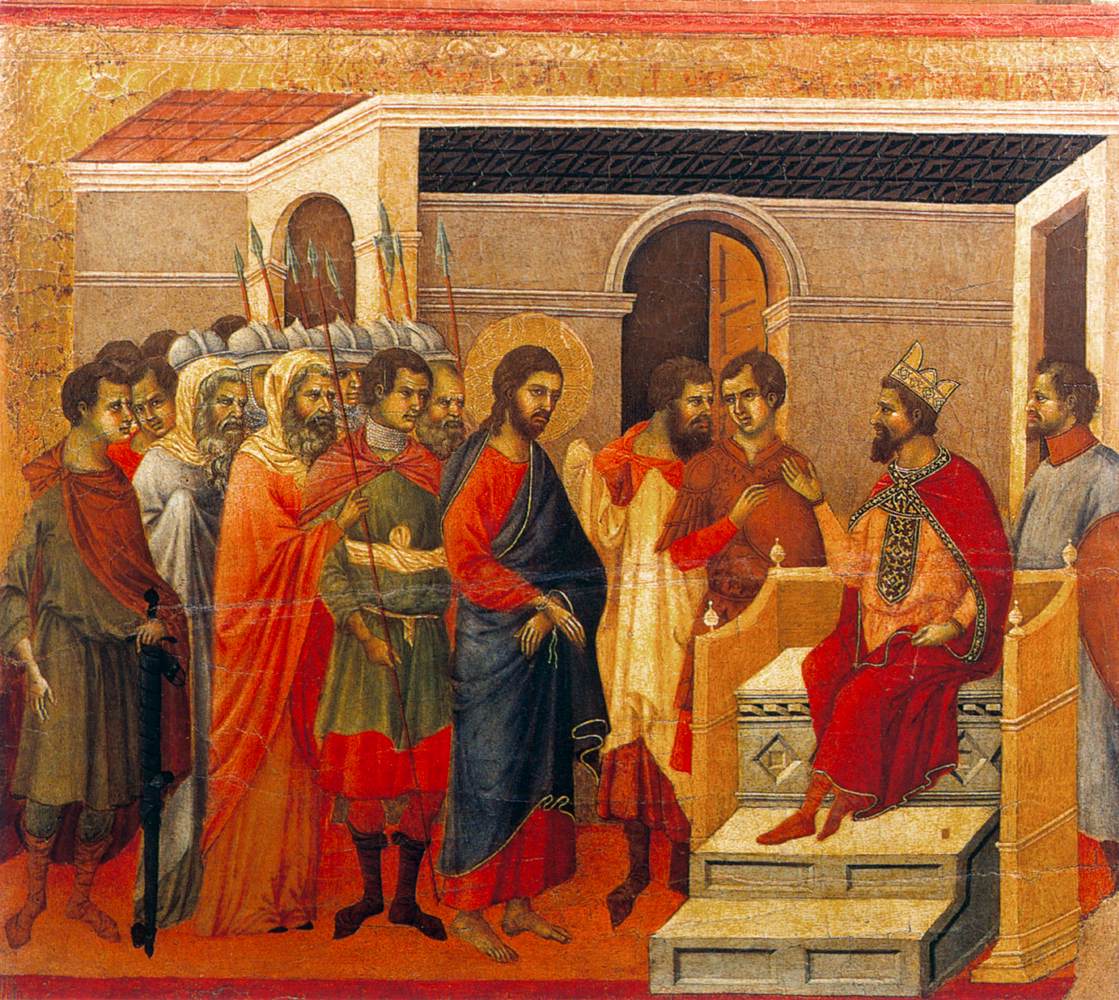
Christ Before Herod
Duccio di Buoninsegna
1308-11
Tempera on wood, 50 x 57 cm
Museo dell'Opera del Duomo, Siena
7
posted on
09/24/2020 6:22:05 AM PDT
by
annalex
(fear them not)
To: annalex
NAVARRE BIBLE COMMENTARY (RSV) ********************************************************************************
From: Ecclesiastes 1:2-11
All is Vanity
------------------
[2] Vanity of vanities, says the Preacher, vanity of vanities! All is vanity. [3] What does man gain by all the toil at which he toils under the sun? [4] A generation goes, and a generation comes, but the earth remains for ever. [5] The sun rises and the sun goes down. and hastens to the place where it rises. [6] The wind blows to the south, and goes round to the north; round and round goes the wind, and on its circuits the wind returns. [7] All streams run to the sea, but the sea is not full; to the place where the streams flow, there they flow again.
[8] All things are full of weariness; a man cannot utter it; the eye is not satisfied with seeing, nor the ear filled with hearing. [9] What has been is what will be, and what has been done is what will be done; and there is nothing new under the sun. [10] Is there a thing of which it is said, "See, this is new"? It has been already, in the ages before us. [11] There is no remembrance of former things, nor will there be any remembrance of later things yet to happen among those who come after.
*******************************************************************
Commentary:
1:1-2. The book begins and ends with the same words: "Vanity of vanities…" (v. 2; cf. 12:8). The phrase sums up wonderfully well the central idea of the book and is the sacred author's assessment of the things of the world and the fruits of human endeavour, included among the latter being the acquisition of a superficial type of knowledge or wisdom that is clearly at odds with what we know from experience. The Hebrew root of the word translated as "vanity" means something like the "vapour", "air", and conveys the idea of something with no consistency to it, illusion, unreality. Some scholars link it to another root that means "fleeting", "evanescent", in the sense of something that man cannot grasp, and that is certainly an aspect of what the author is saying throughout the book. "Vanity of vanities" is the Hebrew form of the superlative, as in "Song of Songs" […]
When reading this book it is useful to bear in mind that the author is a Jewish teacher, very familiar with the Law and the wisdom tradition of Israel, which, in reaction to the arrival in Judea of various currents of Greek thought, was asking itself very seriously about the validity of its own answers about the value of human actions and the rewards or punishments that applied to them; could it be that the hedonistic ideas (which took no account of God) being put forward by Greek philosophers in the squares and streets – could these have some validity? The Preacher takes issue with both traditional wisdom and the Greeks. With a great deal of common sense, he questions all these teachings (which were widely accepted) and concludes that they are approaching the subject in the wrong way. It is not that he is skeptical about the human mind's ability to know reality; what he objects to is the failure of seekers after wisdom to go to the root of the problem: "The book of Ecclesiastes explains that exactly things are made of, and shows and makes clear to us the vanity of many of the things of the world, so that we might come to understand that the passing things of this life are not worth hungering for, and that we should not devote our attention to useless things or fix our desires on any creating thing" (St. Basil, In principium Proverbiorum, 1).
1:3-6:12. The first part of the book is devoted to showing that the type of wisdom man is bent on acquiring is of no use at all. To do this, it points out that if one looks around, one gets the impression that everything in the world forms part of one continuous cyclical movement in which one can never expect anything new to happen: things that seem new are not new at all (1:3-11). It goes on to argue, from experience, that the search for wisdom serves no purpose, for the wise man's lot remains unchanged, no matter what he learns (1:12-2:26). To compound his argument, the Preacher goes on to report what he has seen – fraud and loneliness . . . And from his observation of things around him, he draws a similar conclusion: this, too, is vanity and a waste of effort (3:1-4:16). That being so, in a series of counsels (5:1-12) he expounds the key lesson of the book: "Do you fear God" (5:7). In other words, if one does not take God into account, even riches bring only evils (5:13-6:7). That being the case, what advantages does wisdom offer (6:8-12)? In this way the teacher of Israel, using a rhetoric similar to that of his Hellenist adversaries, composes a diatribe to show that the reasonable thing to do is to put one's trust in God, for all the wisdom of this world is in vain. Both of these notions – true wisdom and the fear of God – will be perfected in the New Testament message. True wisdom is in "Christ, in whom are had all the treasures of wisdom and knowledge" (Col 2:2-3). And the fear of God should be understood as love, not servile fear, because God is our Father. That conviction should govern what we do: "There is no fear in love, but perfect love casts out fear. For fear has to do with punishment and he who fears is not perfected in love (1 Jn 4:18).
1:3-11. In this splendid poem, which acts as a lead-in to his argument, the Preacher shows that if the elements of nature with their sometimes tedious movement change nothing in the established order of things, man likewise will change nothing in his life despite all his strivings (vv. 3-8). According to the Greek teachers, the entire cosmos was made up of four basic elements -- earth, fire, air and water. And the Preacher shows that, in fact, earth, sun, wind and waters always retain the same form despite all their movement. Noting, perhaps, the new ideas about the nature of the world that found their way into Judea at that time, the teacher of Israel takes pleasure in pointing out that things do not change, despite appearances to the contrary. The same holds for man: try as he may, he can find nothing new (vv. 8-11).
8
posted on
09/24/2020 6:41:38 AM PDT
by
fidelis
(Zonie and USAF Cold Warrior)
To: fidelis
From: Luke 9:7-9 Herod's Opinion of Jesus
------------------------
[7] Now Herod the tetrarch heard of all that was done, and he was perplexed, because it was said by some that John had been raised from the dead, [8] by some that Elijah had appeared, and by others that one of the old prophets had risen. [9] Herod said, "John I beheaded; but who is this about whom I hear such things?" And he sought to see Him.
***********************************************************************
Commentary:
7-. Except for the Sadducees, all Jews believed in the resurrection of the dead, as revealed by God in Sacred Scripture (cf. Ezekiel 37:10; Daniel 12:2 and 2 Maccabees 7:9). It was also commonly believed by Jews at the time that Elijah or some other prophet had to appear again (Deuteronomy 19:15). This may have been why Herod began to think that perhaps John had come back to life (Matthew 14:1-2 and Mark 6:14-16), particularly since Jesus worked miracles and people thought this power was the prerogative of those who had risen from the dead 9. And yet he was aware that Christ was working miracles even before John died (cf. John 2:23); therefore, at first, he was disconcerted. Later, as the fame of Christ's miracles spread, to have some sort of adequate explanation he decided, as the other Gospels tell us, that John must indeed have risen.
Daily Word for Reflection -- The Navarre Bible: Text and Commentaries
9
posted on
09/24/2020 6:42:20 AM PDT
by
fidelis
(Zonie and USAF Cold Warrior)
Disclaimer:
Opinions posted on Free Republic are those of the individual
posters and do not necessarily represent the opinion of Free Republic or its
management. All materials posted herein are protected by copyright law and the
exemption for fair use of copyrighted works.
FreeRepublic.com is powered by software copyright 2000-2008 John Robinson