Free Republic
Browse · Search
Religion
Topics · Post Article

Skip to comments.

Catholic Caucus: Daily Mass Readings, 08-19-2020
USCCB/RNAB ^

Posted on 08/19/2020 6:07:31 AM PDT by annalex

August 19, 2020

Wednesday of the Twentieth Week in Ordinary Time

Reading 1

EZ 34:1-11

The word of the Lord came to me:
Son of man, prophesy against the shepherds of Israel,
in these words prophesy to them to the shepherds:
Thus says the Lord GOD: Woe to the shepherds of Israel
who have been pasturing themselves!
Should not shepherds, rather, pasture sheep?
You have fed off their milk, worn their wool,
and slaughtered the fatlings,
but the sheep you have not pastured.
You did not strengthen the weak nor heal the sick
nor bind up the injured.
You did not bring back the strayed nor seek the lost,
but you lorded it over them harshly and brutally.
So they were scattered for the lack of a shepherd,
and became food for all the wild beasts.
My sheep were scattered
and wandered over all the mountains and high hills;
my sheep were scattered over the whole earth,
with no one to look after them or to search for them.

Therefore, shepherds, hear the word of the LORD:
As I live, says the Lord GOD,
because my sheep have been given over to pillage,
and because my sheep have become food for every wild beast,
for lack of a shepherd;
because my shepherds did not look after my sheep,
but pastured themselves and did not pasture my sheep;
because of this, shepherds, hear the word of the LORD:
Thus says the Lord GOD:
I swear I am coming against these shepherds.
I will claim my sheep from them
and put a stop to their shepherding my sheep
so that they may no longer pasture themselves.
I will save my sheep,
that they may no longer be food for their mouths.

For thus says the Lord GOD:
I myself will look after and tend my sheep.

Responsorial Psalm

R. (1) The Lord is my shepherd; there is nothing I shall want.
The LORD is my shepherd; I shall not want.
In verdant pastures he gives me repose;
Beside restful waters he leads me;
he refreshes my soul.
R. The Lord is my shepherd; there is nothing I shall want.
He guides me in right paths
for his name’s sake.
Even though I walk in the dark valley
I fear no evil; for you are at my side
With your rod and your staff
that give me courage.
R. The Lord is my shepherd; there is nothing I shall want.
You spread the table before me
in the sight of my foes;
You anoint my head with oil;
my cup overflows.
R. The Lord is my shepherd; there is nothing I shall want.
Only goodness and kindness will follow me
all the days of my life;
And I shall dwell in the house of the LORD
for years to come.
R. The Lord is my shepherd; there is nothing I shall want.

Alleluia

R. Alleluia, alleluia.
The word of God is living and effective,
able to discern the reflections and thoughts of the heart.
R. Alleluia, alleluia.

Gospel

Jesus told his disciples this parable:
“The Kingdom of heaven is like a landowner
who went out at dawn to hire laborers for his vineyard.
After agreeing with them for the usual daily wage,
he sent them into his vineyard.
Going out about nine o’clock,
he saw others standing idle in the marketplace,
and he said to them, ‘You too go into my vineyard,
and I will give you what is just.’
So they went off.
And he went out again around noon,
and around three o’clock, and did likewise.
Going out about five o’clock,
he found others standing around, and said to them,
‘Why do you stand here idle all day?’
They answered, ‘Because no one has hired us.’
He said to them, ‘You too go into my vineyard.’
When it was evening the owner of the vineyard said to his foreman,
‘Summon the laborers and give them their pay,
beginning with the last and ending with the first.’
When those who had started about five o’clock came,
each received the usual daily wage.
So when the first came, they thought that they would receive more,
but each of them also got the usual wage.
And on receiving it they grumbled against the landowner, saying,
‘These last ones worked only one hour,
and you have made them equal to us,
who bore the day’s burden and the heat.’
He said to one of them in reply,
‘My friend, I am not cheating you.
Did you not agree with me for the usual daily wage?
Take what is yours and go.
What if I wish to give this last one the same as you?
Or am I not free to do as I wish with my own money?
Are you envious because I am generous?’
Thus, the last will be first, and the first will be last.”


TOPICS: Catholic; General Discusssion; Prayer; Worship
KEYWORDS: catholic; mt20; ordinarytime; prayer
For your reading, reflection, faith-sharing, comments, questions, discussion.

1 posted on 08/19/2020 6:07:31 AM PDT by annalex
[ Post Reply | Private Reply | View Replies]

To: All

KEYWORDS: catholic; mt20; ordinarytime; prayer;


2 posted on 08/19/2020 6:08:13 AM PDT by annalex (fear them not)
[ Post Reply | Private Reply | To 1 | View Replies]

To: nickcarraway; NYer; ELS; Pyro7480; livius; ArrogantBustard; Catholicguy; RobbyS; marshmallow; ...
Alleluia Ping

Please FReepmail me to get on/off the Alleluia Ping List.


3 posted on 08/19/2020 6:09:06 AM PDT by annalex (fear them not)
[ Post Reply | Private Reply | To 1 | View Replies]

To: annalex
Matthew
  English: Douay-Rheims Latin: Vulgata Clementina Greek NT: Byzantine/Majority Text (2000)
  Matthew 20
1 THE kingdom of heaven is like to an householder, who went out early in the morning to hire labourers into his vineyard. Simile est regnum cælorum homini patrifamilias, qui exiit primo mane conducere operarios in vineam suam. ομοια γαρ εστιν η βασιλεια των ουρανων ανθρωπω οικοδεσποτη οστις εξηλθεν αμα πρωι μισθωσασθαι εργατας εις τον αμπελωνα αυτου
2 And having agreed with the labourers for a penny a day, he sent them into his vineyard. Conventione autem facta cum operariis ex denario diurno, misit eos in vineam suam. και συμφωνησας μετα των εργατων εκ δηναριου την ημεραν απεστειλεν αυτους εις τον αμπελωνα αυτου
3 And going about the third hour, he saw others standing in the market place idle. Et egressus circa horam tertiam, vidit alios stantes in foro otiosos, και εξελθων περι τριτην ωραν ειδεν αλλους εστωτας εν τη αγορα αργους
4 And he said to them: Go you also into my vineyard, and I will give you what shall be just. et dixit illis : Ite et vos in vineam meam, et quod justum fuerit dabo vobis. και εκεινοις ειπεν υπαγετε και υμεις εις τον αμπελωνα και ο εαν η δικαιον δωσω υμιν
5 And they went their way. And again he went out about the sixth and the ninth hour, and did in like manner. Illi autem abierunt. Iterum autem exiit circa sextam et nonam horam : et fecit similiter. οι δε απηλθον παλιν εξελθων περι εκτην και ενατην ωραν εποιησεν ωσαυτως
6 But about the eleventh hour he went out and found others standing, and he saith to them: Why stand you here all the day idle? Circa undecimam vero exiit, et invenit alios stantes, et dicit illis : Quid hic statis tota die otiosi ? περι δε την ενδεκατην ωραν εξελθων ευρεν αλλους εστωτας αργους και λεγει αυτοις τι ωδε εστηκατε ολην την ημεραν αργοι
7 They say to him: Because no man hath hired us. He saith to them: Go you also into my vineyard. Dicunt ei : Quia nemo nos conduxit. Dicit illis : Ite et vos in vineam meam. λεγουσιν αυτω οτι ουδεις ημας εμισθωσατο λεγει αυτοις υπαγετε και υμεις εις τον αμπελωνα και ο εαν η δικαιον ληψεσθε
8 And when evening was come, the lord of the vineyard saith to his steward: Call the labourers and pay them their hire, beginning from the last even to the first. Cum sero autem factum esset, dicit dominus vineæ procuratori suo : Voca operarios, et redde illis mercedem incipiens a novissimis usque ad primos. οψιας δε γενομενης λεγει ο κυριος του αμπελωνος τω επιτροπω αυτου καλεσον τους εργατας και αποδος αυτοις τον μισθον αρξαμενος απο των εσχατων εως των πρωτων
9 When therefore they were come, that came about the eleventh hour, they received every man a penny. Cum venissent ergo qui circa undecimam horam venerant, acceperunt singulos denarios. και ελθοντες οι περι την ενδεκατην ωραν ελαβον ανα δηναριον
10 But when the first also came, they thought that they should receive more: and they also received every man a penny. Venientes autem et primi, arbitrati sunt quod plus essent accepturi : acceperunt autem et ipsi singulos denarios. ελθοντες δε οι πρωτοι ενομισαν οτι πλειονα ληψονται και ελαβον και αυτοι ανα δηναριον
11 And receiving it they murmured against the master of the house, Et accipientes murmurabant adversus patremfamilias, λαβοντες δε εγογγυζον κατα του οικοδεσποτου
12 Saying: These last have worked but one hour, and thou hast made them equal to us, that have borne the burden of the day and the heats. dicentes : Hi novissimi una hora fecerunt, et pares illos nobis fecisti, qui portavimus pondus diei, et æstus. λεγοντες οτι ουτοι οι εσχατοι μιαν ωραν εποιησαν και ισους ημιν αυτους εποιησας τοις βαστασασιν το βαρος της ημερας και τον καυσωνα
13 But he answering said to one of them: Friend, I do thee no wrong: didst thou not agree with me for a penny? At ille respondens uni eorum, dixit : Amice, non facio tibi injuriam : nonne ex denario convenisti mecum ? ο δε αποκριθεις ειπεν ενι αυτων εταιρε ουκ αδικω σε ουχι δηναριου συνεφωνησας μοι
14 Take what is thine, and go thy way: I will also give to this last even as to thee. Tolle quod tuum est, et vade : volo autem et huic novissimo dare sicut et tibi. αρον το σον και υπαγε θελω δε τουτω τω εσχατω δουναι ως και σοι
15 Or, is it not lawful for me to do what I will? is thy eye evil, because I am good? Aut non licet mihi quod volo, facere ? an oculus tuus nequam est, quia ego bonus sum ? η ουκ εξεστιν μοι ποιησαι ο θελω εν τοις εμοις ει ο οφθαλμος σου πονηρος εστιν οτι εγω αγαθος ειμι
16 So shall the last be first, and the first last. For many are called, but few chosen. Sic erunt novissimi primi, et primi novissimi. Multi enim sunt vocati, pauci vero electi. ουτως εσονται οι εσχατοι πρωτοι και οι πρωτοι εσχατοι πολλοι γαρ εισιν κλητοι ολιγοι δε εκλεκτοι

4 posted on 08/19/2020 6:10:48 AM PDT by annalex (fear them not)
[ Post Reply | Private Reply | To 1 | View Replies]

To: annalex

Catena Aurea by St. Thomas Aguinas

20:1–16

1. For the kingdom of heaven is like unto a man that is an housholder, which went out early in the morning to hire labourers into his vineyard.

2. And when he had agreed with the labourers for a penny a day, he sent them into his vineyard.

3. And he went out about the third hour, and saw others standing idle in the market-place,

4. And said unto them; Go ye also into the vineyard, and whatsoever is right I will give you. And they went their way.

5. Again he went out about the sixth and ninth hour, and did likewise.

6. And about the eleventh hour he went out, and found others standing idle, and saith unto them, Why stand ye here all the day idle?

7. They say unto him, Because no man hath hired us. He saith unto them, Go ye also into the vineyard; and whatsoever is right, that shall ye receive.

8. So when even was come, the lord of the vineyard saith unto his steward, Call the labourers, and give them their hire, beginning from the last unto the first.

9. And when they came that were hired about the eleventh hour, they received every man a penny.

10. But when the first came, they supposed that they should have received more; and they likewise received every man a penny.

11. And when they had received it, they murmured against the goodman of the house,

12. Saying, These last have wrought but one hour, and thou hast made them equal unto us, which have borne the burden and heat of the day.

13. But he answered one of them, and said, Friend, I do thee no wrong: didst not thou agree with me for a penny?

14. Take that thine is, and go thy way: I will give unto this last, even as unto thee.

15. Is it not lawful for me to do what I will with mine own? Is thine eye evil, because I am good?

16. So the last shall be first, and the first last: for many be called, but few chosen.

REMIGIUS. To establish the truth of this saying, There are many first that shall be last, and last first, the Lord subjoins a similitude.

PSEUDO-CHRYSOSTOM. The Master of the household is Christ, whose house are the heavens and the earth; and the creatures of the heavens, and the earth, and beneath the earth, His family. His vineyard is righteousness, in which are set divers sorts of righteousness as vines, as meekness, chastity, patience, and the other virtues; all of which are called by one common name righteousness. Men are the cultivators of this vineyard, whence it is said, Who went out early in the morning to hire labourers into his vineyard. For God placed His righteousness in our senses, not for His own but for our benefit. Know then that we are the hired labourers. But as no man gives wages to a labourer, to the end he should do nothing save only to eat, so likewise we were not thereto called by Christ, that we should labour such things only as pertain to our own good, but to the glory of God. And like as the hired labourer looks first to his task, and after to his daily food, so ought we to mind first those things which concern the glory of God, then those which concern our own profit. Also as the hired labourer occupies the whole day in his Lord’s work, and takes but a single hour for his own meal; so ought we to occupy our whole life in the glory of God, taking but a very small portion of it for the uses of this world. And as the hired labourer when he has done no work is ashamed that day to enter the house, and ask his food; how should not you be ashamed to enter the church, and stand before the face of God, when you have done nothing good in the sight of God?

GREGORY. (Hom. in Ev. xix, 1.) Or; The Master of the household, that is, our Maker, has a vineyard, that is, the Church universal, which has borne so many stocks, as many saints as it has put forth from righteous Abel to the very last saint who shall be born in the end of the world. To instruct this His people as for the dressing of a vineyard, the Lord has never ceased to send out His labourers; first by the Patriarchs, next by the teachers of the Law, then by the Prophets, and at the last by the Apostles, He has toiled in the cultivation of His vineyard; though every man, in whatsoever measure or degree he has joined good action with right faith, has been a labourer in the vineyard.

ORIGEN. For the whole of this present life may be called one day, long to us, short compared to the existence of God.

GREGORY. (ubi sup.) The morning is that age of the world which was from Adam and Noah, and therefore it is said, Who went out early in the morning to hire labourers into his vineyard. The terms of their hiring He adds, And when he had agreed with the labourers for a denarius a day.

ORIGEN. The denarius I suppose here to mean salvation.

REMIGIUS. A denarius was a coin anciently equal to ten sesterces, and bearing the king’s image. Well therefore does the denarius represent the reward of the keeping of the decalogue. And that, Having agreed with them for a denarius a day, is well said, to shew that every man labours in the field of the holy Church in hope of the future reward.

GREGORY. (ubi sup.) The third hour is the period from Noah to Abraham; of which it is said, And he went out about the third hour; and saw others standing in the market-placeidle.

ORIGEN. The market-place is all that is without the vineyard, that is, without the Church of Christ.

PSEUDO-CHRYSOSTOM. For in this world men live by buying and selling, and gain their support by defrauding each other.

GREGORY. (ubi sup.) He that lives to himself, and feeds on the delights of the flesh, is rightly accused as idle, forasmuch as he does not seek the fruit of godly labour.

PSEUDO-CHRYSOSTOM. Or; The idle are not sinners, for they are called dead. But he is idle who works not the work of God. Do you desire to be not idle? Take not that which is another’s; and give of that which is your own, and you have laboured in the Lord’s vineyard, cultivating the vine of mercy. It follows, And he said unto them, Go ye also into my vineyard. Observe that it is with the first alone that He agrees upon the sum to be given, a denarius; the others are hired on no express stipulation, but What is right I will give you. For the Lord knowing that Adam would fall, and that all should hereafter perish in the deluge, made conditions for him, that he should never say that he therefore neglected righteousness, because he knew not what reward he should have. But with the rest He made no contract, seeing He was prepared to give more than the labourers could hope.

ORIGEN. Or, He did not call upon the labourers of the third hour for a complete task, but left to their own choice, how much they should work. For they might perform in the vineyard work equal to that of those who had wrought since the morning, if they chose to put forth upon their task an operative energy, such as had not yet been exerted.

GREGORY. (ubi sup.) The sixth hour is that from Abraham to Moses, the ninth that from Moses to the coming of the Lord.

PSEUDO-CHRYSOSTOM. These two hours are coupled together, because in the sixth and ninth it was that He called the generation of the Jews, and multiplied to publish His testaments among men, whereas the appointed time of salvation now drew nigh.

GREGORY. (ubi sup.) The eleventh hour is that from the coming of the Lord to the end of the world. The labourer in the morning, at the third, sixth, and ninth hours, denotes the ancient Hebrew people, which in its elect from the very beginning of the world, while it zealously and with right faith served the Lord, ceased not to labour in the husbandry of the vineyard. But at the eleventh the Gentiles are called. For they who through so many ages of the world had neglected to labour for their living, were they who had stood the whole day idle. But consider their answer; They say unto him, Because no man hath hired us; for neither Patriarch nor Prophet had come to them. And what is it to say, No man hath hired us, but to say, None has preached to us the way of life,

PSEUDO-CHRYSOSTOM. For what is our hiring, and the wages of that hiring? The promise of eternal life; for the Gentiles knew neither God, nor God’s promises.

HILARY. These then are sent into the vineyard, Go ye also into my vineyard.

RABANUS. But when they had rendered their day’s task, at the fitting time for payment, When even was come, that is, when the day of this world was drawing to its close.

PSEUDO-CHRYSOSTOM. Consider, He gives the reward not the next morning, but in the evening. Thus the judgment shall take place while this world is still standing, and each man shall receive that which is due to him. This is on two accounts. First, because the happiness of the world to come is to be itself the reward of righteousness; so the award is made before, and not in that world. Secondly, that sinners may not behold the blessedness of that day, The Lord saith unto his steward, that is, the Son to the Holy Spirit.

GLOSS. (non occ. sed vid. Raban.) Or, if you choose, the Father saith unto the Son; for the Father wrought by the Son, and the Son by the Holy Spirit, not that there is any difference of substance, or majesty.

ORIGEN. Or; The Lord said to his steward, that is, to one of the Angels who was set over the payment of the labourers; or to one of those many guardians, according to what is written, that The heir as long as he is a child is under tutors and governors. (Gal. 4:2.)

REMIGIUS. Or, the Lord Jesus Christ Himself is the master of the household, and also the steward, like as He is the door, and also the keeper of the door. For He Himself will come to judgment, to render to each man according to that he has done. He therefore calls His labourers, and renders to them their wages, so that when they shall be gathered together in the judgment, each man shall receive according to his works.

ORIGEN. But the first labourers having the witness through faith have not received the promise of God, the lord of the household providing some better thing for us, that they without us should not be made perfect. (Heb. 11:40.) And because we have obtained mercy, we hope to receive the reward first, we, that is, who are Christ’s, and after us they that wrought before us; wherefore it is said, Call the labourers, and give them their hire, beginning from the last unto the first.

PSEUDO-CHRYSOSTOM. For we always give more willingly, where we give without return, seeing it is for our own honour that we give. Therefore God in giving reward to all the saints shews himself just; in giving to us, merciful; as the Apostle speaks, That the Gentiles might glorify God for his mercy; (Rom. 16:9.) and thence it is said, Beginning from the last even unto the first. Or surely that God may shew His inestimable mercy, He first rewards the last and more unworthy, and afterwards the first; for of His great mercy He regarded not order of merit.

AUGUSTINE. (de Spir. et Lit. 24.) Or; The lesser are therefore taken as first, because the lesser are to be made rich.

GREGORY. (ubi sup.) They get alike a denarius who have wrought since the eleventh hour, (for they sought it with their whole soul,) and who have wrought since the first. They, that is, who were called from the beginning of the world have alike received the reward of eternal happiness, with those who come to the Lord in the end of the world.

PSEUDO-CHRYSOSTOM. And this not with injustice. For he who was born in the first period of the world, lived no longer than the determined time of his life, and what harm was it to him, though the world continued after his leaving it? And they that shall be born towards its close will not live less than the days that are numbered to them. And how does it cut then labour shorter, that the world is speedily ended, when they have accomplished their thread of life before? Moreover it is not of man to be born sooner or later, but of the power of God. Therefore he that is born first cannot claim to himself a higher place, nor ought he to be held in contempt that was born later. And when they had received it, they murmured against the goodman of the house, saying. But if this we have said be true, that both first and last have lived their own time, and neither more nor less; and that each man’s death is his consummation, what means this that they say, We have borne the burden and heat of the day? Because to know that the end of the world is at hand is of great force to make us do righteousness. Wherefore Christ in His love to us said, The kingdom of heaven shall draw nigh. (Matt. 4:2.) Whereas it was a weakening of them to know that the duration of the world was to be yet long. So that though they did not indeed live through the whole of time, they seem in a manner to have borne its weight. Or, by the burden of the day is meant the burdensome precepts of the Law; and the heat may be that consuming temptation to error which evil spirits contrived for them, stirring them to imitate the Gentiles; from all which things the Gentiles were exempt, believing on Christ, and by compendiousness of grace being saved completely.

GREGORY. (ubi sup.) Or; To bear the burden and heat of the day, is to be wearied through a life of long duration with the heats of the flesh. But it may be asked, How can they be said to murmur, when they are called to the kingdom of heaven? For none who murmurs shall receive the kingdom, and none who receives that can murmur.

CHRYSOSTOM. But we ought not to pursue through every particular the circumstances of a parable, but enter into its general scope, and seek nothing further. This then is not introduced in order to represent some as moved with envy, but to exhibit the honour that shall be given us as so great as that it might stir the jealousy of others.

GREGORY. (ubi sup.) Or because the old fathers down to the Lord’s coming, notwithstanding their righteous lives, were not brought to the kingdom, this murmur is theirs. But we who have come at the eleventh hour, do not murmur after our labours, forasmuch as having come into this world after the coming of the Mediator, we are brought to the kingdom as soon as ever we depart out of the body.

JEROME. Or, all that were called of old envy the Gentiles, and are pained at the grace of the Gospel.

HILARY. And this murmur of the labourers corresponds with the frowardness of this nation, which even in the time of Moses were stiff-necked.

REMIGIUS. By this one to whom his answer is given, may be understood all the believing Jews, whom he calls friends because of their faith.

PSEUDO-CHRYSOSTOM. Their complaint was not that they were defrauded of their rightful recompense, but that the others had received more than they deserved. For the envious have as much pain at others’ success as at their own loss. From which it is clear, that envy flows from vain glory. A man is grieved to be second, because he wishes to be first. He removes this feeling of envy by saying, Didst thou not agree with me for a denarius?

JEROME. A denarius bears the figure of the king. You have therefore received the reward which I promised you, that is, my image and likeness; what desirest thou more? And yet it is not that thou shouldest have more, but that another should have less that thou seekest. Take that is thine, and go thy way.

REMIGIUS. That is, take thy reward, and enter into glory. I will give to this last, that is, to the gentile people, according to their deserts, as to thee.

ORIGEN. Perhaps it is to Adam He says, Friend, I do thee no wrong; didst thou not agree with me for a denarius? Take that thine is, and go thy way. Salvation is thine, that is, the denarius. I will give unto this last also as unto thee. A person might not improbably suppose, that this last was the Apostle Paul, who wrought but one hour, and was made equal with all who had been before him.

AUGUSTINE. (de Sanc. Virg. 26.) Because that life eternal shall be equal to all the saints, a denarius is given to all; but forasmuch as in that life eternal the light of merits shall shine diversely, there are with the Father many mansions; so that under this same denarius bestowed unequally one shall not live longer than another, but in the many mansions one shall shine with more splendour than another.

GREGORY. (ubi sup.) And because the attainment of this kingdom is of the goodness of His will, it is added, Is it not lawful for me to do what I will with mine own? For it is a foolish complaint of man to murmur against the goodness of God. For complaint is not when a man gives not what he is not bound to give, but if he gives not what he is bound to give; whence it is added, Is thine eye evil because I am good?

REMIGIUS. By the eye is understood his purpose. The Jews had an evil eye, that is, an evil purpose, seeing they were grieved at the salvation of the Gentiles. Whereto this parable pointed, He shews by adding, So the first shall be last, and the last first; and so the Jews of the head are become the tail, and we of the tail are become the head.

PSEUDO-CHRYSOSTOM. Or; He says the first shall be last, and the last first, not that the last are to be exalted before the first, but that they should be put on an equality, so that the difference of time should make no difference in their station. That He says, For many are called, but few chosen, is not to be taken of the elder saints, but of the Gentiles; for of the Gentiles who were called being many, but few were chosen.

GREGORY. (ubi sup.) There be very many come to the faith, yet but few arrive at the heavenly kingdom; many follow God in words, but shun Him in their lives. Whereof spring two things to be thought upon. The first, that none should presume ought concerning himself; for though he be called to the faith, he knows not whether he shall be chosen to the kingdom. Secondly, that none should despair of his neighbour, even though he see him lying in vices; because he knows not the riches of the Divine mercy.

Or otherwise. The morning is our childhood; the third hour may be understood as our youth, the sun as it were mounting to his height is the advance of the heat of age; the sixth hour is manhood, when the sun is steady in his meridian height, representing as it were the maturity of strength; by the ninth is understood old age, in which the sun descends from his vertical height, as our age falls away from the fervour of youth; the eleventh hour is that age which is called decrepit, and doting.

CHRYSOSTOM. That He called not all of them at once, but some in the morning, some at the third hour, and so forth, proceeded from the difference of their minds1. He then called them when they would obey; as He also called the thief when he would obey. Whereas they say, Because no man hath hired us, we ought not to force a sense out of every particular in a parable. Further, it is the labourers and not the Lord who speak thus; for that He, as far as it pertains to Him, calls all men from their earliest years, is shewn in this, He went out early in the morning to hire labourers.

GREGORY. They then who have neglected till extreme old age to live unto God, have stood idle to the eleventh hour, yet even these the master of the household calls, and oftentimes gives them their reward before other, inasmuch as they depart out of the body into the kingdom before those that seemed to be called in their childhood.

ORIGEN. But this, Why stand ye here all the day idle? is not said to such as having begun in the spirit (Gal. 3:3) have been made perfect by the flesh, as inviting them to return again, and to live in the Spirit. This we speak not to dissuade prodigal sons, who have consumed their substance of evangelic doctrine in riotous living, from returning to their father’s house; but because they are not like those who sinned in their youth, before they had learnt the things of the faith.

CHRYSOSTOM. When He says, The first shall be last, and the last first, He alludes secretly to such as were at the first eminent, and afterwards set at nought virtue; and to others who have been reclaimed from wickedness, and have surpassed many. So that this parable was made to quicken the zeal of those who are converted in extreme old age, that they should not suppose that they shall have less than others.

Catena Aurea Matthew 20

5 posted on 08/19/2020 6:14:45 AM PDT by annalex (fear them not)
[ Post Reply | Private Reply | To 4 | View Replies]

To: annalex


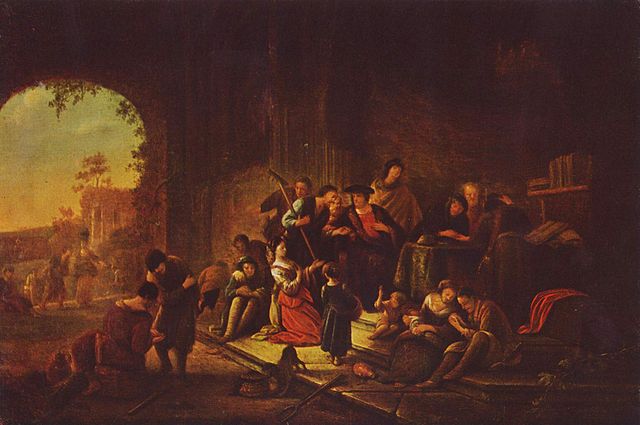
Parable of the Workers in the Vineyard

Jacob Willemsz de Wet (1632-1675)

6 posted on 08/19/2020 6:21:14 AM PDT by annalex (fear them not)
[ Post Reply | Private Reply | To 5 | View Replies]

To: annalex

Optional Memorial of Saint John Eudes, priest

Saint John Eudes’ Story

How little we know where God’s grace will lead. Born on a farm in northern France, John died at 79 in the next “county” or department. In that time, he was a religious, a parish missionary, founder of two religious communities, and a great promoter of the devotion to the Sacred Heart of Jesus and the Immaculate Heart of Mary.

John joined the religious community of the Oratorians and was ordained a priest at 24. During severe plagues in 1627 and 1631, he volunteered to care for the stricken in his own diocese. Lest he infect his fellow religious, during the plague he lived in a huge cask in the middle of a field.

At age 32, John became a parish missionary. His gifts as a preacher and confessor won him great popularity. He preached over 100 parish missions, some lasting from several weeks to several months.

In his concern with the spiritual improvement of the clergy, John realized that the greatest need was for seminaries. He had permission from his general superior, the bishop, and even Cardinal Richelieu to begin this work, but the succeeding general superior disapproved. After prayer and counsel, John decided it was best to leave the religious community.

That same year John founded a new community, ultimately called the Eudists—the Congregation of Jesus and Mary–devoted to the formation of the clergy by conducting diocesan seminaries. The new venture, while approved by individual bishops, met with immediate opposition, especially from Jansenists and some of his former associates. John founded several seminaries in Normandy, but was unable to get approval from Rome—partly, it was said, because he did not use the most tactful approach.

In his parish mission work, John was disturbed by the sad condition of prostitutes who sought to escape their miserable life. Temporary shelters were found, but arrangements were not satisfactory. A certain Madeleine Lamy, who had cared for several of the women, one day said to him, “Where are you off to now? To some church, I suppose, where you’ll gaze at the images and think yourself pious. And all the time what is really wanted of you is a decent house for these poor creatures.” The words, and the laughter of those present, struck deeply within him. The result was another new religious community, called the Sisters of Charity of the Refuge.

John Eudes is probably best known for the central theme of his writings: Jesus as the source of holiness; Mary as the model of the Christian life. His devotion to the Sacred Heart and to the Immaculate Heart led Pope Pius XI to declare him the father of the liturgical cult of the Hearts of Jesus and Mary.


Reflection

Holiness is the wholehearted openness to the love of God. It is visibly expressed in many ways, but the variety of expression has one common quality: concern for the needs of others. In John’s case, those who were in need were plague-stricken people, ordinary parishioners, those preparing for the priesthood, prostitutes, and all Christians called to imitate the love of Jesus and his mother.


franciscanmedia.org

Patronage: Congregation of Jesus And Mary, Order of Our Lady of Charity, Roman Catholic Diocese of Baie-Comeau, Missionary

7 posted on 08/19/2020 6:25:36 AM PDT by annalex (fear them not)
[ Post Reply | Private Reply | To 6 | View Replies]

To: annalex

8 posted on 08/19/2020 6:27:18 AM PDT by annalex (fear them not)
[ Post Reply | Private Reply | To 7 | View Replies]

To: annalex

Ping


9 posted on 08/19/2020 6:34:00 AM PDT by Wpin ("I Have Sworn Upon the Altar of God eternal hostility against every form of tyranny...")
[ Post Reply | Private Reply | To 8 | View Replies]

To: annalex
Navarre Bible Commentary (RSV)

********************************************************************************
From: Ezekiel 34:1-11

------------------------------------------------------
[1] The word of the Lord came to me: [2] "Son of man, prophesy against the shepherds of Israel, prophesy, and say to them, even to the shepherds, Thus says the Lord God: Ho, shepherds of Israel who have been feeding yourselves! Should not shepherds feed the sheep? [3] You eat the fat, you clothe yourselves with the wool, you slaughter the fatlings; but you do not feed the sheep. [4] The weak you have not strengthened, the sick you have not healed, the crippled you have not bound up, the strayed you have not brought back, the lost you have not sought, and with force and harshness you have ruled them. [5] So they were scattered, because there was no shepherd; and they became food for all the wild beasts. [6] My sheep were scattered, they wandered over all the mountains and on every high hill; my sheep were scattered over all the face of the earth, with none to search or seek for them.

[7] "Therefore, you shepherds, hear the word of the Lord: [5] As I live, says the Lord God, because my sheep have become a prey, and my sheep have become food for all the wild beasts, since there was no shepherd; and because my shepherds have not searched for my sheep, but the shepherds have fed themselves, and have not fed my sheep; [9] therefore, you shepherds, hear the word of the Lord: [10] Thus says the Lord God, Behold, I am against the shepherds; and I will require my sheep at their hand, and put a stop to their feeding the sheep; no longer shall the shepherds feed themselves. I will rescue my sheep from their mouths, that they may not be food for them.

************************************************************************
Commentary:

34:1-31. In some Sumerian and Egyptian texts the image of the shepherd is sometimes applied to leading men and gods. In the Bible it is often applied to kings (1 Kings 22:17), perhaps because David began life as a shepherd (1 Sam 17:34; Ps 78:70-72), and to the Lord (cf. Ps 23:1-6; 80:2-3). The prophets, particularly Jeremiah, use the image when talking about rulers, be they kings or priests (cf Jer 2:8; 10:21; 25:34-36; Zech 11:4-17). In this first address to the exiles, Ezekiel talks about bad shepherds, that is, the evil rulers who led the people into the disaster of the exile (vv. 1-10) -- and, by contrast, he speaks of the Lord, the supreme shepherd who takes over the reins of government to rule his people without intermediaries (vv. 11-22), and of the new messiah-ruler whom God himself will place at their head: he will be their new shepherd, David, who will lead his flock to the best pastures (vv. 23-31).

Jesus found this a very appropriate image for explaining his role as Messiah and Saviour (in 10:1-18) and as Judge at the end of time (cf. Mt 25:31-46). Moreover, he confirmed his words by actions. When, at the multiplication of the loaves, he gathers those who have followed him (they are "like sheep without a shepherd": Mk 6:34: cf. Ezek 34:5), and nourishes them with bread and with the word of his teaching, he is fulfilling this prophecy of Ezekiel which promises a new king, a true shepherd, and a new Covenant. Jesus is, then, the shepherd who assembles all mankind to lead it to salvation: "He is the one who has gathered together into one flock all the holy sheep from all the nations under heaven, without neglecting any of the peoples of the earth: he carries out every day what he once promised, when he said: 'There are other sheep, that are not of this flock, and these too I will tend, and they will listen to my voice, and there will be one flock, and there will be one shepherd'" (St Leo the Great, Sermones, 63, 7). And as John Paul II teaches: "The figure of Jesus Christ as shepherd of the Church, his flock, takes up and represents in new and more evocative terms the same content as that of Jesus Christ as head and servant. Fulfilling the prophetic proclamation of the Messiah and saviour joyfully announced by the psalmist and the prophet Ezekiel (cf. Ps 22-23; Ezek 34:11ff), Jesus presents himself as 'the good shepherd' (Jn 10:11, 14), not only of Israel but of all humanity (cf. Jn 10:16). His whole life is a continual manifestation of his 'pastoral charity'" (Pastores dabo vobis, 22).

34:1-10. As is usual in condemnatory oracles, the charges are mentioned first (vv. 2 6) and then comes the sentence, which begins with the usual "Therefore" (vv. 7-10). The rulers of the people (cf. 23:23-31), that is, the princes, priests, elders and professional prophets, have exploited the people and sought their own gain. What Ezekiel says here carries a message for those who hold office in Christian communities: "In the Church of Christ, everyone is obliged to make a tenacious effort to remain loyal to the teaching of Christ. No one is exempt. If the shepherds do not themselves strive to acquire a sensitive conscience and to remain faithful to dogma and moral teaching -- which make up the deposit of faith and the inheritance of all -- then the prophetic words of Ezekiel will he borne out: 'Son of man, prophesy against the shepherds of Israel, prophesy, and say to them, even to the shepherds, thus says the Lord God: Ho, shepherds of Israel who have been feeding yourselves! [...] This is a strong reproof, but the offence against God is even worse when those who have received the task of promoting the spiritual welfare of everyone abuse souls instead, depriving them of the crystal water of baptism, which regenerates the soul; of the soothing oil of confirmation, which strengthens it; of the tribunal which pardons; of the food which gives eternal life" (St Josemaria Escrivá, Christ Is Passing By, 81).

10 posted on 08/19/2020 7:41:14 AM PDT by fidelis (Zonie and USAF Cold Warrior)
[ Post Reply | Private Reply | To 8 | View Replies]

To: fidelis
From: Matthew 20:1-16

The Parable of the Laborers in the Vineyard
-------------------------------------------
[1] "For the Kingdom of Heaven is like a householder who went out early in the morning to hire laborers for his vineyard. [2] After agreeing with the laborers for a denarius a day, he sent them into his vineyard. [3] And going out about the third hour he saw others standing idle in the market place; [4] and to them he said, `You go into the vineyard too, and whatever is right I will give you.' So they went. [5] Going out again about the sixth hour and the ninth hour, he did the same. [6] And about the eleventh hour he went out and found others standing; and he said to them, `Why do you stand here idle all day?' [7] They said to him, `Because no one has hired us.' He said to them, `You go into the vineyard too.' [8] And when evening came, the owner of the vineyard said to his steward, `Call the laborers and pay them their wages, beginning with the last, up to the first.' [9] And when those hired about the eleventh hour came, each of them received a denarius. [10] Now when the first came, they thought they would receive more; but each of them also received a denarius. [11] And on receiving it they grumbled at the householder, [12] saying, `These last worked only one hour, and you have made them equal to us who have borne the burden of the day and the scorching heat.' [13] But he replied to one of them, `Friend, I am doing you no wrong; did you not agree with me for a denarius? [14] Take what belongs to you, and go; I choose to give to this last as I give to you. [15] Am I not allowed to do what I choose with what belongs to me? Or do you begrudge my generosity? [16] So the last will be first, and the first last."

***********************************************************************
Commentary:

1-16. This parable is addressed to the Jewish people, whom God called at an early hour, centuries ago. Now the Gentiles are also being called--with an equal right to form part of the new people of God, the Church. In both cases it is a matter of a gratuitous, unmerited, invitation; therefore, those who were the "first" to receive the call have no grounds for complaining when God calls the "last" and gives them the same reward--membership of His people. At first sight the laborers of the first hour seem to have a genuine grievance—because they do not realize that to have a job in the Lord's vineyard is a divine gift. Jesus leaves us in no doubt that although He calls us to follow different ways, all receive the same reward--Heaven.

2. "Denarius": a silver coin bearing an image of Caesar Augustus (Matthew 22:19-21).

3. The Jewish method of calculating time was different from ours. They divided the whole day into eight parts, four night parts (called "watches") and four day parts (called "hours")--the first, third, sixth and ninth hour.

The first hour began at sunrise and ended around nine o'clock; the third ran to twelve noon; the sixth to three in the afternoon; and the ninth from three to sunset. This meant that the first and ninth hours varied in length, decreasing in autumn and winter and increasing in spring and summer and the reverse happening with the first and fourth watches.

Sometimes intermediate hours were counted--as for example in verse 6 which refers to the eleventh hour, the short period just before sunset, the end of the working day.

16. The Vulgate, other translations and a good many Greek codexes add: "For many are called, but few are chosen" (cf. Matthew 22:14).

11 posted on 08/19/2020 7:41:54 AM PDT by fidelis (Zonie and USAF Cold Warrior)
[ Post Reply | Private Reply | To 10 | View Replies]

Disclaimer: Opinions posted on Free Republic are those of the individual posters and do not necessarily represent the opinion of Free Republic or its management. All materials posted herein are protected by copyright law and the exemption for fair use of copyrighted works.

Free Republic
Browse · Search
Religion
Topics · Post Article

FreeRepublic, LLC, PO BOX 9771, FRESNO, CA 93794
FreeRepublic.com is powered by software copyright 2000-2008 John Robinson