
Madonna and Child with Saints
Marco Palmezzano
1493
Oil on panel, 170 x 158 cm
Pinacoteca di Brera, Milan
The represented saints are John the Baptist, Peter, Dominic, and Mary Magdalen.
Posted on 07/21/2020 5:04:25 AM PDT by annalex
Shepherd your people with your staff,
the flock of your inheritance,
That dwells apart in a woodland,
in the midst of Carmel.
Let them feed in Bashan and Gilead,
as in the days of old;
As in the days when you came from the land of Egypt,
show us wonderful signs.
Who is there like you, the God who removes guilt
and pardons sin for the remnant of his inheritance;
Who does not persist in anger forever,
but delights rather in clemency,
And will again have compassion on us,
treading underfoot our guilt?
You will cast into the depths of the sea
all our sins;
You will show faithfulness to Jacob,
and grace to Abraham,
As you have sworn to our fathers
from days of old.
R. (8a) Lord, show us your mercy and love.
You have favored, O LORD, your land;
you have brought back the captives of Jacob.
You have forgiven the guilt of your people;
you have covered all their sins.
You have withdrawn all your wrath;
you have revoked your burning anger.
R. Lord, show us your mercy and love.
Restore us, O God our savior,
and abandon your displeasure against us.
Will you be ever angry with us,
prolonging your anger to all generations?
R. Lord, show us your mercy and love.
Will you not instead give us life;
and shall not your people rejoice in you?
Show us, O LORD, your kindness,
and grant us your salvation.
R. Lord, show us your mercy and love.
R. Alleluia, alleluia.
Whoever loves me will keep my word,
and my Father will love him
and we will come to him.
R. Alleluia, alleluia.
While Jesus was speaking to the crowds,
his mother and his brothers appeared outside,
wishing to speak with him.
Someone told him, “Your mother and your brothers are standing outside,
asking to speak with you.”
But he said in reply to the one who told him,
“Who is my mother? Who are my brothers?”
And stretching out his hand toward his disciples, he said,
“Here are my mother and my brothers.
For whoever does the will of my heavenly Father
is my brother, and sister, and mother.”
For the readings of the Optional Memorial of Saint Lawrence of Brindisi, please go here
Please FReepmail me to get on/off the Alleluia Ping List.
| Matthew | |||
| English: Douay-Rheims | Latin: Vulgata Clementina | Greek NT: Byzantine/Majority Text (2000) | |
| Matthew 12 |
|||
| 46. | As he was yet speaking to the multitudes, behold his mother and his brethren stood without, seeking to speak to him. | Adhuc eo loquente ad turbas, ecce mater ejus et fratres stabant foras, quærentes loqui ei. | ετι δε αυτου λαλουντος τοις οχλοις ιδου η μητηρ και οι αδελφοι αυτου ειστηκεισαν εξω ζητουντες αυτω λαλησαι |
| 47. | And one said unto him: Behold thy mother and thy brethren stand without, seeking thee. | Dixit autem ei quidam : Ecce mater tua, et fratres tui foris stant quærentes te. | ειπεν δε τις αυτω ιδου η μητηρ σου και οι αδελφοι σου εξω εστηκασιν ζητουντες σοι λαλησαι |
| 48. | But he answering him that told him, said: Who is my mother, and who are my brethren? | At ipse respondens dicenti sibi, ait : Quæ est mater mea, et qui sunt fratres mei ? | ο δε αποκριθεις ειπεν τω ειποντι αυτω τις εστιν η μητηρ μου και τινες εισιν οι αδελφοι μου |
| 49. | And stretching forth his hand towards his disciples, he said: Behold my mother and my brethren. | Et extendens manum in discipulos suos, dixit : Ecce mater mea, et fratres mei. | και εκτεινας την χειρα αυτου επι τους μαθητας αυτου ειπεν ιδου η μητηρ μου και οι αδελφοι μου |
| 50. | For whosoever shall do the will of my Father, that is in heaven, he is my brother, and sister, and mother. | Quicumque enim fecerit voluntatem Patris mei, qui in cælis est, ipse meus frater, et soror, et mater est. | οστις γαρ αν ποιηση το θελημα του πατρος μου του εν ουρανοις αυτος μου αδελφος και αδελφη και μητηρ εστιν |
12:46–50
46. While he yet talked to the people, behold, his mother and his brethren stood without, desiring to speak with him.
47. Then one said unto him, Behold, thy mother and thy brethren stand without, desiring to speak with thee.
48. But he answered and said unto him that told him, Who is my mother? and who are my brethren?
49. And he stretched forth his hand toward his disciples, and said, Behold my mother and my brethren!
50. For whosoever shall do the will of my Father which is in heaven, the same is my brother, and sister, and mother.
HILARY. Because He had spoken all the aforesaid things in the power of His Father’s majesty, therefore the Evangelist proceeds to tell what answer He made to one that told Him that His mother and His brethren waited for Him without; While he yet spake unto the people, his mother and his brethren stood without desiring to see him.
AUGUSTINE. (De Cons. Ev. ii. 40.) We are to understand without doubt that this happened close upon the foregoing; for he begins to tell it with the words, And while he yet spake. What can that yet mean but that it was at the very time He spake the foregoing things? Mark also follows up that which He had said concerning blasphemy against the Holy Ghost, by saying, And there came his mother and his brethren. (Mark 3:31) Luke has not observed the order of action here, but has placed this earlier as he happened to recollect it.
JEROME. (cont. Helvid. 14, et seq.) From this is taken one of Helvidius’s propositions, on the ground that mention is made in the Gospel of the brethren of the Lord. How, says he, are they called brethren of the Lord, if they were not his brethren? But now it should be known that in divine Scripture men are said to be brethren in four different ways, by nature, by nation, by kindred, and by affection. By nature, as Esau and Jacob. By nation, as all Jews are called brethren, as in Deuteronomy, Thou shalt not set over thee a foreigner who is not thy brother. (Deut. 17:15) They are called brethren by kindred who are of one family, as in Genesis, Abraham said unto Lot, Let there not be strife between thee and me, for we are brethren. (Gen. 13:8) Also men are called brethren by affection, which is of two kinds, special and general. Special, as all Christians are called brethren, as the Saviour says, Go tell my brethren. General, inasmuch as all men are born of one father, we are bound together by a tie of consanguinity, as in that, Say unto them that hate you, Ye are our brethren. (Is. 66:5 sec. LXX.) I ask then, after which manner these are called the Lord’s brethren in the Gospel? According to nature? But Scripture saith not, neither calling them sons of Mary nor of Joseph. By nation? But it is absurd that some few out of all the Jews should be called brethren, seeing that all the Jews who were there might have thus been called brethren. By affection, either of a human sort, or of the Spirit? If that be true, yet how were they more His brethren than the Apostles, whom He instructed in the inmost mysteries. Or if because they were men, and all men are brethren, it was foolish to say of them in particular, Behold, thy brethren seek thee. It only remains then that they should be His brethren by kindred, not by affection, not by privilege of nation, not by nature.
JEROME. (in loc.) But some suspect the brethren of the Lord to be sons of Joseph by another wife, following the idle fancies of apocryphal writers, who have coined a certain woman called E sea. But we understand by the brethren of the Lord, not the sons of Joseph, but cousins of the Saviour, sons of a sister of Mary, an aunt of Our Lord, who is said to be the mother of James the Less, and Joseph, and Jude, whom in another place of the Gospel we find called the brethren of the Lord. (Mark 6:3) And that cousins are called brethren, appears from every part of Scripture.
CHRYSOSTOM. (Hom. xliv.) But mart the loftiness of His brethrena; when they should have come in and heartened with the crowd, or if they would not this, to have waited the end of His speech, and then to have approached Him—they on the contrary call Him out to them, and do this before the multitude, therein shewing their superabundant love of honour, and also, that with all authority they lay their commands upon Christ. This the Evangelist covertly hints when he says, While he yet spake; as much as to say, Was there no other time? But what did they seek to say? Was it aught of the dogmas of truth? then should they have brought it forth before all, that all might profit thereby. But if of other things that concerned themselves alone, they should not have called Him in such haste, whence it is plain that they did this out of vain glory.
AUGUSTINE. (De Nat. et Grat. 36.) But whatever may be decided concerning these brethren, yet concerning the holy Virgin Mary, (for the honour of Christ,) when sin in her is in question, I would not have it brought into doubt. For from this only we might know that more abundant grace was conferred upon her that she should overcome sin on all sides, because she merited to conceive and bring forth Him Who it is clear had no sin. It follows; Then said one unto him, Behold, thy mother and thy brethren stand without seeking thee.
JEROME. He that delivers this message, seems to me not to do it casually and without meaning, but as setting a snare for Him, whether He would prefer flesh and blood to the spiritual work; and thus the Lord refused to go out, not because He disowned His mother and His brethren, but that He might confound him that had laid this snare for Him.
CHRYSOSTOM. For He said not, Go and say unto her, She is not My mother, but continues His discourse to him that had brought Him word; as it follows; But he answered and said unto him that told him, Who is my mother? and who are my brethren?
HILARY. And He cannot be held to have thought meanly of His mother, seeing that in His passion He evinced the most extreme carefulness for her.
CHRYSOSTOM. But had He desired to disown His mother, He would have done it at the time when the Jews cast His birth in His teeth.
JEROME. He did not then, as Marcion and Manichæus say, disown His mother, so as to be thought to be born of a phantasm, but He preferred His Apostles to His kindred, that we also in a comparison of our affections should set the spirit before the flesh.
AMBROSE. (in Luc. 8:21.) Nor does He overthrow the duty of filial submission, which is conveyed in the command, Honour thy father and thy mother, (Ex. 20:12.) but shews that He owes more to the mysteries and relationship of His Father, than of His mother; as it follows, And stretching out his hand to his disciples, he said, Behold my mother and my brethren.
GREGORY. (Hom. in Ev. iii. 2.) The Lord deigned to call faithful disciples His brethren, saying, Go, tell my brethren. Since then a man may be made a brother of the Lord by coming to the faith, it should be enquired how one may become also His mother. Be it known by us then, that he that by believing is made brother or sister of Christ, becomes His mother by preaching; for in pouring Him into the heart of the hearer, he may be said to beget the Lord; and he is made the Lord’s mother, when by his word love of the Lord is begotten in the mind of his neighbour.
CHRYSOSTOM. And besides what has been said, He taught also somewhat more, namely, that we should not neglect virtue relying on any kindred. For if it profited His mother nothing that she was such, if she had not had virtue, who is there that shall be saved by his kindred? For there is one only nobility, to do the will of God, and therefore it follows, Whoso shall do the will of my Father which is in heaven, the same is my brother, and sister, and mother. Many women have blessed that holy Virgin and her womb, and have desired to be made such mothers. What is it then that hinders? Behold, He hath set before you a broad way, and not women only, but men likewise, may become the mother of God.
JEROME. Let us also expound in another way. The Saviour is speaking to the multitude—that is, He teaches the Gentiles the inward mysteries; His mother and His brethren, that is the synagogue and the Jewish people, stand without.
HILARY. Although they had like the rest power to come in, yet they abstain from all approach to Him, for he came unto his own, and his own received him not. (John 1:11.)
GREGORY. (ubi sup.) Thus also His mother is declared to stand without, as though she was not acknowledged, because the synagogue is therefore not acknowledged by its Author, because it held to the observance of the Law, and having lost the spiritual discernment thereof, kept itself without to guard the letter.
JEROME. And when they shall have asked and enquired, and sent a messenger, they shall receive for answer, that their will is free, and that they can enter in, if they will believe.
Catena Aurea Matthew 12
The represented saints are John the Baptist, Peter, Dominic, and Mary Magdalen.
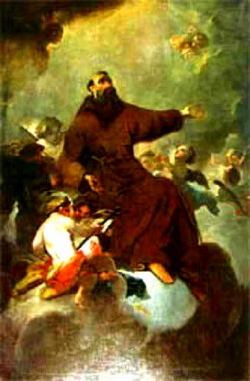
At first glance, perhaps the most remarkable quality of Lawrence of Brindisi is his outstanding gift of languages. In addition to a thorough knowledge of his native Italian, he had complete reading and speaking ability in Latin, Hebrew, Greek, German, Bohemian, Spanish, and French.
Lawrence was born on July 22, 1559, and died exactly 60 years later on his birthday in 1619. His parents William and Elizabeth Russo gave him the name of Julius Caesar, Caesare in Italian. After the early death of his parents, he was educated by his uncle at the College of St. Mark in Venice.
When he was just 16, he entered the Capuchin Franciscan Order in Venice and received the name of Lawrence. He completed his studies of philosophy and theology at the University of Padua and was ordained a priest at 23.
With his facility for languages Lawrence was able to study the Bible in its original texts. At the request of Pope Clement VIII, he spent much time preaching to the Jews in Italy. So excellent was his knowledge of Hebrew, the rabbis felt sure he was a Jew who had become a Christian.
Lawrence’s sensitivity to the needs of people—a character trait perhaps unexpected in such a talented scholar—began to surface. He was elected major superior of the Capuchin Franciscan province of Tuscany at the age of 31. He had the combination of brilliance, human compassion, and administrative skill needed to carry out his duties. In rapid succession he was promoted by his fellow Capuchins and was elected minister general of the Capuchins in 1602. In this position he was responsible for great growth and geographical expansion of the Order.
Lawrence was appointed papal emissary and peacemaker, a job which took him to a number of foreign countries. An effort to achieve peace in his native kingdom of Naples took him on a journey to Lisbon to visit the king of Spain. Serious illness in Lisbon took his life in 1619.
In 1956, the Capuchins completed a 15-volume edition of Lawrence’s writings. Eleven of these 15 contain his sermons, each of which relies chiefly on scriptural quotations to illustrate his teaching.
His constant devotion to Scripture, coupled with great sensitivity to the needs of people, present a lifestyle which appeals to Christians today. Lawrence had a balance in his life that blended self-discipline with a keen appreciation for the needs of those whom he was called to serve.
**************************************************************************************
From: Micah 7:14-15, 18-20
Prayer for Jerusalem
--------------------
[14] Shepherd thy people with thy staff, the flock of thy inheritance, who dwell alone in a forest in the midst of a garden land; let them feed in Báshan and Gilead as in the days of old. [15] As in the days when you came out of the land of Egypt I will show them marvellous things.
Hymn to the Lord
----------------
[18] Who is a God like thee, pardoning iniquity and passing over transgression for the remnant of his inheritance? He does not retain his anger for ever because he delights in steadfast love. [19] He will again have compassion upon us, he will tread our iniquities under foot. Thou wilt cast all our sins into the depths of the sea. [20] Thou wilt show faithfulness to Jacob and steadfast love to Abraham, as thou hast sworn to our fathers from the days of old.
***********************************************************************
Commentary:
7:14-17. These verses also deal with hope in the future restoration, but it is now expressed in the form of a prayer to the Lord. He is asked for a return to the way things were in the early days of the chosen people--a repetition of wondrous works that will astound the Gentiles (vv. 16-17) and convince them of the power of the Lord (v. 16). The prayer also desires the Lord to be the only shepherd of his people (v. 14; cf. 5:3), who now occupy the whole of Palestine again, a land that is most fertile. Bashan and Gilead, on the eastern banks and highlands of the Jordan, were areas renowned for rich pasture-land.
7:18-20. The last three verses of the book, in a liturgical tone, celebrate the Lord’s steadfast love. Witnessing the works of the Lord (his pardoning of sins, and putting them out of his mind: vv. 18-19; his faithfulness to his promises, no matter what: v. 20), all that the believer can do is be grateful and live in awe: “Who is a God like thee?” (v. 18). Many of the terms used in this short hymn (remnant, inheritance, faithfulness, etc.) have come up earlier in the book and are being rehearsed again here. But we can appreciate their importance more if we remember the way Micah is echoed in the Benedictus of Zechariah in the New Testament. That hymn sums up very well the hope in the Messiah harbored by generation upon generation of the people of God, and when we reread it, it will help to revive our own hope in the definitive (second) coming of the Lord: “Blessed be the Lord God of Israel, for he has visited and redeemed his people, and has raised up a horn of salvation for us in the house of his servant David, as he spoke by the mouth of his holy prophets from of old” (Lk 1:68-70).
***********************************************************************
From: Matthew 12:46-50
The True Kinsmen of Jesus
-------------------------
[46] While He (Jesus) was still speaking to the people, behold, His mother and His brethren stood outside, asking to speak to Him.* [48] But He replied to the man who told Him, "Who is My mother, and who are My brethren?" [49] And stretching out His hand toward His disciples, He said, "Here are My mother and My brethren! [50] For whoever does the will of My Father in Heaven is My brother, and sister and mother." (*Other ancient authorities insert verse 47, "Some one told Him, `Your mother and Your brothers are standing outside, asking to speak to You.'")
***********************************************************************
Commentary:
46-47. "Brethren": ancient Hebrew, Aramaic and other languages had no special words for different degrees of relationship, such as are found in more modern languages. In general, all those belonging to the same family, clan and even tribe were "brethren".
In the particular case we have here, we should bear in mind that Jesus had different kinds of relatives, in two groups--some on His mother's side, others on St. Joseph's. Matthew 13:55-56 mentions, as living in Nazareth, James, Joseph, Simon and Judas ("His brethren") and elsewhere there is reference to Jesus' "sisters" (cf. Matthew 6:3). But in Matthew 27:56 we are told that James and Joseph were sons of a Mary distinct from the Blessed Virgin, and that Simon and Judas were not brothers of James and Joseph, but seemingly children of a brother of St. Joseph.
Jesus, on the other hand, was known to everyone as "the son of Mary" (Mark 6:3) or "the carpenter's son" (Matthew 13:55).
The Church has always maintained as absolutely certain that Jesus had no brothers or sisters in the full meaning of the term: it is a dogma that Mary was ever-Virgin (cf. note on Matthew 1:25).
48-50. Jesus obviously loved His Mother and St. Joseph. He uses this episode to teach us that in His Kingdom human ties do not take precedence. In Luke 8:19 the same teaching is to be found. Jesus regards the person who does the will of His Heavenly Father as a member of His own family. Therefore, even though it means going against natural family feelings, a person should do just that when needs be in order to perform the mission the Father has entrusted to him (cf. Luke 2:49).
We can say that Jesus loved Mary more because of the bonds between them created by grace than because He was her son by natural generation: Mary's divine motherhood is the source of all our Lady's other prerogatives; but this very motherhood is, in its turn, the first and greatest of the graces with which Mary was endowed.
Bookmark
Disclaimer: Opinions posted on Free Republic are those of the individual posters and do not necessarily represent the opinion of Free Republic or its management. All materials posted herein are protected by copyright law and the exemption for fair use of copyrighted works.