Posted on 04/18/2020 6:38:27 PM PDT by NRx
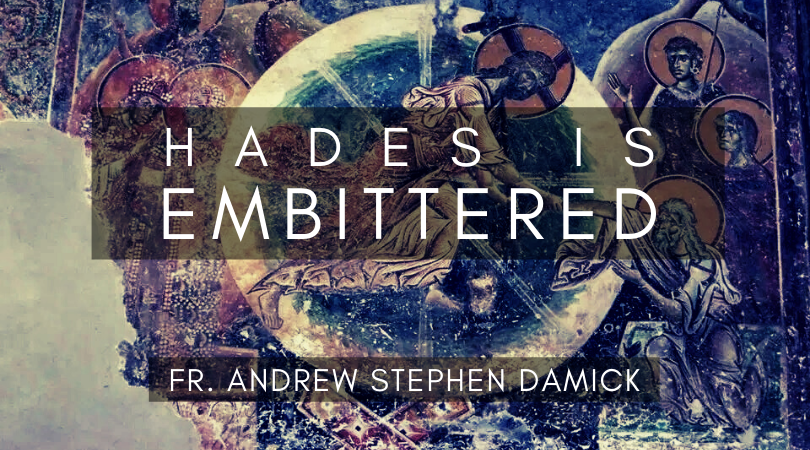
In the great Paschal Homily of St. John Chrysostom, we hear the golden-mouthed preacher say this about the encounter of Christ with Hades (or Hell):
He embittered it when it tasted of His flesh. And Isaiah, foretelling this, did cry:
Hell, said he, was embittered, when it encountered Thee in the lower regions.
It was embittered, for it was abolished.
It was embittered, for it was mocked.
It was embittered, for it was slain.
It was embittered, for it was overthrown.
It was embittered, for it was fettered in chains.
It took a body, and met God face to face.
It took earth, and encountered Heaven.
It took that which was seen, and fell upon the unseen.
Some chafe at the use of the translation Hell and prefer Hades instead, saying that people have an idea of Hell as this fiery place of torment where demons stick the damned with pitchforks, while they don’t have as defined of an idea of Hades, so it’s better for us to use the latter term. But the problem with that analysis is that it fails to see that Hell and Hades are really the same thing but from two different mythological viewpoints.
In Greek myth, Hades is the name of the underworld, the place of death. But it is also the name of the god who rules over death and has death as his power over mankind. He rules there because he was flung there by some power greater than his own. He is able to swallow up the living and keep them in bondage.
In Germanic myth, Hell (or Hel) is also the name of the underworld, the place of death. And it is also the name of the god (or, in the Norse version, the goddess) who rules the underworld.
In short, these are two names from two different ancient cultures for both a place and the god who rules that place. And if you start looking into the names and general character for the underworld in numerous ancient cultures — all over the world, not just the Indo-European cultures that include Germanic and Greek mythology — you will discover that the name of the underworld and the name of the god who controls it are usually either the same name or closely related. The Aztec Mictlān is ruled by Mictlāntēcutli, for instance. The details are not identical across cultures, of course, but the general concept of a god who rules the underworld and has death in his control is almost universal, and in many cases, they do have the same or similar names.
The problem with the “Hades not Hell” crowd is that they’re ignoring the god and thinking only of the place.
You can find some scholarly analyses of mythology that say that the divine beings who rule the underworld are later “personifications” of the location concept, but this viewpoint assumes that mythologies are the product of human imagination and not of encounter with actual divine beings. In other words, they presume materialism and therefore treat narratives about gods as being useful fiction, invented by people who never actually saw a god but came up with the idea to “explain” things.
But even though we do not think and see the world as ancient people did, it is hard to imagine that any human being would start constructing claims about encountering divine beings without any prior experience of something divine. We tend to treat ancient people as though they were just gullible and saw gods in everything, yet somehow they also came up with the concept of gods on their own without having encounters with such beings.
In any event, when Chrysostom says that Hades/Hell was “embittered,” he is referencing this passage from the Prophet Isaiah:
Hades from below was embittered meeting you; all the giants ruling the earth were risen up together against you, the ones rising from their thrones, all the kings of the nations. All shall answer and shall say to you, “You also are captured as even we; and are you reckoned among us? Your glory went down into Hades, your great gladness; underneath you they shall make a bed of putrefaction, and the work shall be your covering. O how fell from out of the heaven the morning star — the one by morning rising — was broken unto the earth, the one sending to all the nations.” (Isaiah 14:9-12, LXX)
So we see here a whole cast of spiritual beings being embittered and surprised at meeting God in the underworld — Hades himself, the giants ruling the earth, the rulers over the nations. These are not politicians and kings and so on, but rather spiritual beings who control the earth and are thrown into an uproar at meeting God there. Why? It is because the realm of death was the last place where they truly had control. And that “morning star” who fell down into the earth was the evil one, who was sent to the underworld and stripped of every power except death after he tempted mankind into joining his rebellion in Eden.
But then God enters into death itself, that last power and last realm left to the evil one, and defeats it. And if we understand death and Hades as fundamentally being about not just a “personified” location or even a state of being medically brain-dead, etc., but rather about being under the power of malevolent spiritual beings, then we can begin to understand what it means that Hades could be embittered (or, in my favorite translation, vexed) at being dethroned and rendered impotent.
Because of the worldwide pandemic, our Great Lent, Holy Week and Pascha here in 2020 have been really difficult to endure, so difficult that many simply refuse to accept that we must endure it, demanding that we find some way to distribute holy communion as a kind of drive-up commodity — grocery stores and Starbucks are open, right? — or that we simply open the doors to the churches and just accept that many of us might die as a result of being infected — after all, is not life and death in the hands of God? Why shouldn’t we engage in behaviors that might kill us or others, if we truly believe that we belong to God? Or some just refuse to believe that a virus could get transmitted during a church service (despite mounting evidence to the contrary) or that churches have ever closed in response to pestilence (despite numerous historical examples).
Setting aside for the moment the many other problems with such an attitude, much of this makes the same mistake as the “Hades not Hell” argument. It treats the problem of death as being a matter simply of a physical state that of course God has control over.
But we might forget that death and Hades can be embittered because, not just according to the Bible but even according to nearly every ancient culture, the realm of death is bound up with spiritual beings — gods — who are the enemies of God. These spiritual powers rose up against Him and are now being judged by Him. Their realm is being justified, that is, being set in order. And that means that these demons are getting what comes to them and being driven out.
I believe that our task in this moment — as witnessed to by the nearly universal consensus not just of governments and medical authorities, but nearly all Orthodox bishops and pastors and even some holy elders who have spoken out — is to experience the embittering of death for ourselves, including even the death of what we expect our spiritual lives to look like. But if we are the Lord’s then we have nothing to fear from this experience, because the judgment of God is wrath to the wicked but refinement to the righteous. Refinement is not an easy or comfortable process, but it is necessary if we are to become purified.
We have been thrown into an embittering exile not because of some vast, worldwide conspiracy that has led to massive apostasy of even holy elders and monastics and the good-hearted pastors of the Church, but because in this age in which Christ rules in the midst of His enemies, even though Hades has been (past tense) embittered, he is still being (present tense) embittered. And inasmuch as we are still loyal in any way to death by means of our sins, then we also are being embittered.
It is not easy to accept this exile and embitterment. But I think our task is clearer if we understand that we are being wrested by God from the hand of His adversary the evil one, who had the power of death. Are we really willing to say that we will not do — for a little while — what is needed to preserve life? The life we have in this world is not nothing. It is the opportunity for each of us to repent, to renounce our alignment with the lord of death and to pledge allegiance to the Lord of Life.
It is true that God can control everything, but He does not actually exercise that level of control. We have free will. And the evil one and the demons have free will. We don’t have full freedom of action because we are not omnipotent. But there are at least three “factions,” as it were, in play in the balance of mankind between life and death. On the side of life is God and the heavenly hosts, and on the side of death is the evil one and the other demons. And then mankind may align himself with either.
Inasmuch as we are aligned with death, we need to repent, and that repentance will include being embittered, because when sin is burned away by God’s presence and action, it is not comfortable. But if we will accept this embittering with grace and patience, then we will find in our rising with Christ that the victory of the arising of God is in us, as well. We will find that the demons tremble and flee at our coming, as well.
Let us think beyond our momentary difficulties and ask how this present bitterness is for our purification and salvation. This means that we have to accept this as from the Lord, including the decisions of people we do not agree with.
I have been criticized a number of times recently because my approach to this pandemic has not been “How do we keep doing business as usual in face of all these obstacles?” but rather “Given that we have this problem, what do we do in the midst of it?” To me, though, the question is whether I believe this present state of things is given to me for my salvation.
After all, it is not as though I can single-handedly alter the near unanimity of leaders both civil and ecclesiastical on our response to COVID-19. So even if I disagree with them, what do I do?
I can rage against them or I can accept that even this is from the Lord, even decisions I may disagree with, even decisions that mean agony for me, like telling my parishioners to stay home, like telling a fellow priest that I cannot let him come and serve with me, like telling my own wife and children to stay home.
One of the most profound things that my spiritual father ever told me and that I keep coming back to is this (and I am paraphrasing a little here): This life that you now have, with all of its difficulties, all of its pain, all of its inconveniences and obstacles, that you see as being so often in the way of the holy life that you want to live — this is God’s answer to all your prayers. He knows what you need for your salvation, and He gave you this. It is not in the way — it is the way.
We will not experience the benefits of refinement if we do not accept what God weaves into the tapestry of our lives — even as it looks like the threads of life and death sometimes are in diabolical hands — if we do not accept them as from the Lord. And I believe that we can accept even this present embitterment if we will remember that this is part of a rebellion being put down by God.
In this rebellion, the evil one seeks to hold on to his last power, which is death. And he seeks to ensnare us in it, to become deathly like him and remain so for eternity.
But how did Christ undo his power? How did Christ embitter Hades and overthrow him? He did it by accepting even the embitterment of death for Himself. It was the most wrong and unjust thing ever to happen, that the Lord of Life should be taken even for a moment by the lord of death. But in the end, it was Hades who was fooled and undone. It was Hades who lost his kingdom. It was Hades who took a body and met God.
Sometimes, I think we want Christ to trample down death by His death but not with our death. It is as though we somehow expect to have resurrection for ourselves without death for ourselves. So we do not accept to die in this present life by accepting impingement upon ourselves. And so when we die (physically), we may end up dying (spiritually).
But if we will accept death with Him even now by accepting to be embittered even now, then we will emerge with Him in life, trampling down death with Him by death. We can’t escape that death has to be trampled by death. Death will not be escaped, but it can be transformed into life, destroyed completely.
The only way to accept this present embittering death so that we are refined for life is through patience and humility, through repentance. There is no other way.
For in the end, even this present Pascha is revealed to be the Pascha of the Lord, the Pascha on which we celebrate the death of Death, the Pascha which crashes into the gates of the underworld, wrests the dead away from Death, and gives them life forevermore.
Christos anesti!
Alithos Anesti!
Disclaimer: Opinions posted on Free Republic are those of the individual posters and do not necessarily represent the opinion of Free Republic or its management. All materials posted herein are protected by copyright law and the exemption for fair use of copyrighted works.