Free Republic
Browse · Search
Religion
Topics · Post Article

Skip to comments.

Catholic Caucus: Daily Mass Readings, 05-19-19
USCCB ^

Posted on 05/19/2019 9:45:30 AM PDT by annalex

May 19 2019

Fifth Sunday of Easter
Lectionary: 54

Reading 1 Acts 14:21-27

After Paul and Barnabas had proclaimed the good news
to that city
and made a considerable number of disciples,
they returned to Lystra and to Iconium and to Antioch.
They strengthened the spirits of the disciples
and exhorted them to persevere in the faith, saying,
"It is necessary for us to undergo many hardships
to enter the kingdom of God."
They appointed elders for them in each church and,
with prayer and fasting, commended them to the Lord
in whom they had put their faith.
Then they traveled through Pisidia and reached Pamphylia.
After proclaiming the word at Perga they went down to Attalia.
From there they sailed to Antioch,
where they had been commended to the grace of God
for the work they had now accomplished.
And when they arrived, they called the church together
and reported what God had done with them
and how he had opened the door of faith to the Gentiles.

Responsorial Psalm Ps 145:8-9, 10-11, 12-13

R. (cf. 1) I will praise your name for ever, my king and my God.
or:
R. Alleluia.
The LORD is gracious and merciful,
slow to anger and of great kindness.
The LORD is good to all
and compassionate toward all his works.
R. I will praise your name for ever, my king and my God.
or:
R. Alleluia.
Let all your works give you thanks, O LORD,
and let your faithful ones bless you.
Let them discourse of the glory of your kingdom
and speak of your might.
R. I will praise your name for ever, my king and my God.
or:
R. Alleluia.
Let them make known your might to the children of Adam,
and the glorious splendor of your kingdom.
Your kingdom is a kingdom for all ages,
and your dominion endures through all generations.
R. I will praise your name for ever, my king and my God.
or:
R. Alleluia.

Reading 2 Rev 21:1-5a

Then I, John, saw a new heaven and a new earth.
The former heaven and the former earth had passed away,
and the sea was no more.
I also saw the holy city, a new Jerusalem,
coming down out of heaven from God,
prepared as a bride adorned for her husband.
I heard a loud voice from the throne saying,
"Behold, God's dwelling is with the human race.
He will dwell with them and they will be his people
and God himself will always be with them as their God.
He will wipe every tear from their eyes,
and there shall be no more death or mourning, wailing or pain,
for the old order has passed away."

The One who sat on the throne said,
"Behold, I make all things new."

Alleluia Jn 13:34

R. Alleluia, alleluia.
I give you a new commandment, says the Lord:
love one another as I have loved you.
R. Alleluia, alleluia.

Gospel Jn 13:31-33a, 34-35

When Judas had left them, Jesus said,
"Now is the Son of Man glorified, and God is glorified in him.
If God is glorified in him,
God will also glorify him in himself,
and God will glorify him at once.
My children, I will be with you only a little while longer.
I give you a new commandment: love one another.
As I have loved you, so you also should love one another.
This is how all will know that you are my disciples,
if you have love for one another."


TOPICS: Catholic; Ministry/Outreach; Prayer; Worship
KEYWORDS:
God bless you.
1 posted on 05/19/2019 9:45:30 AM PDT by annalex
[ Post Reply | Private Reply | View Replies]

To: ArrogantBustard; Catholicguy; clockwise; ELS; I_be_tc; livius; marshmallow; Mrs. Don-o; ...
I stepped in doing the daily Mass readings till such time that Salvation resumes them.

I do not have Salvation's mailing list. I have to grow my own. I haven't heard from her since she stopped posting. Please, pray for her well-being.

Please, drop me a freepmail if you want to be on this list and you aren't, or if you don't want to be on it and you are.

Please contribute your posts and make this thread beautiful. Remember the rules for Catholic Caucus prayer threads: no polemical content of any kind is allowed.

2 posted on 05/19/2019 9:47:04 AM PDT by annalex (fear them not)
[ Post Reply | Private Reply | To 1 | View Replies]

To: annalex
John
  English: Douay-Rheims Latin: Vulgata Clementina Greek NT: Byzantine/Majority Text (2000)
  John 13
31 When he therefore was gone out, Jesus said: Now is the Son of man glorified, and God is glorified in him. Cum ergo exisset, dixit Jesus : Nunc clarificatus est Filius hominis, et Deus clarificatus est in eo. οτε εξηλθεν λεγει ο ιησους νυν εδοξασθη ο υιος του ανθρωπου και ο θεος εδοξασθη εν αυτω
32 If God be glorified in him, God also will glorify him in himself; and immediately will he glorify him. Si Deus clarificatus est in eo, et Deus clarificabit eum in semetipso : et continuo clarificabit eum. ει ο θεος εδοξασθη εν αυτω και ο θεος δοξασει αυτον εν εαυτω και ευθυς δοξασει αυτον
33 Little children, yet a little while I am with you. You shall seek me; and as I said to the Jews: Whither I go you cannot come; so I say to you now. Filioli, adhuc modicum vobiscum sum. Quæretis me ; et sicut dixi Judæis, quo ego vado, vos non potestis venire : et vobis dico modo. τεκνια ετι μικρον μεθ υμων ειμι ζητησετε με και καθως ειπον τοις ιουδαιοις οτι οπου υπαγω εγω υμεις ου δυνασθε ελθειν και υμιν λεγω αρτι
34 A new commandment I give unto you: That you love one another, as I have loved you, that you also love one another. Mandatum novum do vobis : ut diligatis invicem : sicut dilexi vos, ut et vos diligatis invicem. εντολην καινην διδωμι υμιν ινα αγαπατε αλληλους καθως ηγαπησα υμας ινα και υμεις αγαπατε αλληλους
35 By this shall all men know that you are my disciples, if you have love one for another. In hoc cognoscent omnes quia discipuli mei estis, si dilectionem habueritis ad invicem. εν τουτω γνωσονται παντες οτι εμοι μαθηται εστε εαν αγαπην εχητε εν αλληλοις

3 posted on 05/19/2019 9:48:44 AM PDT by annalex (fear them not)
[ Post Reply | Private Reply | To 1 | View Replies]

To: annalex
31. Therefore, when he was gone out, Jesus said, Now is the Son of man glorified, and God is glorified in him.
32. If God be glorified in him, God shall also glorify him in himself, and shall straightway glorify him.

ORIGEN. After the glory of His miracles, and His transfiguration, the next glorifying of the Son of man began, when Judas went out with Satan, who had entered into him; Therefore when he was gone out, Jesus said, Now is the Son of man glorified, and God is glorified in Him. For it is not the eternal only-begotten Word, but the glory of the Man born of the seed of David, which is here meant.

Christ at His death, in which He glorified God, having spoiled principalities and powers, made a show of them, openly triumphing over them (Col 2:15). And again, Made peace by the blood of His cross, to reconcile all things to Himself, whether they be things in earth, or things in heaven (Col 1:20). Thus the Son of man was glorified, and God glorified in Him; for Christ cannot be glorified, except the Father be glorified with Him. But whoever is glorified, is glorified by someone.

By whom then is the Son of man glorified? He tells you; If God be glorified in Him, God shall also glorify if Him in Himself, and shall straightway glorify Him.

CHRYS. i.e. by Himself, not by any other. And shall straightway glorify Him, i.e. not at any distant time, but immediately, while He is yet on the very cross shall His glory appear. For the sun was darkened, rocks were rent, and many bodies of those that slept arose. In this way He restores the drooping spirits of His disciples, and persuades them, instead of sorrowing, to rejoice.

AUG. Or thus: The unclean went out: the clean remained with their cleanser. Thus will it be when the tares are separated from the wheat; The righteous shall shine forth as the sale in the kingdom of their Father (Matt 13:43). Our Lord, foreseeing this, said, when Judas went out, as if the tares were now separated, and He left alone with the wheat, the holy Apostles.

Now is the Son of man glorified; as if to say, Behold what will take place at My glorifying, at which none of the wicked shall be present, none of the righteous shall perish. He does not say, Now is the glorifying of the Son of man signified; but, Now is the Son of man glorified; as it is not that rock signified Christ, or but, That Rock was Christ (1 Cor 10:4).

Scripture often speaks of the things signifying, as if they were the things signified. But the glorifying of the Son of man, is the glorifying of God in Him; as He adds, And God is glorified in Him, which He proceeds to explain; If God is glorified in Him - for He came not to do His own will, but the will of Him that sent Him - God shall also glorify Him in Himself, so that the human nature which was assumed by the eternal Word, shall also be endowed with eternity.

And shall straightway glorify Him. He predicts His own resurrection, which was to follow immediately, not at the end of the world, like ours. Thus it is; Now is the Son of man glorified; the now referring not to His approaching Passion, hut the resurrection which was immediately to follow it: as if that which was so very soon to be, had already taken place.

HILARY. That God is glorified in Him, refers to the glory of the body, which glory is the glory of God, in that the body borrows its glory from its association with the Divine nature because God is glorified in Him, therefore He will; glorify Him in Himself, in that He who reigns in the glory arising from the glory of God, He forthwith passes over into God's glory, leaving the dispensation of His manhood wholly to abide in God.

Nor is He silent as to the time And shall straightway glorify Him. This referring to the glory of His resurrection which was immediately to follow His passion, which He mentions as present, because Judas had now gone out to betray Him; whereas that God would glorify Him in Himself, He reserves for the future. The glory of God was strewn in Him by the miracle of the resurrection; but He will abide in the glory of God when He has left the dispensation of subjection.

The sense of these first words, Now is the Son of man glorified, is not doubtful: it is the glory of the flesh which is meant, not that of the Word But what means the next, And God is glorified in Him? The Son of man is not another Person from the Son of God for, the Word was made flesh (John 1:14). How is God glorified in this Son of man, who is the Son of God?

The next clause helps us; If God is glorified in Him, God also will glorify Him in Himself. A man is not glorified in himself, nor, on the other hand, does God who is glorified in man, because He receives glory, cease to be God. So the words, God is glorified in Him, either mean that Christ is glorified in the flesh, or that God is glorified in Christ. If God means Christ, it is Christ who is glorified in the flesh; if the Father, then it is the Sacrament of unity, the Father glorified in the Son. Again, God glorifies in Himself God glorified in the Son of man.

This overthrows the impious doctrine that Christ is not very God, in verity of nature. For how can that which God glorifies in Himself be out of Himself? He whom the Father glorifies must be confessed to be in His glory, and He who is glorified in the glory of the Father, must be understood to be in the same case with the Father.

ORIGEN. Or thus: The word glory is here used in a different sense from that which some Pagans attach to it, who defined glory to be the collected praises of the many. It is evident that glory in such a sense is a different thing from that mentioned in Exodus, where it is said, that the glory of the Lord filled the tabernacle (Exod 40:34), and that the face of Moses was glorified. The glory here mentioned is something visible, a certain divine appearance in the temple, and on Moses' face; but in a higher and more spiritual sense we are glorified, when with the eye of the understanding we penetrate into the things of God.

For the mind when it ascends above material things, and spiritually sees God, is defied: and of this spiritual glory, the visible glory on the face of Moses is a figure: for his mind it was that was defied by converse with God. But there is no comparison between the excellent glory of Christ, and the knowledge of Moses, whereby the face of his soul was glorified: for the whole of the Father's glory shines upon the Son, who is the brightness of His glory, and the express image of His Person (Heb 1:3). Yea, and from the light of this whole glory there go forth particular glories, throughout the whole rational creation; though none can take in the whole of the divine glory, except the Son.

But so far as the Son was known to the world, so far only was He glorified. And as yet He was not fully known. But afterward the Father spread the knowledge of Him over the whole world, and then was the Son of man glorified in those who knew Him. And of this glory He has made all who know Him partakers: as said the Apostle: We all, with open face beholding as in a glass the glory of the Lord, are changed into the same image, from glory to glory (2 Cor 3:18), i.e. from His glory receive glory.

When He was approaching then that dispensation, by which He was to become known to the world, and to be glorified in the glory of those who glorified Him, He says, Now is the Son of man glorified (Matt 11:27). And because no man knows the Father but the Son, and he to whomsoever the Son will reveal Him, and the Son by the dispensation was about to reveal the Father; for this reason He said, And God is glorified in Him. Or compare this with the text below: He that has seen Me, has seen the Father. The Father who begat the Word is seen in the Word, who is God, and the image of the invisible God. But the words may be taken in a larger sense. For as through some the name of God was blasphemed among the Gentiles, so through the saints whose good deeds are seen and acknowledged by the world, the name of the Father in heaven is magnified.

But in whom was He so glorified as in Jesus, Who did no sin, neither was guile found in His mouth? Such being the Son, He is glorified, and God is glorified in Him. And if God is glorified in Him, the Father returns Him more than He gave. For the glory of the Son of man, when the Father glorifies Him, far exceeds the Father's glory, when He is glorified in the Son: it being fit that the greater should return the greater glory. And as this, viz. the glorifying of the Son of man, was just about to be accomplished, our Lord adds, And will straightway glorify Him.

33. Little children, yet a little while I am with you. you shall seek me: and as I said to the Jews, Whither I go, you cannot come; so now I say to you.
34. A new commandment I give to you, That you love one another; as I have loved you, that you also love one another.
35. By this shall all men know that you are my disciples if you have love one to another.


AUG. After He had said, And shall straightway glorify Him, that they might not think that God was going to glorify Him in such a way, as that He would no longer have any converse with them on earth, He says, Little children, yet a little while I am with you: as if He said, I shall indeed straightway be glorified by My resurrection, but I shall not straightway ascend to heaven. For we read in the Acts of the Apostles, that He was with them forty days after His resurrection. These forty days are what He means by, A little while I am with you.

ORIGEN. Little children, He says; for their souls were yet in infancy. But these little children, after His death, were made brethren; as before they were little children, they were servants.

AUG. It may be understood too thus: I am as yet in this frail flesh, even as you are, until I die and rise again. He was with them after His resurrection, by bodily presence, not by participation of human frailty. These are the words which I spoke to you, while I was yet with you (Luke 24:44). He says to His disciples after His resurrection; meaning, while I was in mortal flesh, as you are. He was in the same flesh then with them, but not subject to the same mortality. But there is another Divine Presence unknown to mortal senses, of which He said, Lo, I am with you always, even to the end of the world (Matt 28:20).

This is not the presence meant by, A little while I am with you; for it is not a little while to the end of the world: or even if it is a little while, because that in the eye of God, a thousand years are as one day, yet what follows shows that it is not what our Lord is here alluding to; for He adds, Whither I go you cannot follow Me now. At the end of the world they were to follow Him, whither He went; as He said below; Father, I will that they be with Me, where I am

ORIGEN. But may there not be a deeper meaning in the words, yet a little while &c. After a little while He was not with them. In what sense not with them? Not because He was not with them according to the flesh, in that He was taken from them, was brought before Pilate, was crucified, descended into hell: but because they all forsook Him, fulfilling His prophecy: All you shall be offended because of Me this night. He was not with them, because He only dwells with those who are worthy of Him. But though they thus wandered from Jesus for a little while, it was only for a little while; they soon sought Him again. Peter wept bitterly after his denial of Jesus, and by his tears sought Him: and therefore it follows, you shall seek Me, and as I said to the Jews, whither I go, you cannot follow Me now. To seek Jesus, is to seek the Word, wisdom, righteousness, truth, all which is Christ. To His disciples therefore who wish to follow Him, not in a bodily sense, as the ignorant think, but in the way He ordains, Whosoever does not bear his cross, and come after Me, cannot be My disciple. Our Lord said, Whither I go you cannot follow Me now. For though they wished to follow the Word, and to confess Him, they were not yet strong enough to do so; The Spirit was not yet given to them, because that Jesus was not yet glorified.

AUG. Or He means that they were not yet fit to follow Him to death for righteousness' sake. For how could they, when they were not ripe for martyrdom? Or how could they follow our Lord to immortality, they who v ere to die, and not to rise again till the end of the world? Or how could tines follow Him to the bosom of the Father, when none could partake of that felicity, but they whose love was perfected? When He told the Jews this, He did not add now. But the disciples, though they could not follow Him then, would be able to do so afterwards, and therefore He adds, So now I say to you.

ORIGEN. As if He said, I say it to you, but with the addition of now, The Jews, who He foresaw would die in their sins, would never be able to follow Him; but the disciples were unable only for a little time.

CHRYS. And therefore He said, little children; for He did not mean to speak to them, as He had to the Jews. you cannot follow Me now, He says, in order to rouse the love of His disciples. For the departure of loved friends kindles all our affection, and especially if they are going to a place where we cannot follow them. He purposely too speaks of His death, as a kind of translation, a happy removal to a place, where here mortal bodies do not enter

AUG. And now He teaches them how to fit themselves to follow. Him: A new commandment I give to you, that you love one another. But does not the old law say, you shall love your neighbor as yourself (Lev 19:18)? Why then does He call it a new commandment? Is it because it strips us of the old man, and puts on us the new? That it renews the hearer, or rather the doer of it? Love does do this; but it is that love which our Lord distinguishes from the carnal affection: As I have loved you, that you also love one another. Not the love with which men love one another, but that of the children of the Most High God, w ho would be brethren of His only-begotten Son, and therefore love one another with that love with which He loved them, and would lead them to the fulfillment of their desires.

CHRYS. Or, as I have loved you: for My love has not been the payment of something owing to you, but had its beginning on My side. And you ought in like manner to do one another good, though you may not owe it.

AUG. But; do not think that that greater commandment, viz. that we: should love the Lord our God, is passed by. For, if we understand the two precepts aright, each is implied in the other. He who loves God cannot despise His commandment that he should love his neighbor; and he who loves his neighbor in a heavenly spiritual way, in the neighbor loves God. That is the love which our Lord distinguishes from all human love, when He adds, As I have loved you, what did He, in loving us, love, but God in us; not who was in us, but so that He might be? Wherefore let each of us so love the other, as that by this working of love, we make each other the habitations of God.

CHRYS. Passing over the miracles, which they were to perform, He makes love: the distinguishing mark of His followers; By this shall all men know that you are My disciples' if you have love one to another. This it is that evidences the saint or the disciple, as He calls him.

AUG. As if He said, Other gifts are shared with you by those who are not mine; birth, life, sense, reason, and such good things as belong alike to man and brutes; nay, and tongues, sacraments, prophecy, knowledge, faith, bestowing of goods upon the poor,; giving the body to be burned: but forasmuch as they have not charity, they are tinkling cymbals, they are nothing: nothing profits them.

Catena Aurea John 13
4 posted on 05/19/2019 9:49:15 AM PDT by annalex (fear them not)
[ Post Reply | Private Reply | To 3 | View Replies]

To: annalex


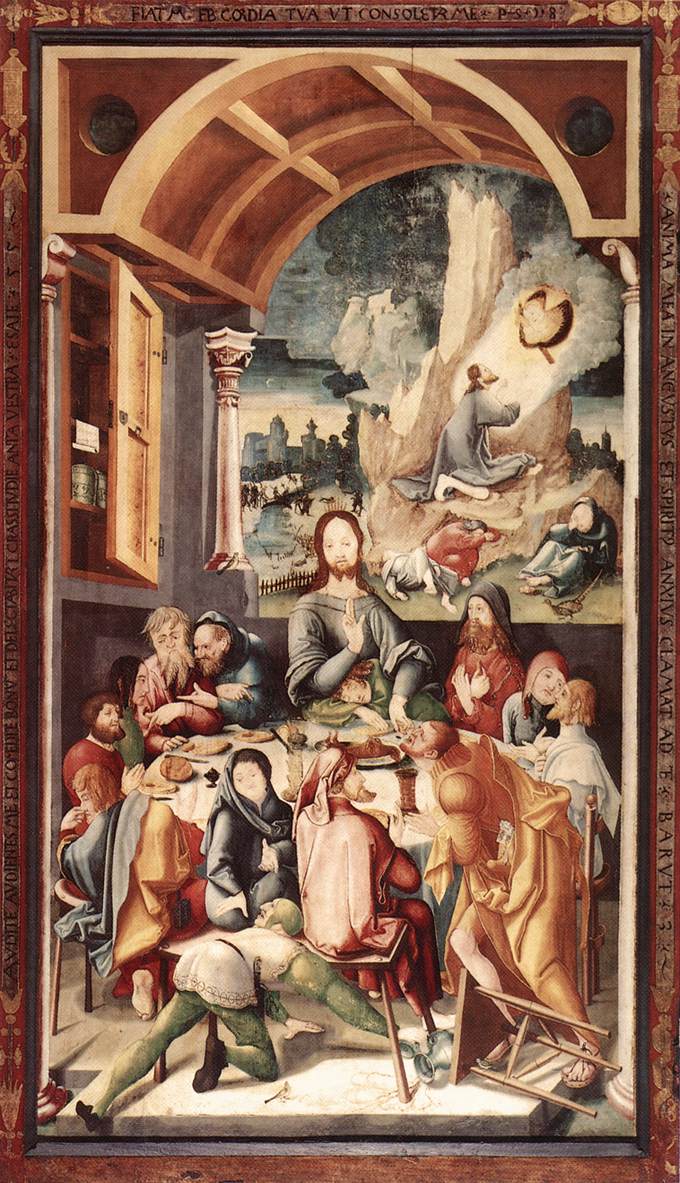
Last Supper

Jörg Ratgeb

1519
Wood
Staatsgalerie, Stuttgart

5 posted on 05/19/2019 9:49:58 AM PDT by annalex (fear them not)
[ Post Reply | Private Reply | To 4 | View Replies]

To: annalex

Thank-you and God Bless.


6 posted on 05/19/2019 9:55:33 AM PDT by Biggirl ("One Lord, one faith, one baptism" - Ephesians 4:5)
[ Post Reply | Private Reply | To 1 | View Replies]

To: annalex

here is Msgr. Charles Pope’s homily: https://blog.adw.org/author/cpope/


7 posted on 05/19/2019 10:25:20 AM PDT by GreyFriar (Spearhead - 3rd Armored Division 75-78 & 83-87)
[ Post Reply | Private Reply | To 2 | View Replies]

To: GreyFriar

Author: Msgr. Charles Pope

The Legacy of Love – A Homily for the 5th Week of Easter

The title of this sermon uses the word legacy, which refers to something transmitted by or received from an ancestor or predecessor.

Perhaps the most accessible image of this is money. If I receive 100 million dollars from a dying relative, I can the money to start living differently. My bills, which now seem overwhelming, can be paid with just the interest earned from my newfound wealth. I can start enjoying things I thought I could never afford in the past. In other words, a legacy can completely change the way I live and open up new possibilities.

It is in this sense that we explore today’s Gospel, wherein our Lord sets forth for us a new power: the power of love. If we tap into it and draw from its riches, we are able to live differently. If we will but lay hold of it, there is a kind of legacy, a deposit of riches from which we can draw.

Let’s look at today’s Gospel in three stages and discover what the Lord has done for us and has left us by way of a legacy.

I. The Provision and Pivot of the Passion – The text says, When Judas had left them, Jesus said, “Now is the Son of Man glorified, and God is glorified in him. If God is glorified in him, God will also glorify him in himself, and God will glorify him at once.

Note how the text speaks in the present tense: the Son of Man is glorified. The aorist tense of the verb (used in the Greek translation) indicates something that has begun and is underway. Judas’ going forth has started a process that is now underway and will, by God’s grace, result in liberation and glorification for Jesus and for us. The Lord Jesus is no mere victim. Everything is unfolding exactly as foretold. The Son of Man will suffer but, in the end, will be glorified. This glory will make available for us a whole new life.

Now this leads us to a question: What happened when the Son of God died and rose for me? This question is not posed in order to receive merely the answer from the catechism. Expressed more deeply, these are the questions: What difference does the passion, death, and resurrection of Jesus Christ make for me today? Are they just ancient historical events that are meaningful only because others say so? Or have I grasped and begun to lay hold of what Jesus has done for me?

Scripture says that Jesus’ death is glorification and new life for us: We know that our old self was crucified with him so that the sinful body might be destroyed, and we might no longer be enslaved to sin…We were buried therefore with him by baptism into death, so that as Christ was raised from the dead by the glory of the Father, we too might have a whole new life (Rom 6:4-7).

In other words, Jesus, the Son of Man, is glorified in His passion and is destroying the power of sin and death by His cross and resurrection. We need to spend our life pondering what happened when the Son of God died for us. It is not merely some historical event. It is that, but it is far more. To the degree that we will lay hold of this saving work, we will come to see and experience the power of the cross of our Lord Jesus Christ to put sin to death and to bring new life forth in Christ.

Of this, I am a witness, for I have seen the power of the cross to quell sinful fears, worldly lusts, and endless preoccupations. On account of what Jesus endures for us, He ascends on high not to leave us but to open the way for us to a greater and fuller life. It is a life in which we see sin put to death and many graces and charisms come alive: charisms of confidence, joy, and hope; it is an increasingly victorious life. It is up to us to grasp this saving work and the new life it offers us by the power of the cross of Christ and Him crucified.

This is the moment of glory, the pivotal point of all things. This the glory and the basis of a new life. Because of what Jesus does at this moment, His glory and ours is ushered in; it is all based on this.

II. The Power and Produce of the Passion – The text says, I give you a new commandment: love one another. As I have loved you, so you also should love one another.

When we hear the phrase “Love one another as I have loved you.” we can fall into the trap of thinking, “Uh oh, I have to do more! I have to try harder. Because He loved me, now I, with the power of my own flesh, have to love others.” However, this is not about rules; it’s about relationship. Jesus is not just saddling us with more responsibilities. He is equipping, empowering, and enabling us to love with the same love with which He has loved us.

The point here is to let Jesus love you, to experience His love, and with this love, experienced and embraced, be empowered to love others.

The Lord does not just say, “Love.” Rather, He says, “Receive love and then love with the love that you have received.” Scripture says,

      • We love, because he first loved us (1 John 4:19).
      • As the Father has loved me, so have I loved you. Abide in my love! If you keep my commandments, you will abide in my love, just as I have kept my Father’s commandments and abide in his love (John 15:9).

In other words, we have the power to keep His commandments and to love others to the degree that we receive and abide—that is, remain—in His love. We love with His love, not merely with our own love.

Do not miss this point! Do you see it? This is the message: by the power of His love and grace we are empowered to love, to keep His commandments, and to see our life changed. Today’s Gospel is not a moralism that tells us to obey a bunch of rules. It is that God has sent His Son, who died for us and rose to give us a wholly new and transformed life, a life that keeps the commandments and loves others with the power of God’s own love, received and experienced.

III. The Proof Positive of the Passion – The text says, This is how all will know that you are my disciples, if you have love for one another.

We have discussed many times on this blog the fact that the usual Greek word for “know” is richer than our modern notion of “intellectual knowing.” The Greek word for merely knowing something intellectually is oida, but the verb used in today’s Gospel is γινώσκω (ginosko), which refers to experiential knowing, to knowing in a deep, personal, and experiential way.

Thus, the point is that others will notice the legacy of love living us in a very real and experiential way. The faith, hope, and love that we proclaim will not, and cannot, be a mere intellectualism; it must be something that others can see and experience at work within us.

Hence, the proof, the evidence, the picture of God’s love, is not some vague feeling or a mere intellectual attribute in us. It is a powerful and dynamic force that equips, empowers, and enables us to love. The Lord says here that His love is something that changes us in a way that others will notice. It changes our relationships in a palpable, tangible, and noticeable way. We notice and experience its power and so do others.

Yes, we will love even our enemies, and we will do this not out of the power of our own flesh or because have to, but because we want to receive, and have received from the Lord, a new heart and the power to love.

Note also that the love we have will not be a merely sentimental one. It will be a true love, a love rooted in truth. It will be a love like Jesus has, one that does not compromise the truth or water down its demands. It will be a love that speaks the truth but does so not merely to win an argument but to summon the other to fulfillment and flourishing. This is what Jesus did. He loved, but He loved in truth and integrity. Nothing would compromise His love for His Father or the glorious vision and plan of the Father for all His children to abide in truth and holiness.

The proof positive that the legacy of love is at work within us is, first of all, our own transformed lives, which others can see. Second, it is the love that others can and do experience from us. Granted, this love will sometimes challenge and irritate others, but it is a love that is difficult to deny, an integrity that is hard to impugn, a love that, even if disconcerting, is real, palpable, and obvious.

This, then, is the legacy of love. It is a treasure, an inheritance that the Lord Jesus has left us to draw upon. This love is not our work; it is not our wealth, not our power. It is all His. He has left it for us to draw upon. Will we? Or will we make excuses about how we are not able to do the things to which He has summoned us? Don’t you get it? It is not our power, not our love; it is His, and He has left us this legacy, this inheritance, to draw upon.

Lay hold of this power, this love, and let it transform your life. Let it turn you into proof positive of the power of the cross to transform lives and to bestow new life.

Here are some of the lyrics from the song “Love Lifted Me”:

Souls in danger look above, Jesus completely saves,
He will lift you by His love, out of the angry waves.
He’s the Master of the sea, billows His will obey,
He your Savior wants to be, be saved today.

Love lifted me! Love lifted me!
When nothing else could help
Love lifted me!


8 posted on 05/19/2019 12:21:14 PM PDT by annalex (fear them not)
[ Post Reply | Private Reply | To 7 | View Replies]

To: GreyFriar

My fear is that posting those in the prayer thread might, — not this time but one day — violate the Caucus obligation not to compare beliefs.

Salvation posted those on an open thread. I just can’t handle the flame wars that often ensued. With a larger ping list, I might venture into that, but at this stage it would eat up all my free time, and I don’t have much of it, even on a Sunday.


9 posted on 05/19/2019 12:26:34 PM PDT by annalex (fear them not)
[ Post Reply | Private Reply | To 7 | View Replies]

Disclaimer: Opinions posted on Free Republic are those of the individual posters and do not necessarily represent the opinion of Free Republic or its management. All materials posted herein are protected by copyright law and the exemption for fair use of copyrighted works.

Free Republic
Browse · Search
Religion
Topics · Post Article

FreeRepublic, LLC, PO BOX 9771, FRESNO, CA 93794
FreeRepublic.com is powered by software copyright 2000-2008 John Robinson