Skip to comments.
[Catholic Caucus] Ultramontanism's Death Sentence
Rorate Caeli ^
| October 15, 2017
| Joseph Shaw
Posted on 10/15/2017 11:17:36 AM PDT by ebb tide
Ultramontanism's Death Sentence
 |
|
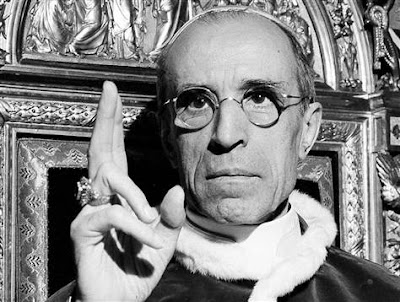
Pope Pius XII
|
In 1952 Pope Pius XII said the following, in a public address recorded among his official acts:
Even when it is a question of the execution of a condemned man, the State does not dispose of the individual's right to life. In this case it is reserved to the public power to deprive the condemned person of the enjoyment of life in expiation of his crime when, by his crime, he has already disposed himself of his right to live.
In 2017 Pope Francis spoke, in a not dissimilar context:
It must be clearly stated that the death penalty is an inhumane measure that, regardless of how it is carried out, abases human dignity. It is per se contrary to the Gospel, because it entails the willful suppression of a human life that never ceases to be sacred in the eyes of its Creator and of which – ultimately – only God is the true judge and guarantor.
Again:
It is necessary, therefore, to reaffirm that no matter how serious the crime that has been committed, the death penalty is inadmissible because it is an attack on the inviolability and the dignity of the person.
What can the Ultramontanists, those with an exaggerated view of papal authority so prominent in the debate over Amoris laetitia, make of this situation?
Presumably, in 1952 all good Ultramontanists said that, because the Pope had said so, it follows that it is true that the death penalty is not only permissible, but for sufficiently serious crimes, uniquely appropriate. (What else does it mean, to say that a criminal has 'disposed' of his 'right to life'?)
Today, in 2017, all good Ultramontanists are saying that, because the Pope has said so, it follows that it is false that the the death penalty is ever permissible.
Now, the official Ultramontanist line is that Papal authority, being supreme and (for practical purposes, always) infallible, can never be self contradictory. But between these two papal statements there is a contradiction as plain as the nose on your face. The suggestion that the 2017 statement is a 'development' or 'clarification' of what was said in 1952, or that is draws out implications of this and other expressions of the Church's teaching on capital punishment over the centuries, is not something one needs to haggle over. It is simply insane.
But for those who wish to haggle, a simple test of the development of doctrine is to ask if later authors can continue to accept earlier expressions of a doctrine as being true. Thus, we find the discussion of grace in Augustine lacking some distinctions developed by later authors and used in dogmatic statements, but Augustine is not for that reason wrong, and what he writes is not, with hindsight, heresy. It might on occasion be misleading to quote Augustine on grace, but one need not disavow him. In this case, by contrast, it is evident that Pope Francis disagrees with Pope Pius XII: they can't both be right.
Today's Ultramontanists are in a bind, therefore. In order to uphold the supreme and (for practical purposes, always) infallible authority of Pope Francis, they are going to have to admit that the authority of Pope Pius XII was not so supreme or infallible after all.
But if people would have been wrong in 1952 to throw themselves on their faces before Pius XII and agree with what he said about capital punishment, just because he'd said it, then the hideous possibility must exist that people may be wrong to agree with everything that Pope Francis says in 2017, just because he's said it.
Pope Francis' statement, by so simply and so clearly contradicting his predecessor of 65 years ago, demonstrates the falsity of Ultramontanism in a way I would never have thought possible. We may point out to the Ultramontanists that the contradiction of one Pope by another on a matter of faith and morals is possible, given the fallibility of most of their pronouncements, even when they are giving every appearance of exercising their teaching office (let alone when they are talking off the cuff on aeroplanes, or writing private letters), but usually Popes are far too careful in preparing their public remarks to allow this to happen, except in the most subtle and tacit way. But Pope Francis has done it. The game is up.
Ultramontanism as a practical guide for Catholics only works, insofar as it can work at all, in times of great stability. At times like the present, it is self-contradictory and absurd. After Pope Francis' statement on the death penalty, no Catholic with intellectual integrity can continue to hold it.
Where does this leave the ordinary Catholic? The ordinary Catholic is obliged to believe what the Church teaches. The Church hands on faithfully what she has received from her Lord. We can see Pope Pius XII doing that in the quoted passage: using the language of his time, certainly, but in its content faithful to the Popes, the Fathers and Doctors, and Scripture (see
Gen. 9:6;
Lev. 20-1;
Deut. 13;
Deut. 21:22;
Matt. 15:4;
Mk. 7:10;
Jn. 19:11;
Rom. 13:4;
Heb. 10:28).
Of Pope Francis' statement, to put it mildly, this cannot be said.
Cardinal Dulles gives a thorough account of the teaching of the Church on First Things
here.
TOPICS: Catholic; Religion & Culture; Religion & Politics
KEYWORDS: francischurch; ultramontanism
1
posted on
10/15/2017 11:17:36 AM PDT
by
ebb tide
To: ebb tide
Generally, the position of the church is - unless there is a compelling social safety reason, executions are not appropriate.
2
posted on
10/15/2017 11:19:53 AM PDT
by
Fido969
(In!)
To: ebb tide
The issue is not papal infallibility. The issue is Church Infallibility. The Church’s Ordinary Universal Magisterium is infallible. Her teaching on the death penalty is part of the OUM.
3
posted on
10/15/2017 12:46:26 PM PDT
by
piusv
(Pray for a return to the pre-Vatican II (Catholic) Faith)
To: Fido969
Generally, the position of the church is - unless there is a compelling social safety reason, executions are not appropriate.That is a prudential position. Catholic doctrine has never opposed capital punishment.
4
posted on
10/15/2017 12:56:47 PM PDT
by
Jeff Chandler
(From now on refer to them as the Weinstein Democrats and the Weinstein media.)
To: Jeff Chandler
Catholic doctrine has never opposed capital punishment. Not per se, however, the Catechism is perfectly clear on the church's reluctance related to that practice.
To say the church "supports" capital punishment is a statement fierce opposition to the long-standing teaching of the church related to that matter.
5
posted on
10/15/2017 1:28:06 PM PDT
by
Fido969
(In!)
To: Jeff Chandler
From the Catechism:
2266 The efforts of the state to curb the spread of behavior harmful to people's rights and to the basic rules of civil society correspond to the requirement of safeguarding the common good. Legitimate public authority has the right and duty to inflict punishment proportionate to the gravity of the offense. Punishment has the primary aim of redressing the disorder introduced by the offense. When it is willingly accepted by the guilty party, it assumes the value of expiation. Punishment then, in addition to defending public order and protecting people's safety, has a medicinal purpose: as far as possible, it must contribute to the correction of the guilty party.67
2267 Assuming that the guilty party's identity and responsibility have been fully determined, the traditional teaching of the Church does not exclude recourse to the death penalty, if this is the only possible way of effectively defending human lives against the unjust aggressor.
If, however, non-lethal means are sufficient to defend and protect people's safety from the aggressor, authority will limit itself to such means, as these are more in keeping with the concrete conditions of the common good and more in conformity to the dignity of the human person.
Today, in fact, as a consequence of the possibilities which the state has for effectively preventing crime, by rendering one who has committed an offense incapable of doing harm - without definitely taking away from him the possibility of redeeming himself - the cases in which the execution of the offender is an absolute necessity "are very rare, if not practically nonexistent."
Emphasis mine.
6
posted on
10/15/2017 1:33:42 PM PDT
by
Fido969
(In!)
To: Fido969
Those sections of the catechism expound upon
prudential opinions which are not only quite recent but which are in direct opposition to 2000 years of Catholic
doctrine.
Emphasis mine.
7
posted on
10/15/2017 1:40:27 PM PDT
by
Jeff Chandler
(From now on refer to them as the Weinstein Democrats and the Weinstein media.)
To: Fido969
To say the church “opposes” capital punishment is a statement in fierce opposition to the eternal doctrine of the church related to that matter.
8
posted on
10/15/2017 1:41:45 PM PDT
by
Jeff Chandler
(From now on refer to them as the Weinstein Democrats and the Weinstein media.)
To: ebb tide
Cardinal Dulles, while pointing to examples of executions in Jesus’ time, fails to mention the one time Jesus was given the opportunity to intervene in an execution, namely in the case of the adulterous woman.
Jesus never raised the issue of her guilt. Adultery was a serious crime, and due to social needs for strong families and proper inheritance, was considered a grave crime punishable by death. Was the adulterous woman “reformed”? Before Jesus’ final admonishment to her, we have no evidence of that. Was it possible, or even likely she might sin again unless stopped? Sure. We can consider society was at risk for her future misdeeds.
So while the adulterous woman met many of the criteria for a “just” execution, Jesus intervened and stopped it when He was asked about the matter.
9
posted on
10/15/2017 1:49:33 PM PDT
by
Fido969
(In!)
To: Fido969; Jeff Chandler
To say the church "supports" capital punishment is a statement fierce opposition to the long-standing teaching of the church related to that matter. To say JP II's 1992 catechism expresses long-standing church teaching is quite an exaggeration.
10
posted on
10/15/2017 1:52:37 PM PDT
by
ebb tide
(We have a rogue curia in Rome.)
To: Fido969
It is fine to refer generally to a recently minted catechism, but the ultimate authority can be found in Sacred Scripture, Sacred Tradition, and the Magisterium. Justly administered capital punishment is sanctioned in Sacred Tradition,
required by Sacred Scripture, and until JPII, sanctioned by the Magisterium.
If a Magisterial declaration is in opposition to Sacred Scripture and Sacred Tradition, it is incorrect. There must be harmony.
11
posted on
10/15/2017 1:58:43 PM PDT
by
Jeff Chandler
(From now on refer to them as the Weinstein Democrats and the Weinstein media.)
To: Fido969; Jeff Chandler
12
posted on
10/15/2017 2:02:37 PM PDT
by
ebb tide
(We have a rogue curia in Rome.)
To: Fido969; Jeff Chandler
13
posted on
10/15/2017 2:06:36 PM PDT
by
ebb tide
(We have a rogue curia in Rome.)
To: ebb tide
I’m not Catholic, but I do know that when He hung on the cross, between two criminals, Jesus didn’t say anything against the Romans putting them to death. He DID say to the repentant thief, “Today, you will be with Me in Paradise”. Criminals condemned to death, have ample time to repent and accept Jesus, something which their victims have usually been denied.
To: Flaming Conservative
As far as I know, Christian nations which practiced the death penalty (which is to say, historically, all Christian nations) also believed and taught, at the same time, that the criminal, though justly executed, could be saved. There were always priests who accompanied the condemned, urged them to the repent and trust in the Lord, and prayed for their redemption.
I think of St. Catherine of Siena, who had miraculous powers to discern the state of people's souls, and often prayed for and with condemned men, while acknowledging that they deserved their sentences.
The "Good Thief" Dimas, on the cross next to Jesus, is an example of this. He himself said that he was being crucified justly, on account of his crime, and Jesus did not contradict that. Interesting that He didn't. He did say the man, accepting his just punishment and appealing to God for mercy, would be in Paradise.
15
posted on
10/15/2017 2:27:41 PM PDT
by
Mrs. Don-o
(Point of Fact.)
To: ebb tide
To say JP II's 1992 catechism expresses long-standing church teaching is quite an exaggeration. Exactly. The modernist wheels were already in motion then.
16
posted on
10/15/2017 2:35:49 PM PDT
by
piusv
(Pray for a return to the pre-Vatican II (Catholic) Faith)
To: Fido969
Why is the story only about the woman taken in adultery? What happened to the man she was committing adultery with? Had he already been killed, or had he managed to escape?
To: Flaming Conservative
OOps, typo.
Dimas = Dismas
18
posted on
10/15/2017 2:54:43 PM PDT
by
Mrs. Don-o
(QWERTY, ergo typo.)
To: Fido969
Peace through strength and preemptive strikes are also "opposed."
I think any well-formed Catholic conscience can A), see the value of peace through superior firepower and B), see how utterly unqualified the current hierarchy is to offer an opinion on the matter.
19
posted on
10/15/2017 4:08:49 PM PDT
by
Wyrd bið ful aræd
(Flag burners can go screw -- I'm mighty PROUD of that ragged old flag)
To: Verginius Rufus
Why is the story only about the woman taken in adultery? What happened to the man she was committing adultery with? Had he already been killed, or had he managed to escape? We wonder about that at Bible study.
20
posted on
10/16/2017 6:56:19 AM PDT
by
Fido969
(In!)
Disclaimer:
Opinions posted on Free Republic are those of the individual
posters and do not necessarily represent the opinion of Free Republic or its
management. All materials posted herein are protected by copyright law and the
exemption for fair use of copyrighted works.
FreeRepublic.com is powered by software copyright 2000-2008 John Robinson
