Posted on 08/11/2015 10:54:19 AM PDT by NRx
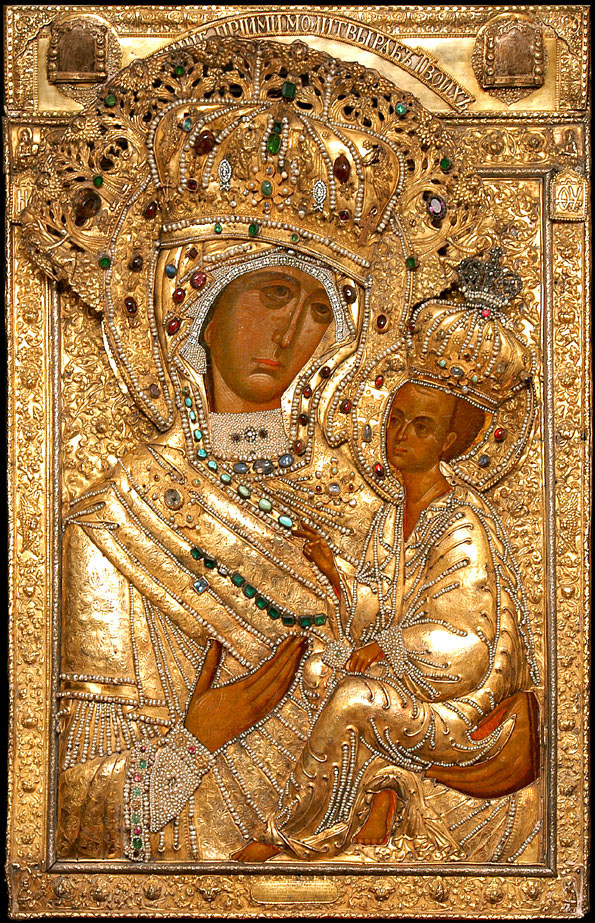
According to ancient tradition, the wonderworking icon of Tikhvin is one of several painted by St Luke the Evangelist. The icon was taken from Jerusalem to Constantinople in the fifth century, where it was enshrined in the Church of Blachernae, which was built especially for this purpose.
In 1383, seventy years before the fall of Constantinople at the hands of the Turks, fishermen on Lake Ladoga in the principality of Novgorod the Great witnessed the icon miraculously hovering over the lake’s waters amidst a radiant light. According to an early sixteenth century Russian manuscript, “The Tale of Miracles of the Icon of the Tikhvin Mother of God,” the Theotokos herself decided that her image should leave Constantinople, perhaps in anticipation of the impending fall of the Byzantine Empire.
Shortly after its miraculous appearance, the icon was discovered in several neighboring towns, including the village of Motchenitsy on the bank of the Tikhvinka River, before it finally appeared near the town of Tikhvin. A wooden church dedicated to the Dormition of the Theotokos was built on the site of the icon’s final resting place. Miraculously, the icon survived a number of fires.
In the early sixteenth century, through the zeal of Great Prince Basil Ivanovich, a stone church was built to replace the original wooden structure. In 1560, by order of Tsar Ivan the Terrible, a men’s monastery was established near the church and enclosed with a stone wall.
In 1613-1614, the Swedish army, having seized Novgorod, made several attempts to destroy the monastery. The countless prayers offered to the Theotokos before the icon were heard, and the monastery was spared. On one occasion, after monks had been alerted to the approaching Swedish army, they decided to flee and to take the icon with them. But the monks soon discovered that they could not remove the icon from its shrine. Seeing this as a sign of the Theotokos’ protection, the monks decided not to abandon the monastery, begging the Theotokos to spare them and their beloved spiritual home. To their amazement, a large Muscovite army appeared to defend the monastery.
When the Swedes encountered the army, they retreated immediately. Word of this miracle spread rapidly, and imperial emissaries soon visited the monastery. Accompanied by a copy of the wonderworking icon, they set off for the village of Stolbovo, 33 miles from Tikhvin, where they concluded a peace treaty with the Swedes on February 10, 1617. Afterwards, the copy of the icon was taken to Moscow and enshrined in the Kremlin’s Dormition Cathedral. Later, the same icon was placed in the Holy Wisdom (Hagia Sophia) cathedral in Novgorod at the request of the city’s faithful, who also found themselves under attack by the Swedes. Once again, through the intercession of the Theotokos, the city was spared.
Over the centuries, the icon’s fame spread far and wide. Copies of the wonderworking icon began to adorn churches throughout the land. Some of these copies also proved to be sources of miracles, and it was not uncommon to find the faithful praying before the icon to seek healing for children who were ill.
No fewer than 24 processions with the icon were celebrated each year at the Tikhvin Monastery, where the icon was enshrined. A decorative cover, or “riza,” adorned the icon, exposing only the faces and hands of the Holy Virgin and Christ child. Numerous precious stones studded the riza, and many of the faithful, desiring to express thanksgiving for prayers answered through the Theotokos’ intercession, affixed precious jewelry to the riza.
Most miraculous is the fact that the icon was preserved from destruction or sale after the Russian Revolution, which ushered in a 74-year persecution of the Church. During the 1920s, the communist government demanded that the Russian Orthodox Church turn over countless icons and other precious liturgical items, which through the nationalization of private property were considered the property of “the people.” Many of these sacred items were sold, allegedly to raise money to feed the Russian and Ukrainian population which was afflicted by famine.
During the World War II German occupation, the Nazis removed the icon from the Tikhvin Monastery, from where it was taken to Pskov and subsequently to Riga, Latvia. When the city was evacuated, Bishop John [Garklavs] of Riga, in whose care the icon was placed, took the icon to Bavaria, where it was venerated by Orthodox faithful who had been displaced because of the war. While Soviet agents had spotted the icon, Bishop John was permitted to take the icon to the United States in 1949, under the pretext that the icon in his care was a reproduction, the work of a simple monk, and that it was of little historic or monetary value. Shortly after his arrival in the United States, Bishop John, who was later elevated to the rank of Archbishop, was elected to oversee the Diocese of Chicago, and the icon was regularly displayed and venerated in Chicago’s Holy Trinity Cathedral.
Bishop John frequently took the icon on pilgrimage to various places throughout the United States and Canada. After his retirement in the late 1970s and death on Palm Sunday in 1982, Archpriest Sergei Garklavs, Bishop John’s adopted son, became the caretaker of the icon. In 2003, over a decade after the fall of communism and the resurrection of the Russian Orthodox Church, the decision was made to return the precious icon to its original home.
The icon began its year-long journey to Russia at the 99th annual Pilgrimage to St Tikhon Monastery, South Canaan, Pennsylvania, May 23-26, 2003. His Beatitude, Metropolitan Herman, Primate of the Orthodox Church in America, together with members of the Holy Synod of Bishops and guest hierarchs, greeted the icon, which was available for veneration by the faithful.
The icon follows the “Hodigitria” model and is similar in style to the ancient Iveron icon of Our Lady. It differs in that the Christ child’s legs are crossed, while the sole of His foot is turned to the viewer. Several historic sources note that several other Hodigitria icons of the Theotokos had been brought to Russia in the 1380s, during the rule of the saintly prince Demetrius Donskoy.
-- Archpriest John Matusiak
The icon has been associated with numerous miracles including the curing of blindness and many childhood illnesses. It is an object of fervent veneration by expectant mothers and those with young children.
This Akathist is particularly beautiful. Thank-you!
From the 3rd Ikos of the Akathist:
Rejoice, O Tabernacle wherein God dwelt in the flesh.
Rejoice, O Holy of Holies into which only the Eternal
High Priest can enter.
Rejoice, O Ark of the Covenant, filled with the Spirit
that bore the Giver of the Law.
Rejoice, O Candlestand aflame with the fire of Divinity.
Rejoice, O Vessel that carried Christ, the Manna of Life
Rejoice, O Banquet Feast, feeding us with the Bread of
Life.
Rejoice, O Censer, radiant with the warmth of God,
filling the world with sweet smelling incense.
Rejoice, O Stem, from which Christ the Flower
blossomed.
Rejoice, O Pillar of Fire which leads us to the Promised
Land.
Rejoice, O Pillar of Cloud that hides us from all visible
and invisible enemies.
Rejoice, O Promised Land.
Rejoice, O Fleece upon which Christ descended as dew
from the heavens. //
Rejoice, O Lady, our merciful defender before God!
And from the 4th:
Rejoice, O Daughter who inclined her ear to the voice of
the Heavenly Father.
Rejoice, for the sorrow of Eve was assuaged by the birth
of your Son.
Rejoice, O Bride, desired for your goodness by the King
of Heaven.
Rejoice, O Queen who stands at the right hand of the King.
Rejoice, for you are clothed with golden robes and
adorned with inner glory.
Rejoice, for you lead the faithful into the mansions of the
Heavenly Kingdom.
Rejoice, O Apple whose fragrance fills the whole world.
Rejoice, O Blossom of Purity that sparkles with brilliance.
Rejoice, O Sweet-smelling Chrism, whose streams cover
the earth.
Rejoice, O Royal Porphyry that brought forth God in the
flesh from your virginal womb.
Rejoice, O Living Fountain from which springs the
Water of Life.
Rejoice, O Vineyard of the Lord in which the Vine of
Divinity has blossomed. //
Rejoice, O Lady, our merciful defender before God!
Exquisite!
Lovely. I recognize some of the phrases from the Akathist of the Annunciation and others from Psalm 45.
In the 4th Ikos of the Akathist we chant on the first four Fridays in Great Lent, we sing:
“With voices of song in faith we cry aloud to thee, who art worthy of all praise: Rejoice, butter mountain, mountain curdled by the Spirit. Rejoice, candlestick and vessel of manna, which sweeteneth the senses of all the pious.”
Calling her “butter mountain, mountain curdled by the Spirit” speaks volumes about the culture which developed the Akathist and that culture’s notions of motherhood. I love it!
I’d almost be tempted to clobber someone who addressed me as “butter mountain,” and “curdled” isn’t generally a nice thing to say about someone in English.
Not that I don’t see the point ...
Of course, but this Akathist was written in Constantinople in Greek in the 6th century by a fellow called St. Romanos the Melodist. He was originally from Syria, Damascus I think and was born a Jew. The imagery is one of richness and life giving nourishment. In a society unfamiliar with formula, it’s a spectacular compliment.
I’m slightly familiar with St. Romanos the Melodist. He appears in our devotional publications sometimes.
And you’re right, it is a spectacular compliment, once one gets past the unexpectedness factor. I get very tired of the vilification of motherhood in our present culture.
Rejoice, O Treasury of Virginity, entrusted for safekeeping
to Joseph.
Rejoice, O Vessel that accepted the burning coal of
divinity in your womb.
Rejoice, O Exalted Throne upon which Christ descended
in the flesh.
Rejoice, O Billowing Cloud upon which the King of
Glory enters.
Rejoice, O Sealed Chamber from which Christ alone
came forth.
Rejoice, O Mount unhewn from which the Cornerstone
was fashioned.
Rejoice, O Fiery Furnace, filled with dew that was not
consumed by the Fire of Divinity. //
Rejoice, O Lady, our merciful defender before God!
I never knew the history of this famous icon. Thanks for sharing.

Disclaimer: Opinions posted on Free Republic are those of the individual posters and do not necessarily represent the opinion of Free Republic or its management. All materials posted herein are protected by copyright law and the exemption for fair use of copyrighted works.