Free Republic
Browse · Search
Religion
Topics · Post Article

Skip to comments.

Catholic Caucus: Daily Mass Readings, 10-13-13
USCCB ^ | October 12, 2013

Posted on 10/12/2013 4:04:24 PM PDT by NYer

Twenty-eighth Sunday in Ordinary Time
Lectionary: 144

Reading 1 2 Kgs 5:14-17

Naaman went down and plunged into the Jordan seven times
at the word of Elisha, the man of God.
His flesh became again like the flesh of a little child,
and he was clean of his leprosy.

Naaman returned with his whole retinue to the man of God.
On his arrival he stood before Elisha and said,
"Now I know that there is no God in all the earth,
except in Israel.
Please accept a gift from your servant."

Elisha replied, "As the LORD lives whom I serve, I will not take it;"
and despite Naaman's urging, he still refused.
Naaman said: "If you will not accept,
please let me, your servant, have two mule-loads of earth,
for I will no longer offer holocaust or sacrifice
to any other god except to the LORD."

Responsorial Psalm Ps 98:1, 2-3, 3-4

R. (cf. 2b) The Lord has revealed to the nations his saving power.
Sing to the LORD a new song,
for he has done wondrous deeds;
his right hand has won victory for him,
his holy arm.
R. The Lord has revealed to the nations his saving power.
The LORD has made his salvation known:
in the sight of the nations he has revealed his justice.
He has remembered his kindness and his faithfulness
toward the house of Israel.
R. The Lord has revealed to the nations his saving power.
All the ends of the earth have seen
the salvation by our God.
Sing joyfully to the LORD, all you lands:
break into song; sing praise.
R. The Lord has revealed to the nations his saving power.

Reading 2 2 Tm 2:8-13

Beloved:
Remember Jesus Christ, raised from the dead, a descendant of David:
such is my gospel, for which I am suffering,
even to the point of chains, like a criminal.
But the word of God is not chained.
Therefore, I bear with everything for the sake of those who are chosen,
so that they too may obtain the salvation that is in Christ Jesus,
together with eternal glory.
This saying is trustworthy:
If we have died with him
we shall also live with him;
if we persevere
we shall also reign with him.
But if we deny him
he will deny us.
If we are unfaithful
he remains faithful,
for he cannot deny himself.

Gospel Lk 17:11-19

As Jesus continued his journey to Jerusalem,
he traveled through Samaria and Galilee.
As he was entering a village, ten lepers met him.
They stood at a distance from him and raised their voices, saying,
"Jesus, Master! Have pity on us!"
And when he saw them, he said,
"Go show yourselves to the priests."
As they were going they were cleansed.
And one of them, realizing he had been healed,
returned, glorifying God in a loud voice;
and he fell at the feet of Jesus and thanked him.
He was a Samaritan.
Jesus said in reply,
"Ten were cleansed, were they not?
Where are the other nine?
Has none but this foreigner returned to give thanks to God?"
Then he said to him, "Stand up and go;
your faith has saved you."


TOPICS: Catholic; Ministry/Outreach; Worship
KEYWORDS: scripture

1 posted on 10/12/2013 4:04:24 PM PDT by NYer
[ Post Reply | Private Reply | View Replies]

To: Tax-chick; GregB; Berlin_Freeper; SumProVita; narses; bboop; SevenofNine; Ronaldus Magnus; tiki; ...
Salvation's computer is in for repairs and I volunteered to post Sunday's readings. Some of you are on Salvation's ping list. Since our lists are similar, I am pinging my list in the hopes that some of you will share this with others.


WDTPRS 28th Ordinary Sunday: “our good works are a result of His grace”

Posted on by Fr. John Zuhlsdorf

Something to think about as we go into the weekend and your upcoming Sunday Mass.

COLLECT – (2002MR):
Tua nos, quaesumus, Domine, gratia
semper et praeveniat et sequatur,
ac bonis operibus iugiter praestet esse intentos
.

This dense little Collect was used for centuries on the Sixteenth Sunday after Pentecost (and still is by those enjoying the use of the 1962 Missale Romanum). There is true elegance in this prayer. Latin word order can be flexible because of the inflection of the word endings. The wide separation of tua and gratia in the first line is a good example of the figure of speech called hyperbaton: unusual word order to produce a dramatic effect. The et… et construction is also effective. This is a lovely prayer to sing aloud with the traditional tone for Collects.

That use of praeveniat…sequatur reminds me of a prayer I would hear at my parish during the Tuesday night devotions, including the Novena of Our Mother of Perpetual Help by St. Alphonsus Liguori (+1787). It is often employed as a prayer for the sick: “May the Lord Jesus Christ be with you that He may defend you, within you that He may sustain you, before you that He may lead you, behind you that He may protect you, above you that He may bless you. In the name of the Father, the Son and the Holy Spirit.”

OBSOLETE ICEL (1973 translation of the 1970MR):
Lord,
our help and guide,
make your love the foundation of our lives.
May our love for you express itself
in our eagerness to do good for others
.

This ICEL version, while probably a wonderful little prayer for use on a Catholic grade school playground, is appallingly bad as a translation for Mass.

We need to examine some vocabulary. The adjective intentus means “to stretch out or forth, extend” as well as “to strain or stretch towards, to extend.” The action packed Lewis & Short Dictionary states that it also stands for, “to direct one’s thoughts or attention to.” Latin has several particles that join parts of sentences and concepts together: et, – que, atque or (ac), etiam, and quoque.

These little words all basically mean “and” but they have their nuances. For example, et simply means “and” while – que (which is always “enclitic”, that is, tacked onto the end of another word) joins elements that are closely enough associated that the second member completes or extends the first. Another conjunction, atque (a compound of ad and – que) often adds something more important to a less important thing. The useful Gildersleeve & Lodge Latin Grammar points out that “the second member often owes its importance to the necessity of having the complement (- que).” Ac is a shorter form of atque and it does not stand before a vowel or the letter “h”. G&L says that ac is “fainter” than atque and can mean nearly et. Briefly, etiam means “even (now), yet, still”. Etiam exaggerates and precedes the words to which it belongs while quoque is “so, also” and complements and follows the words it goes with. There are some other copulative particles or joining words, but that is enough for now.

Let’s nit-pick a little more. Our Collect has both semper and iugiter. The adverb semper is always “always” whereas iugiter (the adverbial form of iugis) means “always” in the sense of “continuously.” Here is the reason. A iugum is a “yoke”, like that which yokes together oxen. Iugum, or in English “juger”, was also a Roman measure of land (28,800 square feet or 240 by 120 feet) It was so-called probably because it was plowed by yoked oxen. Morever, iugum was the name of the constellation we call Libra, the Latin word for a “scale, balance” which has a kind of yoke on it, and thus also for the Roman weight measure the “pound”. This is why the English abbreviation for a pound is “lbs”! The iugum was the infamous ancient symbol of defeat. The Romans would force the vanquished to pass under a yoke to symbolize that they had been subjugated. Variously, iugum also means a connection between mountains or the beam of a weaver’s loom or even the marriage bond. Our adverb iugiter means “always” in a continuous sense probably because of the concept of yoking things together, bridging them, one after another in a unending chain. We get this same word in the famous prayer written by St. Thomas Aquinas (+1274) used at Benediction of the Blessed Sacrament which is the Collect for Corpus Christi: “O God, who bequeathed to us a memorial of Thy Passion under a wondrous sacrament, grant, we implore, that we may venerate the sacred mysteries of Thy Body and Blood, in such a way as to sense within us constantly (iugiter) the fruit of Thy redemption.” This is an appropriate citation of iugiter here at the end of our Year of the Eucharist.

SLAVISHLY LITERAL TRANSLATION:
We beg, O Lord, that Your grace
may always both go before and follow after us,
and hence continuously grant us to be intent upon good works
.

It is important not to get overly picky about particles in our translation work and exaggerate the nuances. Their meanings are close enough that at times one word will be chosen over another by reason of its pleasing sound in this or that context. Still, I think in our prayer today these conjunctions are important. That et…et is a classic “both…and” construction, but our Collect has et…et…ac... The et…et joins praeveniat and sequatur and then that pair of verbs is followed by an ac. If that ac informs us that what follows is of greater importance than what precedes it, then our Collect has built into it a logical climax of ideas. This is why I added a “hence” to my literal version. Keep firmly in mind that tua gratia… “your grace” is the subject of all these verbs. We want God, by means of grace, always to be both before and behind us. We want that so that, by His grace always, we may be attentive to good works. Even our good works are a result of His grace.

We know not either the day or hour when the King of Fearful Majesty will return to unmake our world in fire:

“But the day of the Lord will come like a thief, and then the heavens will pass away with a loud noise, and the elements will be dissolved with fire, and the earth and the works that are upon it will be burned up. Since all these things are thus to be dissolved, what sort of persons ought you to be in lives of holiness and godliness, waiting for and hastening the coming of the day of God, because of which the heavens will be kindled and dissolved, and the elements will melt with fire!” (2 Peter 3:10 RSV).

We must rely on God so absolutely that we do not fail in the vocations He has entrusted to us. God has given us all something to do in this life. If we attend to our work with real devotion He will give us every actual grace we need to accomplish our holy tasks. Living and acting in this way and in the state of grace we merit, through Jesus Christ’s Sacrifice, to enjoy the happiness of the heaven for which we were made. Good works must always be involved in this.

In our prayer we recognize that all good initiatives come from God beforehand. Once we choose to embrace them and cooperate with Him in those initiatives, He is the one who ultimately brings them to completion. He goes before, follows after, and is more present to us than we are to ourselves. The only reason any of our good works have any merit for heaven is that God inspires them, informs them, and brings them to a good completion through us His knowing, willing, and loving servants. The deeds are truly ours, of course, and therefore the reward for them is ours, but merit is God’s which He in love shares with us.

We see in today’s Collect how important our good works are and that they are all manifestations of God’s grace. Just as we hope God will lavish His graces on us, so too ought we be generous with our good works.

2 posted on 10/12/2013 4:06:57 PM PDT by NYer ("The wise man is the one who can save his soul. - St. Nimatullah Al-Hardini)
[ Post Reply | Private Reply | To 1 | View Replies]

To: All
From Deacon Greg Kendra.

Homily for October 13, 2013: 28th Sunday in Ordinary Time

October 12, 2013 By

[Click here for the readings]

Centuries from now, when people are studying our civilization, one of the most fascinating examples of our culture will be something that just a few years ago seemed like a foolish conceit. But it has touched lives in ways even its creator couldn’t have imagined—reaching over one billion people. It’s now a part of our vocabulary.

It’s Facebook.

A few years ago, the movie “The Social Network” offered one account of how Facebook came to be.

In the first scene of the movie, Harvard undergraduate Mark Zuckerberg ends up being rejected by a girl while on a date. You can understand why: he’s really a jerk. But bent on revenge, and feeling like an outsider, he goes back to his dorm and sits down at his computer and sets out to create the ultimate “club” at Harvard – and succeeds beyond anyone’s wildest expectations.

Zuckerberg’s motivations in the movie are the kind any of us can recognize – but it comes down to more than just settling scores or even blind ambition.

It all comes down to wanting to be accepted — our need to belong to something, our yearning to love and to be loved.

That, for better or worse, is part of our humanity.

No one wants to feel like an outcast.

Which brings me to the 10 people Jesus encountered in today’s gospel.

They were the ultimate outcasts: lepers. They lived totally apart from others – diseased and disfigured. By law, they had to keep a certain distance from everyone else. They had to keep their faces covered. Other people could have nothing to do with them. In curing them, Christ offered them more than just a miraculous healing. He offered them a new life. A new way of life. A life in community – able to walk freely in the town, to worship with others, eat with others, to be accepted and even, perhaps, to be loved. They could finally have a life they had long been denied because of their disease.

All of that, on its own, is meaningful enough. But Luke throws in one sentence that makes it clear it’s about much more than another healing miracle.

“He was a Samaritan.”

The only one who went back to Jesus, who fell before him and gave thanks, was the outcast among all outcasts, a figure doubly despised. A Samaritan.

It’s important to remember that Luke was the only writer of the four gospels who was not Jewish. He was a gentile, probably Greek. Like the Samaritan, he was an outsider himself. And so again and again, he opens the gospel to a wider world.

The first chapters of Luke, with the nativity story, bring people from all over the world to Bethlehem – wise men, shepherds, angels, everyone. When tracing Christ’s geneology, Luke doesn’t begin with Abraham, as Matthew does, but with Adam – the father of us all. And in his gospel, Luke takes pains to write about all the despised people who are saved: the tax collectors, the prostitutes, the prodigal son, the penitent thief. And, of course, he also gives us two famous Samaritans: the Good Samaritan, and the man we met today, this healed Samaritan.

All these are people who might be considered outsiders or outcasts – but they are the ones in Luke’s gospel who repeatedly find healing, and salvation, and hope.

Just like the lone figure in this Sunday’s gospel.

The others who were miraculously cured went on with their lives. But this one Samaritan didn’t. He couldn’t. He had to turn around and go back to Christ and fall before him and give thanks.

But Christ made clear it was more than this gesture that changes this man’s life.

“Your faith,” Jesus tells him, “has saved you.”

Something stirred in this Samaritan’s heart, and moved him to reverse course, to go back to where it began – healed, renewed, redeemed. It was gratitude, but with a profound difference.

It was gratitude grounded in faith. Faith in something – and someone.

He understood that what really mattered wasn’t the gift…but the One who gave it.

And as Luke makes clear again and again in his beautiful gospel: that gift is offered to all.

All of us who stand outside the circle, who feel at one time or another rejected or cast out or unloved.

All of us who feel lonely or abandoned, desperate or despairing.

All of us who have felt bullied or betrayed.

Christ can make all of us whole, and healed.

Through the gift of his love and mercy, we no longer have to feel like lepers.

In the world of Facebook, the point of connection is to “friend” someone – some people I know have thousands of Facebook friends, most of them people they’ve never met.

I’m reminded of that old Protestant hymn that proclaims: “What a friend I have in Jesus.”

He is a friend we all have met – and one we will meet again in just a few minutes. The great gift of communion will join us once more to him, and join us together again as a body of believers, bound together by faith, healed together by Christ’s limitless love, redeemed together by his great sacrifice.

That’s the ultimate “social network,” the greatest in all of history.

This morning, let’s remember that – and, like the Samaritan, let’s cherish not only the gift … but the One who gave it.

Like the Samaritan, before we leave, let us turn back to the One who gave it — whispering our thanksgiving, praying in joyful hope that we too may one day hear the words that changed the life of that Samaritan forever:

“Your faith has saved you.”


3 posted on 10/12/2013 4:09:12 PM PDT by NYer ("The wise man is the one who can save his soul. - St. Nimatullah Al-Hardini)
[ Post Reply | Private Reply | To 2 | View Replies]

To: NYer

As I flunked out of Latin I in my freshman year of high school 50 years ago, I will not quibble with the good Father’s translations.


4 posted on 10/12/2013 4:31:16 PM PDT by GreyFriar (Spearhead - 3rd Armored Division 75-78 & 83-87)
[ Post Reply | Private Reply | To 2 | View Replies]

To: NYer
Luke
  English: Douay-Rheims Latin: Vulgata Clementina Greek NT: Byzantine/Majority Text (2000)
  Luke 17
11 And it came to pass, as he was going to Jerusalem, he passed through the midst of Samaria and Galilee. Et factum est, dum iret in Jerusalem, transibat per mediam Samariam et Galilæam. και εγενετο εν τω πορευεσθαι αυτον εις ιερουσαλημ και αυτος διηρχετο δια μεσου σαμαρειας και γαλιλαιας
12 And as he entered into a certain town, there met him ten men that were lepers, who stood afar off; Et cum ingrederetur quoddam castellum, occurrerunt ei decem viri leprosi, qui steterunt a longe : και εισερχομενου αυτου εις τινα κωμην απηντησαν αυτω δεκα λεπροι ανδρες οι εστησαν πορρωθεν
13 And lifted up their voice, saying: Jesus, master, have mercy on us. et levaverunt vocem, dicentes : Jesu præceptor, miserere nostri. και αυτοι ηραν φωνην λεγοντες ιησου επιστατα ελεησον ημας
14 Whom when he saw, he said: Go, shew yourselves to the priests. And it came to pass, as they went, they were made clean. Quos ut vidit, dixit : Ite, ostendite vos sacerdotibus. Et factum est, dum irent, mundati sunt. και ιδων ειπεν αυτοις πορευθεντες επιδειξατε εαυτους τοις ιερευσιν και εγενετο εν τω υπαγειν αυτους εκαθαρισθησαν
15 And one of them, when he saw that he was made clean, went back, with a loud voice glorifying God. Unus autem ex illis, ut vidit quia mundatus est, regressus est, cum magna voce magnificans Deum, εις δε εξ αυτων ιδων οτι ιαθη υπεστρεψεν μετα φωνης μεγαλης δοξαζων τον θεον
16 And he fell on his face before his feet, giving thanks: and this was a Samaritan. et cecidit in faciem ante pedes ejus, gratias agens : et hic erat Samaritanus. και επεσεν επι προσωπον παρα τους ποδας αυτου ευχαριστων αυτω και αυτος ην σαμαρειτης
17 And Jesus answering, said, Were not ten made clean? and where are the nine? Respondens autem Jesus, dixit : Nonne decem mundati sunt ? et novem ubi sunt ? αποκριθεις δε ο ιησους ειπεν ουχι οι δεκα εκαθαρισθησαν οι δε εννεα που
18 There is no one found to return and give glory to God, but this stranger. Non est inventus qui rediret, et daret gloriam Deo, nisi hic alienigena. ουχ ευρεθησαν υποστρεψαντες δουναι δοξαν τω θεω ει μη ο αλλογενης ουτος
19 And he said to him: Arise, go thy way; for thy faith hath made thee whole. Et ait illi : Surge, vade : quia fides tua te salvum fecit. και ειπεν αυτω αναστας πορευου η πιστις σου σεσωκεν σε
Catena Aurea does not a commentary to these verses.

Catena Aurea Luke 17
5 posted on 10/13/2013 11:12:02 AM PDT by annalex (fear them not)
[ Post Reply | Private Reply | To 1 | View Replies]

To: annalex


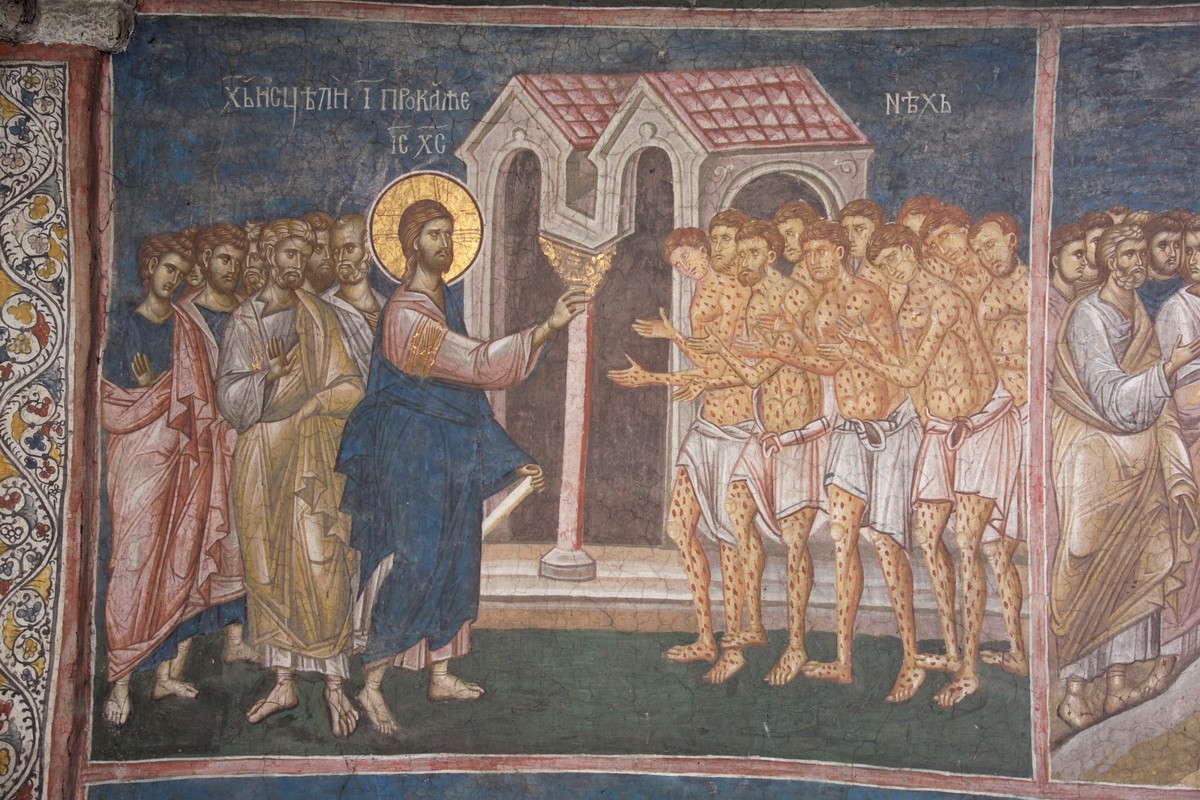
Christ healing the ten lepers

Decani, Serbia

6 posted on 10/13/2013 11:13:22 AM PDT by annalex (fear them not)
[ Post Reply | Private Reply | To 5 | View Replies]

Disclaimer: Opinions posted on Free Republic are those of the individual posters and do not necessarily represent the opinion of Free Republic or its management. All materials posted herein are protected by copyright law and the exemption for fair use of copyrighted works.

Free Republic
Browse · Search
Religion
Topics · Post Article

FreeRepublic, LLC, PO BOX 9771, FRESNO, CA 93794
FreeRepublic.com is powered by software copyright 2000-2008 John Robinson