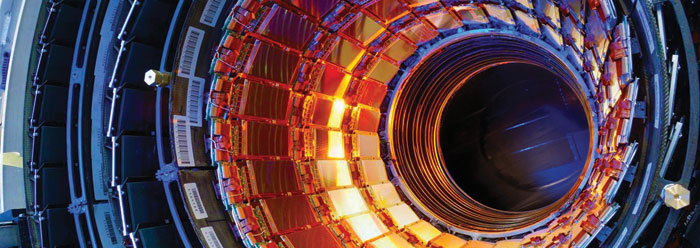
Photo from article.
Posted on 09/04/2012 8:36:01 AM PDT by fishtank
The Higgs Boson and the Big Bang by Jake Hebert, Ph.D. *
Scientists from Europe’s CERN research center presented evidence on July 4, 2012, for a particle that is likely the Higgs boson, the last remaining elementary particle predicted by the Standard Model of particle physics.1 Does this discovery have relevance for the creation-evolution controversy?
Particles can generally be classified into two categories, according to the quantum mechanical rules that they obey: fermions and bosons. The Higgs particle is called a boson because it falls into the second category.
Evidence for the Higgs boson was obtained from data collected at CERN’s Large Hadron Collider near Geneva, Switzerland, as well as at Fermilab’s Tevatron collider in the United States. Although the Higgs boson has been nicknamed the “God particle,” it is widely agreed that the name is more for publicity than accuracy, and many physicists do not like it. “I detest the name ‘God particle’. I am not particularly religious, but I find the term an ‘in your face’ affront to those who [are],” wrote physicist Vivek Sharma, a leader of the Higgs search. “I do experimental physics not GOD.”2
In order to understand the importance of the Higgs boson, it is necessary to review some modern physics. Quantum mechanics is a theory that successfully describes the behavior of matter and energy at subatomic and atomic scales, and quantum field theory is an extension of quantum mechanics. A field is a quantity that has a value at each point in space. Some fields are characterized by numbers at each point in space and are called scalar fields. A temperature field, for instance, would assign a temperature to each point in space and could, for instance, be used to show how the temperature within a room varies with location. Vector fields have both numbers and directions associated with each point in space; an example of a vector field would be the electric field surrounding a charged object.3
There is a tendency to intuitively think of particles as being like little round marbles. In modern physics, however, the reality is more complicated. Roughly speaking, quantum field theory views particles as “ripples” in the fields.4
Researchers think that one of these fields—a scalar field called the Higgs field—gives particles mass through their interaction with this field. Particles that interact strongly with the Higgs field have more mass, and vice versa. The Higgs boson, in turn, can be thought of as the smallest possible ripple in the Higgs field.5
The Standard Model is the theory that describes the relationships between elementary particles and three of the four fundamental forces (it does not include gravity). Prior to July 2012, physicists had confirmed the existence for all the elementary particles of the Standard Model except one—the Higgs boson.
There is no doubt that this discovery, if confirmed, is a triumph for the Standard Model.
Some are claiming that this discovery is a blow to Christianity. The Higgs boson is “another nail in the coffin of religion,” said one Cambridge University professor.6 However, noted theoretical physicist and professing atheist Stephen Hawking lost one hundred dollars betting that the Higgs boson would not be found, as he had apparently hoped that a more “elegant” mechanism would be found that could explain how particles have mass.7
Although quantum field theories are not directly related to the creation-evolution controversy, the Higgs field is sometimes discussed within the context of Big Bang cosmology. Shortly after the supposed Big Bang, proponents speculate that as the very high temperatures in the early universe decreased, a change in the Higgs field occurred, so that it was able to interact with particles in such a way as to give them mass. (The theoretical change in the Higgs field at high temperatures is somewhat similar to the way a magnet can lose its magnetism if heated above a high temperature.)8
But, presumably, particles would have mass as a result of their interaction with the Higgs field in either a creation or an evolution scenario, provided that temperatures are sufficiently low. Why would a theoretical change in the Higgs field at extremely high temperatures necessarily imply that such high temperatures were actually present in the early universe? Moreover, a major media outlet acknowledged the lack of direct evidence for this hypothetical high-temperature transition in the Higgs field, despite the general pro-evolution bias of the popular press.9
Physicist and popular author Michio Kaku wrote:
In quantum physics, it was a Higgs-like particle that sparked the cosmic explosion [the Big Bang]. In other words, everything we see around us, including galaxies, stars, planets and us, owes its existence to the Higgs boson.10
Kaku’s statement is ambiguous because it is not clear whether he is claiming that the Higgs boson itself or another still-hypothetical Higgs-like particle would have been the cause of the Big Bang. He is apparently alluding to the fact that Big Bang cosmologists speculate that a Higgs-like scalar field, the inflaton, could have caused inflation—a phenomenon needed in order to solve serious (if not fatal) problems in the original Big Bang model.
The inflaton is still hypothetical, but Big Bang cosmologists are convinced that, given the chaotic conditions they believe prevailed in the early universe, inflation-driving scalar fields would have been present in at least some regions of space. In older inflation models, inflation occurred shortly after the Big Bang and lasted for a very brief time. Theorists have since concluded, however, that when quantum mechanical fluctuations are taken into account, inflation in different regions of space would end at different times. The result is that a bubble or pocket of space that has stopped inflating will be surrounded by a region of space that is still expanding at a much faster rate. Because the still-inflating region is expanding much more rapidly than the pocket, the pocket becomes an island “universe” in a “sea” of still-inflating space.
This process is thought to continue indefinitely, so that infinitely many of these island universes are formed, and our universe is only one. Moreover, this process never ends—once inflation starts, it continues forever in the bulk of space. In such a view, it is only our universe that supposedly began 13.7 billion years ago. Hence, the idea that our universe is just one of infinitely many universes in a great multiverse is a direct consequence of modern inflationary theory.11
In this view, inflation could be viewed as a cause of the Big Bang, and this is likely why Kaku suggested that a Higgs-like particle (or more precisely, a Higgs-like scalar field) was the “spark” for the Big Bang. However, the inflaton is hypothetical! Although some theoretical physicists might attempt to argue that the Higgs field is the inflaton, others have rejected this idea for technical reasons.12 Paul Steinhardt, one of the world’s leading inflation theorists, acknowledged just last year that the inflaton is hypothetical and distinct from the Higgs field:
The leading example is a hypothesized relative of the magnetic field known as a scalar field, which, in the particular case of inflation, is known as the “inflaton” field. The famous Higgs particle now being sought at CERN’s Large Hadron Collider near Geneva derives from another scalar field [emphasis added].13
Even theoretical physicist and Big Bang evangelist Lawrence Krauss has acknowledged that the discovery of the Higgs boson in and of itself does not provide an explanation for the cause of the Big Bang, saying that determining the cause for this supposed event may be beyond our present technological capabilities.14
Thus, Kaku’s editorial is confusing at best and misleading at worst.
Reuters ran a story containing a statement that the Higgs field “attracted the flying debris of the big bang and turned it into stars, planets and galaxies.”15 This statement (perhaps unintentionally) gives the erroneous impression that the Higgs field can explain star and galaxy formation within the evolutionary model.
Yes, in the Standard Model, particles have mass due to their interaction with the Higgs field, and evolutionists believe that gravitational interactions between massive particles ultimately resulted in the formation of stars and galaxies. But because of serious difficulties in their theories, evolutionists have no convincing explanations as to how gravity could do this, and the (likely) discovery of the Higgs boson has in no way changed that.
Unfortunately, some physicists (though not all) do have an atheistic agenda. At the announcement for the discovery of the Higgs particle, one of the scientists actually thanked “nature” rather than God!16 And yet, many of the properties of our universe appear to have been engineered or “fine-tuned” in order to make our existence possible. Some evolutionists believe that the multiverse of inflation theory can explain this fine-tuning apart from a Creator, but this argument is seriously flawed.17
The discovery of the Higgs boson is a triumph for modern theoretical physics. Christians can and should celebrate the accomplishments of true science, but they have no need to be intimidated by the “vain imaginations” (Romans 1:21) of those seeking to deny their Creator.
References
Wickham, C. “It’s a boson”: Higgs quest bears new particle. Reuters. July 4, 2012. Moskowitz, C. What should ‘God Particle’ Be Renamed? Physicists Weigh In. LiveScience. Posted on livescience.com December 14, 2011, accessed July 6, 2012. The presence of an electric field causes a charged object to experience a force in the presence of other charged objects (like charges repel and opposite charges attract). Because an electric field is characterized by both a number and a direction at different points in space, the electric field can be used to determine the size and direction of the force on a charged object.
Strassler, M. Virtual Particles: What are they? Of Particular Significance Blog. Posted on profmattstrassler.com, accessed July 9, 2012.
Strassler, M. The Higgs FAQ 1.0. Of Particular Significance Blog. Posted on profmattstrassler.com, accessed July 9, 2012. ‘The Higgs boson is another nail in the coffin of religion.’ BBC News World Radio and TV. Posted on bbc. co.uk July 4, 2012, accessed July 6, 2012.
Boyle, A. Higgs’ big loser: Why Stephen Hawking is such a bad gambler. NBCnews.com. Posted on cosmiclog.msnbc.msn.com July 5, 2012, accessed July 13, 2012.
Siegfried, T. Nature’s secrets foretold. ScienceNews. Posted on sciencenews.org July 4, 2012, accessed July 9, 2012
Landau, E. Higgs boson is like…a Justin Bieber fan? CNN light years. Posted on lightyears.blogs.cnn.com July 5, 2012, accessed July 12, 2012.
Kaku, M. The Spark That Caused the Big Bang. The Wall Street Journal. Posted on online.wsj.com July 5, 2012, accessed July 9, 2012.
Steinhardt, P. 2011. The Inflation Debate. Scientific American. 304 (4): 36-43.
Falk, D. Canadian physicist Robert Orr on the Big Bang breakthrough. The Globe and Mail. Posted on theglobeandmail.com July 6, 2012, accessed July 9, 2012.
Steinhardt, The Infation Debate, 38-40.
Krauss, L. What is the Higgs boson and why does it matter? NewScientist. Posted on newscientist.com December 13, 2011, accessed July 6, 2012.
Evans, R. British theorist Peter Higgs lives to see his boson. Reuters, July 4, 2012.
Overbye, D. Physicists Find Elusive Particle Seen as Key to Universe. New York Times. Posted on nytimes.com July 4, 2012, accessed July 9, 2012.
Hebert, J. 2012. A Universe from Nothing? Acts & Facts. 41 (7): 11-13.
* Dr. Hebert is Research Associate at the Institute for Creation Research and received his Ph.D. in Physics from the University of Texas at Dallas.
Cite this article: Hebert, J. 2012. The Higgs Boson and the Big Bang. Acts & Facts. 41 (9): 11-13.
Photo from article.

Obviously, the ICR sees the Big Bang as a threat to their religion. Other religions do not.
A Higgs-Boson particle walks into a Catholic church. The priest looks at it and says; “We don’t want your kind here, you’ll have to leave”. The particle says; “I’m sorry you feel that way. Of course I’ll leave, if that is what you want”. After a pause, it continues; “You do realize though; that without me, you can’t have mass?”
Unnamed, or course.
I am not sure how this is related with religion at all. I don't recall reading about sub-atomic particles in Genesis. This is a quest for knowledge, nothing more. It is a non sequitur to assume that this sets back anything.
That is a lame article really. Let’s just say that they only understand ~4% of the observable universe and leave it at that.
This is the best creationist article I’ve ever read.
However, this,
“But, presumably, particles would have mass as a result of their interaction with the Higgs field in either a creation or an evolution scenario, provided that temperatures are sufficiently low. “
is gibberish.
Creationists have yet to provide any detailed reasonable alternative explanation for the current state of the universe. Some still deny a creation event at all, which I find very puzzling.
If the Big Bang doesn’t confirm the Genesis account, then why bother writing this article?
(1) It seems like the materialists picked this fight when they named it the “God particle”.
(2) TBBT is used as an excuse for atheism... Again, ICR didn’t start this little debate, iirc.
The term was used for the title of a book and never meant to be taken seriously. Most scientists do not like the term and none of them use it formally. It's journalists who keep the term alive.
(2) TBBT is used as an excuse for atheism... Again, ICR didn’t start this little debate, iirc.
My feeling is that godless, pro-state journalists shop around for the few scientists willing to use their work to attempt to disprove God.
The ICR should be battling journalists, not scientists.

Not really. Most Christians accept science. It's just a small handful of YEC'ers who choose to embrace ignorance.
http://www.chabad.org/kabbalah/article_cdo/aid/380568/jewish/Shattered-Vessels.htm
The four worlds, atziluth briah yetzirah assiah (intro)
http://www.yashanet.com/studies/judaism101/lessons/current_lesson.htm
Judaism
According to Jewish teachings in the Talmud, the universe is made of seven heavens (Shamayim) as below:
1.Vilon (וילון), Also see (Isa 40:22)also called "arafel" see Even-Shushan dictionary
2.Raki'a (רקיע), Also see (Gen 1:17)
3.Shehaqim (שחקים), See (Ps 78:23, Midr. Teh. to Ps. xix. 7)
4.Zebul (זבול), See (Isa 63:15, I Kings 8:13)
5.Ma'on (מעון), See (Deut 26:15, Ps 42:9)
6.Machon (מכון), See (1 Kings 7:30, Deut 28:12)
7.Araboth (ערבות), The seventh Heaven where ofanim, the seraphim, and the hayyoth and the throne of the Lord are located.
The Jewish Merkavah and Heichalot literature was devoted to discussing the details of these heavens, sometimes in connection with traditions relating to Enoch, such as the Third Book of Enoch.
http://en.wikipedia.org/wiki/Seven_Heavens
End
Cosmology has divided up the universe, 4 percent is matter, every star, planet, moon, etc. 23 percent is dark matter and 73 percent dark energy.
Lets say dark matter is the realm of heaven and angels, etc. 23 + 4 = 27, and 7 x 4 = 28, hmmm?
Disclaimer: Opinions posted on Free Republic are those of the individual posters and do not necessarily represent the opinion of Free Republic or its management. All materials posted herein are protected by copyright law and the exemption for fair use of copyrighted works.