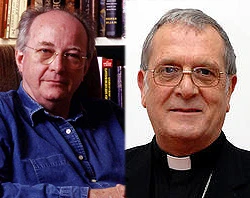
Philip Pullman / Bishop David McGough
Posted on 09/15/2009 5:49:56 AM PDT by NYer
.- Auxiliary Bishop of Birmingham David McGough has criticized a new book by the atheist author Philip Pullman, saying that his contention that St. Paul invented the divinity of Jesus would not be held by any respectable scholar of Scripture.
Pullman’s upcoming book, titled “The Good Man Jesus and the Scoundrel Christ,” claims that St. Paul transformed the character of Jesus and bestowed divine attributes to a normal man through his “fervid imagination,” the Catholic Herald reports.
Bishop McGough responded to the claim, saying that there is no evidence that Paul influenced the Gospels.
“No respectable scriptural scholar would have anything to do with [Pullman's] theory," he said. “This implication ignores the fact that there was a living Christian tradition from very early on which involved re-telling the Gospel in an oral form.”
Pullman told the Sunday London Times that by the time the Gospels were written down Paul had begun to “transform” the story of Jesus into something “altogether different and extraordinary.” He claimed some of this version influenced the Gospel writers.
“Paul was a literary and imaginative genius who has had more influence on the world than anybody else, including Jesus,” Pullman claimed. “He had this great ability to persuade others and his rhetorical skills have been convincing people for 2,000 years.”
The author charged that St. Paul has inspired evil and fanaticism.
"For every man or woman who has been led to goodness by a church, and I know there have been many, there has been another who has been inspired by the same church to a rancid and fanatical bigotry for which the only fitting word is evil,” he told the Times, arguing that the more power the Church has the worst it behaves.
Peter Kearney, a spokesman for the Catholic Church in Scotland, said that Catholics would not be overly concerned by the book.
“It is important that people should be free to express themselves, and Christians have withstood a lot more in the past - namely being thrown to the lions - that puts a book into perspective," he said, according to the Catholic Herald.
Pullman also authored the "His Dark Materials" trilogy, a children’s fantasy story which depicts a Catholic Church-like organization which cruelly experiments on children. The first book of the trilogy, “The Golden Compass,” was made into a 2007 movie.
L’Osservatore Romano described the movie as depicting “a cold and hopeless world without God.” In Pullman’s world, the Vatican newspaper charged, hope does not exist because there is no salvation but “only personal, individualistic capacity to control the situation and dominate events.”
The reviewer added that viewers would find it “devoid of any particular emotion apart from a great chill.”
According to the Internet Movie Database, “The Golden Compass” did not recoup its $180 million budget but earned only $70 million at the U.S. box office.
History revision ping!
LOL. An atheist getting it wrong on matters of faith. What’s next, 2 + 2 = 4?
Pullman has either never read the gospels, or he is betting that the audience for his book has never done so.
But apparently it's okay for Phillip Pullman to invent the "scholarship" of Phillip Pullman?
Christ imputed righteuosness into Paul on the way to Damascus and Paul spent the rest of his life proclaiming the Divinty of Christ. Paul did not make up the gospels, the word of God became alive in his heart!
Bertrand Russell, Richard Dawkins, Phillip Pullman, Arthur Clarke..........
Not to mention it's long and sordid history of anti-Catholicism.
It's in a frightful state.
Although Roberts eventually became a pastor, originally he began as a scholar, and spent many years (nearly 20? more?) at Harvard in New Testament Studies. Now this department at Harvard was not "faith based", at all, in fact something quite opposite, with biases running against the working of miracles, or the deity of Christ.
Yet even in this [mainly] anti-theist setting, using the accepted scholarly tools and disciplines commonly used by those doing such work as the examination and critique of ancient texts, Roberts is able to make a strong case for the reliability of the Gospels.
Read the reviews. Catholics in particular might like this one;
I myself was hoping the book would have been a bit more zap-pow, take THAT explosive in laying out "once-and-for-all" to the whole blasted world, that yes, the Holy Book is true, but that is not how disciplined scholarship operates. Still, I would highly recommend the book to any whom have an interest in the subject. Perhaps even more for those whom have been long affected (infected?) with a Dan Brown-Da Vinci Code sort of suspicion concerning the Gospels.
Roberts gently, in well supported and substantiated, disciplined scholarly fashion, lays those suspicions firmly to rest.
Disclaimer: Opinions posted on Free Republic are those of the individual posters and do not necessarily represent the opinion of Free Republic or its management. All materials posted herein are protected by copyright law and the exemption for fair use of copyrighted works.