Free Republic
Browse · Search
Religion
Topics · Post Article

Skip to comments.

† Traditional Sunday Propers ~ Feast Of The Holy Name of Christ Jesus †
Robert Drobot | 04 January 2008 Anno Dómini | The Most Holy Trinity

Posted on 01/05/2009 8:57:39 AM PST by Robert Drobot

Traditional Holy Mass Propers

† Feast Of The Holy Name of Christ Jesus †

Missa In nomine Jesu omne genuflectatur

( "In the name of Jesus let every knee bow" )

~ 04 January 2008 Anno Dómini

Therefore God has highly exalted Him and bestowed on Him the name that is above every name,
that at the name of Jesus every knee should bow, in heaven and on earth and under the earth,
and every tongue confess that Jesus Christ is Lord, to the glory of God the Father. ~~ Philippians 2:5-11

".... be filled with the knowledge of the will of God...."

"Nothing is so consoling, so piercing, so thrilling, so overcoming, as the Mass, said as it is among us.
I could attend Mass forever, and not be tired.
It is not a mere form of words; it is a great action.
The greatest action that can be on earth. It is. . .the vocation of the Eternal."

-- John Henry Cardinal Newman


TOPICS: Apologetics; Catholic; Orthodox Christian; Worship
KEYWORDS: consecration; eucharist; supplication; transubstantiation
Navigation: use the links below to view more comments.
first 1-2021-34 next last
The Story of Christmas

by Abbe Dom Prosper Gueranger

By God's design the number 40 is most significant in holy Mother Church's liturgical year, especially in this particular liturgical year. After four weeks of Advent, we follow with 40 days of Christmas called Christmastide, with the main emphasis on the time between the Nativity of our Lord and the Epiphany. This year within four days of the Feast of the Purification, we follow Christmastide with the 40 Days of Lent, then 40 glorious days before Christ's Ascension into Heaven. Alleluia, indeed!

We apply the name Christmas to the forty days which begin with the Nativity of Our Lord, December 25, and end with the Purification of the Blessed Virgin, February 2. It is a period which forms a distinct portion of the Liturgical Year, as distinct, by its own special spirit, from every other, as are Advent, Lent, Easter, or Pentecost. One same Mystery is celebrated and kept in view during the whole forty days. Neither the Feasts of the Saints, which so abound during this Season; nor the time of Septuagesima, with its mournful Purple, which often begins before Christmastide is over, seem able to distract our Holy Mother the Church from the immense joy of which she received the good tidings from the Angels on that glorious Night for which the world had been longing four thousand years. The Faithful will remember that the Liturgy commemorates this long expectation by the four penitential weeks of Advent.

The custom of celebrating the Solemnity of our Savior's Nativity by a feast or commemoration of forty days' duration is founded on the Holy Gospel itself; for it tells us that the Blessed Virgin Mary, after spending forty days in the contemplation of the Divine Fruit of her glorious Maternity, went to the Temple, there to fulfill, in most perfect humility, the ceremonies which the Law demanded of the daughters of Israel, when they became mothers.

A Roman Feast

The Feast of Mary's Purification is, therefore, part of that of Jesus' Birth; and the custom of keeping this holy and glorious period of forty days as one continued Festival has every appearance of being a very ancient one, at least in the Roman Church.

And firstly, with regard to our Savior's Birth on December 25, we have Saint John Chrysostom [whose feast is during Christmastide on January 27] telling us, in his homily for this Feast, that the Western Churches had, from the very commencement of Christianity, kept it on this day. He is not satisfied with merely mentioning the tradition; he undertakes to show that it is well founded, inasmuch as the Church of Rome had every means of knowing the true day of our Savior's Birth, since the acts of the Enrolment, taken in Judaea by command of Roman Emperor Augustus, were kept in the public archives of Rome.

The holy Doctor adduces a second argument, which he founds upon the Gospel of Blessed Apostle Saint Luke, and he reasons thus: we know from the sacred Scriptures that it must have been in the fast of the seventh month that the Priest Zachary had the vision in the Temple; after which Elizabeth, his wife, conceived Blessed Saint John the Baptist: hence it follows that the Blessed Virgin Mary having, as Holy Apostolic Evangelist Saint Luke relates, received the Angel Gabriel's visit, and conceived the Savior of the world in the sixth month of Elizabeth's pregnancy, that is to say, in March, the Birth of Jesus must have taken place in the month of December.

Christmas and Epiphany

But it was not till the fourth century that the Churches of the East began to keep the Feast of our Savior's Birth in the month of December. Up to that period they had kept it at one time on the sixth of January, thus uniting it, under the generic term of Epiphany, with the Manifestation of our Savior made to the Magi, and in them to the Gentiles; at another time, as Saint Clement of Alexandria tells us, they kept it on the 25th of the month Pachon (May 15) , or on the 25th of the month Pharmuth ( April 20 ).

Saint John Chrysostom, in the Homily we have just cited, which he gave in 386, tells us that the Roman custom of celebrating the Birth of our Savior on December 25 had then only been observed ten years in the Church of Antioch.

It is probable that this change had been introduced in obedience to the wishes of the Apostolic See, wishes which received additional weight by the edict of the Emperors Theodosius and Valentinian, which appeared towards the close of the fourth century, and decreed that the Nativity and Epiphany of our Lord should be made two distinct Festivals.

An Infant-God and a Virgin-Mother

But what is the characteristic of Christmas in the Latin Liturgy? It is twofold: it is joy, which the whole Church feels at the coming of the Divine Word in the Flesh; and it is admiration of that glorious Virgin, who was made the Mother of God. There is scarcely a prayer, or a rite, in the Liturgy of this glad Season, which does not imply these two grand Mysteries: an Infant-God, and a Virgin-Mother. The Liturgy never loses sight of the Divine Babe and his incomparable Mother, and never tires in their praises, during the whole period from the Nativity to the day when Mary comes to the Temple to present her Jesus.

The Greek Orthodox Catholic Church also make frequent commemorations of the Maternity of Mary in their Offices of this Season: but they have a special veneration for the twelve days between Christmas Day and the Epiphany, which, in their Liturgy, are called the Dodecameron.

During this time they observe no days of Abstinence from flesh-meat; and the Emperors of the East had, out of respect for the great Mystery, decreed that no servile work should be done, and that the Courts of Law should be closed, until after January 6.


1 posted on 01/05/2009 8:57:39 AM PST by Robert Drobot
[ Post Reply | Private Reply | View Replies]

Comment #2 Removed by Moderator

JANUARY
MONTH OF
THE HOLY NAME OF JESUS

"God has highly exalted Him and bestowed on Him the Name which is above every name,
that at the Name of Jesus
every knee should bow in heaven, and on earth and under the earth,
and every tongue confess that Jesus Christ is Lord,
to the glory of God the Father"
~~ Philippians 2:9-10

I C X C

Every Catholic should love and have great devotion to the Most Holy Name of JESUS, for this is the Name of our Divine Savior. More than that, this Name is our very Salvation: "There is salvation in no one else, for there is no other name under heaven given among men by which we must be saved" ~~ Acts 4:12

Yes, this is the teaching of Holy Mother Church. Contrary to popular ( anti-Catholic ) opinion, we do believe that our Divine Lord Jesus Christ is our Savior and Redeemer. We cannot be saved apart from Christ by calling upon the name of Mary or any saint ( although we certainly love them as our family in Christ ). Our salvation is in the Name of Jesus Christ, Who died for our sins and rose from the dead to give us a share in His divine Life! Praised be His Holy Name!

This is why the Church has long promoted devotion to the Most Holy Name of JESUS, and encourages her children to pray that Name often, invoking our God and Savior with His Name Above All Names.

I C X C

Monograms of the Holy Name Explained

IHΣOYΣ
XPIΣTOΣ

*IHS* This monogram of the Holy Name, common among Roman Rite Catholics, comes from the first three letters in the Greek spelling of the name of Jesus. Those letters are iota ( "I" ), eta ( "H" ) and sigma ( here rendered as its Roman equivalent: "S").

Variations: Sometimes the iota is rendered as a "J" ( hence, "JHS" ), or one will see the monogram in all Greek letters, or with the final sigma in a "C" shape ( hence "IHC" ), an alternate way of rendering the letter sigma. They all mean the same thing.

*IC XC* This monogram is more common among Eastern Christians. It is composed of the first and last letters of Jesus' Name in Greek (iota and sigma) with the first and last letters of Christos, the Greek word for Christ (chi and sigma, respectively). The sigmas are both rendered in "C" form, resulting in "IC XC".

This monogram is commonly written on ikons of Christ near His halo to identify Him, and in the phrase "IC XC NIKA", meaning "Jesus Christ Conquers".

I C X C

Holy Name Devotions

The simplest form of devotion to the Most Holy Name of JESUS is the devout, loving recitation of that Name above all names. Each time you whisper His precious Name ... "Jesus" ... let it be a loving invocation to your Divine Savior and Lord. You can even make it part of a short prayer, as in saying: "Jesus, I love You!", "Praise You, Jesus", and or, Jesus, Son of God, have mercy on me! ( a form of the Jesus Prayer ).

Praise to the Holy Name of JESUS

O Glorious Name of Jesus,
gracious Name,
Name of love and of power!
Through You sins are forgiven,
enemies are vanquished,
the sick are freed from illness,
the suffering are made strong and cheerful.

You bring honor to believers, instruction to preachers,
strength to those who toil,
and sustenance to the weary.

Our love for You is ardent and glowing,
through You our prayers are heard.
The souls of those who contemplate You
are filled to overflowing;
and all the blessed in heaven
are filled with Your glory.
Grant that we too may reign with them
through this Your most Holy Name. Amen

PRAYERS OF REPARATION FOR BLASPHEMY

Thou shalt not take the name of the Lord thy God in vain: for the Lord will not hold him guiltless that shall take the name of the Lord his God in vain. ~~ Exodus 20:7

Golden Arrow

"May the most holy, most sacred, most adorable, most mysterious and unutterable Name of God be always praised, blessed, loved, adored and glorified in heaven on earth and under the earth, by all the creatures of God, and by the Sacred Heart of our Lord Jesus Christ in the most Holy Sacrament of the altar." - 1

This prayer is said to have been revealed by Christ Jesus to a Carmelite Nun of Tours in 1843 as a reparation for blasphemy. "This Golden Arrow will wound My Heart delightfully," He said, "and heal the wounds inflicted by blasphemy."

Praise to the Holy Name of Jesus

The Holy Name of our Savior is taken in vain so often. When we hear someone use the Name above all names as a common swear word, we can cross ourselves and reverence the precious Name being defamed. Another commendable practice involves the devout, fervent recitation of the following prayer:

May the Holy Name of Jesus be infinitely blessed!

Act of Reparation to the Sacred Heart of Jesus

O Sacred Heart of Jesus, animated with a desire to repair the outrages unceasingly offered to Thee, we prostrate before Thy throne of mercy, and in the name of all mankind, pledge our love and fidelity to Thee.

The more Thy mysteries are blasphemed, the more firmly we shall believe them, O Sacred Heart of Jesus!

The more impiety endeavors to extinguish our hope of immortality, the more we shall trust in Thy Heart, sole Hope of mankind!

The more hearts resist Thy Divine attractions, the more we shall love Thee, O infinitely amiable Heart of Jesus!

The more unbelief attacks Thy Divinity, the more humbly and profoundly we shall adore It, O Divine Heart of Jesus!

The more Thy holy laws are transgressed and ignored, the more we shall delight to observe them, O most holy Heart of Jesus!

The more Thy Sacraments are despised and abandoned, the more frequently we shall receive them with love and reverence, O most generous Heart of Jesus!

The more the imitation of Thy virtues is neglected and forgotten, the more we shall endeavor to practice them, O Heart, model of every virtue!

The more the devil labors to destroy souls, the more we shall be inflamed with desire to save them, O Heart of Jesus, zealous Lover of souls!

The more sin and impurity destroy the image of God in man, the more we shall try by purity of life to be a living temple of the Holy Spirit, O Heart of Jesus!

The more Thy Holy Church is despised, the more we shall endeavor to be her faithful children, O Sweet Heart of Jesus!

The more Thy True Vicar on earth is persecuted, the more will we honor him as the infallible head of Thy Holy Church, show our fidelity and pray for him, O kingly Heart of Jesus!

O Sacred Heart, through Thy powerful grace, may we become Thy apostles in the midst of a corrupted world, and be Thy crown in the kingdom of Heaven. Amen.

Nihil Obstat - John J. Clifford, S.J. Censor Liborum
Imprimatur - + Samuel A. Stritch, December 17, 1943 Archbishop of Chicago.

1 - "The Golden Arrow", Pieta Prayer Book, (Hickory Corners, MI: MLOR Corporation, 1995) 61. © MLOR Corporation 1995. ("Pictures or prayers may be reproduced for personal use, not for commercial purposes")
2 - "Act of Reparation", Holy Hour of Reparation booklet, pages 12-13; copyright © 1945 Soul Assurance Plan(TM), Chicago, IL.


3 posted on 01/05/2009 3:45:57 PM PST by Robert Drobot (Qui non intelligit aut discat aut taceat)
[ Post Reply | Private Reply | To 1 | View Replies]

"Catholics who remain faithful to Tradition,
even if they are reduced to but a handful,
they are THE TRUE CHURCH. They've got the churches, but we've got the faith"

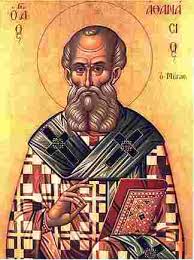
-- Saint Athanasius, "Apostle of Tradition", 373 Anno Domini

The Holy Tridentine Roman Rite Mass

The Tridentine Mass takes its name from the Council of Trent ( 1545-63 ), under the watchful eye of Pope Saint Pius V. The "Tridentine Rite" is, therefore, more properly called the Ancient or Traditional Roman Rite. The last edition of its missal was published in 1962.

The traditional Roman Rite differs from the new rite -- the 1969 Novus Ordo. This “new Mass” omits about 70 percent of the traditional Mass prayers. Most consider the traditional Latin Mass to be much more formal, more dignified.

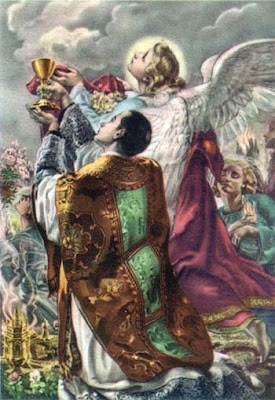
It’s emphasis is on the sacrifice of Jesus and the recognition of the “true presence” of Jesus—Body, Blood, Soul and Divinity—in the Holy Eucharist. The entire Mass focuses on the Consecration of the Body and Blood and on reception of Christ in Holy Communion. This is represented in the photograph below.

The priest and the faithful face forward to the altar...and to God. The Holy Traditional Tridentine Roman Rite Latin Mass is the manner in which Catholics worshiped The One True God for well over 1,000 years. For those over the age of 40, it is the Mass of their youth. For those too young to remember incense filled churches, Gregorian chant, and the reverent silence at Mass, the Tridentine rite offers a return to a profound manner of worship.


4 posted on 01/05/2009 3:49:56 PM PST by Robert Drobot (Qui non intelligit aut discat aut taceat)
[ Post Reply | Private Reply | To 3 | View Replies]

Pope Saint Felix III

"Not to oppose error is to approve it; and not to defend truth is to suppress it; and indeed to neglect to confound evil men, when we can do it, is no less a sin than to encourage them."


5 posted on 01/05/2009 3:52:01 PM PST by Robert Drobot (Qui non intelligit aut discat aut taceat)
[ Post Reply | Private Reply | To 4 | View Replies]

Pope Saint Pius V - July 14, 1570

To Our Venerable Brethren: the Patriarchs, Primates, Archbishops, Bishops, and other Local Ordinaries in Peace and Communion with the Apostolic See -- Venerable Brethren, health and Apostolic Benediction!

From the very first, upon Our elevation to the chief Apostleship, We gladly turned our mind and energies and directed all out thoughts to those matters which concerned the preservation of a pure liturgy, and We strove with God's help, by every means in our power, to accomplish this purpose. For, besides other decrees of the sacred Council of Trent, there were stipulations for Us to revise and re-edit the sacred books: the Catechism, the Missal and the Breviary. With the Catechism published for the instruction of the faithful, by God's help, and the Breviary thoroughly revised for the worthy praise of God, in order that the Missal and Breviary may be in perfect harmony, as fitting and proper - for its most becoming that there be in the Church only one appropriate manner of reciting the Psalms and only one rite for the celebration of Mass - We deemed it necessary to give our immediate attention to what still remained to be done; the re-editing of the Missal as soon as possible.

Hence, We decided to entrust this work to learned men of our selection. They very carefully collated all their work with the ancient codices in Our Vatican Library and with reliable, preserved or emended codices from elsewhere. Besides this, these men consulted the works of ancient and approved authors concerning the same sacred rites; and thus they have restored the Missal itself to the original form and rite of the holy Fathers. When this work has been gone over numerous times and further emended, after serious study and reflection, We commanded that the finished product be printed and published as soon as possible, so that all might enjoy the fruits of this labor; and thus, priests would know which prayers to use and which rites and ceremonies they were required to observe from now on in the celebration of Masses.

Let all everywhere adopt and observe what has been handed down by the Holy Roman Church, the Mother and Teacher of the other churches, and let Masses not be sung or read according to any other formula than that of this Missal published by Us. This ordinance applies henceforth, now, and forever, throughout all the provinces of the Christian world, to all patriarchs, cathedral churches, collegiate and parish churches, be they secular or religious, both of men and of women - even of military orders - and of churches or chapels without a specific congregation in which conventional Masses are sung aloud in choir or read privately in accord with the rites and customs of the Roman Church. This Missal is to be used by all churches, even by those which in their authorization are made exempt, whether by Apostolic indult, custom, or privilege, or even if by oath or official confirmation of the Holy See, or have their rights and faculties guaranteed to them by any other manner whatsoever.

This new rite alone is to be used unless approval of the practice of saying Mass differently was given at the very time of the institution and confirmation of the church by Apostolic See at least 200 years ago, or unless there has prevailed a custom of a similar kind which has been continuously followed for a period of not less than 200 years, in which most cases We in no wise rescind their above-mentioned prerogative or custom. However, if this Missal, which we have seen fit to publish, be more agreeable to these latter, We grant them permission to celebrate Mass according to its rite, provided they have the consent of their bishop or prelate or of their whole Chapter, everything else to the contrary notwithstanding. All other of the churches referred to above, however, are hereby denied the use of other missals, which are to be discontinued entirely and absolutely; whereas, by this present Constitution, which will be valid henceforth, now, and forever, We order and enjoin that nothing must be added to Our recently published Missal, nothing omitted from it, nor anything whatsoever be changed within it under the penalty of Our displeasure.

We specifically command each and every patriarch, administrator, and all other persons or whatever ecclesiastical dignity they may be, be they even cardinals of the Holy Roman Church, or possessed of any other rank or pre-eminence, and We order them in virtue of holy obedience to chant or to read the Mass according to the rite and manner and norm herewith laid down by Us and, hereafter, to discontinue and completely discard all other rubrics and rites of other missals, however ancient, which they have customarily followed; and they must not in celebrating Mass presume to introduce any ceremonies or recite any prayers other than those contained in this Missal.

Furthermore, by these presents [this law], in virtue of Our Apostolic authority, We grant and concede in perpetuity that, for the chanting or reading of the Mass in any church whatsoever, this Missal is hereafter to be followed absolutely, without any scruple of conscience or fear of incurring any penalty, judgment, or censure, and may freely and lawfully be used. Nor are superiors, administrators, canons, chaplains, and other secular priests, or religious, of whatever title designated, obliged to celebrate the Mass otherwise than as enjoined by Us. We likewise declare and ordain that no one whosoever is forced or coerced to alter this Missal, and that this present document cannot be revoked or modified, but remain always valid and retain its full force notwithstanding the previous constitutions and decrees of the Holy See, as well as any general or special constitutions or edicts of provincial or synodal councils, and notwithstanding the practice and custom of the aforesaid churches, established by long and immemorial prescription - except, however, if more than two hundred years' standing.

It is Our will, therefore, and by the same authority, We decree that, after We publish this constitution and the edition of the Missal, the priests of the Roman Curia are, after thirty days, obliged to chant or read the Mass according to it; all others south of the Alps, after three months; and those beyond the Alps either within six months or whenever the Missal is available for sale. Wherefore, in order that the Missal be preserved incorrupt throughout the whole world and kept free of flaws and errors, the penalty for nonobservance for printers, whether immediately or immediately subject to Our dominion, and that of the Holy Roman Church, will be the forfeiting of their books and a fine of one hundred gold ducats, payable ipso facto to the Apostolic Treasury. Further, as for those located in other parts of the world, the penalty is excommunication latae sententiae, and such other penalties as may in Our judgment be imposed; and We decree by this law that they must not dare or presume either to print or to publish or to sell, or in any way to accept books of this nature without Our approval and consent, or without the express consent of the Apostolic Commissaries of those places, who will be appointed by Us. Said printer must receive a standard Missal and agree faithfully with it and in no wise vary from the Roman Missal of the large type ( secundum magnum impressionem).

Accordingly, since it would be difficult for this present pronouncement to be sent to all parts of the Christian world and simultaneously come to light everywhere, We direct that it be, as usual, posted and published at the doors of the Basilica of the Prince of the Apostles, also at the Apostolic Chancery, and on the street at Campo Flora; furthermore, We direct that printed copies of this same edict signed by a notary public and made official by an ecclesiastical dignitary possess the same indubitable validity everywhere and in every nation, as if Our manuscript were shown there. Therefore, no one whosoever is permitted to alter this notice of Our permission, statute, ordinance, command, precept, grant, indult, declaration, will, decree, and prohibition. Should know that he will incur the wrath of Almighty God and of the Blessed Apostles Peter and Paul.

Given at Saint Peter's in the year of the Lord's Incarnation, 1570, on the 14th of July of the Fifth year of Our Pontificate.


6 posted on 01/05/2009 3:54:29 PM PST by Robert Drobot (Qui non intelligit aut discat aut taceat)
[ Post Reply | Private Reply | To 5 | View Replies]

Symbolum Apostolorum ~ THE APOSTLES' CREED

While the present form of the Apostles' Creed first appeared in the 6th century in the writings of Caesarius of Arles ( d 542 ), it can be traced in one form or another back to Apostolic times. Rufinus' Commentary on the Apostle's Creed ( ca. A.D. 407 ) contains the prayer in a form very close to what we have today. The Creed can also be found in a letter to Pope Julius I ( A.D. 340 ) and even earlier in a circa 200 document containing the Roman baptismal liturgy. It appears that originally this Creed was a baptismal creed summarizing the teachings of the Apostles and was given to the catechumens when they were baptized. Instead of the continuous prayer as we have it today, each line was rather in the form of a question to which the catechumen gave assent indicating he both understood and believed. Eventually this question and answer style was modified into the prayer form as we have it today. A partial indulgence is granted to the faithful who recite the Symbolum Apostolorum.


CREDO in Deum Patrem omnipotentem, Creatorem caeli et terrae. Et in Iesum Christum, Filium eius unicum, Dominum nostrum, qui conceptus est de Spiritu Sancto, natus ex Maria Virgine, passus sub Pontio Pilato, crucifixus, mortuus, et sepultus, descendit ad inferos, tertia die resurrexit a mortuis, ascendit ad caelos, sedet ad dexteram Dei Patris omnipotentis, inde venturus est iudicare vivos et mortuos. Credo in Spiritum Sanctum, sanctam Ecclesiam catholicam, sanctorum communionem, remissionem peccatorum, carnis resurrectionem, vitam aeternam. Amen.

  : 

I believe in God the Father, Almighty, Maker of heaven and earth: And in Jesus Christ, his only begotten Son, our Lord: Who was conceived by the Holy Ghost, born of the Virgin Mary: Suffered under Pontius Pilate; was crucified, dead and buried: He descended into hell: The third day he rose again from the dead: He ascended into heaven, and sits at the right hand of God the Father Almighty: From thence he shall come to judge the quick and the dead: I believe in the Holy Ghost: I believe in the holy catholic church: the communion of saints: The forgiveness of sins: The resurrection of the body: And the life everlasting. Amen.


7 posted on 01/05/2009 3:56:57 PM PST by Robert Drobot (Qui non intelligit aut discat aut taceat)
[ Post Reply | Private Reply | To 6 | View Replies]

THE ATHANASIAN CREED

The Athanasian Creed, attributed to Saint Athanasius, also know as the Quicumque vult, was formerly recited at the office of Prime on Sundays and Trinity Sunday is the time when we renew our commitment to our Faith and the dogma Extra Ecclesiam Nulla Salus - "Outside the Church There is No Salvation." The Athanasian Creed is one of the four authoritative Creeds of Holy Mother Church ( The Apostle's Creed; Nicene Creed; and The Tridentine Creed, and it is not something that is an opinion but what every Roman Catholic must believe.


Quicumque vult salvus esse, ante omnia opus est, ut teneat catholicam fidem: Quam nisi quisque integram inviolatamque servaverit, absque dubio in aeternam peribit. Fides autem catholica haec est: ut unum Deum in Trinitate, et Trinitatem in unitate veneremur. Neque confundentes personas, neque substantiam seperantes. Alia est enim persona Patris alia Filii, alia Spiritus Sancti: Sed Patris, et Fili, et Spiritus Sancti una est divinitas, aequalis gloria, coeterna maiestas. Qualis Pater, talis Filius, talis Spiritus Sanctus. Increatus Pater, increatus Filius, increatus Spiritus Sanctus. Immensus Pater, immensus Filius, immensus Spiritus Sanctus. Aeternus Pater, aeternus Filius, aeternus Spiritus Sanctus. Et tamen non tres aeterni, sed unus aeternus. Sicut non tres increati, nec tres immensi, sed unus increatus, et unus immensus. Similiter omnipotens Pater, omnipotens Filius, omnipotens Spiritus Sanctus. Et tamen non tres omnipotentes, sed unus omnipotens. Ita Deus Pater, Deus Filius, Deus Spiritus Sanctus. Ita Dominus Pater, Dominus Filius, Dominus Spiritus Sanctus. Et tamen non tres Domini, sed unus est Dominus. Quia, sicut singillatim unamquamque personam Deum ac Dominum confiteri christiana veritate compelimur: ita tres Deos aut Dominos dicere catholica religione prohibemur. Pater a nullo est factus: nec creatus, nec genitus. Filius a Patre solo est: non factus, nec creatus, sed genitus. Spiritus Sanctus a Patre et Filio: non factus, nec creatus, nec genitus, sed procedens. Unus ergo Pater, non tres Patres: unus Filius, non tres Filii: unus Spiritus Sanctus, non tres Spiritus Sancti. Et in hac Trinitate nihil prius aut posterius, nihil maius aut minus: sed totae tres personae coaeternae sibi sunt et coaequales. Ita ut per omnia, sicut iam supra dictum est, et unitas in Trinitate, et Trinitas in unitate veneranda sit. Qui vult ergo salvus esse, ita de Trinitate sentiat. Sed necessarium est ad aeternam salutem, ut incarnationem quoque Domini nostri Iesu Christi fideliter credat. Est ergo fides recta ut credamus et confiteamur, quia Dominus noster Iesus Christus, Dei Filius, Deus et homo est. Deus est ex substantia Patris ante saecula genitus: et homo est ex substantia matris in saeculo natus. Perfectus Deus, perfectus homo: ex anima rationali et humana carne subsistens. Aequalis Patri secundum divinitatem: minor Patre secundum humanitatem. Qui licet Deus sit et homo, non duo tamen, sed unus est Christus. Unus autem non conversione divinitatis in carnem, sed assumptione humanitatis in Deum. Unus omnino, non confusione substantiae, sed unitate personae. Nam sicut anima rationalis et caro unus est homo: ita Deus et homo unus est Christus. Qui passus est pro salute nostra: descendit ad inferos: tertia die resurrexit a mortuis. Ascendit ad caelos, sedet ad dexteram Dei Patris omnipotentis: inde venturus est iudicare vivos et mortuos. Ad cuius adventum omnes homines resurgere habent cum corporibus suis: et reddituri sunt de factis propriis rationem. Et qui bona egerunt, ibunt in vitam aeternam: qui vero mala, in ignem aeternum. Haec est fides catholica, quam nisi quisque fideliter firmiterque crediderit, salvus esse non poterit. Amen.

  : 

Whosoever wishes to be saved must, above all, keep the Catholic Faith. For unless a person keeps this Faith whole and entire, he will undoubtedly be lost forever. This is what the Catholic Faith teaches: we worship one God in the Trinity and the Trinity in unity. Neither confounding the Persons, nor dividing the substance. For there is one Person of the Father, another of the Son, another of the Holy Spirit. But the Father and the Son and the Holy Spirit have one divinity, equal glory, and coeternal majesty. What the Father is, the Son is, and the Holy Spirit is. The Father is uncreated, the Son is uncreated, and the Holy Spirit is uncreated. The Father is boundless, the Son is boundless, and the Holy Spirit is boundless. The Father is eternal, the Son is eternal, and the Holy Spirit is eternal. Nevertheless, there are not three eternal beings, but one eternal being. So there are not three uncreated beings, nor three boundless beings, but one uncreated being and one boundless being. Likewise, the Father is omnipotent, the Son is omnipotent, the Holy Spirit is omnipotent. Yet there are not three omnipotent beings, but one omnipotent being. Thus the Father is God, the Son is God, and the Holy Spirit is God. However, there are not three gods, but one God. The Father is Lord, the Son is Lord, and the Holy Spirit is Lord. However, there as not three lords, but one Lord. For as we are obliged by Christian truth to acknowledge every Person singly to be God and Lord, so too are we forbidden by the Catholic religion to say that there are three Gods or Lords. The Father was not made, nor created, nor generated by anyone. The Son is not made, nor created, but begotten by the Father alone. The Holy Spirit is not made, nor created, nor generated, but proceeds from the Father and the Son. There is, then, one Father, not three Fathers; one Son, not three sons; one Holy Spirit, not three holy spirits. In this Trinity, there is nothing before or after, nothing greater or less. The entire three Persons are co-eternal and co-equal with one another. So that in all things, as is has been said above, the Unity is to be worshipped in Trinity and the Trinity in Unity. He, therefore, who wishes to be saved, must believe thus about the Trinity. It is also necessary for eternal salvation that he believes steadfastly in the incarnation of our Lord Jesus Christ. Thus the right faith is that we believe and confess that our Lord Jesus Christ, the Son of God, is both God and man. As God, He was begotten of the substance of the Father before time; as man, He was born in time of the substance of His Mother. He is perfect God; and He is perfect man, with a rational soul and human flesh. He is equal to the Father in His divinity, but inferior to the Father in His humanity. Although He is God and man, He is not two, but one Christ. And He is one, not because His divinity was changed into flesh, but because His humanity was assumed unto God. He is one, not by a mingling of substances, but by unity of person. As a rational soul and flesh are one man: so God and man are one Christ. He died for our salvation, descended into hell, and rose from the dead on the third day. He ascended into Heaven, sits at the right hand of God the Father almighty. From there He shall come to judge the living and the dead. At His coming, all men are to arise with their own bodies; and they are to give an account of their own deeds. Those who have done good deeds will go into eternal life; those who have done evil will go into the everlasting fire. This is the Catholic Faith. Everyone must believe it, firmly and steadfastly; otherwise he cannot be saved. Amen.


8 posted on 01/05/2009 4:38:51 PM PST by Robert Drobot (Qui non intelligit aut discat aut taceat)
[ Post Reply | Private Reply | To 7 | View Replies]

THE NICENE CREED

Symbolum Nicaenum, or Nicene Creed, has a complex history. It was first promulgated at the Council of Nicea ( A.D. 325 ), though in an abbreviated form from what we have below. Saint Athanasius attributes its composition to the Papal Legate to the Council, Hossius of Cordova. The Creed is also sometimes called the Nicene-Constantinoplan Creed since it appears in the Acts of the Council of Constantinople ( 381 ), but it is clear that this Council is not the source of that composition for it appears in complete form in the Ancoratus of Epiphanius of Salamis some seven years earlier in 374. In any case, it was this text that appears in the Acts of the Council of Constantinople that was formally promulgated at Chalcedon in 451 and has come down to us as our present Nicene Creed. It was at the councils of Nicea and Constantinople that the true nature of Jesus was defended against two heresies that had sprung up. The Arians denied Christ’s divinity and the Monophysites denied Christ’s humanity. The councils, drawing upon the traditions handed down to them from the Apostles, condemned both heresies and declared that Jesus was indeed both true God and true man.


Credo in unum Deum, Patrem omnipotentem, factorem caeli et terrae, visibilium omnium et invisibilium. Et in unum Dominum Iesum Christum, Filium Dei unigenitum, et ex Patre natum ante omnia saecula. Deum de Deo, Lumen de Luminem, Deum verum de Deo vero, genitum non factum, consubstantialem Patri; per quem omnia facta sunt. Qui propter nos homines et propter nostram salutem descendit de caelis. Et incarnatus est de Spiritu Sancto ex Maria Virgine, et homo factus est. Crucifixus etiam pro nobis sub Pontio Pilato, passus et sepultus est, et resurrexit tertia die, secundum Scripturas, et ascendit in caelum, sedet ad dexteram Patris. Et iterum venturus est cum gloria, iudicare vivos et mortuos, cuius regni non erit finis. Et in Spiritum Sanctum, Dominum et vivificantem, qui ex Patre Filioque procedit. Qui cum Patre et Filio simul adoratur et conglorificatur: qui locutus est per prophetas. Et unam, sanctam, catholicam et apostolicam Ecclesiam. Confiteor unum baptisma in remissionem peccatorum. Et expecto resurrectionem mortuorum, et vitam venturi saeculi. Amen.

  : 

I believe in one God, the Father almighty, maker of heaven and earth, of all things visible and invisible. And in one Lord, Jesus Christ, Son of God, only-begotten and of the Father born before all ages. God from God, Light from Light, true God from true God, begotten, not made, consubstantial with the Father; through Whom all things were made. Who for us men and for our salvation came down from heaven. And was incarnate by the Holy Spirit from the Virgin Mary, and was made man. He was crucified for us under Pontius Pilate; suffered, and was buried, and rose the third day according to the Scriptures; sits at the right hand of the Father. And He will come again in glory to judge the living and the dead, and of His kingdom there shall be no end. And in the Holy Spirit, the Lord and life-giver, Who from the Father and the Son proceeds. Who, with the Father and the Son, is simultaneously adored and equally glorified: Who has spoken through the prophets. And one holy, catholic and apostolic Church. I confess one baptism for the remission of sins. And I look for the resurrection of the dead, and the life of the age to come. Amen.


9 posted on 01/05/2009 4:40:28 PM PST by Robert Drobot (Qui non intelligit aut discat aut taceat)
[ Post Reply | Private Reply | To 8 | View Replies]

Professio fidei Tridentinae
The Tridentine Creed

Pope Pius IV promulgated this creed in his Bull, Injunctium Nobis, in 1565, about year after the close of the Council of Trent. It begins by repeating the Nicene Creed, and then goes on to re-affirm dogmas of the Church that were then being attacked by Protestants. For a long time thereafter it was used in reconciling Protestants who wished to return to the Church. Although seldom used any more, it has never been abrogated and remains one of the four Creeds of the Holy Mother Church.


Ego N. firma fide credo et profiteor omnia et singula, quae continentur in Symbolo, quo Sancta Romana ecclesia utitur, videlicet:

Credo in unum Deum, Patrem omnipotentem, factorem caeli et terrae, visibilium omnium et invisibilium. Et in unum Dominum Iesum Christum, Filium Dei unigenitum, et ex Patre natum ante omnia saecula. Deum de Deo, Lumen de Lumine, Deum verum de Deo vero, genitum non factum, consubstantialem Patri; per quem omnia facta sunt. Qui propter nos homines et propter nostram salutem descendit de caelis. Et incarnatus est de Spiritu Sancto ex Maria Virgine, et homo factus est. Crucifixus etiam pro nobis sub Pontio Pilato, passus et sepultus est, et resurrexit tertia die, secundum Scripturas, et ascendit in caelum, sedet ad dexteram Patris. Et iterum venturus est cum gloria, iudicare vivos et mortuos, cuius regni non erit finis. Et in Spiritum Sanctum, Dominum et vivificantem, qui ex Patre Filioque procedit. Qui cum Patre et Filio simul adoratur et conglorificatur: qui locutus est per prophetas. Et unam, sanctam, catholicam et apostolicam Ecclesiam. Confiteor unum baptisma in remissionem peccatorum. Et expecto resurrectionem mortuorum, et vitam venturi saeculi. Amen.

Apostolicas et ecclesiasticas traditiones reliquasque eiusdem ecclesiae observationes et consitutiones firmissime admitto et amplector.

Item sacram Scripturam iuxta sensum eum, quem tenuit et tenet sancta mater Ecclesia, cuius et iudicare de vero sensu et interpretatione sacrarum Scripturarum, admitto, nec eam umquam nisi iuxta unanimem consensum Patrum accipiam et interpretabor.

Profiteor quoque septem esse vere et proprie Sacramenta novae legis, a Iesu Christo Domino nostro instituta, atque ad salutem humani generis, licet non omnia singulis, necessaria: scilicet Baptismum, Confirmationem, Eucharistiam, Poenitentiam, Extremam Unctionem, Ordinem et Matrimonium, illaque gratiam conferre, et ex his Baptismum, Confirmationem et Ordinem sine sacrilegio reiterari non posse.

Receptos quoque et approbatos ecclesiae catholicae ritus in supradictorum omnium Sacramentorum solemni administratione recipio et admitto.

Omnia et singula, quae de peccato originali et de iustificatione in sacrosancta Tridentina Synodo definita et declarata fuerunt, amplector et recipio.

Profiteor pariter, in Missa oferri Deo verum, proprium et propitiatorium sacrificium pro vivis et defunctis, atque in sanctissimo Eucharistiae Sacramento esse vere, realiter et substantialiter Corpus et Sanguinem, una cum anima et divinitate Domini nostri Iesu Christi, fierique conversionem totius substantiae panis in Corpus at totius substantiae vini in Sanguinem, quam conversionem Ecclesia catholica transsubstantiationem appellat. Fateor etiam sub altera tantum specie totum atque integrum Christum verumque Sacramentum sumi.

Constanter teneo, purgatorium esse, animasque ibi detentas fidelium suffragiis iuvari. Similiter et Sanctos, una cum Christo regnantes, venerandos atque invocandos esse, eosque orationes Deo pro nobis offerre, atque eorum reliquias esse venerandas.

Firmissime assero, imagines Christi ac Deiparae semper Virginis, necnon aliorum Sanctorum habendas et retiendas esse, atque eis debitum honorem et venerationem impertiendum.

Indulgentiarum etiam potestatem a Christo in Ecclesia relictam fuisse, illarumque usu christiano populo maxime salutarem esse affirmo.

Sanctam catholicam et apostolicam Ecclesiam romanam omnium ecclesiarum matrem et magistram agnosco, Romanoque Pontifici, beati Petri, Apostolorum principis, successori, ac Iesu Christi Vicario, veram obedientiam spondeo ac iuro.

Cetera item omnia a sacris canonibus et oecumenicis Conciliis, ac praecipue a sacrosancta Tridentina Synodo, et ab oecumenico Concilio Vaticano tradita, definita et declarata, praesertim de Romani Pontificis primatu et infallibili magesterio indubitanter recipio ac profiteor; simulaque contraria omnia, atque haereses quascumque ab Ecclesia damnatas et reiectas et anathematizatas ego pariter damno, reicio, et anathematizo.

Hanc veram catholicam fidem, extra quam nemo salvus esse potest, quam in praesenti sponte profiteor et veraciter teneo, eamdem integram, et inviolatam usque ad extremum vitae spiritum, constantissime, Deo adiuvante, retinere et confiteri, atque a meis subditis, vel illis, quorum cura ad me in munere meo spectabit, teneri, doceri et praedicari, quantum in me erit, curaturum, ego idem N. spondeo, voveo ac iuro. Sic me Deus adiuvet et haec sancta Dei Evangelia.

  : 

I, ( name ), with firm faith believe and profess all and everything which is contained in the creed of Faith, which the holy Roman Church uses, namely:

“I believe in one God, the Father almighty, maker of heaven and earth, and of all things visible and invisible. And in one Lord Jesus Christ, the only-begotten Son of God; born of the Father before all ages; God of God, light of light, true God of true God; begotten, not made; being of one substance with the Father; by whom all things were made. Who for us men and for our salvation, came down from heaven. And was incarnate by the Holy Ghost of the Virgin Mary; and was made man. He was crucified also for us, suffered under Pontius Pilate, and was buried. And on the third day He rose again according to the Scriptures. And ascended into heaven. He sits at the right hand of the Father. And He shall come again with glory to judge both the living and the dead; of whose kingdom there shall be no end. And I believe in the Holy Spirit, the Lord and giver of life, Who proceeds from the Father and the Son; Who together with the Father and the Son is adored and glorified; Who spoke by the Prophets. And in one, holy, catholic, and apostolic Church. I confess one baptism for the remission of sins. And I look for the resurrection of the dead. And the life of the world to come. Amen.

“The Apostolic and Ecclesiastical traditions and all other observances and constitutions of that same Church I most firmly admit and embrace.

“I likewise accept Holy Scripture according to that sense which our holy Mother Church has held and does hold, whose (office) it is to judge the true meaning and interpretation of Sacred Scriptures; I shall never accept nor interpret it otherwise than in accordance with the unanimous consent of the Fathers.

“I also profess that there are truly and properly seven Sacraments of the New Law instituted by Jesus Christ our Lord, and necessary for the salvation of mankind, although not all are necessary for each individual; these sacraments are Baptism, Confirmation, the Eucharist, Penance, Extreme Unction, Order, and Matrimony; and (I profess) that they confer grace, and that of these Baptism, Confirmation, and Order cannot be repeated without sacrilege. I also receive and admit the accepted and approved rites of the Catholic Church in the solemn administration of all the aforesaid Sacraments.

“I embrace and accept each and everything that has been defined and declared by the Holy Synod of Trent concerning original sin and justification.

“I also profess that in the Mass there is offered to God a true, proper sacrifice of propitiation for the living and the dead, and that in the most holy Sacrament of the Eucharist there is truly, really, and substantially present the Body and Blood together with the soul and divinity of our Lord Jesus Christ, and that there takes place a conversion of the whole substance of bread into the body, and of the whole substance of the wine into the blood; and this conversion the Catholic Church calls Transubstantiation.

“I also acknowledge that under one species alone the whole and entire Christ and the true Sacrament are taken.

“I steadfastly hold that Purgatory exists, and that the souls there detained are aided by the prayers of the faithful; likewise that the Saints reigning together with Christ should be venerated and invoked, and that they offer prayers to God for us, and that their relics should be venerated.

“I firmly assert that the images of Christ and of the Mother of God ever Virgin, and also of the other Saints should be kept and retained, and that due honor and veneration should be paid to them; I also affirm that the power of indulgences has been left in the Church by Christ, and that the use of them is especially salutary for Christian people.

“I acknowledge the holy Catholic and apostolic Roman Church as the mother and teacher of all Churches; and to the Roman Pontiff, the successor of blessed Peter, Prince of Apostles and Vicar of Jesus Christ, I promise and swear true obedience.

“Also all other things taught, defined, and declared by the sacred Canons and Ecumenical Councils, and especially by the sacred and holy Synod of Trent (and by the Ecumenical Council of the Vatican, particularly concerning the Primacy of the Roman Pontiff and his infallible teaching,*) I without hesitation accept and profess; and at the same time all things contrary thereto, and whatever heresies have been condemned, and rejected, and anathematized by the Church, I likewise condemn, reject, and anathematize.

“This true Catholic faith, outside of which no one can be saved, (and) which of my own accord I now profess and truly hold, I (name) do promise, vow, and swear that I will, with the help of God, most faithfully retain and profess the same to the last breath of my life as pure and inviolable, and that I will take care as far as lies in my power that it be held, taught, and preached by my subjects or by those over whom by virtue of my office I have charge, so help me God, and these holy Gospels of God.”


10 posted on 01/05/2009 4:42:30 PM PST by Robert Drobot (Qui non intelligit aut discat aut taceat)
[ Post Reply | Private Reply | To 9 | View Replies]

SACRORUM ANTISTITUM ~ OATH AGAINST MODERNISM

Declared by His Holiness Pope Saint Pius X, September 1, 1910.

To be sworn to by all clergy, pastors, confessors, preachers, religious superiors, and professors in philosophical-theological seminaries.

I . . . . firmly embrace and accept each and every definition that has been set forth and declared by the unerring teaching authority of the Church, especially those principal truths which are directly opposed to the errors of this day. And first of all, I profess that God, the origin and end of all things, can be known with certainty by the natural light of reason from the created world (see Romans 1:90 ), that is, from the visible works of creation, as a cause from its effects, and that, therefore, his existence can also be demonstrated: Secondly, I accept and acknowledge the external proofs of revelation, that is, divine acts and especially miracles and prophecies as the surest signs of the divine origin of the Christian religion and I hold that these same proofs are well adapted to the understanding of all eras and all men, even of this time. Thirdly, I believe with equally firm faith that the Church, the guardian and teacher of the revealed word, was personally instituted by the real and historical Christ when he lived among us, and that the Church was built upon Peter, the prince of the apostolic hierarchy, and his successors for the duration of time. Fourthly, I sincerely hold that the doctrine of faith was handed down to us from the apostles through the orthodox Fathers in exactly the same meaning and always in the same purport. Therefore, I entirely reject the heretical' misrepresentation that dogmas evolve and change from one meaning to another different from the one which the Church held previously. I also condemn every error according to which, in place of the divine deposit which has been given to the spouse of Christ to be carefully guarded by her, there is put a philosophical figment or product of a human conscience that has gradually been developed by human effort and will continue to develop indefinitely. Fifthly, I hold with certainty and sincerely confess that faith is not a blind sentiment of religion welling up from the depths of the subconscious under the impulse of the heart and the motion of a will trained to morality; but faith is a genuine assent of the intellect to truth received by hearing from an external source. By this assent, because of the authority of the supremely truthful God, we believe to be true that which has been revealed and attested to by a personal God, our creator and Lord.

Furthermore, with due reverence, I submit and adhere with my whole heart to the condemnations, declarations, and all the prescripts contained in the encyclical Pascendi and in the decree Lamentabili, especially those concerning what is known as the history of dogmas. I also reject the error of those who say that the faith held by the Church can contradict history, and that Catholic dogmas, in the sense in which they are now understood, are irreconcilable with a more realistic view of the origins of the Christian religion. I also condemn and reject the opinion of those who say that a well-educated Christian assumes a dual personality-that of a believer and at the same time of a historian, as if it were permissible for a historian to hold things that contradict the faith of the believer, or to establish premises which, provided there be no direct denial of dogmas, would lead to the conclusion that dogmas are either false or doubtful. Likewise, I reject that method of judging and interpreting Sacred Scripture which, departing from the tradition of the Church, the analogy of faith, and the norms of the Apostolic See, embraces the misrepresentations of the rationalists and with no prudence or restraint adopts textual criticism as the one and supreme norm. Furthermore, I reject the opinion of those who hold that a professor lecturing or writing on a historico-theological subject should first put aside any preconceived opinion about the supernatural origin of Catholic tradition or about the divine promise of help to preserve all revealed truth forever; and that they should then interpret the writings of each of the Fathers solely by scientific principles, excluding all sacred authority, and with the same liberty of judgment that is common in the investigation of all ordinary historical documents.

Finally, I declare that I am completely opposed to the error of the modernists who hold that there is nothing divine in sacred tradition; or what is far worse, say that there is, but in a pantheistic sense, with the result that there would remain nothing but this plain simple fact-one to be put on a par with the ordinary facts of history-the fact, namely, that a group of men by their own labor, skill, and talent have continued through subsequent ages a school begun by Christ and his apostles. I firmly hold, then, and shall hold to my dying breath the belief of the Fathers in the charism of truth, which certainly is, was, and always will be in the succession of the episcopacy from the apostles. The purpose of this is, then, not that dogma may be tailored according to what seems better and more suited to the culture of each age; rather, that the absolute and immutable truth preached by the apostles from the beginning may never be believed to be different, may never be understood in any other way.

I promise that I shall keep all these articles faithfully, entirely, and sincerely, and guard them inviolate, in no way deviating from them in teaching or in any way in word or in writing. Thus I promise, this I swear, so help me God.


11 posted on 01/05/2009 4:54:28 PM PST by Robert Drobot (Qui non intelligit aut discat aut taceat)
[ Post Reply | Private Reply | To 10 | View Replies]

Compare...
Traditional Latin Mass

Atmosphere of Reverent Worship :
Peaceful, otherworldly atmosphere. Emphasis on individual 'lifting his heart & mind to God.' The faithful direct their prayer and attention to God, not each other."

Profound Reverence for His Real Presence :
Sixteen genuflections. The hands of the priest alone touch the consecrated host. Communion given only on tongue.

Fidelity to Catholic Doctrine :
Over the course of a year, all facets of Roman Rite Catholicism are presented.

Antiquity :
Bulk of Sunday prayers & their arrangement goes back at least to 300s and 400s AD. Canon essentially the same since Blessed Saint Ambrose ( 397 Anno Dómini ).

Stability :
Everything regulated by precise tradition to protect the purity of worship and doctrine.

Priest is Sacrificer:
Priest faces tabernacle, cross and altar ( symbolically toward God ). Priest performs all the actions & recites all the prayers of the Mass.


With....
Modern Mass at your parish

Social, Classroom, Entertainment Atmosphere :
Constant standing, sitting, amplified noise; atmosphere like a public meeting. Emphasis on 'instruction.' Socializing in church before & after service, and handshaking during.

Indifference, Irreverence towards Real Presence :
Only three genuflections required. Lay men & women distribute communion. Communion given in hand - a practice protestants introduced to deny Christ's Real Presence.

Systematic Omission of Catholic Doctrines :
New and or 'revised' prayers systematically omit all references to hell; judgment; punishment for sin; merits of the Saints; the One True Church; the souls of the departed; and heavenly miracles.

Novelty :
Traditional Sunday prayers omitted, or stripped of doctrines, and 'rearranged' from the 1960s to this day. Only 17% of old prayers remain. Chunks of ancient Canon are now 'optional'. The words of consecration, Christ's own words "For you and for many" have been changed. Three substitute 'Canons' invented & introduced in 1960s, with more invented later.

Constant Change :
Options, options and more options. Individual priests & parish liturgy committees get to pick, drop or invent texts to push whatever they think the faithful should believe.

Priest is "President", Actor :
Priest faces people instead of symbolically "toward God." Priest sits off to side. His functions given away to lay men and women whose hands have not been consecrated to hold the precious Body of Christ Jesus, nor have they been given the Holy Sacrament of Holy Orders to perform priestly duties.

©2007 traditionalmass.org.


12 posted on 01/05/2009 4:57:29 PM PST by Robert Drobot (Qui non intelligit aut discat aut taceat)
[ Post Reply | Private Reply | To 11 | View Replies]

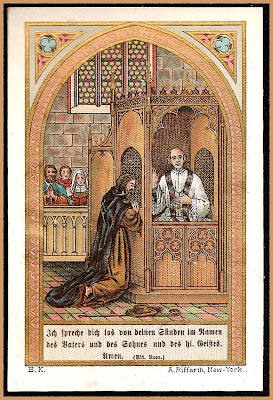
THE SACRAMENT OF PENANCE

"Confession heals, confession justifies, confession grants pardon of sin. All hope consists in confession. In confession there is mercy. Believe it firmly, do not hesitate, never despair of the mercy of God." ~ Saint Isidore of Seville

As soon as Jesus rose from the dead and earned salvation for us, he brought his apostles a new gift. After speaking peace to them, he said, "As the Father has sent me, even so I send you" ( Blessed Apostle Saint John 20:21 ). Just as Jesus was sent by the Father to reconcile the world to God, Jesus sent the apostles to continue his mission.

Jesus then breathed on the apostles. This is a verse that is often passed over, but it has extraordinary significance because it is only the second time in all of Scripture where God breathes on anyone. The other instance was at the moment of creation, when God breathed his own life into the nostrils of Adam. This should tell us that something of great importance is taking place. Upon doing this, Jesus said, "Receive the Holy Spirit. If you forgive the sins of any, they are forgiven; if you retain the sins of any, they are retained" ( Blessed Apostle Saint John 20:22–23 ).

Notice that Jesus is not simply commissioning the apostles to preach about God’s forgiveness. He is not saying, "Go tell everyone that when God forgives men’s sins, they’re forgiven." In using the second person plural you, Jesus is telling his apostles that by the power of the Holy Spirit he has given them the power to forgive and retain the sins of men. Having the power to forgive and to retain sins implies that the apostle knows what a person’s sins are, which in turn implies oral confession. Otherwise, how is the apostle to know what to retain or forgive?

Consider the following early Christian writings from the first five centuries:

"Confess your sins in church, and do not go up to your prayer with an evil conscience. This is the way of life. . . . On the Lord’s Day gather together, break bread, and give thanks, after confessing your transgressions so that your sacrifice may be pure" ( Didache 4:14, 14:1 [ A.D. 70 ] ).

"[ Regarding confession, some ] flee from this work as being an exposure of themselves, or they put it off from day to day. I presume they are more mindful of modesty than of salvation, like those who contract a disease in the more shameful parts of the body and shun making themselves known to the physicians; and thus they perish along with their own bashfulness"(Tertullian, Repentance 10:1 [ A.D. 203 ] ).

"[ The bishop conducting the ordination of the new bishop shall pray: ] God and Father of our Lord Jesus Christ . . . pour forth now that power which comes from you, from your royal spirit, which you gave to your beloved Son, Jesus Christ, and which he bestowed upon his holy apostles . . . and grant this your servant, whom you have chosen for the episcopate, [the power] to feed your holy flock and to serve without blame as your high priest . . . and by the Spirit of the high-priesthood to have the authority to forgive sins, in accord with your command" ( Hippolytus, Apostolic Tradition 3 [ A.D. 215 ] ).

"Priests have received a power which God has given neither to angels nor to archangels. It was said to them: ‘Whatsoever you shall bind on earth shall be bound in heaven; and whatsoever you shall loose, shall be loosed.’ Temporal rulers have indeed the power of binding; but they can only bind the body. Priests, in contrast, can bind with a bond which pertains to the soul itself and transcends the very heavens. Did [God] not give them all the powers of heaven? ‘Whose sins you shall forgive,’ he says, ‘they are forgiven them; whose sins you shall retain, they are retained.’ What greater power is there than this? The Father has given all judgment to the Son. And now I see the Son placing all this power in the hands of men" ( Saint John Chrysostom, The Priesthood 3:5 [ A.D. 387 ] ).


EXAMINATION OF CONSCIENCE

Prayers before Confession

Act of Contrition

O my God, I am heartily sorry for having offended Thee, and I detest all my sins, because I dread the loss of Heaven and the pains of Hell, but most of all because they offend Thee, my God, Who art all-good and deserving of all my love. I firmly resolve, with the help of Thy grace, to confess my sins, do penance and to amend my life. Amen.

A Review of the Ten Commandments

Preliminary

Besides telling the nature of your sins, you must also recollect, as far as possible, the number of times you have committed them, telling also ( and only ) those circumstances which at times may either make a venial sin mortal or a mortal sin notably worse.

1. Have I ever failed to confess a serious sin or disguised it?
2. Have I been guilty of irreverence for this sacrament by failing to examine my conscience carefully?
3. Have I failed to perform the penance given me by the confessor or disobeyed any of his directions?
4. Have I neglected the Easter duty of receiving Holy Communion or failed to confess my sins within a year?
5. Have I any habits of serious sin to confess first (impurity, drunkenness, etc.)?
6. Have I improved on cutting down these habitual sins or is one confession after another sound like the same? If so, what can I resolve to improve?

First Commandment : I am the Lord thy God. Thou shalt not have strange gods before Me

1. Am I ignorant of my catechism ( Act of Contrition, Apostle's Creed, Ten Commandments, Seven Sacraments, the Our Father )?
2. Have I willfully doubted or denied any of the teachings of the Church ( heresy )?
3. Have I taken active part in any non-Catholic worship?
4. Am I a member of any anti-Catholic or any secret society?
5. Have I knowingly read any anti-Catholic literature or watched an anti-Catholic film or program or listened to anti-Catholic rhetoric?
6. Have I practiced any superstitions (horoscopes, fortune tellers, etc.)?
7. Have I failed to defend my Faith when it was attacked or have I remained silent for fear of being rebuked?

Second Commandment : Thou shalt not take the name of the Lord thy God in vain

1. Have I used God's name in vain by way of profanity?
2. Have I condoned others who use profanity by my silent approval?
3. Have I murmured or complained against God (blasphemy)?
4. Have I maligned priests or others consecrated to God without just reason?
5. Have I sworn by God's name (oath) either falsely or rashly?
6. Have I broken any vow to God either public or private?
7. Have I rationalized myself around a vow by cutting corners?

Third Commandment : Keep holy the Lord's Day

1. Have I missed Mass on Sundays or holydays through my own fault?
2. Have I been late for Mass through my own negligence?
3. Do I realize it is a venial sin to miss any part of the Mass?
4. Do I realize being really late for Mass is a mortal sin and my only alternative is to wait and go to another Mass?
5. Have I been inattentive at Mass or otherwise failed in reverence for the Most Blessed Sacrament?
6. Have I done unnecessary servile work (physical labor) or shopping on Sunday?
7. Have I eaten flesh meat on Friday (especially on Good Friday) or on Ash Wednesday or the assigned vigil fast days?
8. Have I obeyed the laws of the Church on fast and abstinence?

Fourth Commandment : Honor thy Father and Mother

1. Have I been disrespectful to my parents or neglected them?
2. Have I failed in obedience or reverence to others in authority?
3. Have I mistreated my wife or children?
4. Have I been disobedient or disrespectful to my husband?
5. Regarding my children:

-Have I neglected their material needs?
-Have I failed to care for their early Baptism or their proper religious instruction?
-Have I allowed them to neglect their religious duties?
-Have I tolerated their keeping questionable company or steady dating without chaperones?
-Have I otherwise failed to discipline them?
-Have I given them bad example in any way?
-Have I let boys and girls sleep together or with their parents?
-Have I interfered with their freedom to marry or follow a religious vocation?

Fifth Commandment : Thou shalt not kill

1. Have I placed any one's life in danger?
2. Have I threatened any one's life in anger?
3. Have I condoned or promoted abortion?
4. Have I condoned or tolerated others who promote abortion?
5. Have I taken pleasure in anyone's misfortune?
6. Have I jeopardized others by my driving recklessly?
7. Have I used contraceptives thus preventing life?
8. Have I been sympathetic to those contemplating suicide?

Sixth & Ninth Commandments : Thou shalt not commit adultery and Thou shalt not covet thy neighbor's wife

1. Have I committed adultery or fornication?
2. Have I jeopardized my marriage by flirting or untoward glances and advances toward the opposite sex?
3. Have I denied my spouse his or her marriage rights?
4. Have I practiced birth control?
5. Have I abused my marriage rights in any other way?
6. Have I touched or embraced another impurely?
7. Have I sinned with others of the same sex?
8. Have I committed masturbation or otherwise sinned impurely with myself?
9. Have I harbored lustful desires for anyone?
10. Have I indulged in other impure thoughts?
11. Have I failed to dress modestly?
12. Have I done anything to provoke or occasion impure thoughts in others?
13. Have I read indecent literature or looked at indecent pictures or websites?
14. Have I watched suggestive films or television programs?
15. Have I permitted my children or others under my charge to do these things?
16. Have I used indecent language or told indecent stories?
17. Have I willingly listened to such stories?
18. Have I boasted of my sins?
19. Have I condoned promiscuity by my silent consent of the actions of others?
20. Have I sinned against chastity in any other way?
21. Do I realize my body is the temple of the Holy Ghost and must be treated as such?
22. Do I realize that there are more souls in hell for the sins of the flesh than any other sin? How seriously do I take that and what can I do to become more chaste?

Seventh & Tenth Commandments : Thou shalt not steal and Thou shalt not covet thy neighbor's goods

1. Have I stolen anything?
2. Have I damaged anyone's property through my own fault?
3. Have I cheated or defrauded others?
4. Have I refused or neglected to pay any just debts?
5. Have I neglected my duties or been slothful in my work?
6. Have I refused or neglected to help anyone in urgent necessity?
7. Have I failed to make restitution?
8. Have I harmed the good name or reputation of others in any way?

Eighth Commandment : Thou shalt not bear false witness against thy neighbor

1. Have I lied about anyone ( calumny )?
2. Have I rash judged anyone of a serious sin?
3. Have I engaged in gossip (detraction) or spread scandal?
4. Have I lent an ear to scandal about my neighbor?
5. Have I been jealous or envious of anyone?
6. Have I taken pleasure in anyone's misfortune?
8. Have I quarreled with any one and caused scandal?
2. Have I cursed anyone or otherwise wished evil on him?
7. Is there anyone to whom I refuse to speak or be reconciled?

OTHER SINS :

1. Have I knowingly caused others to sin?
2. Have I cooperated in the sins of others?
3. Have I sinned by gluttony?
4. Have I become intoxicated?
5. Have I misused liquor or narcotics?
6. Have I been motivated by avarice?
7. Have I indulged in boasting or vain glory?
8. Have I received Holy Communion or another sacrament in the state of mortal sin?
9. Is there any other sin I need to confess?

Take time to thoroughly go over the list before you travel to church to go to confession. Once at church or in line for confession, recall the sins you have examined, and sincerely say the following prayer:

Prayer to the Holy Ghost

Come, Holy Ghost, fill the hearts of Thy faithful and enkindle in them the fire of Thy love.

For inspiration, read how Christ forgives from the Cross (Blessed Apostle Saint Luke 23:33-34), the story of Mary Magdalen and the Parable of The Two Debtors ( Blessed Apostle Saint Luke 7:36-50), and the Parable of the Prodigal Son ( Blessed Apostle Saint Luke 15:11-32 ). See also Saint Ephraem's "Homily on the Sinful Woman."


13 posted on 01/05/2009 5:05:55 PM PST by Robert Drobot (Qui non intelligit aut discat aut taceat)
[ Post Reply | Private Reply | To 12 | View Replies]

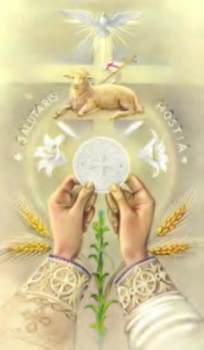
To be a Roman Rite Catholic you must believe the body of Jesus Christ is present in each consecrated wafer ( Holy Eucharist ); that the sacrifice of Calvary is repeated at every Mass; and that he gives Himself to us in the form of Holy Communion to sustain His creation ( you ) as His tabernacle.

Eucharistic Adoration of the Blessed Sacrament in the Tabernacle or through exposition :

Perpetual Eucharistic Adoration is a wonderful devotion that adores Jesus present in the Blessed Sacrament. Through a deeper love and closer relationship with Jesus, you acquire the strength, healing and peace to make it through your pilgrimage of life and to achieve your ultimate goal - Heaven and the Beatific Vision.

In many ways, Our Lord, is calling us to worship and receive Him in the Eucharist. He speaks this desire in many ways: through the Pope and the Magisterium of the Church, in the Bible ( Blessed Apostle Saint John 6 ), through his Blessed Mother in approved Marian apparitions, through the testimonies of Saints and Martyrs, through Eucharistic miracles, through Church approved messages given by Jesus by Divine Revelation, through our souls who long for Jesus in Communion, and through our suffering world which is in much need of prayer before the Blessed Sacrament. Unfortunately many of us disbelieve or have grown indifferent towards Jesus in the Blessed Sacrament.

COMMUNION IN THE HAND BY ONE NOT CONSECRATED

REMAINS A PROHIBITED AND CONDEMNED ABOMINATION

WITHIN THE HOLY AND APOSTOLIC CHURCH

"Communion in the hand" is a Protestant innovation foisted upon the Roman Rite Catholic world in the name of false ecumenism. The Novus Ordo practice of communion in the hand is rooted in the rejection of the Catholic doctrine on the Holy Eucharist and the denial of the Catholic priesthood.

The Church has condemned communion in the hand from the early centuries :

Pope Saint Sixtus ( 115-125 ). Prohibited the faithful from even touching the Sacred Vessels: "Statutum est ut sacra vasa non ab aliis quam a sacratis Dominoque dicatis contrectentur hominibus..." [It has been decreed that the Sacred Vessels are not to be handled by others than by those consecrated and dedicated to the Lord.]

Pope Saint Eutychian ( 275-283 ). Forbade the faithful from taking the Sacred Host in their hand.

Saint Basil The Great, Doctor of The Church ( 330-379 ). "The right to receive Holy Communion in the hand is permitted only in time of persecution." Saint Basil considered Communion in the hand so irregular that he did not hesitate to consider it a grave fault.

COUNCIL OF SARAGOSSA ( 380 ). It was decided to punish with EXCOMMUNICATION anyone who dared to continue the practice of Holy Communion in the hand. The Synod of Toledo confirmed this decree.

Pope Saint Leo The Great ( 440-461 ). Energetically defended and required faithful obedience to the practice of administering Holy Communion on the tongue of the faithful.

SYNOD OF ROUEN (650). Condemned Communion in the hand to halt widespread abuses that occurred from this practice, and as a safeguard against sacrilege.

SIXTH ECUMENICAL COUNCIL, AT CONSTANTINOPLE (680-681). Forbade the faithful to take the Sacred Host in their hand, threatening the transgressors with excommunication.

Saint Thomas Aquinas (1225-1274). "Out of reverence towards this sacrament [ the Holy Eucharist ], nothing touches it, but what is consecrated; hence the corporal and the chalice are consecrated, and likewise the priest's hands, for touching this sacrament." ( Summa Theologica, Pars III, Q. 82, Art. 3, Rep. Obj. 8 ).

COUNCIL OF TRENT (1545-1565). "The fact that only the priest gives Holy Communion with his consecrated hands is an Apostolic Tradition."

Pope Paul VI ( 1963-1978 ). "This method [on the tongue] must be retained." (Apostolic Epistle "Memoriale Domini" ).

Pope John Paul II. "To touch the sacred species and to distribute them with their own hands is a privilege of the ordained. ( Dominicae Cenae, sec. 11)

"It is not permitted that the faithful should themselves pick up the consecrated bread and the sacred chalice, still less that they should hand them from one to another." ( Inaestimabile Donum, April 17, 1980, sec. 9).

The Sacrifice of the Eucharist as the central act of worship of the Roman Rite Catholic Church. The "Mass" is a late form of mission (sending), from which the faithful are sent to put into practice what they have learned and use the graces they have received in the Eucharistic liturgy. The Mass cannot be understood apart from Calvary, of which it is a re-presentation, memorial, and effective application of the merits gained by Christ.

"Now as they were eating, Jesus took bread, and blessed, and broke it, and gave it to the disciples and said, "Take, eat; this is my body.' And he took a cup, and when he had given thanks he gave it to them, saying, "Drink of it, all of you; for this is my blood of the covenant, which is poured out for many for the forgiveness of sins." ( Blessed Apostle Saint Matthew 26:26-28 ).


14 posted on 01/05/2009 5:08:20 PM PST by Robert Drobot (Qui non intelligit aut discat aut taceat)
[ Post Reply | Private Reply | To 13 | View Replies]

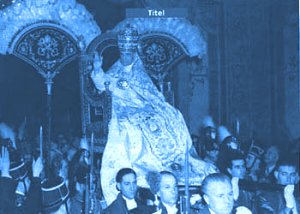
Pope Pius XII with Tiara and Sedalia

"The use of the Latin language, customary in a considerable section of the Church, is a manifest and beautiful sign of unity, as well as an effective antidote for any corruption of doctrinal truth." ~~ Pope Pius XII, Encyclical Mediator Dei #60, November 20, 1947


15 posted on 01/05/2009 5:12:40 PM PST by Robert Drobot (Qui non intelligit aut discat aut taceat)
[ Post Reply | Private Reply | To 14 | View Replies]

Traditional Holy Mass Propers

† FEAST OF THE HOLY NAME OF JESUS †

Missa In nomine Jesu omne genuflectatur

( "In the name of Jesus let every knee bow" )

04 January 2008 Anno Dómini

".... be filled with the knowledge of the will of God...."

"All whatsoever you do in word or work, do all in the Name of the Lord Jesus Christ,
giving thanks to God the Father through Jesus Christ our Lord"--- Blessed Apostle Saint Paul

"Let it not be as a murderer or a thief, a malefactor or a coveter of other men's goods that any of you suffer; but if it is for the name of Christian, let him be not ashamed, but glorify God in that name." --- Blessed Apostle Saint Peter ( First Epistle 4:15-16 )

For God so loved the faithful that He gave His only begotten son, that whosoever believeth in Him may not perish, but have everlasting life. ~~ Blessed Apostle Saint John 3:16

Therefore God has highly exalted Him and bestowed on Him the name that is above every name,
that at the name of Jesus every knee should bow, in heaven and on earth and under the earth,
and every tongue confess that Jesus Christ is Lord, to the glory of God the Father. ~~ Philippians 2:5-11

Color: Albus/White Vestments II Classis ~ Second Class Observance

A very special 'Thank you' to the ASU.edu; fisheaters.com; Friends of Fatima; catholic.org; and saints.sqpn.com, for edited commentaries and resources related to the presentation of today's Proper. Additional sources: Saint Andrew Daily Missal and the 1945 Marian Missal

Introitus ~ Introit
Philippénses II:X-X ~ Philippians 2: 10-11


In nomine Jesu omne genuflectatur, Caelestium, terrestrium, et infernorum: et omnis lingua contiteatur, quia Dominus Jesus Christus in gloria est Dei Patris. Psalm 8:2 Domine Dominus noster: quam admirabile est nomen tuum in universa terra! V. Gloria Patri, et Filio, et Spiritui Sancto. Sicut erat in principio et nunc et semper et in saecula saeculorum. Amen. Repeat : In nomine Jesu omne genuflectatur....


I n the name of Jesus let every knee bow of those that are in heaven, on earth, and under the earth; and let every tongue confess that the Lord Jesus Christ is in the glory of God the Father. Psalm 8:2 O Lord, our Lord, how wonderful is Thy Name in the whole earth. Glory he to the Father. V. Glory be to the Father and to the Son and to the Holy Ghost, as it was in the beginning, is now and ever shall be, world without end. Amen. Repeat : In the name of Jesus let every knee bow....

ORATIO ~ COLLECT


Deus, Qui unigenitum Filium Tuum, constituisti humani generis Salvatorem, et Jesum vocari jussisti: concede propitius; ut, cujus sanctum nomen veneramur in terris, ejus quoquo aspectu perfruamur in Caelis. Per eumdem Dominum.

Collect For The Intercession Of
The Blessed Virgin Mary

Deus, qui de beátæ Maríæ Vírginis útero Verbum tuum, Angelo nuntiánte, carnem suscípere voluísti: præsta supplícibus tuis; utqui vere eam Genitricem Dei crédimus, ejus apud to intercessiónibus adjuvémur. Per eúmdem Dóminum nostrum Jesum Christum fílium tuum, qui tecum vivit et regnat in unitáte Spíritus Sancti, Deus.

Collect For The Intercession Of The Saints

A cunctis nos quæsumus Dómine mentis et córporis defénde perículis: et intercedénte beáta et gloriósa semper Vírgine Dei Genitrice María, cum beáto Joseph, beátis Apóstolis tuis Petro et Paulo, et ómnibus Sanctis, salútem nobis tríbue benígnus et pacem; ut destrúctis adversitátibus et erróribus univérsis, Ecclésia tua secúra tibi sérviat libertáte. Per Dóminum nostrum Jesum Christum Fílium tuum, qui tecum vivit et regnat in unitáte Spíritus Sancti, Deus, Per omnia saecula saeculorum. Amen.

Collect For The Living and the Dead

Omnipotens sempiterna Deus, qui vivorum dominaris simuesse praenoscis: te supplices exoramus; ut, pro quibus effundere preces decrevimus, quosque vel praesens saeculum adhuc in carne retinet, vel futurum jam exutos corpore suscepit, intercedentibus omnibus Sanctis tuis, pietatis tuae clementia omnium delictorum suorum veniam consequantur. Per Dominum nostrum Jesum Christum, Qui Tecum vivit et regnat in unitate Spiritus Sancti, Deus, Per omnia saecula saeculorum. Amen.

Collect for God's Holy Church

Ecclésiæ tuæ, quæ-sumus, Dómine, preces placátus admítte: ut, destrúctis adversitátibus et erróribus univérsis, secura tibi sérviat libertáte. Per Dóminum nostrum Jesum Christum Fílium tuum, qui tecum vivit et regnat in unitáte Spíritus Sancti, Deus.


O God Who didst appoint Thine only-begotten Son the Savior of mankind, and didst bid that He should be called Jesus: mercifully grant that we may enjoy the vision of Him in Heaven Whose holy Name we venerate on earth. Through the same Jesus Christ.

Collect For The Intercession Of
The Blessed Virgin Mary

O God, Who didst will that at the message of an angel Thy word should take flesh in the womb of the Blessed Virgin Mary: grant that we, Thy suppliants, who believe her to be truly the mother of God, may be helped by her intercession with Thee. Through the same Jesus Christ, Thy Son, Who liveth and reigneth with Thee in the unity of the Holy Ghost, One God.

Collect For The Intercession Of The Saints

D efend us, we beseech Thee, O Lord, from all dangers of mind and body: and through the intercession of the blessed and glorious Mary, ever Virgin, mother of God, of Saint Joseph, of Thy holy apostles, Saints Peter and Paul, and of all the saints, in Thy loving-kindness grant us safety and peace; that, all adversities and errors being overcome, Thy Church may serve Thee in security and freedom.

Collect For The Living and the Dead

O Almighty and Eternal God, Who hast dominion over both the living and the dead, and hast mercy on all Whom Thou knowest shall be Thine by faith and good works: we humbly beseech Thee that all for whom we have resolved to make supplication whether the present world still holds them in the flesh, or the world to come has already received them out of the body, may, through the intercession of all Thy saints, obtain of Thy goodness and clemency pardon for all their sins, through our Lord Jesus Christ, Thy Son, Who liveth and reigneth with Thee in the unity of the Holy Ghost; One God; forever and ever, Amen.

Collect For God's Holy Church

Graciously hear, O Lord, the prayers of Thy Church that, having overcome all adversity and every error, she may serve Thee in security and freedom.

EPISTOLA ~ EPISTLE ¤ Actuum Apostolorum IV:VIII-XII ~ Acts of the Apostles 4: 8-12


Lectio Actuum Apostolorum.

In diébus illis: Petrus repletus Spiritu Sancto, dixit: Princepes populi et seniores, audite: Si nos hodie dijudicamur in benefacto hóminis infirmi, in quo iste salvus factus est, notum sit omnibus vobis, et omni plebi Israel: quia in nomine Domini nostri Jesu Christi Nazareni, Quem vos crucifixistis, Qum Deus suscitávit a mortuis, in hoc iste adstat coram vobis sanus. Hic est lapis, qui factus est in caput anguli: et non est in alio aliquo salus. Nec enim aliud nomen est sub Caelo datum hominibus, in quo opórtet nos salvos fieri.


Lesson from the Epistle of the Acts of the Apostles.

In those days: Peter filled with the Holy Ghost, said to them: Ye princes of the people and ancients, hear: If we this day are examined concerning the good deed done to the infirm man, by what means he hath been made whole, be it known to you all, and to all the people of Israel, that by the name of our Lord Jesus Christ of Nazareth, whom you crucified, whom God hath raised from the dead, even by Him this man standeth before you whole, This is the stone which was rejected by you the builders, which is become the head of the corner: neither is there salvation in any other. For there is no other name under heaven given to men, whereby we must be saved.

GRADUALE Psalm CV:XLVII ~ GRADUAL ¤ Psalm 105:47


S Salvos fac nos, Domine, Deus noster, et congrega nos de nationibus: ut confiteamur nómini sancto tuo, et gloriémur in Gloria tua. V. Isaias 63: 16 Tu, Dómine, pater noster, et Redemptor noster: a saeculo nomen Tuum.

Allelúia, allelúia. V. Hebrews 1: 1-2 Lauden Domini loquétur os meum, et benedícat omnis caro nomen sanctum ejus. Alleluia.


Save us, 0 Lord our God, and gather us from among the nations: that we may give thanks to Thy holy Name, and may glory in Thy praise. V. Isaias 63: 16 Thou, 0 Lord, art our Father and Redeemer, Thy Name is from eternity.

Allelúia, allelúia. V. Hebrews 1: 1-2 My mouth shall speak the praise of the Lord, and let all flesh bless His holy Name Alleluia.


From A Series of 153 Woodcuts by Jerome Nadal, SJ,
published in Evangelicae Historiae Imagines c.1593

EVANGELIUM ~ GOSPEL - Blessed Apostle Saint Lucam II:XXI ~ Luke 2:21


† Sequentia sancti Evangelii secundum Lucam †
I n illo témpore: Et postquam consummati sunt dies octo ut circumcideretur vocatum est nomen Eius Iesus quod vocatum est ab Angelo priúsquam in útero conciperetur.


† The Gospel recorded by Blessed Apostle Saint Luke †
A t that time, After eight days were accomplished that the child should be circumcised; His Name was called Jesus, which was called by the Angel before He was conceived in the Womb.

Homily For The Feast Of the Holy Name of Jesus
02 January 2004 Anno Domini

by Father Louis J. Campbell
"Qui legit, intelligat"
"He who readeth, let him understand"

""Blessed be the Name of the Lord"" ~ Psalm 112:2

The Latin praise, Benedictum nomen Jesu and the monogram emblem Iesus Hóminum Salvátor - abbreviated 'IHS' - have been so lost in today's modernistic haunts. The saddest thing is that you hear the Name of Jesus more often in the secular sector accompanied by profanity. Woe to them as God so says in Exodus. It is time to resurrect total reverence to the Most Holy Name of Jesus to Whom every knee should and must bend.

In the name of the Father and of the Son and of the Holy Ghost. Amen.

THE Second Commandment requires us to have reverence for the Name of God: "You shall not take the name of the Lord, your God, in vain. For the Lord will not leave unpunished him who takes his name in vain" ( Exodus 20:7 ). We honor the Name of God because His Name is holy, as God Himself is holy. When Moses approached the burning bush at Mount Sinai, God spoke to him from a burning bush: "Come no nearer! Remove the sandals from your feet, for the place where you stand is holy ground" ( Exodus 3:5 ).

The punishment for blasphemy under the Old Law was severe: "Anyone who curses his God shall bear the penalty of his sin; whoever blasphemes the name of the Lord shall be put to death. The whole community shall stone him; alien and native alike must be put to death for blaspheming the Lord's name" ( Leviticus 24:15-16 ).

In the Book of Ecclesiastes (Sirach) we find some sobering words concerning reverence for the Holy Name of God:

"Let not your mouth form the habit of swearing, or becoming too familiar with the Holy Name. Just as a slave that is constantly under scrutiny will not be without welts, so one who swears continually by the Holy Name will not remain free from sin. A man who often swears heaps up obligations; the scourge will never be far from his house. If he swears in error, he incurs guilt; if he neglects his obligation, his sin is doubly great. If he swears without reason he cannot be found just, and all his house will suffer affliction. There are words which merit death; may they never be heard among Jacob's heirs. For all such words are foreign to the devout, who do not wallow in sin. Let not your mouth become used to coarse talk, for in it lies sinful matter. Keep your father and mother in mind when you sit among the mighty, lest in their presence you commit a blunder and disgrace your upbringing, by wishing you had never been born or cursing the day of your birth. A man who has the habit of abusive language will never mature in character as long as he lives" ( Ecclesiastes 23:9-15 ).

On this day when we celebrate the Feast of the Holy Name of Jesus, we give equal homage to the Son of God as we honor His Holy Name, the name that was announced by the Angel Gabriel before He was conceived in the womb of the Blessed Virgin Mary: "Thou shalt call His name Jesus" ( Blessed Apostle Saint Luke 1:31 ).

Blessed Apostle Saint Paul, speaks of Jesus, obedient unto death: "Therefore God also has exalted him and has bestowed upon Him the name that is above every name, so that at the name of Jesus every knee should bend of those in Heaven, on earth and under the earth, and every tongue should confess that the Lord Jesus Christ is in the glory of God the Father" ( Philippians 2:9-11 ).

After speaking of various sins against the Second Commandment, the Catechism of the Council of Trent declares:

"Still more enormous is the guilt of those who, with impure and defiled lips, dare to curse or blaspheme the holy name of God - that name which is to be blessed and praised above measure by all creatures, or even the names of the Saints who reign with Him in glory. So atrocious and horrible is this crime that the Sacred Scriptures, sometimes when speaking of blasphemy use the word blessing" (Tan Books, 1982, p. 394).

The same Catechism seems to speak directly to our time:

"…[T]here are not wanting those who are so blinded by the darkness of error as not to dread to blaspheme His name, whom the Angels glorify. Men are not deterred by the Commandment laid down from shamelessly and daringly outraging His divine Majesty every day, or rather every hour and moment of the day. Who is ignorant that every assertion is accompanied with an oath and teems with curses and imprecations? To such lengths has this impiety been carried, that there is scarcely anyone who buys, or sells, or transacts business of any sort, without having recourse to swearing, and who, even in matters the most unimportant and trivial, does not profane the most holy name of God thousands of times" ( p. 382 ).

Clearly, we must have profound reverence for the Holy Name of Jesus. To lack respect for the Name of the Son is to lack respect for all three Persons of the Holy Trinity - Father, Son and Holy Ghost. Those who lack reverence for the Three Divine Persons walk a dangerous path. It is a sign that they do not know Him of Whom they speak so carelessly. Let us bow our heads and bend our knees at the Holy Name of Jesus, Who sits at the right hand of the Father interceding for us.

"In the Name of Jesus we obtain every blessing and grace for time and eternity, for Christ has said: "If you ask the Father anything in my name he will give it you'." ( Blessed Apostle Saint John 16: 23 ). Therefore the Church concludes all her prayers by the words: 'Through Our Lord Jesus Christ,…'" ( Holy Name of Jesus, The Catholic Encyclopedia).

Saint Bernard of Clairvaux encourages us with these words:

"The sweet Name of Jesus produces in us holy thoughts, fills the soul with noble sentiments, strengthens virtue, begets good works, and nourishes pure affections. All spiritual food leaves the soul dry, if it contain not that penetrating oil, the Name Jesus. When you take your pen, write the Name Jesus : if you write books, let the Name of Jesus be contained in them, else they will possess no charm or attraction for me; you may speak, or you may reply, but if the Name of Jesus sounds not from your lips, you are without unction and without charm. Jesus is honey in our mouth, light in our eyes, a flame in our heart. This name is the cure for all diseases of the soul. Are you troubled? think but of Jesus, speak but the Name of Jesus, the clouds disperse, and peace descends anew from Heaven. Have you fallen into sin? so that you fear death? invoke the Name of Jesus, and you will soon feel life returning. No obduracy of the soul, no weakness, no coldness of heart can resist this holy Name; there is no heart which will not soften and open in tears at this holy name. Are you surrounded by sorrow and danger? Invoke the Name of Jesus, and your fears will vanish."

"O Lord, our Lord, how glorious is your name over all the earth" (Ps.8:1).

"Blessed be the name of the Lord both now and forever" (Ps. 112:2). †

In the name of the Father and of the Son and of the Holy Ghost. Amen.

OFFERTORIUM / OFFERTORY ¤ Psalm 85:12, 5


Confitebor tibi, Domine Deus meus, in toto corde meo, et glorificabo nomen tuum in aetérnum: quoniam tu, Domine, suavis et mitis es: et multae misericordiae omnibus invocántibus te, alleluia.

I will praise Thee, 0 Lord my God with my whole heart, and I will glorify Thy Name for ever; for Thou, 0 Lord, art sweet and mild, and plenteous in mercy to all that call upon Thee, alleluia.

SECRETA ~ SECRET


Benedictio tua, clementissime Deus, qua omnis vivet creatura, sanctificent, quáesumus, hoc sacrificium nostrum, quod ad gloriam nóminis Filii tui, Domini nostril Jesu Christi, offérimus tibi: ut majestati tuae placére posit ad laudem, et nobis proficere ad salutem. Per eumdem Dominum nostrum Jesum Christum, Filium Tuum, Qui Tecum vivit et regnat in unitate Spiritus Sancti, Deus.

Secret For The Blessed Virgin Mary

In méntibus nóstris, quæsumus, Dómine, veræ fídei sacraménta confírma: ut, qui concéptum de Vírgine Deum verum et hóminem confitémur; per ejus salutíferæ resurrectiónis poténtiam, ad ætérnam mereámur perveníre lætítiam. Per eúmdem Dóminum nostrum Jesum Christum Fílium tuum, qui tecum vivit et regnat in unitáte Spíritus Sancti, Deus, Per omnia saecula saeculorum. Amen.

Secret For The Intercession Of The Saints

Exaudi nos Deus salutáris noster: ut per hujus sacraménti virtútem, a cunctis nos mentis et córporis hóstibus tueáris, grátiam tríbuens in præsénti, et glóriam in futuro. Per Dóminum nostrum Jesum Christum Fílium tuum, qui tecum vivit et regnat in unitáte Spíritus Sancti, Deus, Per omnia saecula saeculorum. Amen.

Secret For The Living and the Dead

Omnipotens sempiterna Deus, qui vivorum dominaris simul et mortuorum, omniumque misereris quos tuos fide et opera futuros esse praenoscis: te supplices exoramus; ut, pro quibus effundere preces decrevimus, quosque vel praesens saeculum adhuc in carne retinet, vel futurum jam exutos corpore suscepit, intercedentibus omnibus Sanctis tuis, pietatis tuae clementia omnium delictorum suorum veniam consequantur. Per Dominum nostrum Jesum Christum, Qui Tecum vivit et regnat in unitate Spiritus Sancti, Deus, Per omnia saecula saeculorum. Amen.

Secret for God's Holy Church

Prótege nos, Dómine, tuis mystériis serviéntes: ut divínis rebus inhæréntes, et córpore tibi famulémur et mente. Per Dóminum nostrum Jesum Christum.


M ay Thy blessing, by which all creatures live, hallow, we beseech Thee, most merciful God, this our sacrifice which we ,offer to Thee to the glory of the Name of Thy Son our Lord Jesus Christ, that it may please Thy majesty and Bring Thee praise, and avail us unto salvation. Through our Lord Jesus Christ, Thy Son, Who liveth and reigneth with Thee in the unity of the Holy Ghost, one God.

Secret For The Blessed Virgin Mary

Strengthen in our minds, O Lord, we beseech Thee, the mysteries of the true faith, that, confessing Him Who was conceived of the Virgin to be true God and true man, we may deserve, through the power of His saving resurrection, to attain everlasting joy, through our Lord Jesus Christ, Thy Son, Who liveth and reigneth with Thee in the unity of the Holy Ghost, One God, forever and ever. Amen.

Secret For The Intercession Of The Saints

Graciously hear us, O God our Savior, and, by virtue of this Sacrament, defend us from all enemies of soul and body, bestowing upon us Thy grace here and Thy glory hereafter.

Secret For The Living and the Dead

O Almighty and Eternal God, Who hast dominion over both the living and the dead, and hast mercy on all Whom Thou knowest shall be Thine by faith and good works: we humbly beseech Thee that all for whom we have resolved to make supplication whether the present world still holds them in the flesh or the world to come has already received them out of the body, may, through the intercession of all Thy saints, obtain of Thy goodness and clemency pardon for all their sins. Through our Lord Jesus Christ, Thy Son, Who liveth and reigneth with Thee in the unity of the Holy Ghost; One God; forever and ever, Amen.

Secret For God's Holy Church

Protect us, O Lord, who assist at Thy mysteries, that, cleaving to things divine, we may serve Thee both in body and in mind. Through our Lord Jesus Christ.

PREFACE OF THE NATIVITY


Vere dignum et justum est, aequum et salutare, nos tibi semper, et ubique gratias agere: Domine sancte, Pater omnipotens, aeterne Deus: Quia per incarnati Verbi mysterium, nova mentis nostrae fulsit: ut dum visibiliter Deum cognoscimus, per hunc in invisibilium amorem rapiamur. Et ideo cum Angelis et Archangelis, cum Thronis et Dominationibus, cumque omni militia caelestis exercitus, hymnum gloriae tuae canimus, sine fine dicentes: SANCTUS, SANCTUS, SANCTUS....


It is truly meet and just, right and for our salvation, that we should at all times and in all places, give thanks unto Thee, O holy Lord, Father almighty, everlasting God, for through the Mystery of the Word made flesh, the new light of Thy glory hath shone upon the eyes of our mind, so that while we acknowledge God in visible form, we may through Him be drawn to the love things invisible. And therefore with Angels and Archangels, with Thrones and Dominations, and with all the hosts of the heavenly army, we sing the hymn of The glory, evermore saying: HOLY, HOLY, HOLY....

COMMUNICANTES - INVOCATION OF THE
SAINTS IN THE CANON
For the Nativity of Our Lord
   

Communicantes, et diem sacratissimum celebrantes, quo beatae Mariae intemerata virginitas huic mundo edidit Salvatorem: sed et memoriam venerantes, in primis ejusdem gloriosae semper Virginis Mariae, Genetricis ejusdem Dei et Domini nostri Jesu Christi: sed et beatorum Apostolorum ac Martyrum tuorum, Petri et Pauli, Andreae, Iacobi, Ioannis, Thomae, Iacobi, Philippi, Bartholomaei, Marrhaei, Simonis, et Thaddei: Lini, Clet, Clementis, Xysti, Cornelii, Cypriani, Laurentii, Chrysogoni, Ioannis et Pauli, Cosmae et Damianis: et omnium Sanctorum tuorum; quorum meritis, precibusque concedas, ut in omnibus protentionis tuae muniamur auxilio. Per eumdem Christum Dominum nostrum. Amen.

  Communicating, and keeping this most holy day, on which the spotless virginity of blessed Mary brought forth a Savior to this world; and also reverencing the memory first of the same glorious Mary, ever Virgin, Mother of the same our God and Lord Jesus Christ: as also of the blessed Apostles and Martyrs Peter and Paul, Andrew, James, John, Thomas, James, Philip, Bartholomew, Matthew, Simon, and Thaddeus; Linus, Cletus, Clement, Xystus, Cornelius, Cyprian, Lawrence, Chrysogonus, John and Paul, Cosmas and Damian, and of all Thy Saints, through whose merits and prayers, grant that we may in all things be defended by the help of Thy protection. Through the same Christ our Lord. Amen.

COMMUNIO ~ COMMUNION ¤ Psalms 97:3
   

Omnes gentes quascumque fecisti, vénient, et adorábunt, coram t, Domine, et glorificabunt nomen tuum: quoniam magnus es tu et faciens mirabília: tu es Deus solus. Alleluia.

  All the nations Thou hast made shall come and adore before Thee, 0 Lord; and they shall glorify Thy Name: for Thou art great, and dost wonderful things: Thou art God alone, alleluia.

POSTCOMMUNIO ~ POSTCOMMUNION
   

Omnipotens aeterne Deus, qui creasti et redemfti nos, respice propitious vota nostra et sacrificium salutaris hostiae, quod in honorem nóminis Filii tui, Domini nostril Jesu Christi, majestati tuae obtulimus, placido et benigno vultu suscípere digneris; ut gratia tua nobis infusa, sub gloriso nominee Jesu, aeternae praedestinationis tiulo gaudeamus nomina nostra scripta esse in Caelis. Per eundem Dominum nostrum Jesum Christum, Filium Tuum, Qui Tecum vivit et regnat in unitate Spiritus Sancti, Deus.

Postcommunion For The Blessed Virgin Mary

Grátiam tuam quæsumus, Dómine, méntibus nostris infúnde: ut qui, Angelo nuntiánte, Christi Fílii tui incarnatiónem cognóvimus: per passiónem ejus et crucem, ad resurrectiónis glóriam perducámur. Per eúmdem Dóminum nostrum Jesum Christum Fílium tuum, qui tecum vivit et regnat in unitate Spíritus Sancti, Deus. Per omnia saecula saeculorum. Amen.

Postcommunion For The Intercession Of The Saints

Mundet et múniat nos quáesumus Dómine dívini sacraménti munus oblátum: et intercedénte beáta Vírgine Dei Genitríce María, cum beáto Joseph, beátis Apóstolis tuis Petro et Paulo, et ómnibus Sanctis; a cunctis nos reddat et pervérsitátibus expiátos, et advérsitátibus expedítos. Per eúmdem Dóminum nostrum Jesum Christum Fiiium tuum: Qui tecum vivit et regnat in unitate Spíritus Sancti, Deus. Per omnia saecula saeculorum. Amen.

Postcommunion For The Living and the Dead

Omnipotens sempiterna Deus, qui vivorum dominaris simul et mortuorum, omniumque misereris quos tuos fide et opera futuros esse praenoscis: te supplices exoramus; ut, pro quibus effundere preces decrevimus, quosque vel praesens saeculum adhuc in carne retinet, vel futurum jam exutos corpore suscepit, intercedentibus omnibus Sanctis tuis, pietatis tuae clementia omnium delictorum suorum veniam consequantur. Per Dominum nostrum Jesum Christum.

Postcommunion for God's Holy Church

Quæsumus, Dómine Deus noster, ut quos divína tribuis participatióne gaudére, humánis non sinas subjacére perículis. Per Dóminum nostrum Jesum Christum.


O Almighty and Everlasting God who didst create and redeem us, look graciously upon our prayer, and with a favorable and benign countenance deign to accept the Sacrifice of the saving Victim, which we have offered to Thy Majesty in honor of the Name of Thy Son, our Lord Jesus Christ: that through the infusion of Thy grace we may rejoice that our names are written in heaven, under the glorious Name of Jesus, the pledge of eternal predestination. Through the same Lord Jesus Christ, Thy Son, Who liveth and reigneth with Thee in the unity of the Holy Ghost, one God.

Postcommunion For The Blessed Virgin Mary

Pour forth, we beseech Thee, O Lord, Thy grace into our hearts, that we, to whom the incarnation of Christ Thy Son was made known by the message of an angel, may, by His passion and cross, be brought to the glory of His resurrection.

Postcommunion For The Intercession Of The Saints

Graciously hear us, O God our Savior, and, by virtue of this Sacrament, defend us from all enemies of soul and body, bestowing upon us Thy grace here and Thy glory hereafter.

Postcommunion For The Living and the Dead

O Almighty and Eternal God, Who hast dominion over both the living and the dead, and hast mercy on all Whom Thou knowest shall be Thine by faith and good works: we humbly beseech Thee that all for whom we have resolved to make supplication whether the present world still holds them in the flesh or the world to come has already received them out of the body, may, through the intercession of all Thy saints, obtain of Thy goodness and clemency pardon for all their sins. Through our Lord Jesus Christ.

Postcommunion for God's Holy Church

O Lord our God, we pray Thee that Thou suffer not to succumb to human hazards those whom Thou hast been pleased to make sharers of divine mysteries. Through our Lord Jesus Christ.

PRAYER OVER THE MANY
   

Inclinantes se, Domine, majestati Tuaee, propitiatus intende; ut, Qui divino munere sunt refecti, caelestibus semper nutriantur auxiliis. Per Dominum nostrum Jesum Christum. Qui vivis et regnas in cum Deo Patri in unitate Spiritus Sancti, Deus, unum Deum. Per omnia saecula saeculorum. Amen.


Look down, O Lord, in Thy mercy, upon those who bow before Thy majesty; that they who are refreshed by Thy divine gift may ever be sustained by heavenly aid, through our Lord Jesus Christ, Who livest and reignest, with You Almighty Father, in the unity of the Holy Ghost, one God; for ever and ever. Amen.

THE BLESSING
   

V. Sit Nomen Domini benedictum.
R. Ex hoc nunc, et usque in saeculum.
V. U Adjutorium nostrum in Nomine Domini.
R. Qui fecit cœlum et terram.
V. Benedicat vos, Omnipotens Deus:
V. Pater, et Filius, et Spiritus Sanctus, descendat super vos, et maneat semper.
R. Amen.

  V. Blessed be the Name of the Lord.
R. Now and for ever more.
V. U Our help is in the Name of the Lord.
R. Who made Heaven and earth.
V. May Almighty God bless thee:
V. The Father, the Son, and the Holy Ghost, descend upon thee, and always remain with thee.
R. Amen.

† - Holy Queen of Heaven and Earth, pray for us. - †


16 posted on 01/05/2009 5:29:10 PM PST by Robert Drobot (Qui non intelligit aut discat aut taceat)
[ Post Reply | Private Reply | To 15 | View Replies]


Litany of the Most Precious
Blood of Jesus

Lord, have mercy on us. Christ, have mercy on us.

Lord, have mercy on us. Christ, hear us. Christ, graciously hear us.

God the Father of Heaven, Have mercy on us.

God the Son, Redeemer of the world, Have mercy on us.

God the Holy Spirit, Have mercy on us.

Holy Trinity, One God, Have mercy on us.

Blood of Christ, only-begotten Son of the Eternal Father, Save us.

Blood of Christ, Incarnate Word of God, Save us.

Blood of Christ, of the New and Eternal Testament, Save us.

Blood of Christ, falling upon the earth in the Agony, Save us.

Blood of Christ, shed profusely in the Scourging, Save us.

Blood of Christ, flowing forth in the Crowning with Thorns, Save us.

Blood of Christ, poured out on the Cross, Save us.

Blood of Christ, Price of our salvation, Save us.

Blood of Christ, without which there is no forgiveness, Save us.

Blood of Christ, Eucharistic drink and refreshment of souls, Save us.

Blood of Christ, river of mercy, Save us.

Blood of Christ, Victor over demons, Save us.

Blood of Christ, Courage of martyrs, Save us.

Blood of Christ, Strength of confessors, Save us.

Blood of Christ, bringing forth virgins, Save us.

Blood of Christ, Help of those in peril, Save us.

Blood of Christ, Relief of the burdened, Save us.

Blood of Christ, Solace in sorrow, Save us.

Blood of Christ, Hope of the penitent, Save us.

Blood of Christ, Consolation of the dying, Save us.

Blood of Christ, Peace and Tenderness of hearts, Save us.

Blood of Christ, Pledge of Eternal Life, Save us.

Blood of Christ, freeing souls from Purgatory, Save us.

Blood of Christ, most worthy of all glory and honor, Save us.

Lamb of God, Who takest away the sins of the world, Spare us, O Lord.

Lamb of God, Who takest away the sins of the world, Graciously hear us, O Lord.

Lamb of God, Who takest away the sins of the world, Have mercy on us.

Thou hast redeemed us, O Lord, in Thy Blood, And made of us a kingdom for our God.

Let Us Pray:

Almighty and Eternal God, Thou hast appointed Thine only-begotten Son the Redeemer of the world, and willed to be appeased by His Blood. Grant, we beseech Thee, that we may worthily adore This Sacrifice for our salvation, and through Its Power be safeguarded from the evils of this present life, so that we may rejoice in its fruits forever in Heaven. Through the will of the Most Holy Trinity. Amen.

Source: Treasury of Novenas, Father Lawrence G. Lovasik


17 posted on 01/05/2009 5:34:07 PM PST by Robert Drobot (Qui non intelligit aut discat aut taceat)
[ Post Reply | Private Reply | To 16 | View Replies]

CALENDAR of the SAINTS

04 January 2009 Anno Dómini

"....and, lo, a great multitude, which no man could number, of all nations, and kindreds, and people, and tongues, stood before the throne, and before the Lamb, clothed with white robes, and palms in their hands; And cried with a loud voice, saying, Salvation to our God which sitteth upon the throne, and unto the Lamb. ~ ~ Apocalypse

Α Ω

Saint Abraham

A monk. Born to a wealthy Kemetian property owner. He was graced with a vision of Yeshua ( Jesus ) on the Chariot of the Cherubim. Sick for 18 years, while living in Djirdjeh, where he died. His residence was converted to a shrine.

Α Ω

Saint Aedh Dubh

Also known as : Aedh of Kildare

King of Leinster, Ireland. He abdicated in 592 A.D., to become a monk at Kildare. Bishop of Kildare in 630.

Α Ω


Saint Haggai the Prophet

Also known as :

  • Aggaeus

  • Aggeus

Sixth century BC Old Testament prophet during the period after the exile. The message he brought focused upon the rebuilding the Temple in Jerusalem.

Α Ω


Blessed Angela of Foligno

Also known as : Mistress of Theologians

Born a wealthy non-Christian. Married young, and had several children. Lived wild, adulterously, and sacrilegiously for a while. Following a vision in 1285, A.D., she had a conversion. After the death of her mother, husband, and children, she turned to God and penance. Franciscan tertiary, and led a group of other tertiaries. Noted for her charity, patience and humility. Visionary, mystic, and mystical writer.

Α Ω

Saint Aquilinus

Martyred with Saint Eugene, Saint Geminus, Saint Marcian, Saint Quintus, Saint Theodotus, and Saint Tryphon in the year 484 A.D., by the Arian Hunneric, king of the Vandals. Blessed Bede had access to records about them, and wrote of their heroic deaths.

Α Ω

Saint Benedicta

Pious laywoman. Martyred in Rome, Italy in the year 362 A.D., with Saint Priscus and Saint Priscillianus during the persecutions of Julian the Apostate.

Α Ω

Saint Dafrosa

Also known as :

  • Aifrosa

  • Affrosa

Mother of Saint Bibiana. Married to Saint Flavian. Martyred in the year 362 A.D., during the persecutions of Julian the Apostate. Her story is included in the Acts of Bibiana.

Α Ω


Saint Dorotea

Α Ω


Saint Elizabeth Ann Seton

Also known as :

  • Elizabeth Ann Bayley Seton

  • Mother Seton

Born into a wealthy and influential Episcopalian family, the daughter of a Dr Richard Bayley; Elizabeth was raised in the New York high society of the late 18th century. Her mother died when Elizabeth was three years old, her baby sister a year later. In 1794 at age 19 she married the wealthy businessman William Magee Seton, and was the mother of five.

About ten years into the marriage, William’s business failed, and soon after he died of tuberculosis, leaving Elizabeth an impoverished widow with five small children. For years Elizabeth had felt drawn to Catholicism, believing in the Real Presence in the Eucharist and in the lineage of the Church going back to Christ and the Apostles. She converted to Catholicism, entering the Church on 14 March 1805, alienating many of her strict Episcopalian family in the process.

To support her family, and insure the proper education of her children, she opened a school in Boston. Though a private and secular institution, from the beginning she ran it along the lines of a religious community. At the invitation of the archbishop, she established a Catholic girl’s school in Baltimore, Maryland which initiated the parochial school system in America. To run the system she founded the Sisters of Charity in 1809, the first native American religious community for women.

Α Ω

Saint Eugene

Martyred in 484 A.D. with Saint Aquilinus, Saint Geminus, Saint Marcian, Saint Quintus, Saint Theodotus, and Saint Tryphon by the Arian Hunneric, king of the Vandals. Blessed Bede had access to records about them, and wrote of their heroic deaths.

Α Ω

Saint Eustatius of Serbia

Α Ω

Saint Euthymios of Vatopedi

Α Ω

Saint Faustus of Armagnac

Α Ω

Saint Ferreolus of Uzès

Sixth century bishop of Uzes, France. Devoted to converting Jews to Christianity. Exiled for three years by King Childebert I of Paris over a political dispute. Founded a monastery in his see, and wrote its Rule.

Α Ω

Saint Gaius

Martyred during the year 300 A.D., along with Saint Hermes Haggai and Saint Aggaeus.

Α Ω

Saint Geminus

Martyred in 484 A.D., with Saint Aquilinus, Saint Eugene, Saint Marcian, Saint Quintus, Saint Theodotus, and Saint Tryphon. by the Arian Hunneric, king of the Vandals. Blessed Bede had access to records about them, and wrote of their heroic deaths, but his sources have not survived.

Α Ω

Saint Genovefa Torres Morales

Α Ω

Saint Gregory of Langres

Martyred i the year 484 A.D., with Saint Aquilinus, Saint Eugene, Saint Marcian, Saint Quintus, Saint Theodotus, and Saint Tryphon. by the Arian Hunneric, king of the Vandals. Blessed Bede had access to records about them, and wrote of their heroic deaths, but his sources have not survived.

Α Ω

Saint Hermes Haggai

Martyred in the year 300 A.D., with Saint Gaius and Saint Aggaeus.

Α Ω

Saint Kristiana Menabuoi of Santa Croce

Α Ω

Saint Libentius of Hamburg

Also known as :

  • Liawizo

  • Apostle of the Slavs

Benedictine bishop of Hamburg in 988.

Α Ω


Blessed Manuel Gonzalez Garcia

Also known as :

  • Bishop of the Abandoned Tabernacle

  • Manuel González y García

Ordained on 21 September 1901. Auxiliary bishop of Málaga, Spain and titular bishop of Olympus on 6 December 1915. Bishop of Málaga, Spain on 22 April 1920. Bishop of Palencia, Spain on 5 August 1935. Founder of the Congregation of the Eucharistic Missionaries of Nazareth; the Disciples of Saint John>/i>; and the Children of Reparation.

Α Ω

Saint Marcian

Martyred in the year 484 A.D., with Saint Aquilinus, Saint Eugene, Saint Geminus, Saint Quintus, Saint Theodotus, and Saint Tryphon. by the Arian Hunneric, king of the Vandals. Blessed Bede had access to records about them, and wrote of their heroic deaths, but his sources have not survived.

Α Ω

Saint Mavilus of Adrumetum

Thrown to wild animals in 212 A.D. at Adrumetum, North Africa during the persecutions of Emperor Caracalla.

Α Ω

Saint Neofyta

Α Ω

Saint Oringa of the Cross

Also known as : Christiana of the Cross

Farm girl. Fled home to escape an arranged marriage. Worked as a servant in Lucca, then became an itinerant miracle worker in the region. Eventually returned to her birthplace, to found and lead an Augustinian convent. Known for her dedication to her prayer life.

Α Ω

Blessed Palumbus of Subiaco

Benedictine monk. Priest in the abbey of Subiaco, Italy. Lived several years as a hermit near the monastery.

Α Ω

Saint Pharaildis

Also known as :

  • Vareide

  • Varelde

  • Veerle

  • Verylde

Sister of Saint Gudule. Niece of Saint Gertrude of Nivelles. After making a private vow of virginity, she was forced into marriage with a wealthy nobleman. Her husband insisted that she was married to him, and her sexual fidelity was owed to him, not God. Physically abused for her refusal to submit to him, and for her late night visits to churches. When widowed, she was still a virgin. Legend says that Pharaildis caused a well to spring up whose waters cured sick children.

Α Ω

Saint Priscillianus

Cleric. Martyred in the year 362 A.D., in Rome, Italy, with Saint Priscus and Saint Benedicta in the persecutions of Julian the Apostate.

Α Ω

Saint Priscus

Priest. Martyred in the year 362 A.D. in Rome, Italy, with Saint Priscillianus and Saint Benedicta during the persecutions of Julian the Apostate.

Α Ω

Saint Quintus

Martyred in the year 484 A.D., with Saint Aquilinus, Saint Eugene, Saint Geminus, Saint Marcian, Saint Theodotus, and Saint Tryphon by the Arian Hunneric, king of the Vandals. Blessed Bede had access to records about them, and wrote of their heroic deaths.

Α Ω

Saint Rigobert of Rheims

Benedictine monk. Abbot of Orbais. Archbishop of Rheims, France. Persecuted and exiled by Charles Martel. While he was away, another was appointed bishop. He eventually returned to his see, but to prevent scandal and dissention among the faithful, he did not try to recover his bishopric, and spent the rest of his days as a hermit. Noted for his patience, and as a miracle worker.

Α Ω

Blessed Roger of Ellant

Cistercian monk at Lorroyen-Berry, France. Founding abbot of a monastery at Ellent, archdiocese of Rheims, France in 1156. Known for his dedication to the monastic life, and his care for the area sick.

Α Ω

Saint Simeon Niger

Α Ω

Saint Stephen du Bourg

Canon of Saint Rufus at Valence. Companion of Saint Bruno at the foundation of the Grande Chartreuse. Founded the charterhouse at Meyria in 1116.

Α Ω

Α Ω

Blessed Thomas Plumtree

English martyr. Born in Lincoinshire, he studied at Corpus Christi College, Oxford, and was rector of Stubton. A dedicated Catholic, he took part in the uprising launched by northern Catholics, the Rising of the North against Queen Elizabeth I (r. 1558-1603), but was captured as the revolt failed completely. He was offered his freedom if he abjured the faith and he refused. He was hanged in Durham Castle.

Saint Theodotus

Martyred in the year 484 A.D. with Saint Aquilinus, Saint Eugene, Saint Geminus, Saint Marcian, Saint Quintus, and Saint Tryphon. by the Arian Hunneric, king of the Vandals. Blessed Bede had access to records about them, and wrote of their heroic deaths.

Α Ω


Saint Trophimus of Arles

Evangelist sent from Rome to Gaul in the year 250 A.D. Worked with Saint Sernin of Toulouse and Saint Denis. First bishop of Arles. His cultus is ancient; Pope Zosimus wrote about him in 417. Often confused with the Trophimus mentioned by Saint Paul the Apostle, they were actually centuries apart.

Α Ω

Saint Tryphon

Martyred in the year 484 A.D. with Saint Aquilinus, Saint Eugene, Saint Geminus, Saint Marcian, Saint Quintus, and Saint Theodotus. by the Arian Hunneric, king of the Vandals. Blessed Bede had access to records about them, and wrote of their heroic deaths.

Α Ω


18 posted on 01/05/2009 5:47:23 PM PST by Robert Drobot (Qui non intelligit aut discat aut taceat)
[ Post Reply | Private Reply | To 17 | View Replies]

To: Robert Drobot

CHINESE MARTYRS

Prayerfully dedicated to the courageous and loyal
Faithful of China,
where
Holy Mother Church
has been sustained
on the sacrifice, arrest, torture, imprisonment and
blood of
Holy Martyrs.


19 posted on 01/05/2009 5:53:31 PM PST by Robert Drobot (Qui non intelligit aut discat aut taceat)
[ Post Reply | Private Reply | To 18 | View Replies]

VIETNAMESE MARTYRS

Prayerfully dedicated to the courageous, loyal and persecuted
Faithful of Vietnam,
where
Holy Mother Church
has been sustained
on the sacrifice, arrest, torture, imprisonment and
murder of
Holy Martyrs.

A Litany of the Martyrs of Vietnam


Lord, have mercy on us.
Christ, hear us.

  God the father of heaven;
God the son, redeemer of the world;
God the Holy Spirit;
Holy Trinity, one God;

  Holy Mary;
Queen of martyrs;
Queen of all saints;

  Christ, have mercy on us.
Christ, have mercy on us.
Christ, graciously hear us.

  Have mercy on us.
Have mercy on us.
Have mercy on us.
Have mercy on us.

  Pray for us.
Pray for us.
Pray for us.
Pray for us.

Saint Matthew Alonso Leciniana, pray for us. ~ January 22, 1745
Saint Francis Gil de Federich, pray for us. ~ January 22, 1745
Saint Hyacinth Castaneda, pray for us. ~ November 7, 1773
Saint Vincent Le Quang Liem, pray for us. ~ November 7, 1773
Saint Emmanuel Nguyen Van Trieu, pray for us. ~ September 17, 1798
Saint John Dat, pray for us. ~ October 28, 1798
Saint Peter Le Tuy, pray for us. ~ October 11, 1833
Saint Francis Isidore Gagelin, pray for us. ~ October 17, 1833
Saint Paul Tong Viet Buong, pray for us. ~ October 23, 1833
Saint Andrew Tran Van Trong, pray for us. ~ November 28, 1835
Saint Joseph Marchand, pray for us. ~ November 30, 1835
Saint John Charles Cornay, pray for us. ~ September 20, 1837
Saint Francis Xavier Can, pray for us. ~ November 20, 1837
Saint Francis Do Van Chieu, pray for us. ~ June 25, 1838
Saint Dominic Henares, pray for us. ~ June 25, 1838
Saint Vincent Do Yen, pray for us. ~ June 30, 1838
Saint Joseph Nguyen Dinh Uyen, pray for us. ~ July 4, 1838
Saint Peter Nguyen Ba Tuan, pray for us. ~ July 15, 1838
Saint Clement Ignatius Delgado, pray for us. ~ July 21, 1838
Saint Joseph Fernandez, pray for us. ~ July 24, 1838
Saint Bernard Vu Van Due, pray for us. ~ August 1, 1838
Saint Dominic Nguyen Van Hanh, pray for us. ~ August 1, 1838
Saint Anthony Nguyen Dich, pray for us. ~ August 12, 1838
Saint Michael Nguyen Huy My, pray for us. ~ August 12, 1838
Saint James Do Mai Nam, pray for us. ~ August 12, 1838
Saint Joseph Dang Dinh Vien, pray for us. ~ August 21, 1838
Saint Joseph Hoang Luong Canh, pray for us. ~ September 5, 1838
Saint Peter Nguyen Van Tu, pray for us. ~ September 5, 1838
Saint Francis Jaccard, pray for us. ~ September 21, 1838
Saint Thomas Tran Van Thien, pray for us. ~ September 21, 1838
Saint Vincent Nguyen The Diem, pray for us. ~ November 24, 1838
Saint Peter Dumoulin Borie, pray for us. ~ November 24, 1838
Saint Peter Vo Dang Khoa, pray for us. ~ November 24, 1838
Saint Peter Truong Van Duong, pray for us. ~ December 18, 1838
Saint Paul Nguyen Van My, pray for us. ~ December 18, 1838
Saint Peter Vu Van Truat, pray for us. ~ December 18, 1838
Saint Dominic Vu Dinh Tuoc, pray for us. ~ April 2, 1839
Saint Augustine Phan Viet Huy, pray for us. ~ June 12, 1839
Saint Nicholas Bui Duc The, pray for us. ~ June 12, 1839
Saint Dominic Dinh Dat, pray for us. ~ July 18, 1839
Saint Thomas Dinh Viet Du, pray for us. ~ Nov. 26, 1839
Saint Dominic Nguyen Van Xuyen, pray for us. ~ Nov. 26, 1839
Saint Thomas Nguyen Van De, pray for us. ~ December 19, 1839
Saint Francis Xavier Ha Trong Mau, pray for us. ~ December 19, 1839
Saint Augustine Nguyen Van Moi, pray for us. ~ December 19, 1839
Saint Stephen Nguyen Van Vinh, pray for us. ~ December 19, 1839
Saint Dominic Bui Van Uy, pray for us. ~ December 19, 1839
Saint Andrew Tran An Dung Lac, pray for us. ~ December 21, 1839
Saint Peter Truong Van Ti, pray for us. ~ December 21, 1839
Saint Peter Nguyen Van Hieu, pray for us. ~ Apr. 28, 1840
Saint Paul Pham Khac Khoan, pray for us. ~ April 28, 1840
Saint John Baptist Dinh Van Thanh, pray for us. ~ April 28, 1840
Saint Joseph Do Quang Hien, pray for us. ~ May 9, 1840
Saint Luke Vu Ba Loan, pray for us. ~ June 5, 1840
Saint Thomas Toan, pray for us. ~ June 27, 1840
Saint Anthony Nguyen Huu Quynh, pray for us. ~ July 10, 1840
Saint Peter Nguyen Khac Tu, pray for us. ~ July 10, 1840
Saint Dominic Trach, pray for us. ~ September 18, 1840
Saint John Baptist Con, pray for us. ~ November 8, 1840
Saint Paul Nguyen Ngan, pray for us. ~ November 8, 1840
Saint Joseph Nguyen Dinh Nghi, pray for us. ~ November 8, 1840
Saint Martin Ta Duc Thinh, pray for us. ~ November 8, 1840
Saint Martin Tho, pray for us. ~ November 8, 1840
Saint Simon Phan Dac Hoa, pray for us. ~ December 12, 1840
Saint Agnes Le Thi Thanh, pray for us. ~ July 12, 1841
Saint Peter Khanh, pray for us. ~ July 12, 1842
Saint Matthew Le Van Gam, pray for us. ~ May 11, 1847
Saint Augustine Schoeffler, pray for us. ~ May 1, 1851
Saint John Louis Bonnard, pray for us. ~ May 1, 1852
Saint Philip Phan Van Minh, pray for us. ~ July 3, 1853
Saint Joseph Nguyen Van Luu, pray for us. ~ May 2, 1854
Saint Andrew Nguyen Kim Thong, pray for us. ~ July 15, 1855
Saint Lawrence Nguyen Van Huong, pray for us. ~ February 13, 1856
Saint Paul Le Bao Tinh, pray for us. ~ April 6, 1857
Saint Michael Ho Dinh Hy, pray for us. ~ May 22, 1857
Saint Peter Doan Van Van, pray for us. ~ May 25, 1857
Saint Joseph Mary Diaz Sanjurjo, pray for us. ~ July 20, 1857
Saint Melchior Garcia Sampedro, pray for us. ~ July 28, 1858
Saint Francis Tran Van Trung, pray for us. ~ October 6, 1858
Saint Dominic Ha Trong Mau, pray for us. ~ November 5, 1858
Saint Dominic Pham Trong Kham, pray for us. ~ January 13, 1859
Saint Luke Pham Trong Thin, pray for us. ~ January 13, 1859
Saint Joseph Pham Trong Ta, pray for us. ~ January 13, 1859
Saint Paul Le Van Loc, pray for us. ~ February 13, 1859
Saint Dominic Dinh Cam, pray for us. ~ March 11, 1859
Saint Paul Hanh, pray for us. ~ May 28, 1859
Saint Emmanuel Le Van Phung, pray for us. ~ July 31, 1859
Saint Peter Doan Cong Quy, pray for us. ~ July 31, 1859
Saint Thomas Khuong, pray for us. ~ January 30, 1860
Saint Joseph Le Dang Thi pray for us. ~ October 24, 1860
Saint Peter Francis Neron, pray for us. ~ Novemeber 3, 1860
Saint John Theophane Venard, pray for us. ~ February 2, 1861
Saint Peter Nguyen Van Luu, pray for us. ~ April 7, 1861
Saint Joseph Tuan, O.P., pray for us. ~ April 30, 1861
Saint John Doan Trinh Hoan, pray for us. ~ May 26, 1861
Saint Matthew Nguyen Van Phuong, pray for us. ~ May 28, 1861
Saint Peter Almato Ribera, pray for us. ~ November 1, 1861
Saint Valentine Berrio Ochoa, pray for us. ~ November 1, 1861
Saint Jerome Hermosilla, pray for us. ~ November 1, 1861
Saint Stephen Theodore Cuenot, pray for us. ~ November 14, 1861
Saint Joseph Nguyen Duy Khang, pray for us. ~ December 6, 1861
Saint Joseph Tuan, pray for us. ~ January 7, 1862
Saint Lawrence Ngon, pray for us. ~ May 22, 1862
Saint Joseph Tuc, pray for us. ~ June 1, 1862
Saint Dominic Ninh, pray for us. ~ June 2, 1862
Saint Paul Duong, pray for us. ~ June 3, 1862
Saint Dominic Huyen, pray for us. ~ June 5, 1862
Saint Dominic Toai, pray for us. ~ June 5, 1862
Saint Peter Dinh Van Dung, pray for us. ~ June 6, 1862
Saint Vincent Duong, pray for us. ~ June 6, 1862
Saint Peter Thuan, pray for us. ~ June 6, 1862
Saint Dominic Mao, pray for us. ~ June 16, 1862
Saint Dominic Nguyen, pray for us. ~ June 16, 1862
Saint Dominic Nhi, pray for us. ~ June 16, 1862
Saint Andrew Tuong, pray for us. ~ June 16, 1862
Saint Vincent Tuong, pray for us. ~ June 16, 1862
Saint Peter Da, pray for us. ~ June 17, 1862

All holy men and women, intercede for us.

Lamb of God, who takes away the sins of the world; Spare us, O Lord.
Lamb of God, who takes away the sins of the world; Graciously hear us, O Lord.
Lamb of God, who takes away the sins of the world; Have mercy on u us.


20 posted on 01/05/2009 6:11:16 PM PST by Robert Drobot (Qui non intelligit aut discat aut taceat)
[ Post Reply | Private Reply | To 19 | View Replies]


Navigation: use the links below to view more comments.
first 1-2021-34 next last

Disclaimer: Opinions posted on Free Republic are those of the individual posters and do not necessarily represent the opinion of Free Republic or its management. All materials posted herein are protected by copyright law and the exemption for fair use of copyrighted works.

Free Republic
Browse · Search
Religion
Topics · Post Article

FreeRepublic, LLC, PO BOX 9771, FRESNO, CA 93794
FreeRepublic.com is powered by software copyright 2000-2008 John Robinson